


Philip Neri

Encyclopedia
Saint Philip Romolo Neri (Italian: Filippo Neri) (July 21, 1515 – May 25, 1595), also known as Apostle of Rome, was an Italian
priest, noted for founding a society of secular priests
called the "Congregation of the Oratory".
in the service of the state. Neri was carefully brought up, and received his early teaching from the friars at San Marco
, the famous Dominican
monastery in Florence. He was accustomed in later life to ascribe most of his progress to the teaching of two amongst them, Zenobio de' Medici and Servanzio Mini. At the age of 18, Philip was sent to his uncle, Romolo, a wealthy merchant at San Germano, a Neapolitan town near the base of Monte Cassino
, to assist him in his business, and with the hope that he might inherit his uncle's fortune. He did gain Romolo's confidence and affection, but soon after coming to San Germano Philip had a conversion. He no longer cared for things of the world, and chose to relocate to Rome
in 1533.
.M. Walsh, ed. Butler's Lives of the Saints. (HarperSanFrancisco: New York, 1991), 156. Following this, he began those labours amongst the sick and poor which gained him in later life the title of "Apostle of Rome", and also ministering to the prostitutes of the city. In 1538 he entered on the home mission work for which he became famous; like Socrates
he travelled throughout the city, seeking opportunities of entering into conversation with people, and of leading them on to consider the topics he desired to set before them.
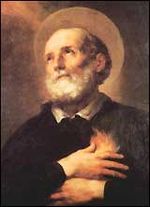 In 1548 he founded (with his confessor, Fr Persiano Rossa) the confraternity of the Santissima Trinita de' Pellegrini e de' Convalescenti,M. Walsh, ed. Butler's Lives of the Saints. (HarperSanFrancisco: New York, 1991), 157. whose primary object was to minister to the needs of the thousands of poor pilgrims who flock to Rome, especially in years of jubilee, and also to relieve the patients discharged from hospitals but who were still too weak for labour. In 1551 he passed through all the minor orders, and was ordained deacon, and finally priest (on 23 May). He thought of going to India
as a missionary
, but was dissuaded by his friends who saw that there was abundant work to be done in Rome. Accordingly he settled down, with some companions, at the hospital of San Girolamo della Carità, and while there tentatively began, in 1556, the institute with which his name is more especially connected, that of the Oratory. The scheme at first was no more than a series of evening meetings in a hall (the Oratory), at which there were prayers, hymns, readings from Scripture, from the church fathers, and from the Martyrology, followed by a lecture, or by discussion of some religious question proposed for consideration. The musical selections (settings of scenes from sacred history) were called oratorio
s. The scheme was developed, and the members of the society undertook various kinds of mission work throughout Rome, notably the preaching of sermons in different churches every evening, a completely new idea at that time. He also spent much of his time hearing confessions, and effected many conversions in this way.M. Walsh, ed. Butler's Lives of the Saints. (HarperSanFrancisco: New York, 1991), 157.
In 1564 the Florentines requested that he leave San Girolamo, and to oversee their church in Rome, San Giovanni dei Fiorentini, then newly built. He was at first reluctant, but by consent of Pope Pius IV
he accepted, while retaining the charge of San Girolamo, where the exercises of the Oratory were kept up. At this time the new society included amongst its members Caesar Baronius
, the ecclesiastical historian, Francesco Maria Tarugi, afterwards Archbishop of Avignon, and Ottavio Paravicini, all three subsequently cardinals, and also Gallonius, author of a well-known work on the Sufferings of the Martyrs, Ancina
, Bordoni, and other men of ability and distinction. In 1574, the Florentines built a large oratory or mission-room for the society, next to San Giovanni, in order to save them the fatigue of the daily journey to and from San Girolamo, and to provide a more convenient place of assembly, and the headquarters were transferred there. As the community grew, and its mission work extended, the need for a church entirely its own, and not subject to other claims, as were San Girolamo and San Giovanni, made itself felt, and the offer of the small parish church of Santa Maria in Vallicella
, conveniently situated in the middle of Rome, was made and accepted. The building, however, was not large enough for their purpose, was pulled down, and a splendid church erected on the site. It was immediately after taking possession of their new quarters that Neri formally organized, under permission of a papal bull
dated July 15, 1575, a community of secular priests, called the Congregation of the Oratory. The new church was consecrated early in 1577, and the clergy of the new society at once resigned the charge of San Giovanni dei Fiorentini; but Neri himself did not leave San Girolamo until 1583, and then only by virtue of an injunction of the pope that he, as the superior, should reside at the chief house of his congregation. He was at first elected for a term of three years (as is usual in modern societies), but in 1587 was nominated superior for life. He was, however, entirely free from personal ambition, and had no desire to be general over a number of dependent houses, so that he desired that all congregations formed on his model outside Rome should be autonomous, governing themselves, and without endeavouring to retain control over any new colonies they might themselves send out—a regulation afterwards formally confirmed by a brief of Gregory XV
in 1622.
that year, after having spent the day hearing confessions and receiving visitors. About midnight he began hemorrhaging, and Baronius read the commendatory prayers over him. Baronius asked that he would bless his spiritual sons before dying, and though he could no longer speak, he blessed them with the sign of the cross and died.
St Philip Neri was beatified by Paul V
in 1615, and canonized
by Gregory XV in 1622. His memorial is celebrated on 26 May in the traditional calendar and on 25 May in the reformed calendar. His body is in the Chiesa Nuova.
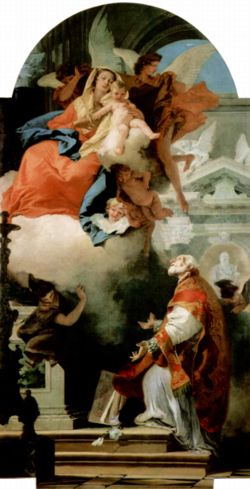 Much as he mingled with society, and with persons of importance in church and state, his single action in regard to political matters was in 1593, when his persuasions induced Pope Clement VIII
to withdraw the excommunication and anathema of Henry IV of France
, and the refusal to receive his ambassador, even though the king had formally abjured Calvinism
. Neri saw that the pope's attitude was more than likely to drive Henry to a relapse, and probably to rekindle the civil war in France, and directed Baronius, then the pope's confessor, to refuse him absolution, and to resign his office of confessor, unless he would withdraw the anathema. Clement yielded at once, though the whole college of cardinals had supported his policy; and Henry, who did not learn the facts till several years afterwards, testified lively gratitude for the timely and politic intervention. Neri continued in the government of the Oratory until his death. He was succeeded by Baronius.
This was the secret of his popularity and of his place in the folklore of the Roman poor. Many miracle
s were attributed to him, and it is said that when his body was dissected it was found that two of his ribs had been broken, an event attributed to the expansion of his heart while fervently praying in the catacombs about the year 1545. This phenomenon is in the same category as the stigmata
of St Francis of Assisi.
"Practical commonplaceness," says Frederick William Faber in his panegyric
of Neri, "was the special mark which distinguishes his form of ascetic piety from the types accredited before his day. He looked like other men ... he was emphatically a modern gentleman, of scrupulous courtesy, sportive gaiety, acquainted with what was going on in the world, taking a real interest in it, giving and getting information, very neatly dressed, with a shrewd common sense always alive about him, in a modern room with modern furniture, plain, it is true, but with no marks of poverty about it—In a word, with all the ease, the gracefulness, the polish of a modern gentleman of good birth, considerable accomplishments, and a very various information." Accordingly, he was ready to meet the needs of his day to an extent and in a manner which even the versatile Jesuits, who much desired to enlist him in their company, did not rival; and, though an Italian priest and head of a new religious order, his genius was entirely unmonastic and unmedieval, frequent and popular preaching, unconventional prayer, and unsystematized, albeit fervent, private devotion.
Neri was not a reformer, except in the sense that in the active discharge of pastoral work he laboured to reform individuals. He had no difficulties in respect of the teaching and practice of his church, being in truth an ardent Ultramontane in doctrine, as was all but inevitable in his time and circumstances, and his great merit was the instinctive tact which showed him that the system of monasticism could never be the leaven of secular life, but that something more homely, simple, and everyday in character was needed for the new time.
, Stephen Harding
, Saint Francis or Saint Dominic
. It admits only priests aged at least thirty-six, or ecclesiastics who have completed their studies and are ready for ordination. The members live in community, and each pays his own expenses, having the usufruct of his private means—a startling innovation on the monastic vow of poverty. They have indeed a common table, but it is kept up precisely as a regimental mess, by monthly payments from each member. Nothing is provided by the society except the bare lodging, and the fees of a visiting physician. Everything else—clothing, books, furniture, medicines—must be defrayed at the private charges of each member. There are no vows, and every member of the society is at liberty to withdraw when he pleases, and to take his property with him. The government, strikingly unlike the Jesuit autocracy, is of a republican
form; and the superior, though first in honour, has to take his turn in discharging all the duties which come to each priest of the society in the order of his seniority, including that of waiting at table, which is not entrusted in the Oratory to lay brothers, according to the practice in most other communities. Four deputies assist the superior in the government, and all public acts are decided by a majority of votes of the whole congregation, in which the superior has no casting voice. To be chosen superior, fifteen years of membership are requisite as a qualification, and the office is tenable, as all the others, for but three years at a time. No one can vote until he has been three years in the society; the deliberative voice is not obtained before the eleventh year.
There are thus three classes of members—novices, triennials and decennials. Each house can call its superior to account, can depose, and can restore him, without appeal to any external authority, although the bishop of the diocese in which any house of the Oratory is established is its ordinary and immediate superior, though without power to interfere with the rule. Their churches are non-parochial, and they can perform such rites as baptism
s, marriage
s, etc., only by permission of the parish priest, who is entitled to receive all fees due in respect of these ministrations.
The Oratory chiefly spread in Italy and in France, where in 1760 there were 58 houses all under the government of a superior-general. Nicolas Malebranche
, Louis Thomassin
, Jules Mascaron
and Jean Baptiste Massillon
were members of the famous branch established in Paris in 1611 by Bérulle
(later cardinal), which had a great success and a distinguished history. It fell in the crash of the Revolution, but was revived by Père Pététot, curé of St Roch, in 1852, as the "Oratory of Jesus and the Immaculate Mary"; the Church of the Oratory near the Louvre
belongs to the Reformed Church. An English house, founded in 1847 at Birmingham
, is celebrated as the place at which Cardinal Newman fixed his abode after his submission to the Roman Catholic Church. In 1849 a second congregation was founded in King William Street, Strand, London, with FW Faber as superior; in 1854 it was transferred to Brompton, where it is still based. Its church, the Church of the Immaculate Heart of Mary
, was consecrated April 16, 1884 and is the second largest Roman Catholic church in London. The society has never thrived in Germany, though a few houses have been founded there, in Munich and also in Vienna, Austria.
Neri encouraged the singing of the lauda spirituale (laude
) in his oratory services. The prominent composers Tomás Luis de Victoria
and Giovanni Pierluigi da Palestrina
probably participated in this music.
His unique and varied aesthetic experience has been brilliantly highlighted in a study of the young Italian historian Francesco Danieli
.
Italy
Italy , officially the Italian Republic languages]] under the European Charter for Regional or Minority Languages. In each of these, Italy's official name is as follows:;;;;;;;;), is a unitary parliamentary republic in South-Central Europe. To the north it borders France, Switzerland, Austria and...
priest, noted for founding a society of secular priests
Secular clergy
The term secular clergy refers to deacons and priests who are not monastics or members of a religious order.-Catholic Church:In the Catholic Church, the secular clergy are ministers, such as deacons and priests, who do not belong to a religious order...
called the "Congregation of the Oratory".
Early life
He was born in Florence, the youngest child of Francesco, a lawyer, and his wife Lucrezia da Mosciano, whose family were nobilityNobility of Italy
The Nobility of Italy consisted of individuals and their families of Italy recognized by sovereigns, such as the Holy Roman Emperor, the Holy See, Kings of Italy or certain other Italian kings and sovereigns as members of a class of persons officially enjoying hereditary privileges which...
in the service of the state. Neri was carefully brought up, and received his early teaching from the friars at San Marco
San Marco, Florence
San Marco is the name of a religious complex in Florence, Italy. It comprises a church and a convent. The convent, which is now a museum, has three claims to fame: during the 15th century it was home to two famous Dominicans, the painter Fra Angelico and the preacher, Girolamo Savonarola...
, the famous Dominican
Dominican Order
The Order of Preachers , after the 15th century more commonly known as the Dominican Order or Dominicans, is a Catholic religious order founded by Saint Dominic and approved by Pope Honorius III on 22 December 1216 in France...
monastery in Florence. He was accustomed in later life to ascribe most of his progress to the teaching of two amongst them, Zenobio de' Medici and Servanzio Mini. At the age of 18, Philip was sent to his uncle, Romolo, a wealthy merchant at San Germano, a Neapolitan town near the base of Monte Cassino
Monte Cassino
Monte Cassino is a rocky hill about southeast of Rome, Italy, c. to the west of the town of Cassino and altitude. St. Benedict of Nursia established his first monastery, the source of the Benedictine Order, here around 529. It was the site of Battle of Monte Cassino in 1944...
, to assist him in his business, and with the hope that he might inherit his uncle's fortune. He did gain Romolo's confidence and affection, but soon after coming to San Germano Philip had a conversion. He no longer cared for things of the world, and chose to relocate to Rome
Rome
Rome is the capital of Italy and the country's largest and most populated city and comune, with over 2.7 million residents in . The city is located in the central-western portion of the Italian Peninsula, on the Tiber River within the Lazio region of Italy.Rome's history spans two and a half...
in 1533.
Missions work and founding of the Oratory
After arriving in Rome, he became a tutor in the house of a Florentine aristocrat named Galeotto Caccia.M. Walsh, ed. Butler's Lives of the Saints. (HarperSanFrancisco: New York, 1991), 156. After two years he began to pursue his own studies (for a period of three years) under the guidance of the AugustiniansAugustinians
The term Augustinians, named after Saint Augustine of Hippo , applies to two separate and unrelated types of Catholic religious orders:...
.M. Walsh, ed. Butler's Lives of the Saints. (HarperSanFrancisco: New York, 1991), 156. Following this, he began those labours amongst the sick and poor which gained him in later life the title of "Apostle of Rome", and also ministering to the prostitutes of the city. In 1538 he entered on the home mission work for which he became famous; like Socrates
Socrates
Socrates was a classical Greek Athenian philosopher. Credited as one of the founders of Western philosophy, he is an enigmatic figure known chiefly through the accounts of later classical writers, especially the writings of his students Plato and Xenophon, and the plays of his contemporary ...
he travelled throughout the city, seeking opportunities of entering into conversation with people, and of leading them on to consider the topics he desired to set before them.
India
India , officially the Republic of India , is a country in South Asia. It is the seventh-largest country by geographical area, the second-most populous country with over 1.2 billion people, and the most populous democracy in the world...
as a missionary
Missionary
A missionary is a member of a religious group sent into an area to do evangelism or ministries of service, such as education, literacy, social justice, health care and economic development. The word "mission" originates from 1598 when the Jesuits sent members abroad, derived from the Latin...
, but was dissuaded by his friends who saw that there was abundant work to be done in Rome. Accordingly he settled down, with some companions, at the hospital of San Girolamo della Carità, and while there tentatively began, in 1556, the institute with which his name is more especially connected, that of the Oratory. The scheme at first was no more than a series of evening meetings in a hall (the Oratory), at which there were prayers, hymns, readings from Scripture, from the church fathers, and from the Martyrology, followed by a lecture, or by discussion of some religious question proposed for consideration. The musical selections (settings of scenes from sacred history) were called oratorio
Oratorio
An oratorio is a large musical composition including an orchestra, a choir, and soloists. Like an opera, an oratorio includes the use of a choir, soloists, an ensemble, various distinguishable characters, and arias...
s. The scheme was developed, and the members of the society undertook various kinds of mission work throughout Rome, notably the preaching of sermons in different churches every evening, a completely new idea at that time. He also spent much of his time hearing confessions, and effected many conversions in this way.M. Walsh, ed. Butler's Lives of the Saints. (HarperSanFrancisco: New York, 1991), 157.
In 1564 the Florentines requested that he leave San Girolamo, and to oversee their church in Rome, San Giovanni dei Fiorentini, then newly built. He was at first reluctant, but by consent of Pope Pius IV
Pope Pius IV
Pope Pius IV , born Giovanni Angelo Medici, was Pope from 1559 to 1565. He is notable for presiding over the culmination of the Council of Trent.-Biography:...
he accepted, while retaining the charge of San Girolamo, where the exercises of the Oratory were kept up. At this time the new society included amongst its members Caesar Baronius
Caesar Baronius
Cesare Baronio was an Italian Cardinal and ecclesiastical historian...
, the ecclesiastical historian, Francesco Maria Tarugi, afterwards Archbishop of Avignon, and Ottavio Paravicini, all three subsequently cardinals, and also Gallonius, author of a well-known work on the Sufferings of the Martyrs, Ancina
Giovenale Ancina
Giovanni Giovenale Ancina was an Italian priest, scholar and music composer, known also as an orator. He was beatified in the late nineteenth century....
, Bordoni, and other men of ability and distinction. In 1574, the Florentines built a large oratory or mission-room for the society, next to San Giovanni, in order to save them the fatigue of the daily journey to and from San Girolamo, and to provide a more convenient place of assembly, and the headquarters were transferred there. As the community grew, and its mission work extended, the need for a church entirely its own, and not subject to other claims, as were San Girolamo and San Giovanni, made itself felt, and the offer of the small parish church of Santa Maria in Vallicella
Santa Maria in Vallicella
Santa Maria in Vallicella, also called Chiesa Nuova, is a church in Rome, Italy, which today faces onto the main thoroughfare of the Corso Vittorio Emanuele...
, conveniently situated in the middle of Rome, was made and accepted. The building, however, was not large enough for their purpose, was pulled down, and a splendid church erected on the site. It was immediately after taking possession of their new quarters that Neri formally organized, under permission of a papal bull
Papal bull
A Papal bull is a particular type of letters patent or charter issued by a Pope of the Catholic Church. It is named after the bulla that was appended to the end in order to authenticate it....
dated July 15, 1575, a community of secular priests, called the Congregation of the Oratory. The new church was consecrated early in 1577, and the clergy of the new society at once resigned the charge of San Giovanni dei Fiorentini; but Neri himself did not leave San Girolamo until 1583, and then only by virtue of an injunction of the pope that he, as the superior, should reside at the chief house of his congregation. He was at first elected for a term of three years (as is usual in modern societies), but in 1587 was nominated superior for life. He was, however, entirely free from personal ambition, and had no desire to be general over a number of dependent houses, so that he desired that all congregations formed on his model outside Rome should be autonomous, governing themselves, and without endeavouring to retain control over any new colonies they might themselves send out—a regulation afterwards formally confirmed by a brief of Gregory XV
Pope Gregory XV
Pope Gregory XV , born Alessandro Ludovisi, was pope from 1621, succeeding Paul V on 9 February 1621...
in 1622.
Death and veneration
Philip died around the end of the day on 25 May 1595, Corpus ChristiCorpus Christi (feast)
Corpus Christi is a Latin Rite solemnity, now designated the solemnity of The Most Holy Body and Blood of Christ . It is also celebrated in some Anglican, Lutheran and Old Catholic Churches. Like Trinity Sunday and the Solemnity of Christ the King, it does not commemorate a particular event in...
that year, after having spent the day hearing confessions and receiving visitors. About midnight he began hemorrhaging, and Baronius read the commendatory prayers over him. Baronius asked that he would bless his spiritual sons before dying, and though he could no longer speak, he blessed them with the sign of the cross and died.
St Philip Neri was beatified by Paul V
Pope Paul V
-Theology:Paul met with Galileo Galilei in 1616 after Cardinal Bellarmine had, on his orders, warned Galileo not to hold or defend the heliocentric ideas of Copernicus. Whether there was also an order not to teach those ideas in any way has been a matter for controversy...
in 1615, and canonized
Canonization
Canonization is the act by which a Christian church declares a deceased person to be a saint, upon which declaration the person is included in the canon, or list, of recognized saints. Originally, individuals were recognized as saints without any formal process...
by Gregory XV in 1622. His memorial is celebrated on 26 May in the traditional calendar and on 25 May in the reformed calendar. His body is in the Chiesa Nuova.
Political activity
Pope Clement VIII
Pope Clement VIII , born Ippolito Aldobrandini, was Pope from 30 January 1592 to 3 March 1605.-Cardinal:...
to withdraw the excommunication and anathema of Henry IV of France
Henry IV of France
Henry IV , Henri-Quatre, was King of France from 1589 to 1610 and King of Navarre from 1572 to 1610. He was the first monarch of the Bourbon branch of the Capetian dynasty in France....
, and the refusal to receive his ambassador, even though the king had formally abjured Calvinism
Calvinism
Calvinism is a Protestant theological system and an approach to the Christian life...
. Neri saw that the pope's attitude was more than likely to drive Henry to a relapse, and probably to rekindle the civil war in France, and directed Baronius, then the pope's confessor, to refuse him absolution, and to resign his office of confessor, unless he would withdraw the anathema. Clement yielded at once, though the whole college of cardinals had supported his policy; and Henry, who did not learn the facts till several years afterwards, testified lively gratitude for the timely and politic intervention. Neri continued in the government of the Oratory until his death. He was succeeded by Baronius.
Character
St. Philip possessed a playful humour, combined with a shrewd wit. He considered a cheerful temper to be more Christian than a melancholy one, and carried this spirit into his whole life:- "A joyful heart is more easily made perfect than a downcast one."
This was the secret of his popularity and of his place in the folklore of the Roman poor. Many miracle
Miracle
A miracle often denotes an event attributed to divine intervention. Alternatively, it may be an event attributed to a miracle worker, saint, or religious leader. A miracle is sometimes thought of as a perceptible interruption of the laws of nature. Others suggest that a god may work with the laws...
s were attributed to him, and it is said that when his body was dissected it was found that two of his ribs had been broken, an event attributed to the expansion of his heart while fervently praying in the catacombs about the year 1545. This phenomenon is in the same category as the stigmata
Stigmata
Stigmata are bodily marks, sores, or sensations of pain in locations corresponding to the crucifixion wounds of Jesus, such as the hands and feet...
of St Francis of Assisi.
"Practical commonplaceness," says Frederick William Faber in his panegyric
Panegyric
A panegyric is a formal public speech, or written verse, delivered in high praise of a person or thing, a generally highly studied and discriminating eulogy, not expected to be critical. It is derived from the Greek πανηγυρικός meaning "a speech fit for a general assembly"...
of Neri, "was the special mark which distinguishes his form of ascetic piety from the types accredited before his day. He looked like other men ... he was emphatically a modern gentleman, of scrupulous courtesy, sportive gaiety, acquainted with what was going on in the world, taking a real interest in it, giving and getting information, very neatly dressed, with a shrewd common sense always alive about him, in a modern room with modern furniture, plain, it is true, but with no marks of poverty about it—In a word, with all the ease, the gracefulness, the polish of a modern gentleman of good birth, considerable accomplishments, and a very various information." Accordingly, he was ready to meet the needs of his day to an extent and in a manner which even the versatile Jesuits, who much desired to enlist him in their company, did not rival; and, though an Italian priest and head of a new religious order, his genius was entirely unmonastic and unmedieval, frequent and popular preaching, unconventional prayer, and unsystematized, albeit fervent, private devotion.
Neri was not a reformer, except in the sense that in the active discharge of pastoral work he laboured to reform individuals. He had no difficulties in respect of the teaching and practice of his church, being in truth an ardent Ultramontane in doctrine, as was all but inevitable in his time and circumstances, and his great merit was the instinctive tact which showed him that the system of monasticism could never be the leaven of secular life, but that something more homely, simple, and everyday in character was needed for the new time.
The Oratory
Accordingly, the congregation he founded is of the least conventional nature, rather resembling a residential clerical club than a monastery of the older type, and its rules (never written by Neri, but approved by Paul V in 1612) would have appeared incredibly lax, nay, its religious character almost doubtful, to BrunoBruno of Cologne
Saint Bruno of Cologne , the founder of the Carthusian Order, personally founded the order's first two communities...
, Stephen Harding
Stephen Harding
Saint Stephen Harding is a Christian saint and abbot, one of the founders of the Cistercian Order.-Life:Stephen Harding was born in Dorset, England. He was placed in Sherborne Abbey at a young age, but eventually put aside the cowl and became a travelling scholar. He eventually moved to Molesme...
, Saint Francis or Saint Dominic
Saint Dominic
Saint Dominic , also known as Dominic of Osma, often called Dominic de Guzmán and Domingo Félix de Guzmán was the founder of the Friars Preachers, popularly called the Dominicans or Order of Preachers , a Catholic religious order...
. It admits only priests aged at least thirty-six, or ecclesiastics who have completed their studies and are ready for ordination. The members live in community, and each pays his own expenses, having the usufruct of his private means—a startling innovation on the monastic vow of poverty. They have indeed a common table, but it is kept up precisely as a regimental mess, by monthly payments from each member. Nothing is provided by the society except the bare lodging, and the fees of a visiting physician. Everything else—clothing, books, furniture, medicines—must be defrayed at the private charges of each member. There are no vows, and every member of the society is at liberty to withdraw when he pleases, and to take his property with him. The government, strikingly unlike the Jesuit autocracy, is of a republican
Republicanism
Republicanism is the ideology of governing a nation as a republic, where the head of state is appointed by means other than heredity, often elections. The exact meaning of republicanism varies depending on the cultural and historical context...
form; and the superior, though first in honour, has to take his turn in discharging all the duties which come to each priest of the society in the order of his seniority, including that of waiting at table, which is not entrusted in the Oratory to lay brothers, according to the practice in most other communities. Four deputies assist the superior in the government, and all public acts are decided by a majority of votes of the whole congregation, in which the superior has no casting voice. To be chosen superior, fifteen years of membership are requisite as a qualification, and the office is tenable, as all the others, for but three years at a time. No one can vote until he has been three years in the society; the deliberative voice is not obtained before the eleventh year.
There are thus three classes of members—novices, triennials and decennials. Each house can call its superior to account, can depose, and can restore him, without appeal to any external authority, although the bishop of the diocese in which any house of the Oratory is established is its ordinary and immediate superior, though without power to interfere with the rule. Their churches are non-parochial, and they can perform such rites as baptism
Baptism
In Christianity, baptism is for the majority the rite of admission , almost invariably with the use of water, into the Christian Church generally and also membership of a particular church tradition...
s, marriage
Marriage
Marriage is a social union or legal contract between people that creates kinship. It is an institution in which interpersonal relationships, usually intimate and sexual, are acknowledged in a variety of ways, depending on the culture or subculture in which it is found...
s, etc., only by permission of the parish priest, who is entitled to receive all fees due in respect of these ministrations.
The Oratory chiefly spread in Italy and in France, where in 1760 there were 58 houses all under the government of a superior-general. Nicolas Malebranche
Nicolas Malebranche
Nicolas Malebranche ; was a French Oratorian and rationalist philosopher. In his works, he sought to synthesize the thought of St. Augustine and Descartes, in order to demonstrate the active role of God in every aspect of the world...
, Louis Thomassin
Louis Thomassin
Louis Thomassin was a French theologian and Oratorian.-Life:At the age of thirteen he entered the Oratory and for some years was professor of literature in various colleges of the congregation, of theology at Saumur, and finally in the seminary of Saint Magloire, in Paris, where he remained until...
, Jules Mascaron
Jules Mascaron
Jules Mascaron was a popular French preacher. He was born in Marseille as the son of a barrister at Aix-en-Provence. He entered the French Oratory early and became reputed as a preacher...
and Jean Baptiste Massillon
Jean Baptiste Massillon
Jean Baptiste Massillon was a French Catholic bishop and famous preacher, Bishop of Clermont from 1717 until his death.-Early years:Massillon was born at Hyères in Provence where his father was a royal notary...
were members of the famous branch established in Paris in 1611 by Bérulle
Pierre de Bérulle
Pierre de Bérulle was a French cardinal and statesman, one of the most important mystics of the 17th century in France, and founder of the French school of spirituality, who could count among his friends and disciples St. Vincent de Paul and St...
(later cardinal), which had a great success and a distinguished history. It fell in the crash of the Revolution, but was revived by Père Pététot, curé of St Roch, in 1852, as the "Oratory of Jesus and the Immaculate Mary"; the Church of the Oratory near the Louvre
Louvre
The Musée du Louvre – in English, the Louvre Museum or simply the Louvre – is one of the world's largest museums, the most visited art museum in the world and a historic monument. A central landmark of Paris, it is located on the Right Bank of the Seine in the 1st arrondissement...
belongs to the Reformed Church. An English house, founded in 1847 at Birmingham
Birmingham
Birmingham is a city and metropolitan borough in the West Midlands of England. It is the most populous British city outside the capital London, with a population of 1,036,900 , and lies at the heart of the West Midlands conurbation, the second most populous urban area in the United Kingdom with a...
, is celebrated as the place at which Cardinal Newman fixed his abode after his submission to the Roman Catholic Church. In 1849 a second congregation was founded in King William Street, Strand, London, with FW Faber as superior; in 1854 it was transferred to Brompton, where it is still based. Its church, the Church of the Immaculate Heart of Mary
Church of the Immaculate Heart of Mary
The Church of the Immaculate Heart of Mary, popularly known as Brompton Oratory, is a Roman Catholic church in South Kensington, London...
, was consecrated April 16, 1884 and is the second largest Roman Catholic church in London. The society has never thrived in Germany, though a few houses have been founded there, in Munich and also in Vienna, Austria.
Neri encouraged the singing of the lauda spirituale (laude
Laude
The lauda or lauda spirituale was the most important form of vernacular sacred song in Italy in the late medieval era and Renaissance. Laude remained popular into the nineteenth century....
) in his oratory services. The prominent composers Tomás Luis de Victoria
Tomás Luis de Victoria
Tomás Luis de Victoria, sometimes Italianised as da Vittoria , was the most famous composer of the 16th century in Spain, and one of the most important composers of the Counter-Reformation, along with Giovanni da Palestrina and Orlando di Lasso. Victoria was not only a composer, but also an...
and Giovanni Pierluigi da Palestrina
Giovanni Pierluigi da Palestrina
Giovanni Pierluigi da Palestrina was an Italian Renaissance composer of sacred music and the best-known 16th-century representative of the Roman School of musical composition...
probably participated in this music.
His unique and varied aesthetic experience has been brilliantly highlighted in a study of the young Italian historian Francesco Danieli
Francesco Danieli
Francesco Danieli is an Italian historian and art historian.- Life and activities :Born in 1981, Francesco Danieli is an Italian historian and iconologist...
.
External links
- As described by Goethe
- Filippo Neri's memo to Pope Clement VIII
- Maxims of St. Philip Neri
- Founder Statue in St Peter's Basilica
- Catholic Encyclopedia article
- St. Philip Neri Church, Kalamulla, Sri Lanka
- Oratorio de San Felipe Neri de Getafe, España
Biographies
- Alfonso CapecelatroAlfonso CapecelatroAlfonso Capecelatro was an Italian Archbishop of Capua, ecclesiastical writer, Vatican librarian, and Cardinal.-Life:He was descended from the family of the dukes of Castel Pagano...
, The life of Saint Philip Neri, Apostle of Rome v.1 (1894) - The life of Saint Philip Neri, Apostle of Rome v.2 (1894)
- Bacci, Pietro Giacomo. The life of Saint Philip Neri, Apostle of Rome, and founder of the congregation of the oratory(1902)