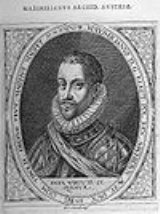
Maximilian III, also known as
Maximilian der Deutschmeister (12 October 1558 – 2 November 1618) was the Archduke of Further Austria from 1612 until his death.
Born in
Wiener Neustadt----Wiener Neustadt , is a town located south of Vienna, in the state of Lower Austria, Austria. It is a self-governed city and the seat of the district administration of Wiener Neustadt-Land.- History :...
, he was the fourth son of Emperor
Maximilian IIMaximilian II was king of Bohemia from 1562, king of Hungary from 1563, emperor of the Holy Roman Empire from 1564 and king of the Romans until his death. He was a member of the House of Habsburg.-Biography:...
and
Maria of SpainMaria of Spain was the first daughter of Charles V and Isabella of Portugal. She was Holy Roman Empress, German Queen, Queen of Hungary and Bohemia as the wife of Maximilian II, Holy Roman Emperor...
. Maximilian was a grandson of
Anna of Bohemia and HungaryAnna of Bohemia and Hungary, also sometimes known as Anna Jagellonica was, by marriage to Ferdinand I, King of the Romans and later Holy Roman Emperor, Queen of the Romans.-Family:She was the elder child and only daughter of king Vladislaus II of Bohemia and Hungary and his third...
, daughter and heiress of
Ladislaus II of BohemiaLadislaus II of Bohemia may refer to:* Vladislaus II of Bohemia * Vladislaus II of Bohemia and Hungary...
and Hungary, who himself was the eldest son of Casimir IV of Poland. He descended from the ancient Piast kings of Poland, and from Jogaila and his forefathers, Grand Dukes of Lithuania.
Maximilian III, also known as
Maximilian der Deutschmeister (12 October 1558 – 2 November 1618) was the Archduke of Further Austria from 1612 until his death.
Biography
Born in
Wiener Neustadt----Wiener Neustadt , is a town located south of Vienna, in the state of Lower Austria, Austria. It is a self-governed city and the seat of the district administration of Wiener Neustadt-Land.- History :...
, he was the fourth son of Emperor
Maximilian IIMaximilian II was king of Bohemia from 1562, king of Hungary from 1563, emperor of the Holy Roman Empire from 1564 and king of the Romans until his death. He was a member of the House of Habsburg.-Biography:...
and
Maria of SpainMaria of Spain was the first daughter of Charles V and Isabella of Portugal. She was Holy Roman Empress, German Queen, Queen of Hungary and Bohemia as the wife of Maximilian II, Holy Roman Emperor...
. Maximilian was a grandson of
Anna of Bohemia and HungaryAnna of Bohemia and Hungary, also sometimes known as Anna Jagellonica was, by marriage to Ferdinand I, King of the Romans and later Holy Roman Emperor, Queen of the Romans.-Family:She was the elder child and only daughter of king Vladislaus II of Bohemia and Hungary and his third...
, daughter and heiress of
Ladislaus II of BohemiaLadislaus II of Bohemia may refer to:* Vladislaus II of Bohemia * Vladislaus II of Bohemia and Hungary...
and Hungary, who himself was the eldest son of Casimir IV of Poland. He descended from the ancient Piast kings of Poland, and from Jogaila and his forefathers, Grand Dukes of Lithuania. The late
Sigismund I the OldSigismund I the Old of the Jagiellon dynasty reigned as King of Poland and also as the Grand Duke of Lithuania from 1506 until 1548...
, himself a younger son, was Maximilian's great-great-uncle, and Maximilian descended from Sigismund's eldest brother.
From 1585 onwards, he was the Grand Master of the Teutonic Order.
In 1587 Maximilian was a candidate for the
monarchA monarch is the person who heads a monarchy, a form of government in which the country or entity usually ruled or controlled by an individual who usually rules for life or until abdication...
of
Polish-Lithuanian CommonwealthThe Polish–Lithuanian Commonwealth was formed by the union of the Kingdom of Poland and Grand Duchy of Lithuania in 1569. The new Commonwealth was one of the largest and most populous countries of 16th and 17th-century Europe....
, following the death of the previous Polish king,
Stefan BatoryStephen Báthory was a Hungarian noble Prince of Transylvania , then King of Poland and Grand Duke of Lithuania . He was a member of the Somlyo branch of the noble Hungarian Báthory family...
. The election was disputed by another candidate,
Sigismund III VasaSigismund III Vasa was King of Polish Crown and Grand Duke of Lithuania, a monarch of joined Polish-Lithuanian Commonwealth from 1587 to 1632, and King of Sweden from 1592 until he was deposed in 1599...
, prince of Sweden, grandson of Sigismund I the Old. When Maximilian attempted to resolve the dispute by bringing a military force and starting the
war of the Polish SuccessionThe War of the Polish Succession was a major European war sparked by a Polish civil war over the succession to Augustus II, King of Poland that widened as France and Spain, the two Bourbon powers, attempted to check the power of the Austrian Habsburgs in western Europe...
, wherein he was defeated at the
Battle of ByczynaThe Battle of Byczyna was a battle fought in the course of the War of the Polish Succession. It saw the victory of newly-elected King Sigismund III Vasa's Polish-Lithuanian army over the Austrian army of Archduke Maximilian III, a pretender to the Polish throne.Taking place near the Silesian town...
by the supporters of Sigismund III, the newly proclaimed king, under the command of Polish
hetmanHetman was the title of the second highest military commander used in 15th to 18th century Poland, Ukraine and Grand Duchy of Lithuania, known from 1569 to 1795 as the Rzeczpospolita....
Jan Zamojski. He was taken captive and released only after intervention by
Pope Sixtus VPope Sixtus V , born Felice Peretti di Montalto, was Pope from 1585 to 1590.-Biography:Felice Peretti was born at Grottammare, in the Papal States, son of Piergentile di Giacomo, nicknamed "Peretto", and Marianna da Frontillo. He took the surname "Peretti" in 1551 and was more generally known as...
. In 1589, he waived his right to the Polish crown. The inactivity of his brother Emperor
Rudolf II, Holy Roman EmperorRudolf II , Holy Roman Emperor as Rudolf II , King of Hungary as Rudolf , King of Bohemia as Rudolf II and Archduke of Austria as Rudolf V...
in this matter contributed to Rudolf's bad reputation.
From 1593 to 1595 Maximilian was regent for his young cousin, Ferdinand, Archduke of
Inner AustriaInner Austria was a term used from the late 14th to the 16th century referring to Styria, Carinthia, Carniola and the Windic march, the County of Gorizia, Trieste and assorted smaller Habsburg possessions bordering the area .In the Treaty of Neuberg of 1379, the Habsburgs split into the...
. Subsequently in 1595 he succeeded their uncle Ferdinand II, Archduke of Further Austria in his territories, including
TirolTyrol is a state or Bundesland, located in the west of Austria. It comprises the Austrian part of the historical region of Tyrol.The state is split into two parts – called North Tyrol and East Tyrol – by a 20 km-wide strip of land where the state of Salzburg borders directly on the Italian...
, where he proved to be a consequent proponent of the
Counter-ReformationThe Counter-Reformation denotes the period of Catholic revival beginning with the Council of Trent and ending at the close of the Thirty Years' War, 1648....
. He also worked to depose Melchior Khlesl, and to ensure that
Archduke Ferdinand of Inner AustriaFerdinand II , of the House of Habsburg, Holy Roman Emperor , King of Bohemia , King of Hungary .-Life:...
, his former young charge, would succeed as Holy Roman Emperor.
Maximilian's best known legacy is the
baroqueBaroque is an artistic style prevalent from the late 16th century to the early 18th century. The popularity and success of the Baroque style was encouraged by the Roman Catholic Church, which had decided at the time of the Council of Trent that the arts should communicate religious themes in...
archducal hatThe first archducal coronet was shown on a portrait of Rudolf IV, Duke of Austria, though this coronet probably never existed. Ernest the Iron had a coronet made, and another was made on the death of Archduke Ferdinand II of the Tyrol in 1595...
, which is exhibited in the treasure chamber of the
monasteryMonastery , a term derived from the Greek word μοναστήριον, neut. of μοναστήριος - monasterios denotes the building, or complex of buildings, that houses a room reserved for prayer Monastery (plural: monasteries), a term derived from the Greek word μοναστήριον, neut. of μοναστήριος - monasterios...
of
KlosterneuburgKlosterneuburg is a city in Lower Austria, Austria with a population of 24,442.It is located on the Danube, immediately north of Vienna, from which it is separated by the Kahlenberg and the Leopoldsberg...
and was used for ceremonial purposes as late as 1835.
He died at Vienna in 1618; he is buried in the St. Jakobskirche at
InnsbruckInnsbruck is the capital city of the federal state of Tyrol in western Austria. It is located in the Inn Valley at the junction with the Wipptal , which provides access to the Brenner Pass, some south of Innsbruck...
.
Ancestors
Maximilian's ancestors in three generations
| Maximilian III, Archduke of Austria |
Father: Maximilian II, Holy Roman EmperorMaximilian II was king of Bohemia from 1562, king of Hungary from 1563, emperor of the Holy Roman Empire from 1564 and king of the Romans until his death. He was a member of the House of Habsburg.-Biography:...
|
Paternal Grandfather: Ferdinand I, Holy Roman EmperorFerdinand I was a Central European monarch from the House of Habsburg. He was Holy Roman Emperor from 1558, King of Bohemia and Hungary from 1526. He ruled the Austrian hereditary lands of the Habsburgs most of his public life, at the behest of his elder brother, Charles V, Holy Roman Emperor and...
|
Paternal Great-grandfather: Philip I of CastilePhilip I , known as the Handsome or the Fair, was the son of Maximilian I, Holy Roman Emperor...
|
Paternal Great-grandmother: Joanna of CastileJoanna , called Joanna the Mad reigned as Queen of Castile jointly with her husband Philip the Handsome and later also as Queen of Aragon jointly with her son the Holy Roman Emperor Charles V. She is most famous for having been obsessed with her husband, never recovering from his loss...
|
Paternal Grandmother: Anna of Bohemia and HungaryAnna of Bohemia and Hungary, also sometimes known as Anna Jagellonica was, by marriage to Ferdinand I, King of the Romans and later Holy Roman Emperor, Queen of the Romans.-Family:She was the elder child and only daughter of king Vladislaus II of Bohemia and Hungary and his third...
|
Paternal Great-grandfather: Vladislaus II of Bohemia and HungaryVladislas II, also known as Ladislaus Jagiellon ; was King of Bohemia from 1471 and King of Hungary from 1490 until his death in 1516...
|
Paternal Great-grandmother: Anna of Foix-CandaleAnna of Foix was the third Queen consort of King Vladislaus II of Hungary, and his only wife to produce an heir.-Life:Anna was the daughter of Gaston of Foix, Count of Candale and Infanta Catherine of Navarre...
|
Mother: Maria of SpainMaria of Spain was the first daughter of Charles V and Isabella of Portugal. She was Holy Roman Empress, German Queen, Queen of Hungary and Bohemia as the wife of Maximilian II, Holy Roman Emperor...
|
Maternal Grandfather: Charles V, Holy Roman EmperorCharles V was ruler of the Holy Roman Empire from 1519 and, as Charles I of Spain, of the Spanish realms from 1516 until his abdication in 1556...
|
Maternal Great-grandfather: Philip I of CastilePhilip I , known as the Handsome or the Fair, was the son of Maximilian I, Holy Roman Emperor...
|
Maternal Great-grandmother: Joanna of CastileJoanna , called Joanna the Mad reigned as Queen of Castile jointly with her husband Philip the Handsome and later also as Queen of Aragon jointly with her son the Holy Roman Emperor Charles V. She is most famous for having been obsessed with her husband, never recovering from his loss...
|
Maternal Grandmother: Isabella of PortugalIsabella of Portugal was the daughter of Manuel I of Portugal and Maria of Aragon. By her marriage to Charles V, Holy Roman Emperor, Isabella was also Holy Roman Empress and Queen consort of Aragon and Castile....
|
Maternal Great-grandfather: Manuel I of PortugalManuel I , the Fortunate , 14th king of Portugal and the Algarves was the son of Infante Fernando, Duke of Viseu, , by his wife, Infanta Beatriz of Portugal.His mother was the granddaughter of King John I of...
|
Maternal Great-grandmother: Maria of AragonMaria of Aragon was a Spanish infanta, second wife of Portuguese King Manuel I and because of that queen consort of Portugal from her marriage on 30 October 1500 until her death.-Family:She was the third surviving daughter of Isabella of Castile and Ferdinand II of Aragon...
|