
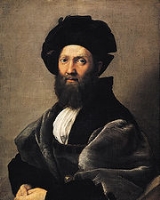
Baldassare Castiglione, count of (baldas'sare kastiʎ'ʎone; December 6, 1478 – February 2, 1529) was an
ItalianItaly , officially the Italian Republic languages]] under the European Charter for Regional or Minority Languages. In each of these, Italy's official name is as follows:;;;;;;;;), is a unitary parliamentary republic in South-Central Europe. To the north it borders France, Switzerland, Austria and...
courtierA courtier is a person who is often in attendance at the court of a king or other royal personage. Historically the court was the centre of government as well as the residence of the monarch, and social and political life were often completely mixed together...
,
diplomatA diplomat is a person appointed by a state to conduct diplomacy with another state or international organization. The main functions of diplomats revolve around the representation and protection of the interests and nationals of the sending state, as well as the promotion of information and...
, soldier and a prominent
RenaissanceThe Renaissance was a cultural movement that spanned roughly the 14th to the 17th century, beginning in Italy in the Late Middle Ages and later spreading to the rest of Europe. The term is also used more loosely to refer to the historical era, but since the changes of the Renaissance were not...
authorAn author is broadly defined as "the person who originates or gives existence to anything" and that authorship determines responsibility for what is created. Narrowly defined, an author is the originator of any written work.-Legal significance:...
.
Biography
Castiglione was born into an illustrious Lombard family at Casatico, near
MantuaMantua is a city and comune in Lombardy, Italy and capital of the province of the same name. Mantua's historic power and influence under the Gonzaga family, made it one of the main artistic, cultural and notably musical hubs of Northern Italy and the country as a whole...
, where his family had constructed an impressive palazzo. The
signoriaA Signoria was an abstract noun meaning 'government; governing authority; de facto sovereignty; lordship in many of the Italian city states during the medieval and renaissance periods....
(lordship) of Casatico (today part of the
communeIn Italy, the comune is the basic administrative division, and may be properly approximated in casual speech by the English word township or municipality.-Importance and function:...
of
MarcariaMarcaria is a comune in the Province of Mantua in the Italian region Lombardy, located about 110 km southeast of Milan and about 20 km west of Mantua....
) had been assigned to an ancestor, Baldassare da Castiglione, a friend of Ludovico II Gonzaga Marquis of Mantua, in 1445. The later Baldasare was related to Ludovico through his mother, Luigia Gonzaga.
In 1494 at the age of sixteen Castiglione began his
humanist studiesRenaissance humanism was an activity of cultural and educational reform engaged by scholars, writers, and civic leaders who are today known as Renaissance humanists. It developed during the fourteenth and the beginning of the fifteenth centuries, and was a response to the challenge of Mediæval...
in
MilanMilan is the second-largest city in Italy and the capital city of the region of Lombardy and of the province of Milan. The city proper has a population of about 1.3 million, while its urban area, roughly coinciding with its administrative province and the bordering Province of Monza and Brianza ,...
, which would eventually inform his future writings. However, in 1499 after the death of his father Castiglione left his studies and Milan to succeed his father as the head of their noble family. Soon his duties seem to have included representative offices for the
GonzagaThe Gonzaga family ruled Mantua in Northern Italy from 1328 to 1708.-History:In 1433, Gianfrancesco I assumed the title of Marquis of Mantua, and in 1530 Federico II received the title of Duke of Mantua. In 1531, the family acquired the Duchy of Monferrato through marriage...
court; for instance, he accompanied his marquis for the
Royal entryThe Royal Entry, also known by various other names, including Triumphal Entry and Joyous Entry, embraced the ceremonial and festivities accompanying a formal entry by a ruler or his representative into a city in the Middle Ages and Early Modern Period in Europe...
at Milan of
Louis XIILouis proved to be a popular king. At the end of his reign the crown deficit was no greater than it had been when he succeeded Charles VIII in 1498, despite several expensive military campaigns in Italy. His fiscal reforms of 1504 and 1508 tightened and improved procedures for the collection of taxes...
. For the Gonzaga he traveled quite often; during one of his missions to
RomeRome is the capital of Italy and the country's largest and most populated city and comune, with over 2.7 million residents in . The city is located in the central-western portion of the Italian Peninsula, on the Tiber River within the Lazio region of Italy.Rome's history spans two and a half...
he met
Guidobaldo da Montefeltrothumb|240px|Portrait of Guidobaldo da Montefeltro by [[Raphael]].Guidobaldo da Montefeltro , also known as Guidobaldo I, was an Italian condottiero and the Duke of Urbino from 1482 to 1508.-Biography:...
, duke of Urbino and in 1504 a reluctant
Francesco GonzagaFrancesco II Gonzaga was the ruler of the Italian city of Mantua from 1484 until his death.-Biography:Gonzaga was born in Mantua, the son of Marquess Federico I Gonzaga. He had a career as a condottiero acting as Venice's commander from 1489 to 1498...
allowed him to leave and take up residence in that court.
Urbino was at that time the most refined and elegant among Italian courts, a meeting point of culture ably directed and managed by duchess
Elisabetta GonzagaThe Gonzaga family ruled Mantua in Northern Italy from 1328 to 1708.-History:In 1433, Gianfrancesco I assumed the title of Marquis of Mantua, and in 1530 Federico II received the title of Duke of Mantua. In 1531, the family acquired the Duchy of Monferrato through marriage...
and her sister-in-law Maria Emilia Pia. The most constant guests included:
Pietro BemboPietro Bembo was an Italian scholar, poet, literary theorist, and cardinal. He was an influential figure in the development of the Italian language, specifically Tuscan, as a literary medium, and his writings assisted in the 16th-century revival of interest in the works of Petrarch...
,
Giuliano de' MediciGiuliano di Lorenzo de' Medici was an Italian nobleman, one of three sons of Lorenzo the Magnificent.-Biography:He was born in Florence, Italy. His brothers were Piero and Giovanni de' Medici....
, Cardinal Bibbiena, Ottaviano and
Federigo FregosoFederigo Fregoso , was an Italian nobleman, prelate and general.-Biography:Fregoso was born to the Fregosi family, a family who in the late fourteenth century gave two Doges of Genoa to the Republic of Genoa...
, and
Cesare GonzagaThe Gonzaga family ruled Mantua in Northern Italy from 1328 to 1708.-History:In 1433, Gianfrancesco I assumed the title of Marquis of Mantua, and in 1530 Federico II received the title of Duke of Mantua. In 1531, the family acquired the Duchy of Monferrato through marriage...
, a cousin of both Castiglione and the duke. The hosts and guests organized intellectual competitions which resulted in an interesting stimulating cultural life producing brilliant literary activity.
In 1506 Castiglione wrote (and played in) a pastoral play, his eclogue
Tirsi, in which allusively through the figures of three shepherds he depicted the court of Urbino. The work contains echoes of both ancient and contemporary poetry, recalling
PolizianoAngelo Ambrogini, commonly known by his nickname, anglicized as Politian, Italian Poliziano, Latin Politianus was an Italian Renaissance classical scholar and poet, one of the revivers of Humanist Latin...
and Sannazzaro as well as
VirgilPublius Vergilius Maro, usually called Virgil or Vergil in English , was an ancient Roman poet of the Augustan period. He is known for three major works of Latin literature, the Eclogues , the Georgics, and the epic Aeneid...
.
Castiglione wrote about his works and of those of other guests in letters to other princes, maintaining an activity very near to diplomacy, though in a literary form, as in his correspondence with Ludovico da Canossa.
Francesco Maria della RovereFrancesco Maria I della Rovere was an Italian condottiero, who was Duke of Urbino from 1508 until 1538.- Biography :...
succeeded as duke of Urbino at Guidobaldo's death and Castiglione remained at his court. With Francesco Maria he took part in
Pope Julius IIPope Julius II , nicknamed "The Fearsome Pope" and "The Warrior Pope" , born Giuliano della Rovere, was Pope from 1503 to 1513...
's expedition against
VeniceVenice is a city in northern Italy which is renowned for the beauty of its setting, its architecture and its artworks. It is the capital of the Veneto region...
, an episode in the
Italian WarsThe Italian Wars, often referred to as the Great Italian Wars or the Great Wars of Italy and sometimes as the Habsburg–Valois Wars, were a series of conflicts from 1494 to 1559 that involved, at various times, most of the city-states of Italy, the Papal States, most of the major states of Western...
. For this he received the title of Conte di Novilara, a fief near Pesaro. When
Pope Leo XPope Leo X , born Giovanni di Lorenzo de' Medici, was the Pope from 1513 to his death in 1521. He was the last non-priest to be elected Pope. He is known for granting indulgences for those who donated to reconstruct St. Peter's Basilica and his challenging of Martin Luther's 95 Theses...
was elected in 1512 Castiglione was sent to Rome as an ambassador of the duke of Urbino. In Rome he formed friendships with many artists and writers; among these,
RaphaelRaffaello Sanzio da Urbino , better known simply as Raphael, was an Italian painter and architect of the High Renaissance. His work is admired for its clarity of form and ease of composition and for its visual achievement of the Neoplatonic ideal of human grandeur...
, a native of Urbino, soon became a close friend, frequently asking for his suggestions. Raphael gratefully painted a
famous portrait of CastiglionePortrait of Baldassare Castiglione is an oil painting attributed to the Italian High Renaissance painter Raphael, c. 1514-1515. It is considered one of the great painted portraits of the Renaissance, and has been a work of lasting influence...
, now at the Louvre.
In 1516 Castiglione was back in Mantua where he married Ippolita Torelli, descendant of another ancient noble family. Two passionate letters he wrote to her expressing deep sentiment have survived but she died only four years later. At that time Castiglione was in Rome again as an ambassador, this time for the Duke of Mantua. In 1521 Pope Leo X conceded to him the
tonsuraTonsure is the traditional practice of Christian churches of cutting or shaving the hair from the scalp of clerics, monastics, and, in the Eastern Orthodox Church, all baptized members...
(first sacerdotal ceremony) and thereupon began Castiglione's second, ecclesiastical career.
In 1524
Pope Clement VIIClement VII , born Giulio di Giuliano de' Medici, was a cardinal from 1513 to 1523 and was Pope from 1523 to 1534.-Early life:...
sent him to
SpainSpain , officially the Kingdom of Spain languages]] under the European Charter for Regional or Minority Languages. In each of these, Spain's official name is as follows:;;;;;;), is a country and member state of the European Union located in southwestern Europe on the Iberian Peninsula...
as Apostolic nuncio (ambassador of the
Holy SeeThe Holy See is the episcopal jurisdiction of the Catholic Church in Rome, in which its Bishop is commonly known as the Pope. It is the preeminent episcopal see of the Catholic Church, forming the central government of the Church. As such, diplomatically, and in other spheres the Holy See acts and...
) in Madrid, and in this role he followed
Charles VCharles V was ruler of the Holy Roman Empire from 1519 and, as Charles I, of the Spanish Empire from 1516 until his voluntary retirement and abdication in favor of his younger brother Ferdinand I and his son Philip II in 1556.As...
to
ToledoToledo's Alcázar became renowned in the 19th and 20th centuries as a military academy. At the outbreak of the Spanish Civil War in 1936 its garrison was famously besieged by Republican forces.-Economy:...
,
SevilleSeville is the artistic, historic, cultural, and financial capital of southern Spain. It is the capital of the autonomous community of Andalusia and of the province of Seville. It is situated on the plain of the River Guadalquivir, with an average elevation of above sea level...
and
GranadaGranada is a city and the capital of the province of Granada, in the autonomous community of Andalusia, Spain. Granada is located at the foot of the Sierra Nevada mountains, at the confluence of three rivers, the Beiro, the Darro and the Genil. It sits at an elevation of 738 metres above sea...
. At the time of the
Sack of Rome (1527)The Sack of Rome on 6 May 1527 was a military event carried out by the mutinous troops of Charles V, Holy Roman Emperor in Rome, then part of the Papal States...
the Pope Clement VII suspected him of a "special friendship" for the Spanish emperor Charles: in effect Castiglione should have informed the Holy See about the intentions of
Charles VCharles V was ruler of the Holy Roman Empire from 1519 and, as Charles I, of the Spanish Empire from 1516 until his voluntary retirement and abdication in favor of his younger brother Ferdinand I and his son Philip II in 1556.As...
, for it was his duty to investigate what Spain was planning against the Eternal City. On the other side, Alonso, brother of
Juan de ValdésJuan de Valdés was a Spanish religious writer.He was the younger of twin sons of Fernando de Valdés, hereditary regidor of Cuenca in Castile, where Valdés was born. He has been confused with his twin brother Alfonso...
and secretary of the emperor, publicly declared that the sack was a divine punishment for the too many sins of the
clergyClergy is the generic term used to describe the formal religious leadership within a given religion. A clergyman, churchman or cleric is a member of the clergy, especially one who is a priest, preacher, pastor, or other religious professional....
.
Castiglione answered both the Pope and Valdés in two famous letters from
BurgosBurgos is a city of northern Spain, historic capital of Castile. It is situated at the edge of the central plateau, with about 178,966 inhabitants in the city proper and another 20,000 in its suburbs. It is the capital of the province of Burgos, in the autonomous community of Castile and León...
. Valdés received a very long and severe letter in which the nuncio used hard terms to define the
Sacco and Valdés' comments. The Pope Clement VII, on the other hand, received a letter (dated December 10, 1527) in which the sense of Castiglione's daring argument was that several aspects of
VaticanThe Holy See is the episcopal jurisdiction of the Catholic Church in Rome, in which its Bishop is commonly known as the Pope. It is the preeminent episcopal see of the Catholic Church, forming the central government of the Church. As such, diplomatically, and in other spheres the Holy See acts and...
politics were ambiguous and contradictory, not at all a valid support in his action of pursuing a fair agreement with the Empire; this lack of coherence in the Church's actions had therefore irritated Charles V.
Against any expectation, he received the excuses of the Pope and great honors by the emperor. He was awarded by Charles V offering him, apparently, the position of Bishop of Avila. Today it seems quite certain that Castiglione had no responsibility in the sack, and he had played honestly his role in Spain. He died of plague at Toledo in 1529.
The Book of the Courtier
In 1528, the year before his death, the book by which he is most famous,
The Book of the CourtierThe Book of the Courtier is a courtesy book. It was written by Baldassare Castiglione over the course of many years, beginning in 1508, and published in 1528 by the Aldine Press just before his death...
(
Il Libro del Cortegiano), was published in
VeniceVenice is a city in northern Italy which is renowned for the beauty of its setting, its architecture and its artworks. It is the capital of the Veneto region...
by the
Aldine PressAldine Press was the printing office started by Aldus Manutius in 1494 in Venice, from which were issued the celebrated Aldine editions of the classics . The Aldine Press is famous in the history of typography, among other things, for the introduction of italics...
run by Andrea d'Asolo, father-in-law of
Aldus ManutiusAldus Pius Manutius , the Latinised name of Aldo Manuzio —sometimes called Aldus Manutius, the Elder to distinguish him from his grandson, Aldus Manutius, the Younger—was an Italian humanist who became a printer and publisher when he founded the Aldine Press at Venice.His publishing legacy includes...
. The book is based on a nostalgic recreation of Castiglione's experience at the court of Duke
Guidobaldo da Montefeltrothumb|240px|Portrait of Guidobaldo da Montefeltro by [[Raphael]].Guidobaldo da Montefeltro , also known as Guidobaldo I, was an Italian condottiero and the Duke of Urbino from 1482 to 1508.-Biography:...
of Urbino at the turn of the sixteenth century. It describes the ideal
courtThe court of a monarch, or at some periods an important nobleman, is a term for the extended household and all those who regularly attended on the ruler or central figure...
and
courtierA courtier is a person who is often in attendance at the court of a king or other royal personage. Historically the court was the centre of government as well as the residence of the monarch, and social and political life were often completely mixed together...
, going into great detail about the philosophical and cultured and lively conversations that occurred at Urbino, presided over by
Elisabetta GonzagaElisabetta Gonzaga was a noblewoman of the Italian Renaissance, renowned for her cultured and virtuous life. A member of the noble House of Gonzaga, she was a sister of Francesco II Gonzaga, Marquess of Mantua and by marriage the Duchess of Urbino...
. Castiglione himself does not contribute to the discussion: the book is his tribute to his friendship with the participants of the discussion, all of whom went on to have important positions.
The conversation, which takes place over a span of four days in the year 1507, addressed the topic, proposed by Federico Fregoso, of what constitutes an ideal Renaissance gentleman. In the
Middle AgesThe Middle Ages is a periodization of European history from the 5th century to the 15th century. The Middle Ages follows the fall of the Western Roman Empire in 476 and precedes the Early Modern Era. It is the middle period of a three-period division of Western history: Classic, Medieval and Modern...
, the perfect gentleman had been a
chivalrousChivalry is a term related to the medieval institution of knighthood which has an aristocratic military origin of individual training and service to others. Chivalry was also the term used to refer to a group of mounted men-at-arms as well as to martial valour...
knight who distinguished himself by his prowess on the battlefield. Castiglione's book changed that. Now the perfect gentleman had to also have a classical education in Greek and Latin letters as well. The Ciceronian humanist ideal of the perfect orator (which
CiceroMarcus Tullius Cicero , was a Roman philosopher, statesman, lawyer, political theorist, and Roman constitutionalist. He came from a wealthy municipal family of the equestrian order, and is widely considered one of Rome's greatest orators and prose stylists.He introduced the Romans to the chief...
called "the honest man"), on which
The Courtier is based, prescribes for the orator an active political life of service to country whether in war or peace. Jennifer Richards argues that Castiglione drew heavily from Cicero's newly discovered and published (1501) treatise
De OfficiisDe Officiis is an essay by Marcus Tullius Cicero divided into three books, in which Cicero expounds his conception of the best way to live, behave, and observe moral obligations.- Origin :...
[The Duties of a Gentleman]. She notes that the question put forth by
De Oratore, namely, can rhetoric be taught or is it an inborn gift, is arguably the same as that of
The Courtier. The genre also, a comfortable informal discussion (in rhetorical terms
sermo, conversation, as opposed to oratory) among equals at leisure, holding differing opinions in which no definitive conclusion is reached, is also the same in
The Courtier and
De Oratore. Since republics were dying out when Castiglione wrote, this meant in practice that the perfect gentleman had to win the respect and friendship of his peers and of a ruler, i.e., be a courtier, so as to be able to offer valuable assistance and advice on how to rule the city. To do this, he must be accomplished—in sports, telling jokes, fighting, poetry, music, drawing, and dancing—but not too much. To his moral elegance (his personal goodness) must be added the spiritual elegance conferred by familiarity with good literature (i.e., the humanities, including history). He must excel in all without apparent effort and make everything look easy. In a famous passage, Lodovico da Canossa explains "the mysterious source of courtly gracefulness, the quality which makes the courtier seem a natural nobleman":
sprezzaturaSprezzatura is an Italian word originating from Baldassare Castiglione’s The Book of the Courtier, where it is defined by the author as “a certain nonchalance, so as to conceal all art and make whatever one does or says appear to be without effort and almost without any thought about it.” It is...
.
Theoretically, noble birth is not necessary and anyone can be a perfect courtier, even if lowly born; but in practice, it is easier if one is born into a distinguished family. In any case, the ideal courtier should be able to speak appropriately with people of all stations in life. Ideally, the courtier should be young, about twenty-seven at least mentally, but should give the appearance of being graver and more thoughtful than his years. To do this he should wear subdued rather than bright colors, though in general attire he should follow the prevalent customs of his surroundings.
In addition to the formation of the perfect courtier, the participants (who do not always agree by any means, for in Ciceronian fashion the conversation is open ended, leading the reader to draw his or her own conclusions) also address a variety of other questions, such as which form of government is best, a republic or a principality; what constitute appropriate topics for joking; whether painting or sculpture is superior, the role of music. They also deplore the rude and uncultivated manners of the French, who know more about fighting than literature and look down with disdain on what they call a "clerk" (though hope is expressed for
Francis of ValoisFrancis I was King of France from 1515 until his death. During his reign, huge cultural changes took place in France and he has been called France's original Renaissance monarch...
, the future king of France). This is a bitter topic, since the French, who had just invaded Italy, had shown themselves clearly superior in fighting to the Italians. Another topic is that of the Court Lady, which brings up the topic of the equality of the sexes. One character, Gaspare Pallavicino, aged twenty, is depicted as a misogynist who attacks women, but the others rush to their defense, affirming the equality of women to men in every respect.
Giuliano de' MediciGiuliano de' Medici may refer to:*Giuliano di Piero de' Medici...
points out that throughout history some women have excelled in philosophy and others have waged war and governed cities, and he lists the heroines of classical times. Pallavicino, piqued, hints that Giuliano is wrong, but in the end he concedes that he himself has been wrong. Ironically, the affable Giuliano (a lover of women and famous as a philanderer) is the very person to whom Machiavelli planned to address his book
The PrinceThe Prince is a political treatise by the Italian diplomat, historian and political theorist Niccolò Machiavelli. From correspondence a version appears to have been distributed in 1513, using a Latin title, De Principatibus . But the printed version was not published until 1532, five years after...
.Giuliano later was given the title of Duc de Nemours by
Francis IFrancis I was King of France from 1515 until his death. During his reign, huge cultural changes took place in France and he has been called France's original Renaissance monarch...
. He died soon after.
The book ends on a very elevated note with a long speech about love by the
humanistHumanism is an approach in study, philosophy, world view or practice that focuses on human values and concerns. In philosophy and social science, humanism is a perspective which affirms some notion of human nature, and is contrasted with anti-humanism....
scholar
Pietro BemboPietro Bembo was an Italian scholar, poet, literary theorist, and cardinal. He was an influential figure in the development of the Italian language, specifically Tuscan, as a literary medium, and his writings assisted in the 16th-century revival of interest in the works of Petrarch...
(later a Cardinal). Bembo, who is older than the others, talks about an old man's love, which is of necessity Platonic. Bembo's speech is based on that of
Socrates Socrates was a classical Greek Athenian philosopher. Credited as one of the founders of Western philosophy, he is an enigmatic figure known chiefly through the accounts of later classical writers, especially the writings of his students Plato and Xenophon, and the plays of his contemporary ...
in the
SymposiumIn ancient Greece, the symposium was a drinking party. Literary works that describe or take place at a symposium include two Socratic dialogues, Plato's Symposium and Xenophon's Symposium, as well as a number of Greek poems such as the elegies of Theognis of Megara...
, except that the object of love is heterosexual not homosexual as in Plato. He describes how the experience of sublimated love leads one to the contemplation of ideal beauty and ideas. He talks about the divine nature and origin of love, the "father of true pleasures, of all blessings, of peace, of gentleness, and of good will: the enemy of rough savagery and vileness", which ultimately lifts the lover to the contemplation of the spiritual realm, leading to God (however Bembo does say that it is all right for the platonic lover to kiss his beloved on the lips, describing the kiss as the union of two souls). When Bembo has finished, the others notice that they have all become so enraptured by his speech that they have lost track of the time and the night has passed and the sun is rising over the hills.
The
Book of the Courtier caught the "spirit of the times" and was soon translated into Spanish, German, French, and English. One hundred and eight editions were published between 1528 and 1616 alone. (
Pietro AretinoPietro Aretino was an Italian author, playwright, poet and satirist who wielded immense influence on contemporary art and politics and invented modern literate pornography.- Life :...
's
La cortigiana is a parody of this famous work.) Castiglione's depiction of how the ideal gentleman should be educated and behave remained, for better or for worse, the touchstone for all the upper classes of Europe for the next five centuries.
Castiglione's minor works are less known, yet still interesting, including love sonnets and four
Amorose canzoni which he wrote about his
Platonic lovePlatonic love is a chaste and strong type of love that is non-sexual.-Amor Platonicus:The term amor platonicus was coined as early as the 15th century by the Florentine scholar Marsilio Ficino. Platonic love in this original sense of the term is examined in Plato's dialogue the Symposium, which has...
for Elisabetta Gonzaga, in the style of Francesco Petrarca's and
Pietro BemboPietro Bembo was an Italian scholar, poet, literary theorist, and cardinal. He was an influential figure in the development of the Italian language, specifically Tuscan, as a literary medium, and his writings assisted in the 16th-century revival of interest in the works of Petrarch...
's. His sonnet
Superbi colli e voi, sacre ruine, written more by the man of letters than by the poet in Castiglione, still contains a pre-romantic inspiration.
He also produced a number of Latin poems, together with an elegy for the death of Raphael entitled
De morte Raphaellis pictoris, and another elegy in which he imagined his dead wife was writing to him. In Italian prose, he wrote a prologue for Bibbiena's
Calandria.
His letters are another, perhaps greater, point of interest, describing not only the man and his personality but also details about the famous people he met and visited, or about his diplomatic activity; they are considered very important for political, literary, and historical studies.
Sources
- Raffini, Christine, Marsilio Ficino, Pietro Bembo, Baldassare Castiglione: Philosophical, Aesthetic, and Political Approaches in Renaissance Platonism, (Renaissance and Baroque Studies and Texts, v.21,) Peter Lang Publishing, 1998. ISBN 0-8204-3023-4
External links