

Politics of Malta

Encyclopedia
The politics of Malta takes place within a framework of a parliamentary
representative democratic
republic
, whereby the President of Malta
is the constitutional head of state. Executive Authority is vested in the President of Malta with the general direction and control of the Government of Malta
remaining with the Prime Minister of Malta
who is the head of government
and the cabinet. Legislative power is vested in the Parliament of Malta
which consists of the President of Malta
and the unicameral House of Representatives of Malta
with the Speaker
presiding officer of the legislative body. Judicial power remains with the Chief Justice
and the Judiciary of Malta
. Since Independence, the party electoral system has been dominated by the Christian democratic Nationalist Party
(Partit Nazzjonalista) and the social democratic Labour Party (Partit Laburista).
(Nationalist Party) and the Partit Laburista
(Labour Party). Third parties have failed to score any electoral success: in the 2008 election
the Alternattiva Demokratika (Democratic Alternative - a Green Party established in 1989) and the Azzjoni Nazzjonali
(National Action) managed to secure only 1.31% and 0.5% of the first preference votes nationwide respectively. Elections have invariably generated a widespread voter turnout exceeding 90% of registered voters.
The 1996 elections resulted in the election of the Labour Party, by 8,000 votes, to replace the Nationalists who had won in 1987 and 1992. Voter turnout was characteristically high at 96%, with the Labour Party receiving 50.72%, the Nationalist Party 47.8%, the Democratic Alternative
1.46%, and independent candidates 0.02%. In 1998, the Labour Party's loss in a parliamentary vote led the Prime Minister to call an early election. The Nationalist Party was returned to office in September 1998 by a majority of 13,000 votes, holding a five-seat majority in Parliament. Voter turnout was 95%, with the Nationalist Party receiving 51.81%, the Labour Party 46.97%, the Democratic Alternative 1.21%, and independent candidates 0.01%.
The Nationalist government wrapped up negotiations for European Union
membership by the end of 2002. A referendum
on the issue was called in March 2003 for which the Nationalists and the Democratic Alternative campaigned for a "yes" vote while Labour campaigned heavily for "no" vote, invalidate their vote or abstain. Turnout was 91%, with more than 53% voting "yes".
The Labour Party argued that the "yes" votes amounted to less than 50% of the overall votes, hence, and citing the Integration referendum as an example, they claimed that the "yes" had not in fact won the referendum. The then MLP Leader Alfred Sant said that the General Elections that was to be held within a month would settle the affair. In the General Elections the Nationalists were returned to office with 51.79% of the vote to Labour's 47.51%. The Democratic Alternative managed 0.68%. The Nationalists were thus able to form a government and sign and ratify the EU Accession Treaty on 16 April 2003.
On 1 May 2004 Malta joined the EU and on 1 January 2008, the Eurozone
with the euro
as the national currency. The first elections after membership were held in March 2008 resulting in a narrow victory for the Nationalist Party with 49.34% of first preference votes.
was sovereign of Malta, and a Governor-General
exercised executive authority on her behalf, while the actual direction and control of the government and the nation's affairs were in the hands of the cabinet under the leadership of a Maltese prime minister.
On December 13, 1974, the constitution was revised, and Malta became a republic within the Commonwealth, with executive authority vested in the President of Malta
which can be exercised directly or through officers subordinate to him. The president is elected by the House of Representatives for a five-year term. He appoints as Prime Minister the leader of the party with a majority of seats in the unicameral House of Representatives, known in Maltese as Kamra tad-Deputati.
The President also nominally appoints, upon recommendation of the Prime Minister, the individual ministers. Ministers are selected from among the members of the House of Representatives, which usually consists of 65 members unless bonus seats are given to a party which gains an absolute majority of votes but not a Parliamentary majority. Elections must be held at least every 5 years and the electoral system used is single transferable vote
.
, with each council responsible for the administration of cities or regions of varying sizes. Administrative responsibility is distributed between the local councils and the central government in Valletta.
The Local Councils Act, 1993 (Act XV of 1993) was published on June 30, 1993, subdividing Malta into 54 local councils in Malta and 14 in Gozo
. The inhabitants who are registered elect the Council every three years, as voters in the Local Councils' Electoral Register. Elections are held by means of the system of proportional representation using the single transferable vote. The mayor is the head of the Local Council and the representative of the Council for all effects under the Act. The Executive Secretary, who is appointed by the Council, is the executive, administrative, and financial head of the Council. All decisions are taken collectively with the other members of the Council. Local councils are responsible for the general upkeep and embellishment of the locality, local wardens, and refuse collection, and carry out general administrative duties for the central government such as collection of government rents and funds, and answering government-related public inquiries.
There are also Administrative Committees elected with responsibility for smaller regions.
(Kamra tad-Deputati) are based on the single transferable vote
system, which in turn is a variant of the proportional representation
electoral system. First vacancies are filled through casual election and subsequent vacancies through co-option, meaning that no by-election
s are held between one general election and the other. The Parliamentary term cannot exceed five years.
Ordinarily, 65 members are elected to the House from 13 multi-seat constituencies each returning 5 MPs. Additional MPs are elected in two circumstances:
A third electoral amendment has been enacted which guarantees strict-proportionality with respect to votes and seats to parliamentary political groups.
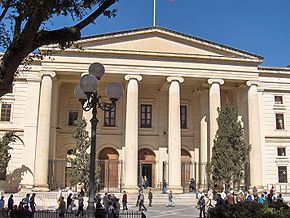 The President appoints the Chief Justice of Malta
and the judges of the superior courts on the advice of the Prime Minister of Malta
. There are also inferior courts presided over by a Magistrates which have original jurisdiction in criminal and civil actions.
Malta's judiciary is independent and they have security of tenure until their mandatory retiring age currently set at 65 or impeachment
. Members of the judiciary are impeached by the President upon a vote by the House of Representatives that is supported by a 2/3s majority of all the members on the grounds of proved inability to perform his functions in office (whether it is infirmity of body or mind or any other cause) or proved misbehavior by the Commission for the Administration of Justice. Therefore, the Maltese court system safeguards both the positions of the judge and to a certain extent, the position of the courts, from political interference by government or by Parliament.
Judges’ security of tenure is also guaranteed by the constitutional requirement that the judiciary’s salaries are paid from the Consolidated fund and thus the government may not diminish or amend them to their prejudice. The government may increase their salary. Therefore any judgements would not be taken according to the influence of politics but the principles and rules of law i.e. the judiciary is subject only to law.
There is a Civil Court and a Criminal Court. In the latter, the presiding judge sits with a jury of nine. There are also Tribunals having Civil Jurisdiction. The Court of Appeal and the Court of Criminal Appeal hear appeals from decisions of the civil and criminal actions respectively.
The highest court, the Constitutional Court, has both original and appellate jurisdiction. In its appellate jurisdiction it listens to cases involving violations of human rights and interpretation of the constitution. It can also perform judicial review
. In its original jurisdiction it has jurisdiction over disputed parliamentary elections and electoral corrupt practices.
, CE
, EBRD
, ECE
, EU
(member from 1 May 2004), FAO
, IAEA
, IBRD
, ICAO
, ICCt
, ICFTU
, ICRM
, IFAD
, IFRCS
, ILO
, IMF
, IMO
, Inmarsat
, Intelsat
, Interpol
, IOC, IOM
(observer), ISO
, ITU
, OPCW
, OSCE
, PCA
, UN
, UNCTAD
, UNESCO
, UNIDO
, UPU
, WCL
, WCO
, WHO
, WIPO
, WMO
, WToO
, WTrO
Malta was a long-time member of NAM
. It ceased to be part of the movement when it joined the European Union.
Parliamentary system
A parliamentary system is a system of government in which the ministers of the executive branch get their democratic legitimacy from the legislature and are accountable to that body, such that the executive and legislative branches are intertwined....
representative democratic
Representative democracy
Representative democracy is a form of government founded on the principle of elected individuals representing the people, as opposed to autocracy and direct democracy...
republic
Republic
A republic is a form of government in which the people, or some significant portion of them, have supreme control over the government and where offices of state are elected or chosen by elected people. In modern times, a common simplified definition of a republic is a government where the head of...
, whereby the President of Malta
President of Malta
The President of Malta is the constitutional head of state of Malta.The President is appointed by a resolution of the House of Representatives of Malta for a five year term, taking an oath to "preserve, protect and defend" the Constitution....
is the constitutional head of state. Executive Authority is vested in the President of Malta with the general direction and control of the Government of Malta
Government of Malta
The Government of Malta is the executive branch of Malta. It is made up of the Cabinet and the Parliamentary Secretaries. The Prime Minister is appointed by the President of Malta, with the President making his or her decision based on the situation within the Maltese parliament. The Prime...
remaining with the Prime Minister of Malta
Prime Minister of Malta
The Prime Minister of Malta is the Head of Government of Malta.-Establishment of the office and developments:The office of "Head of Ministry" was created as soon as Malta was granted autonomous government in 1921. The 1921 constitution was suspended twice before being revoked...
who is the head of government
Head of government
Head of government is the chief officer of the executive branch of a government, often presiding over a cabinet. In a parliamentary system, the head of government is often styled prime minister, chief minister, premier, etc...
and the cabinet. Legislative power is vested in the Parliament of Malta
Parliament of Malta
The Parliament of the Republic of Malta is the constitutional legislative body in Malta, located in Valletta...
which consists of the President of Malta
President of Malta
The President of Malta is the constitutional head of state of Malta.The President is appointed by a resolution of the House of Representatives of Malta for a five year term, taking an oath to "preserve, protect and defend" the Constitution....
and the unicameral House of Representatives of Malta
House of Representatives of Malta
The House of Representatives is the unicameral legislature of Malta and a component of the Parliament of Malta.The House is composed of an odd number of members elected for a five year term...
with the Speaker
Speaker of the House of Representatives of Malta
The Speaker of the House of Representatives of Malta is the collective representative of the House of Representatives of Malta. The Speaker is responsible for controlling the flow of House business and acts as "referee" during debates...
presiding officer of the legislative body. Judicial power remains with the Chief Justice
Chief Justice of Malta
The Chief Justice of Malta is the primus inter pares of the judicial branch of the Republic of Malta. The Chief Justice leads the business of the Supreme Court and is appointed by the President of Malta acting in accordance with the advice of the Prime Minister of Malta...
and the Judiciary of Malta
Judiciary of Malta
The Chief Justice and judges, two of whom are currently serving in international courts, are appointed by the President of Malta on the advice of the prime minister after consultation with the leader of the opposition...
. Since Independence, the party electoral system has been dominated by the Christian democratic Nationalist Party
Nationalist Party (Malta)
The Nationalist Party is one of two major contemporary political parties in Malta, along with the Labour Party. It was founded by Fortunato Mizzi in 1880 as the Anti-Reform Party, opposing taxation decreed by the British colonial authorities and measures to Anglicise the educational and the...
(Partit Nazzjonalista) and the social democratic Labour Party (Partit Laburista).
Political developments since independence
Since independence, general elections have been held in 1966, 1971, 1976, 1981, 1987, 1992, 1996, 1998 , 2003 and 2008. Two parties have dominated Malta's polarized and evenly-divided politics during this period: the Partit NazzjonalistaNationalist Party (Malta)
The Nationalist Party is one of two major contemporary political parties in Malta, along with the Labour Party. It was founded by Fortunato Mizzi in 1880 as the Anti-Reform Party, opposing taxation decreed by the British colonial authorities and measures to Anglicise the educational and the...
(Nationalist Party) and the Partit Laburista
Malta Labour Party
The Labour Party is, along with the Nationalist Party, one of two major contemporary political parties in Malta. It is the party of opposition in the Maltese House of Representatives where it has thirty-four of the sixty-nine seats.- Party Structure :...
(Labour Party). Third parties have failed to score any electoral success: in the 2008 election
Maltese general election, 2008
The latest Maltese general election for the renewal of the House of Representatives of Malta was held on March 8, 2008. The incumbent ruling party the Christian democratic Nationalist Party, led by Prime Minister Lawrence Gonzi, narrowly won over the social democratic Malta Labour Party led by...
the Alternattiva Demokratika (Democratic Alternative - a Green Party established in 1989) and the Azzjoni Nazzjonali
Democratic Alternative (Malta)
The Democratic Alternative is a Green political party in Malta, particularly dedicated to environmentalism.-History:Democratic Alternative was founded in 1989 when former Malta Labour Party President Toni Abela and former Labour MP and Parliamentary whip Wenzu Mintoff joined a number of...
(National Action) managed to secure only 1.31% and 0.5% of the first preference votes nationwide respectively. Elections have invariably generated a widespread voter turnout exceeding 90% of registered voters.
The 1996 elections resulted in the election of the Labour Party, by 8,000 votes, to replace the Nationalists who had won in 1987 and 1992. Voter turnout was characteristically high at 96%, with the Labour Party receiving 50.72%, the Nationalist Party 47.8%, the Democratic Alternative
Democratic Alternative (Malta)
The Democratic Alternative is a Green political party in Malta, particularly dedicated to environmentalism.-History:Democratic Alternative was founded in 1989 when former Malta Labour Party President Toni Abela and former Labour MP and Parliamentary whip Wenzu Mintoff joined a number of...
1.46%, and independent candidates 0.02%. In 1998, the Labour Party's loss in a parliamentary vote led the Prime Minister to call an early election. The Nationalist Party was returned to office in September 1998 by a majority of 13,000 votes, holding a five-seat majority in Parliament. Voter turnout was 95%, with the Nationalist Party receiving 51.81%, the Labour Party 46.97%, the Democratic Alternative 1.21%, and independent candidates 0.01%.
The Nationalist government wrapped up negotiations for European Union
European Union
The European Union is an economic and political union of 27 independent member states which are located primarily in Europe. The EU traces its origins from the European Coal and Steel Community and the European Economic Community , formed by six countries in 1958...
membership by the end of 2002. A referendum
Referendum
A referendum is a direct vote in which an entire electorate is asked to either accept or reject a particular proposal. This may result in the adoption of a new constitution, a constitutional amendment, a law, the recall of an elected official or simply a specific government policy. It is a form of...
on the issue was called in March 2003 for which the Nationalists and the Democratic Alternative campaigned for a "yes" vote while Labour campaigned heavily for "no" vote, invalidate their vote or abstain. Turnout was 91%, with more than 53% voting "yes".
The Labour Party argued that the "yes" votes amounted to less than 50% of the overall votes, hence, and citing the Integration referendum as an example, they claimed that the "yes" had not in fact won the referendum. The then MLP Leader Alfred Sant said that the General Elections that was to be held within a month would settle the affair. In the General Elections the Nationalists were returned to office with 51.79% of the vote to Labour's 47.51%. The Democratic Alternative managed 0.68%. The Nationalists were thus able to form a government and sign and ratify the EU Accession Treaty on 16 April 2003.
On 1 May 2004 Malta joined the EU and on 1 January 2008, the Eurozone
Eurozone
The eurozone , officially called the euro area, is an economic and monetary union of seventeen European Union member states that have adopted the euro as their common currency and sole legal tender...
with the euro
Euro
The euro is the official currency of the eurozone: 17 of the 27 member states of the European Union. It is also the currency used by the Institutions of the European Union. The eurozone consists of Austria, Belgium, Cyprus, Estonia, Finland, France, Germany, Greece, Ireland, Italy, Luxembourg,...
as the national currency. The first elections after membership were held in March 2008 resulting in a narrow victory for the Nationalist Party with 49.34% of first preference votes.
Executive branch
Under its 1964 constitution, Malta became a parliamentary democracy within the Commonwealth. Queen Elizabeth II of the United KingdomElizabeth II of the United Kingdom
Elizabeth II is the constitutional monarch of 16 sovereign states known as the Commonwealth realms: the United Kingdom, Canada, Australia, New Zealand, Jamaica, Barbados, the Bahamas, Grenada, Papua New Guinea, the Solomon Islands, Tuvalu, Saint Lucia, Saint Vincent and the Grenadines, Belize,...
was sovereign of Malta, and a Governor-General
Governor-General
A Governor-General, is a vice-regal person of a monarch in an independent realm or a major colonial circonscription. Depending on the political arrangement of the territory, a Governor General can be a governor of high rank, or a principal governor ranking above "ordinary" governors.- Current uses...
exercised executive authority on her behalf, while the actual direction and control of the government and the nation's affairs were in the hands of the cabinet under the leadership of a Maltese prime minister.
On December 13, 1974, the constitution was revised, and Malta became a republic within the Commonwealth, with executive authority vested in the President of Malta
President of Malta
The President of Malta is the constitutional head of state of Malta.The President is appointed by a resolution of the House of Representatives of Malta for a five year term, taking an oath to "preserve, protect and defend" the Constitution....
which can be exercised directly or through officers subordinate to him. The president is elected by the House of Representatives for a five-year term. He appoints as Prime Minister the leader of the party with a majority of seats in the unicameral House of Representatives, known in Maltese as Kamra tad-Deputati.
The President also nominally appoints, upon recommendation of the Prime Minister, the individual ministers. Ministers are selected from among the members of the House of Representatives, which usually consists of 65 members unless bonus seats are given to a party which gains an absolute majority of votes but not a Parliamentary majority. Elections must be held at least every 5 years and the electoral system used is single transferable vote
Single transferable vote
The single transferable vote is a voting system designed to achieve proportional representation through preferential voting. Under STV, an elector's vote is initially allocated to his or her most preferred candidate, and then, after candidates have been either elected or eliminated, any surplus or...
.
Administrative divisions
Malta is divided into 68 elected local councilsLocal councils of Malta
Since 1993, Malta has been subdivided into 68 local councils or localities . These form the most basic form of local government and there are no intermediate levels between it and the national level...
, with each council responsible for the administration of cities or regions of varying sizes. Administrative responsibility is distributed between the local councils and the central government in Valletta.
The Local Councils Act, 1993 (Act XV of 1993) was published on June 30, 1993, subdividing Malta into 54 local councils in Malta and 14 in Gozo
Gozo
Gozo is a small island of the Maltese archipelago in the Mediterranean Sea. The island is part of the Southern European country of Malta; after the island of Malta itself, it is the second-largest island in the archipelago...
. The inhabitants who are registered elect the Council every three years, as voters in the Local Councils' Electoral Register. Elections are held by means of the system of proportional representation using the single transferable vote. The mayor is the head of the Local Council and the representative of the Council for all effects under the Act. The Executive Secretary, who is appointed by the Council, is the executive, administrative, and financial head of the Council. All decisions are taken collectively with the other members of the Council. Local councils are responsible for the general upkeep and embellishment of the locality, local wardens, and refuse collection, and carry out general administrative duties for the central government such as collection of government rents and funds, and answering government-related public inquiries.
There are also Administrative Committees elected with responsibility for smaller regions.
Legislative branch
Elections to the House of RepresentativesHouse of Representatives of Malta
The House of Representatives is the unicameral legislature of Malta and a component of the Parliament of Malta.The House is composed of an odd number of members elected for a five year term...
(Kamra tad-Deputati) are based on the single transferable vote
Single transferable vote
The single transferable vote is a voting system designed to achieve proportional representation through preferential voting. Under STV, an elector's vote is initially allocated to his or her most preferred candidate, and then, after candidates have been either elected or eliminated, any surplus or...
system, which in turn is a variant of the proportional representation
Proportional representation
Proportional representation is a concept in voting systems used to elect an assembly or council. PR means that the number of seats won by a party or group of candidates is proportionate to the number of votes received. For example, under a PR voting system if 30% of voters support a particular...
electoral system. First vacancies are filled through casual election and subsequent vacancies through co-option, meaning that no by-election
By-election
A by-election is an election held to fill a political office that has become vacant between regularly scheduled elections....
s are held between one general election and the other. The Parliamentary term cannot exceed five years.
Ordinarily, 65 members are elected to the House from 13 multi-seat constituencies each returning 5 MPs. Additional MPs are elected in two circumstances:
- when a party achieves 50%+1 of first-preference valid votes in the election but does not secure a Parliamentary majority it is awarded enough seats (filled by the best runner-up candidates) to make a Parliamentary majority
- when in an election contested by more than two parties only two parties are elected to Parliament and the relative Parliamentary strength is not proportionate to the first preference votes obtained, additional seats are allocated to establish proportionality
A third electoral amendment has been enacted which guarantees strict-proportionality with respect to votes and seats to parliamentary political groups.
Political parties and elections
Judicial branch
Chief Justice of Malta
The Chief Justice of Malta is the primus inter pares of the judicial branch of the Republic of Malta. The Chief Justice leads the business of the Supreme Court and is appointed by the President of Malta acting in accordance with the advice of the Prime Minister of Malta...
and the judges of the superior courts on the advice of the Prime Minister of Malta
Prime Minister of Malta
The Prime Minister of Malta is the Head of Government of Malta.-Establishment of the office and developments:The office of "Head of Ministry" was created as soon as Malta was granted autonomous government in 1921. The 1921 constitution was suspended twice before being revoked...
. There are also inferior courts presided over by a Magistrates which have original jurisdiction in criminal and civil actions.
Malta's judiciary is independent and they have security of tenure until their mandatory retiring age currently set at 65 or impeachment
Impeachment
Impeachment is a formal process in which an official is accused of unlawful activity, the outcome of which, depending on the country, may include the removal of that official from office as well as other punishment....
. Members of the judiciary are impeached by the President upon a vote by the House of Representatives that is supported by a 2/3s majority of all the members on the grounds of proved inability to perform his functions in office (whether it is infirmity of body or mind or any other cause) or proved misbehavior by the Commission for the Administration of Justice. Therefore, the Maltese court system safeguards both the positions of the judge and to a certain extent, the position of the courts, from political interference by government or by Parliament.
Judges’ security of tenure is also guaranteed by the constitutional requirement that the judiciary’s salaries are paid from the Consolidated fund and thus the government may not diminish or amend them to their prejudice. The government may increase their salary. Therefore any judgements would not be taken according to the influence of politics but the principles and rules of law i.e. the judiciary is subject only to law.
There is a Civil Court and a Criminal Court. In the latter, the presiding judge sits with a jury of nine. There are also Tribunals having Civil Jurisdiction. The Court of Appeal and the Court of Criminal Appeal hear appeals from decisions of the civil and criminal actions respectively.
The highest court, the Constitutional Court, has both original and appellate jurisdiction. In its appellate jurisdiction it listens to cases involving violations of human rights and interpretation of the constitution. It can also perform judicial review
Judicial review
Judicial review is the doctrine under which legislative and executive actions are subject to review by the judiciary. Specific courts with judicial review power must annul the acts of the state when it finds them incompatible with a higher authority...
. In its original jurisdiction it has jurisdiction over disputed parliamentary elections and electoral corrupt practices.
International organization participation
Malta is member of CCommonwealth of Nations
The Commonwealth of Nations, normally referred to as the Commonwealth and formerly known as the British Commonwealth, is an intergovernmental organisation of fifty-four independent member states...
, CE
Council of Europe
The Council of Europe is an international organisation promoting co-operation between all countries of Europe in the areas of legal standards, human rights, democratic development, the rule of law and cultural co-operation...
, EBRD
European Bank for Reconstruction and Development
Founded in 1991, the European Bank for Reconstruction and Development uses the tools of investment to help build market economies and democracies in 30 countries from central Europe to central Asia. Its mission was to support the formerly communist countries in the process of establishing their...
, ECE
United Nations Economic Commission for Europe
The United Nations Economic Commission for Europe was established in 1947 to encourage economic cooperation among its member states. It is one of five regional commissions under the administrative direction of United Nations headquarters. It has 56 member states, and reports to the UN Economic and...
, EU
European Union
The European Union is an economic and political union of 27 independent member states which are located primarily in Europe. The EU traces its origins from the European Coal and Steel Community and the European Economic Community , formed by six countries in 1958...
(member from 1 May 2004), FAO
Food and Agriculture Organization
The Food and Agriculture Organization of the United Nations is a specialised agency of the United Nations that leads international efforts to defeat hunger. Serving both developed and developing countries, FAO acts as a neutral forum where all nations meet as equals to negotiate agreements and...
, IAEA
International Atomic Energy Agency
The International Atomic Energy Agency is an international organization that seeks to promote the peaceful use of nuclear energy, and to inhibit its use for any military purpose, including nuclear weapons. The IAEA was established as an autonomous organization on 29 July 1957...
, IBRD
International Bank for Reconstruction and Development
The International Bank for Reconstruction and Development is one of five institutions that compose the World Bank Group. The IBRD is an international organization whose original mission was to finance the reconstruction of nations devastated by World War II. Now, its mission has expanded to fight...
, ICAO
International Civil Aviation Organization
The International Civil Aviation Organization , pronounced , , is a specialized agency of the United Nations. It codifies the principles and techniques of international air navigation and fosters the planning and development of international air transport to ensure safe and orderly growth...
, ICCt
International Criminal Court
The International Criminal Court is a permanent tribunal to prosecute individuals for genocide, crimes against humanity, war crimes, and the crime of aggression .It came into being on 1 July 2002—the date its founding treaty, the Rome Statute of the...
, ICFTU
International Confederation of Free Trade Unions
The International Confederation of Free Trade Unions was an international trade union. It came into being on 7 December 1949 following a split within the World Federation of Trade Unions , and was dissolved on 31 October 2006 when it merged with the World Confederation of Labour to form the...
, ICRM
ICRM
ICRM may refer to:* International Red Cross and Red Crescent Movement, an international humanitarian movement* International Cliff Richard Movement, a fan club for English musician Cliff Richard...
, IFAD
International Fund for Agricultural Development
The International Fund for Agricultural Development , a specialized agency of the United Nations, was established as an international financial institution in 1977 as one of the major outcomes of the 1974 World Food Conference. IFAD is dedicated to eradicating rural poverty in developing countries...
, IFRCS
International Red Cross and Red Crescent Movement
The International Red Cross and Red Crescent Movement is an international humanitarian movement with approximately 97 million volunteers, members and staff worldwide which was founded to protect human life and health, to ensure respect for all human beings, and to prevent and alleviate human...
, ILO
International Labour Organization
The International Labour Organization is a specialized agency of the United Nations that deals with labour issues pertaining to international labour standards. Its headquarters are in Geneva, Switzerland. Its secretariat — the people who are employed by it throughout the world — is known as the...
, IMF
International Monetary Fund
The International Monetary Fund is an organization of 187 countries, working to foster global monetary cooperation, secure financial stability, facilitate international trade, promote high employment and sustainable economic growth, and reduce poverty around the world...
, IMO
International Maritime Organization
The International Maritime Organization , formerly known as the Inter-Governmental Maritime Consultative Organization , was established in Geneva in 1948, and came into force ten years later, meeting for the first time in 1959...
, Inmarsat
International Mobile Satellite Organization
The International Mobile Satellite Organization is the intergovernmental organization that oversees certain public satellite safety and security communication services provided via the Inmarsat satellites...
, Intelsat
Intelsat
Intelsat, Ltd. is a communications satellite services provider.Originally formed as International Telecommunications Satellite Organization , it was—from 1964 to 2001—an intergovernmental consortium owning and managing a constellation of communications satellites providing international broadcast...
, Interpol
Interpol
Interpol, whose full name is the International Criminal Police Organization – INTERPOL, is an organization facilitating international police cooperation...
, IOC, IOM
International Organization for Migration
The International Organization for Migration is an intergovernmental organization. It was initially established in 1951 as the Intergovernmental Committee for European Migration to help resettle people displaced by World War II....
(observer), ISO
International Organization for Standardization
The International Organization for Standardization , widely known as ISO, is an international standard-setting body composed of representatives from various national standards organizations. Founded on February 23, 1947, the organization promulgates worldwide proprietary, industrial and commercial...
, ITU
International Telecommunication Union
The International Telecommunication Union is the specialized agency of the United Nations which is responsible for information and communication technologies...
, OPCW
Organisation for the Prohibition of Chemical Weapons
The Organisation for the Prohibition of Chemical Weapons is an intergovernmental organization, located in The Hague, Netherlands. The organization promotes and verifies the adherence to the Chemical Weapons Convention which prohibits of the use of chemical weapons and requires their destruction...
, OSCE
Organization for Security and Co-operation in Europe
The Organization for Security and Co-operation in Europe is the world's largest security-oriented intergovernmental organization. Its mandate includes issues such as arms control, human rights, freedom of the press and fair elections...
, PCA
Permanent Court of Arbitration
The Permanent Court of Arbitration , is an international organization based in The Hague in the Netherlands.-History:The court was established in 1899 as one of the acts of the first Hague Peace Conference, which makes it the oldest institution for international dispute resolution.The creation of...
, UN
United Nations
The United Nations is an international organization whose stated aims are facilitating cooperation in international law, international security, economic development, social progress, human rights, and achievement of world peace...
, UNCTAD
United Nations Conference on Trade and Development
The United Nations Conference on Trade and Development was established in 1964 as a permanent intergovernmental body. It is the principal organ of the United Nations General Assembly dealing with trade, investment, and development issues....
, UNESCO
UNESCO
The United Nations Educational, Scientific and Cultural Organization is a specialized agency of the United Nations...
, UNIDO
United Nations Industrial Development Organization
The United Nations Industrial Development Organization , French/Spanish acronym ONUDI, is a specialized agency in the United Nations system, headquartered in Vienna, Austria...
, UPU
Universal Postal Union
The Universal Postal Union is an international organization that coordinates postal policies among member nations, in addition to the worldwide postal system. The UPU contains four bodies consisting of the Congress, the Council of Administration , the Postal Operations Council and the...
, WCL
World Confederation of Labour
The World Confederation of Labour was an international labour organization founded in 1920 and based in Europe. Totalitarian governments of the 1930s repressed the federation and imprisoned many of its leaders, limiting operations until the end of World War II...
, WCO
World Customs Organization
The World Customs Organization is an intergovernmental organization headquartered in Brussels, Belgium. With its worldwide membership, the WCO is recognized as the voice of the global customs community...
, WHO
World Health Organization
The World Health Organization is a specialized agency of the United Nations that acts as a coordinating authority on international public health. Established on 7 April 1948, with headquarters in Geneva, Switzerland, the agency inherited the mandate and resources of its predecessor, the Health...
, WIPO
World Intellectual Property Organization
The World Intellectual Property Organization is one of the 17 specialized agencies of the United Nations. WIPO was created in 1967 "to encourage creative activity, to promote the protection of intellectual property throughout the world"....
, WMO
World Meteorological Organization
The World Meteorological Organization is an intergovernmental organization with a membership of 189 Member States and Territories. It originated from the International Meteorological Organization , which was founded in 1873...
, WToO
World Tourism Organization
The World Tourism Organization , based in Madrid, Spain, is a United Nations agency dealing with questions relating to tourism. It compiles the World Tourism rankings. The World Tourism Organization is a significant global body, concerned with the collection and collation of statistical information...
, WTrO
World Trade Organization
The World Trade Organization is an organization that intends to supervise and liberalize international trade. The organization officially commenced on January 1, 1995 under the Marrakech Agreement, replacing the General Agreement on Tariffs and Trade , which commenced in 1948...
Malta was a long-time member of NAM
Non-Aligned Movement
The Non-Aligned Movement is a group of states considering themselves not aligned formally with or against any major power bloc. As of 2011, the movement had 120 members and 17 observer countries...
. It ceased to be part of the movement when it joined the European Union.
See also
- MaltaMaltaMalta , officially known as the Republic of Malta , is a Southern European country consisting of an archipelago situated in the centre of the Mediterranean, south of Sicily, east of Tunisia and north of Libya, with Gibraltar to the west and Alexandria to the east.Malta covers just over in...
- Nationalist PartyNationalist Party (Malta)The Nationalist Party is one of two major contemporary political parties in Malta, along with the Labour Party. It was founded by Fortunato Mizzi in 1880 as the Anti-Reform Party, opposing taxation decreed by the British colonial authorities and measures to Anglicise the educational and the...
- Labour Party
- Democratic AlternativeDemocratic Alternative (Malta)The Democratic Alternative is a Green political party in Malta, particularly dedicated to environmentalism.-History:Democratic Alternative was founded in 1989 when former Malta Labour Party President Toni Abela and former Labour MP and Parliamentary whip Wenzu Mintoff joined a number of...
- Mass meetingMass meetingIn parliamentary law, a mass meeting is a type of deliberative assembly, which in a publicized or selectively distributed notice known as the call of the meeting - has been announced:...