


Kufra

Encyclopedia
Kufra ˈkuːfrə is a basin
(Arab: Uádi el Kufra) and oasis group in Al Kufrah District, southeastern Cyrenaica
in Libya
. Kufra is historically important above all because at the end of nineteenth century it became the center and holy place of the Senussi
order. Moreover, it played a minor role in the Western Desert Campaign
of World War II.
It is in a particularly isolated location not only because it is in the middle of the Sahara Desert but also because it is surrounded on three sides by depressions
– which makes it dominate the passage in east-west land traffic across the desert; for the colonial Italians, it was also important as a station on the north-south air traffic to Italian East Africa
. These factors, along with Kufra's dominance of the southeastern Cyrenaica region of Libya, explains the Oasis' strategic importance and why it was a point of conflict during World War II.
word kafir
, the Arabic term for non-Muslims (often translated as "infidels", literally "those who conceal [the truth]") with reference to the pagan Tebu
people native to the region.
(Wádi el Kufra), oriented in NE–SW direction. The major axis is 50 km, the minor 20 km long. It is bordered by hills which are at most 100 m high. The soil consists of red marl
or sand, and in the lowest parts there are salt lakes or dried salines.
In the basin lie the following oases:
Moreover, on the North edge of the basin there is the village of Al-Tag ("Crown" in Arab, due to its dominating position), without oasis. It was founded by Sayyid Muhammad al-Mahdi (son of the founder of the Senussi order) when he moved to Kufra, and is considered the holy place of Senussi.
In the late 15th century, Leo Africanus
reported an oasis in the land of the Berdoa, visited by a caravan coming from Awjila
. It is possible that this oasis was identical with either the Al Jawf or the Tazirbu
oasis, and on early modern maps, the Al Kufra region was often labelled as Berdoa based on this report.
The Berdoa possibly correspond to the Tebu
, a Nilo-Saharan speaking tribal people indigenous to the region.
Kufra did not fall under the dominion of either the Arabs
or the Ottomans
, and was part of a Tebu Sultanate with capital in Tazirbu.
In the 1840s, the Tebu were colonized by the Arabized Berber
tribe of Zuwayya
, and eventually by the Italians
by the 1930s.
. Rohlfs reportedly first reached the oasis from the north in 1879.
Kufra was an important trade and travelling route for various nomadic desert people. In 1895 the Ottomans forced the Senussi
to leave Giarabub, making the oasis their main centre. After that, Westerners had no longer the chance to visit it until the first world war, when several soldiers of the Entente
were held prisoner there.
In 1931, during the campaign of Cyrenaica, General Rodolfo Graziani
easily conquered Kufra – considered a strategic region – leading about 3000 soldiers from infantry and artillery, supported by about twenty bombers.
Many refugees fled the Italian conquest eastwards via Uweinat into Egypt. The British explorer Pat Clayton
, engaged in mapping areas of previously unmapped desert, encountered the Kufra refugees when running triangulation from Wadi Halfa
to Uweinat, and helped save many from death in the arid desert.
) in Buma oasis and a fort in al-Tag, which dominated the area.
Buma airport was equipped with a radio-centre for flight assistance and was often used as a stop for routes
toward Asmara
and Italian East Africa
(Africa Orientale Italiana
, or AOI). The fort was also used as a radio post to guide in Italian aircraft as well as to maintain communication with Italian East Africa
.
Kufra increased its importance when the Second World War started and, after the Suez Canal
was closed to Italian shipping, connections with AOI
became mainly aerial, using Kufra and its strategic location.
Kufra, thanks to its key role for the Italian Royal Army, soon became a target for the Allies, with Free France and British desert troops beginning a long battle for its conquest. On 31 January 1941 Pat Clayton
– an explorer recruited by British Intelligence – was captured by the Italian Auto-Saharan Company
near Gebel Sherif
, when leading "T" Patrol in reconnaissance of the planned attack on Kufra.
The Free French from Chad
, with General Leclerc
's leading a combined force of Free French and Chad
native troops, acted together with the British Long Range Desert Group
, attacked and took Kufra in the Battle of Kufra
(1 March 1941).
In later stages of the Western Desert Campaign
, Kufra was used as a staging post for Allied units such as the Long Range Desert Group
and the Special Air Service
.
, the Buma
airfield at Kufra has fallen into disrepair and is little-used. The town surrounding the Oasis is still dominated by the old fort of El Tag
, built by the Italians in the mid-1930s.
On 26 August 2008, a hijacked Sudan
ese Boeing 737
landed at Kufra Airport after having departed from Nyala Airport
, Darfur
, with destination Khartoum
. Earlier, Egypt
ian authorities had refused to allow the plane to land in their national capital, Cairo
.
In recent decades, Kufra has become a major point on the route of African migrants who try to reach Europe by various routes, and some of whom get incarcerated in Kufra's notorious prison.
Following the 2011 mass protests
, the area was reported to be under control of anti-Gaddafi forces
and not the government of Muammar Gaddafi
on 2 April 2011. On 28 April 2011, loyalist forces reportedly re-captured Kufra. There were no reports of casualties in the fighting for the town after the rebels put up only light resistance. By 6 May 2011 the town had been retaken by the Libyan rebels.
pass through and compulsorily stop in Kufra. It is a little village of transit along the traditional route between Khartum and the coastal Libyan towns, which has lately turned to be a spot gathering Libyan-Sudanese criminal organizations involved in the illegal transport of immigrants, police officers controlling the boundaries and the need of people working in local productive activities.
The village of Kufra has long been suspected and accused by European Parliamentary delegations as being criminally instrumental in assisting migrants. In 2007, they defined Kufra as a free zone, a sort of starting Centre of Temporary Permanence CPT against the law... These gathering centres are places, in which the first contacts with the criminal organizations occur. Such organizations promote the "journey of hope", with a flexible handling of the Migrants' African routes
according to the restriction policies adopted by the various governments. The minds of the criminal organizations act accordingly to what happens in each country: if Morocco
stresses its restrain policies, the routes move towards the Canary Islands
, if the controls in Libya increase, the streams are diverted towards Malta
. When the migratory stream is over, the routes are back on Libya
and Tunisia
.
The 1500 km (about 950-mile) long route towards the coastal Libyan towns is done at night on covered trucks. Such journey conditions are described as "hellish". People are often stopped by the police and therefore the route is covered many times in both directions. Once the migrants arrive, or are brought back, in Kufra, the only way to escape this situation is to pay people traders, which are often colluded with the police officers. People brought back to the Sudan
ese border may reverse the course just with cash money. Hence the occurrence of continuous exploitation, enlistment in the work and prostitution
black market, painful waiting for a money order urged by relatives and friends through mobile phone
communications, which are allowed only for this aim.
Kufra (like Dirkou
in Niger
, Oujda
in Morocco
, Nouadhibou
in Mauritania
, Tinzouatine in Algeria
, etc.) are the new places of human trade and of exploitment of the illegal migrants' situation through Saharan routes. According to Gabriele Del Grande's point of view "the money involved in Saharan illegal emigration, including extorsions and ravages, is worth till 20 millions € per year. Military forces and passeurs are the usual receivers of these amounts of money. Illegal migrants have to give them till the last cent. If you are broke, you are a dead man. Hundreds, or even thousands, of migrants have been stuck for years in the oasis of Dirkou and Madama. These are the new Tuareg slaves. Boys and girls work day and night just for a bunch of rice and a little money. Life in the desert is hanging on a thread. If the engine doesn't work, the car gets stuck into the sand or the driver decides to leave the passengers and go back alone, the game is over. Within a distance of hundreds kilometres there is nothing apart from sand."
In 2005 Italy allocated funds for the creation of a detention camp at Kufra.

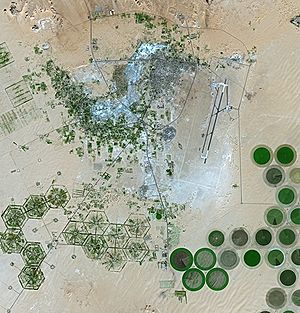 At the beginning of the '70s, Libya launched in Kufra a great cultivation project aimed at developing agriculture in the desert. LEPA irrigation is provided by fossil water
beneath the ground surface, the Nubian Sandstone Aquifer System
, a non-renewable source and the only accessible water resource in the area. Rotors (high sprinkler that rotates) provide irrigation and the obtained circles have a diameter af about 1 km (1,100 yd) and can be observed from space.
This is one of Libya's largest agricultural
projects. Because only about 2 percent of Libya's land receives enough rainfall to be cultivated, this project uses the underground aquifer
. The green circles in the desert frequently indicate tracts of agriculture supported by center-pivot irrigation. The agricultural project is an easy-to-recognize landmark for orbiting astronauts aboard the International Space Station. The Libyan government also has a project called the Great Manmade River
to pump and transport these groundwater reserves to the coast to support Libya’s growing population and industrial development.
Depression (geology)
A depression in geology is a landform sunken or depressed below the surrounding area. Depressions may be formed by various mechanisms.Structural or tectonic related:...
(Arab: Uádi el Kufra) and oasis group in Al Kufrah District, southeastern Cyrenaica
Cyrenaica
Cyrenaica is the eastern coastal region of Libya.Also known as Pentapolis in antiquity, it was part of the Creta et Cyrenaica province during the Roman period, later divided in Libia Pentapolis and Libia Sicca...
in Libya
Libya
Libya is an African country in the Maghreb region of North Africa bordered by the Mediterranean Sea to the north, Egypt to the east, Sudan to the southeast, Chad and Niger to the south, and Algeria and Tunisia to the west....
. Kufra is historically important above all because at the end of nineteenth century it became the center and holy place of the Senussi
Senussi
The Senussi or Sanussi refers to a Muslim political-religious order in Libya and the Sudan region founded in Mecca in 1837 by the Grand Senussi, Sayyid Muhammad ibn Ali as-Senussi. Senussi was concerned with both the decline of Islamic thought and spirituality and the weakening of Muslim political...
order. Moreover, it played a minor role in the Western Desert Campaign
Western Desert Campaign
The Western Desert Campaign, also known as the Desert War, was the initial stage of the North African Campaign during the Second World War. The campaign was heavily influenced by the availability of supplies and transport. The ability of the Allied forces, operating from besieged Malta, to...
of World War II.
It is in a particularly isolated location not only because it is in the middle of the Sahara Desert but also because it is surrounded on three sides by depressions
Depression (geology)
A depression in geology is a landform sunken or depressed below the surrounding area. Depressions may be formed by various mechanisms.Structural or tectonic related:...
– which makes it dominate the passage in east-west land traffic across the desert; for the colonial Italians, it was also important as a station on the north-south air traffic to Italian East Africa
Italian East Africa
Italian East Africa was an Italian colonial administrative subdivision established in 1936, resulting from the merger of the Ethiopian Empire with the old colonies of Italian Somaliland and Italian Eritrea. In August 1940, British Somaliland was conquered and annexed to Italian East Africa...
. These factors, along with Kufra's dominance of the southeastern Cyrenaica region of Libya, explains the Oasis' strategic importance and why it was a point of conflict during World War II.
Etymology
The word Kufra comes from the ArabicArabic language
Arabic is a name applied to the descendants of the Classical Arabic language of the 6th century AD, used most prominently in the Quran, the Islamic Holy Book...
word kafir
Kafir
Kafir is an Arabic term used in a Islamic doctrinal sense, usually translated as "unbeliever" or "disbeliever"...
, the Arabic term for non-Muslims (often translated as "infidels", literally "those who conceal [the truth]") with reference to the pagan Tebu
Toubou
The Tubu are an ethnic group that live mainly in northern Chad, but also in Libya, Niger and Sudan....
people native to the region.
Geography
Kufra is an elliptic shaped basinDepression (geology)
A depression in geology is a landform sunken or depressed below the surrounding area. Depressions may be formed by various mechanisms.Structural or tectonic related:...
(Wádi el Kufra), oriented in NE–SW direction. The major axis is 50 km, the minor 20 km long. It is bordered by hills which are at most 100 m high. The soil consists of red marl
Marl
Marl or marlstone is a calcium carbonate or lime-rich mud or mudstone which contains variable amounts of clays and aragonite. Marl was originally an old term loosely applied to a variety of materials, most of which occur as loose, earthy deposits consisting chiefly of an intimate mixture of clay...
or sand, and in the lowest parts there are salt lakes or dried salines.
In the basin lie the following oases:
- Al JawfAl Jawf, LibyaAl Jawf is a town in southeastern Libya, the capital of the Kufra district in Libya.The city has an elevation of 382.2 m . In a 1984 census the city's population was 17,320. Al Jawf receives almost no rain whatsoever, averaging only .1 inch per year. Summer high temperatures average above 100°F...
("Center"), the largest, situated at the NE end of the basin, 5 km long and 2–3 km wide. It is rich with palms and gardens. - Buma and Buema, both small and situated to the E of Al Jawf. Gerhard RohlfsFriedrich Gerhard RohlfsFriedrich Gerhard Rohlfs was a German geographer, explorer, author and adventurer.He was born at Vegesack, now part of Bremen. There was much pressure on Rohlfs to be in the medicine field, and he eventually joined the French Foreign Legion in a medical capacity...
set his camp North of Buema, and since then the locality is known as "Garet-en-Nasrani" ("Field of the Christian" in Arab). Kufra AirportKufra AirportKufra Airport is an airport in Kufra, southeastern Libya - .- History :Kufra Airport began as Buma Airfield, built in the 1930s as a minor facility by the Italians. In early World War II, it provided an air link to Italian East Africa...
is located in Buma. - Ez-Zurgh, situated 4 km to the South of Al Jawf. It consists of a line of Palm treesArecaceaeArecaceae or Palmae , are a family of flowering plants, the only family in the monocot order Arecales. There are roughly 202 currently known genera with around 2600 species, most of which are restricted to tropical, subtropical, and warm temperate climates...
extending in E-W direction. Until the Italian occupation it was inhabited only by slaves. - Et-Tleilíb and Et-Talláb, both situated to the SW of Al Jawf. The latter is the farthest from Al Jawf, lying 20 km away.
Moreover, on the North edge of the basin there is the village of Al-Tag ("Crown" in Arab, due to its dominating position), without oasis. It was founded by Sayyid Muhammad al-Mahdi (son of the founder of the Senussi order) when he moved to Kufra, and is considered the holy place of Senussi.
Early history
In 1154 al-Idrisi describes a place identified by Lewicki (1965) as the oasis of Kufra. Al Idrisi writes that the place was once flourishing and peopled, but was by that point in ruin, its wells dry, its herds returned to the wild.In the late 15th century, Leo Africanus
Leo Africanus
Joannes Leo Africanus, was a Moorish diplomat and author who is best known for his book Descrittione dell’Africa describing the geography of North Africa.-Biography:Most of what is known about his life is gathered from autobiographical...
reported an oasis in the land of the Berdoa, visited by a caravan coming from Awjila
Awjila
Awjila is a Berber-speaking oasis town in the Al Wahat District in the Cyrenaica region of northeastern Libya. It is the place after which the Awgila-Berber language, an Eastern Berber language, is named...
. It is possible that this oasis was identical with either the Al Jawf or the Tazirbu
Tazirbu
Tāzirbū , is an Oasis placed in the Libyan Desert in the Al Kufrah District of Libya, about 250 km to the NW of Kufra. The name means "main seat" in Tebu language, because this was the seat of the Tebu Sultanate before the Arab invasion. The oasis is 25-30 km long, and 10 km wide...
oasis, and on early modern maps, the Al Kufra region was often labelled as Berdoa based on this report.
The Berdoa possibly correspond to the Tebu
Toubou
The Tubu are an ethnic group that live mainly in northern Chad, but also in Libya, Niger and Sudan....
, a Nilo-Saharan speaking tribal people indigenous to the region.
Kufra did not fall under the dominion of either the Arabs
History of Islamic Tripolitania and Cyrenaica
Arab rule in Tripolitania and Cyrenaica began as early as the 7th century. With tenuous Byzantine control over Libya restricted to a few poorly defended coastal strongholds, the Arab horsemen who first crossed into Pentapolis, Cyrenaica in September 642 encountered little resistance...
or the Ottomans
Ottoman Tripolitania
The coastal region of what is today Libya was ruled by the Ottoman Empire from 1551 to 1911, from 1864 as the Vilayet of Tripolitania . It was also known as the Kingdom of Tripoli, even though it was not technically a kingdom, but an Ottoman province ruled by pashas , as the Karamanli dynasty...
, and was part of a Tebu Sultanate with capital in Tazirbu.
In the 1840s, the Tebu were colonized by the Arabized Berber
Arabized Berber
Arabized Berber is a term to denote an inhabitant of the North African Maghreb of Berber origin whose native language is a dialect of Arabic. According to these persons, the Arab identity in North Africa is a myth coming from the Arabization of the official institutions after French rule.They...
tribe of Zuwayya
Zuwayya
The Zuwayya are an independent Murabtin tribe, one of the major Arab Bedouin tribes of Cyrenaica, Libya.Traditionally practicing nomadic pastoralism of sheep and camels in a triangular area with its apex at Ajdabiya, the Zuwayya conquered the richest oasis of the interior, Kufra, in 1840,...
, and eventually by the Italians
History of Libya as Italian Colony
The History of Libya as an Italian colony began in the 1910s and lasted until February 1947, when Italy officially lost all the colonies of the former Italian Empire.-First years:...
by the 1930s.
Early Western contact and The Senussi
The territory of Kufra was first explored by Westerners beginning with the 1873/74 expedition by German Gerhard RohlfsFriedrich Gerhard Rohlfs
Friedrich Gerhard Rohlfs was a German geographer, explorer, author and adventurer.He was born at Vegesack, now part of Bremen. There was much pressure on Rohlfs to be in the medicine field, and he eventually joined the French Foreign Legion in a medical capacity...
. Rohlfs reportedly first reached the oasis from the north in 1879.
Kufra was an important trade and travelling route for various nomadic desert people. In 1895 the Ottomans forced the Senussi
Senussi
The Senussi or Sanussi refers to a Muslim political-religious order in Libya and the Sudan region founded in Mecca in 1837 by the Grand Senussi, Sayyid Muhammad ibn Ali as-Senussi. Senussi was concerned with both the decline of Islamic thought and spirituality and the weakening of Muslim political...
to leave Giarabub, making the oasis their main centre. After that, Westerners had no longer the chance to visit it until the first world war, when several soldiers of the Entente
Allies of World War I
The Entente Powers were the countries at war with the Central Powers during World War I. The members of the Triple Entente were the United Kingdom, France, and the Russian Empire; Italy entered the war on their side in 1915...
were held prisoner there.
In 1931, during the campaign of Cyrenaica, General Rodolfo Graziani
Rodolfo Graziani
Rodolfo Graziani, 1st Marquis of Neghelli , was an officer in the Italian Regio Esercito who led military expeditions in Africa before and during World War II.-Rise to prominence:...
easily conquered Kufra – considered a strategic region – leading about 3000 soldiers from infantry and artillery, supported by about twenty bombers.
Many refugees fled the Italian conquest eastwards via Uweinat into Egypt. The British explorer Pat Clayton
Pat Clayton
Patrick Andrew Clayton DSO MBE was a British surveyor and soldier. He was the basis for the character of Peter Madox in The English Patient....
, engaged in mapping areas of previously unmapped desert, encountered the Kufra refugees when running triangulation from Wadi Halfa
Wadi Halfa
Wadi Halfa is a city in the state of Northern, in northern Sudan, on the shores of Lake Nubia . It is the terminus of a rail line from Khartoum and the point where goods are transferred from rail to ferries going down the Lake Nasser...
to Uweinat, and helped save many from death in the arid desert.
Italian Rule and World War II
In the following years the Italians built an airfield (now Kufra AirportKufra Airport
Kufra Airport is an airport in Kufra, southeastern Libya - .- History :Kufra Airport began as Buma Airfield, built in the 1930s as a minor facility by the Italians. In early World War II, it provided an air link to Italian East Africa...
) in Buma oasis and a fort in al-Tag, which dominated the area.
Buma airport was equipped with a radio-centre for flight assistance and was often used as a stop for routes
Routes
Routes is a commune in the Seine-Maritime department in the Haute-Normandie region in northern France.-Geography:A small farming village in the Pays de Caux, some northeast of Le Havre, at the junction of the D88 and D420 roads.-Population:...
toward Asmara
Asmara
Asmara is the capital city and largest settlement in Eritrea, home to a population of around 579,000 people...
and Italian East Africa
Italian East Africa
Italian East Africa was an Italian colonial administrative subdivision established in 1936, resulting from the merger of the Ethiopian Empire with the old colonies of Italian Somaliland and Italian Eritrea. In August 1940, British Somaliland was conquered and annexed to Italian East Africa...
(Africa Orientale Italiana
Italian East Africa
Italian East Africa was an Italian colonial administrative subdivision established in 1936, resulting from the merger of the Ethiopian Empire with the old colonies of Italian Somaliland and Italian Eritrea. In August 1940, British Somaliland was conquered and annexed to Italian East Africa...
, or AOI). The fort was also used as a radio post to guide in Italian aircraft as well as to maintain communication with Italian East Africa
Italian East Africa
Italian East Africa was an Italian colonial administrative subdivision established in 1936, resulting from the merger of the Ethiopian Empire with the old colonies of Italian Somaliland and Italian Eritrea. In August 1940, British Somaliland was conquered and annexed to Italian East Africa...
.
Kufra increased its importance when the Second World War started and, after the Suez Canal
Suez Canal
The Suez Canal , also known by the nickname "The Highway to India", is an artificial sea-level waterway in Egypt, connecting the Mediterranean Sea and the Red Sea. Opened in November 1869 after 10 years of construction work, it allows water transportation between Europe and Asia without navigation...
was closed to Italian shipping, connections with AOI
Italian East Africa
Italian East Africa was an Italian colonial administrative subdivision established in 1936, resulting from the merger of the Ethiopian Empire with the old colonies of Italian Somaliland and Italian Eritrea. In August 1940, British Somaliland was conquered and annexed to Italian East Africa...
became mainly aerial, using Kufra and its strategic location.
Kufra, thanks to its key role for the Italian Royal Army, soon became a target for the Allies, with Free France and British desert troops beginning a long battle for its conquest. On 31 January 1941 Pat Clayton
Pat Clayton
Patrick Andrew Clayton DSO MBE was a British surveyor and soldier. He was the basis for the character of Peter Madox in The English Patient....
– an explorer recruited by British Intelligence – was captured by the Italian Auto-Saharan Company
Auto-Saharan Company
The Auto-Saharan Companies were Italian military units specialised in long range patrols of the Sahara Desert. The units operated from the late 1930s to the Italian surrender in 1943.-History:...
near Gebel Sherif
Gebel Sherif
Jebel Sherif is a mountain in southeastern Libya, about 130 km southwest of Kufra. It was the site of an action during the Battle of Kufra.-References:*http://www.nzetc.org/tm/scholarly/WH2-1Epi-fig-WH2-1Epi-e017a.html...
, when leading "T" Patrol in reconnaissance of the planned attack on Kufra.
The Free French from Chad
Chad
Chad , officially known as the Republic of Chad, is a landlocked country in Central Africa. It is bordered by Libya to the north, Sudan to the east, the Central African Republic to the south, Cameroon and Nigeria to the southwest, and Niger to the west...
, with General Leclerc
Philippe Leclerc de Hauteclocque
Philippe François Marie, comte de Hauteclocque, then Leclerc de Hauteclocque, by a 1945 decree that incorporated his French Resistance alias Jacques-Philippe Leclerc to his name, , was a French general during World War II...
's leading a combined force of Free French and Chad
Chad
Chad , officially known as the Republic of Chad, is a landlocked country in Central Africa. It is bordered by Libya to the north, Sudan to the east, the Central African Republic to the south, Cameroon and Nigeria to the southwest, and Niger to the west...
native troops, acted together with the British Long Range Desert Group
Long Range Desert Group
The Long Range Desert Group was a reconnaissance and raiding unit of the British Army during the Second World War. The commander of the German Afrika Corps, Field Marshal Erwin Rommel, admitted that the LRDG "caused us more damage than any other British unit of equal strength".Originally called...
, attacked and took Kufra in the Battle of Kufra
Battle of Kufra (1941)
The Battle of Kufra was part of the World War II Allies Western Desert Campaign in the colony of Italian Libya, in the Libyan Desert of present day southeastern Libya...
(1 March 1941).
In later stages of the Western Desert Campaign
Western Desert Campaign
The Western Desert Campaign, also known as the Desert War, was the initial stage of the North African Campaign during the Second World War. The campaign was heavily influenced by the availability of supplies and transport. The ability of the Allied forces, operating from besieged Malta, to...
, Kufra was used as a staging post for Allied units such as the Long Range Desert Group
Long Range Desert Group
The Long Range Desert Group was a reconnaissance and raiding unit of the British Army during the Second World War. The commander of the German Afrika Corps, Field Marshal Erwin Rommel, admitted that the LRDG "caused us more damage than any other British unit of equal strength".Originally called...
and the Special Air Service
Special Air Service
Special Air Service or SAS is a corps of the British Army constituted on 31 May 1950. They are part of the United Kingdom Special Forces and have served as a model for the special forces of many other countries all over the world...
.
After the war
After the Axis were expelled from North Africa, and when after the war it became part of independent LibyaLibya
Libya is an African country in the Maghreb region of North Africa bordered by the Mediterranean Sea to the north, Egypt to the east, Sudan to the southeast, Chad and Niger to the south, and Algeria and Tunisia to the west....
, the Buma
Kufra Airport
Kufra Airport is an airport in Kufra, southeastern Libya - .- History :Kufra Airport began as Buma Airfield, built in the 1930s as a minor facility by the Italians. In early World War II, it provided an air link to Italian East Africa...
airfield at Kufra has fallen into disrepair and is little-used. The town surrounding the Oasis is still dominated by the old fort of El Tag
El Tag
El Tag is a village and holy site in the Kufra Oasis, within the Libyan Desert subregion of the Sahara. It is in the Kufra District in the southern Cyrenaica region of southeastern Libya. The Arabic el tag translates as "crown" in English, and derives from the position above the Kufra basin...
, built by the Italians in the mid-1930s.
On 26 August 2008, a hijacked Sudan
Sudan
Sudan , officially the Republic of the Sudan , is a country in North Africa, sometimes considered part of the Middle East politically. It is bordered by Egypt to the north, the Red Sea to the northeast, Eritrea and Ethiopia to the east, South Sudan to the south, the Central African Republic to the...
ese Boeing 737
Boeing 737
The Boeing 737 is a short- to medium-range, twin-engine narrow-body jet airliner. Originally developed as a shorter, lower-cost twin-engine airliner derived from Boeing's 707 and 727, the 737 has developed into a family of nine passenger models with a capacity of 85 to 215 passengers...
landed at Kufra Airport after having departed from Nyala Airport
Nyala Airport
Nyala Airport is an airport in Nyala, Sudan .-Airlines and destinations:...
, Darfur
Darfur
Darfur is a region in western Sudan. An independent sultanate for several hundred years, it was incorporated into Sudan by Anglo-Egyptian forces in 1916. The region is divided into three federal states: West Darfur, South Darfur, and North Darfur...
, with destination Khartoum
Khartoum
Khartoum is the capital and largest city of Sudan and of Khartoum State. It is located at the confluence of the White Nile flowing north from Lake Victoria, and the Blue Nile flowing west from Ethiopia. The location where the two Niles meet is known as "al-Mogran"...
. Earlier, Egypt
Egypt
Egypt , officially the Arab Republic of Egypt, Arabic: , is a country mainly in North Africa, with the Sinai Peninsula forming a land bridge in Southwest Asia. Egypt is thus a transcontinental country, and a major power in Africa, the Mediterranean Basin, the Middle East and the Muslim world...
ian authorities had refused to allow the plane to land in their national capital, Cairo
Cairo
Cairo , is the capital of Egypt and the largest city in the Arab world and Africa, and the 16th largest metropolitan area in the world. Nicknamed "The City of a Thousand Minarets" for its preponderance of Islamic architecture, Cairo has long been a centre of the region's political and cultural life...
.
In recent decades, Kufra has become a major point on the route of African migrants who try to reach Europe by various routes, and some of whom get incarcerated in Kufra's notorious prison.
Following the 2011 mass protests
2011 Libyan civil war
The 2011 Libyan civil war was an armed conflict in the North African state of Libya, fought between forces loyal to Colonel Muammar Gaddafi and those seeking to oust his government. The war was preceded by protests in Benghazi beginning on 15 February 2011, which led to clashes with security...
, the area was reported to be under control of anti-Gaddafi forces
Anti-Gaddafi forces
The anti-Gaddafi forces were Libyan groups that opposed and militarily defeated the government of Muammar Gaddafi, killing him in the process. These opposition forces included organised and armed militia groups, participants in the 2011 Libyan civil war, Libyan diplomats who switched their...
and not the government of Muammar Gaddafi
Muammar Gaddafi
Muammar Muhammad Abu Minyar Gaddafi or "September 1942" 20 October 2011), commonly known as Muammar Gaddafi or Colonel Gaddafi, was the official ruler of the Libyan Arab Republic from 1969 to 1977 and then the "Brother Leader" of the Libyan Arab Jamahiriya from 1977 to 2011.He seized power in a...
on 2 April 2011. On 28 April 2011, loyalist forces reportedly re-captured Kufra. There were no reports of casualties in the fighting for the town after the rebels put up only light resistance. By 6 May 2011 the town had been retaken by the Libyan rebels.
Kufra in migrants' routes and human trafficking
Migrants coming from the East African coast and the Near EastNear East
The Near East is a geographical term that covers different countries for geographers, archeologists, and historians, on the one hand, and for political scientists, economists, and journalists, on the other...
pass through and compulsorily stop in Kufra. It is a little village of transit along the traditional route between Khartum and the coastal Libyan towns, which has lately turned to be a spot gathering Libyan-Sudanese criminal organizations involved in the illegal transport of immigrants, police officers controlling the boundaries and the need of people working in local productive activities.
The village of Kufra has long been suspected and accused by European Parliamentary delegations as being criminally instrumental in assisting migrants. In 2007, they defined Kufra as a free zone, a sort of starting Centre of Temporary Permanence CPT against the law... These gathering centres are places, in which the first contacts with the criminal organizations occur. Such organizations promote the "journey of hope", with a flexible handling of the Migrants' African routes
Migrants' African routes
The expression migrants' routes suggests the main geographical routes tracked down by migrants.From Africa, the routes mainly head towards Europe, however they are slightly changing in the last years, moving towards South Africa and Asia....
according to the restriction policies adopted by the various governments. The minds of the criminal organizations act accordingly to what happens in each country: if Morocco
Morocco
Morocco , officially the Kingdom of Morocco , is a country located in North Africa. It has a population of more than 32 million and an area of 710,850 km², and also primarily administers the disputed region of the Western Sahara...
stresses its restrain policies, the routes move towards the Canary Islands
Canary Islands
The Canary Islands , also known as the Canaries , is a Spanish archipelago located just off the northwest coast of mainland Africa, 100 km west of the border between Morocco and the Western Sahara. The Canaries are a Spanish autonomous community and an outermost region of the European Union...
, if the controls in Libya increase, the streams are diverted towards Malta
Malta
Malta , officially known as the Republic of Malta , is a Southern European country consisting of an archipelago situated in the centre of the Mediterranean, south of Sicily, east of Tunisia and north of Libya, with Gibraltar to the west and Alexandria to the east.Malta covers just over in...
. When the migratory stream is over, the routes are back on Libya
Libya
Libya is an African country in the Maghreb region of North Africa bordered by the Mediterranean Sea to the north, Egypt to the east, Sudan to the southeast, Chad and Niger to the south, and Algeria and Tunisia to the west....
and Tunisia
Tunisia
Tunisia , officially the Tunisian RepublicThe long name of Tunisia in other languages used in the country is: , is the northernmost country in Africa. It is a Maghreb country and is bordered by Algeria to the west, Libya to the southeast, and the Mediterranean Sea to the north and east. Its area...
.
The 1500 km (about 950-mile) long route towards the coastal Libyan towns is done at night on covered trucks. Such journey conditions are described as "hellish". People are often stopped by the police and therefore the route is covered many times in both directions. Once the migrants arrive, or are brought back, in Kufra, the only way to escape this situation is to pay people traders, which are often colluded with the police officers. People brought back to the Sudan
Sudan
Sudan , officially the Republic of the Sudan , is a country in North Africa, sometimes considered part of the Middle East politically. It is bordered by Egypt to the north, the Red Sea to the northeast, Eritrea and Ethiopia to the east, South Sudan to the south, the Central African Republic to the...
ese border may reverse the course just with cash money. Hence the occurrence of continuous exploitation, enlistment in the work and prostitution
Prostitution
Prostitution is the act or practice of providing sexual services to another person in return for payment. The person who receives payment for sexual services is called a prostitute and the person who receives such services is known by a multitude of terms, including a "john". Prostitution is one of...
black market, painful waiting for a money order urged by relatives and friends through mobile phone
Mobile phone
A mobile phone is a device which can make and receive telephone calls over a radio link whilst moving around a wide geographic area. It does so by connecting to a cellular network provided by a mobile network operator...
communications, which are allowed only for this aim.
Kufra (like Dirkou
Dirkou
Dirkou is a town in the Bilma Department, Agadez Region of north-eastern Niger. It lies in the northern Kaouar escarpment, a north-south line of cliffs which form an isolated oasis in the Sahara desert....
in Niger
Niger
Niger , officially named the Republic of Niger, is a landlocked country in Western Africa, named after the Niger River. It borders Nigeria and Benin to the south, Burkina Faso and Mali to the west, Algeria and Libya to the north and Chad to the east...
, Oujda
Oujda
Oujda is a city in eastern Morocco with an estimated population of 1 million. The city is located about 15 kilometers west of Algeria and about 60 kilometers south of the Mediterranean Sea. It is the capital of the Oriental Region of Morocco and the birthplace of the current Algerian president,...
in Morocco
Morocco
Morocco , officially the Kingdom of Morocco , is a country located in North Africa. It has a population of more than 32 million and an area of 710,850 km², and also primarily administers the disputed region of the Western Sahara...
, Nouadhibou
Nouadhibou
Nouadhibou is the second largest city in Mauritania and serves as a major commercial centre. The city itself has about 75,000 inhabitants expanding to over 90,000 in the larger metropolitan area. It is situated on a 40-mile peninsula or headland called Ras Nouadhibou, Cap Blanc, or Cabo Blanco, of...
in Mauritania
Mauritania
Mauritania is a country in the Maghreb and West Africa. It is bordered by the Atlantic Ocean in the west, by Western Sahara in the north, by Algeria in the northeast, by Mali in the east and southeast, and by Senegal in the southwest...
, Tinzouatine in Algeria
Algeria
Algeria , officially the People's Democratic Republic of Algeria , also formally referred to as the Democratic and Popular Republic of Algeria, is a country in the Maghreb region of Northwest Africa with Algiers as its capital.In terms of land area, it is the largest country in Africa and the Arab...
, etc.) are the new places of human trade and of exploitment of the illegal migrants' situation through Saharan routes. According to Gabriele Del Grande's point of view "the money involved in Saharan illegal emigration, including extorsions and ravages, is worth till 20 millions € per year. Military forces and passeurs are the usual receivers of these amounts of money. Illegal migrants have to give them till the last cent. If you are broke, you are a dead man. Hundreds, or even thousands, of migrants have been stuck for years in the oasis of Dirkou and Madama. These are the new Tuareg slaves. Boys and girls work day and night just for a bunch of rice and a little money. Life in the desert is hanging on a thread. If the engine doesn't work, the car gets stuck into the sand or the driver decides to leave the passengers and go back alone, the game is over. Within a distance of hundreds kilometres there is nothing apart from sand."
In 2005 Italy allocated funds for the creation of a detention camp at Kufra.
Inhuman conditions of detention
Kufra jail is defined by Ethiopian ed Eritrean migrants, who stayed there, as:Agricultural Project
Fossil water
Fossil water or paleowater is groundwater that has remained sealed in an aquifer for a long period of time. Water can rest underground in "fossil aquifers" for thousands or even millions of years...
beneath the ground surface, the Nubian Sandstone Aquifer System
Nubian Sandstone Aquifer System
The Nubian Sandstone Aquifer System is the world’s largest known fossil water aquifer system. It is located underground in the Eastern end of the Sahara Desert and spans the political boundaries of four countries in north-eastern Africa...
, a non-renewable source and the only accessible water resource in the area. Rotors (high sprinkler that rotates) provide irrigation and the obtained circles have a diameter af about 1 km (1,100 yd) and can be observed from space.
This is one of Libya's largest agricultural
Agriculture
Agriculture is the cultivation of animals, plants, fungi and other life forms for food, fiber, and other products used to sustain life. Agriculture was the key implement in the rise of sedentary human civilization, whereby farming of domesticated species created food surpluses that nurtured the...
projects. Because only about 2 percent of Libya's land receives enough rainfall to be cultivated, this project uses the underground aquifer
Aquifer
An aquifer is a wet underground layer of water-bearing permeable rock or unconsolidated materials from which groundwater can be usefully extracted using a water well. The study of water flow in aquifers and the characterization of aquifers is called hydrogeology...
. The green circles in the desert frequently indicate tracts of agriculture supported by center-pivot irrigation. The agricultural project is an easy-to-recognize landmark for orbiting astronauts aboard the International Space Station. The Libyan government also has a project called the Great Manmade River
Great Manmade River
The Great Man-Made River is a network of pipes that supplies water from the Sahara Desert in Libya, from the Nubian Sandstone Aquifer System fossil aquifer. It is the world's largest irrigation project....
to pump and transport these groundwater reserves to the coast to support Libya’s growing population and industrial development.
Related pages
- Al Kufrah District
- LibyaLibyaLibya is an African country in the Maghreb region of North Africa bordered by the Mediterranean Sea to the north, Egypt to the east, Sudan to the southeast, Chad and Niger to the south, and Algeria and Tunisia to the west....
- Kufra Battle
- Rodolfo GrazianiRodolfo GrazianiRodolfo Graziani, 1st Marquis of Neghelli , was an officer in the Italian Regio Esercito who led military expeditions in Africa before and during World War II.-Rise to prominence:...
- Migrants' African routesMigrants' African routesThe expression migrants' routes suggests the main geographical routes tracked down by migrants.From Africa, the routes mainly head towards Europe, however they are slightly changing in the last years, moving towards South Africa and Asia....
- 2011 Libyan civil war2011 Libyan civil warThe 2011 Libyan civil war was an armed conflict in the North African state of Libya, fought between forces loyal to Colonel Muammar Gaddafi and those seeking to oust his government. The war was preceded by protests in Benghazi beginning on 15 February 2011, which led to clashes with security...
- Al Jawf, LibyaAl Jawf, LibyaAl Jawf is a town in southeastern Libya, the capital of the Kufra district in Libya.The city has an elevation of 382.2 m . In a 1984 census the city's population was 17,320. Al Jawf receives almost no rain whatsoever, averaging only .1 inch per year. Summer high temperatures average above 100°F...
External links
- "Al Kufrah, Libya" Falling Rain Genomics, Inc.
- migreurope
- Information about the Battle for Kufra
- (DE) Kufra Project
- (DE) Green Desert, Kufra Project