

Pentium 4

Encyclopedia
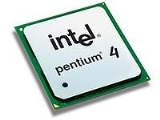
Pentium 4 was a line of single-core desktop
and laptop
central processing unit
s (CPUs), introduced by Intel on November 20, 2000 and shipped through August 8, 2008. They had a 7th-generation x86 microarchitecture, called NetBurst, which was the company's first all-new design since the introduction of the P6 microarchitecture
of the Pentium Pro
CPUs in 1995. NetBurst differed from P6 (Pentium III
, II
, etc.) by featuring a very deep instruction pipeline
to achieve very high clock speeds (up to 3.8 GHz) limited only by TDP
s reaching up to 115 W
in 3.4 GHz –3.8 GHz Prescott and Prescott 2M cores. In 2004, the initial 32-bit x86 instruction set
of the Pentium 4 microprocessor
s was extended by the 64-bit x86-64
set. The performance difference between a Pentium III at 1.13 GHz and a Pentium 4 at 1.3 GHz would have been hardly noticeable. So the Pentium 4 clock frequency needed to be approximately 1.15 higher than a Pentium 3 to achieve the same performance.
The first Pentium 4 cores, codenamed Willamette, were clocked from 1.3 GHz to 2 GHz. They were released on November 20, 2000, using the Socket 423
system. Notable with the introduction of the Pentium 4 was the 400 MT/s FSB
. It actually operated at 100 MHz but the FSB was quad-pumped, meaning that the maximum transfer rate was four times the base clock of the bus, so it was marketed to run at 400 MHz. The AMD Athlon's double-pumped FSB was running at 200 MT/s or 266 MT/s at that time.
Pentium 4 CPUs introduced the SSE2
and, in the Prescott-based Pentium 4s, SSE3
instruction set
s to accelerate calculations, transactions, media processing, 3D graphics, and games. Later versions featured Hyper-Threading Technology
(HTT), a feature to make one physical CPU work as two logical CPUs. Intel also marketed a version of their low-end Celeron
processors based on the NetBurst microarchitecture (often referred to as Celeron 4), and a high-end derivative, Xeon
, intended for multiprocessor
server
s and workstation
s. In 2005, the Pentium 4 was complemented by the Pentium D
and Pentium Extreme Edition dual-core CPUs.
with many branching or x87
floating-point
instructions, the Pentium 4 would merely match or even fall behind its predecessor. Its main handicap was a shared unidirectional bus. Furthermore, the NetBurst microarchitecture consumed more power and emitted more heat than any previous Intel or AMD microarchitectures.
As a result, the Pentium 4's introduction was met with mixed reviews: Developers disliked the Pentium 4, as it posed a new set of code optimization
rules. For example, in mathematical applications AMD's lower-clocked Athlon
(the fastest-clocked model was clocked at 1.2 GHz at the time) easily outperformed the Pentium 4, which would only catch up if software were re-compiled with SSE2
support. Tom Yager of Infoworld magazine called it "the fastest CPU - for programs that fit entirely in cache". Computer-savvy buyers avoided Pentium 4 PCs due to their price-premium and questionable benefit. In terms of product marketing, the Pentium 4's singular emphasis on clock frequency (above all else) made it a marketer's dream. The result of this was that the NetBurst microarchitecture was often referred to as a marchitecture
by various computing websites and publications during the life of the Pentium 4.
The two classical metrics of CPU performance are IPC (instructions per cycle) and clock speed. While IPC is difficult to quantify (due to dependence on the benchmark
application's instruction mix), clock speed is a simple measurement yielding a single absolute number. Unsophisticated buyers would simply consider the processor with the highest clock speed to be the best product, and the Pentium 4 was the undisputed megahertz champion. As AMD was unable to compete by these rules, it countered Intel's marketing advantage with the "megahertz myth
" campaign. AMD product marketing used a "PR-rating" system, which assigned a merit value based on relative performance to a baseline machine.
 At the launch of the Pentium 4, Intel stated NetBurst-based processors were expected to scale to 10 GHz (which should be achieved over several fabrication process
generations). However, the NetBurst microarchitecture ultimately hit a frequency ceiling far below that expectation – the fastest clocked NetBurst-based models reached a peak clock speed of 3.8 GHz. Intel had not anticipated a rapid upward scaling of transistor power leakage that began to occur as the die reached the 90 nm lithography and smaller. This new power leakage phenomenon, along with the standard thermal output, created cooling and clock scaling problems as clock speeds increased. Reacting to these unexpected obstacles, Intel attempted several core redesigns ("Prescott" most notably) and explored new manufacturing technologies, such as using multiple cores, increasing FSB speeds, increasing the cache size, and using a longer instruction pipeline along with higher clock speeds. Nothing solved their problems though and in 2003–05 Intel shifted development away from NetBurst to focus on the cooler-running Pentium M microarchitecture. On January 5, 2006, Intel launched the Core processors, which put greater emphasis on energy efficiency and performance per clock. The final NetBurst-derived products were released in 2007, with all subsequent product families switching exclusively to the Core microarchitecture.
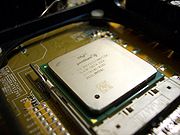
was sometimes used by people worried about damaging the core. Overclockers sometimes removed the IHS on Socket 423 and Socket 478 chips to allow for more direct heat transfer. However, on processors using the Socket LGA 775 (Socket T) interface, the IHS is directly soldered to the die(s), meaning that the IHS cannot be easily removed.
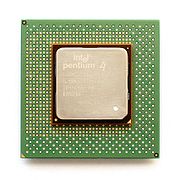
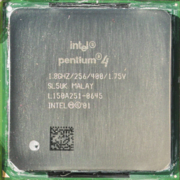 Willamette, the project codename for the first NetBurst microarchitecture implementation, experienced long delays in completion of its design process. The project was started in 1998, when Intel saw the Pentium II as their permanent line. At that time, the Willamette core was expected to operate at frequencies of around 1 GHz, maximum. However, Willamette's release delays saw the introduction of the Pentium III
prior to its completion. Due to the radical differences in the P6
and NetBurst microarchitectures, Intel could not market Willamette as a Pentium III, so it was marketed as Pentium 4.
On November 20, 2000, Intel released the Willamette-based Pentium 4 clocked at 1.4 and 1.5 GHz. Most industry experts regarded the initial release as a stopgap product, introduced before it was truly ready. According to these experts, the Pentium 4 was released because the competing Thunderbird-based AMD Athlon was outperforming the aging Pentium III, and further improvements to the Pentium III were not yet possible. This Pentium 4 was produced using a 180 nm process and initially used Socket 423
(a.k.a. socket W, for "Willamette"), with later revisions moving to Socket 478
(socket N, for "Northwood"). These variants were identified by the Intel product codes 80528 and 80531 respectively.
On the test bench, the Willamette was somewhat disappointing to analysts in that not only was it unable to outperform the Athlon and the highest-clocked Pentium IIIs in all testing situations, but it was not superior to the budget segment's AMD Duron. Although introduced at prices of $644 (1.4 GHz) and $819 (1.5 GHz) for 1000 quantities to OEM PC manufacturers (prices for models for the consumer market varied by retailer), it sold at a modest but respectable rate, handicapped somewhat by the requirement for relatively fast yet expensive Rambus
Dynamic RAM (RDRAM
). The Pentium III remained Intel's top selling processor line, with the Athlon also selling slightly better than the Pentium 4. While Intel bundled two RDRAM modules with each boxed Pentium 4, it did not facilitate Pentium 4 sales and was not considered a true solution by Anand Lal Shimpi of AnandTech, who stated in his review that the Pentium 4 needed a chipset that used a memory controller that could support DDR SDRAM.
In January 2001, a still slower 1.3 GHz model was added to the range, but over the next twelve months, Intel gradually started reducing AMD's leadership in performance. In April 2001 a 1.7 GHz Pentium 4 was launched, the first model to provide performance clearly superior to the old Pentium III. July saw 1.6 and 1.8 GHz models and in August 2001, Intel released 1.9 and 2 GHz Pentium 4s. In the same month, they released the 845 chipset that supported much cheaper PC133
SDRAM
instead of RDRAM. While SDRAM was much slower than RDRAM and severely hampered the bandwidth-hungry Pentium 4, the fact that it was so much cheaper caused the Pentium 4's sales to grow considerably. The new chipset allowed the Pentium 4 to replace the Pentium III virtually overnight, becoming the top-selling mainstream processor on the market.
The Willamette code name is derived from the Willamette Valley
region of Oregon
, where a large number of Intel's manufacturing facilities are located.
which provided double the bandwidth of PC133 SDRAM, and alleviated the associated high costs of using Rambus RDRAM for maximal performance with Pentium 4.
A 2.4 GHz Pentium 4 was released on April 2, 2002, and the bus speed increased from 400 MT/s to 533 MT/s (133 MHz physical clock) for the 2.26 GHz, 2.4 GHz, and 2.53 GHz models in May, 2.66 GHz and 2.8 GHz models in August, and 3.06 GHz model in November. With Northwood, the Pentium 4 came of age. The battle for performance leadership remained competitive (as AMD introduced faster versions of the Athlon XP) but most observers agreed that the fastest-clocked Northwood-based Pentium 4 was usually ahead of its rival. This was particularly so in the summer of 2002, when AMD's changeover to its 130 nm production process did not help the initial "Thoroughbred A" revision Athlon XP CPUs to clock high enough to overcome the advantages of Northwood in the 2.4 to 2.8 GHz range.
The 3.06 GHz Pentium 4 enabled Hyper-Threading
Technology that was first supported in Foster-based Xeons. This began the convention of virtual processors (or virtual cores) under x86 by enabling multiple threads to be run at the same time on the same physical processor. By shuffling two (ideally differing) program instructions to simultaneously execute through a single physical processor core, the goal is to best utilize processor resources that would have otherwise been unused from the traditional approach of having these single instructions wait for each other to execute singularly through the core. This initial 3.06 GHz 533FSB Pentium 4 Hyper-Threading enabled processor was not branded as such. That would be reserved for the 800FSB variant known as Pentium 4 HT.
On April 14, 2003, Intel officially launched the new Pentium 4 HT processor. This processor used a 800 MT/s FSB (200 MHz physical clock), was clocked at 3 GHz, and had Hyper-Threading Technology (which is what the HT moniker represents). This was meant to help the Pentium 4 better compete with AMD's Opteron
line of processors. However, when the Opteron was launched, due to its server-oriented positioning motherboard manufacturers did not initially build motherboards with AGP
as Opteron initially did not share a common socket with AMD's desktop processor line (Socket A). Because AGP was the primary graphics expansion port for desktop use, this oversight prevented the Opteron from encroaching from the server market and threaten the Pentium 4 desktop market. Meanwhile with the launch of the Athlon XP 3200+ in AMD's desktop line, AMD increased the Athlon XP's FSB speed from 333 MT/s to 400 MT/s, but it was not enough to hold off the new 3 GHz Pentium 4 HT. The Pentium 4 HT's increase to a 200 MHz quad-pumped bus (200x4=800Mhz effective) greatly helped to satisfy the bandwidth requirements the Netburst architecture desired for reaching optimal performance. While the Athlon XP architecture was less dependent on bandwidth, the bandwidth numbers reached by Intel were well out of range for the Athlon's EV6 bus. EV6 could have only been able to hypothetically achieve the same bandwidth numbers at speeds unreachable at the time. Intel's higher bandwidth proved useful in benchmarks for streaming operations, and Intel marketing wisely capitalized on this as a tangible improvement over AMD's desktop processors. Northwood 2.4 GHz, 2.6 GHz and 2.8 GHz variants were released on May 21, 2003. A 3.2 GHz variant was launched on June 23, 2003 and the final 3.4 GHz version arrived on February 2, 2004.
Overclocking early stepping Northwood cores yielded a startling phenomenon. While core voltage
increases past 1.7 V would often allow substantial additional gains in overclocking headroom, the processor would slowly become more unstable over time with a degradation in maximum stable clock speed before dying and becoming totally unusable. This became known as Sudden Northwood Death Syndrome (SNDS), which is caused by electromigration
.
and Deeper Sleep technologies. Intel's naming conventions made it difficult at the time of the processor's release to identify the processor model. There was the Pentium III
mobile chip, the Mobile Pentium 4-M, the Mobile Pentium 4, and then just the Pentium M
which itself was based on the Pentium III and significantly faster than the former three. Its TDP
is about 35 watts in most applications. This lowered power consumption was due to lowered core voltage, and other features mentioned previously.
Unlike the desktop Pentium 4, the Pentium 4-M did not feature an integrated heat spreader (IHS), since it operates at a lower voltage. The lower voltage means lower power consumption, and in turn less heat. However, according to Intel specifications, the Pentium 4-M had a maximum thermal junction temperature
rating of 100 degrees C, approximately 40 degrees higher than the desktop Pentium 4.
and Athlon 64 FX. The design was mostly identical to Pentium 4 (to the extent that it would run in the same motherboards), but differed by an added 2 MB of level 3 cache. It shared the same Gallatin core as the Xeon MP, though in a Socket 478 form factor (as opposed to Socket 603 for the Xeon MP) and with an 800 MT/s bus, twice as fast as that of the Xeon MP.
While Intel maintained that the Extreme Edition was aimed at gamers, critics viewed it as an attempt to steal the Athlon 64's launch thunder, nicknaming it the "Emergency Edition". With a price tag of $999, it was also referred to as the "Expensive Edition" or "Extremely Expensive".
The added cache generally resulted in a noticeable performance increase in most processor intensive applications. Multimedia encoding and certain games benefited the most, with the Extreme Edition outperforming the Pentium 4, and even the two Athlon 64 variants, although the lower price and more balanced performance of the Athlon 64 (particularly the non-FX version) led to it usually being seen as the better value proposition. Nonetheless, the Extreme Edition did achieve Intel's apparent aim, which was to prevent the Athlon 64 winning every single major benchmark over the existing Pentium 4s, which it would otherwise have done.
In January 2004 a 3.4 GHz version was released for Socket 478, and in Summer 2004 the CPU was released using the new Socket 775. A slight performance increase was achieved in late 2004 by increasing the bus speed from 800 MT/s to 1066 MT/s, resulting in a 3.46 GHz Pentium 4 Extreme Edition. By most metrics, this was on a per-clock basis the fastest single-core NetBurst processor that was ever produced, even outperforming many of its successor chips (not counting the dual-core Pentium D). Afterwards, the Pentium 4 Extreme Edition was migrated to the Prescott core. The new 3.73 GHz Extreme Edition had the same features as a 6x0-sequence Prescott 2M, but with a 1066 MT/s bus. In practice however, the 3.73 GHz Pentium 4 Extreme Edition almost always proved to be slower than the 3.46 GHz Pentium 4 Extreme Edition, which is most likely due to the lack of an L3 cache and the longer instruction pipeline. The only advantage the 3.73 GHz Pentium 4 Extreme Edition had over the 3.46 GHz Pentium 4 Extreme Edition was the ability to run 64-bit applications since all Gallatin-based Pentium 4 Extreme Edition processors lacked the Intel 64 instruction set.
Although never a particularly good seller, especially since it was released in a time when AMD were asserting near total dominance in the processor performance race, the Pentium 4 Extreme Edition established a new position within Intel's product line, that of an enthusiast oriented chip with the highest-end specifications offered by Intel chips, along with unlocked multipliers to allow for easier overclocking. In this role it has since been succeeded by the Pentium Extreme Edition (The Extreme version of the dual-core Pentium D
), the Core 2 Extreme, and most recently, the Core i7.
On February 1, 2004, Intel introduced a new core codenamed "Prescott". The core used the 90 nm
process for the first time, which one analyst described as "a major reworking of the Pentium 4's microarchitecture—major enough that I am surprised Intel did not opt to call this processor the Pentium 5." Despite this overhaul, the performance gains were inconsistent. Some programs benefited from Prescott's doubled cache and SSE3 instructions, whereas others were harmed by its longer pipeline. The Prescott's microarchitecture allowed slightly higher clock speeds, but not nearly as high as Intel had anticipated. The fastest mass-produced Prescott-based Pentium 4s were clocked at 3.8 GHz. While Northwood ultimately achieved clock speeds 70% higher than Willamette, Prescott ultimately scaled just 12% beyond Northwood, which was attributed to the high power consumption and heat output of the processor. In actual fact Prescott's power and heat characteristics were only slightly higher than those of Northwood of the same speed and nearly-equal to the Gallatin-based Extreme Editions, but since those processors had already been operating near the limits of what was considered thermally acceptable, this still posed a major issue.
The "Prescott" Pentium 4 contains 125 million transistors and has a die area of 122 mm2. It was fabricated in a 90 nm process with seven levels of copper interconnect. The process has features such as strained silicon
transistors and Low-K
carbon-doped silicon oxide (CDO) dielectric
, which is also known as organosilicate glass (OSG). The Prescott was first fabricated at the D1C development fab and was later moved to F11X production fab.
Originally, Intel released two Prescott lines: the E-series, with an 800 MT/s FSB and Hyper-Threading
support, and the low-end A-series, with a 533 MT/s FSB and Hyper-Threading disabled. Intel eventually added XD Bit (eXecute Disable) and Intel 64 functionality to Prescott.
LGA 775 Prescott uses a rating system, labeling them as the 5xx series (Celeron Ds are the 3xx series, while Pentium Ms are the 7xx series). The LGA 775 version of the E-series uses model numbers 5x0 (520-560), and the LGA 775 version of the A-series uses model numbers 5x5 and 5x9 (505-519). The fastest, the 570J and 571, is clocked at 3.8 GHz. Plans to mass-produce a 4 GHz Pentium 4 were cancelled by Intel in favor of dual core processors, although some European retailers claimed to be selling a Pentium 4 580, clocked at 4 GHz.
The 5x0J series (and its low-end equivalent, the 5x5J and 5x9J series) introduced the XD Bit (eXecute Disable) or Execute Disabled Bit http://www.intel.com/business/bss/infrastructure/security/xdbit.htm to Intel's line of processors. This technology, introduced to the x86 line by AMD and called NX (No eXecute)
, can help prevent certain types of malicious code from exploiting a buffer overflow
to get executed. Intel also released a series of Prescott supporting Intel 64, Intel's implementation of the AMD-developed x86-64
64-bit extensions to the x86 architecture. These were originally released as the F-series, and only sold to OEMs, but they were later renamed to the 5x1 series and sold to the general public. Two low-end Intel64-enabled Prescotts, based on the 5x5/5x9 series, were also released with model numbers 506 and 516. 5x0, 5x0J, and 5x1 series Prescott incorporates Hyper-Threading
in order to speed up some processes that use multithreaded software, such as video editing. The 5x1 series also supports 64 bit computing.
derivative, "Irwindale". It features Intel 64, the XD Bit, EIST
(Enhanced Intel SpeedStep Technology), Tm2
(for processors at 3.6 GHz and above), and 2 MB of L2 cache. However, higher cache latency and the double word size, if using Intel 64 mode, negated any advantage that added cache introduced. Rather than being a targeted speed boost the double size cache was intended to provide the same space and hence performance for 64-bit mode operations.
6xx series Prescott 2Ms have incorporated Hyper-Threading
in order to speed up some processes that use multithreaded software, such as video editing.
On November 14, 2005, Intel released Prescott 2M processors with VT (Virtualization Technology, codenamed "Vanderpool") enabled. Intel only released two models of this Prescott 2M category: 662 and 672, running at 3.6 GHz and 3.8 GHz, respectively.
of 86 W. The Core Stepping of D0 in late 2006 reduced this to 65 watts. It has a 65 nm core and features a 31-stage pipeline (just like Prescott), 800 MT/s FSB, Intel 64, Hyper-Threading
and Virtualization Technology. As with Prescott 2M, Cedar Mill also has a 2 MB L2 cache. It was released as Pentium 6x1 and 6x3 (product code 80552) at frequencies from 3 GHz up to 3.6 GHz. Overclockers managed to exceed 8 GHz with these processors using liquid Nitrogen cooling.
To distinguish Cedar Mill cores from Prescott cores with the same features, Intel added 1 to their model numbers. Thus, Pentium 4 631, 641, 651 and 661 are 65 nm microprocessors, while Pentium 630, 640, 650 and 660 respectively are their 90 nm equivalents.
The name "Cedar Mill" refers to Cedar Mill, Oregon
, a neighborhood near Intel's Hillsboro, Oregon
facilities.
, which was scheduled for an early-mid-2005 release. However, it was cancelled a few months after the release of Prescott due to extremely high TDPs (a 2.8 GHz Tejas emitted 150 W of heat, compared to around 80 W for a Northwood of the same speed, and 100 W for a comparably clocked Prescott) and development on the NetBurst microarchitecture as a whole ceased, with the exception of the dual-core Pentium D and Pentium Extreme Edition and the Cedar Mill-based Pentium 4 HT.
Since May 2005, Intel has released dual-core processors based on the Pentium 4 under the names Pentium D
and Pentium Extreme Edition. They represent Intel's shift towards parallelism and their intent was to eventually make the bulk of their main processor line multiple-core. These came under the code names Smithfield and Presler for the 90 nm and 65 nm parts respectively.
The ultimate successors to Pentium 4 are the Intel Core 2
processors using the "Conroe
" core based upon the Core microarchitecture, released on July 27, 2006. Intel Core 2 processors have been released as single, dual and quad core processors. Single core counterparts are present in the Intel Core 2 line, primarily for the OEM market, while dual and quad core processors can be sold to retail and OEM.
Desktop computer
A desktop computer is a personal computer in a form intended for regular use at a single location, as opposed to a mobile laptop or portable computer. Early desktop computers are designed to lay flat on the desk, while modern towers stand upright...
and laptop
Laptop
A laptop, also called a notebook, is a personal computer for mobile use. A laptop integrates most of the typical components of a desktop computer, including a display, a keyboard, a pointing device and speakers into a single unit...
central processing unit
Central processing unit
The central processing unit is the portion of a computer system that carries out the instructions of a computer program, to perform the basic arithmetical, logical, and input/output operations of the system. The CPU plays a role somewhat analogous to the brain in the computer. The term has been in...
s (CPUs), introduced by Intel on November 20, 2000 and shipped through August 8, 2008. They had a 7th-generation x86 microarchitecture, called NetBurst, which was the company's first all-new design since the introduction of the P6 microarchitecture
P6 (microarchitecture)
The P6 microarchitecture is the sixth generation Intel x86 microarchitecture, implemented by the Pentium Pro microprocessor that was introduced in November 1995. It is sometimes referred to as i686. It was succeeded by the NetBurst microarchitecture in 2000, but eventually revived in the Pentium M...
of the Pentium Pro
Pentium Pro
The Pentium Pro is a sixth-generation x86 microprocessor developed and manufactured by Intel introduced in November 1, 1995 . It introduced the P6 microarchitecture and was originally intended to replace the original Pentium in a full range of applications...
CPUs in 1995. NetBurst differed from P6 (Pentium III
Pentium III
The Pentium III brand refers to Intel's 32-bit x86 desktop and mobile microprocessors based on the sixth-generation P6 microarchitecture introduced on February 26, 1999. The brand's initial processors were very similar to the earlier Pentium II-branded microprocessors...
, II
Pentium II
The Pentium II brand refers to Intel's sixth-generation microarchitecture and x86-compatible microprocessors introduced on May 7, 1997. Containing 7.5 million transistors, the Pentium II featured an improved version of the first P6-generation core of the Pentium Pro, which contained 5.5 million...
, etc.) by featuring a very deep instruction pipeline
Instruction pipeline
An instruction pipeline is a technique used in the design of computers and other digital electronic devices to increase their instruction throughput ....
to achieve very high clock speeds (up to 3.8 GHz) limited only by TDP
Thermal Design Power
The thermal design power , sometimes called thermal design point, refers to the maximum amount of power the cooling system in a computer is required to dissipate. For example, a laptop's CPU cooling system may be designed for a 20 watt TDP, which means that it can dissipate up to 20 watts of heat...
s reaching up to 115 W
Watt
The watt is a derived unit of power in the International System of Units , named after the Scottish engineer James Watt . The unit, defined as one joule per second, measures the rate of energy conversion.-Definition:...
in 3.4 GHz –3.8 GHz Prescott and Prescott 2M cores. In 2004, the initial 32-bit x86 instruction set
Instruction set
An instruction set, or instruction set architecture , is the part of the computer architecture related to programming, including the native data types, instructions, registers, addressing modes, memory architecture, interrupt and exception handling, and external I/O...
of the Pentium 4 microprocessor
Microprocessor
A microprocessor incorporates the functions of a computer's central processing unit on a single integrated circuit, or at most a few integrated circuits. It is a multipurpose, programmable device that accepts digital data as input, processes it according to instructions stored in its memory, and...
s was extended by the 64-bit x86-64
X86-64
x86-64 is an extension of the x86 instruction set. It supports vastly larger virtual and physical address spaces than are possible on x86, thereby allowing programmers to conveniently work with much larger data sets. x86-64 also provides 64-bit general purpose registers and numerous other...
set. The performance difference between a Pentium III at 1.13 GHz and a Pentium 4 at 1.3 GHz would have been hardly noticeable. So the Pentium 4 clock frequency needed to be approximately 1.15 higher than a Pentium 3 to achieve the same performance.
The first Pentium 4 cores, codenamed Willamette, were clocked from 1.3 GHz to 2 GHz. They were released on November 20, 2000, using the Socket 423
Socket 423
Socket 423 is a 423 pin CPU socket used for the first generation of Pentium 4 processors, based on the Willamette core.-Technical specifications:This socket houses any processor designed in the Socket 423 package....
system. Notable with the introduction of the Pentium 4 was the 400 MT/s FSB
Front side bus
A front-side bus is a computer communication interface often used in computers during the 1990s and 2000s.It typically carries data between the central processing unit and a memory controller hub, known as the northbridge....
. It actually operated at 100 MHz but the FSB was quad-pumped, meaning that the maximum transfer rate was four times the base clock of the bus, so it was marketed to run at 400 MHz. The AMD Athlon's double-pumped FSB was running at 200 MT/s or 266 MT/s at that time.
Pentium 4 CPUs introduced the SSE2
SSE2
SSE2, Streaming SIMD Extensions 2, is one of the Intel SIMD processor supplementary instruction sets first introduced by Intel with the initial version of the Pentium 4 in 2001. It extends the earlier SSE instruction set, and is intended to fully supplant MMX. Intel extended SSE2 to create SSE3...
and, in the Prescott-based Pentium 4s, SSE3
SSE3
SSE3, Streaming SIMD Extensions 3, also known by its Intel code name Prescott New Instructions , is the third iteration of the SSE instruction set for the IA-32 architecture. Intel introduced SSE3 in early 2004 with the Prescott revision of their Pentium 4 CPU...
instruction set
Instruction set
An instruction set, or instruction set architecture , is the part of the computer architecture related to programming, including the native data types, instructions, registers, addressing modes, memory architecture, interrupt and exception handling, and external I/O...
s to accelerate calculations, transactions, media processing, 3D graphics, and games. Later versions featured Hyper-Threading Technology
Hyper-threading
Hyper-threading is Intel's term for its simultaneous multithreading implementation in its Atom, Intel Core i3/i5/i7, Itanium, Pentium 4 and Xeon CPUs....
(HTT), a feature to make one physical CPU work as two logical CPUs. Intel also marketed a version of their low-end Celeron
Celeron
Celeron is a brand name given by Intel Corp. to a number of different x86 computer microprocessor models targeted at budget personal computers....
processors based on the NetBurst microarchitecture (often referred to as Celeron 4), and a high-end derivative, Xeon
Xeon
The Xeon is a brand of multiprocessing- or multi-socket-capable x86 microprocessors from Intel Corporation targeted at the non-consumer server, workstation and embedded system markets.-Overview:...
, intended for multiprocessor
Multiprocessor
Computer system having two or more processing units each sharing main memory and peripherals, in order to simultaneously process programs.Sometimes the term Multiprocessor is confused with the term Multiprocessing....
server
Server (computing)
In the context of client-server architecture, a server is a computer program running to serve the requests of other programs, the "clients". Thus, the "server" performs some computational task on behalf of "clients"...
s and workstation
Workstation
A workstation is a high-end microcomputer designed for technical or scientific applications. Intended primarily to be used by one person at a time, they are commonly connected to a local area network and run multi-user operating systems...
s. In 2005, the Pentium 4 was complemented by the Pentium D
Pentium D
The Pentium D brand refers to two series of desktop dual-core 64-bit x86-64 microprocessors with the NetBurst microarchitecture manufactured by Intel. Each CPU comprised two dies, each containing a single core, residing next to each other on a multi-chip module package. The brand's first processor,...
and Pentium Extreme Edition dual-core CPUs.
Microarchitecture
In benchmark evaluations, the advantages of the NetBurst microarchitecture were not clear. With carefully optimized application code, the first Pentium 4s did outperform Intel's fastest Pentium III (clocked at 1.13 GHz at the time), as expected. But in legacy applicationsLegacy system
A legacy system is an old method, technology, computer system, or application program that continues to be used, typically because it still functions for the users' needs, even though newer technology or more efficient methods of performing a task are now available...
with many branching or x87
X87
x87 is a floating point-related subset of the x86 architecture instruction set. It originated as an extension of the 8086 instruction set in the form of optional floating point coprocessors that worked in tandem with corresponding x86 CPUs. These microchips had names ending in "87"...
floating-point
Floating point
In computing, floating point describes a method of representing real numbers in a way that can support a wide range of values. Numbers are, in general, represented approximately to a fixed number of significant digits and scaled using an exponent. The base for the scaling is normally 2, 10 or 16...
instructions, the Pentium 4 would merely match or even fall behind its predecessor. Its main handicap was a shared unidirectional bus. Furthermore, the NetBurst microarchitecture consumed more power and emitted more heat than any previous Intel or AMD microarchitectures.
As a result, the Pentium 4's introduction was met with mixed reviews: Developers disliked the Pentium 4, as it posed a new set of code optimization
Optimization (computer science)
In computer science, program optimization or software optimization is the process of modifying a software system to make some aspect of it work more efficiently or use fewer resources...
rules. For example, in mathematical applications AMD's lower-clocked Athlon
Athlon
Athlon is the brand name applied to a series of x86-compatible microprocessors designed and manufactured by Advanced Micro Devices . The original Athlon was the first seventh-generation x86 processor and, in a first, retained the initial performance lead it had over Intel's competing processors...
(the fastest-clocked model was clocked at 1.2 GHz at the time) easily outperformed the Pentium 4, which would only catch up if software were re-compiled with SSE2
SSE2
SSE2, Streaming SIMD Extensions 2, is one of the Intel SIMD processor supplementary instruction sets first introduced by Intel with the initial version of the Pentium 4 in 2001. It extends the earlier SSE instruction set, and is intended to fully supplant MMX. Intel extended SSE2 to create SSE3...
support. Tom Yager of Infoworld magazine called it "the fastest CPU - for programs that fit entirely in cache". Computer-savvy buyers avoided Pentium 4 PCs due to their price-premium and questionable benefit. In terms of product marketing, the Pentium 4's singular emphasis on clock frequency (above all else) made it a marketer's dream. The result of this was that the NetBurst microarchitecture was often referred to as a marchitecture
Marchitecture
Marchitecture is a portmanteau of the words marketing and architecture. The term is applied to any form of electronic architecture perceived to have been produced purely for marketing reasons...
by various computing websites and publications during the life of the Pentium 4.
The two classical metrics of CPU performance are IPC (instructions per cycle) and clock speed. While IPC is difficult to quantify (due to dependence on the benchmark
Benchmark (computing)
In computing, a benchmark is the act of running a computer program, a set of programs, or other operations, in order to assess the relative performance of an object, normally by running a number of standard tests and trials against it...
application's instruction mix), clock speed is a simple measurement yielding a single absolute number. Unsophisticated buyers would simply consider the processor with the highest clock speed to be the best product, and the Pentium 4 was the undisputed megahertz champion. As AMD was unable to compete by these rules, it countered Intel's marketing advantage with the "megahertz myth
Megahertz Myth
The megahertz myth, or less commonly the gigahertz myth, refers to the misconception of only using clock rate to compare the performance of different microprocessors...
" campaign. AMD product marketing used a "PR-rating" system, which assigned a merit value based on relative performance to a baseline machine.
Semiconductor fabrication
Semiconductor device fabrication is the process used to create the integrated circuits that are present in everyday electrical and electronic devices. It is a multiple-step sequence of photolithographic and chemical processing steps during which electronic circuits are gradually created on a wafer...
generations). However, the NetBurst microarchitecture ultimately hit a frequency ceiling far below that expectation – the fastest clocked NetBurst-based models reached a peak clock speed of 3.8 GHz. Intel had not anticipated a rapid upward scaling of transistor power leakage that began to occur as the die reached the 90 nm lithography and smaller. This new power leakage phenomenon, along with the standard thermal output, created cooling and clock scaling problems as clock speeds increased. Reacting to these unexpected obstacles, Intel attempted several core redesigns ("Prescott" most notably) and explored new manufacturing technologies, such as using multiple cores, increasing FSB speeds, increasing the cache size, and using a longer instruction pipeline along with higher clock speeds. Nothing solved their problems though and in 2003–05 Intel shifted development away from NetBurst to focus on the cooler-running Pentium M microarchitecture. On January 5, 2006, Intel launched the Core processors, which put greater emphasis on energy efficiency and performance per clock. The final NetBurst-derived products were released in 2007, with all subsequent product families switching exclusively to the Core microarchitecture.
Processor cores
The Pentium 4 has an integrated heat spreader (IHS) that prevents the die from accidentally getting damaged when mounting and unmounting cooling solutions. Prior to the IHS, a CPU shimCPU shim
A CPU shim is a shim used between the CPU and the heat sink in a computer. Shims make it easier and less risky to mount a heatsink on the processor because it stabilizes the heatsink, preventing accidental damaging of the fragile CPU packaging...
was sometimes used by people worried about damaging the core. Overclockers sometimes removed the IHS on Socket 423 and Socket 478 chips to allow for more direct heat transfer. However, on processors using the Socket LGA 775 (Socket T) interface, the IHS is directly soldered to the die(s), meaning that the IHS cannot be easily removed.
| Intel Pentium 4 processor family | |||||||
|---|---|---|---|---|---|---|---|
| Desktop | Laptop | ||||||
| Code-named | Core | Date released | Code-named | Core | Date released | ||
| Willamette Northwood Prescott |
180 nm 130 nm 90 nm |
Nov 2000 Jan 2002 Mar 2004 |
Northwood | 130 nm | Jun 2003 | ||
| Northwood Pentium 4-M |
130 nm | Apr 2002 | |||||
| Hyper-threading Hyper-threading Hyper-threading is Intel's term for its simultaneous multithreading implementation in its Atom, Intel Core i3/i5/i7, Itanium, Pentium 4 and Xeon CPUs.... (HT) |
|||||||
| Northwood Prescott Prescott 2M Cedar Mill |
130 nm 90 nm 90 nm 65 nm |
May 2003 Feb 2004 Feb 2005 Jan 2006 |
Northwood Prescott |
130 nm 90 nm |
Sep 2003 Jun 2004 |
||
| Gallatin XE Prescott 2M XE |
130 nm 90 nm |
Sep 2003 Feb 2005 |
|||||
| List of Intel Pentium 4 microprocessors | |||||||
Willamette
Pentium III
The Pentium III brand refers to Intel's 32-bit x86 desktop and mobile microprocessors based on the sixth-generation P6 microarchitecture introduced on February 26, 1999. The brand's initial processors were very similar to the earlier Pentium II-branded microprocessors...
prior to its completion. Due to the radical differences in the P6
P6 (microarchitecture)
The P6 microarchitecture is the sixth generation Intel x86 microarchitecture, implemented by the Pentium Pro microprocessor that was introduced in November 1995. It is sometimes referred to as i686. It was succeeded by the NetBurst microarchitecture in 2000, but eventually revived in the Pentium M...
and NetBurst microarchitectures, Intel could not market Willamette as a Pentium III, so it was marketed as Pentium 4.
On November 20, 2000, Intel released the Willamette-based Pentium 4 clocked at 1.4 and 1.5 GHz. Most industry experts regarded the initial release as a stopgap product, introduced before it was truly ready. According to these experts, the Pentium 4 was released because the competing Thunderbird-based AMD Athlon was outperforming the aging Pentium III, and further improvements to the Pentium III were not yet possible. This Pentium 4 was produced using a 180 nm process and initially used Socket 423
Socket 423
Socket 423 is a 423 pin CPU socket used for the first generation of Pentium 4 processors, based on the Willamette core.-Technical specifications:This socket houses any processor designed in the Socket 423 package....
(a.k.a. socket W, for "Willamette"), with later revisions moving to Socket 478
Socket 478
Socket 478 is a 478-contact CPU socket used for Intel's Pentium 4 and Celeron series CPUs.Socket 478 was launched with the Northwood core to compete with AMD's 462-pin Socket A and their Athlon XP processors. Socket 478 was intended to be the replacement for Socket 423, a Willamette-based...
(socket N, for "Northwood"). These variants were identified by the Intel product codes 80528 and 80531 respectively.
On the test bench, the Willamette was somewhat disappointing to analysts in that not only was it unable to outperform the Athlon and the highest-clocked Pentium IIIs in all testing situations, but it was not superior to the budget segment's AMD Duron. Although introduced at prices of $644 (1.4 GHz) and $819 (1.5 GHz) for 1000 quantities to OEM PC manufacturers (prices for models for the consumer market varied by retailer), it sold at a modest but respectable rate, handicapped somewhat by the requirement for relatively fast yet expensive Rambus
Rambus
Rambus Incorporated , founded in 1990, is a technology licensing company. The company became well known for its intellectual property based litigation following the introduction of DDR-SDRAM memory.- History :...
Dynamic RAM (RDRAM
RDRAM
Direct Rambus DRAM or DRDRAM is a type of synchronous dynamic RAM. RDRAM was developed by Rambus inc., in the mid-1990s as a replacement for then-prevalent DIMM SDRAM memory architecture....
). The Pentium III remained Intel's top selling processor line, with the Athlon also selling slightly better than the Pentium 4. While Intel bundled two RDRAM modules with each boxed Pentium 4, it did not facilitate Pentium 4 sales and was not considered a true solution by Anand Lal Shimpi of AnandTech, who stated in his review that the Pentium 4 needed a chipset that used a memory controller that could support DDR SDRAM.
In January 2001, a still slower 1.3 GHz model was added to the range, but over the next twelve months, Intel gradually started reducing AMD's leadership in performance. In April 2001 a 1.7 GHz Pentium 4 was launched, the first model to provide performance clearly superior to the old Pentium III. July saw 1.6 and 1.8 GHz models and in August 2001, Intel released 1.9 and 2 GHz Pentium 4s. In the same month, they released the 845 chipset that supported much cheaper PC133
PC133
PC133 is a computer memory standard defined by the JEDEC. PC133 refers to Synchronous DRAM operating at a clock frequency of 133 MHz, on a 64-bit-wide bus, at a voltage of 3.3 V. PC133 is available in 168 pin DIMM and 144 pin SO-DIMM form factors...
SDRAM
SDRAM
Synchronous dynamic random access memory is dynamic random access memory that is synchronized with the system bus. Classic DRAM has an asynchronous interface, which means that it responds as quickly as possible to changes in control inputs...
instead of RDRAM. While SDRAM was much slower than RDRAM and severely hampered the bandwidth-hungry Pentium 4, the fact that it was so much cheaper caused the Pentium 4's sales to grow considerably. The new chipset allowed the Pentium 4 to replace the Pentium III virtually overnight, becoming the top-selling mainstream processor on the market.
The Willamette code name is derived from the Willamette Valley
Willamette Valley
The Willamette Valley is the most populated region in the state of Oregon of the United States. Located in the state's northwest, the region is surrounded by tall mountain ranges to the east, west and south and the valley's floor is broad, flat and fertile because of Ice Age conditions...
region of Oregon
Oregon
Oregon is a state in the Pacific Northwest region of the United States. It is located on the Pacific coast, with Washington to the north, California to the south, Nevada on the southeast and Idaho to the east. The Columbia and Snake rivers delineate much of Oregon's northern and eastern...
, where a large number of Intel's manufacturing facilities are located.
Northwood
In October 2001, the Athlon XP regained a clear lead for AMD. In January 2002 Intel released Pentium 4s with a new core code named "Northwood" at speeds of 1.6 GHz, 1.8 GHz, 2 GHz and 2.2 GHz. Northwood (product code 80532) combined an increase in the L2 cache size from 256 KB to 512 KB (increasing the transistor count from 42 million to 55 million) with a transition to a new 130 nm fabrication process. By making the processor out of smaller transistors, processors can run at higher clock speeds or at the same speed while producing less heat. In the same month boards utilizing the 845 chipset were released with enabled support for DDR SDRAMDDR SDRAM
Double data rate synchronous dynamic random access memory is a class of memory integrated circuits used in computers. DDR SDRAM has been superseded by DDR2 SDRAM and DDR3 SDRAM, neither of which are either forward or backward compatible with DDR SDRAM, meaning that DDR2 or DDR3 memory modules...
which provided double the bandwidth of PC133 SDRAM, and alleviated the associated high costs of using Rambus RDRAM for maximal performance with Pentium 4.
A 2.4 GHz Pentium 4 was released on April 2, 2002, and the bus speed increased from 400 MT/s to 533 MT/s (133 MHz physical clock) for the 2.26 GHz, 2.4 GHz, and 2.53 GHz models in May, 2.66 GHz and 2.8 GHz models in August, and 3.06 GHz model in November. With Northwood, the Pentium 4 came of age. The battle for performance leadership remained competitive (as AMD introduced faster versions of the Athlon XP) but most observers agreed that the fastest-clocked Northwood-based Pentium 4 was usually ahead of its rival. This was particularly so in the summer of 2002, when AMD's changeover to its 130 nm production process did not help the initial "Thoroughbred A" revision Athlon XP CPUs to clock high enough to overcome the advantages of Northwood in the 2.4 to 2.8 GHz range.
The 3.06 GHz Pentium 4 enabled Hyper-Threading
Hyper-threading
Hyper-threading is Intel's term for its simultaneous multithreading implementation in its Atom, Intel Core i3/i5/i7, Itanium, Pentium 4 and Xeon CPUs....
Technology that was first supported in Foster-based Xeons. This began the convention of virtual processors (or virtual cores) under x86 by enabling multiple threads to be run at the same time on the same physical processor. By shuffling two (ideally differing) program instructions to simultaneously execute through a single physical processor core, the goal is to best utilize processor resources that would have otherwise been unused from the traditional approach of having these single instructions wait for each other to execute singularly through the core. This initial 3.06 GHz 533FSB Pentium 4 Hyper-Threading enabled processor was not branded as such. That would be reserved for the 800FSB variant known as Pentium 4 HT.
On April 14, 2003, Intel officially launched the new Pentium 4 HT processor. This processor used a 800 MT/s FSB (200 MHz physical clock), was clocked at 3 GHz, and had Hyper-Threading Technology (which is what the HT moniker represents). This was meant to help the Pentium 4 better compete with AMD's Opteron
Opteron
Opteron is AMD's x86 server and workstation processor line, and was the first processor which supported the AMD64 instruction set architecture . It was released on April 22, 2003 with the SledgeHammer core and was intended to compete in the server and workstation markets, particularly in the same...
line of processors. However, when the Opteron was launched, due to its server-oriented positioning motherboard manufacturers did not initially build motherboards with AGP
Accelerated Graphics Port
The Accelerated Graphics Port is a high-speed point-to-point channel for attaching a video card to a computer's motherboard, primarily to assist in the acceleration of 3D computer graphics. Since 2004 AGP has been progressively phased out in favor of PCI Express...
as Opteron initially did not share a common socket with AMD's desktop processor line (Socket A). Because AGP was the primary graphics expansion port for desktop use, this oversight prevented the Opteron from encroaching from the server market and threaten the Pentium 4 desktop market. Meanwhile with the launch of the Athlon XP 3200+ in AMD's desktop line, AMD increased the Athlon XP's FSB speed from 333 MT/s to 400 MT/s, but it was not enough to hold off the new 3 GHz Pentium 4 HT. The Pentium 4 HT's increase to a 200 MHz quad-pumped bus (200x4=800Mhz effective) greatly helped to satisfy the bandwidth requirements the Netburst architecture desired for reaching optimal performance. While the Athlon XP architecture was less dependent on bandwidth, the bandwidth numbers reached by Intel were well out of range for the Athlon's EV6 bus. EV6 could have only been able to hypothetically achieve the same bandwidth numbers at speeds unreachable at the time. Intel's higher bandwidth proved useful in benchmarks for streaming operations, and Intel marketing wisely capitalized on this as a tangible improvement over AMD's desktop processors. Northwood 2.4 GHz, 2.6 GHz and 2.8 GHz variants were released on May 21, 2003. A 3.2 GHz variant was launched on June 23, 2003 and the final 3.4 GHz version arrived on February 2, 2004.
Overclocking early stepping Northwood cores yielded a startling phenomenon. While core voltage
Voltage
Voltage, otherwise known as electrical potential difference or electric tension is the difference in electric potential between two points — or the difference in electric potential energy per unit charge between two points...
increases past 1.7 V would often allow substantial additional gains in overclocking headroom, the processor would slowly become more unstable over time with a degradation in maximum stable clock speed before dying and becoming totally unusable. This became known as Sudden Northwood Death Syndrome (SNDS), which is caused by electromigration
Electromigration
Electromigration is the transport of material caused by the gradual movement of the ions in a conductor due to the momentum transfer between conducting electrons and diffusing metal atoms. The effect is important in applications where high direct current densities are used, such as in...
.
Pentium 4-M
Also based on the Northwood core, the Mobile Intel Pentium 4 Processor - M was released on April 23, 2002 and included Intel's SpeedStepSpeedStep
SpeedStep is a trademark for a series of dynamic frequency scaling technologies built into some Intel microprocessors that allow the clock speed of the processor to be dynamically changed by software...
and Deeper Sleep technologies. Intel's naming conventions made it difficult at the time of the processor's release to identify the processor model. There was the Pentium III
Pentium III
The Pentium III brand refers to Intel's 32-bit x86 desktop and mobile microprocessors based on the sixth-generation P6 microarchitecture introduced on February 26, 1999. The brand's initial processors were very similar to the earlier Pentium II-branded microprocessors...
mobile chip, the Mobile Pentium 4-M, the Mobile Pentium 4, and then just the Pentium M
Pentium M
The Pentium M brand refers to a family of mobile single-core x86 microprocessors introduced in March 2003 , and forming a part of the Intel Carmel notebook platform under the then new Centrino brand...
which itself was based on the Pentium III and significantly faster than the former three. Its TDP
TDP
- Archaeology :* Thames Discovery Programme, a community archaeology project, focussing on the tidal Thames.- Computing :* Thermal design power, a value describing the thermal limits of a computer system...
is about 35 watts in most applications. This lowered power consumption was due to lowered core voltage, and other features mentioned previously.
Unlike the desktop Pentium 4, the Pentium 4-M did not feature an integrated heat spreader (IHS), since it operates at a lower voltage. The lower voltage means lower power consumption, and in turn less heat. However, according to Intel specifications, the Pentium 4-M had a maximum thermal junction temperature
Junction temperature
Junction temperature is the highest temperature of the actual semiconductor in an electronic device. In operation it is higher than case temperature and the temperature of the part's exterior...
rating of 100 degrees C, approximately 40 degrees higher than the desktop Pentium 4.
Mobile Pentium 4
The Mobile Intel Pentium 4 Processor was released to address the problem of putting a full desktop Pentium 4 processor into a laptop, which some manufacturers were doing. The Mobile Pentium 4 used a 533 MT/s FSB, following the desktop Pentium 4's evolution. Oddly, increasing the bus speed by 133 MT/s (33 MHz) caused a massive increase in TDPs, as mobile Pentium 4 processors emitted 59.8 W - 70 W of heat, with the Hyper-Threading variants emitting 66.1 W - 88 W. This allowed the mobile Pentium 4 to bridge the gap between the desktop Pentium 4 (up to 115 W TDP), and the Pentium 4-M (up to 35 W TDP).Gallatin (Extreme Edition)
In September 2003, at the Intel Developer Forum, the Pentium 4 Extreme Edition (P4EE) was announced, just over a week before the launch of Athlon 64Athlon 64
The Athlon 64 is an eighth-generation, AMD64-architecture microprocessor produced by AMD, released on September 23, 2003. It is the third processor to bear the name Athlon, and the immediate successor to the Athlon XP...
and Athlon 64 FX. The design was mostly identical to Pentium 4 (to the extent that it would run in the same motherboards), but differed by an added 2 MB of level 3 cache. It shared the same Gallatin core as the Xeon MP, though in a Socket 478 form factor (as opposed to Socket 603 for the Xeon MP) and with an 800 MT/s bus, twice as fast as that of the Xeon MP.
While Intel maintained that the Extreme Edition was aimed at gamers, critics viewed it as an attempt to steal the Athlon 64's launch thunder, nicknaming it the "Emergency Edition". With a price tag of $999, it was also referred to as the "Expensive Edition" or "Extremely Expensive".
The added cache generally resulted in a noticeable performance increase in most processor intensive applications. Multimedia encoding and certain games benefited the most, with the Extreme Edition outperforming the Pentium 4, and even the two Athlon 64 variants, although the lower price and more balanced performance of the Athlon 64 (particularly the non-FX version) led to it usually being seen as the better value proposition. Nonetheless, the Extreme Edition did achieve Intel's apparent aim, which was to prevent the Athlon 64 winning every single major benchmark over the existing Pentium 4s, which it would otherwise have done.
In January 2004 a 3.4 GHz version was released for Socket 478, and in Summer 2004 the CPU was released using the new Socket 775. A slight performance increase was achieved in late 2004 by increasing the bus speed from 800 MT/s to 1066 MT/s, resulting in a 3.46 GHz Pentium 4 Extreme Edition. By most metrics, this was on a per-clock basis the fastest single-core NetBurst processor that was ever produced, even outperforming many of its successor chips (not counting the dual-core Pentium D). Afterwards, the Pentium 4 Extreme Edition was migrated to the Prescott core. The new 3.73 GHz Extreme Edition had the same features as a 6x0-sequence Prescott 2M, but with a 1066 MT/s bus. In practice however, the 3.73 GHz Pentium 4 Extreme Edition almost always proved to be slower than the 3.46 GHz Pentium 4 Extreme Edition, which is most likely due to the lack of an L3 cache and the longer instruction pipeline. The only advantage the 3.73 GHz Pentium 4 Extreme Edition had over the 3.46 GHz Pentium 4 Extreme Edition was the ability to run 64-bit applications since all Gallatin-based Pentium 4 Extreme Edition processors lacked the Intel 64 instruction set.
Although never a particularly good seller, especially since it was released in a time when AMD were asserting near total dominance in the processor performance race, the Pentium 4 Extreme Edition established a new position within Intel's product line, that of an enthusiast oriented chip with the highest-end specifications offered by Intel chips, along with unlocked multipliers to allow for easier overclocking. In this role it has since been succeeded by the Pentium Extreme Edition (The Extreme version of the dual-core Pentium D
Pentium D
The Pentium D brand refers to two series of desktop dual-core 64-bit x86-64 microprocessors with the NetBurst microarchitecture manufactured by Intel. Each CPU comprised two dies, each containing a single core, residing next to each other on a multi-chip module package. The brand's first processor,...
), the Core 2 Extreme, and most recently, the Core i7.
Prescott
 |
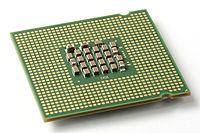 |
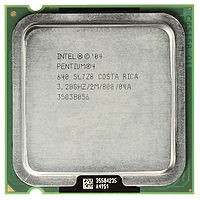
On February 1, 2004, Intel introduced a new core codenamed "Prescott". The core used the 90 nm
90 nanometer
The 90 nm process refers to the level of CMOS process technology that was reached in the 2002–2003 timeframe, by most leading semiconductor companies, like Intel, AMD, Infineon, Texas Instruments, IBM, and TSMC....
process for the first time, which one analyst described as "a major reworking of the Pentium 4's microarchitecture—major enough that I am surprised Intel did not opt to call this processor the Pentium 5." Despite this overhaul, the performance gains were inconsistent. Some programs benefited from Prescott's doubled cache and SSE3 instructions, whereas others were harmed by its longer pipeline. The Prescott's microarchitecture allowed slightly higher clock speeds, but not nearly as high as Intel had anticipated. The fastest mass-produced Prescott-based Pentium 4s were clocked at 3.8 GHz. While Northwood ultimately achieved clock speeds 70% higher than Willamette, Prescott ultimately scaled just 12% beyond Northwood, which was attributed to the high power consumption and heat output of the processor. In actual fact Prescott's power and heat characteristics were only slightly higher than those of Northwood of the same speed and nearly-equal to the Gallatin-based Extreme Editions, but since those processors had already been operating near the limits of what was considered thermally acceptable, this still posed a major issue.
The "Prescott" Pentium 4 contains 125 million transistors and has a die area of 122 mm2. It was fabricated in a 90 nm process with seven levels of copper interconnect. The process has features such as strained silicon
Strained silicon
Strained silicon is a layer of silicon in which the silicon atoms are stretched beyond their normal interatomic distance. This can be accomplished by putting the layer of silicon over a substrate of silicon germanium...
transistors and Low-K
Low-K
In semiconductor manufacturing, a low-κ dielectric is a material with a small dielectric constant relative to silicon dioxide. Although the proper symbol for the dielectric constant is the Greek letter κ , in conversation such materials are referred to as being "low-k" rather than "low-κ"...
carbon-doped silicon oxide (CDO) dielectric
Dielectric
A dielectric is an electrical insulator that can be polarized by an applied electric field. When a dielectric is placed in an electric field, electric charges do not flow through the material, as in a conductor, but only slightly shift from their average equilibrium positions causing dielectric...
, which is also known as organosilicate glass (OSG). The Prescott was first fabricated at the D1C development fab and was later moved to F11X production fab.
Originally, Intel released two Prescott lines: the E-series, with an 800 MT/s FSB and Hyper-Threading
Hyper-threading
Hyper-threading is Intel's term for its simultaneous multithreading implementation in its Atom, Intel Core i3/i5/i7, Itanium, Pentium 4 and Xeon CPUs....
support, and the low-end A-series, with a 533 MT/s FSB and Hyper-Threading disabled. Intel eventually added XD Bit (eXecute Disable) and Intel 64 functionality to Prescott.
LGA 775 Prescott uses a rating system, labeling them as the 5xx series (Celeron Ds are the 3xx series, while Pentium Ms are the 7xx series). The LGA 775 version of the E-series uses model numbers 5x0 (520-560), and the LGA 775 version of the A-series uses model numbers 5x5 and 5x9 (505-519). The fastest, the 570J and 571, is clocked at 3.8 GHz. Plans to mass-produce a 4 GHz Pentium 4 were cancelled by Intel in favor of dual core processors, although some European retailers claimed to be selling a Pentium 4 580, clocked at 4 GHz.
The 5x0J series (and its low-end equivalent, the 5x5J and 5x9J series) introduced the XD Bit (eXecute Disable) or Execute Disabled Bit http://www.intel.com/business/bss/infrastructure/security/xdbit.htm to Intel's line of processors. This technology, introduced to the x86 line by AMD and called NX (No eXecute)
NX bit
The NX bit, which stands for No eXecute, is a technology used in CPUs to segregate areas of memory for use by either storage of processor instructions or for storage of data, a feature normally only found in Harvard architecture processors...
, can help prevent certain types of malicious code from exploiting a buffer overflow
Buffer overflow
In computer security and programming, a buffer overflow, or buffer overrun, is an anomaly where a program, while writing data to a buffer, overruns the buffer's boundary and overwrites adjacent memory. This is a special case of violation of memory safety....
to get executed. Intel also released a series of Prescott supporting Intel 64, Intel's implementation of the AMD-developed x86-64
X86-64
x86-64 is an extension of the x86 instruction set. It supports vastly larger virtual and physical address spaces than are possible on x86, thereby allowing programmers to conveniently work with much larger data sets. x86-64 also provides 64-bit general purpose registers and numerous other...
64-bit extensions to the x86 architecture. These were originally released as the F-series, and only sold to OEMs, but they were later renamed to the 5x1 series and sold to the general public. Two low-end Intel64-enabled Prescotts, based on the 5x5/5x9 series, were also released with model numbers 506 and 516. 5x0, 5x0J, and 5x1 series Prescott incorporates Hyper-Threading
Hyper-threading
Hyper-threading is Intel's term for its simultaneous multithreading implementation in its Atom, Intel Core i3/i5/i7, Itanium, Pentium 4 and Xeon CPUs....
in order to speed up some processes that use multithreaded software, such as video editing. The 5x1 series also supports 64 bit computing.
Prescott 2M (Extreme Edition)
Intel, by the first quarter of 2005, released a new Prescott core with 6x0 numbering, codenamed "Prescott 2M". Prescott 2M is also sometimes known by the name of its XeonXeon
The Xeon is a brand of multiprocessing- or multi-socket-capable x86 microprocessors from Intel Corporation targeted at the non-consumer server, workstation and embedded system markets.-Overview:...
derivative, "Irwindale". It features Intel 64, the XD Bit, EIST
SpeedStep
SpeedStep is a trademark for a series of dynamic frequency scaling technologies built into some Intel microprocessors that allow the clock speed of the processor to be dynamically changed by software...
(Enhanced Intel SpeedStep Technology), Tm2
Tm2
TM2, or "Thermal Monitoring 2", is a throttling control method used on LGA 775 versions of the Pentium 4, Pentium D and Celeron processors and also on the Pentium M series of processors. TM2 reduces processor temperature by lowering the CPU clock multiplier, and thereby the processor core speed...
(for processors at 3.6 GHz and above), and 2 MB of L2 cache. However, higher cache latency and the double word size, if using Intel 64 mode, negated any advantage that added cache introduced. Rather than being a targeted speed boost the double size cache was intended to provide the same space and hence performance for 64-bit mode operations.
6xx series Prescott 2Ms have incorporated Hyper-Threading
Hyper-threading
Hyper-threading is Intel's term for its simultaneous multithreading implementation in its Atom, Intel Core i3/i5/i7, Itanium, Pentium 4 and Xeon CPUs....
in order to speed up some processes that use multithreaded software, such as video editing.
On November 14, 2005, Intel released Prescott 2M processors with VT (Virtualization Technology, codenamed "Vanderpool") enabled. Intel only released two models of this Prescott 2M category: 662 and 672, running at 3.6 GHz and 3.8 GHz, respectively.
Cedar Mill
The final revision of the Pentium 4 was Cedar Mill, released on January 5, 2006. This was simply a straightforward die shrink of the Prescott-based 600 series core to 65 nm, with no real feature additions. Cedar Mill had a lower heat output than Prescott, with a TDPThermal Design Power
The thermal design power , sometimes called thermal design point, refers to the maximum amount of power the cooling system in a computer is required to dissipate. For example, a laptop's CPU cooling system may be designed for a 20 watt TDP, which means that it can dissipate up to 20 watts of heat...
of 86 W. The Core Stepping of D0 in late 2006 reduced this to 65 watts. It has a 65 nm core and features a 31-stage pipeline (just like Prescott), 800 MT/s FSB, Intel 64, Hyper-Threading
Hyper-threading
Hyper-threading is Intel's term for its simultaneous multithreading implementation in its Atom, Intel Core i3/i5/i7, Itanium, Pentium 4 and Xeon CPUs....
and Virtualization Technology. As with Prescott 2M, Cedar Mill also has a 2 MB L2 cache. It was released as Pentium 6x1 and 6x3 (product code 80552) at frequencies from 3 GHz up to 3.6 GHz. Overclockers managed to exceed 8 GHz with these processors using liquid Nitrogen cooling.
To distinguish Cedar Mill cores from Prescott cores with the same features, Intel added 1 to their model numbers. Thus, Pentium 4 631, 641, 651 and 661 are 65 nm microprocessors, while Pentium 630, 640, 650 and 660 respectively are their 90 nm equivalents.
The name "Cedar Mill" refers to Cedar Mill, Oregon
Cedar Mill, Oregon
Cedar Mill is a census-designated place and an unincorporated community in Washington County, Oregon, mostly north of U.S. Route 26 and west of the Willamette Stone...
, a neighborhood near Intel's Hillsboro, Oregon
Hillsboro, Oregon
Hillsboro is the fifth-largest city in the U.S. state of Oregon and is the county seat of Washington County. Lying in the Tualatin Valley on the west side of the Portland metropolitan area, the city is home to many high-technology companies, such as Intel, that compose what has become known as the...
facilities.
Successor
The original successor to the Pentium 4 was (codenamed) TejasTejas and Jayhawk
Tejas was a code name for Intel's microprocessor which was to be a successor to the latest Pentium 4 with the Prescott core. Jayhawk was a code name for its Xeon counterpart...
, which was scheduled for an early-mid-2005 release. However, it was cancelled a few months after the release of Prescott due to extremely high TDPs (a 2.8 GHz Tejas emitted 150 W of heat, compared to around 80 W for a Northwood of the same speed, and 100 W for a comparably clocked Prescott) and development on the NetBurst microarchitecture as a whole ceased, with the exception of the dual-core Pentium D and Pentium Extreme Edition and the Cedar Mill-based Pentium 4 HT.
Since May 2005, Intel has released dual-core processors based on the Pentium 4 under the names Pentium D
Pentium D
The Pentium D brand refers to two series of desktop dual-core 64-bit x86-64 microprocessors with the NetBurst microarchitecture manufactured by Intel. Each CPU comprised two dies, each containing a single core, residing next to each other on a multi-chip module package. The brand's first processor,...
and Pentium Extreme Edition. They represent Intel's shift towards parallelism and their intent was to eventually make the bulk of their main processor line multiple-core. These came under the code names Smithfield and Presler for the 90 nm and 65 nm parts respectively.
The ultimate successors to Pentium 4 are the Intel Core 2
Intel Core 2
Core 2 is a brand encompassing a range of Intel's consumer 64-bit x86-64 single-, dual-, and quad-core microprocessors based on the Core microarchitecture. The single- and dual-core models are single-die, whereas the quad-core models comprise two dies, each containing two cores, packaged in a...
processors using the "Conroe
Conroe (microprocessor)
Conroe is the code name for many Intel processors sold as Core 2 Duo, Xeon, Pentium Dual-Core and Celeron. It was the first desktop processor to be based on the Core microarchitecture, replacing the NetBurst microarchitecture based Cedar Mill processor. It has product code 80557, which is shared...
" core based upon the Core microarchitecture, released on July 27, 2006. Intel Core 2 processors have been released as single, dual and quad core processors. Single core counterparts are present in the Intel Core 2 line, primarily for the OEM market, while dual and quad core processors can be sold to retail and OEM.
See also
- Intel Core 2Intel Core 2Core 2 is a brand encompassing a range of Intel's consumer 64-bit x86-64 single-, dual-, and quad-core microprocessors based on the Core microarchitecture. The single- and dual-core models are single-die, whereas the quad-core models comprise two dies, each containing two cores, packaged in a...
- List of Intel Pentium 4 microprocessors
- List of all Intel microprocessors