
All Topics  
Semiconductor fabrication

 
Semiconductor Fabrication

   Email Print
   Bookmark   Link


Semiconductor fabrication


Semiconductor device fabrication is the process used to create chips, the integrated circuit
Integrated circuit

In electronics, an integrated circuit is a miniaturized electronic circuit that has been manufactured in the surface of a thin Wafer of semiconductor material....
s that are present in everyday electrical and electronic
Electronics

Electronics refers to the flow of charge through nonmetal electrical conductor , whereas electrical refers to the flow of charge through metal electrical conductor....
 devices. It is a multiple-step sequence of photographic and chemical processing steps during which electronic circuits are gradually created on a wafer
Wafer (electronics)

A wafer is a thin slice of semiconductor material, such as a silicon crystal, used in the Semiconductor fabrication of integrated circuit and other microdevices....
 made of pure semiconducting
Semiconductor

A semiconductor is a material that has electrical conductivity between those of a Electrical conductor and an electrical insulation; it can vary over that wide range either permanently or dynamically....
 material. Silicon
Silicon

Silicon is the most common metalloid. It is a chemical element, which has the symbol Si and atomic number 14. The atomic mass is 28.0855....
 is the most commonly used semiconductor material today, along with various compound semiconductor
Compound semiconductor

A Compound Semiconductor is a semiconductor compound composed of chemical element from two or more different groups of the periodic table. For e.g....
s.

The entire manufacturing process from start to packaged chips ready for shipment takes six to eight weeks and is performed in highly specialized facilities referred to as fabs.

pical wafer is made out of extremely pure silicon
Silicon

Silicon is the most common metalloid. It is a chemical element, which has the symbol Si and atomic number 14. The atomic mass is 28.0855....
 that is grown into mono-crystalline
Single crystal

A single crystal, also called a monocrystal, is a crystalline solid in which the crystal lattice of the entire sample is continuous and unbroken to the edges of the sample, with no grain boundaries....
 cylindrical ingot
Ingot

An ingot is a material, usually metal, that is Casting into a shape suitable for further processing. It requires a second procedure of shaping, by means of cold/hot working to produce the final product....
s (boule
Boule (crystal)

A boule is a single crystal ingot produced by synthetic means. A boule of silicon is the starting material for most of the integrated circuits used today....
s) up to 300 mm (slightly less than 12 inches) in diameter using the Czochralski process
Czochralski process

The Czochralski process is a method of crystal growth used to obtain single crystals of semiconductors , metals , salts, and synthetic gemstones....
.


Discussion
Ask a question about 'Semiconductor fabrication'
Start a new discussion about 'Semiconductor fabrication'
Answer questions from other users
Full Discussion Forum


Recent Posts


Encyclopedia


Clean Room
Semiconductor device fabrication is the process used to create chips, the integrated circuit
Integrated circuit

In electronics, an integrated circuit is a miniaturized electronic circuit that has been manufactured in the surface of a thin Wafer of semiconductor material....
s that are present in everyday electrical and electronic
Electronics

Electronics refers to the flow of charge through nonmetal electrical conductor , whereas electrical refers to the flow of charge through metal electrical conductor....
 devices. It is a multiple-step sequence of photographic and chemical processing steps during which electronic circuits are gradually created on a wafer
Wafer (electronics)

A wafer is a thin slice of semiconductor material, such as a silicon crystal, used in the Semiconductor fabrication of integrated circuit and other microdevices....
 made of pure semiconducting
Semiconductor

A semiconductor is a material that has electrical conductivity between those of a Electrical conductor and an electrical insulation; it can vary over that wide range either permanently or dynamically....
 material. Silicon
Silicon

Silicon is the most common metalloid. It is a chemical element, which has the symbol Si and atomic number 14. The atomic mass is 28.0855....
 is the most commonly used semiconductor material today, along with various compound semiconductor
Compound semiconductor

A Compound Semiconductor is a semiconductor compound composed of chemical element from two or more different groups of the periodic table. For e.g....
s.

The entire manufacturing process from start to packaged chips ready for shipment takes six to eight weeks and is performed in highly specialized facilities referred to as fabs.

Wafers

A typical wafer is made out of extremely pure silicon
Silicon

Silicon is the most common metalloid. It is a chemical element, which has the symbol Si and atomic number 14. The atomic mass is 28.0855....
 that is grown into mono-crystalline
Single crystal

A single crystal, also called a monocrystal, is a crystalline solid in which the crystal lattice of the entire sample is continuous and unbroken to the edges of the sample, with no grain boundaries....
 cylindrical ingot
Ingot

An ingot is a material, usually metal, that is Casting into a shape suitable for further processing. It requires a second procedure of shaping, by means of cold/hot working to produce the final product....
s (boule
Boule (crystal)

A boule is a single crystal ingot produced by synthetic means. A boule of silicon is the starting material for most of the integrated circuits used today....
s) up to 300 mm (slightly less than 12 inches) in diameter using the Czochralski process
Czochralski process

The Czochralski process is a method of crystal growth used to obtain single crystals of semiconductors , metals , salts, and synthetic gemstones....
. These ingots are then sliced into wafers about 0.75 mm thick and polished to obtain a very regular and flat surface.

Once the wafers are prepared, many process steps are necessary to produce the desired semiconductor integrated circuit. In general, the steps can be grouped into two areas:
  • Front-end processing
  • Back-end processing


Processing


In semiconductor device fabrication, the various processing steps fall into four general categories: deposition, removal, patterning, and modification of electrical properties.
  • Deposition is any process that grows, coats, or otherwise transfers a material onto the wafer. Available technologies consist of physical vapor deposition
    Physical vapor deposition

    Physical vapor deposition is a variety of vacuum deposition and is a general term used to describe any of a variety of methods to deposit thin films by the condensation of a vaporized form of the material onto various surfaces ....
     (PVD), chemical vapor deposition
    Chemical vapor deposition

    Chemical vapor deposition is a chemical process used to produce high-purity, high-performance solid materials. The process is often used in the semiconductor industry to produce thin films....
     (CVD), electrochemical deposition (ECD), molecular beam epitaxy
    Molecular beam epitaxy

    Molecular beam epitaxy , is one of several methods of thin-film deposition single crystals. It was invented in the late 1960s at Bell Telephone Laboratories by J....
     (MBE) and more recently, atomic layer deposition
    Atomic layer deposition

    Atomic layer deposition is a Thin-film deposition that is based on the sequential use of a gas phase chemical process. The majority of ALD reactions use two chemicals, typically called wiktionary:precursors....
     (ALD) among others.
  • Removal processes are any that remove material from the wafer either in bulk or selectively and consist primarily of etch processes, either wet etching
    Wet etching

    Wet etching may refer to:*Industrial etching*Etching ...
     or dry etching
    Dry etching

    Dry etching refers to the removal of material, typically a masked pattern of semiconductor material, by exposing the material to a bombardment of ions that dislodge portions of the material from the exposed surface....
    . Chemical-mechanical planarization
    Chemical-mechanical planarization

    Chemical-mechanical planarization or Chemical-mechanical polishing, commonly abbreviated CMP, is a technique used in semiconductor Fabrication for plane a semiconductor wafer or other substrate....
     (CMP) is also a removal process used between levels.
  • Patterning covers the series of processes that shape or alter the existing shape of the deposited materials and is generally referred to as lithography
    Lithography

    Lithography is a method for printing using a stone or a metal plate with a completely smooth surface. By contrast, in intaglio a plate is engraving, etching or mezzotint to make cavities to contain the printing ink, and in woodblock printing and letterpress ink is applied to the raised surfaces of letters or images....
    . For example, in conventional lithography, the wafer is coated with a chemical called a “photoresist
    Photoresist

    Photoresist is a light-sensitive material used in several industrial processes, such as photolithography and photoengraving to form a patterned coating on a surface....
    ”. The photoresist is exposed by a “stepper
    Stepper

    A stepper is a device used in the manufacture of integrated circuits that is similar in operation to a slide projector or a photographic enlarger....
    ”, a machine that focuses, aligns, and moves the mask, exposing select portions of the wafer to short wavelength light. The unexposed regions are washed away by a developer solution. After etching or other processing, the remaining photoresist is removed by plasma ashing
    Plasma ashing

    In semiconductor manufacturing plasma ashing is the process of removing the photoresist from an Etching wafer. Using a Plasma source, a monatomic reactive species is generated....
    .
  • Modification of electrical properties has historically consisted of doping transistor sources and drains originally by diffusion furnaces and later by ion implantation
    Ion implantation

    Ion implantation is a materials engineering process by which ion s of a material can be implanted into another solid, thereby changing the physical properties of the solid....
    . These doping processes are followed by furnace anneal
    Furnace anneal

    Furnace annealing is a process used in Fabrication which consist of heating multiple semiconductor Wafer in order to affect their electrical properties....
     or in advanced devices, by rapid thermal anneal (RTA) which serve to activate the implanted dopants. Modification of electrical properties now also extends to reduction of dielectric constant in low-k insulating materials via exposure to ultraviolet light in UV processing (UVP).
Many modern chips have eight or more levels produced in over 300 sequenced processing steps.

Front-end processing


"Front-end processing" refers to the formation of the transistor
Transistor

In electronics, a transistor is a semiconductor device commonly used to Electronic amplifier or switch Electronics signals. A transistor is made of a solid piece of a semiconductor material, with at least three terminals for connection to an external circuit....
s directly on the silicon
Silicon

Silicon is the most common metalloid. It is a chemical element, which has the symbol Si and atomic number 14. The atomic mass is 28.0855....
. The raw wafer is engineered by the growth of an ultrapure, virtually defect-free silicon layer through epitaxy
Epitaxy

Epitaxy refers to the method of depositing a monocrystalline film on a monocrystalline substrate. The deposited film is denoted as epitaxial film or epitaxial layer....
. In the most advanced logic devices, prior to the silicon epitaxy step, tricks are performed to improve the performance of the transistors to be built. One method involves introducing a "straining step" wherein a silicon variant such as "silicon-germanium" (SiGe
SiGe

SiGe , or silicon-germanium, is a general term for the alloy Si1-xGex which consists of any molar ratio of silicon and germanium....
) is deposited. Once the epitaxial silicon is deposited, the crystal lattice becomes stretched somewhat, resulting in improved electronic mobility. Another method, called "silicon on insulator
Silicon on insulator

Silicon on insulator technology refers to the use of a layered silicon-insulator-silicon Substrate in place of conventional silicon substrates in semiconductor manufacturing, especially microelectronics, to reduce parasitic device capacitance and thereby improve....
" technology involves the insertion of an insulating layer between the raw silicon wafer and the thin layer of subsequent silicon epitaxy. This method results in the creation of transistors with reduced parasitic effects.

Silicon dioxide


Front-end surface engineering is followed by: growth of the gate dielectric
Gate dielectric

A gate dielectric is a dielectric used between the gate and substrate of a field effect transistor. In state-of-the-art processes, the gate dielectric is subject to many constraints, including:...
, traditionally silicon dioxide
Silicon dioxide

The chemical compound 'silicon dioxide', also known as 'silica' , is an oxide of silicon with a chemical formula of and has been known for its hardness since antiquity....
 (SiO2), patterning of the gate, patterning of the source and drain regions, and subsequent implantation or diffusion of dopants to obtain the desired complementary electrical properties. In memory devices, storage cells, conventionally capacitors, are also fabricated at this time, either into the silicon surface or stacked above the transistor.

Metal layers


Once the various semiconductor devices have been created they must be interconnected to form the desired electrical circuits. This "back end of line" (BEOL – the latter portion of the wafer fabrication, not to be confused with "back end" of chip fabrication which refers to the package and test stages) involves creating metal interconnecting wires that are isolated by insulating dielectrics. The insulating material was traditionally a form of SiO2 or a silicate glass
Silicate glass

Silicate glasses have been commonly used in the field of Fabrication as an insulator between active layers of the semiconductor device. Also, some airbags in cars react SiO2 with harmful byproducts of nitrogen gas producing reactions to produce Silicate glass to remove the harmful substances ....
, but recently new low dielectric constant
Low-K

In semiconductor manufacturing, a Low-? dielectric is a material with a small dielectric constant relative to silicon dioxide. Although the proper symbol for the dielectric constant is the Greece letter ? , in conversation such materials are referred to as being "low-k" rather than "low-?" ....
 materials are being used. These dielectrics presently take the form of SiOC and have dielectric constants around 2.7 (compared to 3.9 for SiO2), although materials with constants as low as 2.2 are being offered to chipmakers.

Interconnect


Historically, the metal wires consisted of aluminium
Aluminium

Aluminium or aluminum is a silvery white and ductile member of the boron group of chemical elements. It has the symbol Al; its atomic number is 13....
. In this approach to wiring often called "subtractive aluminium", blanket films of aluminium are deposited first, patterned, and then etched, leaving isolated wires. Dielectric material is then deposited over the exposed wires. The various metal layers are interconnected by etching holes, called "vias," in the insulating material and depositing tungsten
Tungsten

Tungsten , also known as wolfram , is a chemical element that has the symbol W and atomic number 74.A steel-gray metal, tungsten is found in several ores, including wolframite and scheelite....
 in them with a CVD
Chemical vapor deposition

Chemical vapor deposition is a chemical process used to produce high-purity, high-performance solid materials. The process is often used in the semiconductor industry to produce thin films....
 technique. This approach is still used in the fabrication of many memory chips such as dynamic random access memory
Dynamic random access memory

Dynamic random access memory is a type of random access memory that stores each bit of data in a separate capacitor within an integrated circuit....
 (DRAM) as the number of interconnect levels is small, currently no more than four.

More recently, as the number of interconnect levels for logic has substantially increased due to the large number of transistors that are now interconnected in a modern microprocessor
Microprocessor

A microprocessor incorporates most or all of the functions of a central processing unit on a single integrated circuit . The first microprocessors emerged in the early 1970s and were used for electronic calculators, using Binary-coded decimal arithmetic on 4-bit Word ....
, the timing delay in the wiring has become significant prompting a change in wiring material from aluminium to copper
Copper

Copper is a chemical element with the symbol Cu and atomic number 29.It is a ductile metal with very high thermal and electrical conductivity....
 and from the silicon dioxides to newer low-K
Low-K

In semiconductor manufacturing, a Low-? dielectric is a material with a small dielectric constant relative to silicon dioxide. Although the proper symbol for the dielectric constant is the Greece letter ? , in conversation such materials are referred to as being "low-k" rather than "low-?" ....
 material. This performance enhancement also comes at a reduced cost via damascene processing that eliminates processing steps. In damascene processing, in contrast to subtractive aluminium technology, the dielectric material is deposited first as a blanket film, and is patterned and etched leaving holes or trenches. In "single damascene" processing, copper is then deposited in the holes or trenches surrounded by a thin barrier film resulting in filled vias or wire "lines" respectively. In "dual damascene" technology, both the trench and via are fabricated before the deposition of copper resulting in formation of both the via and line simultaneously, further reducing the number of processing steps. The thin barrier film, called copper barrier seed (CBS), is necessary to prevent copper diffusion into the dielectric. The ideal barrier film is as thin as possible. As the presence of excessive barrier film competes with the available copper wire cross section, formation of the thinnest continuous barrier represents one of the greatest ongoing challenges in copper processing today.

As the number of interconnect levels increases, planarization of the previous layers is required to ensure a flat surface prior to subsequent lithography. Without it, the levels would become increasingly crooked and extend outside the depth of focus of available lithography, interfering with the ability to pattern. CMP (chemical mechanical planarization) is the primary processing method to achieve such planarization although dry "etch back" is still sometimes employed if the number of interconnect levels is no more than three.

Wafer test


The highly serialized nature of wafer processing has increased the demand for metrology in between the various processing steps. Wafer test metrology equipment is used to verify that the wafers haven't been damaged by previous processing steps up until testing. If the number of dies—the integrated circuits that will eventually become chips— etched on a wafer exceeds a failure threshold (ie. too many failed dies on one wafer), the wafer is scrapped rather than investing in further processing.

Device test


Once the front-end process has been completed, the semiconductor devices are subjected to a variety of electrical tests to determine if they function properly. The proportion of devices on the wafer found to perform properly is referred to as the yield.

The fab tests the chips on the wafer
Wafer testing

Wafer testing is a step performed during Fabrication . During this step, performed before a wafer is sent to die preparation, all individual integrated circuits that are present on the wafer are tested for functional defects by applying special test patterns to them....
 with an electronic tester that presses tiny probes against the chip. The machine marks each bad chip with a drop of dye. The fab charges for test time; the prices are on the order of cents per second. Chips are often designed with “testability features” such as "built-in self-test
Built-in self-test

A built-in self-test or built-in test is a mechanism that permits a machine to test itself. Engineers design BISTs to meet requirements such as:...
" to speed testing, and reduce test costs.

Good designs try to test and statistically manage corners: extremes of silicon behavior caused by operating temperature combined with the extremes of fab processing steps. Most designs cope with more than 64 corners.

Packaging


Once tested, the wafer is scored and then broken into individual die. Only the good, unmarked chips go on to be packaged.

Plastic or ceramic packaging involves mounting the die, connecting the die pads to the pins on the package, and sealing the die. Tiny wires are used to connect pads to the pins. In the old days, wires were attached by hand, but now purpose-built machines perform the task. Traditionally, the wires to the chips were gold, leading to a “lead frame” (pronounced “leed frame”) of copper, that had been plated with solder, a mixture of tin and lead. Lead is poisonous, so lead-free “lead frames” are now mandated by ROHS.

Chip-scale package (CSP) is another packaging technology. Plastic packaged chips are usually considerably larger than the actual die, whereas CSP chips are nearly the size of the die. CSP can be constructed for each die before the wafer is diced .

The packaged chips are retested to ensure that they were not damaged during packaging and that the die-to-pin interconnect operation was performed correctly. A laser etches the chip’s name and numbers on the package.

List of steps


This is a list of processing techniques that are employed numerous times in a modern electronic device and do not necessarily imply a specific order.
  • Wafer processing
    • Wet cleans
    • Photolithography
      Photolithography

      Photolithography is a process used in microfabrication to selectively remove parts of a thin film . It uses light to transfer a geometric pattern from a photomask to a light-sensitive chemical on the substrate....
    • Ion implantation
      Ion implantation

      Ion implantation is a materials engineering process by which ion s of a material can be implanted into another solid, thereby changing the physical properties of the solid....
       (in which dopant
      Dopant

      A dopant, also called doping agent and dope, is an impurity element added to a crystal or semiconductor lattice in low concentrations in order to alter the optical/electrical properties of the semiconductor....
      s are embedded in the wafer creating regions of increased (or decreased) conductivity)
    • Dry etching
      Dry etching

      Dry etching refers to the removal of material, typically a masked pattern of semiconductor material, by exposing the material to a bombardment of ions that dislodge portions of the material from the exposed surface....
    • Wet etching
      Wet etching

      Wet etching may refer to:*Industrial etching*Etching ...
    • Plasma ashing
      Plasma ashing

      In semiconductor manufacturing plasma ashing is the process of removing the photoresist from an Etching wafer. Using a Plasma source, a monatomic reactive species is generated....
    • Thermal treatments
      • Rapid thermal anneal
      • Furnace anneal
        Furnace anneal

        Furnace annealing is a process used in Fabrication which consist of heating multiple semiconductor Wafer in order to affect their electrical properties....
        s
      • Thermal oxidation
        Thermal oxidation

        In microfabrication, thermal oxidation is a way to produce a thin layer of oxide on the surface of a wafer . The technique forces an oxidizing agent to diffuse into the wafer at high temperature and react with it....
    • Chemical vapor deposition
      Chemical vapor deposition

      Chemical vapor deposition is a chemical process used to produce high-purity, high-performance solid materials. The process is often used in the semiconductor industry to produce thin films....
       (CVD)
    • Physical vapor deposition
      Physical vapor deposition

      Physical vapor deposition is a variety of vacuum deposition and is a general term used to describe any of a variety of methods to deposit thin films by the condensation of a vaporized form of the material onto various surfaces ....
       (PVD)
    • Molecular beam epitaxy
      Molecular beam epitaxy

      Molecular beam epitaxy , is one of several methods of thin-film deposition single crystals. It was invented in the late 1960s at Bell Telephone Laboratories by J....
       (MBE)
    • Electrochemical Deposition (ECD). See Electroplating
      Electroplating

      Electroplating is a plating process that uses electrical direct current to redox cations of a desired material from a solution and coat a electrical conductivity object with a thin layer of the material, such as a metal....
    • Chemical-mechanical planarization
      Chemical-mechanical planarization

      Chemical-mechanical planarization or Chemical-mechanical polishing, commonly abbreviated CMP, is a technique used in semiconductor Fabrication for plane a semiconductor wafer or other substrate....
       (CMP)
    • Wafer testing
      Wafer testing

      Wafer testing is a step performed during Fabrication . During this step, performed before a wafer is sent to die preparation, all individual integrated circuits that are present on the wafer are tested for functional defects by applying special test patterns to them....
       (where the electrical performance is verified)
    • Wafer backgrinding (to reduce the thickness of the wafer so the resulting chip can be put into a thin device like a smartcard or PCMCIA card.)
  • Die preparation
    Die preparation

    Die preparation is a step of Fabrication during which a Wafer is prepared for IC packaging and IC testing. The process of die preparation typically consists of 2 steps: wafer mounting and wafer dicing....
    • Wafer mounting
    • Die cutting
  • IC packaging
    • Die attachment
      Die attachment

      Die attachment is the step during the integrated circuit packaging phase of Fabrication during which a die is mounted and fixed to the Chip carrier or support structure....
    • IC Bonding
      • Wire bonding
        Wire bonding

        Wire bonding is the primary method of making interconnections between an integrated circuit and a printed circuit board during Fabrication ....
      • Flip chip
        Flip chip

        Flip chip, also known as Controlled Collapse Chip Connection or its acronym, C4, is a method for interconnecting semiconductor devices, such as Integrated circuits and MEMS, to external circuitry with solder bumps that have been deposited onto the chip pads....
      • Tab bonding
    • IC encapsulation
      • Baking
      • Plating
        Plating

        Plating describes surface-covering where a metal is deposited on a conductive surface. Plating has been done for hundreds of years, but it is also critical for modern technology....
      • Lasermarking
      • Trim and form
  • IC testing
    Semiconductor fabrication

    Semiconductor device fabrication is the process used to create chips, the integrated circuits that are present in everyday electrical and electronics devices....


Hazardous materials note


Many toxic materials are used in the fabrication process. These include:

  • poisonous elemental dopants such as arsenic
    Arsenic

    Arsenic is a well-known chemical element that has the symbol As and atomic number 33. Arsenic was first documented by Albertus Magnus in 1250....
    , antimony
    Antimony

    Antimony is a chemical element with the symbol Sb and atomic number 51. A metalloid, antimony has four allotropy forms. The stable form of antimony is a blue-white metalloid....
     and phosphorus
    Phosphorus

    Phosphorus is the chemical element that has the symbol P and atomic number 15. The name comes from the and . A Valency nonmetal of the nitrogen group, phosphorus is commonly found in inorganic phosphate minerals....
  • poisonous compounds like arsine
    Arsine

    Arsine is the chemical chemical compound with the Chemical formula arsenichydrogen3. This flammable, pyrophoric, and highly toxic gas is the simplest compound of arsenic....
    , phosphine
    Phosphine

    Phosphine is the common name for phosphorus trihydride , also known by the IUPAC name phosphane and, occasionally, phosphamine....
     and silane
    Silane

    Silane is a chemical compound with chemical formula siliconhydrogen4. It is the silicon Analog of methane. At room temperature, silane is a gas, and is pyrophoric ? it undergoes spontaneous combustion in air, without the need for external ignition....
  • highly reactive liquids, such as hydrogen peroxide
    Hydrogen peroxide

    Hydrogen peroxide is a very pale blue liquid which appears colorless in a dilute solution, slightly more viscous than water. It is a weak acid....
    , fuming nitric acid
    Nitric acid

    Nitric acid , also known as aqua fortis and spirit of nitre, is a highly corrosion and toxic strong acid that can cause severe burns....
    , sulfuric acid
    Sulfuric acid

    Sulfuric acid, hydrogen2sulfuroxygen4, is a strong mineral acid. It is soluble in water at all concentrations. Sulfuric acid has many applications, and is one of the top products of the chemical industry....
     and hydrofluoric acid
    Hydrofluoric acid

    Hydrofluoric acid is a solution of hydrogen fluoride in water. While it is extremely corrosive and dangerous to handle, it is technically a weak acid....


It is vital that workers not be directly exposed to these dangerous substances. The high degree of automation common in the IC fabrication industry helps to reduce the risks of exposure of this sort. Most fabrication facillities employ exhaust management systems, such as wet scrubbers, combustors, heated absorber cartridges etc, to control the risk to workers and also the environment if these toxic materials are released into the atmosphere.

History


When feature widths were far greater than about 10 micrometre
Micrometre

A micrometre or micron is one Micro- of a metre, or equivalently one thousandth of a millimetre. It is also commonly known as a micron....
s, purity was not the issue that it is today in device manufacturing. As devices became more integrated, cleanroom
Cleanroom

A cleanroom is an environment, typically used in manufacturing or scientific research, that has a low level of environmental pollutants such as dust, airborne microbes, Particulate particles and chemical vapors....
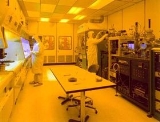
s became even cleaner. Today, the fabs are pressurized with filtered air to remove even the smallest particles, which could come to rest on the wafers and contribute to defects. The workers in a semiconductor fabrication facility are required to wear cleanroom suit
Cleanroom suit

A clean room suit, cleanroom suit, or bunny suit, is an overall garment worn in a clean room. One common type is an all-in-one coverall worn by semiconductor and nanotechnology line production workers, technicians, and process / equipment engineers, as well as people in similar roles creating sterile products for the medical devi...
s to protect the devices from human contamination.

In an effort to increase profits, semiconductor device manufacturing has spread from Texas
Texas

Texas is a U.S. state located in the South Central United States, nicknamed the Lone Star State. Texas is the second largest U.S. state in both area and population, spanning , and with a growing population of 24.3 million residents....
 and California
California

California is a U.S. state on the West Coast of the United States of the United States, along the Pacific Ocean. It is bordered by Oregon to the north, Nevada to the east, Arizona to the southeast, and to the south the Mexico state of Baja California....
 in the 1960s to the rest of the world, such as Europe
Europe

Europe is, conventionally, one of the world's seven continents. Comprising the westernmost peninsula of Eurasia, Europe is generally divided from Asia to its east by the water divide of the Ural Mountains, the Ural , the Caspian Sea, and by the Caucasus Mountains to the southeast....
, Israel
Israel

Israel officially the State of Israel , is a country in the Middle East located on the eastern shore of the Mediterranean Sea. It borders Lebanon in the north, Syria in the northeast, Jordan in the east, and Egypt on the southwest, and contains geographically diverse features within its relatively small area....
, Japan
Japan

Japan is an island country in East Asia. Located in the Pacific Ocean, it lies to the east of the Sea of Japan, People's Republic of China, North Korea, South Korea and Russia, stretching from the Sea of Okhotsk in the north to the East China Sea and Taiwan in the south....
, Taiwan
Taiwan

Taiwan is an island in East Asia. "Taiwan" is also commonly used to refer to the country governed by the Republic of China and to the ROC itself, which governs the island of Taiwan, Orchid Island and Green Island, Taiwan in the Pacific Ocean off the Taiwan coast, the Penghu islands in the Taiwan Strait, and Kinmen and the Matsu Islands...
, Korea
Korea

Korea is a geographic area composed of two sovereign countries, a civilization, and a former state situated on the Korean Peninsula in East Asia....
, Singapore
Singapore

Singapore , officially the Republic of Singapore, is an island country microstate located at the southern tip of the Malay Peninsula. It lies 137 kilometres north of the equator, south of the Malaysian state of Johor and north of Indonesia's Riau Islands....
 and China
China

China is a Culture of China, an ancient civilization, and, depending on perspective, a national or multinational entity extending over a large area in East Asia....
. It is a global business today.

The leading semiconductor manufacturers typically have facilities all over the world. Intel, the world's largest manufacturer, has facilities in Europe and Asia as well as the U.S. Other top manufacturers include STMicroelectronics
STMicroelectronics

STMicroelectronics is an Italy-France electronics and semiconductor manufacturer headquartered in Geneva, Switzerland.While STMicroelectronics corporate headquarters and the headquarters for Europe and emerging markets, are based in Geneva, the holding company, STMicroelectronics N.V....
 (Europe), Analog Devices
Analog Devices

Analog Devices is an United States Multinational corporation producer of semiconductor devices. Analog specializes in analog-to-digital converter, digital-to-analog converter, MEMS, and digital signal processing chips for consumer and industrial goods....
 (US/Asia), Atmel
Atmel

Atmel Corporation is a manufacturer of semiconductors, founded in 1984. Its focus is on system-level solutions built around flash memory microcontrollers....
 (US/Europe), Freescale Semiconductor
Freescale Semiconductor

Freescale Semiconductor, Inc. is an American semiconductor manufacturer. It was created by the divestiture of the Semiconductor Products Sector of Motorola in 2004....
 (US), Samsung (Korea), Texas Instruments
Texas Instruments

Texas Instruments , better known in the electronics industry as TI, is an United States company based in Dallas, Texas, Texas, United States, renowned for developing and commercializing semiconductor and computer technology....
 (US), Advanced Micro Devices
Advanced Micro Devices

Advanced Micro Devices, Inc. is an United States multinational corporation semiconductor industry company based in Sunnyvale, California, that develops Central processing unit and related technologies for commercial and consumer markets....
 (AMD) (US/Germany) see , Toshiba
Toshiba

is a multinational corporation list of conglomerates manufacturing company, headquartered in Tokyo, Japan. The company's main business is in Infrastructure, Consumer Products, and Electronic devices and components....
 (Japan), (Japan), Infineon (Europe), Renesas (Japan), Taiwan Semiconductor Manufacturing Company
TSMC

Taiwan Semiconductor Manufacturing Company, Limited is the world's largest dedicated independent semiconductor Foundry , with its headquarters and main operations located in the Hsinchu Science Park in Hsinchu, Taiwan....
 (Taiwan, see ), Sony
Sony

is a multinational corporation list of conglomerates corporation headquartered in Minato, Tokyo, Japan, and one of the world's largest media conglomerates with revenue exceeding US$99.1 billion ....
(Japan), NXP Semiconductors (Europe), Micron Technology
Micron Technology

Micron Technology is a Multinational corporation based in Boise, Idaho, Idaho, USA, best known for producing many forms of semiconductor devices....
 (US), Hynix
Hynix

Hynix Semiconductor Inc. of South Korea is a memory semiconductor supplier of dynamic random access memory chips and flash memory chips. Formerly known as Hyundai Electronics, the company has manufacturing sites in Korea, the U.S., China and Taiwan....
 (Korea) and SMIC
Semiconductor Manufacturing International Corporation

Semiconductor Manufacturing International Corporation, is a semiconductor foundry in mainland China, providing integrated circuit manufacturing services at 350 nm to 90nm technologies....
 (China, see ).

See also


  • Atomic layer deposition
    Atomic layer deposition

    Atomic layer deposition is a Thin-film deposition that is based on the sequential use of a gas phase chemical process. The majority of ALD reactions use two chemicals, typically called wiktionary:precursors....
  • Cleanroom
    Cleanroom

    A cleanroom is an environment, typically used in manufacturing or scientific research, that has a low level of environmental pollutants such as dust, airborne microbes, Particulate particles and chemical vapors....
    s
  • Electronic design automation
    Electronic design automation

    Electronic Design Automation is the category of tools for designing and producing electronic systems ranging from printed circuit boards to integrated circuits....
  • Foundry (electronics)
    Foundry (electronics)

    In the microelectronics industry, a semiconductor fabrication plant is a factory where devices such as integrated circuits are manufactured.A business that operates a semiconductor fab for the purpose of fabricating the designs of other companies, such as fabless semiconductor company, is known as a foundry....
  • GDS-II
  • International Technology Roadmap for Semiconductors
    International Technology Roadmap for Semiconductors

    The International Technology Roadmap for Semiconductors is a set of documents produced by a group of semiconductor industry experts. These experts are representative of the sponsoring organisations which include the Semiconductor Industry Associations of the US, Europe, Japan, Korea and Taiwan....
  • Microfabrication
    Microfabrication

    Microfabrication or micromanufacturing are the terms to describe processes of fabrication of miniature structures, of micrometre sizes and smaller....
  • OASIS
  • SEMI
    Semiconductor Equipment and Materials International

    Semiconductor Equipment and Materials International is a trade organization of manufacturers of equipment and materials used in the fabrication of semiconductor devices such as integrated circuits, transistors, diodes, and thyristors....
     — The semiconductor industry trade association


External links