

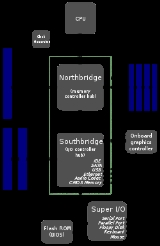
Front side bus

Encyclopedia
A front-side bus is a computer communication interface (bus) often used in computers during the 1990s and 2000s.
It typically carries data between the central processing unit
(CPU) and a memory controller hub, known as the northbridge
.
Depending on the implementation, some computers may also have a back-side bus that connects the CPU to the cache
. This bus and the cache connected to it are faster than accessing the system memory (or RAM) via the front-side bus.
The speed of the front side bus is often used as an important measure of the performance of a computer.
about the time the Pentium Pro
and Pentium II
products were announced, in the 1990s.
"Front side" refers to the external interface from the processor to the rest of the computer system, as opposed to the back side, where the back-side bus connects the cache (and potentially other CPUs).
An FSB is mostly used on PC-related motherboard
s (including personal computers and servers), seldom with the data and address buses used in embedded system
s and similar small computers. This design represented a performance improvement over the single system bus
designs of the previous decades, but sometimes is still called the "system bus".
Front-side buses usually connect the CPU and the rest of the hardware via a chipset
, which Intel implemented as a northbridge
and a southbridge
. Other buses like the Peripheral Component Interconnect
(PCI), Accelerated Graphics Port
(AGP), and memory buses all connect to the chipset in order for data to flow between the connected devices. These secondary system buses usually run at speeds derived from the front-side bus clock, but are not necessarily synchronized
to it.
In response to AMD
's Torrenza
initiative, Intel opened its FSB CPU socket to third party devices.
Prior to this announcement, made in Spring 2007 at Intel Developer Forum
in Beijing
, Intel had very closely guarded who had access to the FSB, only allowing Intel processors in the CPU socket. The first example was Field-programmable gate array
(FPGA) co-processors, a result of collaboration between Intel-Xilinx
-Nallatech
and Intel-Altera
-XtremeData (which shipped in 2008).
at which a processor (CPU) operates is determined by applying a clock multiplier to the front-side bus (FSB) speed in some cases. For example, a processor running at 3200 MHz might be using a 400 MHz FSB. This means there is an internal clock multiplier
setting (also called bus/core ratio) of 8. That is, the CPU is set to run at 8 times the frequency of the front-side bus: 400 MHz × 8 = 3200 MHz. By varying either the FSB or the multiplier, different CPU speeds can be achieved.
In newer systems, it is possible to see memory ratios of "4:5" and the like. The memory will run 5/4 times as fast as the FSB in this situation, meaning a 400 MHz bus can run with the memory at 500 MHz. This is often referred to as an 'asynchronous' system. It is important to realize that due to differences in CPU and system architecture, overall system performance can vary in unexpected ways with different FSB-to-memory ratios.
In image
, audio
, video
, gaming, FPGA
synthesis and scientific applications that perform a small amount of work on each element of a large data set
, FSB speed becomes a major performance issue. A slow FSB will cause the CPU to spend significant amounts of time waiting for data to arrive from system memory. However, if the computations involving each element are more complex, the processor will spend longer performing these; therefore, the FSB will be able to keep pace because the rate at which the memory is accessed is reduced.
. In newer systems, the PCI, AGP, and PCI Express
peripheral buses often receive their own clock signal
s, which eliminates their dependence on the front-side bus for timing.
is the practice of making computer components operate beyond their stock performance levels.
Many motherboards allow the user to manually set the clock multiplier and FSB settings by changing jumper
s or BIOS settings. Almost all CPU manufacturers now "lock" a preset multiplier setting into the chip. It is possible to unlock some locked CPUs; for instance, some Athlon
s can be unlocked by connecting electrical contacts across points on the CPU's surface. For all processors, increasing the FSB speed can be done to boost processing speed by reducing latency
between CPU and the northbridge.
This practice pushes components beyond their specifications and may cause erratic behavior, overheating or premature failure. Even if the computer appears to run normally, problems may appear under a heavy load. Most PC
s purchased from retailers or manufacturers, such as Hewlett-Packard
or Dell
, do not allow the user to change the multiplier or FSB settings due to the probability of erratic behavior or failure. Motherboards purchased separately to build a custom machine are more likely to allow the user to edit the multiplier and FSB settings in the PC's BIOS.
The front-side bus was used in all of Intel's Atom
, Celeron
, Pentium, Core 2, and Xeon
processor models through about 2008. Originally, this bus was a central connecting point for all system devices and the CPU.
The speed of a faster CPU is wasted if it cannot fetch instructions and data as fast as it can execute them. The CPU must wait for one or more clock cycles until the memory returns its value, or access other devices attached to the FSB if it becomes a bottleneck.
The front-side bus was criticized by AMD as being an old and slow technology that limits system performance.
More modern designs use point-to-point connections like AMD's HyperTransport
and Intel's QuickPath Interconnect (QPI).
FSB's fastest transfer speed was 1.6 GT/s, which provided only 80% of the theoretical bandwidth of a 16-bit HyperTransport 3.0 link as implemented on AM3
Phenom II
CPUs, only half of the bandwidth of a 6.4 GT/s QuickPath Interconnect link, and only 25% of the bandwidth of a 32-bit HyperTransport 3.1 link. In addition, in an FSB-based architecture, the memory must be accessed via the FSB. In HT- and QPI-based systems, the memory is accessed independently by means of a memory controller
on the CPU itself, freeing bandwidth on the HyperTransport or QPI link for other uses.
or maximum theoretical throughput of the front-side bus is determined by the product of the width of its data path, its clock frequency
(cycles per second) and the number of data transfers it performs per clock cycle. For example, a 64-bit
(8-byte
) wide FSB operating at a frequency of 100 MHz that performs 4 transfers per cycle has a bandwidth of 3200 megabyte
s per second (MB/s):
8B x 100 MHz x 4/cycle
= 8B x 100M x Hz x 4/cycle
= 8B x 100M x cycle/s x 4/cycle
= 3200MB/s
The number of transfers per clock cycle
depends on the technology used. For example, GTL+ performs 1 transfer/cycle, EV6 2 transfers/cycle, and AGTL+ 4 transfers/cycle. Intel calls the technique of four transfers per cycle Quad Pumping
.
Many manufacturers publish the speed of the FSB in MHz, but often do not use the actual physical clock frequency but the theoretical effective data rate (which is commonly called megatransfers per second or MT/s). This is because the actual speed is determined by how many transfers can be performed by each clock cycle as well as by the clock frequency. For example, if a motherboard (or processor) has an FSB clocked at 200 MHz and performs 4 transfers per clock cycle, the FSB is rated at 800 MT/s.
It typically carries data between the central processing unit
Central processing unit
The central processing unit is the portion of a computer system that carries out the instructions of a computer program, to perform the basic arithmetical, logical, and input/output operations of the system. The CPU plays a role somewhat analogous to the brain in the computer. The term has been in...
(CPU) and a memory controller hub, known as the northbridge
Northbridge (computing)
The northbridge has historically been one of the two chips in the core logic chipset on a PC motherboard, the other being the southbridge. Increasingly these functions have migrated to the CPU chip itself, beginning with memory and graphics controllers. For Intel Sandy Bridge and AMD Fusion...
.
Depending on the implementation, some computers may also have a back-side bus that connects the CPU to the cache
CPU cache
A CPU cache is a cache used by the central processing unit of a computer to reduce the average time to access memory. The cache is a smaller, faster memory which stores copies of the data from the most frequently used main memory locations...
. This bus and the cache connected to it are faster than accessing the system memory (or RAM) via the front-side bus.
The speed of the front side bus is often used as an important measure of the performance of a computer.
History
The term came into use by Intel CorporationIntel Corporation
Intel Corporation is an American multinational semiconductor chip maker corporation headquartered in Santa Clara, California, United States and the world's largest semiconductor chip maker, based on revenue. It is the inventor of the x86 series of microprocessors, the processors found in most...
about the time the Pentium Pro
Pentium Pro
The Pentium Pro is a sixth-generation x86 microprocessor developed and manufactured by Intel introduced in November 1, 1995 . It introduced the P6 microarchitecture and was originally intended to replace the original Pentium in a full range of applications...
and Pentium II
Pentium II
The Pentium II brand refers to Intel's sixth-generation microarchitecture and x86-compatible microprocessors introduced on May 7, 1997. Containing 7.5 million transistors, the Pentium II featured an improved version of the first P6-generation core of the Pentium Pro, which contained 5.5 million...
products were announced, in the 1990s.
"Front side" refers to the external interface from the processor to the rest of the computer system, as opposed to the back side, where the back-side bus connects the cache (and potentially other CPUs).
An FSB is mostly used on PC-related motherboard
Motherboard
In personal computers, a motherboard is the central printed circuit board in many modern computers and holds many of the crucial components of the system, providing connectors for other peripherals. The motherboard is sometimes alternatively known as the mainboard, system board, or, on Apple...
s (including personal computers and servers), seldom with the data and address buses used in embedded system
Embedded system
An embedded system is a computer system designed for specific control functions within a larger system. often with real-time computing constraints. It is embedded as part of a complete device often including hardware and mechanical parts. By contrast, a general-purpose computer, such as a personal...
s and similar small computers. This design represented a performance improvement over the single system bus
System bus
A system bus is a single computer bus that connects the major components of a computer system. The technique was developed to reduce costs and improve modularity....
designs of the previous decades, but sometimes is still called the "system bus".
Front-side buses usually connect the CPU and the rest of the hardware via a chipset
Chipset
A chipset, PC chipset, or chip set refers to a group of integrated circuits, or chips, that are designed to work together. They are usually marketed as a single product.- Computers :...
, which Intel implemented as a northbridge
Northbridge (computing)
The northbridge has historically been one of the two chips in the core logic chipset on a PC motherboard, the other being the southbridge. Increasingly these functions have migrated to the CPU chip itself, beginning with memory and graphics controllers. For Intel Sandy Bridge and AMD Fusion...
and a southbridge
Southbridge (computing)
The southbridge is one of the two chips in the core logic chipset on a personal computer motherboard, the other being the northbridge. The southbridge typically implements the slower capabilities of the motherboard in a northbridge/southbridge chipset computer architecture. In Intel chipset...
. Other buses like the Peripheral Component Interconnect
Peripheral Component Interconnect
Conventional PCI is a computer bus for attaching hardware devices in a computer...
(PCI), Accelerated Graphics Port
Accelerated Graphics Port
The Accelerated Graphics Port is a high-speed point-to-point channel for attaching a video card to a computer's motherboard, primarily to assist in the acceleration of 3D computer graphics. Since 2004 AGP has been progressively phased out in favor of PCI Express...
(AGP), and memory buses all connect to the chipset in order for data to flow between the connected devices. These secondary system buses usually run at speeds derived from the front-side bus clock, but are not necessarily synchronized
Synchronization (computer science)
In computer science, synchronization refers to one of two distinct but related concepts: synchronization of processes, and synchronization of data. Process synchronization refers to the idea that multiple processes are to join up or handshake at a certain point, so as to reach an agreement or...
to it.
In response to AMD
Advanced Micro Devices
Advanced Micro Devices, Inc. or AMD is an American multinational semiconductor company based in Sunnyvale, California, that develops computer processors and related technologies for commercial and consumer markets...
's Torrenza
Torrenza
Torrenza was an initiative announced by Advanced Micro Devices in 2006 to improve support for the integration of specialized coprocessors in systems based on AMD Opteron microprocessors...
initiative, Intel opened its FSB CPU socket to third party devices.
Prior to this announcement, made in Spring 2007 at Intel Developer Forum
Intel Developer Forum
Intel Developer Forum , is a gathering of technologists to discuss Intel products and products based around Intel products. The first IDF was in 1997...
in Beijing
Beijing
Beijing , also known as Peking , is the capital of the People's Republic of China and one of the most populous cities in the world, with a population of 19,612,368 as of 2010. The city is the country's political, cultural, and educational center, and home to the headquarters for most of China's...
, Intel had very closely guarded who had access to the FSB, only allowing Intel processors in the CPU socket. The first example was Field-programmable gate array
Field-programmable gate array
A field-programmable gate array is an integrated circuit designed to be configured by the customer or designer after manufacturing—hence "field-programmable"...
(FPGA) co-processors, a result of collaboration between Intel-Xilinx
Xilinx
Xilinx, Inc. is a supplier of programmable logic devices. It is known for inventing the field programmable gate array and as the first semiconductor company with a fabless manufacturing model....
-Nallatech
Nallatech
Nallatech is a Scottish computer hardware and software firm based in Cumbernauld in North Lanarkshire, Scotland that specializes in field-programmable gate array microchip technology applied in computing...
and Intel-Altera
Altera
Altera Corporation is a Silicon Valley manufacturer of PLDs . The company offered its first programmable logic device in 1984. PLDs can be reprogrammed during the design cycle as well as in the field to perform multiple functions, and they support a fairly fast design process...
-XtremeData (which shipped in 2008).
CPU
The frequencyFrequency
Frequency is the number of occurrences of a repeating event per unit time. It is also referred to as temporal frequency.The period is the duration of one cycle in a repeating event, so the period is the reciprocal of the frequency...
at which a processor (CPU) operates is determined by applying a clock multiplier to the front-side bus (FSB) speed in some cases. For example, a processor running at 3200 MHz might be using a 400 MHz FSB. This means there is an internal clock multiplier
CPU multiplier
In computing, the clock multiplier measures the ratio of an internal CPU clock rate to the externally supplied clock. A CPU with a 10x multiplier will thus see 10 internal cycles for every external clock cycle...
setting (also called bus/core ratio) of 8. That is, the CPU is set to run at 8 times the frequency of the front-side bus: 400 MHz × 8 = 3200 MHz. By varying either the FSB or the multiplier, different CPU speeds can be achieved.
Memory
Setting an FSB speed is related directly to the speed grade of memory a system must use. The memory bus connects the northbridge and RAM, just as the front-side bus connects the CPU and northbridge. Often, these two buses must operate at the same frequency. Increasing the front-side bus to 450 MHz in most cases also means running the memory at 450 MHz.In newer systems, it is possible to see memory ratios of "4:5" and the like. The memory will run 5/4 times as fast as the FSB in this situation, meaning a 400 MHz bus can run with the memory at 500 MHz. This is often referred to as an 'asynchronous' system. It is important to realize that due to differences in CPU and system architecture, overall system performance can vary in unexpected ways with different FSB-to-memory ratios.
In image
Image
An image is an artifact, for example a two-dimensional picture, that has a similar appearance to some subject—usually a physical object or a person.-Characteristics:...
, audio
Sound recording and reproduction
Sound recording and reproduction is an electrical or mechanical inscription and re-creation of sound waves, such as spoken voice, singing, instrumental music, or sound effects. The two main classes of sound recording technology are analog recording and digital recording...
, video
Motion graphics
Motion graphics are graphics that use video footage and/or animation technology to create the illusion of motion or rotation, graphics are usually combined with audio for use in multimedia projects. Motion graphics are usually displayed via electronic media technology, but may be displayed via...
, gaming, FPGA
Field-programmable gate array
A field-programmable gate array is an integrated circuit designed to be configured by the customer or designer after manufacturing—hence "field-programmable"...
synthesis and scientific applications that perform a small amount of work on each element of a large data set
Data set
A data set is a collection of data, usually presented in tabular form. Each column represents a particular variable. Each row corresponds to a given member of the data set in question. Its values for each of the variables, such as height and weight of an object or values of random numbers. Each...
, FSB speed becomes a major performance issue. A slow FSB will cause the CPU to spend significant amounts of time waiting for data to arrive from system memory. However, if the computations involving each element are more complex, the processor will spend longer performing these; therefore, the FSB will be able to keep pace because the rate at which the memory is accessed is reduced.
Peripheral buses
Similar to the memory bus, the PCI and AGP buses can also be run asynchronously from the front-side bus. In older systems, these buses are operated at a set fraction of the front-side bus frequency. This fraction was set by the BIOSBIOS
In IBM PC compatible computers, the basic input/output system , also known as the System BIOS or ROM BIOS , is a de facto standard defining a firmware interface....
. In newer systems, the PCI, AGP, and PCI Express
PCI Express
PCI Express , officially abbreviated as PCIe, is a computer expansion card standard designed to replace the older PCI, PCI-X, and AGP bus standards...
peripheral buses often receive their own clock signal
Clock signal
In electronics and especially synchronous digital circuits, a clock signal is a particular type of signal that oscillates between a high and a low state and is utilized like a metronome to coordinate actions of circuits...
s, which eliminates their dependence on the front-side bus for timing.
Overclocking
OverclockingOverclocking
Overclocking is the process of operating a computer component at a higher clock rate than it was designed for or was specified by the manufacturer, but some manufacturers purposely underclock their components to improve battery life. Many people just overclock or 'rightclock' their hardware to...
is the practice of making computer components operate beyond their stock performance levels.
Many motherboards allow the user to manually set the clock multiplier and FSB settings by changing jumper
Jumper (computing)
In electronics and particularly computing, a jumper is a short length of conductor used to close a break in or bypass part of an electrical circuit...
s or BIOS settings. Almost all CPU manufacturers now "lock" a preset multiplier setting into the chip. It is possible to unlock some locked CPUs; for instance, some Athlon
Athlon
Athlon is the brand name applied to a series of x86-compatible microprocessors designed and manufactured by Advanced Micro Devices . The original Athlon was the first seventh-generation x86 processor and, in a first, retained the initial performance lead it had over Intel's competing processors...
s can be unlocked by connecting electrical contacts across points on the CPU's surface. For all processors, increasing the FSB speed can be done to boost processing speed by reducing latency
Latency (engineering)
Latency is a measure of time delay experienced in a system, the precise definition of which depends on the system and the time being measured. Latencies may have different meaning in different contexts.-Packet-switched networks:...
between CPU and the northbridge.
This practice pushes components beyond their specifications and may cause erratic behavior, overheating or premature failure. Even if the computer appears to run normally, problems may appear under a heavy load. Most PC
Personal computer
A personal computer is any general-purpose computer whose size, capabilities, and original sales price make it useful for individuals, and which is intended to be operated directly by an end-user with no intervening computer operator...
s purchased from retailers or manufacturers, such as Hewlett-Packard
Hewlett-Packard
Hewlett-Packard Company or HP is an American multinational information technology corporation headquartered in Palo Alto, California, USA that provides products, technologies, softwares, solutions and services to consumers, small- and medium-sized businesses and large enterprises, including...
or Dell
Dell
Dell, Inc. is an American multinational information technology corporation based in 1 Dell Way, Round Rock, Texas, United States, that develops, sells and supports computers and related products and services. Bearing the name of its founder, Michael Dell, the company is one of the largest...
, do not allow the user to change the multiplier or FSB settings due to the probability of erratic behavior or failure. Motherboards purchased separately to build a custom machine are more likely to allow the user to edit the multiplier and FSB settings in the PC's BIOS.
Evolution
The front-side bus had the advantage of high flexibility and low cost. Simple symmetric multiprocessors place a number of CPUs on an FSB, though performance does not scale linearly due to the architecture's bandwidth bottleneck.The front-side bus was used in all of Intel's Atom
Intel Atom
Intel Atom is the brand name for a line of ultra-low-voltage x86 and x86-64 CPUs from Intel, designed in 45 nm CMOS and used mainly in netbooks, nettops, embedded application ranging from health care to advanced robotics and Mobile Internet devices...
, Celeron
Celeron
Celeron is a brand name given by Intel Corp. to a number of different x86 computer microprocessor models targeted at budget personal computers....
, Pentium, Core 2, and Xeon
Xeon
The Xeon is a brand of multiprocessing- or multi-socket-capable x86 microprocessors from Intel Corporation targeted at the non-consumer server, workstation and embedded system markets.-Overview:...
processor models through about 2008. Originally, this bus was a central connecting point for all system devices and the CPU.
The speed of a faster CPU is wasted if it cannot fetch instructions and data as fast as it can execute them. The CPU must wait for one or more clock cycles until the memory returns its value, or access other devices attached to the FSB if it becomes a bottleneck.
The front-side bus was criticized by AMD as being an old and slow technology that limits system performance.
More modern designs use point-to-point connections like AMD's HyperTransport
HyperTransport
HyperTransport , formerly known as Lightning Data Transport , is a technology for interconnection of computer processors. It is a bidirectional serial/parallel high-bandwidth, low-latency point-to-point link that was introduced on April 2, 2001...
and Intel's QuickPath Interconnect (QPI).
FSB's fastest transfer speed was 1.6 GT/s, which provided only 80% of the theoretical bandwidth of a 16-bit HyperTransport 3.0 link as implemented on AM3
Socket AM3
Socket AM3 is a CPU socket for AMD processors. AM3 was launched as the successor to Socket AM2+ on February 9, 2009, alongside the initial grouping of Phenom II processors designed for it...
Phenom II
Phenom II
Phenom II is a family of AMD's multi-core 45 nm processors using the AMD K10 microarchitecture, succeeding the original Phenom. Advanced Micro Devices released the Socket AM2+ version of Phenom II in December 2008, while Socket AM3 versions with DDR3 support, along with an initial batch of...
CPUs, only half of the bandwidth of a 6.4 GT/s QuickPath Interconnect link, and only 25% of the bandwidth of a 32-bit HyperTransport 3.1 link. In addition, in an FSB-based architecture, the memory must be accessed via the FSB. In HT- and QPI-based systems, the memory is accessed independently by means of a memory controller
Memory controller
The memory controller is a digital circuit which manages the flow of data going to and from the main memory. It can be a separate chip or integrated into another chip, such as on the die of a microprocessor...
on the CPU itself, freeing bandwidth on the HyperTransport or QPI link for other uses.
Transfer rates
The bandwidthBandwidth (computing)
In computer networking and computer science, bandwidth, network bandwidth, data bandwidth, or digital bandwidth is a measure of available or consumed data communication resources expressed in bits/second or multiples of it .Note that in textbooks on wireless communications, modem data transmission,...
or maximum theoretical throughput of the front-side bus is determined by the product of the width of its data path, its clock frequency
Clock rate
The clock rate typically refers to the frequency that a CPU is running at.For example, a crystal oscillator frequency reference typically is synonymous with a fixed sinusoidal waveform, a clock rate is that frequency reference translated by electronic circuitry into a corresponding square wave...
(cycles per second) and the number of data transfers it performs per clock cycle. For example, a 64-bit
Bit
A bit is the basic unit of information in computing and telecommunications; it is the amount of information stored by a digital device or other physical system that exists in one of two possible distinct states...
(8-byte
Byte
The byte is a unit of digital information in computing and telecommunications that most commonly consists of eight bits. Historically, a byte was the number of bits used to encode a single character of text in a computer and for this reason it is the basic addressable element in many computer...
) wide FSB operating at a frequency of 100 MHz that performs 4 transfers per cycle has a bandwidth of 3200 megabyte
Megabyte
The megabyte is a multiple of the unit byte for digital information storage or transmission with two different values depending on context: bytes generally for computer memory; and one million bytes generally for computer storage. The IEEE Standards Board has decided that "Mega will mean 1 000...
s per second (MB/s):
8B x 100 MHz x 4/cycle
= 8B x 100M x Hz x 4/cycle
= 8B x 100M x cycle/s x 4/cycle
= 3200MB/s
The number of transfers per clock cycle
Cycles Per Instruction
In computer architecture, cycles per instruction is a term used to describe one aspect of a processor's performance: the number of clock cycles that happen when an instruction is being executed...
depends on the technology used. For example, GTL+ performs 1 transfer/cycle, EV6 2 transfers/cycle, and AGTL+ 4 transfers/cycle. Intel calls the technique of four transfers per cycle Quad Pumping
Quad Data Rate
Quad data rate is a communication signaling technique wherein data are transmitted at four points in the clock cycle: on the rising and falling edges, and at two intermediate points between them. The intermediate points are defined by a 2nd clock that is 90° out of phase from the first...
.
Many manufacturers publish the speed of the FSB in MHz, but often do not use the actual physical clock frequency but the theoretical effective data rate (which is commonly called megatransfers per second or MT/s). This is because the actual speed is determined by how many transfers can be performed by each clock cycle as well as by the clock frequency. For example, if a motherboard (or processor) has an FSB clocked at 200 MHz and performs 4 transfers per clock cycle, the FSB is rated at 800 MT/s.
Intel processors
| CPU | FSB Clock | Number of Transfers/Cycle | Bus Width | Transfer Rate |
|---|---|---|---|---|
| Pentium | 50 MHz-66 MHz | 1 | 64-bit | 400 MB/s-528 MB/s |
| Pentium Overdrive | 25 MHz-66 MHz | 1 | 64-bit | 200 MB/s-528 MB/s |
| Pentium MMX | 60 MHz-66 MHz | 1 | 64-bit | 480 MB/s-528 MB/s |
| Pentium MMX Overdrive | 50 MHz-66 MHz | 1 | 64-bit | 400 MB/s-528 MB/s |
| Pentium II | 66 MHz-100 MHz | 1 | 64-bit | 528 MB/s-800 MB/s |
| Pentium II Overdrive | 60 MHz-66 MHz | 1 | 64-bit | 480 MB/s-528 MB/s |
| Pentium III | 100 MHz-133 MHz | 1 | 64-bit | 800 MB/s-1064 MB/s |
| Pentium III-M | 100 MHz-133 MHz | 1 | 64-bit | 800 MB/s-1064 MB/s |
| Pentium 4 | 100 MHz-133 MHz | 4 | 64-bit | 3200 MB/s-4256 MB/s |
| Pentium 4-M | 100 MHz | 4 | 64-bit | 3200 MB/s |
| Pentium 4 HT | 133 MHz-200 MHz | 4 | 64-bit | 4256 MB/s-6400 MB/s |
| Pentium 4 HT Extreme Edition | 200 MHz-266 MHz | 4 | 64-bit | 6400 MB/s-8512 MB/s |
| Pentium D | 133 MHz-200 MHz | 4 | 64-bit | 4256 MB/s-6400 MB/s |
| Pentium Extreme Edition | 200 MHz-266 MHz | 4 | 64-bit | 6400 MB/s-8512 MB/s |
| Pentium M | 100 MHz-133 MHz | 4 | 64-bit | 3200 MB/s-4256 MB/s |
| Core Solo | 133 MHz-166 MHz | 4 | 64-bit | 4256 MB/s-5312 MB/s |
| Core Duo | 133 MHz-166 MHz | 4 | 64-bit | 4256 MB/s-5312 MB/s |
| Core 2 Solo | 133 MHz-200 MHz | 4 | 64-bit | 4256 MB/s-6400 MB/s |
| Core 2 Duo | 133 MHz-333 MHz | 4 | 64-bit | 4256 MB/s-10656 MB/s |
| Core 2 Quad | 266 MHz-333 MHz | 4 | 64-bit | 8512 MB/s-10656 MB/s |
| Core 2 Extreme | 200 MHz-400 MHz | 4 | 64-bit | 6400 MB/s-12800 MB/s |
| Atom | 133 MHz-166 MHz | 4 | 64-bit | 4256 MB/s-5312 MB/s |
| Celeron | 66 MHz-266 MHz | 1-4 | 64-bit | 528 MB/s-8512 MB/s |
| Celeron D | 133 MHz | 4 | 64-bit | 4256 MB/s |
| Celeron M | 100 MHz-200 MHz | 4 | 64-bit | 3200 MB/s-6400 MB/s |
| Celeron Dual-Core | 133 MHz-200 MHz | 4 | 64-bit | 4256 MB/s-6400 MB/s |
| Pentium Dual-Core | 133 MHz-266 MHz | 4 | 64-bit | 4256 MB/s-8512 MB/s |
| Pentium Pro | 60 MHz-66 MHz | 1 | 64-bit | 480 MB/s-528 MB/s |
| Pentium II Xeon | 100 MHz | 1 | 64-bit | 800 MB/s |
| Pentium III Xeon | 100 MHz-133 MHz | 1 | 64-bit | 800 MB/s-1064 MB/s |
| Xeon | 100 MHz-400 MHz | 4 | 64-bit | 3200 MB/s-12800 MB/s |
| Itanium | 100 MHz-133 MHz | 1 | 64-bit | 800 MB/s-1064 MB/s |
| Itanium 2 | 100 MHz-166 MHz | 4 | 64-bit | 3200 MB/s-5312 MB/s |
AMD processors
| CPU | FSB Clock | Number of Cycles | Bus Width | Transfer Rate |
|---|---|---|---|---|
| K5 | 50 MHz-66 MHz | 1 | 64-bit | 400 MB/s-528 MB/s |
| K6 | 66 MHz | 1 | 64-bit | 528 MB/s |
| K6-II | 66 MHz-100 MHz | 1 | 64-bit | 528 MB/s-800 MB/s |
| K6-III | 66 MHz-100 MHz | 1 | 64-bit | 528 MB/s-800 MB/s |
| Athlon | 100 MHz-133 MHz | 2 | 64-bit | 1600 MB/s-2128 MB/s |
| Athlon XP | 100 MHz-200 MHz | 2 | 64-bit | 1600 MB/s-3200 MB/s |
| Mobile Athlon 4 | 100 MHz | 2 | 64-bit | 1600 MB/s |
| Athlon XP-M | 100 MHz-133 MHz | 2 | 64-bit | 1600 MB/s-2128 MB/s |
| Duron | 100 MHz-133 MHz | 2 | 64-bit | 1600 MB/s-2128 MB/s |
| Sempron | 166 MHz-200 MHz | 2 | 64-bit | 2656 MB/s-3200 MB/s |
| Athlon MP | 100 MHz-133 MHz | 2 | 64-bit | 1600 MB/s-2128 MB/s |
See also
- HyperTransportHyperTransportHyperTransport , formerly known as Lightning Data Transport , is a technology for interconnection of computer processors. It is a bidirectional serial/parallel high-bandwidth, low-latency point-to-point link that was introduced on April 2, 2001...
- Intel QuickPath Interconnect