

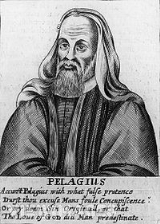
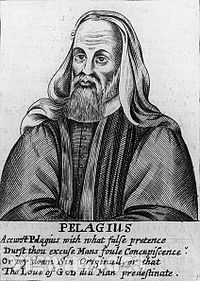
Pelagius

Encyclopedia
Asceticism
Asceticism describes a lifestyle characterized by abstinence from various sorts of worldly pleasures often with the aim of pursuing religious and spiritual goals...
who denied the need for divine aid in performing good works. For him, the only grace necessary was the declaration of the law; humans were not wounded by Adam's sin and were perfectly able to fulfill the law apart from any divine aid. He also, therefore, denied the more specific doctrine of original sin
Original sin
Original sin is, according to a Christian theological doctrine, humanity's state of sin resulting from the Fall of Man. This condition has been characterized in many ways, ranging from something as insignificant as a slight deficiency, or a tendency toward sin yet without collective guilt, referred...
as developed by Augustine of Hippo
Augustine of Hippo
Augustine of Hippo , also known as Augustine, St. Augustine, St. Austin, St. Augoustinos, Blessed Augustine, or St. Augustine the Blessed, was Bishop of Hippo Regius . He was a Latin-speaking philosopher and theologian who lived in the Roman Africa Province...
. Pelagius was declared a heretic
Heresy
Heresy is a controversial or novel change to a system of beliefs, especially a religion, that conflicts with established dogma. It is distinct from apostasy, which is the formal denunciation of one's religion, principles or cause, and blasphemy, which is irreverence toward religion...
by the Council of Carthage
Councils of Carthage
Councils of Carthage, also referred to as Synods of Carthage were church synods held during the 3rd, 4th, and 5th centuries in the town of Carthage in Africa...
. His interpretation of a doctrine of free will
Free will
"To make my own decisions whether I am successful or not due to uncontrollable forces" -Troy MorrisonA pragmatic definition of free willFree will is the ability of agents to make choices free from certain kinds of constraints. The existence of free will and its exact nature and definition have long...
became known as Pelagianism
Pelagianism
Pelagianism is a theological theory named after Pelagius , although he denied, at least at some point in his life, many of the doctrines associated with his name. It is the belief that original sin did not taint human nature and that mortal will is still capable of choosing good or evil without...
. He was well educated, fluent in both Greek
Ancient Greek
Ancient Greek is the stage of the Greek language in the periods spanning the times c. 9th–6th centuries BC, , c. 5th–4th centuries BC , and the c. 3rd century BC – 6th century AD of ancient Greece and the ancient world; being predated in the 2nd millennium BC by Mycenaean Greek...
and Latin
Latin
Latin is an Italic language originally spoken in Latium and Ancient Rome. It, along with most European languages, is a descendant of the ancient Proto-Indo-European language. Although it is considered a dead language, a number of scholars and members of the Christian clergy speak it fluently, and...
, and learned in theology
Theology
Theology is the systematic and rational study of religion and its influences and of the nature of religious truths, or the learned profession acquired by completing specialized training in religious studies, usually at a university or school of divinity or seminary.-Definition:Augustine of Hippo...
. He spent time as an ascetic, focusing on practical asceticism
Asceticism
Asceticism describes a lifestyle characterized by abstinence from various sorts of worldly pleasures often with the aim of pursuing religious and spiritual goals...
, which his teachings clearly reflect. He was certainly well known in Rome
Rome
Rome is the capital of Italy and the country's largest and most populated city and comune, with over 2.7 million residents in . The city is located in the central-western portion of the Italian Peninsula, on the Tiber River within the Lazio region of Italy.Rome's history spans two and a half...
, both for the harsh asceticism of his public life as well as the power and persuasiveness of his speech. His reputation in Rome earned him praise early in his career even from such pillars of the Church as Augustine, who referred to him as a "saintly man." However, he was later accused of lying about his own teachings in order to avoid public condemnation. Most of his later life was spent defending his doctrine against Catholic theologians who held that Catholicism came from the apostles and that Pelagius was spreading novelties in the Faith unknown to the apostolic tradition.
Due to his status as a heretic, little of his work has come down to the present day except in the quotes of his opponents. However, more recently some have defended Pelagius as a misunderstood orthodox:
Beginnings
Pelagius was born about 354. While his exact birthplace is not known, the Encyclopedia of World Biography states that "widespread evidence indicates that he came originally from the British IslesBritish Isles
The British Isles are a group of islands off the northwest coast of continental Europe that include the islands of Great Britain and Ireland and over six thousand smaller isles. There are two sovereign states located on the islands: the United Kingdom of Great Britain and Northern Ireland and...
", although a few sources suggest he may have been born in Brittany in modern France. He was a Culdee Monk and wore the moon shaped tonsure
Tonsure
Tonsure is the traditional practice of Christian churches of cutting or shaving the hair from the scalp of clerics, monastics, and, in the Eastern Orthodox Church, all baptized members...
of that ascetic Celtic Johannine Christian Order. He became better known c. 380 when he moved to Rome to write and teach about his ascetic practices. There, he wrote a number of his major works: "De fide Trinitatis libri III" ("On Faith in the Trinity: Three Books"), "Eclogarum ex divinis Scripturis liber primus" ("Excerpts out of Divine Scriptures: One Book"), and "Commentarii in epistolas S. Pauli" ("Commentary on the Epistles of Saint Paul"). Unfortunately, most of his work survives only in the quotations of his opponents. Only in the past century have works attributable to Pelagius been identified as such. Pelagius's commentary on Romans is currently available in English, as translated by Theodore De Bruyn (Clarendon Press, 2002), as well as a collection of other writings by Pelagius himself, translated into English by B. R. Rees (The Boydell Press, 1998).
In Rome, Pelagius became concerned about the moral laxity of society. He blamed this laxity on the theology of divine grace
Divine grace
In Christian theology, grace is God’s gift of God’s self to humankind. It is understood by Christians to be a spontaneous gift from God to man - "generous, free and totally unexpected and undeserved" - that takes the form of divine favour, love and clemency. It is an attribute of God that is most...
preached by Augustine, among others.
Around 405, it is said that Pelagius heard a quotation from Augustine's Confessions
Confessions (St. Augustine)
Confessions is the name of an autobiographical work, consisting of 13 books, by St. Augustine of Hippo, written between AD 397 and AD 398. Modern English translations of it are sometimes published under the title The Confessions of St...
: "Give me what you command and command what you will". This verse concerned Pelagius because it seemed that Augustine was teaching doctrine contrary to traditional Christian understandings of grace and free will, turning man into a mere automaton.
When Alaric
Alaric I
Alaric I was the King of the Visigoths from 395–410. Alaric is most famous for his sack of Rome in 410, which marked a decisive event in the decline of the Roman Empire....
sacked Rome in 410, Pelagius and his close follower Caelestius
Caelestius
Caelestius was the major follower of the Christian teacher Pelagius and the Christian doctrine of Pelagianism, which was opposed to Augustine of Hippo and his doctrine in original sin, and was later declared to be heresy....
fled to Carthage where he continued his work and briefly encountered St. Augustine in person. He was subsequently in the Holy Land as late as 418.
Opponents
An objective view of Pelagius and his effect is difficult. His name has been used as an epithet for centuries by both Protestants and Catholics, and he has had few defenders. The Catholic Church denounced his ideas and yet the Reformation accused Catholics of adhering to his beliefs and condemned both Pelagius and the Catholic Church. Meanwhile, the Eastern Orthodox ChurchEastern Orthodox Church
The Orthodox Church, officially called the Orthodox Catholic Church and commonly referred to as the Eastern Orthodox Church, is the second largest Christian denomination in the world, with an estimated 300 million adherents mainly in the countries of Belarus, Bulgaria, Cyprus, Georgia, Greece,...
is silent. Regardless, Pelagius stands, both in reality and in icon, as a radical dissenter from the traditional view of original sin
Original sin
Original sin is, according to a Christian theological doctrine, humanity's state of sin resulting from the Fall of Man. This condition has been characterized in many ways, ranging from something as insignificant as a slight deficiency, or a tendency toward sin yet without collective guilt, referred...
and the means of salvation.
Augustine of Hippo
PelagianismPelagianism
Pelagianism is a theological theory named after Pelagius , although he denied, at least at some point in his life, many of the doctrines associated with his name. It is the belief that original sin did not taint human nature and that mortal will is still capable of choosing good or evil without...
quickly spread, especially around Carthage
Carthage
Carthage , implying it was a 'new Tyre') is a major urban centre that has existed for nearly 3,000 years on the Gulf of Tunis, developing from a Phoenician colony of the 1st millennium BC...
, which is one reason the opponents acted so promptly and firmly. Augustine wrote four letters specifically on Pelagianism, "De peccatorum meritis et remissione libri III" (Three Books on the Merits and Forgiveness of Sins) in 412, "De spiritu et litera" (On the Spirit and the Letter) and "Definitiones Caelestii" (Caelestius's Definitions) in 414, and "De natura et gratia" (On Nature and Grace) in 415. In these he strongly affirmed the existence of original sin, the need for infant baptism, the impossibility of a sinless life without Christ, and the necessity of Christ's grace. Augustine's works are intended in part for the common people and thus do not address Pelagius or his disciple Caelestius (except for the Definitiones Caelestii) by name. One can find little of Pelagius' works in print save his commentary on the Epistle to the Romans, which is similar to Antiochian writings of the same age.
Jerome
Pelagius soon left for Palestine, befriending the bishop there. JeromeJerome
Saint Jerome was a Roman Christian priest, confessor, theologian and historian, and who became a Doctor of the Church. He was the son of Eusebius, of the city of Stridon, which was on the border of Dalmatia and Pannonia...
, who lived there, became involved as well. Jerome wrote against Pelagius in his "Letter to Ctesiphon" and "Dialogus contra Pelagianos." With Jerome at the time was Orosius, a visiting pupil of Augustine, with similar views on the dangers of Pelagianism. Together they publicly condemned Pelagius. Bishop John of Jerusalem, a personal friend of Pelagius, called a council in July 415. Church sources claim Orosius' lack of fluency in Greek rendered him unconvincing and John's Eastern background made him more willing to accept that humans did not have inherent sinfulness. Yet the council rendered no verdict and passed the controversy to the Latin Church because Pelagius, Jerome, and Orosius were all Latin.
Diospolis
A few months later in December of 415, another synod in DiospolisLod
Lod is a city located on the Sharon Plain southeast of Tel Aviv in the Center District of Israel. At the end of 2010, it had a population of 70,000, roughly 75 percent Jewish and 25 percent Arab.The name is derived from the Biblical city of Lod...
(Lydda) under the bishop of Cæsarea was called by two deposed bishops who came to the Holy Land. However, neither bishop attended for unrelated reasons and Orosius had left after consultation with Bishop John. Pelagius explained to the synod that he did believe God was necessary for salvation because every human is created by God. He also claimed that many works of Celestius did not represent his own views. He also showed letters of recommendation by other authoritative figures including Augustine himself who, for all their disagreements, thought highly of Pelagius' character.
The Synod of Diospolis therefore concluded: "Now since we have received satisfaction in respect of the charges brought against the monk Pelagius in his presence and since he gives his assent to sound doctrines but condemns and anathematises those contrary to the faith of the Church, we adjudge him to belong to the communion of the Catholic Church."
Pope Innocent I
When Orosius returned to Africa, two local synods condemned Pelagius and Celestius without their presence. Because the synods did not have complete authority without papal approval, Augustine and four other bishops wrote a letter urging Pope Innocent IPope Innocent I
-Biography:He was, according to his biographer in the Liber Pontificalis, the son of a man called Innocens of Albano; but according to his contemporary Jerome, his father was Pope Anastasius I , whom he was called by the unanimous voice of the clergy and laity to succeed -Biography:He was,...
to condemn Pelagianism. He agreed without much persuading.
Pope Zosimus
Pelagius' guilt in the eyes of the Church, however, was undecided. Pelagius wrote a letter and statement of belief showing himself to be orthodox and sent them to Innocent I. In these he articulated his beliefs so as not to contradict what the synods condemned. ZosimusPope Zosimus
Pope Saint Zosimus was Pope from March 18, 417 to December 26, 418 .He succeeded Innocent I, and was followed by Boniface I. Zosimus took a decided part in the protracted dispute in Gaul as to the jurisdiction of the see of Arles over that of Vienne, giving energetic decisions in favour of the...
had become Pope by the time the letter reached Rome in 417. Zosimus was duly impressed and declared him innocent.
St. Augustine, shocked that Pelagius and Celestius were not denounced as heretics, called the Council of Carthage
Councils of Carthage
Councils of Carthage, also referred to as Synods of Carthage were church synods held during the 3rd, 4th, and 5th centuries in the town of Carthage in Africa...
in 418 and stated nine beliefs of the Church that Pelagianism denied:
- Death came from sin, not man's physical nature.
- Infants must be baptized to be cleansed from original sin.
- Justifying grace covers past sins and helps avoid future sins.
- The grace of Christ imparts strength and will to act out God's commandments.
- No good works can come without God's grace.
- We confess we are sinners because it is true, not from humility.
- The saints ask for forgiveness for their own sins.
- The saints also confess to be sinners because they are.
- Children dying without baptism are excluded from both the Kingdom of heaven and eternal life.
It is worth noting, also, that in the extant letters of Pelagius and his followers, they claim to believe that all good works are done only with the grace of God (which he saw as enabling, but not forcing, good works), that infants must be baptized for salvation, and that the saints were not always sinless, but that some at least have been able to stop sinning. It is not clear therefore whether these statements reflect the beliefs of Pelagius himself. Augustine did accuse Pelagius specifically of thinking of God's grace as consisting only of external helps: "God’s grace lies in the fact that we have been so created as to be able to do this by the will, and in the further fact that God has given to us the assistance of His law and commandments, and also in that He forgives their past sins when men turn to Him... [and] in these things alone." However, Pelagius himself may not have believed that this was the extent of grace. He instead said that "This grace we for our part do not, as you suppose, allow to consist merely in the law, but also in the help of God. God helps us by His teaching and revelation, whilst He opens the eyes of our heart; whilst He points out to us the future, that we may not be absorbed in the present; whilst He discovers to us the snares of the devil; whilst He enlightens us with the manifold and ineffable gift of heavenly grace." In a letter to the Pope defending himself he stated that "This free will is in all good works always assisted by divine help," and in an accompanying confession of faith, "Free-will we do so own, as to say that we always stand in need of God’s help," However, he affirmed that "We do also abhor the blasphemy of those who say that any impossible thing is commanded to man by God; or that the commandments of God cannot be performed by any one man" (which the pope approved of upon receiving the letter), whereas Augustine famously stated "non possum non peccare" ("It is not possible to not sin"). The Council in Africa was in any case specifically concerned with the suspected errors of Celestius.
Pelagius and the doctrine of free will
After his acquittal in Diospolis, Pelagius wrote two major treatises which are no longer extant, On Nature and Defense of the Freedom of the Will. In these, he defends his position on sin and sinlessness, and accuses Augustine of being under the influence of Manicheanism by elevating evil to the same status as God and teaching pagan fatalism as if it were a Christian doctrine.Augustine had been converted to Christianity from the religion of Manicheanism, which stressed that the spirit was God-created, while the flesh was corrupt and evil, since it had not been created directly by God. Pelagius argued that Augustine's doctrine that humans went to hell for doing what they could not avoid (sin) was tantamount to the Manichean belief in fatalism and predestination, and took away all of mankind's free will.
Pelagius and his followers saw remnants of this fatalistic belief in Augustine's teachings on the Fall of Adam, which was not a settled doctrine at the time the Augustinian/Pelagian dispute began. Their view that mankind can avoid sinning, and that we can freely choose to obey God's commandments, stand at the core of Pelagian teaching, and comes through even in the writings of Pelagius's opponents. However, a careful reading of Pelagius's own statements indicates that he believed that God's grace assists all right action.
An illustration of Pelagius' views on man's "moral ability" not to sin can be found in his Letter to Demetrias. He was in the Holy Land when, in 413, he received a letter from the renowned Anician
Anicia (gens)
The gens Anicia was a plebeian family at Rome, mentioned first towards the end of the 4th century BC The first of the Anicii under to achieve prominence under the Republic was Lucius Anicius Gallus, who conducted the war against the Illyrii during the Third Macedonian War, in 168 BC.A noble family...
family in Rome. One of the aristocratic ladies who had been among his followers, Anicia Juliana, was writing to a number of eminent Western theologians, including Jerome and possibly Augustine, for moral advice for her 14-year-old daughter, Demetrias
Demetrias (daughter of Anicius Hermogenianus Olybrius)
Demetrias was a Roman noblewoman, member of the powerful family of the Anicii and acquaintance of several churchmen.- Biography :...
. Pelagius used the letter to argue his case for morality, stressing his views of natural sanctity and man's moral capacity to choose to live a holy life. It is perhaps the only extant writing in Pelagius' own hand, and it was, ironically, thought to be a letter by Jerome for centuries, though Augustine himself references it in his work, On the Grace of Christ.
Death and later
After being banished from Rome, Pelagius headed east. He probably died in Palestine around 420, as reported by some. Others mention him living as many as twenty years later. The cause of his death is unknown.His death did not end his teachings, although those who followed him may have modified those teachings. Because little information remains with regard to Pelagius' actual teachings, it is possible that some of his doctrines were subject to revision and suppression by his enemies (followers of Augustine and the Church leadership as a whole at that time).
Belief in Pelagianism and Semipelagianism
Semipelagianism
Semipelagianism is a Christian theological and soteriological school of thought on salvation; that is, the means by which humanity and God are restored to a right relationship. Semipelagian thought stands in contrast to the earlier Pelagian teaching about salvation , which had been dismissed as...
was common for the next few centuries, especially in Britain, the Holy Land and North Africa.
Writings By Pelagius
- Letters of Pelagius: To a Presbyter, Augustine of Hippo, and Pope Innocent I
- On Nature
- Defense of the Freedom of the Will
- The Letters of Pelagius: Celtic Soul Friend; edited by Robert Van de Weyer. (Little Gidding books.) Evesham: Arthur James, 1995.
- The Letters of Pelagius and his Followers; edited and translated by Brinley Roderick Rees. 355 p. Woodbridge: Boydell Press, 1991. ISBN 0 85115 282 1 Translation of 18 letters, including Epistle to Demetrias, and minor treatises attributed at various times to Pelagius or his followers.
- Pelagius's Commentary on St Paul's Epistle to the Romans; translated with introduction and notes [by] Theodore de Bruyn. 236 p. Oxford: Clarendon Press, 1993 ISBN 0198143990
- Pelagius's Expositions of the Thirteen Epistles of St. Paul; edited by A. Souter. (Texts and Studies; 9.) 3 vols. in 1. Cambridge: Cambridge University Press, 1922-1931 1: Introduction - 2: Text - 3: Pseudo-Jerome interpolations
- Excerpts Out of Divine Scriptures: One Book (a.k.a. Chapters)
- Confession of Faith
- Written Anathema
Pelagius in literature and film
In Hilaire BellocHilaire Belloc
Joseph Hilaire Pierre René Belloc was an Anglo-French writer and historian who became a naturalised British subject in 1902. He was one of the most prolific writers in England during the early twentieth century. He was known as a writer, orator, poet, satirist, man of letters and political activist...
's The Four Men, the Sailor leads his companions in the "Song of the Pelagian Heresy for the Strengthening of Men's Backs and the very Robust Out-thrusting of Doubtful Doctrine and the Uncertain Intellectual".
The Pelagius Book by Paul Morgan is a historical novel
Historical novel
According to Encyclopædia Britannica, a historical novel is-Development:An early example of historical prose fiction is Luó Guànzhōng's 14th century Romance of the Three Kingdoms, which covers one of the most important periods of Chinese history and left a lasting impact on Chinese culture.The...
that presents Pelagius as a gentle humanist
Humanism
Humanism is an approach in study, philosophy, world view or practice that focuses on human values and concerns. In philosophy and social science, humanism is a perspective which affirms some notion of human nature, and is contrasted with anti-humanism....
emphasizing individual responsibility in contrast to Augustine's fierce fatalism
Fatalism
Fatalism is a philosophical doctrine emphasizing the subjugation of all events or actions to fate.Fatalism generally refers to several of the following ideas:...
.
Pelagius is referred to in Stephen Lawhead's book, The Black Rood, and makes an appearance in Patrick where he has a discussion with the Hiberno-British saint.
Pelagius is frequently referred to in Jack Whyte
Jack Whyte
Jack Whyte is a Scottish-Canadian novelist of historical fiction. Born and raised in Scotland, Whyte has been living in Canada since 1967. He resides in Kelowna, British Columbia....
's series of books known as A Dream of Eagles, where a major character's belief in Pelagius' ideas of Free Will and the laxity of the Roman Catholic Church eventually cause him to come into conflict with Church representatives.
John Cowper Powys
John Cowper Powys
-Biography:Powys was born in Shirley, Derbyshire, in 1872, the son of the Reverend Charles Francis Powys , who was vicar of Montacute, Somerset for thirty-two years, and Mary Cowper Johnson, a descendent of the poet William Cowper. He came from a family of eleven children, many of whom were also...
' novel Porius (1951) features the conflict between Augustinian/Pelagian beliefs,with the eponymous
hero being a follower of Pelagius. Powys referred approvingly to Pelagianism in his non-fiction book Obstinate Cymric (1947).
The Saint Augustine/Pelagius debate is mockingly discussed in the novel by Flann O'Brien
Flann O'Brien
Brian O'Nolan was an Irish novelist, playwright and satirist regarded as a key figure in postmodern literature. Best known for novels such as At Swim-Two-Birds, The Third Policeman and An Béal Bocht and many satirical columns in The Irish Times Brian O'Nolan (5 October 1911 – 1 April 1966) was...
titled The Dalkey Archive
The Dalkey Archive
The Dalkey Archive is a novel by the Irish writer Flann O'Brien. It is his fifth and final novel, published in 1964, two years before his death. It features a mad scientist, De Selby, who tries to destroy the world by removing all the oxygen from the air. He has also many strange inventions...
, wherein Saint Augustine actually makes a ghostly appearance.
The government of the English-Speaking Union (Enspun) in Anthony Burgess
Anthony Burgess
John Burgess Wilson – who published under the pen name Anthony Burgess – was an English author, poet, playwright, composer, linguist, translator and critic. The dystopian satire A Clockwork Orange is Burgess's most famous novel, though he dismissed it as one of his lesser works...
' The Wanting Seed is locked in a perpetual cycle, rotating between the 'Pel-Phase', named after Pelagius, and an Augustinian phase. The former is one of police and social services, the latter is characterized by martial law. Burgess took up the Augustine/Pelagius theme again in The Clockwork Testament
The Clockwork Testament, or Enderby's End
The Clockwork Testament is a novella by the British author Anthony Burgess. It is the third of Burgess' four Enderby novels and was first published in 1974 by Hart-Davis, MacGibbon Publishers. It is usually subtitled Enderby's End, as it was originally intended to be the last book in the Enderby...
.
Pelagius features in the movie King Arthur. Although not a major character, he is portrayed as the mentor of young Lucius Artorius Castus, or Arthur
King Arthur
King Arthur is a legendary British leader of the late 5th and early 6th centuries, who, according to Medieval histories and romances, led the defence of Britain against Saxon invaders in the early 6th century. The details of Arthur's story are mainly composed of folklore and literary invention, and...
. Throughout the film, Artorius/Arthur champions Pelagius' ideas, such as believing that every person is not inherently sinful, and that we are capable of attaining grace through good works. This leads him to oppose the practices of more "mainline" Roman Christian authorities, who believe that the inherent sinfulness of everyone is justification for torturing native Celts into conversion (a practice which Augistine did approve of, to some extent, and which others used his teachings to justify). Upon hearing of Pelagius's excommunication and murder in Rome
Rome
Rome is the capital of Italy and the country's largest and most populated city and comune, with over 2.7 million residents in . The city is located in the central-western portion of the Italian Peninsula, on the Tiber River within the Lazio region of Italy.Rome's history spans two and a half...
, Arthur's affection for the monk leads him to realize that the ideal of "Rome" he believed in doesn't exist anymore, break off loyalty with the Roman Empire
Roman Empire
The Roman Empire was the post-Republican period of the ancient Roman civilization, characterised by an autocratic form of government and large territorial holdings in Europe and around the Mediterranean....
, and help the Britons fight the Saxon invaders.
Pelagius is the subject of a poem by the Glasgow
Glasgow
Glasgow is the largest city in Scotland and third most populous in the United Kingdom. The city is situated on the River Clyde in the country's west central lowlands...
poet Edwin Morgan ('Cathures', Carcanet 2002) which imagines that Pelagius has returned to his native Glasgow ('Cathures') and that his Celtic name was 'Morgan'.
Stephen Baxter
Stephen Baxter
Stephen Baxter is a prolific British hard science fiction author. He has degrees in mathematics and engineering.- Writing style :...
, in his book "Emperor," imagines how time's tapestry would have looked had Pelagius' views and not Augustine's influenced the evolution of Christianity. He also portrays the Emperor Constantine's actions as having had dealt a harsh blow, but not necessarily a mortal one, to Pelagius' teaching that humans are free and sin is not inherent in us.
Facsimile of 1808 "A Dissertation of the Pelagian Heresy and the Refutation of it al Llandewi Brevi by St David" has just been printed in Carmarthen on the same street as the original.
See also
- PelagianismPelagianismPelagianism is a theological theory named after Pelagius , although he denied, at least at some point in his life, many of the doctrines associated with his name. It is the belief that original sin did not taint human nature and that mortal will is still capable of choosing good or evil without...
- SemipelagianismSemipelagianismSemipelagianism is a Christian theological and soteriological school of thought on salvation; that is, the means by which humanity and God are restored to a right relationship. Semipelagian thought stands in contrast to the earlier Pelagian teaching about salvation , which had been dismissed as...
- CaelestiusCaelestiusCaelestius was the major follower of the Christian teacher Pelagius and the Christian doctrine of Pelagianism, which was opposed to Augustine of Hippo and his doctrine in original sin, and was later declared to be heresy....
- Julian of EclanumJulian of EclanumJulian of Eclanum was bishop of Eclanum, near today's Benevento . He was a distinguished leader of the Pelagians of 5th century.-Life:...
- ManichaeismManichaeismManichaeism in Modern Persian Āyin e Māni; ) was one of the major Iranian Gnostic religions, originating in Sassanid Persia.Although most of the original writings of the founding prophet Mani have been lost, numerous translations and fragmentary texts have survived...
- Celtic ChristianityCeltic ChristianityCeltic Christianity or Insular Christianity refers broadly to certain features of Christianity that were common, or held to be common, across the Celtic-speaking world during the Early Middle Ages...
External links
- Pelagius & the Pelagians: What they really taught and believed
- Transcript From The Council of Diospolis (Lydda) Against Pelagius, 415AD
- Canons From The Council Of Carthage Against Pelagianism, May 1, 418
- Pohle, Joseph. Pelagius and Pelagianism. In The Catholic Encyclopedia, Volume XI. Online edition accessed October 29, 2006.
- Pierce, Peter. The Pelagius Book. The Age. June 11, 2005. Melbourne: Fairfax Digital. Accessed September 17, 2005.
- Deacon Geoffrey Ó Riada. Pelagius: To Demetrias. An analysis of the letter and a brief biography.