
John Burgess Wilson (pseudonym
Anthony Burgess) (25 February 1917 – 22 November 1993) was an
EnglishEngland is a country that is part of the United Kingdom. It shares land borders with Scotland to the north and Wales to the west; the Irish Sea is to the north west, the Celtic Sea to the south west and the North Sea to the east, with the English Channel to the south separating it from continental...
authorAn author is defined both as "the person who originates or gives existence to anything" and that authorship determines responsibility for what is created...
,
poetA poet is a person who writes poetry. A poet's work can be literal, meaning that his work is derived from a specific event, or metaphorical, meaning that his work can take on many meanings and forms. Poets have existed since antiquity, in nearly all languages, and have produced works that vary...
,
playwrightA playwright, also known as a dramatist, is a person who writes dramatic literature or drama. These works are usually written to be performed in front of a live audience by actors...
,
composerA composer is a person who creates music, usually by musical notation, for interpretation and performance. The level of distinction between composers and other musicians varies, which affects issues such as copyright and the deference given to individual interpretations of a particular piece of...
, linguist, translator and
criticThe word critic comes from the Greek , "able to discern", which in turn derives from the word , meaning a person who offers reasoned judgment or analysis, value judgment, interpretation, or observation...
.
His
dystopianThe utopia and its offshoot, the dystopia, are genres of literature that explore social and political structures. Utopian fiction is the creation of an ideal world, or utopia, as the setting for a novel. Dystopian fiction is the opposite: creation of a nightmare world, or dystopia...
satireSatire is often strictly defined as a literary genre or form; although in practice it is also found in the graphic and performing arts. In satire, human or individual vices, follies, abuses, or shortcomings are held up to censure by means of ridicule, derision, burlesque, irony, or other methods,...
A Clockwork OrangeA Clockwork Orange is a dystopian novel by Anthony Burgess.The title is taken from an old Cockney expression, "as queer as a clockwork orange".¹, and alludes to the prevention of the main character's exercise of his free will through the use of a classical conditioning technique...
, is by far his most famous novel, and was adapted into a famous, if highly controversial,
1971 filmA Clockwork Orange is a 1971 satirical futuristic film adaptation of Anthony Burgess's 1962 novel A Clockwork Orange. The film concerns Alex DeLarge , a charismatic, psychopathic delinquent whose pleasures are classical music , rape, and ultra-violence...
by
Stanley KubrickStanley Kubrick was an American director, writer, producer, and photographer of films, who lived in England during most of the last 40 years of his career...
. However, the author later dismissed it as one of his lesser works. Burgess produced numerous other novels, including the much loved
EnderbyEnderby is the hero of a quartet of comic novels by Anthony Burgess.The character is a reclusive poet plagued by depression and dyspepsia. He writes all his poetry while sitting on the toilet.The four volumes that make up the cycle are:*Inside Mr...
quartetIn music, a quartet is a method of instrumentation , used to perform a musical composition, and consisting of four parts.-Western art music:...
, and his 1980 magnum opus,
Earthly PowersEarthly Powers is a panoramic saga of the 20th century by Anthony Burgess first published in 1980. On one level it is a parody of a "blockbuster" novel, with the 81-year-old hero, Kenneth Toomey , telling the story of his life in 81 chapters...
. He was also a prominent critic, authoring acclaimed studies of classic writers such as
William ShakespeareWilliam Shakespeare was an English poet and playwright, widely regarded as the greatest writer in the English language and the world's preeminent dramatist. He is often called England's national poet and the "Bard of Avon"...
,
James JoyceJames Augustine Aloysius Joyce was an Irish expatriate author, playwright and poet of the 20th century. He is known for his landmark novel Ulysses and its controversial successor Finnegans Wake , as well as the short story collection Dubliners and the semi-autobiographical novel A Portrait of...
,
D. H. LawrenceDavid Herbert Richards Lawrence was an English author, poet, playwright, essayist and literary critic. His collected works represent an extended reflection upon the dehumanising effects of modernity and industrialisation...
and
Ernest HemingwayErnest Miller Hemingway was an American writer and journalist. He was part of the 1920s expatriate community in Paris, and one of the veterans of World War I later known as "the Lost Generation." He received the Pulitzer Prize in 1953 for The Old Man and the Sea, and the Nobel Prize in Literature...
.
Aside from literature, Anthony Burgess was an accomplished musician and linguist. He composed over 250 musical compositions, including his first symphony around age 18, wrote a number of
librettiA libretto is the text used in an extended musical work such as an opera, operetta, masque, sacred or secular oratorio and cantata, musical, and ballet. The term "libretto" is also sometimes used to refer to the text of major liturgical works, such as mass, requiem, and sacred cantata.Libretto ,...
, and translated, amongst others,
Cyrano de BergeracCyrano de Bergerac is a play written in 1897 by Edmond Rostand. There was a real Cyrano de Bergerac, but the play bears very scant resemblance to the life of the actual person....
,
Oedipus the KingOedipus the King is an Athenian tragedy by Sophocles that was first performed c. 429 BC. It was the second of Sophocles's three Theban plays to be produced, but it comes first in the internal chronology, followed by Oedipus at Colonus and then Antigone...
and
CarmenCarmen is a French opéra comique by Georges Bizet. The libretto is by Henri Meilhac and Ludovic Halévy, based on the novella of the same title by Prosper Mérimée, first published in 1845, itself influenced by the narrative poem The Gypsies by Alexander Pushkin...
.
Early life
Burgess was born
John Burgess Wilson on 25 February 1917 in
HarpurheyHarpurhey is a district of the city of Manchester, in North West England. It is approximately three miles north east of Manchester city centre....
, a suburb of
ManchesterManchester is a city and metropolitan borough of Greater Manchester, England. In 2007, the population of the city was estimated to be 458,100...
, to
CatholicThe Catholic Church, also known as the Roman Catholic Church, is the world's largest Christian church. With more than a billion members, over half of all Christians and more than one-sixth of the world's population, the Catholic Church is a communion of the Western, or Latin Rite Church, and...
parents. He was known in childhood as Jack Wilson, Little Jack, and Johnny Eagle. At his confirmation, the name Anthony was added and he became John Anthony Burgess Wilson. He began using the pen-name Anthony Burgess on publication of his 1956 novel
Time for a Tiger.
His mother Elizabeth died at the age of 30 at home on 19 November 1918, during the 1918–1919
Spanish fluThe 1918 flu pandemic was an influenza pandemic that spread to nearly every part of the world. It was caused by an unusually virulent and deadly influenza A virus strain of subtype H1N1. Historical and epidemiological data are inadequate to identify the geographic origin of the virus...
pandemicSee also: 2009 flu pandemic A pandemic is an epidemic of infectious disease that is spreading through human populations across a large region; for instance a continent, or even worldwide. A widespread endemic disease that is stable in terms of how many people are getting sick from it is not a...
. The causes listed on her death certificate were influenza, acute pneumonia, and cardiac failure. His sister Muriel had died four days earlier on 15 November from influenza, broncho-pneumonia, and cardiac failure, aged eight. Burgess believed that he was resented by his father, Joseph Wilson, for having survived the incident. After the death of his mother, Burgess was raised by his maternal aunt, Ann Bromley, in
CrumpsallCrumpsall is an urban area and electoral ward of the city of Manchester, in Greater Manchester, England. It is about north of Manchester city centre...
with her two daughters. During this time, Burgess's father worked as a bookkeeper for a beef market by day, and in the evening played piano at a public house in
Miles PlattingMiles Platting is an inner city district of Manchester, in North West England. It is east-northeast of Manchester city centre, along the course of the Rochdale Canal and A62 road...
. In 1922 Joseph Wilson married the landlady of the public house he worked at, Margaret Dwyer. Burgess was later raised by his stepmother. By 1924, Joseph and Margaret Wilson had established a tobacconist and off-licence business with four properties. The profits from the business paid for Burgess's education all the way to university.
He said of his largely solitary childhood: "I was either distractedly persecuted or ignored. I was one despised ... Ragged boys in gangs would pounce on the well-dressed like myself". He attended St. Edmund's Roman Catholic Elementary School before moving on to Bishop Bilsborrow Memorial Elementary School in
Moss SideMoss Side is an inner city, residential area and electoral ward of Manchester, in Greater Manchester, England. It lies south of Manchester city centre and has a population of around 11,000...
. He later reflected: "When I went to school I was able to read. At the Manchester elementary school I attended, most of the children could not read, so I was ... a little apart, rather different from the rest". Good grades resulted in a place at
Xaverian CollegeXaverian College is a Roman Catholic sixth form college in the city of Manchester. It lies in the inner city suburb of Rusholme close to Wilmslow Road and Oxford Road...
(1928–1937).
Burgess wrote that as a young child he did not care about music, until he heard on his home-built radio "a quite incredible flute solo, sinuous, exotic, erotic" and became spellbound. Eight minutes later the announcer told him he had been listening to
Prélude à l'après-midi d'un faunePrelude to the Afternoon of a Faun is a musical composition for orchestra by Claude Debussy, approximately 10 minutes in duration...
by
Claude DebussyAchille-Claude Debussy was a French composer. Along with Maurice Ravel, he was one of the most prominent figures working within the field of Impressionist music, though he himself intensely disliked the term when applied to his compositions...
. He referred to this as a "psychedelic moment ... a recognition of verbally inexpressible spiritual realities". Burgess announced to his family that he wanted to be a composer. They objected as "there was no money in it". Music was not taught at his school, and at about age 14 he taught himself to play the piano.
On 18 April 1938, his father died from cardiac failure,
pleurisyPleurisy, also known as pleuritis, is an inflammation of the pleura, the lining of the pleural cavity surrounding the lungs. Among other things, infections are the most common cause of pleurisy....
, and influenza at the age of 55. Intestate, Burgess' father left no inheritance.
Burgess had originally hoped to study music at university, but the music department at the
Victoria University of ManchesterThe Victoria University of Manchester was a university in Manchester, England. On 1 October 2004 it merged with the University of Manchester Institute of Science and Technology to form a new entity, "The University of Manchester".-History:The University was founded in 1851 as Owens College, named...
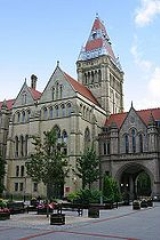
turned down his application due to poor grades in physics. Instead he studied English language and literature at the Victoria University of Manchester from 1937–1940, graduating with a
Bachelor of ArtsBachelor of Arts , from the Latin artium baccalaureus, is a bachelor's degree awarded for an undergraduate course or program in either the liberal arts, the sciences or both....
. His thesis was on the subject of
MarloweChristopher Marlowe was an English dramatist, poet and translator of the Elizabethan era. The foremost Elizabethan tragedian next to William Shakespeare, he is known for his blank verse, his overreaching protagonists, and his mysterious and untimely death.A warrant was issued for Marlowe's arrest...
's
Doctor FaustusThe Tragical History of Doctor Faustus, normally known simply as Doctor Faustus, is a play by Christopher Marlowe, based on the Faust story, in which a man sells his soul to the devil for power and knowledge...
, and he graduated with an upper second-class honours which he was disappointed about. One of his professors at the University was A.J.P. Taylor; grading one of Burgess's term papers, he wrote: "Bright ideas insufficient to conceal lack of knowledge". Burgess first met Llewela Isherwood Jones at Victoria University of Manchester, where she was studying economics, politics and modern history, graduating in 1942 with an upper second-class. The two married on 22 January 1942.
Military service
Burgess spent six weeks in 1940 as an army recruit in Eskbank, before becoming a Nursing Orderly Class 3 in the
Royal Army Medical CorpsThe Royal Army Medical Corps is a specialist corps in the British Army which provides medical services to all British Army personnel and their families in war and in peace...
. During his service, he was unpopular, and was involved in incidents such as knocking off a corporal's cap and polishing the floor of a corridor to make people slip. In 1942 he asked to be transferred to the Army Educational Corps, and despite his loathing of authority he was promoted to sergeant. During the
blackoutA blackout during war, or apprehended war, is the practice of collectively minimizing outdoor light, including upwardly directed light. This was done in the 20th century to keep the crews of enemy aircraft from being able to navigate to their targets simply by sight...
, his pregnant wife Lynne was attacked by four GI deserters, and as a result lost the child and suffered a broken finger. Burgess, stationed at the time in
GibraltarGibraltar is a self-governing British overseas territory located on the southern end of the Iberian Peninsula and Europe at the entrance of the Mediterranean overlooking the Strait of Gibraltar. The territory covers and shares a land border with Spain to the north...
, was denied leave to see her.
At his stationing in Gibraltar, he worked as a training college lecturer in speech and drama, teaching German, Russian, French and Spanish. An important role was the help he gave in taking troops through "The British Way and Purpose" programme, which was designed to reintroduce them to the peacetime socialism of the post-war years in Britain. He was also an instructor for the Central Advisory Council for Forces Education of the
Ministry of EducationThe Ministry of Education was a central government department in the United Kingdom. It was previously called the Board of Education.- See also :* Department for Education and Skills, created in 2001 until 2007...
. Burgess's flair for languages was noticed by army intelligence, and he took part in debriefings of Free Dutch and Free French who found refuge in Gibraltar during the war. On one occasion in the neighbouring Spanish town of
La Línea de la ConcepciónLa Línea de la Concepción is a town in Spain, in the province of Cádiz in Andalucia. It lies on the eastern isthmus of the Bay of Gibraltar on the border with the British overseas territory of Gibraltar, with which it has close economic and social links...
, he was arrested for insulting General Franco. He was released from custody shortly after the incident. In 1941 Burgess was pursued by military police of the
British Armed ForcesThe armed forces of the United Kingdom, known as His/Her Majesty's Armed Forces or sometimes the British Armed Forces, and sometimes legally the Armed Forces of the Crown, encompasses a navy, an army, and an air force...
for desertion after overstaying his leave from Morpeth military base with his bride Lynne.
Early teaching career
Burgess left the army in 1946 with the rank of sergeant-major, and was for the next four years a lecturer in speech and drama at the Mid-West School of Education near
WolverhamptonWolverhampton is a city and metropolitan borough of the West Midlands, England. In 2004, the local government district had an estimated population of 239,100; the wider Urban Area had a population of 251,462, which makes it the 13th most populous city in England.Historically a part of...
and at the Bamber Bridge Emergency Teacher Training College near
PrestonPreston is a city and non-metropolitan district of Lancashire, in North West England. It is located on the north bank of the River Ribble, and was granted city status in 2002, becoming England's 50th city in the 50th year of Queen Elizabeth II's reign...
.
In late 1950 he worked as a
secondary schoolSecondary school is a term used to describe an educational institution where the final stage of compulsory schooling, known as secondary education, takes place. It follows on from elementary or primary education....
teacher at Banbury Grammar School now
Banbury SchoolBanbury School is a mixed, multi-heritage, fully comprehensive school with 1650 students situated on Ruskin Road, in the Easington ward of Banbury, Oxfordshire, England. The school is a specialist Humanities College....
, teaching English literature. In addition to his teaching duties Burgess was required to occasionally supervise sports, and he also ran the school's drama society. He organised a number of amateur theatrical events in his spare time. These involved local people and students and included productions of
T. S. EliotThomas Stearns Eliot, OM , was a poet, playwright, and literary critic. He received the Nobel Prize in Literature in 1948. Among his most famous writings are The Love Song of J...
's
Sweeney Agonistes.
With financial assistance provided by Lynne's father, the couple was able to put a down payment on a cottage in the village of
AdderburyAdderbury is a village and civil parish in northern Oxfordshire, England. It is about south of Banbury and from Junction 10 of the M40 motorway. The village is divided in two by the Sor Brook. The village consists of two neighbourhoods: West Adderbury and East Adderbury...
, close to
BanburyBanbury is a market town and civil parish in the district of Cherwell in northern Oxfordshire, England, located on the River Cherwell. It lies northwest of London, southeast of Birmingham, south of Coventry and north northwest of the county town of Oxford...
. He named the cottage "Little Gidding", after one of Eliot's
Four QuartetsFour Quartets is a set of four poems written by T. S. Eliot that were published individually over a six-year period. The first poem, "Burnt Norton", was written and published with a collection of his early works following the production of Eliot's play, Murder in the Cathedral...
and
Aldous HuxleyAldous Leonard Huxley was an English writer and one of the most prominent members of the famous Huxley family. He spent the later part of his life in the United States, living in Los Angeles from 1937 until his death in 1963...
's
The Gioconda Smile. In Adderbury Burgess cut his journalistic teeth, with several of his contributions published in the local newspaper the
Banbury Guardian.
Malaya
In 1954 Burgess joined the British Colonial Service as a teacher and education officer in
MalayaThe Federation of Malaya , is the name given to a federation of 11 states that existed from 31 January 1948 until 16 September 1963. Comprising the nine Malay states and the British settlements of Penang and Malacca, it was eventually superseded by Malaysia.-History:From 1946 to 1948, the 11...
. He was initially stationed at
Kuala KangsarKuala Kangsar is the royal town of Perak, Malaysia, located at the downstream of Kangsar River, where it flows into the Perak River. It is the main town in the administrative district of Kuala Kangsar.- History :...
in
PerakPerak is one of the 13 states of Malaysia. It is the second largest state in Peninsular Malaysia bordering Kedah and Yala Province of Thailand to the north, Penang to the northwest, Kelantan and Pahang to the east, Selangor southward and to the west by the Strait of Malacca.Perak means silver in...
, in what were then known as the
Federated Malay StatesThe Federated Malay States was a federation of four protected states in the Malay Peninsula—Selangor, Perak, Negeri Sembilan and Pahang—established by the British government in 1895, which lasted until 1946, when they, together with the Straits Settlements and the Unfederated Malay...
. Here he taught at the
Malay CollegeThe Malay College Kuala Kangsar is a residential school in Malaysia. It is an all-boys and all-Malay school located in the royal town of Kuala Kangsar, Perak...
, dubbed "the Eton of the East" and now known as Malay College Kuala Kangsar (MCKK). In addition to his teaching duties, he had responsibilities as a
housemasterThe house system is a traditional feature of British schools, and schools in ex-British colonies. Historically it was associated with established public schools, where a 'house' refers to a boarding house or dormitory of a boarding school...
in charge of students of the
preparatory schoolIn English language usage in the former British Empire, the present-day Commonwealth, a preparatory school is an independent school preparing children up to the age of eleven or thirteen for entry into fee-paying, secondary independent schools, some of which are known as public schools...
, who were housed at a
VictorianThe term Victorian architecture can refer to one of a number of architectural styles predominantly employed during the Victorian era. As with the latter, the period of building that it covers may slightly overlap the actual reign, 20 June 1837 – 22 January 1901, of Queen Victoria after whom it is...
mansion known as "King's Pavilion".
After a dispute with the Malay College's principal over his accommodation, Burgess was posted elsewhere. He and his wife had occupied a noisy apartment where privacy was supposedly minimal, and this caused resentment. This was the professed reason for his transfer to the Malay Teachers' Training College at
Kota BharuKota Bharu , a city in Malaysia, is the state capital and Royal City of Kelantan. It is also the name of the territory in which Kota Bharu City is situated. The name means 'new city' or 'new castle/fort' in Malay. Kota Bharu is situated in the northeastern part of Peninsular Malaysia, and lies...
,
KelantanKelantan is a state of Malaysia. The capital and royal seat is Kota Bharu. The Arabic honorific of the state is Darul Naim, ....
.
Burgess attained fluency in Malay, spoken and written, achieving distinction in the examinations in the language set by the colonial office. He was rewarded with a salary increment for his proficiency in the language. Malay was still at that time rendered in the adapted Arabic script known as Jawi.
He devoted some of his free time in Malaya to creative writing "as a sort of gentlemanly hobby, because I knew there wasn't any money in it" and published his first novels,
Time for a TigerTime for a Tiger is part one of Anthony Burgess's Malayan Trilogy The Long Day Wanes, "the first panel of a triptych" set in the twilight of British rule of the peninsula....
,
The Enemy in the BlanketThe Enemy in the Blanket is the second novel in Anthony Burgess's Malayan Trilogy The Long Day Wanes. The idiom in the title signifies "traitor" while also alluding to the struggles of marriage...
and
Beds in the EastBeds in the East is the third novel in Anthony Burgess's Malayan Trilogy The Long Day Wanes. It was published in 1959.The title is taken from a line spoken by Mark Antony in Antony and Cleopatra, act 2, scene 6: "The beds i' the east are soft; and thanks to you,/That call'd me timelier than my...
. These became known as
The Malayan Trilogy and were later published in one volume as
The Long Day WanesThe Long Day Wanes: A Malayan Trilogy, also published as The Malayan Trilogy, is Anthony Burgess's novel cycle about the withdrawal from empire....
. During his time in the East he also wrote
English Literature: A Survey for Students, and this book was in fact the first Burgess work published.
Borneo
After a brief period of leave in Britain during 1958, Burgess took up a further Eastern post, this time at the Sultan Omar Ali Saifuddin College in
Bandar Seri BegawanBandar Seri Begawan, estimated population 27,285 , is the capital and largest city of the Sultanate of Brunei.-History:...
,
BruneiBrunei , officially the State of Brunei Darussalam or the Nation of Brunei, the Abode of Peace , is a country located on the north coast of the island of Borneo, in Southeast Asia...
, a sultanate on the northern coast of the island of
BorneoBorneo is the third largest island in the world and is located at the centre of Maritime Southeast Asia. Administratively, this island is divided among Indonesia , Malaysia and Brunei . Indonesians refer to the island as Kalimantan...
. Brunei had been a British protectorate since 1888, and was not to achieve independence until 1984. In the sultanate Burgess sketched the novel that, when it was published in 1961, was to be entitled
Devil of a StateDevil of a State is a 1961 novel by Anthony Burgess based on his experience living and working in Bandar Seri Begawan in the Southeast Asian sultanate of Brunei, on the island of Borneo, in 1958-59....
. Although it dealt with Brunei, for libel reasons the action had to be transposed to an imaginary East African territory the like of
ZanzibarZanzibar is a semi-autonomous part of the United Republic of Tanzania, in East Africa. It comprises the Zanzibar Archipelago in the Indian Ocean, off the coast of the mainland, and consists of numerous small islands and two large ones: Unguja , and Pemba...
.
About this time Burgess "collapsed" in a Brunei classroom while teaching history. He reports that he was diagnosed as having an inoperable brain tumour. Burgess claimed that he was given just a year to live, prompting him to write several novels to get money to provide for his widow.
He gave a different account to
Jeremy IsaacsSir Jeremy Isaacs is a British television producer and executive, winner of many BAFTA awards and international Emmy Awards. He was also General Director of the Royal Opera House, Covent Garden .-Early life:...
in 1987 when he said: "I was driven out of the Colonial Service for political reasons that were disguised as clinical reasons." He alluded to this in an interview with
Don SwaimDon Swaim is an American journalist and broadcaster.Born in Kansas, Swaim earned a degree in broadcast journalism from Ohio University and worked as editor, writer, producer, reporter and anchor at WCBS in New York and CBS in Baltimore....
, explaining that his wife Lynne had said something "obscene" to the UK Queen's consort, the Duke of Edinburgh, during an official visit, and the colonial authorities turned against him. He had already earned their displeasure, he told Swaim, by writing articles in the newspaper in support of the revolutionary opposition party the
Parti Rakyat BruneiThe Brunei People's Party is a banned political party in Brunei.PRB was established as a left leaning party in 1956 and aimed to bring Brunei into full independence from the United Kingdom...
, and for his friendship with its leader Dr. Azahari.
Repatriate years
Burgess was later repatriated and relieved of his position in Brunei. He spent some time in the neurological ward of a London hospital (see
The Doctor is SickThe Doctor is Sick is a 1960 novel by Anthony Burgess.According to his autobiography, Burgess composed the book in just six weeks. He wrote it after his return to England from Malaya in a burst of literary activity that also produced Devil of a State, A Clockwork Orange, The Right to an Answer and...
) where he underwent cerebral tests that proved negative. On his discharge, benefiting from a sum of money his wife had inherited from her father, together with their savings built up over six years in the East, he decided to become a full-time writer.
The couple lived first in an apartment in the town of
HoveHove is a town on the south coast of England, immediately to the west of its larger neighbour Brighton, with which it forms the unitary authority Brighton and Hove. It forms a single conurbation together with Brighton and some smaller towns and villages running along the coast...
, near
BrightonBrighton is a town in the city of Brighton and Hove in East Sussex on the south coast of Great Britain...
. They later moved to a semi-detached house called "Applegarth" in
EtchinghamEtchingham is a village and civil parish in the Rother District located in East Sussex, southern England. The village is located approximately twelve miles north-west of Hastings, on the A265, half a mile west of its junction with the A21....
, approximately a mile from the Jacobean house where
Rudyard KiplingRudyard Kipling was a British author and poet. Born in Bombay, British India, he is best known for his works of fiction The Jungle Book , Kim , many short stories, including The Man Who Would Be King ; and his poems, including...
lived in
BurwashBurwash is a village and civil parish in the Rother District of East Sussex, England. It is located five miles south-west of Hurst Green, on the A265 road, and on the River Dudwell, a tributary of the River Rother....
, and one mile from the
RobertsbridgeRobertsbridge is a village in East Sussex, England within the civil parish of Salehurst and Robertsbridge. It is approximately ten miles north of Hastings and thirteen miles south-east of Tunbridge Wells...
home of
Malcolm MuggeridgeThomas Malcolm Muggeridge was a British journalist, author, satirist, media personality, soldier-spy and, in his later years, a Christian convert and writer.- Biography :...
.
Upon the death of his father-in-law, he and his wife used their inheritance and decamped to a terraced town house in
ChiswickChiswick is an area of West London, located west of Charing Cross, which covers the eastern part of the London Borough of Hounslow. The area is identified in the London Plan as one of 35 major centres in Greater London....
. This provided convenient access to the
White City-Australia:* White City Woodville, a football club from the South Australian Super League* White City Football Club, a football club from the NSW Conference League South...
BBC television studios in which he later became a frequent guest. During these years Burgess became a regular drinking partner of the novelist
William S. BurroughsWilliam Seward Burroughs II was an American novelist, essayist, social critic, painter and spoken word performer.Much of Burroughs's work is semi-autobiographical, drawn from his experiences as an opiate addict, a condition that marked the last fifty years of his life...
. Their meetings took place in London and Tangiers.
A cruise holiday Burgess and his wife took to
LeningradLeningrad is the former name of Saint Petersburg, Russia.Leningrad may also refer to:Places:* Leningrad Oblast, a federal subject of Russia, around Saint Petersburg* Leningrad, Tajikistan, capital of Muminobod district in Khatlon Province...
in the USSR, resulted in
Honey for the BearsHoney for the Bears is a 1963 novel by Anthony Burgess.-Plot summary:Antique dealer Paul Hussey and his US wife Belinda travel to Leningrad for a holiday, but with a view to making a little money on the side by flogging dresses on the Soviet black market...
and inspired some of the invented slang "
NadsatNadsat is a fictional register or argot used by the teenagers in Anthony Burgess's novel A Clockwork Orange. In addition to being a novelist, Burgess was also a linguist and he used this background to depict his characters as speaking a form of Russian-influenced English...
" used in
A Clockwork OrangeA Clockwork Orange is a dystopian novel by Anthony Burgess.The title is taken from an old Cockney expression, "as queer as a clockwork orange".¹, and alludes to the prevention of the main character's exercise of his free will through the use of a classical conditioning technique...
.
Liana MacellariLiliana "Liana" Macellari was born at Porto Civitanova, Marche, Italy, and was the daughter of photographer and actor Gilberto Macellari and Contessa Lucrezia Pasi della Pergola....
, an Italian translator 12 years younger than Burgess, came across Burgess' novels
Inside Mr Enderby and
A Clockwork Orange while writing about English fiction. The two first met in 1963 over lunch in
ChiswickChiswick is an area of West London, located west of Charing Cross, which covers the eastern part of the London Borough of Hounslow. The area is identified in the London Plan as one of 35 major centres in Greater London....
. They began an affair and in 1964, Liana gave birth to Burgess' son, Paolo Andrea. The affair was hidden from his now alcoholic wife, with Burgess refusing to leave her for fear of offending his cousin
George Patrick DwyerGeorge Patrick Dwyer was Roman Catholic Archbishop of Birmingham from 1965 to 1981.The son of John William Dwyer, a wholesale egg and potato merchant, and his wife Jemima, he was educated at St Bede's College, Manchester , then at the Venerable English College, Rome after being accepted by the...
, then Catholic
Bishop of LeedsThe Bishop of Leeds is the Ordinary of the Roman Catholic Diocese of Leeds in the Province of Liverpool.The diocese covers an area of 4,075 km² of the County of West Yorkshire, parts of North Yorkshire, Cumbria, Greater Manchester, Humberside and Lancashire...
. Lynne Burgess died from cirrhosis of the liver, on 20 March 1968. Six months later, in September 1968, Burgess married Liana. He then acknowledged the four year old boy as his own, although the birth certificate listed Roy Halliday, who was previously Liana's companion, as the father.
An attempt to kidnap Paolo-Andrea in Rome is believed to have been one of the factors influencing the family's move to Monaco. Paolo Andrea (also known as Andrew Burgess Wilson) died in London in 2002, aged 37.
Tax exile
To avoid the 90% tax the family would have incurred due to their high income, they left Britain. During their travels through France and across the Alps, Burgess wrote in the back of the van as Liana drove. In this period, he wrote novels and produced film scripts for
Lew GradeLew Grade, Baron Grade , born Lev Winogradsky, was an influential Ukraine-born English impresario and media mogul.-Early years:...
and
Franco ZeffirelliFranco Zeffirelli is an Italian film director. He is also an opera director, designer and producer of opera, theatre, film and television, and a politician....
.
His first place of residence after leaving England was
LijaLija is a small village on the island of Malta. It forms part of the Three villages of Malta, along with Attard and Balzan. Lija has a baroque parish church and seven other small chapels...
,
MaltaMalta , officially the Republic of Malta , is a densely populated developed European country in the European Union. The Southern European island nation is an archipelago that includes the inhabited islands of Malta, Gozo and Comino, along with a number of smaller, uninhabited islands...
(1968-1970), where he bought a house. Problems with the Maltese state censor later prompted a move to Rome. He maintained a flat in the Italian capital, a country house in
BraccianoBracciano is a small town in the Italian region of Lazio, 30 km northwest of Rome. The town is famous for its volcanic lake and for a particularly well-preserved medieval castle...
, and a property in Montalbuccio. There was a villa in
ProvenceProvence is a region of southeastern France on the Mediterranean adjacent to Italy. It is part of the administrative région of Provence-Alpes-Côte d'Azur...
, in Callian of the Var, France, and an apartment just off
Baker StreetBaker Street is a street in the Marylebone district of the City of Westminster in London. It forms part of the A41. It is most famous for its connection to the fictional detective Sherlock Holmes, who lived at 221B Baker Street, an address that does not actually exist. The street is named after...
, London, very near the fictional home of
Sherlock HolmesSherlock Holmes is a fictional character of the late nineteenth and early twentieth centuries who first appeared in publication in 1887. He is the creation of British author and physician Sir Arthur Conan Doyle...
in the
Arthur Conan DoyleSir Arthur Ignatius Conan Doyle,
DL was a British physician and writer, most noted for his stories about the detective Sherlock Holmes, which are generally considered a major innovation in the field of crime fiction, and for the adventures of Professor Challenger...
stories.
Burgess lived for two years in the United States, working as a visiting professor at
Princeton UniversityPrinceton University a private university located in Princeton, New Jersey, United States. The school is one of the eight universities of the Ivy League and is considered one of the Colonial Colleges....
(1970), where he helped teach the creative writing program, and as a "distinguished professor" at the
City College of New YorkThe City College of the City University of New York is a senior college of the City University of New York , in New York City. It is also the oldest of the City University's twenty-three institutions of higher learning...
(1972). At City College he was a close colleague and friend of
Joseph HellerJoseph Heller was an American satirical novelist, short story writer and playwright. He wrote the influential novel Catch-22 about American servicemen during World War II...
. He went on to teach creative writing at
Columbia UniversityColumbia University in the City of New York is a private university in the United States and a member of the Ivy League. Columbia's main campus lies in the Morningside Heights neighborhood in the borough of Manhattan, in New York City...
. He was also a writer-in-residence at the
University of North Carolina at Chapel HillThe University of North Carolina at Chapel Hill is a public research university located in Chapel Hill, North Carolina, United States. The university is the oldest in, and flagship of, the University of North Carolina system...
(1969) and at the
University at BuffaloState University of New York at Buffalo, commonly known as the University at Buffalo or UB, is a public research university which has multiple campuses located in Buffalo and Amherst, New York, USA...
(1976). He lectured on the novel at the
University of IowaThe University of Iowa is a public research university located in Iowa City, Iowa. The university is organized into eleven colleges granting undergraduate, graduate, and professional degrees...
in 1975.
Eventually he settled in
MonacoMonaco , officially the Principality of Monaco , is a small sovereign city-state located in South Western Europe on the northern central coast of the Mediterranean Sea, having a land border on three sides only with France, and being about away from Italy. Its size is just under 2 km² with an...
, where he was active in the local community, becoming a co-founder in 1984 of the
Princess Grace Irish Library-Foundation and collections:Opened in November 1984 by Rainier III in honor of Princess Grace's Irish origins, it contains the princess's personal collection of Irish books and Irish-American sheet music.The library was co-founded by the novelist Anthony Burgess....
, a centre for Irish cultural studies.
Burgess spent much time also at one of his houses, a chalet two kilometres outside
LuganoLugano is a town in the south of Switzerland, in the Italian-speaking canton of Ticino, which borders Italy...
, Switzerland.
Death
Burgess died on 22 November 1993 from
lung cancerLung cancer is a disease of uncontrolled cell growth in tissues of the lung. This growth may lead to metastasis, which is the invasion of adjacent tissue and infiltration beyond the lungs. The vast majority of primary lung cancers are carcinomas of the lung, derived from epithelial cells...
, at the Hospital of St John & St Elizabeth in London. His ashes went to the cemetery in Monte Carlo.
The epitaph on Burgess's marble memorial stone, behind which the vessel with his remains is kept, reads "Abba Abba", being
- "Father, father" in Aramaic (Arabic and in Hebrew as well as in other Semitic languages), that is, an invocation to God as Father (Mark
The Gospel of Mark is the second of the four Canonical Gospels, but is believed by most contemporary scholars to be the first gospel written, on which the other two synoptic gospels, Matthew and Luke, were partially based....
14:36 etc.)
- Burgess's initials forwards and backwards
- part of the rhyme scheme for the Petrarchan sonnet
- the Burgess novel about the death of Keats, Abba Abba
Abba Abba was published in 1977. It is English writer Anthony Burgess's 22nd novel.The theme is the last months in the life of John Keats.-Plot summary:...
- the abba rhyme scheme that Tennyson used for his poem on death, In Memoriam
Eulogies at his memorial service at
St Paul's, Covent GardenSt Paul's Church, also commonly known as the Actors' Church, is a church located in Covent Garden, London, England.As well as being the parish church of Covent Garden, the church gained its nickname by a long association with the theatre community....
, London in 1994 were delivered by the journalist
Auberon WaughAuberon Alexander Waugh was a British author and journalist.-Life and career:Born at his maternal grandparents' house at Pixton Park, Dulverton, Somerset, he was known as "Bron" by friends and family. He was the second child and first son of the novelist Evelyn Waugh and his wife, Laura...
and the novelist
William BoydWilliam Boyd, CBE is a Scottish novelist and screenwriter.-Biography:Of Scottish descent, William Andrew Murray Boyd was born in Accra, Ghana on 7 March 1952 and spent much of his early life there and in Nigeria where his mother was a teacher and his father, a doctor, and he was in Nigeria during...
.
At his death he was a multi-millionaire, leaving a Europe-wide property portfolio of houses and apartments.
Novels
His Malayan trilogy
The Long Day WanesThe Long Day Wanes: A Malayan Trilogy, also published as The Malayan Trilogy, is Anthony Burgess's novel cycle about the withdrawal from empire....
was Burgess's first published venture into the art of fiction. Its three books are
Time for a TigerTime for a Tiger is part one of Anthony Burgess's Malayan Trilogy The Long Day Wanes, "the first panel of a triptych" set in the twilight of British rule of the peninsula....
,
The Enemy in the BlanketThe Enemy in the Blanket is the second novel in Anthony Burgess's Malayan Trilogy The Long Day Wanes. The idiom in the title signifies "traitor" while also alluding to the struggles of marriage...
and
Beds in the EastBeds in the East is the third novel in Anthony Burgess's Malayan Trilogy The Long Day Wanes. It was published in 1959.The title is taken from a line spoken by Mark Antony in Antony and Cleopatra, act 2, scene 6: "The beds i' the east are soft; and thanks to you,/That call'd me timelier than my...
.
It was Burgess's ambition to become "the true fictional expert on Malaya"; with the trilogy, he staked a claim to have written the definitive novel of the expatriate experience of Malaya.
The trilogy joined a family of Eastern fictional explorations, among them
OrwellEric Arthur Blair , better known by his pen name George Orwell, was an English novelist and journalist...
's treatment of Burma (
Burmese DaysBurmese Days is a novel by British writer George Orwell. It was first published in the USA in 1934. It is a tale about the waning days of British imperialism after World War I.-Background:...
), Forster's of India (
A Passage to IndiaA Passage to India is a novel by E. M. Forster set against the backdrop of the British Raj and the Indian independence movement in the 1920s. It was selected as one of the 100 great works of English literature by the Modern Library and won the 1924 James Tait Black Memorial Prize for fiction...
) and
GreeneHenry Graham Greene OM, CH was an English author, playwright and literary critic. His works explore the ambivalent moral and political issues of the modern world...
's of Vietnam (
The Quiet AmericanThe Quiet American is a novel by British author Graham Greene. It was adapted into films in 1958 and 2002.-Background:The Quiet American is one of Greene's later books, written in 1955, and draws on his experiences as a SIS agent spying for Britain in World War II in Sierra Leone in the early...
). In these works, Burgess was working in the tradition established by
KiplingRudyard Kipling was a British author and poet. Born in Bombay, British India, he is best known for his works of fiction The Jungle Book , Kim , many short stories, including The Man Who Would Be King ; and his poems, including...
for British India, and
ConradJoseph Conrad was a Polish-born British novelist, who in 1886 became a British subject....
and
MaughamWilliam Somerset Maugham , CH was an English playwright, novelist and short story writer...
for Southeast Asia.
Conrad, Maugham and Greene made no effort to learn local languages. But Burgess operated more in the mode of Orwell, who had a good command of
UrduUrdu is a Central Indo-Aryan language of the Indo-Iranian branch, belonging to the Indo-European family of languages. It is one of the two official languages of Pakistan. It is also one of the 22 scheduled languages of India and is an official language of five Indian states...
and
BurmeseThe Burmese language is the official language of Burma. Although the constitution officially recognizes it as the Myanmar language, most continue to refer to the language as Burmese. It is the native language of the Bamar and other related sub-ethnic groups of the Bamar...
(necessary for Orwell's work as a police officer) and Kipling, who spoke
HindiStandard Hindi, also known as High Hindi, Nagari Hindi or Literary Hindi is a standardised register of Hindi. It is one of the 22 languages with official status in India, and is used, along with English, for administration of the central government.Standard Hindi is a sanskritised register derived...
(having learnt it as a child). Like his fellow English expats in Asia, Burgess had excellent spoken and written command of his operative language(s), both as a novelist and speaker, including
MalayMalay is a group of languages closely related to each other to the point of mutual intelligibility but that linguists consider to be separate languages. They are grouped into a group called "Local Malay", part of a larger group called "Malayan" within the Malayo-Polynesian branch of the...
. (It may be argued that a respect and sensitivity for contexts both historical and cultural led to an enhanced understanding of the concerns of indigenous people in Burgess's Malayan trilogy.)
Burgess's repatriate years (c. 1960-69) produced not just
Enderby but the neglected
The Right to an AnswerThe Right to an Answer is a darkly comic 1960 novel by Anthony Burgess, the first of his repatriate years . One of its themes is the disillusionment of the returning exile.-Characters and plot:...
, which touches on the theme of death and dying, and
One Hand ClappingOne Hand Clapping is a 1961 work by Anthony Burgess published originally under the pseudonym Joseph Kell.The novel was intended as an indictment of what Burgess saw as the degradation of contemporary Western education and culture....
, a satire on the vacuity of popular culture. This period also witnessed the publication of
The Worm and the RingThe Worm and the Ring is a 1961 novel by English novelist Anthony Burgess, drawing on his time as a teacher at Banbury Grammar School, Oxfordshire, England, in the early 1950s.It is Burgess's version of the Ring Cycle...
, which had to be withdrawn from circulation under the threat of libel action from one of Burgess's former colleagues.
A product of these highly fertile years was his best-known (or most notorious, after
Stanley KubrickStanley Kubrick was an American director, writer, producer, and photographer of films, who lived in England during most of the last 40 years of his career...
made a
motion picture adaptationA Clockwork Orange is a 1971 satirical futuristic film adaptation of Anthony Burgess's 1962 novel A Clockwork Orange. The film concerns Alex DeLarge , a charismatic, psychopathic delinquent whose pleasures are classical music , rape, and ultra-violence...
), work the dystopian novel
A Clockwork OrangeA Clockwork Orange is a dystopian novel by Anthony Burgess.The title is taken from an old Cockney expression, "as queer as a clockwork orange".¹, and alludes to the prevention of the main character's exercise of his free will through the use of a classical conditioning technique...
(1962). Inspired initially by an incident during
World War IIWorld War II, or the Second World War , was a global military conflict which involved a majority of the world's nations, including all great powers, organized into two opposing military alliances: the Allies and the Axis...
in which his wife Lynne was allegedly robbed and assaulted in London during the blackout by deserters from the U.S. Army (an event that may have contributed to a miscarriage she suffered), the book was an examination of free will and morality. The young
anti-heroIn fiction, an antihero is a protagonist archetype whose character or goals are antithetical to traditional heroism. The term dates to 1714, although literary criticism identifies the trope in earlier literature. - History :...
, Alex, captured after a career of violence and mayhem, is given aversion conditioning to stop his violence. It makes him defenceless against other people and unable to enjoy music that, besides violence, had been an intense pleasure for him. In the non-fiction book
Flame Into Being (1985), Burgess described
A Clockwork Orange as "a jeu d'esprit knocked off for money in three weeks, it became known as the raw material for a film which seemed to glorify sex and violence. The film made it easy for readers of the book to misunderstand what it was about, and the misunderstanding will pursue me till I die."
Burgess followed this with
Nothing Like the SunNothing Like the Sun is a fictional biography of William Shakespeare by Anthony Burgess first published in 1964.The novel's title refers to the first line of Sonnet 130: "My mistress' eyes are nothing like the sun."...
, a fictional recreation of Shakespeare's love-life and an examination of the (partly syphilitic, it was implied) sources of the bard's imaginative vision. The novel, which made use of Edgar I. Fripp's 1938 biography
Shakespeare, Man and Artist, won critical acclaim and placed Burgess in the front rank of novelists of his generation.
By the 1970s his output had become highly experimental, and there was a falling-off in the quality of his work in the period between the release of the
Clockwork Orange movie and the end of the decade.
The bold and extraordinarily complex
M/FM/F is a 1971 novel by the English author Anthony Burgess.-Plot introduction:Miles Faber is to spend some time on vacation before inheriting the company that belonged to his late father....
(1971) showed the influence of
Claude Lévi-StraussClaude Lévi-Strauss is a French-Jewish anthropologist.-Biography:Claude Lévi-Strauss, born in Brussels, grew up in Paris, living in a street of the 16th arrondissement named after the artist Claude Lorrain, whose work he later admired and wrote about...
and the structuralists, and was later listed by the writer himself as one of the works of which he was most proud.
Beard's Roman WomenBeard's Roman Women is a 1977 novel by British novelist Anthony Burgess.Dated "Montalbuccio-Monte Carlo-Eze-Callian, Summer 1975", according to Burgess it was written in the back of his Bedford Dormobile and "partly in the bedroom of a small hotel run by Swiss homosexuals" .The novel is set in La...
is considered to be his least successful novel (plea of mitigation: it was written entirely while on the road in his
Bedford DormobileThe Bedford Dormobile is a 1960s-era campervan conversion based on the Bedford CA van, and subsequently on the Bedford CF. It was manufactured in Folkestone in Kent, southern England, by Martin Walter....
campervan). Burgess has frequently been criticised for writing too many novels and too quickly. All the same,
BeardBeard's Roman Women is a 1977 novel by British novelist Anthony Burgess.Dated "Montalbuccio-Monte Carlo-Eze-Callian, Summer 1975", according to Burgess it was written in the back of his Bedford Dormobile and "partly in the bedroom of a small hotel run by Swiss homosexuals" .The novel is set in La...
was revealing on a personal level, dealing with the death of his first wife, his bereavement, and the affair that led to his second marriage.
In another ambitious modernist fictional expedition,
Napoleon SymphonyNapoleon Symphony: A Novel in Four Movements is Anthony Burgess's fictional recreation of the life and world of Napoleon Bonaparte, first published in 1974...
, Burgess brought
BonaparteThe House of Bonaparte is an imperial and royal European dynasty founded by Napoleon I of France in 1804, a Corsican military leader who rose to notability out of the French Revolution and transformed the French Republic into the First French Empire within five years of his coup d'état...
to life by shaping the novel's structure on
BeethovenLudwig van Beethoven was a German composer and pianist. He was a crucial figure in the transitional period between the Classical and Romantic eras in Western classical music, and remains one of the most acclaimed and influential composers of all time.Born in Bonn, of the Electorate of Cologne and...
's
EroicaThe Symphony No. 3 in E flat major by Ludwig van Beethoven is a musical work sometimes cited as marking the end of the Classical Era and the beginning of musical Romanticism....
symphony. This daring fictional experiment contains a portrait of an
ArabArab people or Arabs are an ethnic group whose members identify along linguistic, cultural or genealogical grounds...
and
Muslim:A Muslim , , is an adherent of the religion of Islam. The feminine form is Muslimah . Literally, the word means "one who submits ". Muslim is the participle of the same verb of which Islam is the infinitive. Muslims believe that there is only one God, translated in Arabic as Allah...
society under occupation by a Christian western power (
EgyptEgypt , officially the Arab Republic of Egypt, is a country mainly in North Africa, with the Sinai Peninsula forming a land bridge in Western Asia...
by
CatholicThe Catholic Church, also known as the Roman Catholic Church, is the world's largest Christian church. With more than a billion members, over half of all Christians and more than one-sixth of the world's population, the Catholic Church is a communion of the Western, or Latin Rite Church, and...
FranceThe French Empire
, also known as the Greater French Empire or First French Empire, but more commonly known as the Napoleonic Empire, was the empire of Napoleon I in France...
). The novel showed that while Burgess always regarded himself as little more than a student and epigone of
JoyceJames Augustine Aloysius Joyce was an Irish expatriate author, playwright and poet of the 20th century. He is known for his landmark novel Ulysses and its controversial successor Finnegans Wake , as well as the short story collection Dubliners and the semi-autobiographical novel A Portrait of...
, he was at times able to equal the master of modernism in literary sophistication and range.
There was a return to form in the 1980s, when religious themes began to weigh heavily (see
The Kingdom of the WickedThe Kingdom of the Wicked is a 1985historical novel by Anthony Burgess.Like two of his earlier works, the long narrative poem Moses and the novel Man of Nazareth , Burgess wrote The Kingdom of the Wicked in part as preparation for a screenplay; in this case for thetelevision...
and
Man of NazarethMan of Nazareth is a historical novel by Anthony Burgess based on his screenplay for Franco Zeffirelli's TV miniseries Jesus of Nazareth...
as well as
Earthly PowersEarthly Powers is a panoramic saga of the 20th century by Anthony Burgess first published in 1980. On one level it is a parody of a "blockbuster" novel, with the 81-year-old hero, Kenneth Toomey , telling the story of his life in 81 chapters...
). Though Burgess lapsed from Catholicism early in his youth, the influence of the Catholic "training" and worldview remained strong in his work all his life. This is notable in the discussion of free will in
A Clockwork OrangeA Clockwork Orange is a dystopian novel by Anthony Burgess.The title is taken from an old Cockney expression, "as queer as a clockwork orange".¹, and alludes to the prevention of the main character's exercise of his free will through the use of a classical conditioning technique...
, and in the apocalyptic vision of devastating changes in the
Catholic ChurchThe Catholic Church, also known as the Roman Catholic Church, is the world's largest Christian church. With more than a billion members, over half of all Christians and more than one-sixth of the world's population, the Catholic Church is a communion of the Western, or Latin Rite Church, and...
— due to what can be understood as
SatanSatan is an embodiment of antagonism that originates from the Abrahamic religions, being traditionally considered an angel in Judeo-Christian belief, and a Jinn in Islamic belief...
ic influence—in
Earthly PowersEarthly Powers is a panoramic saga of the 20th century by Anthony Burgess first published in 1980. On one level it is a parody of a "blockbuster" novel, with the 81-year-old hero, Kenneth Toomey , telling the story of his life in 81 chapters...
(1980). That work was written as a parody of the blockbuster novel.
He kept working through his final illness, and was writing on his deathbed. A late novel was
Any Old IronAny Old Iron, Anthony Burgess's epic updating of the Excalibur legend, was published in 1988.Among the historical figures fictionalized in the novel are Chaim Weizmann, A. J...
, a generational saga about two families, one Russian-Welsh, the other Jewish. It encompasses the sinking of the Titanic, World War I, the Russian Revolution, the Spanish Civil War, World War II, and the early years of the State of Israel, as well as the imagined rediscovery of King Arthur's Excalibur.
A Dead Man in DeptfordA Dead Man in Deptford was written late in Anthony Burgess's life, and is the last of his novels to be published during his lifetime.It depicts the life and character of Christopher Marlowe, one of the greatest playwrights of the Elizabethan era....
, about Christopher Marlowe, a companion volume to his Shakespeare novel
Nothing Like the SunNothing Like the Sun is a fictional biography of William Shakespeare by Anthony Burgess first published in 1964.The novel's title refers to the first line of Sonnet 130: "My mistress' eyes are nothing like the sun."...
. The verse novel
ByrneByrne is the English author Anthony Burgess's last novel, written partly on his deathbed and published posthumously in 1995.The story follows the fluctuating fortunes of Michael Byrne, a pornographer and artist who becomes a servant of the Nazi regime in 1930s Germany.Michael Byrne is an Irish man...
was published posthumously.
Criticism
Burgess began his career as a critic. Aimed at newcomers to the subject,
English LiteratureEnglish literature is the literature written in the English language, including literature composed in English by writers not necessarily from England; Joseph Conrad was born in Poland, Robert Burns was Scottish, James Joyce was Irish, Dylan Thomas was Welsh, Edgar Allan Poe was American, V.S....
, A Survey for Students is still used in schools today. He followed this with
The NovelA novel is a long narrative in literary prose. The genre has historical roots both in the fields of the medieval and early modern romance and in the tradition of the novella. The latter supplied the present generic term in the late 18th century....
To-day and
The Novel Now: A Student's Guide to Contemporary FictionFiction is a branch of literature which deals, in part or in whole, with temporally contrafactual events...
.
Then came the
JoyceJames Augustine Aloysius Joyce was an Irish expatriate author, playwright and poet of the 20th century. He is known for his landmark novel Ulysses and its controversial successor Finnegans Wake , as well as the short story collection Dubliners and the semi-autobiographical novel A Portrait of...
studies
Here Comes Everybody: An Introduction to James Joyce for the Ordinary Reader (also published as
Re Joyce) and
Joysprick: An Introduction to the Language of James JoyceJoysprick: An Introduction to the Language of James Joyce is a work of literary criticism by Anthony Burgess. It was first published in 1973....
. Also published was
A Shorter 'Finnegans WakeFinnegans Wake is a work of comic fiction by Irish author James Joyce, significant for an experimental style, and its resulting reputation as one of the most difficult works of fiction in the English language. Written in Paris over a period of 17 years, and published in 1939, two years before the...
, Burgess's abridgement.
His 1970 Encyclopædia BritannicaThe Encyclopædia Britannica is a general English-language encyclopaedia published by Encyclopædia Britannica, Inc., a privately held company. The articles in the Britannica are aimed at educated adult readers, and written by a staff of about 100 full-time editors and more than...
entry on the novel (under "Novel, the") is regarded as a classic of the genre.
Burgess wrote full-length critical studies of William Shakespeare, Ernest Hemingway and D. H. Lawrence. His Ninety-Nine NovelsAnthony Burgess's book Ninety-Nine Novels: The Best in English since 1939 — A Personal Choice covers a 44-year span between 1939 and 1983. Burgess was a prolific reader, in his early career reviewing more than 350 novels in just over two years for the Yorkshire Post...
: The Best in English since 1939
remains a useful guide, while the published lecture Obscenity and the Arts
explores issues of pornography.
Linguistics
"Burgess's linguistic training," wrote Raymond Chapman and Tom McArthur in The Oxford Companion to the English Language
, "is shown in dialogue enriched by distinctive pronunciations and the niceties of register."
His interest in linguistics was reflected in the invented, Anglo-Russian teen slangSlang is the use of highly informal words and expressions that are not considered standard in the speaker's dialect or language. It is often used as a way to say words that are not appropriate, and is not often found in the standard dictionary for the language...
of A Clockwork Orange
(NadsatNadsat is a fictional register or argot used by the teenagers in Anthony Burgess's novel A Clockwork Orange. In addition to being a novelist, Burgess was also a linguist and he used this background to depict his characters as speaking a form of Russian-influenced English...
), and in the movie Quest for Fire----Quest for Fire is a 1981 film based on the 1911 French novel by J.-H. Rosny aîné . Directed by Jean-Jacques Annaud and adapted by Gérard Brach, the film stars Everett McGill, Ron Perlman, Nameer El-Kadi, and Rae Dawn Chong. It won the Academy Award for Makeup. Michael D...
(1981), for which he inventedA planned or constructed language—known colloquially or informally as a conlang—is a language whose phonology, grammar, and/or vocabulary have been consciously devised by an individual or group, instead of having evolved naturally...
a prehistoric language (Ulam
) for the characters to speak.
The hero of The Doctor is SickThe Doctor is Sick is a 1960 novel by Anthony Burgess.According to his autobiography, Burgess composed the book in just six weeks. He wrote it after his return to England from Malaya in a burst of literary activity that also produced Devil of a State, A Clockwork Orange, The Right to an Answer and...
, Dr. Edwin Spindrift, is a lecturer in linguistics. He escapes from a hospital ward which is peopled, as the critic Saul Maloff put it in a review, with "brain cases who happily exemplify varieties of English speech."
Burgess, who had lectured on phonetics at the University of Birmingham in the late 1940s, investigates the field of linguistics in Language Made PlainLanguage Made Plain by Anthony Burgess is a brief overview of the field of linguistics. Without dealing specifically with any one language, it provides an introduction to semantics, phonetics, and the development of language....
and A Mouthful of AirA Mouthful of Air: Language and Languages, Especially English is a work on the subject of linguistics by Anthony Burgess. It was first published in August 1993....
.
Screenwriting
Burgess wrote the screenplays for Moses the LawgiverMoses the Lawgiver was a 1975 TV mini-series directed by Gianfranco De Bosio and starring Burt Lancaster, with screenplay by Vittorio Bonicelli and Anthony Burgess, and music by Ennio Morricone.- Cast :* Burt Lancaster as Moses* Anthony Quayle as Aaron...
(Gianfranco De Bosio 1975, with Burt Lancaster, Anthony Quayle and Ingrid Thulin), Jesus of Nazareth
(Franco Zeffirelli 1977, with Robert Powell, Olivia Hussey and Rod Steiger), and A.D.A.D. is a British/Italian miniseries from 1985 in 6 parts which tells the Acts of the Apostles. Considered as the third and final installment in a TV miniseries trilogy which began with Moses the Lawgiver and Franco Zeffirelli's Jesus of Nazareth , it was adapted from Anthony Burgess's novel The...
(Stuart Cooper 1985, with Ava Gardner, Anthony Andrews and James Mason).
He devised the Stone AgeThe Stone Age is a broad prehistoric time period during which humans widely used stone for toolmaking.Stone tools were made from a variety of different sorts of stone. For example, flint and chert were shaped for use as cutting tools and weapons, while basalt and sandstone were used for ground...
language for La Guerre du Feu
(Quest for Fire
) (Jean-Jacques Annaud 1981, with Everett McGill, Ron Perlman and Nicholas KadiNicholas Kadi is a Turkish-born Iraqi American actor.Kadi was born in Istanbul, Turkey of Iraqi descent. His father, Nizar el Kadi, was an Iraqi ambassador....
).
Burgess was co-writer of the script for the TV series Sherlock Holmes and Doctor Watson
(1980).
He penned many unpublished scripts, including one about Shakespeare entitled Will!
or The Bawdy Bard
based on his novel Nothing Like The Sun
.
Among the motion picture treatments he produced are AmundsenAmundsen may refer to:* Roald Amundsen, the Norwegian polar explorer, or his namesakes:** in the Antarctic:*** Amundsen-Scott South Pole Station*** Amundsen Glacier, descending from the Queen Maud Mountains to the Ross Ice Shelf....
, Attila
, The Black Prince-Personal nicknames:* Edward, the Black Prince, English prince in the Middle Ages* Naresuan, King of Siam* Junio Valerio Borghese, Italian noble and military leader* Kostas Davourlis, Greek footballer* Peter Jackson , 19th century bare-knuckle boxer...
, Cyrus the GreatCyrus the Great , also known as Cyrus II of Persia and Cyrus the Elder, was the first Zoroastrian Persian Shāhanshāh...
, Dawn Chorus
, The Dirty Tricks of Bertoldo
, Eternal Life
, Onassis
, Puma
, Samson and Delila
, Schreber
, The Sexual Habits of the English Middle Class
, Shah
, That Man Freud
and Uncle Ludwig
.
Encouraged by his novel Tremor of IntentTremor of Intent: An Eschatological Spy Novel , by Anthony Burgess, is an English espionage novel. Burgess conceived it as a reaction to both the heavy-handed, humorless spy fiction of John le Carré and to Ian Fleming's James Bond, a character Burgess thought an imperialist relic...
(a parodyA parody , in contemporary usage, is a work created to mock, comment on, or poke fun at an original work, its subject, author, style, or some other target, by means of humorous, satiric or ironic imitation...
of James BondJames Bond 007 is a fictional character created in 1953 by writer Ian Fleming, who featured him in twelve novels and two short story collections. The character has also been used in the longest running and most financially successful English language film franchise to date, starting in 1962 with Dr...
adventures), Burgess wrote a screenplay for The Spy Who Loved MeThe Spy Who Loved Me is the tenth spy film in the James Bond series, and the third to star Roger Moore as the fictional MI6 agent James Bond. It was directed by Lewis Gilbert and the screenplay was written by Christopher Wood and Richard Maibaum...
. It was rejected.
Music
As Burgess put it, in the way that others might enjoy yachting or golf, "I write music." He was an accomplished musician and composed regularly throughout his life.
His works are infrequently performed today, but several of his pieces were broadcast during his lifetime on
BBC RadioBBC Radio is a service of the British Broadcasting Corporation which has operated in the United Kingdom under the terms of a Royal Charter since 1927...
. His Symphony (No. 3) in C was premiered by the
University of IowaThe University of Iowa is a public research university located in Iowa City, Iowa. The university is organized into eleven colleges granting undergraduate, graduate, and professional degrees...
orchestra in Iowa City in 1975. Many of his unpublished compositions are listed in This Man and Music
.
Sinfoni MelayuSinfoni Melayu is a symphony composed in 1956 by Anthony Burgess. It draws on many of the musical styles he encountered while he was living and working in Malaya. Burgess described it as an attempt to "combine the musical elements of the country into a synthetic language which called on native...
was described by Burgess, its composer, as an attempt to "combine the musical elements of the country into a synthetic language which called on native drums and xylophones".
The structure of Napoleon Symphony: A Novel in Four MovementsNapoleon Symphony: A Novel in Four Movements is Anthony Burgess's fictional recreation of the life and world of Napoleon Bonaparte, first published in 1974...
(1974) was modelled on BeethovenLudwig van Beethoven was a German composer and pianist. He was a crucial figure in the transitional period between the Classical and Romantic eras in Western classical music, and remains one of the most acclaimed and influential composers of all time.Born in Bonn, of the Electorate of Cologne and...
's Eroica symphonyThe Symphony No. 3 in E flat major by Ludwig van Beethoven is a musical work sometimes cited as marking the end of the Classical Era and the beginning of musical Romanticism....
, while Mozart and the Wolf GangMozart and the Wolf Gang is a 1991 novel by Anthony Burgess about the life and world of Wolfgang Amadeus Mozart.Among other things, it attempts to fictionalize Mozart's Symphony No.40....
(1991) mirrors the sound and rhythm of Mozartian composition, among other things attempting a fictional representation of Symphony No.40Wolfgang Amadeus Mozart wrote his Symphony No. 40 in G minor, KV. 550, in 1788.The 40th Symphony is sometimes referred to as the “Great” G minor symphony, to distinguish it from the “Little” G minor symphony, No. 25...
. Beethoven's Symphony No. 9The Symphony No. 9 in D minor, Op. 125 "Choral" is the final complete symphony of Ludwig van Beethoven. Completed in 1824, the symphony is one of the best known works of the Western classical repertoire and is considered one of Beethoven's greatest masterpieces.The symphony was the first example of...
features prominently in A Clockwork OrangeA Clockwork Orange is a dystopian novel by Anthony Burgess.The title is taken from an old Cockney expression, "as queer as a clockwork orange".¹, and alludes to the prevention of the main character's exercise of his free will through the use of a classical conditioning technique...
(and also in Stanley Kubrick's film versionA Clockwork Orange is a 1971 satirical futuristic film adaptation of Anthony Burgess's 1962 novel A Clockwork Orange. The film concerns Alex DeLarge , a charismatic, psychopathic delinquent whose pleasures are classical music , rape, and ultra-violence...
of the novel).
When Burgess was on the BBC's Desert Island DiscsDesert Island Discs is a long-running BBC Radio 4 programme. It was first broadcast on 29 January 1942 and is said by the Guinness Book of Records to be the longest-running music programme in the history of radio...
radio programme in 1966, he made the following choices: PurcellHenry Purcell , was an English Baroque composer. Purcell incorporated Italian and French stylistic elements but devised a peculiarly English style of Baroque music.-Early life and career:...
, Rejoice in the Lord Alway; BachJohann Sebastian Bach was a German composer and organist whose ecclesiastical and secular works for choir, orchestra, and solo instruments drew together the strands of the Baroque period and brought it to its ultimate maturity...
, Goldberg Variations No. 13; ElgarSir Edward William Elgar, 1st Baronet, OM, GCVO was an English composer. Several of his first major orchestral works, including the Enigma Variations and the Pomp and Circumstance Marches, were greeted with acclaim. He also composed oratorios, chamber music, symphonies, instrumental concertos,...
, Symphony No. 1 in A flat major; WagnerWilhelm Richard Wagner was a German composer, conductor, theatre director and essayist, primarily known for his operas...
, Walter's Trial Song from Die Meistersinger von Nürnberg;
DebussyAchille-Claude Debussy was a French composer. Along with Maurice Ravel, he was one of the most prominent figures working within the field of Impressionist music, though he himself intensely disliked the term when applied to his compositions...
, Fêtes; LambertLeonard Constant Lambert was a British composer and conductor.-Early life:Lambert was the son of Russian-born Australian painter George Lambert...
, The Rio Grande; WaltonSir William Turner Walton OM was a British composer and conductor.His style was influenced by the works of Stravinsky and Prokofiev as well as jazz music, and is characterized by rhythmic vitality, bittersweet harmony, sweeping Romantic melody and brilliant orchestration...
, Symphony No. 1 in B flat; and Vaughan WilliamsRalph Vaughan Williams OM was an English composer of symphonies, chamber music, opera, choral music, and film scores...
, On Wenlock Edge.
For a list of some of Burgess's musical compositions, see under List of Burgess' works.
Opera and musicals
Burgess produced a translation of Bizet's CarmenCarmen is a French opéra comique by Georges Bizet. The libretto is by Henri Meilhac and Ludovic Halévy, based on the novella of the same title by Prosper Mérimée, first published in 1845, itself influenced by the narrative poem The Gypsies by Alexander Pushkin...
which was performed by the English National OperaEnglish National Opera is is an opera company based in London, England, resident at the London Coliseum in St. Martin's Lane. It is one of the two principal opera companies in London, along with the Royal Opera, Covent Garden...
.
He created an operettaOperetta is a genre of light opera, light in terms both of music and subject matter. It is also closely related, in English-language works, to forms of musical theatre.-Operetta in French:...
based on James JoyceJames Augustine Aloysius Joyce was an Irish expatriate author, playwright and poet of the 20th century. He is known for his landmark novel Ulysses and its controversial successor Finnegans Wake , as well as the short story collection Dubliners and the semi-autobiographical novel A Portrait of...
's UlyssesUlysses is a novel by James Joyce, first serialized in parts in the American journal The Little Review from March 1918 to December 1920, then published in its entirety by Sylvia Beach on February 2, 1922, in Paris...
called Blooms of DublinBlooms of Dublin is a musical play or operetta by Anthony Burgess. The work was first performed for the Dublin Joyce Centenary in 1982 by BBC radio. The operetta is based on James Joyce's Ulysses....
(composed in 1982 and performed on the BBC), and wrote the book for the 1973 BroadwayBroadway Theatre, commonly called simply Broadway, is the theatre associated with the 40 large professional theaters with 500 seats or more located in the Theatre District, New York in Manhattan, New York City...
musical CyranoCyrano is a musical with a book and lyrics by Anthony Burgess and music by Michael J. Lewis.Based on Edmond Rostand's classic 1897 play of the same name, it focuses on a love triangle involving the large-nosed poetic Cyrano de Bergerac, his beautiful cousin Roxana, and his classically handsome but...
, using his own adaptation of the Rostand play as its basis.
His new libretto for Weber's OberonOberon, or The Elf King's Oath is a romantic opera in three acts by Carl Maria von Weber to an English libretto by James Robinson Planche, after a German poem, Oberon, by Christoph Martin Wieland, which itself was based on the story Huon de Bordeaux, a French medieval tale.Commissioned by Charles...
was performed by the Edinburgh-based Scottish OperaScottish Opera is a Scottish opera company. Founded in 1962 and based in Glasgow, it is Scotland's national opera company and the largest performing arts organisation in Scotland.-History:...
.
Work methods
He revealed in Martin Seymour-SmithMartin Roger Seymour-Smith was a British poet, critic and biographer.Seymour-Smith was born in London. He began as one of the most promising of Anglophone post-war poets, but became better known as a critic, writing biographies of Robert Graves , Rudyard Kipling and Thomas Hardy, and producing...
's Novels and Novelists: A Guide to the World of Fiction (1980) that he would often prepare a synopsis with a name-list before beginning a project. But Seymour-Smith wrote: "Burgess believes over planning is fatal to creativity and regards his
unconscious mindThe unconscious mind is a term invented by the 18th century German romantic philosopher Ser Christopher Riegel and later introduced into English by the poet and essayist Samuel Taylor Coleridge...
and the act of writing itself as indispensable guides. He does not produce a draft of a whole novel but prefers to get one page finished before he goes on to the next, which involves a good deal of revision and correction."
Linguistic gifts
Burgess's multilingual proficiency came under discussion in
Roger LewisRoger Lewis , a former Fellow of Wolfson College at Oxford University, is the biographer of Anthony Burgess. Lewis's controversial book, Anthony Burgess: A Life, was published in 2002. Critics could not decide whether it was an out-and-out hatchet job, a complicated form of tribute, or both...
's
2002 biographyAnthony Burgess is the title of a biography of the novelist and critic Anthony Burgess by Roger Lewis.Lewis's controversial, but for many readers, penetrating and revealing work was published in 2002. Critics could not decide whether it was an out-and-out hatchet job, a complicated form of...
. Lewis claimed that during production in Malaysia of the BBC documentary A Kind of Failure
(1982), Burgess, supposedly fluent in Malay, was unable to communicate with waitresses at a restaurant where they were filming. It was claimed that the documentary's director deliberately kept these moments intact in the film in order to expose Burgess's linguistic pretensions. A letter from David Wallace that appeared in the magazine of the London Independent on Sunday newspaper on 25 November 2002 shed light on the affair. Wallace's letter read, in part: "…the tale was inaccurate. It tells of Burgess, the great linguist, 'bellowing Malay at a succession of Malayan waitresses' but 'unable to make himself understood'. The source of this tale was a 20-year-old BBC documentary....[The suggestion was] that the director left the scene in, in order to poke fun at the great author. Not so, and I can be sure, as I was that director…. The story as seen on television made it clear that Burgess knew that these waitresses were not Malay. It was a Chinese restaurant and Burgess's point was that the ethnic Chinese had little time for the government-enforced national language, Bahasa Malaysia [i.e. Malay]. Burgess may well have had an accent, but he did speak the language; it was the girls in question who did not." Lewis may not have been fully aware of the fact that a quarter of Malaysia's population is made up of
HokkienThe Southern Min language, or Min Nan , is a family of Chinese languages which are spoken in southern Fujian and neighboring areas, and by descendants of emigrants from these areas in diaspora. In common parlance, Southern Min usually refers to the Hokkien, in particular the Amoy and Taiwanese...
- and Cantonese-speaking Chinese. However, Malay had been installed as the National Language with the installation of the Language Act of 1967. By 1982 all national primary and secondary schools in Malaysia would have been teaching with Bahasa Melayu as a base language (see Harold Crouch, Government and Society in Malaysia
, Ithaca and London: Cornell University Press, 1996).
During his years in Malaya, and after he had mastered JawiJawi is an adapted Arabic alphabet for writing the Malay language.Jawi is one of the two official scripts in Brunei and Malaysia as the script for the Malay language...
, the Arabic script adapted for Malay, Burgess taught himself the Persian languagePersian is an Iranian language within the Indo-Iranian branch of the Indo-European languages. It is widely spoken in Iran, Afghanistan, Tajikistan, Uzbekistan and to some extent in Iraq and Bahrain, and has a status of official language in the first three countries under different names...
, after which he produced a translation of Eliot's The Waste LandThe Waste Land[A] is a 434 line[B] modernist poem by T. S. Eliot published in 1922...
into Persian. It was never published, in Tehran or elsewhere. He also worked on an anthology of the best of English literature translated into Malay, which also failed to achieve publication.
Honours
Commandeur des Arts et des Lettres
distinction of France and became a Monégasque Commandeur de Merite Culturel
.
He was a Fellow of the Royal Society of LiteratureThe Royal Society of Literature is the "senior literary organisation in Britain". It was founded in 1820 by King George IV, in order to "reward literary merit and excite literary talent". The Society's first president was Thomas Burgess, who later became the Bishop of Salisbury...
.
He took honorary degrees from St AndrewsThe University of St Andrews is the oldest university in Scotland and third oldest in the English-speaking world, having been founded between 1410 and 1413...
, BirminghamThe University of Birmingham is a British 'Redbrick' university located in the city of Birmingham, England...
and ManchesterThe Victoria University of Manchester was a university in Manchester, England. On 1 October 2004 it merged with the University of Manchester Institute of Science and Technology to form a new entity, "The University of Manchester".-History:The University was founded in 1851 as Owens College, named...
universities.
Earthly PowersEarthly Powers is a panoramic saga of the 20th century by Anthony Burgess first published in 1980. On one level it is a parody of a "blockbuster" novel, with the 81-year-old hero, Kenneth Toomey , telling the story of his life in 81 chapters...
was shortlisted for, but failed to win, the 1980 English Booker Prize for fiction (the prize went to William GoldingSir William Gerald Golding was a British novelist, poet and Nobel Prize for Literature laureate best known for his novel Lord of the Flies...
for Rites of Passage
).
Novels
Time for a TigerTime for a Tiger is part one of Anthony Burgess's Malayan Trilogy The Long Day Wanes, "the first panel of a triptych" set in the twilight of British rule of the peninsula....
(1956) (Volume 1 of the Malayan trilogy, The Long Day WanesThe Long Day Wanes: A Malayan Trilogy, also published as The Malayan Trilogy, is Anthony Burgess's novel cycle about the withdrawal from empire....
)
The Enemy in the BlanketThe Enemy in the Blanket is the second novel in Anthony Burgess's Malayan Trilogy The Long Day Wanes. The idiom in the title signifies "traitor" while also alluding to the struggles of marriage...
(1958) (Volume 2 of the trilogy)
Beds in the EastBeds in the East is the third novel in Anthony Burgess's Malayan Trilogy The Long Day Wanes. It was published in 1959.The title is taken from a line spoken by Mark Antony in Antony and Cleopatra, act 2, scene 6: "The beds i' the east are soft; and thanks to you,/That call'd me timelier than my...
(1959) (Volume 3 of the trilogy)
The Right to an AnswerThe Right to an Answer is a darkly comic 1960 novel by Anthony Burgess, the first of his repatriate years . One of its themes is the disillusionment of the returning exile.-Characters and plot:...
(1960)
The Doctor is SickThe Doctor is Sick is a 1960 novel by Anthony Burgess.According to his autobiography, Burgess composed the book in just six weeks. He wrote it after his return to England from Malaya in a burst of literary activity that also produced Devil of a State, A Clockwork Orange, The Right to an Answer and...
(1960)
The Worm and the RingThe Worm and the Ring is a 1961 novel by English novelist Anthony Burgess, drawing on his time as a teacher at Banbury Grammar School, Oxfordshire, England, in the early 1950s.It is Burgess's version of the Ring Cycle...
(1960)
Devil of a StateDevil of a State is a 1961 novel by Anthony Burgess based on his experience living and working in Bandar Seri Begawan in the Southeast Asian sultanate of Brunei, on the island of Borneo, in 1958-59....
(1961)
(as Joseph Kell) One Hand ClappingOne Hand Clapping is a 1961 work by Anthony Burgess published originally under the pseudonym Joseph Kell.The novel was intended as an indictment of what Burgess saw as the degradation of contemporary Western education and culture....
(1961)
A Clockwork OrangeA Clockwork Orange is a dystopian novel by Anthony Burgess.The title is taken from an old Cockney expression, "as queer as a clockwork orange".¹, and alludes to the prevention of the main character's exercise of his free will through the use of a classical conditioning technique...
(1962; 2008 Prometheus Hall of Fame Award)
The Wanting SeedThe Wanting Seed is a dystopian novel by the English author Anthony Burgess, written in 1962.-Theme:Although the novel addresses many societal issues, the primary subject is overpopulation and its relation to culture. Religion, government, and history are also addressed...
(1962)
Honey for the BearsHoney for the Bears is a 1963 novel by Anthony Burgess.-Plot summary:Antique dealer Paul Hussey and his US wife Belinda travel to Leningrad for a holiday, but with a view to making a little money on the side by flogging dresses on the Soviet black market...
(1963)
(as Joseph Kell) Inside Mr. EnderbyInside Mr Enderby is a the first volume of the Enderby series, a quartet of comic novels by the British author Anthony Burgess.The book was first published in 1963 in London by William Heinemann under the pseudonym Joseph Kell...
(1963) (Volume 1 of the Enderby quartet)
The Eve of St. VenusThe Eve of St. Venus is a novella, or, as he put it, "opusculum", by Anthony Burgess on the theme of marriage. It was first published in 1964....
(1964)
Nothing Like the Sun: A Story of Shakespeare's Love LifeNothing Like the Sun is a fictional biography of William Shakespeare by Anthony Burgess first published in 1964.The novel's title refers to the first line of Sonnet 130: "My mistress' eyes are nothing like the sun."...
(1964)
A Vision of BattlementsA Vision of Battlements is a 1965 novel by Anthony Burgess based on his experiences during World War II in Gibraltar, where he was serving with the British army....
(1965)
Tremor of Intent: An Eschatological Spy NovelTremor of Intent: An Eschatological Spy Novel , by Anthony Burgess, is an English espionage novel. Burgess conceived it as a reaction to both the heavy-handed, humorless spy fiction of John le Carré and to Ian Fleming's James Bond, a character Burgess thought an imperialist relic...
(1966)
Enderby OutsideEnderby Outside, first published in 1968 in London by William Heinemann, is the second volume in the Enderby series of comic novels by Anthony Burgess.-Plot summary:...
(1968) (Volume 2 of the Enderby quartet)
M/FM/F is a 1971 novel by the English author Anthony Burgess.-Plot introduction:Miles Faber is to spend some time on vacation before inheriting the company that belonged to his late father....
(1971)
Napoleon Symphony: A Novel in Four MovementsNapoleon Symphony: A Novel in Four Movements is Anthony Burgess's fictional recreation of the life and world of Napoleon Bonaparte, first published in 1974...
(1974)
The Clockwork Testament, or Enderby's EndThe Clockwork Testament is a novella by the British author Anthony Burgess. It is the third of Burgess' four Enderby novels and was first published in 1974 by Hart-Davis, MacGibbon Publishers. It is usually subtitled Enderby's End, as it was originally intended to be the last book in the Enderby...
(1974) (Volume 3 of the Enderby quartet)
Beard's Roman WomenBeard's Roman Women is a 1977 novel by British novelist Anthony Burgess.Dated "Montalbuccio-Monte Carlo-Eze-Callian, Summer 1975", according to Burgess it was written in the back of his Bedford Dormobile and "partly in the bedroom of a small hotel run by Swiss homosexuals" .The novel is set in La...
(1976)
Abba AbbaAbba Abba was published in 1977. It is English writer Anthony Burgess's 22nd novel.The theme is the last months in the life of John Keats.-Plot summary:...
(1977)
1985
(1978)
Man of NazarethMan of Nazareth is a historical novel by Anthony Burgess based on his screenplay for Franco Zeffirelli's TV miniseries Jesus of Nazareth...
(based on his screenplay for Jesus of NazarethJesus of Nazareth is a 1977 Anglo-Italian television miniseries dramatizing the birth, life, ministry, death, and resurrection of Jesus based on the accounts in the four New Testament Gospels....
) (1979)
Earthly PowersEarthly Powers is a panoramic saga of the 20th century by Anthony Burgess first published in 1980. On one level it is a parody of a "blockbuster" novel, with the 81-year-old hero, Kenneth Toomey , telling the story of his life in 81 chapters...
(1980)
The End of the World News: An EntertainmentThe End of the World News is a 1982 novel by British author Anthony Burgess.The plot is split into three sections. One follows Leon Trotsky on a journey to New York City shortly before the Russian Revolution of 1917. This section is written as the libretto of an Off-Broadway musical. A second...
(1982)
Enderby's Dark Lady, or No End of Enderby
(1984) (Volume 4 of the Enderby quartet)
The Kingdom of the WickedThe Kingdom of the Wicked is a 1985historical novel by Anthony Burgess.Like two of his earlier works, the long narrative poem Moses and the novel Man of Nazareth , Burgess wrote The Kingdom of the Wicked in part as preparation for a screenplay; in this case for thetelevision...
(1985)
The PianoplayersThe Pianoplayers is a 1986 novel by Anthony Burgess, drawing heavily on his memories of his father, a pub piano-player. The narrator, Ellen Henshaw, is a prostitute who later becomes a madam. Her father, Billy, plays the piano in the cinema, accompanying silent movies....
(1986)
Any Old IronAny Old Iron, Anthony Burgess's epic updating of the Excalibur legend, was published in 1988.Among the historical figures fictionalized in the novel are Chaim Weizmann, A. J...
(1988)
Mozart and the Wolf GangMozart and the Wolf Gang is a 1991 novel by Anthony Burgess about the life and world of Wolfgang Amadeus Mozart.Among other things, it attempts to fictionalize Mozart's Symphony No.40....
(1991)
A Dead Man in DeptfordA Dead Man in Deptford was written late in Anthony Burgess's life, and is the last of his novels to be published during his lifetime.It depicts the life and character of Christopher Marlowe, one of the greatest playwrights of the Elizabethan era....
(1993)
Byrne: A NovelByrne is the English author Anthony Burgess's last novel, written partly on his deathbed and published posthumously in 1995.The story follows the fluctuating fortunes of Michael Byrne, a pornographer and artist who becomes a servant of the Nazi regime in 1930s Germany.Michael Byrne is an Irish man...
(in verse) (1995)
Biographies
- Roger Lewis
Roger Lewis , a former Fellow of Wolfson College at Oxford University, is the biographer of Anthony Burgess. Lewis's controversial book, Anthony Burgess: A Life, was published in 2002. Critics could not decide whether it was an out-and-out hatchet job, a complicated form of tribute, or both...
,
Anthony BurgessAnthony Burgess is the title of a biography of the novelist and critic Anthony Burgess by Roger Lewis.Lewis's controversial, but for many readers, penetrating and revealing work was published in 2002. Critics could not decide whether it was an out-and-out hatchet job, a complicated form of...
(2002)
Andrew BiswellAndrew Biswell is the biographer of Anthony Burgess. He is a lecturer in the English department of Manchester Metropolitan University.Biswell wrote his doctoral thesis on Burgess's fiction and journalism. His biography, semi-authorised by Burgess's widow, is entitled The Real Life of Anthony Burgess...
, The Real Life of Anthony BurgessThe Real Life of Anthony Burgess is a biography of the novelist and critic Anthony Burgess by Andrew Biswell, a lecturer in the English department of Manchester Metropolitan University....
(2005)
Selected studies
Anthony Burgess
(British Council, 1971)
Robert K. Morris, The Consolations of Ambiguity: An Essay on the Novels of Anthony Burgess
(Missouri, 1971)
A.A. Devitis, Anthony Burgess
(New York, 1972)
Geoffrey Aggeler, Anthony Burgess: The Artist as Novelist
(Alabama, 1979)
Samuel Coale, Anthony Burgess
(New York, 1981)
Martine Ghosh-Schellhorn, Anthony Burgess: A Study in Character
(Peter Lang AG, 1986)
Richard Mathews, The Clockwork Universe of Anthony Burgess (Borgo Press, 1990)
John J. Stinson, "Anthony Burgess Revisited" (Boston, 1991)
Paul PhillipsPaul Schuyler Phillips is an American conductor, composer and music scholar. He is Director of Orchestras and Chamber Music, with the rank of Senior Lecturer in Music, at Brown University. He is also Music Director and Conductor of the Pioneer Valley Symphony and Chorus, and maintains an...
, "The Music of Anthony Burgess" (1999)
Paul Phillips, "Anthony Burgess", New Grove Dictionary of Music and Musicians, 2nd ed.The Grove Dictionary of Music and Musicians is an encyclopaedic dictionary of music and musicians. Along with the German-language Musik in Geschichte und Gegenwart, it is the largest single reference work on Western music. The Dictionary has gone through several editions since the 19th century and...
(2001)
Collections
- Many of Burgess's literary and musical papers are archived at the International Anthony Burgess Foundation
The International Anthony Burgess Foundation is a UK charity set up to back research into the life and achievements of the influential 20th-century novelist Anthony Burgess...
in WithingtonWithington is a suburban area of the City of Manchester, in Greater Manchester, England. It lies south of Manchester city centre, about south of Fallowfield, north-east of Didsbury, and east of Chorlton-cum-Hardy, near the centre-to-south edges of the Greater Manchester Urban Area; in the...
, Manchester.
- The largest collection of Burgessiana is held at the Harry Ransom Humanities Research Center
The Harry Ransom Center is a library and archive at the University of Texas at Austin, specializing in the collection of literary and cultural artifacts from the United States and Europe. The Ransom Center houses 36 million literary manuscripts, 1 million rare books, 5 million photographs, and more...
of the University of Texas at AustinThe University of Texas at Austin is a public research university located in Austin, Texas, United States, and is the flagship institution of The University of Texas System. The main campus is located approximately from the Texas State Capitol...
.
- Burgess scholars will find much of interest at the Anthony Burgess Center
The Anthony Burgess Center of the University of Angers, France, exists to honor the memory of the 20th-century English novelist Anthony Burgess. It houses a collection of books, manuscripts, scores, and other items belonging to Burgess donated by his second wife Liana, and these can be inspected...
of the University of AngersThe University of Angers is situated in the town of the same name, in western France. It was founded in 1356, closed down in 1793 and reestablished in 1971....
, with which Burgess's widow Liana (Liliana MacellariLiliana "Liana" Macellari was born at Porto Civitanova, Marche, Italy, and was the daughter of photographer and actor Gilberto Macellari and Contessa Lucrezia Pasi della Pergola....
) is connected.
External links