

Pincian Hill

Encyclopedia
The Pincian Hill is a hill
Hill
A hill is a landform that extends above the surrounding terrain. Hills often have a distinct summit, although in areas with scarp/dip topography a hill may refer to a particular section of flat terrain without a massive summit A hill is a landform that extends above the surrounding terrain. Hills...
in the northeast quadrant of the historical center of Rome
Rome
Rome is the capital of Italy and the country's largest and most populated city and comune, with over 2.7 million residents in . The city is located in the central-western portion of the Italian Peninsula, on the Tiber River within the Lazio region of Italy.Rome's history spans two and a half...
. The hill lies to the north of the Quirinal
Quirinal Hill
The Quirinal Hill is one of the Seven Hills of Rome, at the north-east of the city center. It is the location of the official residence of the Italian Head of State, who resides in the Quirinal Palace; by metonymy "the Quirinal" has come to stand for the Italian President.- History :It was...
, overlooking the Campus Martius
Campus Martius
The Campus Martius , was a publicly owned area of ancient Rome about in extent. In the Middle Ages, it was the most populous area of Rome...
. It was outside the original boundaries of the ancient city of Rome, and was not one of the Seven hills of Rome
Seven hills of Rome
The Seven Hills of Rome east of the river Tiber form the geographical heart of Rome, within the walls of the ancient city.The seven hills are:* Aventine Hill * Caelian Hill...
, but it lies within the wall
Aurelian Walls
The Aurelian Walls is a line of city walls built between 271 and 275 in Rome, Italy, during the reign of the Roman Emperors Aurelian and Probus....
built by Roman Emperor
Roman Emperor
The Roman emperor was the ruler of the Roman State during the imperial period . The Romans had no single term for the office although at any given time, a given title was associated with the emperor...
Aurelian
Aurelian
Aurelian , was Roman Emperor from 270 to 275. During his reign, he defeated the Alamanni after a devastating war. He also defeated the Goths, Vandals, Juthungi, Sarmatians, and Carpi. Aurelian restored the Empire's eastern provinces after his conquest of the Palmyrene Empire in 273. The following...
between 270 and 273.
Villas and gardens
Several important families in Ancient RomeAncient Rome
Ancient Rome was a thriving civilization that grew on the Italian Peninsula as early as the 8th century BC. Located along the Mediterranean Sea and centered on the city of Rome, it expanded to one of the largest empires in the ancient world....
had villas
Roman villa
A Roman villa is a villa that was built or lived in during the Roman republic and the Roman Empire. A villa was originally a Roman country house built for the upper class...
and gardens
Roman gardens
Roman gardens and ornamental horticulture became highly developed during the history of Roman civilization. The Gardens of Lucullus on the Pincian Hill at the edge of Rome introduced the Persian garden to Europe, around 60 BC...
(horti) on the south-facing slopes in the late Roman Republic
Roman Republic
The Roman Republic was the period of the ancient Roman civilization where the government operated as a republic. It began with the overthrow of the Roman monarchy, traditionally dated around 508 BC, and its replacement by a government headed by two consuls, elected annually by the citizens and...
, including the Horti Lucullani (created by Lucullus
Lucullus
Lucius Licinius Lucullus , was an optimate politician of the late Roman Republic, closely connected with Sulla Felix...
), the Horti Sallustiani (created by the historian Sallust
Sallust
Gaius Sallustius Crispus, generally known simply as Sallust , a Roman historian, belonged to a well-known plebeian family, and was born at Amiternum in the country of the Sabines...
), the Horti Pompeiani, and the Horti Aciliorum. The hill came to be known in Roman times as Collis Hortulorum (the "Hill of Gardens"). Its current name comes from the Pincii, one of the families that occupied it in the 4th century AD.
Modern Rome
The Pincio as we see it today was laid out in 1809-14 by Giuseppe ValadierGiuseppe Valadier
Giuseppe Valadier was an Italian architect and designer, urban planner and archeologist, a chief exponent of Neoclassicism in Italy.-Biography:...
; the French Academy at Rome had moved into the Villa Medici
Villa Medici
The Villa Medici is a mannerist villa and an architectural complex with a garden contiguous with the larger Borghese gardens, on the Pincian Hill next to Trinità dei Monti in Rome, Italy. The Villa Medici, founded by Ferdinando I de' Medici, Grand Duke of Tuscany and now property of the French...
in 1802. The orchards of the Pincio were laid out with wide gravelled allée
Allee
Allee may refer to:* Alfred Allee , U.S. sheriff.* J. Frank Allee , U.S. merchant and politician.* Warder Clyde Allee , U.S. ecologist, discoverer of the Allee effect.* Verna Allee , U.S. business consultant....
s (viali) that are struck through dense boschi
Bosquet
In the French formal garden, a bosquet is a formal plantation of trees, at least five of identical species planted as a quincunx, or set in strict regularity as to rank and file, so that the trunks line up as one passes along either face...
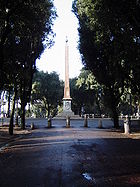
to unite some pre-existing features: one viale extends a garden axis of the Villa Medici to the obelisk (illustration, left) placed at the center of radiating viali. The obelisk was erected in September 1822 to provide an eye-catcher in the vistas; it is a Roman obelisk, not an Egyptian one, erected under the Emperor Hadrian in the early 2nd century, as part of a memorial to his beloved Antinous
Antinous
Antinoüs or Antinoös was a beautiful Bithynian youth and the favourite of the Roman emperor Hadrian...
outside the Porta Maggiore.. The Piazza Napoleone— in fact Napoleon's grand urbanistic example was set from a distance, as he never visited Rome— is a grand open space that looks out over Piazza del Popolo
Piazza del Popolo
Piazza del Popolo is a large urban square in Rome. The name in modern Italian literally means "People's Square", but historically it derives from the poplars after which the church of Santa Maria del Popolo, in the northeast corner of the piazza, takes its name.The piazza lies inside the northern...
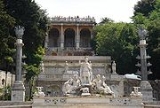
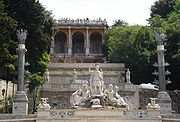
, also laid out by Valadier, and provides views to the west, and of the skyline of Rome beyond. Valadier linked the two spaces with formal staircases broken by generous landings, (illustration) and a switchback carriageway.
Giuseppe Mazzini
Giuseppe Mazzini , nicknamed Soul of Italy, was an Italian politician, journalist and activist for the unification of Italy. His efforts helped bring about the independent and unified Italy in place of the several separate states, many dominated by foreign powers, that existed until the 19th century...
's urging that lined the viali with busts of notable Italians.
Though the Villa Ludovisi
Villa Ludovisi
The Villa Ludovisi was a suburban villa in Rome, built in the 17th century on the area once occupied by the Gardens of Sallust near the Porta Salaria...
was built over at the turn of the 20th century, several villas and their gardens still occupy the hill, including the Borghese gardens, linked to the Pincio by a pedestrian bridge that crosses the via del Muro Torto in the narrow cleft below; the Muro Torto is the winding stretch of the Aurelian Wall, pierced by the Porta Pinciana.
See also
- Seven hills of RomeSeven hills of RomeThe Seven Hills of Rome east of the river Tiber form the geographical heart of Rome, within the walls of the ancient city.The seven hills are:* Aventine Hill * Caelian Hill...
- Aventine Hill (Aventino)Aventine HillThe Aventine Hill is one of the seven hills on which ancient Rome was built. It belongs to Ripa, the twelfth rione, or ward, of Rome.-Location and boundaries:The Aventine hill is the southernmost of Rome's seven hills...
- Caelian Hill (Celio)Caelian HillThe Caelian Hill is one of the famous Seven Hills of Rome. Under reign of Tullus Hostilius, the entire population of Alba Longa was forcibly resettled on the Caelian Hill...
- Capitoline Hill (Capitolino)Capitoline HillThe Capitoline Hill , between the Forum and the Campus Martius, is one of the seven hills of Rome. It was the citadel of the earliest Romans. By the 16th century, Capitolinus had become Capitolino in Italian, with the alternative Campidoglio stemming from Capitolium. The English word capitol...
- Cispian Hill (Cispio)CispiusCispius is the nomen of the Roman gens Cispia.-Cispius Laevus:The Mons Cispius, or Cispian Hill, is one of several summits of the Esquiline Hill in Rome. The grammarian Festus says that it was named for a Cispius Laevus of Anagnia, of the Publilia voting tribe . This Cispius may be legendary.-M...
- Esquiline Hill (Esquilino)
- Janiculum Hill (Gianicolo)
- Monte MarioMonte Mario-External links :* * *...
- Oppian Hill (Oppio)Oppian HillThe Oppian Hill is the southern spur of the Esquiline Hill , one of the famous Seven Hills of Rome. It is separated from the Cispius on the north by the valley of the Subura, and from the Caelian Hill on the south by the valley of the Colosseum...
- Palatine Hill (Palatino)Palatine HillThe Palatine Hill is the centermost of the Seven Hills of Rome and is one of the most ancient parts of the city...
- Quirinal Hill (Quirinale)Quirinal HillThe Quirinal Hill is one of the Seven Hills of Rome, at the north-east of the city center. It is the location of the official residence of the Italian Head of State, who resides in the Quirinal Palace; by metonymy "the Quirinal" has come to stand for the Italian President.- History :It was...
- Vatican Hill (Vaticano)Vatican HillVatican Hill is the name given, long before the founding of Christianity, to one of the hills on the side of the Tiber opposite the traditional seven hills of Rome...
- Velian Hill (Velia)Velian HillThe Velia — or Velian Hill or Velian Ridge — is a saddle or spur stretching out from the middle of the north side of the Palatine Hill towards the Oppian Hill ....
- Viminal Hill (Viminale)Viminal HillThe Viminal Hill is the smallest of the famous seven hills of Rome. A finger-shape cusp pointing toward central Rome between the Quirinal Hill to the northwest and the Esquiline Hill to the southeast, it is home to the Teatro dell'Opera and the Termini Railway Station.At the top of Viminal Hill...