
All Topics  
Peridotite

 
Peridotite

   Email Print
   Bookmark   Link


Peridotite


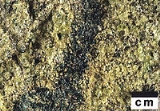
A peridotite is a dense, coarse-grained igneous rock
Igneous rock

Igneous rock is one of the three main Rock types . Igneous rock is formed by magma being cooled and becoming solid . They may form with or without crystallization, either below the surface as Intrusion rocks or on the surface as extrusive rocks....
, consisting mostly of the minerals olivine
Olivine

The mineral olivine is a magnesium iron Silicate minerals with the formula 2siliconoxygen4. It is one of the most common minerals on Earth, and has also been identified in meteorites and on the Moon, Mars, and comet Wild 2....
 and pyroxene
Pyroxene

The pyroxenes are a group of important rock-forming silicate minerals found in many igneous and metamorphic rock rock . They share a common structure comprised of single chains of silica tetrahedra and they crystallize in the monoclinic and orthorhombic systems....
. Peridotite is ultramafic and ultrabasic, as the rock contains less than 45% silica. It is high in magnesium
Magnesium

Magnesium is a chemical element with the symbol Mg, atomic number 12, atomic weight 24.3050 and common oxidation number +2.Magnesium, an alkaline earth metal, is the ninth most abundance of the chemical elements in the universe by mass....
, reflecting the high proportions of magnesium-rich olivine, with appreciable iron
Iron

Iron is a chemical element with the symbol Fe and atomic number 26. Iron is a Group 8 element and period 4 element. Iron is lustrous and silvery in color....
.


Discussion
Ask a question about 'Peridotite'
Start a new discussion about 'Peridotite'
Answer questions from other users
Full Discussion Forum


Recent Posts


Encyclopedia


Perid Sancarlos
A peridotite is a dense, coarse-grained igneous rock
Igneous rock

Igneous rock is one of the three main Rock types . Igneous rock is formed by magma being cooled and becoming solid . They may form with or without crystallization, either below the surface as Intrusion rocks or on the surface as extrusive rocks....
, consisting mostly of the minerals olivine
Olivine

The mineral olivine is a magnesium iron Silicate minerals with the formula 2siliconoxygen4. It is one of the most common minerals on Earth, and has also been identified in meteorites and on the Moon, Mars, and comet Wild 2....
 and pyroxene
Pyroxene

The pyroxenes are a group of important rock-forming silicate minerals found in many igneous and metamorphic rock rock . They share a common structure comprised of single chains of silica tetrahedra and they crystallize in the monoclinic and orthorhombic systems....
. Peridotite is ultramafic and ultrabasic, as the rock contains less than 45% silica. It is high in magnesium
Magnesium

Magnesium is a chemical element with the symbol Mg, atomic number 12, atomic weight 24.3050 and common oxidation number +2.Magnesium, an alkaline earth metal, is the ninth most abundance of the chemical elements in the universe by mass....
, reflecting the high proportions of magnesium-rich olivine, with appreciable iron
Iron

Iron is a chemical element with the symbol Fe and atomic number 26. Iron is a Group 8 element and period 4 element. Iron is lustrous and silvery in color....
. Peridotite is derived from the Earth's mantle, either as solid blocks and fragments, or as crystals accumulated from magmas that formed in the mantle. The compositions of peridotites from these layered igneous complexes vary widely, reflecting the relative proportions of pyroxene
Pyroxene

The pyroxenes are a group of important rock-forming silicate minerals found in many igneous and metamorphic rock rock . They share a common structure comprised of single chains of silica tetrahedra and they crystallize in the monoclinic and orthorhombic systems....
s, chromite
Chromite

Chromite is iron magnesium chromium oxide: Cr2O4. It is an oxide mineral belonging to the spinel group. Magnesium can substitute for iron in variable amounts; also, aluminium and ferric iron commonly substitute for chromium....
, plagioclase
Plagioclase

Plagioclase is a very important series of Silicate minerals minerals within the feldspar family. Rather than referring to a particular mineral with a specific chemical composition, plagioclase is a solid solution series, more properly known as the plagioclase feldspar series ....
, and amphibole
Amphibole

Amphibole defines an important group of generally dark-colored rock-forming Silicate minerals minerals, composed of double chain SiO4 tetrahedron, linked at the vertices and generally containing ions of iron and/or magnesium in their structures....
.

Peridotite is the dominant rock of the upper part of the Earth's mantle
Mantle (geology)

The mantle is a part of an astronomical object. The interior of the Earth, similar to the other terrestrial planets, is chemically divided into layers....
. The compositions of peridotite nodule
Nodule

Nodule may refer to:*Nodule , a small knobbly rock or mineral cluster, such as a manganese nodule*Nodule , a small aggregation of cells*Nodule_, a lesion similar to a papule...
s found in certain basalts and diamond pipes (kimberlites) are of special interest, because they provide samples of the Earth's Mantle roots of continents brought up from depths from about 30 km or so to depths at least as great as about 200 km. Some of the nodules preserve isotope
Isotope

Isotopes are any of the different types of atoms of the same chemical element, each having a different atomic mass . Isotopes of an element have atomic nucleus with the same number of protons but different numbers of neutron....
 ratios of osmium
Osmium

Osmium is a chemical element that has the symbol Os and atomic number 76. Osmium is a hard, brittle, blue-gray or blue-black transition metal in the platinum family, and is the densest natural element....
 and other elements that record processes over three billion years ago, and so they are of special interest to paleogeologists
Paleogeology

Paleogeology is the historical geological state of a particular area, or the study of the Geology history and origins of the earth, including such things as reconstructions of previous configurations of the earth's continents, the history and evolution of the earth's surface geological configuration, the formation and development of continent...
 because they provide clues to the composition of the Earth's early mantle and the complexities of the processes that were involved.

Types of peridotite

  • Dunite
    Dunite

    Dunite is an igneous rock, plutonic rock , of ultramafic composition, with coarse-grained or phaneritic texture. The mineral assemblage is greater than 90% olivine, with minor amounts of other minerals such as pyroxene, chromite and pyrope....
    : more than 90% olivine, typically with Mg/Fe ratio of about 9:1.
  • Wehrlite: mostly composed of olivine plus clinopyroxene.
  • Harzburgite
    Harzburgite

    The ultramafic rock, harzburgite, is a variety of peridotite consisting mostly of the two minerals, olivine and low-calcium pyroxene ; it is named for occurrences in the Harz Mountains of Germany....
    : mostly composed of olivine plus orthopyroxene, and relatively low proportions of basaltic ingredients (because garnet and clinopyroxene are minor).
  • Lherzolite
    Lherzolite

    Lherzolite is a type of ultramafic igneous rock. It is a coarse grained rock consisting of 40 to 90% olivine along with significant orthopyroxene and lesser calcic chromium rich clinopyroxene....
    : mostly composed of olivine, orthopyroxene (commonly enstatite), and clinopyroxene (diopside
    Diopside

    Diopside is a monoclinic pyroxene mineral with composition MgCaSi2O6. It forms complete solid solution series with hedenbergite and augite, and partial solid solutions with orthopyroxene and pigeonite....
    ), and have relatively high proportions of basaltic ingredients (garnet and clinopyroxene). Partial fusion of lherzolite and extraction of the melt fraction can leave a solid residue of harzburgite.

Composition

Peridotites are rich in magnesium, reflecting the high proportions of magnesium-rich olivine. The compositions of peridotites from layered igneous complexes vary widely, reflecting the relative proportions of pyroxenes, chromite, plagioclase, and amphibole. Minor minerals and mineral groups in peridotite include plagioclase
Plagioclase

Plagioclase is a very important series of Silicate minerals minerals within the feldspar family. Rather than referring to a particular mineral with a specific chemical composition, plagioclase is a solid solution series, more properly known as the plagioclase feldspar series ....
, spinel
Spinel

The spinels are any of a class of minerals of general formulation A2+B23+oxygen42- which crystallise in the cubic crystal system crystal system, with the oxide anions arranged in a cubic close-packing Bravais lattice and the cations A and B occupying some or all of the octahedral molecul...
 (commonly the mineral chromite
Chromite

Chromite is iron magnesium chromium oxide: Cr2O4. It is an oxide mineral belonging to the spinel group. Magnesium can substitute for iron in variable amounts; also, aluminium and ferric iron commonly substitute for chromium....
), garnet
Garnet

The garnet group includes a group of minerals that have been used since the Bronze Age as gemstones and abrasives. The name "garnet" comes from the Latin language granatus , possibly a reference to the Punica granatum , a plant with red seeds similar in shape, size, and color to some garnet crystals....
 (especially the mineral pyrope), amphibole
Amphibole

Amphibole defines an important group of generally dark-colored rock-forming Silicate minerals minerals, composed of double chain SiO4 tetrahedron, linked at the vertices and generally containing ions of iron and/or magnesium in their structures....
, and phlogopite
Phlogopite

Phlogopite is a yellow, greenish, or reddish-brown member of the mica family of silicate minerals. It is also known as magnesium mica.Phlogopite is the magnesium endmember of the biotite solid solution series, with the chemical formula potassiummagnesium3aluminumsilicon3oxygen102, or 2<...
. In peridotite, plagioclase is stable at relatively low pressures (crustal depths), aluminous spinel at higher pressures (to depths of 60 km or so), and garnet at yet higher pressures.

Pyroxenite
Pyroxenite

Pyroxenite is an ultramafic igneous Rock consisting essentially of minerals of the pyroxene group, such as augite and diopside, hypersthene, bronzite or enstatite....
s are related ultramafic rocks, which are composed largely of orthopyroxene and/or clinopyroxene; minerals that may be present in lesser abundance include olivine, garnet, plagioclase, amphibole, and spinel
Spinel

The spinels are any of a class of minerals of general formulation A2+B23+oxygen42- which crystallise in the cubic crystal system crystal system, with the oxide anions arranged in a cubic close-packing Bravais lattice and the cations A and B occupying some or all of the octahedral molecul...
.

Distribution and location

Peridotite is the dominant rock of the Earth's mantle above a depth of about 400 km; below that depth, olivine is converted to a higher-pressure mineral. Oceanic plates consist of up to about 100 km of peridotite covered by a thin crust; the crust, commonly about 6 km thick, consists of basalt, gabbro, and minor sediments. The peridotite below the ocean crust, "abyssal peridotite," is found on the walls of rifts in the deep sea floor. Oceanic plates are usually subducted back into the mantle in subduction zone
Subduction

In geology, subduction is the process that takes place at convergent boundary by which one tectonic plate moves under another tectonic plate, sinking into the Earth's mantle, as the plates converge....
s. However, pieces can be emplaced into or overthrust on continental crust
Continental crust

The continental crust is the layer of igneous, sedimentary, and metamorphic rocks which form the continents and the areas of shallow seabed close to their shores, known as Continental shelf....
 by a process called obduction
Obduction

Obduction is the overthrusting of continental crust by oceanic crust or mantle rocks at a destructive plate boundary. It can occur during an orogeny....
, rather than carried down into the mantle; the emplacement may occur during orogenies
Orogeny

Orogeny refers to natural mountain building, and may be studied as a tectonic structural event, as a geographical event, and a chronological event: orogenic events cause distinctive structural phenomena and related tectonic activity, affect certain regions of rocks and crust, and happen within a specific period of time....
, as during collisions of one continent with another or with an island arc. The pieces of oceanic plates emplaced within continental crust are referred to as ophiolites
Ophiolites

An Ophiolite is a section of the Earth's oceanic crust and the underlying upper Earth's mantle that has been uplifted or emplaced to be exposed within continental crustal rocks....
; typical ophiolites consist mostly of peridotite plus associated rocks such as gabbro
Gabbro

Gabbro refers to a large group of dark, coarse-grained, intrusive igneous rock chemically equivalent to basalt. The rocks are Intrusive, formed when molten magma is trapped beneath the Earth's surface and cools into a crystalline mass....
, pillow basalt
Basalt

Basalt is a common extrusive volcanic rock. It is usually gray to black and fine-grained due to rapid cooling of lava at the surface of a planet....
, diabase sill-and-dike complexes, and red chert. Other masses of peridotite have been emplaced into mountain belts as solid masses but do not appear to be related to ophiolites, and they have been called "orogenic peridotite massifs" and "alpine peridotites." Peridotites also occur as fragments (xenolith
Xenolith

A xenolith is a rock fragment which becomes enveloped in a larger rock during the latter's development and hardening. In geology, the term xenolith is almost exclusively used to describe inclusions in igneous rock during magma emplacement and eruption....
s) carried up by magmas from the mantle. Among the rocks that commonly include peridotite xenoliths are basalt
Basalt

Basalt is a common extrusive volcanic rock. It is usually gray to black and fine-grained due to rapid cooling of lava at the surface of a planet....
 and kimberlite
Kimberlite

Kimberlite is a type of potassic volcanic rock best known for sometimes containing diamonds. It is named after the town of Kimberley, Northern Cape in South Africa, where the discovery of an diamond in 1871 spawned a diamond rush, eventually creating the Big Hole....
. Certain volcanic rocks, sometimes called komatiites, are so rich in olivine and pyroxene that they also can be termed peridotite. Small pieces of peridotite have even been found in lunar breccias.

The rocks of the peridotite family are uncommon at the surface and are highly unstable, because olivine reacts quickly with water at typical temperatures of the upper crust and at the Earth's surface. Many, if not most, surface outcrops have been at least partly altered to serpentinite
Serpentinite

Serpentinite is a Rock composed of one or more serpentine minerals. Minerals in this group are formed by serpentinization, a hydration and metamorphic rock transformation of ultramafic rock from the Earth's Mantle ....
, a process in which the pyroxenes and olivines are converted to green serpentine
Serpentine

The serpentine group describes a group of common rock-forming hydroxy magnesium iron Silicate minerals#Phyllosilicates minerals; they may contain minor amounts of other elements including chromium, manganese, cobalt and nickel....
. This hydration reaction involves considerable increase in volume with concurrent deformation of the original textures. Serpentinites are mechanically weak and so flow readily within the earth. Distinctive plant communities grow in soils developed on serpentinite, because of the unusual composition of the underlying rock. One mineral in the serpentine group, chrysotile
Chrysotile

Chrysotile or white asbestos is the most commonly encountered form of asbestos, accounting for approximately 95% of the asbestos in place in the United States and a similar proportion in other countries....
, is a type of asbestos.

Morphology and texture

Some peridotites are layered or are themselves layers; others are massive. Many layered peridotites occur near the base of bodies of stratified gabbroic complexes. Other layered peridotites occur isolated, but possibly once composed part of major gabbroic complexes. Both layered and massive peridotites can have any of three principal textures: (1) rather well formed crystals of olivine separated by other minerals. This probably reflects the original deposition of olivine sediment from magma. (2) Equigranular crystals with straight grain boundaries intersecting at about 120°. This may result from slow cooling whereby recrystallization leads to a minimization of surface energy. (3) Long crystals with ragged curvilinear boundaries. This probably results from internal deformation.

Many peridotite occurrences have characteristic textures. For example, peridotites with well-formed olivine crystals occur mainly as layers in gabbroic complexes. "Alpine" peridotites generally have irregular crystals that occur as more or less serpentinized lenses bounded by faults in belts of folded mountains such as the Alpines, the Pacific coast ranges, and in the Appalachian piedmont. Peridotite nodules with irregular equigranular textures are often found in alkaline basalts and in kimberlite pipes. Some peridotites rich in amphibole have a concentric layered structure and form parts of plutons called Alaskan-type zoned ultramafic complexes.

Origin

Peridotites have two primary modes of origin, as mantle rocks formed during the accretion and differentiation of the Earth, or as cumulate rocks formed by precipitation of olivine ± pyroxenes from basaltic or ultramafic magmas; these magmas are ultimately derived from the upper mantle by partial melting of mantle peridotites.

Mantle peridotites are sampled as alpine-type massifs in collisional mountain ranges or as xenoliths in basalt or kimberlite. In all cases these rocks are pyrometamorphic (that is, metamorphosed in the presence of molten rock) and represent either fertile mantle (lherzolite) or partially depleted mantle (harzburgite, dunite). Alpine peridotites may be either of the ophiolite association and representing the uppermost mantle below ocean basins, or masses of subcontinental mantle emplaced along thrust faults in mountain belts.

Layered peridotites are igneous sediments and form by mechanical accumulation of dense olivine crystals. Some peridotite forms by precipitation and collection of cumulate olivine and pyroxene from mantle-derived magmas, such as those of basalt composition. Peridotites associated with Alaskan-type ultramafic complexes are cumulates that probably formed in the root zones of volcanoes. Cumulate peridotites are also formed in komatiite
Komatiite

Komatiites are ultramafic mantle-derived volcanic rocks. They have low SiO2, low K2O, low Al2O3, and high to extremely high MgO....
 lava flows.

Mantle lherzolites may be the principal source rock for basaltic magmas, whereas mantle harzburgites probably form both from the crystalline residue left after basaltic magma migrates out of lherzolite and from a crystalline accumulation of early solidification products of some basaltic magmas within the mantle.

Associated rocks

Komatiite
Komatiite

Komatiites are ultramafic mantle-derived volcanic rocks. They have low SiO2, low K2O, low Al2O3, and high to extremely high MgO....
s are the rare volcanic equivalent of peridotite.

Eclogite
Eclogite

Eclogite is a coarse-grained mafic metamorphic rock. Eclogite is of special interest for at least two reasons. First, it forms at pressures greater than those typical of the Crust of the Earth....
, a rock similar to basalt in composition, is composed primarily of sodic clinopyroxene and garnet. Eclogite is associated with peridotite in some xenolith occurrences; it also occurs with peridotite in rocks metamorphosed at high pressures during processes related to subduction.

Economic geology

According to a new study released in November 2008, peridotite may have potential economic value as a low-cost, safe and permanent method to capture and store atmospheric CO2 as part of climate change
Global warming

Global warming is the increase in the Instrumental temperature record of the Earth's near-surface air and the oceans since the mid-twentieth century and its projected continuation....
-related greenhouse gas sequestration
Carbon capture and storage

Carbon capture and storage is an approach to Mitigation of global warming the contribution of fossil fuel emissions to global warming, based on capturing carbon dioxide from large Point source pollution such as fossil fuel power plants....
. While it was already known that peridotite reacts with CO2 to form a solid carbonate
Carbonate rock

Carbonate rocks are a class of sedimentary rocks composed primarily of carbonate minerals. The two major types are limestone and dolomite, composed of calcite and the mineral dolomite respectively....
-like limestone or marble mineral, the study concludes that this process can be sped up a million times or more with simple drilling and hydraulic fracturing
Hydraulic fracturing

Hydraulic fracturing is a method used to create Fracture that extend from a borehole into rock formations, which are typically maintained by a proppant, a material such as grains of sand or other material which prevent the fractures from closing....
 to allow injection of the CO2 into the subsurface peridotite formation.

Peridotite is named for the gemstone
Gemstone

A gemstone or gem, also called a precious or semi-precious stone, is a piece of attractive mineral, which — when cut and polished — is used to make jewellery or other adornments....
 peridot
Peridot

Peridot is gem-quality forsterite olivine. The chemical composition of peridot is 2SiO4, with Mg in greater quantities than Fe....
, a glassy green gem mined in Asia
Asia

Asia is the world's largest and most populous continent. It covers 8.6% of the Earth's total surface area and, with over 4 billion people, it contains more than 60% of the world's current human population....
 and Arizona
Arizona

The State of Arizona is a U.S. state located in the Southwestern United States of the United States. The capital and largest city is Phoenix, Arizona....
 (Peridot Cove). Some peridotite is mined for ornamental stone.

Peridotite that has been hydrated at low temperatures forms serpentine
Serpentine

The serpentine group describes a group of common rock-forming hydroxy magnesium iron Silicate minerals#Phyllosilicates minerals; they may contain minor amounts of other elements including chromium, manganese, cobalt and nickel....
, which may include chrysotile asbestos (a form of serpentine) and talc
Talc

Talc is a mineral composed of hydrated magnesium silicate with the chemical formula Hydrogen2Magnesium34 or Magnesium3Silicon4Oxygen102....
.

Layered intrusions with cumulate peridotite are typically associated with sulfide or chromite ores. Sulfides associated with peridotites form nickel ores and platinoid metals; most of the platinum
Platinum

Platinum is a chemical element with the chemical symbol Pt and an atomic number of 78. Its name is derived from the Spanish term platina del Pinto, which is literally translated into "little silver of the Pinto River." It is in Group 10 of the periodic table of elements....
 used in the world today is mined from the Bushveld Igneous Complex
Bushveld igneous complex

The Bushveld Igneous Complex is a large igneous intrusion within the Earth's Crust which has been tilted and erosion and now outcrops around what appears to be the edge of a great Basin ....
 in South Africa
South Africa

The Republic of South Africa, also known by Official names of South Africa, is a country located at the southern tip of the continent of Africa....
 and the Great Dyke
Great Dyke

The Great Dyke is a linear geological feature that trends nearly north-south through the center of Zimbabwe passing just to the west of the capital, Harare....
 of Zimbabwe
Zimbabwe

Zimbabwe , is a landlocked country located in the southern part of the continent of Africa, between the Zambezi and Limpopo River rivers. It is bordered by South Africa to the south, Botswana to the southwest, Zambia to the northwest and Mozambique to the east....
. The chromite bands commonly associated with peridotites are the world's major ores of chromium
Chromium

Chromium is a chemical element which has the symbol Cr and atomic number 24. It is a steely-gray, Lustre , hard metal that takes a high polish and has a high melting point....
.