


Gabbro

Encyclopedia
Mafic
Mafic is an adjective describing a silicate mineral or rock that is rich in magnesium and iron; the term is a portmanteau of the words "magnesium" and "ferric". Most mafic minerals are dark in color and the relative density is greater than 3. Common rock-forming mafic minerals include olivine,...
igneous rock
Igneous rock
Igneous rock is one of the three main rock types, the others being sedimentary and metamorphic rock. Igneous rock is formed through the cooling and solidification of magma or lava...
s chemically equivalent to basalt
Basalt
Basalt is a common extrusive volcanic rock. It is usually grey to black and fine-grained due to rapid cooling of lava at the surface of a planet. It may be porphyritic containing larger crystals in a fine matrix, or vesicular, or frothy scoria. Unweathered basalt is black or grey...
. The rocks are plutonic, formed when molten magma
Magma
Magma is a mixture of molten rock, volatiles and solids that is found beneath the surface of the Earth, and is expected to exist on other terrestrial planets. Besides molten rock, magma may also contain suspended crystals and dissolved gas and sometimes also gas bubbles. Magma often collects in...
is trapped beneath the Earth
Earth
Earth is the third planet from the Sun, and the densest and fifth-largest of the eight planets in the Solar System. It is also the largest of the Solar System's four terrestrial planets...
's surface and cools into a crystalline mass.
The vast majority of the Earth's surface is underlain by gabbro within the oceanic crust
Oceanic crust
Oceanic crust is the part of Earth's lithosphere that surfaces in the ocean basins. Oceanic crust is primarily composed of mafic rocks, or sima, which is rich in iron and magnesium...
, produced by basalt magmatism at mid-ocean ridge
Mid-ocean ridge
A mid-ocean ridge is a general term for an underwater mountain system that consists of various mountain ranges , typically having a valley known as a rift running along its spine, formed by plate tectonics. This type of oceanic ridge is characteristic of what is known as an oceanic spreading...
s.
Petrology
Pyroxene
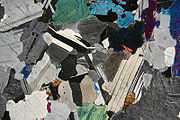
The pyroxenes are a group of important rock-forming inosilicate minerals found in many igneous and metamorphic rocks. They share a common structure consisting of single chains of silica tetrahedra and they crystallize in the monoclinic and orthorhombic systems...
, plagioclase
Plagioclase
Plagioclase is an important series of tectosilicate minerals within the feldspar family. Rather than referring to a particular mineral with a specific chemical composition, plagioclase is a solid solution series, more properly known as the plagioclase feldspar series...
, amphibole
Amphibole
Amphibole is the name of an important group of generally dark-colored rock-forming inosilicate minerals, composed of double chain tetrahedra, linked at the vertices and generally containing ions of iron and/or magnesium in their structures.-Mineralogy:...
, and olivine
Olivine
The mineral olivine is a magnesium iron silicate with the formula 2SiO4. It is a common mineral in the Earth's subsurface but weathers quickly on the surface....
(olivine gabbro when olivine is present in a large amount).
The pyroxene is mostly clinopyroxene; small amounts of orthopyroxene may be present. If the amount of orthopyroxene is substantially greater than the amount of clinopyroxene, the rock is then a norite
Norite
Norite is a mafic intrusive igneous rock composed largely of the calcium-rich plagioclase labradorite and hypersthene with olivine. Norite is essentially indistinguishable from gabbro without thin section study under the petrographic microscope...
. Quartz
Quartz
Quartz is the second-most-abundant mineral in the Earth's continental crust, after feldspar. It is made up of a continuous framework of SiO4 silicon–oxygen tetrahedra, with each oxygen being shared between two tetrahedra, giving an overall formula SiO2. There are many different varieties of quartz,...
gabbros are also known to occur and are probably derived from magma that was over-saturated with silica. Essexite
Essexite
Essexite , also called nepheline monzogabbro , is a dark gray or black holocrystalline plutonic igneous rock. Its name is derived from the type locality in Essex County, MA.Modern petrology identifies rocks according to mineralogical criteria...
s represent gabbros whose parent magma was under-saturated with silica, resulting in the formation of the feldspathoid
Feldspathoid
The feldspathoids are a group of tectosilicate minerals which resemble feldspars but have a different structure and much lower silica content. They occur in rare and unusual types of igneous rocks....
mineral nepheline
Nepheline
Nepheline, also called nephelite , is a feldspathoid: a silica-undersaturated aluminosilicate, Na3KAl4Si4O16, that occurs in intrusive and volcanic rocks with low silica, and in their associated pegmatites...
. (Silica saturation of a rock can be evaluated by normative mineralogy
Normative mineralogy
Normative mineralogy is a geochemical calculation of the whole rock geochemistry of a rock sample that estimates the idealised mineralogy of a rock according to the principles of geochemistry....
). Gabbros contain minor amounts, typically a few percent, of iron-titanium oxides such as magnetite
Magnetite
Magnetite is a ferrimagnetic mineral with chemical formula Fe3O4, one of several iron oxides and a member of the spinel group. The chemical IUPAC name is iron oxide and the common chemical name is ferrous-ferric oxide. The formula for magnetite may also be written as FeO·Fe2O3, which is one part...
, ilmenite
Ilmenite
Ilmenite is a weakly magnetic titanium-iron oxide mineral which is iron-black or steel-gray. It is a crystalline iron titanium oxide . It crystallizes in the trigonal system, and it has the same crystal structure as corundum and hematite....
, and ulvospinel
Ulvöspinel
Ulvöspinel or ulvite is an iron titanium oxide mineral with formula: Fe2TiO4 or TiFe2+2O4. It forms brown to black metallic isometric crystals with a Mohs hardness of 5.5 to 6...
.
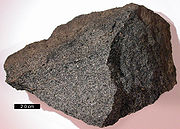
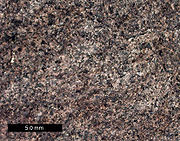
Gabbro is generally coarse grained, with crystals in the size range of 1 mm or greater. Finer grained equivalents of gabbro are called diabase
Diabase
Diabase or dolerite is a mafic, holocrystalline, subvolcanic rock equivalent to volcanic basalt or plutonic gabbro. In North American usage, the term diabase refers to the fresh rock, whilst elsewhere the term dolerite is used for the fresh rock and diabase refers to altered material...
, although the vernacular term microgabbro is often used when extra descriptiveness is desired. Gabbro may be extremely coarse grained to pegmatitic, and some pyroxene-plagioclase cumulates
Cumulate rock
Cumulate rocks are igneous rocks formed by the accumulation of crystals from a magma either by settling or floating. Cumulate rocks are named according to their texture; cumulate texture is diagnostic of the conditions of formation of this group of igneous rocks.-Formation:Cumulate rocks are the...
are essentially coarse grained gabbro, although these may exhibit acicular crystal habits.
Gabbro is usually equigranular
Equigranular
An equigranular material is composed chiefly of crystals of similar orders of magnitude to one another. Basalt and gabbro commonly exhibit an equigranular texture....
in texture, although it may be porphyritic
Porphyritic
Porphyritic is an adjective used in geology, specifically for igneous rocks, for a rock that has a distinct difference in the size of the crystals, with at least one group of crystals obviously larger than another group...
at times, especially when plagioclase oikocrysts have grown earlier than the groundmass minerals.
Distribution
Gabbro can be formed as a massive, uniform intrusion via in-situ crystallisation of pyroxene and plagioclase, or as part of a layered intrusion as a cumulateCumulate rock
Cumulate rocks are igneous rocks formed by the accumulation of crystals from a magma either by settling or floating. Cumulate rocks are named according to their texture; cumulate texture is diagnostic of the conditions of formation of this group of igneous rocks.-Formation:Cumulate rocks are the...
formed by settling of pyroxene and plagioclase. Cumulate gabbros are more properly termed pyroxene-plagioclase orthocumulate.
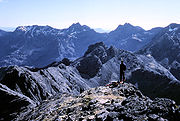
Gabbro is an essential part of the oceanic crust, and can be found in many ophiolite complexes as parts of zones III and IV (sheeted dyke zone
Sheeted dyke complex
A sheeted dyke complex or sheeted dike complex is a normal component of an ophiolite, a piece of oceanic crust that has been emplaced within a sequence of continental rocks. The dykes act as feeders for the overlying sequence of extrusive rocks typically pillow lavas, together forming layer 2 of...
to massive gabbro zone). Long belts of gabbroic intrusions are typically formed at proto-rift zones and around ancient rift
Rift
In geology, a rift or chasm is a place where the Earth's crust and lithosphere are being pulled apart and is an example of extensional tectonics....
zone margins, intruding into the rift flanks. Mantle plume
Mantle plume
A mantle plume is a hypothetical thermal diapir of abnormally hot rock that nucleates at the core-mantle boundary and rises through the Earth's mantle. Such plumes were invoked in 1971 to explain volcanic regions that were not thought to be explicable by the then-new theory of plate tectonics. Some...
hypotheses may rely on identifying mafic and ultramafic intrusions and coeval basalt
Basalt
Basalt is a common extrusive volcanic rock. It is usually grey to black and fine-grained due to rapid cooling of lava at the surface of a planet. It may be porphyritic containing larger crystals in a fine matrix, or vesicular, or frothy scoria. Unweathered basalt is black or grey...
volcanism.
Uses
Gabbro often contains valuable amounts of chromiumChromium
Chromium is a chemical element which has the symbol Cr and atomic number 24. It is the first element in Group 6. It is a steely-gray, lustrous, hard metal that takes a high polish and has a high melting point. It is also odorless, tasteless, and malleable...
, nickel
Nickel
Nickel is a chemical element with the chemical symbol Ni and atomic number 28. It is a silvery-white lustrous metal with a slight golden tinge. Nickel belongs to the transition metals and is hard and ductile...
, cobalt
Cobalt
Cobalt is a chemical element with symbol Co and atomic number 27. It is found naturally only in chemically combined form. The free element, produced by reductive smelting, is a hard, lustrous, silver-gray metal....
, gold
Gold
Gold is a chemical element with the symbol Au and an atomic number of 79. Gold is a dense, soft, shiny, malleable and ductile metal. Pure gold has a bright yellow color and luster traditionally considered attractive, which it maintains without oxidizing in air or water. Chemically, gold is a...
, silver
Silver
Silver is a metallic chemical element with the chemical symbol Ag and atomic number 47. A soft, white, lustrous transition metal, it has the highest electrical conductivity of any element and the highest thermal conductivity of any metal...
, platinum
Platinum
Platinum is a chemical element with the chemical symbol Pt and an atomic number of 78. Its name is derived from the Spanish term platina del Pinto, which is literally translated into "little silver of the Pinto River." It is a dense, malleable, ductile, precious, gray-white transition metal...
, and copper
Copper
Copper is a chemical element with the symbol Cu and atomic number 29. It is a ductile metal with very high thermal and electrical conductivity. Pure copper is soft and malleable; an exposed surface has a reddish-orange tarnish...
sulfide
Sulfide
A sulfide is an anion of sulfur in its lowest oxidation state of 2-. Sulfide is also a slightly archaic term for thioethers, a common type of organosulfur compound that are well known for their bad odors.- Properties :...
s.
Ocellar varieties of gabbro can be used as ornamental facing stones, paving stones and it is also known by the trade name of 'black granite', which is a popular type of graveyard headstone used in funerary rites. It is also used in kitchens and their countertops, also under the misnomer of 'black granite'.
Etymology
Gabbro was named by the German geologist Christian Leopold von BuchChristian Leopold von Buch
Christian Leopold Freiherr von Buch was a German geologist and paleontologist born in Stolpe an der Oder and is remembered as one of the most important contributors to geology in the first half of the nineteenth century...
after a town in the Italian
Italy
Italy , officially the Italian Republic languages]] under the European Charter for Regional or Minority Languages. In each of these, Italy's official name is as follows:;;;;;;;;), is a unitary parliamentary republic in South-Central Europe. To the north it borders France, Switzerland, Austria and...
Tuscany
Tuscany
Tuscany is a region in Italy. It has an area of about 23,000 square kilometres and a population of about 3.75 million inhabitants. The regional capital is Florence ....
region. Essexite is named after the type locality in Essex County
Essex County, Massachusetts
-National protected areas:* Parker River National Wildlife Refuge* Salem Maritime National Historic Site* Saugus Iron Works National Historic Site* Thacher Island National Wildlife Refuge-Demographics:...
, Massachusetts, US.
See also
- PeridotitePeridotiteA peridotite is a dense, coarse-grained igneous rock, consisting mostly of the minerals olivine and pyroxene. Peridotite is ultramafic, as the rock contains less than 45% silica. It is high in magnesium, reflecting the high proportions of magnesium-rich olivine, with appreciable iron...
- Igneous differentiationIgneous differentiationIn geology, igneous differentiation is an umbrella term for the various processes by which magmas undergo bulk chemical change during the partial melting process, cooling, emplacement or eruption.-Primary melts:...
- Fractional crystallisationFractional crystallization (geology)Fractional crystallization is one of the most important geochemical and physical processes operating within the Earth's crust and mantle. Fractional crystallization is the removal and segregation from a melt of mineral precipitates; except in special cases, removal of the crystals changes the...