

Okavango Delta

Encyclopedia
Botswana
Botswana, officially the Republic of Botswana , is a landlocked country located in Southern Africa. The citizens are referred to as "Batswana" . Formerly the British protectorate of Bechuanaland, Botswana adopted its new name after becoming independent within the Commonwealth on 30 September 1966...
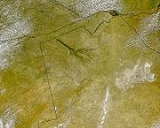
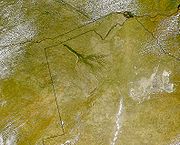
, is the world's largest inland delta
River delta
A delta is a landform that is formed at the mouth of a river where that river flows into an ocean, sea, estuary, lake, reservoir, flat arid area, or another river. Deltas are formed from the deposition of the sediment carried by the river as the flow leaves the mouth of the river...
. It is formed where the Okavango River
Okavango River
The Okavango River is a river in southwest Africa. It is the fourth-longest river system in southern Africa, running southeastward for . It begins in Angola, where it is known as the Cubango River...
empties onto a swamp
Zambezian flooded grasslands
The Zambezian flooded grasslands is an ecoregion of southern and eastern Africa that is rich in wildlife.-Setting:The Zambezian flooded grasslands can be found on seasonally or permanently flooded lowlands in the basin of the Zambezi and neighboring river basins...
in an endorheic basin in the Kalahari Desert
Kalahari Desert
The Kalahari Desert is a large semi-arid sandy savannah in Southern Africa extending , covering much of Botswana and parts of Namibia and South Africa, as semi-desert, with huge tracts of excellent grazing after good rains. The Kalahari supports more animals and plants than a true desert...
, where most of the water is lost to evaporation
Evaporation
Evaporation is a type of vaporization of a liquid that occurs only on the surface of a liquid. The other type of vaporization is boiling, which, instead, occurs on the entire mass of the liquid....
and transpiration
Transpiration
Transpiration is a process similar to evaporation. It is a part of the water cycle, and it is the loss of water vapor from parts of plants , especially in leaves but also in stems, flowers and roots. Leaf surfaces are dotted with openings which are collectively called stomata, and in most plants...
instead of draining into the sea. Each year approximately 11 cubic kilometres of water irrigate the 15,000 km² area and some flood-waters drain into Lake Ngami
Lake Ngami
Lake Ngami is an endorheic lake in Botswana north of the Kalahari Desert. It is seasonally filled by the Taughe River an affluent of the Okavango River system flowing out of the western side of the Okavango Delta. It is one of the fragmented remnants of the ancient Lake Makgadikgadi...
. The Moremi Game Reserve, a National Park, spreads across the eastern side of the delta.
The area was once part of Lake Makgadikgadi
Lake Makgadikgadi
Lake Makgadikgadi is an ancient lake that existed in what is now the Kalahari Desert in Botswana. It may have once covered as much as 80,000 km² and was 30 m deep...
, an ancient lake that mostly dried up by the early Holocene
Holocene
The Holocene is a geological epoch which began at the end of the Pleistocene and continues to the present. The Holocene is part of the Quaternary period. Its name comes from the Greek words and , meaning "entirely recent"...
.
Geography
FloodThe Okavango Delta is produced by seasonal flooding. The Okavango river drains the summer (January–February) rainfall from the Angola
Angola
Angola, officially the Republic of Angola , is a country in south-central Africa bordered by Namibia on the south, the Democratic Republic of the Congo on the north, and Zambia on the east; its west coast is on the Atlantic Ocean with Luanda as its capital city...
highlands and the surge flows 1,200 kilometres in approximately one month. The waters then spread over the 250 km by 150 km area of the delta over the next four months (March–June). The high temperature of the delta causes rapid transpiration and evaporation, resulting in a cycle of rising and falling water level that was not fully understood until the early 20th century. The flood peaks between June and August, during Botswana
Botswana
Botswana, officially the Republic of Botswana , is a landlocked country located in Southern Africa. The citizens are referred to as "Batswana" . Formerly the British protectorate of Bechuanaland, Botswana adopted its new name after becoming independent within the Commonwealth on 30 September 1966...
’s dry winter months, when the delta swells to three times its permanent size, attracting animals from kilometres around and creating one of Africa’s greatest concentrations of wildlife
Wildlife
Wildlife includes all non-domesticated plants, animals and other organisms. Domesticating wild plant and animal species for human benefit has occurred many times all over the planet, and has a major impact on the environment, both positive and negative....
.
The delta is very flat, with less than 2 metres variation in height across its 15,000 km².
Where the water goes
Every year, circa 11 cubic kilometres (11,000,000,000,000 litres) of water flow into the delta. Approximately 60% is consumed through transpirationTranspiration
Transpiration is a process similar to evaporation. It is a part of the water cycle, and it is the loss of water vapor from parts of plants , especially in leaves but also in stems, flowers and roots. Leaf surfaces are dotted with openings which are collectively called stomata, and in most plants...
by plants, 36% by evaporation
Evaporation
Evaporation is a type of vaporization of a liquid that occurs only on the surface of a liquid. The other type of vaporization is boiling, which, instead, occurs on the entire mass of the liquid....
, 2% percolates into the aquifer
Aquifer
An aquifer is a wet underground layer of water-bearing permeable rock or unconsolidated materials from which groundwater can be usefully extracted using a water well. The study of water flow in aquifers and the characterization of aquifers is called hydrogeology...
system; and 2% flows into Lake Ngami. This turgid outflow means that the delta is unable to flush out the minerals carried by the river and is liable to become increasingly salty and uninhabitable, but this effect is reduced by the low salt content which collects around the roots of the plants. The low salinity of the water also means that the floods do not greatly enrich the floodplain with nutrients.
Salt islands
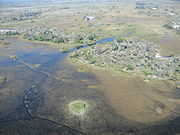
The agglomeration of salt around plant roots means that many of the thousands of islands have barren white patches in their centre, which have become too salty to support plants, aside from the odd salt resistant palm treeArecaceae
Arecaceae or Palmae , are a family of flowering plants, the only family in the monocot order Arecales. There are roughly 202 currently known genera with around 2600 species, most of which are restricted to tropical, subtropical, and warm temperate climates...
. Trees and grasses grow in sand near the edges of the islands that has yet to become too salty.
Approximately 70% of the islands began as termite
Termite
Termites are a group of eusocial insects that, until recently, were classified at the taxonomic rank of order Isoptera , but are now accepted as the epifamily Termitoidae, of the cockroach order Blattodea...
mounds, where a tree then takes root on the mound of earth
Earth
Earth is the third planet from the Sun, and the densest and fifth-largest of the eight planets in the Solar System. It is also the largest of the Solar System's four terrestrial planets...
.
Chief’s Island
Chief’s Island, the largest island in the delta, was formed by a fault lineFault line
In geology, fault line refers to the surface trace of a fault.Fault line, Fault Line, or faultline may also refer to:* "Faultline", a song from the 2008 studio album Versus by The Haunted...
which uplifted an area over 70 km long and 15 km wide. Historically it was reserved as an exclusive hunting area for the chief. It now provides the core area for much of the resident wildlife when the waters rise.
Climate
The Delta's profuse greenery is not the result of a tropical climate, rather it is an oasisOasis
In geography, an oasis or cienega is an isolated area of vegetation in a desert, typically surrounding a spring or similar water source...
in an arid country. The average annual rainfall is 450mm (approximately one third that of its Angolan catchment area) and most of it falls between December and March in the form of heavy afternoon thunderstorms.
December to February are hot wet months with daytime temperatures as high as 40°C, warm nights, and humidity levels fluctuating between 50 and 80%. From March to May the temperature becomes far more comfortable with a maximum of 30°C during the day and mild to cool nights. The rains quickly dry up leading into the dry, cold winter months of June to August. Daytime temperatures at this time of year are mild to warm but the temperature begin to fall after sunset. Nights can be surprisingly cold in the Delta with temperatures barely above freezing.
September to November sees the heat and atmospheric pressure build up once more as the dry season slides into the rainy season. October is the most challenging month for visitors - daytime temperatures often push past 40°C and the dryness is only occasionally broken by a sudden cloudburst.
Wildlife
The Okavango delta is both a permanent and seasonal home to a wide variety of wildlifeWildlife
Wildlife includes all non-domesticated plants, animals and other organisms. Domesticating wild plant and animal species for human benefit has occurred many times all over the planet, and has a major impact on the environment, both positive and negative....
which is now a popular tourist attraction.
Species include African Bush Elephant
African Bush Elephant
The African Bush Elephant or African Savanna Elephant is the larger of the two species of African elephant. Both it and the African Forest Elephant have usually been classified as a single species, known simply as the African Elephant...
, African Buffalo
African Buffalo
The African buffalo, affalo, nyati, Mbogo or Cape buffalo is a large African bovine. It is not closely related to the slightly larger wild Asian water buffalo, but its ancestry remains unclear...
, Hippopotamus
Hippopotamus
The hippopotamus , or hippo, from the ancient Greek for "river horse" , is a large, mostly herbivorous mammal in sub-Saharan Africa, and one of only two extant species in the family Hippopotamidae After the elephant and rhinoceros, the hippopotamus is the third largest land mammal and the heaviest...
, Lechwe
Lechwe
The Lechwe, or Southern Lechwe, is an antelope found in Botswana, Zambia, south-eastern Democratic Republic of the Congo, north-eastern Namibia, and eastern Angola, especially in the Okavango Delta, Kafue Flats and Bangweulu Swamps....
, Topi
Topi
The Tsessebe , is one of five subspecies in the binomial class D. lunatus. The other subspecies include Korrigum , Tiang , Coastal Topi , and Topi . Tesessebe are found primarily in Zambia, Namibia, Botswana, Zimbabwe, and South Africa...
, Blue Wildebeest
Blue Wildebeest
The Blue Wildebeest , also called the Common Wildebeest, is a large antelope and one of two species of wildebeest. It grows to 115–145 cm shoulder height and attains a body mass of 168–274 kg. They range the open plains, bushveld and dry woodlands of Southern and East Africa, living for...
, Giraffe
Giraffe
The giraffe is an African even-toed ungulate mammal, the tallest of all extant land-living animal species, and the largest ruminant...
, Nile crocodile
Nile crocodile
The Nile crocodile or Common crocodile is an African crocodile which is common in Somalia, Ethiopia, Uganda, Kenya, Egypt, Tanzania, Zambia, Zimbabwe, Gabon, South Africa, Malawi, Sudan, Botswana, and Cameroon...
, Lion
Lion
The lion is one of the four big cats in the genus Panthera, and a member of the family Felidae. With some males exceeding 250 kg in weight, it is the second-largest living cat after the tiger...
, Cheetah
Cheetah
The cheetah is a large-sized feline inhabiting most of Africa and parts of the Middle East. The cheetah is the only extant member of the genus Acinonyx, most notable for modifications in the species' paws...
, Leopard
Leopard
The leopard , Panthera pardus, is a member of the Felidae family and the smallest of the four "big cats" in the genus Panthera, the other three being the tiger, lion, and jaguar. The leopard was once distributed across eastern and southern Asia and Africa, from Siberia to South Africa, but its...
, Brown Hyena
Brown Hyena
The brown hyena is a species of hyena which occurs in Namibia, Botswana, western and southern Zimbabwe, southern Mozambique and South Africa. It is currently the rarest hyena.-Description:...
, Spotted Hyena
Spotted Hyena
The spotted hyena also known as laughing hyena, is a carnivorous mammal of the family Hyaenidae, of which it is the largest extant member. Though the species' prehistoric range included Eurasia extending from Atlantic Europe to China, it now only occurs in all of Africa south of the Sahara save...
, Greater Kudu
Greater Kudu
The Greater Kudu is a woodland antelope found throughout eastern and southern Africa. Despite occupying such widespread territory, they are sparsely populated in most areas, due to a declining habitat, deforestation and hunting....
, Sable Antelope
Sable Antelope
The Sable Antelope is an antelope which inhabits wooded savannah in East Africa south of Kenya, and in Southern Africa.-Subspecies:There are four subspecies:* H. n. niger which is considered low risk conservation dependent...
, Black Rhinoceros
Black Rhinoceros
The Black Rhinoceros or Hook-lipped Rhinoceros , is a species of rhinoceros, native to the eastern and central areas of Africa including Kenya, Tanzania, Cameroon, South Africa, Namibia, Zimbabwe, and Angola...
, White Rhinoceros
White Rhinoceros
The White Rhinoceros or Square-lipped rhinoceros is one of the five species of rhinoceros that still exist. It has a wide mouth used for grazing and is the most social of all rhino species...
, Plains Zebra
Plains Zebra
The plains zebra , also known as the common zebra or Burchell's zebra, is the most common and geographically widespread species of zebra. It ranges from the south of Ethiopia through East Africa to as far south as Angola and eastern South Africa...
, Warthog
Warthog
The Warthog or Common Warthog is a wild member of the pig family that lives in grassland, savanna, and woodland in Sub-Saharan Africa. In the past it was commonly treated as a subspecies of P...
and Chacma Baboon
Chacma Baboon
The Chacma baboon , also known as the Cape baboon, is, like all other baboons, from the Old World monkey family. With a body length of up to 115 cm and a weight from 15 to 31 kg, it is among the largest and heaviest baboon species. The Chacma is generally dark brown to gray in color,...
. Notably the endangered African Wild Dog
African Wild Dog
Lycaon pictus is a large canid found only in Africa, especially in savannas and lightly wooded areas. It is variously called the African wild dog, African hunting dog, Cape hunting dog, painted dog, painted wolf, painted hunting dog, spotted dog, or ornate wolf...
still survives within the Okavango Delta, exhibiting one of the richest pack densities in Africa. The delta also includes over 400 species of birds, including African Fish Eagle
African Fish Eagle
The African Fish Eagle or – to distinguish it from the true fish eagles , the African Sea Eagle – is a large species of eagle that is found throughout sub-Saharan Africa wherever large bodies of open water occur that have an abundant food supply. As a result of its large range, it is known in many...
, Crested Crane, Lilac-breasted Roller
Lilac-breasted Roller
The Lilac-breasted Roller is a member of the roller family of birds. It is widely distributed in sub-Saharan Africa and the southern Arabian Peninsula, preferring open woodland and savanna; it is largely absent from treeless places...
, Hammerkop
Hammerkop
The Hamerkop , also known as Hammerkop,Hammerkopf, Hammerhead, Hammerhead Stork, Umbrette, Umber Bird, Tufted Umber, or Anvilhead, is a medium-sized wading bird...
, Ostrich
Ostrich
The Ostrich is one or two species of large flightless birds native to Africa, the only living member of the genus Struthio. Some analyses indicate that the Somali Ostrich may be better considered a full species apart from the Common Ostrich, but most taxonomists consider it to be a...
, and Sacred Ibis
Sacred Ibis
The African Sacred Ibis is a species of ibis.-Description:An adult individual is 68 cm long with all-white body plumage apart from dark plumes on the rump. The bald head and neck, thick curved bill and legs are black. The white wings show a black rear border in flight...
.
The majority of the estimated 200,000 large mammals in and around the delta are not year-round residents. They leave with the summer rains to find renewed fields of grass to graze on and trees to browse, then make their way back as winter approaches. Large herds of buffalo and elephant total about 30,000 beasts.
Fish
The Okavango Delta is home to 71 fish species including TigerfishHydrocynus goliath
Hydrocynus goliath, also known as the goliath tigerfish, giant tigerfish or mbenga, is a very large African fish from the Congo River Basin, Lualaba River, Lake Upemba, and Lake Tanganyika. This large-toothed, highly predatory fish grows to a length of and a weight of .A number of incidents have...
, Tilapia
Tilapia
Tilapia , is the common name for nearly a hundred species of cichlid fish from the tilapiine cichlid tribe. Tilapia inhabit a variety of fresh water habitats, including shallow streams, ponds, rivers and lakes. Historically, they have been of major importance in artisan fishing in Africa and the...
and Catfish
Catfish
Catfishes are a diverse group of ray-finned fish. Named for their prominent barbels, which resemble a cat's whiskers, catfish range in size and behavior from the heaviest and longest, the Mekong giant catfish from Southeast Asia and the second longest, the wels catfish of Eurasia, to detritivores...
. They range from 1.4 m Sharptooth-Catfish to 3.2 cm Sickle-fin Barb. The same species are to be found in the Zambezi River, indicating a historic link between the two river systems.
Lechwe
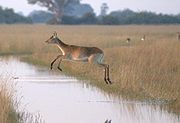
Lechwe
The Lechwe, or Southern Lechwe, is an antelope found in Botswana, Zambia, south-eastern Democratic Republic of the Congo, north-eastern Namibia, and eastern Angola, especially in the Okavango Delta, Kafue Flats and Bangweulu Swamps....
antelope, with more than 60,000. It is a little larger than an impala
Impala
An impala is a medium-sized African antelope. The name impala comes from the Zulu language meaning "gazelle"...
with elongated hooves and a water repellent substance on their legs that enables rapid movement through knee deep water. They graze on aquatic plant
Aquatic plant
Aquatic plants are plants that have adapted to living in aquatic environments. They are also referred to as hydrophytes or aquatic macrophytes. These plants require special adaptations for living submerged in water, or at the water's surface. Aquatic plants can only grow in water or in soil that is...
s and, like Waterbuck
Waterbuck
The Waterbuck is a large antelope found widely in Sub-Saharan Africa.Waterbuck stand at the shoulder. Males weigh and females . Their coats are reddish brown in colour and become progressively darker with age; they have a white 'bib' under their throats and white on their rumps...
, take to water when threatened by predators. Only the males have horns.
Plants
Papyrus and reed rafts make up a large part of the Okavango's vegetation. During the flood season they float well above the sandy river bed with roots dangling free in the water. This gap between bed and roots is utilised as shelter by crocodiles.The plants of the Delta play an important role in providing cohesion for the sand. The banks or levees of a river
River
A river is a natural watercourse, usually freshwater, flowing towards an ocean, a lake, a sea, or another river. In a few cases, a river simply flows into the ground or dries up completely before reaching another body of water. Small rivers may also be called by several other names, including...
normally have a high mud
Mud
Mud is a mixture of water and some combination of soil, silt, and clay. Ancient mud deposits harden over geological time to form sedimentary rock such as shale or mudstone . When geological deposits of mud are formed in estuaries the resultant layers are termed bay muds...
content and this combines with the sand in the river’s load to continuously build up the river banks. In the Delta, because of the clean waters of the Okavango, there is almost no mud and the river’s load consists almost entirely of sand. The plants capture the sand, acting as the glue and making up for the lack of mud and in the process creating further islands on which more plants can take root.
This process is important in the formation of linear islands. They are long and thin and often curved like a gently meandering river. The reason for that is that they are actually the natural banks of old river channels which over time have become blocked up by plant growth and sand deposition, resulting in the river changing course and the old river levees becoming islands. Due to the flatness of the Delta, and the large tonnage of sand flowing into it from the Okavango River, the floor of the delta is slowly but constantly rising. Where channels are today, islands will be tomorrow and then new channels may wash away these existing islands.
Game Lodges
The Botswana Okavango Game Lodges(2011) cater for small numbers of guests, each one operating in its own Okavango Delta private concession area.There are a huge number of lodges with low impact policies to the environmentPeople
The Okavango Delta peoples consist of five ethnic groupEthnic group
An ethnic group is a group of people whose members identify with each other, through a common heritage, often consisting of a common language, a common culture and/or an ideology that stresses common ancestry or endogamy...
s, each with its own ethnic identity and language. They are Hambukushu (also known as Mbukushu, Bukushu, Bukusu, Mabukuschu, Ghuva, Haghuva), Dceriku (Dxeriku, Diriku, Gciriku, Gceriku, Giriku, Niriku), Wayeyi (Bayei
Bayei
The Yeyi, or Bayei, are Bantu-speaking people of Ngamiland, Botswana. The Yei immigrated to the area in the 18th century from the north, and lived in close cooperation with the San people, or Basarwa, who had lived in the area previously...
, Bayeyi, Yei), Bugakhwe (Kxoe, Khwe, Kwengo, Barakwena, G/anda) and ||anikhwe (Gxanekwe, //tanekwe, River Bushmen, Swamp Bushmen, G//ani, //ani, Xanekwe). The Hambukushu, Dceriku, and Wayeyi are all Bantus who have traditionally engaged in mixed economies of millet/sorghum agriculture; fishing, hunting, and the collection of wild plant foods; and pastoralism.
The Bugakhwe and ||anikwhe are Bushmen
Bushmen
The indigenous people of Southern Africa, whose territory spans most areas of South Africa, Zimbabwe, Lesotho, Mozambique, Swaziland, Botswana, Namibia, and Angola, are variously referred to as Bushmen, San, Sho, Barwa, Kung, or Khwe...
who have traditionally practised fishing, hunting, and the collection of wild plant foods; Bugakhwe utilized both forest and riverine resources while the ||anikhwe mostly focused on riverine resources. The Hambukushu
Mbukushu language
Mbukushu or Thimbukushu is a Bantu language spoken by 45,000 people along the Okavango River in Namibia, where it is a national language; in Botswana; in Angola; and in Zambia, where it is an official regional language. It appears to be an divergent lineage of Bantu.Mbukushu is one of several...
, Dceriku, and Bugakhwe are present along the Okavango River in Angola and in the Caprivi Strip
Caprivi Strip
Caprivi, sometimes called the Caprivi Strip , Caprivi Panhandle or the Okavango Strip and formally known as Itenge, is a narrow protrusion of Namibia eastwards about , between Botswana to the south, Angola and Zambia to the north, and Okavango Region to the west. Caprivi is bordered by the...
of Namibia, and there are small numbers of Hambukushu and Bugakhwe in Zambia as well. Within the Okavango Delta, over the past 150 years or so Hambukushu, Dceriku, and Bugakhwe have inhabited the Panhandle and the Magwegqana in the northeastern Delta. ||anikhwe have inhabited the Panhandle and the area along the Boro River through the Delta, as well as the area along the Boteti River
Boteti River
The Boteti River is a natural watercourse in Botswana. It derives flow from the core Okavango Delta through the Thamalakane River in Maun. It flowed year-round before the mid 1990s, after which decreasing flows led to seasonal desiccation in some lower reaches...
.
The Wayeyi have inhabited the area around Seronga
Seronga
Seronga is a village in North-West District, Botswana. It is located close to beginning of the Okavango Delta, and has a local airstrip. The population of Seronga was 1,641 in 2001 census....
as well as the southern Delta around Maun
Maun
Maun is the fifth largest town in Botswana. As of 2001, it had a population of 43,776. It is an eclectic mix of modern buildings and native huts. Maun is the "tourism capital" of Botswana and the administrative centre of Ngamiland district...
, and a few Wayeyi live in their putative ancestral home in the Caprivi Strip. Within the past 20 years many people from all over the Okavango have migrated to Maun, the late 1960s and early 1970s over 4,000 Hambukushu refugees from Angola were settled in the area around Etsha in the western Panhandle.
The Okavango Delta has been under the political control of the Batawana (a Tswana sub-tribe) since the late 18th century. Most Batawana, however, have traditionally lived on the edges of the Delta. Small numbers of people from other ethnic groups such as Ovaherero and Ovambanderu now live in parts of the Okavango Delta, but since the majority of the members of those groups live elsewhere and the habitation is recent they are not considered as part of the Okavango Delta peoples. There are also several Bushmen groups represented by a handful of people. These groups were decimated by diseases of contact in the middle part of the 20th century, and most of the remaining members have intermarried with the ||anikwhe.
Hydropower proposals
The Namibian government has presented plans to build a hydropowerHydropower
Hydropower, hydraulic power, hydrokinetic power or water power is power that is derived from the force or energy of falling water, which may be harnessed for useful purposes. Since ancient times, hydropower has been used for irrigation and the operation of various mechanical devices, such as...
station in the Caprivi Region
Caprivi Region
Caprivi is one of the 13 regions of Namibia. It takes its name from the Caprivi Strip which in turn was named after Leo von Caprivi.-Geography:...
, which would regulate the Okavango's flow to some extent. While proponents argue that the effect would be minimal, environmentalists argue that this project could destroy most of the rich wildlife and plant life in the Delta.
See also
- Irrigation of alluvial fansIrrigation of alluvial fansIrrigation of alluvial fans is the use of water resources, mainly river floods and groundwater recharged by infiltration of river water, to enhance the production of agricultural crops.*Alluvial fans, when large and flat, are also called inland deltas...
including the Okavango Delta. - The SuddSuddThe Sudd , also known as the Bahr al Jabal, As Sudd or Al Sudd, is a vast swamp in South Sudan, formed by the White Nile. The word “sudd” is derived from the Arabic word “sadd”, meaning “block.” The term has come to refer to any large solid floating vegetation island or mat...
- Africa's largest marshland
External links
- Conservation International
- Earth-Touch.com Okavango Delta HD Videos
- Flow : information for Okavango Delta planning is the weblog of the Library of the Harry Oppenheimer Okavango Research Centre.
- The Ngami Times is Ngamiland's weekly newspaper.Flow charts and rain data are also available.
- Official Botswana Government site on Moremi Game Reserve, inside the Okavango Delta
- Information Website on the Okavango Delta - maps, photos, blogs
- Picture gallery of wildlife in the Okavango Delta
- Wild Entrust International
- Discovery Channel - Kalahari Flood
- http://www.waterlog.info/pdf/molapos.pdf Flood-recession cropping in the molapos of the Okavango Delta