

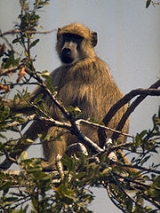
Chacma Baboon

Encyclopedia
The Chacma baboon also known as the Cape baboon, is, like all other baboon
s, from the Old World monkey
family. With a body length of up to 115 cm and a weight from 15 to 31 kg, it is among the largest and heaviest baboon species. The Chacma is generally dark brown to gray in color, with a patch of rough hair on the nape of its neck. Unlike the northern baboon species (the Guinea
, Hamadryas
, and Olive
baboons), Chacma males do not have a mane. Perhaps the most distinctive feature of this baboon is its long, downward sloping face. Males can have canine teeth as long as 2 inches (longer than a lion's canine teeth). Baboons are sexually dimorphic, males being considerably larger than females.
, ranging from South Africa
north to Angola
, Zambia
, and Mozambique
. Size and color vary within that range. The Cape Chacma (P. ursinus ursinus) from southern South Africa is a large, heavy, dark brown baboon with black feet. Another subspecies, the Gray-footed Chacma (P. u. griseipes), is present from northern South Africa to southern Zambia. It is slightly smaller than the Cape Chacma, lighter in color and build, and has gray feet. The Ruacana Chacma (P. u. ruacana) is found in Namibia and southern Angola, and generally appears to be a smaller, less darkly colored version of the Cape Chacma.

to the Kalahari desert. The Chacma baboon is omnivorous with a preference for fruits, while also eating insects, seeds, grass and smaller vertebrate animals. The Chacma baboon is generally a scavenger when it comes to game meat and rarely engages in hunting large animals. There has been one incident where a Chacma baboon has killed a human infant, however the event is so rare the locals believed it was due to witchcraft. Normally Chacma baboons will flee at the approach of humans. This has been changing due to the easy availability of food where there is interaction with humans.
The Chacma is considered to be potentially threatened under C.I.T.E.S Appendix 2, if populations are not monitored. The only area in South Africa where they are monitored is in the Cape Peninsula where they are protected.
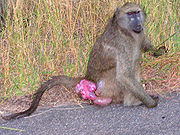 Observations by those working hands-on in South Africa's rehabilitation centres, have found that this species is damaged by human intervention; troop structures are influenced and over the years there has been a significant loss in numbers. Because they live near human habitats, baboons are shot, poisoned, electrocuted, run over and captured for the pet industry, research laboratories and muthi (medicine).
Snaring primates and other species for bushmeat has become a growing problem around poverty stricken areas.
aired an eight episode mini-series, hosted by popular British comedian Bill Bailey
, with exclusive features from the series on itvWILD. The series followed the lives of three different family groups of Chacma baboons in South Africa. The series focuses on the baboons' abilities of adaptation to human settlement and their complex social-lives. It is generally structured within a narrative, with each adult baboon having a name and being treated as an 'actor' in the story. The three families of baboons have each developed their own ways of life, the 'Smitz' group spends most its time trying to rob food from tourists along a coastal highway, the 'Tokai' group has remained in a more natural forest area, while the 'Da Gama' group lives on the rooftops of an apartment complex. The program is the second attempt of Bailey to produce a semi-serious nature documentary and it has received good reviews.
Baboon
Baboons are African and Arabian Old World monkeys belonging to the genus Papio, part of the subfamily Cercopithecinae. There are five species, which are some of the largest non-hominoid members of the primate order; only the mandrill and the drill are larger...
s, from the Old World monkey
Old World monkey
The Old World monkeys or Cercopithecidae are a group of primates, falling in the superfamily Cercopithecoidea in the clade Catarrhini. The Old World monkeys are native to Africa and Asia today, inhabiting a range of environments from tropical rain forest to savanna, shrubland and mountainous...
family. With a body length of up to 115 cm and a weight from 15 to 31 kg, it is among the largest and heaviest baboon species. The Chacma is generally dark brown to gray in color, with a patch of rough hair on the nape of its neck. Unlike the northern baboon species (the Guinea
Guinea Baboon
The Guinea baboon is a baboon from the Old World monkey family. Some classifications list only two species in the genus Papio, this one and the Hamadryas baboon. In those classifications, all other Papio species are considered subspecies of P...
, Hamadryas
Hamadryas Baboon
The Hamadryas baboon is a species of baboon from the Old World monkey family. It is the northernmost of all the baboons; being native to the Horn of Africa and the southwestern tip of the Arabian Peninsula. These regions provide habitats with the advantage for this species of fewer natural...
, and Olive
Olive Baboon
The olive baboon , also called the Anubis baboon, is a member of the family Cercopithecidae . The species is the most widely spread of all baboons: it is found in 25 countries throughout Africa, extending south from Mali to Ethiopia and to Tanzania. Isolated populations are also found in some...
baboons), Chacma males do not have a mane. Perhaps the most distinctive feature of this baboon is its long, downward sloping face. Males can have canine teeth as long as 2 inches (longer than a lion's canine teeth). Baboons are sexually dimorphic, males being considerably larger than females.
Range
The Chacma baboon is found in southern AfricaAfrica
Africa is the world's second largest and second most populous continent, after Asia. At about 30.2 million km² including adjacent islands, it covers 6% of the Earth's total surface area and 20.4% of the total land area...
, ranging from South Africa
South Africa
The Republic of South Africa is a country in southern Africa. Located at the southern tip of Africa, it is divided into nine provinces, with of coastline on the Atlantic and Indian oceans...
north to Angola
Angola
Angola, officially the Republic of Angola , is a country in south-central Africa bordered by Namibia on the south, the Democratic Republic of the Congo on the north, and Zambia on the east; its west coast is on the Atlantic Ocean with Luanda as its capital city...
, Zambia
Zambia
Zambia , officially the Republic of Zambia, is a landlocked country in Southern Africa. The neighbouring countries are the Democratic Republic of the Congo to the north, Tanzania to the north-east, Malawi to the east, Mozambique, Zimbabwe, Botswana and Namibia to the south, and Angola to the west....
, and Mozambique
Mozambique
Mozambique, officially the Republic of Mozambique , is a country in southeastern Africa bordered by the Indian Ocean to the east, Tanzania to the north, Malawi and Zambia to the northwest, Zimbabwe to the west and Swaziland and South Africa to the southwest...
. Size and color vary within that range. The Cape Chacma (P. ursinus ursinus) from southern South Africa is a large, heavy, dark brown baboon with black feet. Another subspecies, the Gray-footed Chacma (P. u. griseipes), is present from northern South Africa to southern Zambia. It is slightly smaller than the Cape Chacma, lighter in color and build, and has gray feet. The Ruacana Chacma (P. u. ruacana) is found in Namibia and southern Angola, and generally appears to be a smaller, less darkly colored version of the Cape Chacma.
Behaviour
Chacmas usually live in social groups composed of multiple adult males, adult females, and their offspring. Occasionally, however, very small groups form that include only a single adult male and several adult females. Chacma troops are characterized by a dominance hierarchy. Female ranking within the troop is inherited through the mother and remains quite fixed, while male ranking is often in flux, especially when the dominant male is replaced. Chacmas are unusual among baboons in that neither males nor females form strong relationships with members of the same sex. Instead, the strongest social bonds are often between unrelated adult males and females. Infanticide is also common compared to other baboons species, as newly dominant males will often attempt to kill young baboons sired by the previously dominant male. Baboon troops possess a complex group behavior and communicate by means of body attitudes, facial expressions, vocalisations and touch.Habitat
Chacmas inhabit a wide array of habitats, from the grassy alpine slopes of the DrakensbergDrakensberg
The Drakensberg is the highest mountain range in Southern Africa, rising to in height. In Zulu, it is referred to as uKhahlamba , and in Sesotho as Maluti...
to the Kalahari desert. The Chacma baboon is omnivorous with a preference for fruits, while also eating insects, seeds, grass and smaller vertebrate animals. The Chacma baboon is generally a scavenger when it comes to game meat and rarely engages in hunting large animals. There has been one incident where a Chacma baboon has killed a human infant, however the event is so rare the locals believed it was due to witchcraft. Normally Chacma baboons will flee at the approach of humans. This has been changing due to the easy availability of food where there is interaction with humans.
Status
The Chacma baboon is widespread and does not rank among threatened animal species. However, in some confined locations such as South Africa's Southern Cape Peninsula, local populations are dwindling due to habitat loss, as well as predation from other protected species, such as leopards and lions. Some troops have become a suburban menace, overturning trash cans and entering houses in their search for food. These animals can be aggressive and dangerous, such negative encounters have resulted in frustrated local residents resorting to hunting them. It is thought that this isolated population will face extinction within 10 years.The Chacma is considered to be potentially threatened under C.I.T.E.S Appendix 2, if populations are not monitored. The only area in South Africa where they are monitored is in the Cape Peninsula where they are protected.
Snaring primates and other species for bushmeat has become a growing problem around poverty stricken areas.
Subspecies
There are three subspecies of the Chacma baboon:- Papio ursinus ursinus Kerr, 1792 – Cape Chacma (found in southern South AfricaSouth AfricaThe Republic of South Africa is a country in southern Africa. Located at the southern tip of Africa, it is divided into nine provinces, with of coastline on the Atlantic and Indian oceans...
) - Papio ursinus griseipes Pocock, 1911 – Gray-footed Chacma (found in northern South Africa to southern ZambiaZambiaZambia , officially the Republic of Zambia, is a landlocked country in Southern Africa. The neighbouring countries are the Democratic Republic of the Congo to the north, Tanzania to the north-east, Malawi to the east, Mozambique, Zimbabwe, Botswana and Namibia to the south, and Angola to the west....
) - Papio ursinus raucana Shortridge, 1942 – Ruacana Chacma (found from NamibiaNamibiaNamibia, officially the Republic of Namibia , is a country in southern Africa whose western border is the Atlantic Ocean. It shares land borders with Angola and Zambia to the north, Botswana to the east and South Africa to the south and east. It gained independence from South Africa on 21 March...
to southern AngolaAngolaAngola, officially the Republic of Angola , is a country in south-central Africa bordered by Namibia on the south, the Democratic Republic of the Congo on the north, and Zambia on the east; its west coast is on the Atlantic Ocean with Luanda as its capital city...
)
In Popular Culture
In 2011, the British Television Channel ITV1ITV1
ITV1 is a generic brand that is used by twelve franchises of the British ITV Network in the English regions, Wales, southern Scotland , the Isle of Man and the Bailiwicks of Jersey and Guernsey. The ITV1 brand was introduced by Carlton and Granada in 2001, alongside the regional identities of their...
aired an eight episode mini-series, hosted by popular British comedian Bill Bailey
Bill Bailey
Bill Bailey is an English comedian, musician and actor. As well as his extensive stand-up work, Bailey is well known for his appearances on Black Books, Never Mind the Buzzcocks, Have I Got News for You, and QI.Bailey was listed by The Observer as one of the 50 funniest acts in British comedy in...
, with exclusive features from the series on itvWILD. The series followed the lives of three different family groups of Chacma baboons in South Africa. The series focuses on the baboons' abilities of adaptation to human settlement and their complex social-lives. It is generally structured within a narrative, with each adult baboon having a name and being treated as an 'actor' in the story. The three families of baboons have each developed their own ways of life, the 'Smitz' group spends most its time trying to rob food from tourists along a coastal highway, the 'Tokai' group has remained in a more natural forest area, while the 'Da Gama' group lives on the rooftops of an apartment complex. The program is the second attempt of Bailey to produce a semi-serious nature documentary and it has received good reviews.