
All Topics  
White Rhinoceros

 
White Rhinoceros

   Email Print
   Bookmark   Link


White Rhinoceros


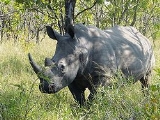
The White Rhinoceros or Square-lipped rhinoceros (Ceratotherium simum) is one of the five species of rhinoceros
Rhinoceros

Rhinoceros , often colloquially abbreviated rhino, is a name used to group five extant species of odd-toed ungulates in the family Rhinocerotidae....
 that still exist and is one of the few megafauna
Megafauna

The term megafauna has two distinct meanings in the biological sciences. The less commonly found meaning is of any animal which can be seen with the unaided eye, in contrast to microfauna....
 species left. It has a wide mouth used for grazing and is the most social of all rhino species. The White Rhino is the most common of all rhinos and consists of two subspecies
Subspecies

In biology, subspecies is the taxonomic rank immediately subordinate to a species. A subspecies is a taxonomic group which is less distinct than the Common descent or species from which it originates....
: the Southern White Rhino, with an estimated 17,480 wild-living animals at the end of 2007 (IUCN 2008), and the much rarer Northern White Rhino.


Discussion
Ask a question about 'White Rhinoceros'
Start a new discussion about 'White Rhinoceros'
Answer questions from other users
Full Discussion Forum


Encyclopedia


The White Rhinoceros or Square-lipped rhinoceros (Ceratotherium simum) is one of the five species of rhinoceros
Rhinoceros

Rhinoceros , often colloquially abbreviated rhino, is a name used to group five extant species of odd-toed ungulates in the family Rhinocerotidae....
 that still exist and is one of the few megafauna
Megafauna

The term megafauna has two distinct meanings in the biological sciences. The less commonly found meaning is of any animal which can be seen with the unaided eye, in contrast to microfauna....
 species left. It has a wide mouth used for grazing and is the most social of all rhino species. The White Rhino is the most common of all rhinos and consists of two subspecies
Subspecies

In biology, subspecies is the taxonomic rank immediately subordinate to a species. A subspecies is a taxonomic group which is less distinct than the Common descent or species from which it originates....
: the Southern White Rhino, with an estimated 17,480 wild-living animals at the end of 2007 (IUCN 2008), and the much rarer Northern White Rhino. The northern subspecies may have as few as 13 remaining world-wide - 9 captive and 4 wild - although the wild population has not been seen since 2006 and may have disappeared entirely.

Taxonomy and naming

A popular theory of the origins of the name White Rhinoceros is a mistranslation from Dutch
Dutch language

Dutch is a West Germanic languages spoken by over 22 million people as a first language, and about 5 million people as a second language."1% of the EU population claims to speak Dutch well enough in order to have a conversation." Outside the European Union the number of second language speakers of Dutch is very small. Most native...
 into Afrikaans
Afrikaans

Afrikaans is an Indo-European language, derived from Dutch language and thus classified as Low Franconian languages West Germanic languages. It is mainly spoken in South Africa and Namibia, with smaller numbers of speakers living in Botswana, Angola, Swaziland, Zimbabwe, Lesotho, Zambia, Australia, New Zealand, United States of America, Taiwa...
 and English
English language

English is a West Germanic language that originated in Anglo-Saxon England and has lingua franca status in many parts of the world as a result of the military, economic, scientific, political and cultural influence of the British Empire in the 18th, 19th and early 20th centuries and that of the United States from the mid 20th century onwa...
. The Afrikaans word "wit", meaning "white" in English is said to have been derived by mistranslation of the Dutch word "wijde", which means "wide" in English and is spelt "wyd" in Afrikaans. The word "wide" refers to the width of the Rhinoceros mouth. So early European settlers in South Africa misinterpreted the "wyd" for "white" and the rhino with the wide mouth ended up being called the White Rhino and the other one, with the narrow pointed mouth, was called the Black Rhinoceros
Black Rhinoceros

The Black Rhinoceros , also colloquially Black Rhino, is a species of rhinoceros, native to the eastern and central areas of Africa including Kenya, Tanzania, Cameroon, South Africa, Namibia and Zimbabwe....
. A review of Dutch and Afrikaans literature about the rhinoceros, however, has also failed to produce any evidence that the word wyd was ever used to describe the rhino. Other popular theories suggest the name comes from its wide appearance throughout Africa, its colour due to wallowing in calcerous soil or bird droppings or because of the lighter colour of its horn. An alternative common name for the white rhinoceros, more accurate but rarely used, is the square-lipped rhinoceros. The White Rhinoceros' generic name, Ceratotherium, given by the zoologist John Edward Gray
John Edward Gray

John Edward Gray was a United Kingdom zoology. He was the elder brother of George Robert Gray and son of the pharmacologist and botanist Samuel Frederick Gray ....
 in 1868, is derived from the Greek
Ancient Greek

Ancient Greek is the historical stage in the development of the Greek language spanning across the Archaic Greece , Classical Greece , and Hellenistic civilization periods of ancient Greece and the classical antiquity....
 terms keras (?e?a?) "horn" and therion "beast". Simum, is derived from the Greek term simus (s?µ??), meaning "flat nosed".

Southern white rhinoceros

There are two subspecies
Subspecies

In biology, subspecies is the taxonomic rank immediately subordinate to a species. A subspecies is a taxonomic group which is less distinct than the Common descent or species from which it originates....
 of White Rhinos; the Southern White Rhino (Ceratotherium simum simum) and the Northern White Rhinoceros. As of 31 December 2007, there were an estimated 17,480 Southern White Rhino in the wild (IUCN 2008), making them the most abundant subspecies of rhino in the world. South Africa is the stronghold for this subspecies (93.0%), conserving 16,255 individuals in the wild in 2007 (IUCN 2008). There are smaller reintroduced populations within the historical range of the species in Namibia, Botswana, Zimbabwe and Swaziland, while a small population survives in Mozambique. Populations have also been introduced outside of the former range of the species to Kenya, Uganda and Zambia (Emslie and Brooks 1999; Emslie et al. 2007).

Wild-caught southern whites will readily breed in captivity given appropriate amounts of space and food, as well as the presence of other female rhinos of breeding age. For instance, 91 calves have been born at the San Diego Wild Animal Park
San Diego Wild Animal Park

The San Diego Zoo's Wild Animal Park is a zoo in the San Pasqual Valley, San Diego, California area of San Diego, California. It is one of the largest tourist attractions in the city and Southern California....
 since 1972. However, for reasons that are not currently understood, the rate of reproduction is extremely low among captive-born southern white females.

Northern white rhinoceros

The Northern White Rhinoceros
Northern White Rhinoceros

The Northern White Rhinoceros or Northern Square-lipped rhinoceros is one of the two subspecies of the White Rhinoceros. This subspecies is a grazer and is an animal of grasslands and savannah woodlands....
 (Ceratotherium simum cottoni), formerly found in several countries in East and Central Africa south of the Sahara
Sahara

The Sahara is the world's largest hot desert. At over 9,000,000 square kilometers , it covers most of Northern Africa, making it almost as large as the United States or the continent of Europe....
, is considered Critically Endangered
Endangered species

An endangered species is a population of an organism which is at risk of becoming extinct because it is either few in numbers, or threatened by changing environmental or predation parameters....
.

According to the WWF, there are only four Northern White Rhinos left in the wild. However, in June 2008 it was reported that the species may have gone extinct since none of these four known remaining individuals has been seen since 2006.

Description

The White Rhinoceros is the world's largest land mammal after the elephant
Elephant

Elephants are large land mammals of the order Proboscidea and the family Elephantidae. There are three living species: the African Bush Elephant, the African Forest Elephant and the Asian Elephant ....
s. It has a massive body and large head, a short neck and broad chest. The head and body length is 3.4 to 4.2 m (11 to 13.75 ft), with the tail adding another 50 to 70 cm (20 to 27.5 in). The shoulder height is 150-185 cm (59-73 inches). Weight typically ranges from 1,440 to 3,600 kg (3,168 to 7,920 lbs), with the male being slightly heavier. The record-sized White Rhinoceros was about 4500 kg (10,000 lb).. On its snout it has two horns
Horn (anatomy)

A horn is a pointed projection of the skin on the head of various mammals, consisting of a covering of horn surrounding a core of living bone....
 made of keratin
Keratin

Keratins are a family of fibrous protein; tough and insoluble, they form the hard but mineral structures found in reptiles, birds, amphibians and mammals....
, rather than bone as in deer antlers. The front horn is larger than the other horn and averages 89.9 cm (35 inches) in length and can reach 150 cm (59 inches). The White Rhinoceros also has a noticeable hump on the back of its neck which supports its large head. Each of the rhino's four stumpy feet has three toes. The colour of this animal ranges from yellowish brown to slate grey. The only hair on them is on the ear fringes and tail bristles. White Rhinos have the distinctive flat broad mouth which is used for grazing.

Its ears can move independently to pick up more sounds but it depends most of all on smell. The olfactory passages which are responsible for smell are larger than their entire brain.

Behaviour and ecology

White Rhinoceros are found in grassland and savannah habitat. Herbivore grazers that eat grass, preferring the shortest grains, the White Rhino is one of the largest pure grazers. Regularly it drinks twice a day if water is available, but if conditions get dry it can live four or five days without water. It spends about half of the day eating, one third resting, and the rest of the day doing various other things. White Rhinos, like all species of rhino, love wallowing in mudholes to cool down.

White rhinos can produce sounds which include a panting contact call, grunts and snorts during courtship, squeals of distress, and deep bellows or growls when threatened. Threat displays (in males mostly) include wiping its horn on the ground and a head-low posture with ears back, combined with snarl threats and shrieking if attacked. The White Rhino is quick and agile and can run 30 mph (50 km/h).

White Rhinos can live in a crash or herd of up to 14 animals (usually mostly female). Sub-adult males will congregate, often in association with an adult female. Most adult bulls are solitary
Solitary

Solitary may refer to:* shortened form of solitary confinement in jail* Solitary , an episode of the TV series Lost* Solitary , a reality show made by FOX...
. Dominant bulls mark their territory with excrement and urine. The dung is laid in well defined piles. It may have 20-30 of these piles to alert passing rhinos that it's his territory. Another way of marking their territory is wiping his horns on bushes or the ground and scrapes with its feet before urine spraying. They do this around 10 times an hour while patrolling territory. The same ritual as urine marking except without spraying is also commonly used. The territorial male will scrape-mark every 30 yards or so around its territory boundary. Subordinate males do not mark territory. The most serious fights break out over mating rights over a female. Female territory is overlapped extensively and they do not defend it.

Reproduction

Females reach sexually maturity 6-7 years while males reach sexual maturity at a later date which is 10-12 years of age. Courtship is often a difficult affair. The male stays beyond the point where the female acts aggressively and will give out a call when approaching her. The male chases and or blocks the way of the female while squealing or wailing loudly if the female tries to leave his territory. When ready to mate the female curls its tail and gets into a stiff stance during the half hour copulation. Breeding pairs stay together between 5-20 days before they part their separate ways. Gestation occurs around 16-18 months. A single calf is born and weighs between 40 and 65 kilograms (90 and 140 pounds) and are unsteady for their first 2 to 3 days of life. When threatened the baby will run in front of the mother. The mother is very protective of her calf and will fight for her baby vigorously. Weaning starts at 2 months and may continue suckling for over 12 months. The birth interval for the White Rhino is between 2 and 3 years. Before giving birth the mother will chase off her current calf. White Rhinos can live to be up to 40-50 years old. Adult White Rhinos have no natural predators due to their size, and even young rhinos are rarely preyed on due to the mother's presence.

Distribution

The northern subspecies is now only found in the Republic of Congo while the southern subspecies or majority of white rhino live in southern Africa. 98.5% of white rhino occur in just five countries (South Africa, Namibia, Zimbabwe, Kenya and Uganda). Almost at the edge of extinction in the early 20th century, the southern subspecies has made a tremendous comeback. In 2001 it was estimated that there were 11,670 white rhinos in the wild with a further 777 in captivity worldwide, making it the most common Rhino in the world. By the end of 2007 wild-living Southern White Rhino had increased to an estimated 17,480 animals (IUCN 2008).

Like the black rhino, the White Rhino is under threat from habitat loss and poaching, most recently by Janjaweed
Janjaweed

The Janjaweed is a blanket term used to describe mostly armed gunmen in Darfur, western Sudan, and now eastern Chad. Using the United Nations definition, the Janjaweed comprised nomadic Arabic-speaking African tribes , the core of whom are from the Abbala background with significant Lambo recruitment from the Baggara people....
. The horn is mostly used for traditional medicine although there are no health benefits from the horn; the horn is also used for traditional necklaces. A recent population count in the Republic Congo turned up only 10 rhinos left in the wild, which led conservationists on January 15, 2005 to propose airlifting White Rhinos from Garamba into Kenya. Although official approval was initially obtained, resentment of foreign interference within the Congo has prevented the airlift from happening as of the beginning of 2006. On June 12, 2007 poachers shot the last 2 rhinos in Zambia, injuring one and killing the other. They had removed the horn off the deceased rhino.

Distribution of Northern White Rhino

The Northern White Rhino (Ceratotherium simum cottoni), formerly ranged over parts of north-western Uganda, southern Chad, south-western Sudan, the eastern part of Central African Republic, and north-eastern Democratic Republic of the Congo
Democratic Republic of the Congo

The Democratic Republic of the Congo , is a country in central Africa with a small length of Atlantic coastline. It is the third largest list of African countries in order of geographical area....
 (DRC). The only confirmed population today occurs in north-eastern DRC.

Poachers reduced their population from 500 to 15 in the 1970s and 1980s. By the early 1990s through mid 2003 the population recovered to more than 32 animals. Surveys in 2000 indicated that the population has started recovering with 30 animals confirmed in 2000 with up to a possible six others. Between 2003 and 2006 poaching had intensified and reduced the wild population to only 5 to 10 animals. According to the WWF, there are now only four Northern White Rhinos left in the wild, however in June 2008 it was reported that the species may have gone extinct.

Garamba National Park
The last surviving population of wild Northern white rhinos are all located in Garamba National Park
Garamba National Park

Garamba National Park, located in the Democratic Republic of the Congo in Africa, was established in 1938. One of Africa's oldest National parks, it was designated a UNESCO World Heritage Site in 1980....
, Democratic Republic of the Congo (DRC). Recent civil wars and disruptions have been cause for much concern about the status of this last surviving population.

In January 2005, the Government of the Democratic Republic of Congo (DRC) approved a two-part plan for the translocation of five northern white rhino from Garamba National Park to a wildlife sanctuary in Kenya. The second part commits the Government and its international partners to increase conservation efforts in Garamba, so that the northern white rhinos can be returned when it is safe again. The translocation has not occurred yet.

In August 2005, ground and aerial surveys conducted under the direction of African Parks Foundation and the African Rhino Specialist Group (ARSG) have only found four animals. A solitary adult male and a group of one adult male and two adult females. Efforts to locate further animals continue. According to Newsweek ("Extinction Trade," March 10, 2008) there were only 2 northern white rhinos alive in Garamba - "a death sentence for that population."

White rhinos in zoos

Most white rhinos in zoos are southern white rhinos. The San Diego Wild Animal Park
San Diego Wild Animal Park

The San Diego Zoo's Wild Animal Park is a zoo in the San Pasqual Valley, San Diego, California area of San Diego, California. It is one of the largest tourist attractions in the city and Southern California....
 in San Diego
San Diego, California

San Diego is the second largest city in California and the List of United States cities by population, located along the Pacific Ocean on the West Coast of the United States of the Western United States....
, California
California

California is a U.S. state on the West Coast of the United States of the United States, along the Pacific Ocean. It is bordered by Oregon to the north, Nevada to the east, Arizona to the southeast, and to the south the Mexico state of Baja California....
, U.S.A.
United States

The United States of America is a Federal government constitutional republic comprising U.S. state and a federal district. The country is situated mostly in central North America, where its Contiguous United States and Washington, D.C., the Capital districts and territories, lie between the Pacific Ocean and Atlantic Oceans, Borders of the U...
 had three Northern White Rhinos, all of which were wild-caught. Only a female named Nola, and a male named Angalifu remain after the second female, Nadi, died in late May 2007 from what was believed to be old age. Nola is not fertile, and Nadi was not behaviorally receptive, so this captive population is not breeding.

Angalifu is the last known male Northern White Rhino in existence. A massive effort between the San Diego Wild Animal Park and the Czech Republic to get as much of Angalifu's semen to the female Rhinos in captivity in the Czech Republic to hopefully reproduce in the last effort to save this subspecies.

There are also a few southern white rhinos at Disney's Animal Kingdom
Disney's Animal Kingdom

Disney's Animal Kingdom is a theme park at the Walt Disney World Resort. The fourth park built at the resort, it opened on April 22, 1998, and it is the largest single Disney theme park in the world, covering more than 500 acres ....
 in Orlando, Florida
Orlando, Florida

Orlando is a major city in Central Florida, United States and is the county seat of Orange County, Florida, Florida. It is also the principal city of Orlando-Kissimmee, Florida, Metropolitan Statistical Area....
. These are some of the largest animals at Disney's Animal Kingdom
Disney's Animal Kingdom

Disney's Animal Kingdom is a theme park at the Walt Disney World Resort. The fourth park built at the resort, it opened on April 22, 1998, and it is the largest single Disney theme park in the world, covering more than 500 acres ....
.

In Brevard county FL, the Brevard Zoo is home to four white rhinos. Two males, Howard and Max along with two females. They are located across from the giraffe feeding platform. The largest of the group is Max, weighing in right below 6,000 lbs.

The Rio Grande Zoo
Rio Grande Zoo

Founded in 1927, the 64 acre Rio Grande Zoo, located in Albuquerque, New Mexico, is a facility of the Albuquerque Biological Park. The zoo offers visitors a pleasant stroll highlighted by close encounters with more than 250 species of exotic and native animals....
 in Albuquerque, New Mexico
New Mexico

New Mexico is a U. S. State located in the Southwestern United States of the United States. Inhabited by Native Americans in the United States populations for many centuries, it has also has been part of the Spanish Empire viceroyalty of New Spain, part of Mexico, and a U.S....
 has five southern white rhinos. Werribee Open Range Zoo in Werribee, Australia has five southern white rhinos, and has shipped two to Steve Irwin's Australia Zoo.

Budapest Zoo & Botanical Garden

Budapest Zoo & Botanical Garden is the oldest zoo park in Hungary.It has 733 animal species and located within the City Park Park.The zoo opened its doors on August 9, 1866....
 has four southern white rhinos, one born recently, on September 22 2008. The baby is the first one in the World being born using cryoconservated sperm. Its older sister, born in the beginning of 2007, Layla was the first rhino conceived through artificial insemination. The newborn baby and its mother can be watched through webcam.

Footnotes


External links

  • & on the website.
  • on International Rhino Foundation
    International Rhino Foundation

    The International Rhino Foundation is a Yulee, Florida-based Charitable organization focused on the conservation movement of the five species of rhinoceros: the White Rhinoceros and Black Rhinoceros in Africa; the Indian Rhinoceros, Javan Rhinoceros and Sumatran Rhinoceros in Asia....
     website.
  • on World Wide Fund for Nature
    World Wide Fund for Nature

    The World Wide Fund for Nature is an Internationalism non-governmental organization for the Conservation biology, Environmental science and Restoration ecology of the environment , formerly named the World Wildlife Fund, which remains its official name in the United States and Canada....
     website.
  • on IUCN Red List
    IUCN Red List

    The IUCN Red List of Threatened Species , created in 1963, is the world's most comprehensive inventory of the global Conservation movement status of plant and animal species....
    .