


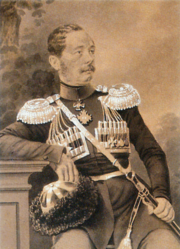
Nikolay Muravyov-Amursky

Encyclopedia
Russia
Russia or , officially known as both Russia and the Russian Federation , is a country in northern Eurasia. It is a federal semi-presidential republic, comprising 83 federal subjects...
n statesman and diplomat, who played a major role in the expansion
Amur Annexation
The Amur Annexation refers to the annexation of the southeast corner of Siberia by Russia from China in 1858–60. The two areas involved are the Priamurye between the Amur River and the Stanovoy Range to the north and the Primorye which runs down the coast from the Amur mouth to the Korean border...
of the Russian Empire into the Amur River basin and to the shores of the Sea of Japan
Sea of Japan
The Sea of Japan is a marginal sea of the western Pacific Ocean, between the Asian mainland, the Japanese archipelago and Sakhalin. It is bordered by Japan, North Korea, Russia and South Korea. Like the Mediterranean Sea, it has almost no tides due to its nearly complete enclosure from the Pacific...
.
Surname spelling
The surname Muravyov has also been transcribed as Muravyev or Murav'ev.Early life and career
Nikolay Muravyov was born in St. PetersburgSaint Petersburg
Saint Petersburg is a city and a federal subject of Russia located on the Neva River at the head of the Gulf of Finland on the Baltic Sea...
. He graduated from the Page Corps
Page Corps
Page Corps was a military academy in Imperial Russia, which prepared sons of the nobility and of senior officers for military service....
in 1827. He participated in the Siege of Varna
Siege of Varna
Siege of Varna was a war episode during the Russo-Turkish War, 1828-1829.Varna was held by the Ottoman army...
in the Russo-Turkish War in 1828–1829, and later in suppression of the November Uprising
November Uprising
The November Uprising , Polish–Russian War 1830–31 also known as the Cadet Revolution, was an armed rebellion in the heartland of partitioned Poland against the Russian Empire. The uprising began on 29 November 1830 in Warsaw when the young Polish officers from the local Army of the Congress...
in Poland
Poland
Poland , officially the Republic of Poland , is a country in Central Europe bordered by Germany to the west; the Czech Republic and Slovakia to the south; Ukraine, Belarus and Lithuania to the east; and the Baltic Sea and Kaliningrad Oblast, a Russian exclave, to the north...
in 1831. Due to health reasons, he retired from the military in 1833 and returned home to manage his father's estate. However, he returned to active duty in 1838, as General Golovin's aide-de-camp
Aide-de-camp
An aide-de-camp is a personal assistant, secretary, or adjutant to a person of high rank, usually a senior military officer or a head of state...
, to serve in the Caucasus
Caucasus
The Caucasus, also Caucas or Caucasia , is a geopolitical region at the border of Europe and Asia, and situated between the Black and the Caspian sea...
region. During one of the campaigns
Caucasian War
The Caucasian War of 1817–1864, also known as the Russian conquest of the Caucasus was an invasion of the Caucasus by the Russian Empire which ended with the annexation of the areas of the North Caucasus to Russia...
against the mountain people Muravyov was wounded.
In 1840, Muravyov was assigned to command one of the sections of the Black Sea
Black Sea
The Black Sea is bounded by Europe, Anatolia and the Caucasus and is ultimately connected to the Atlantic Ocean via the Mediterranean and the Aegean seas and various straits. The Bosphorus strait connects it to the Sea of Marmara, and the strait of the Dardanelles connects that sea to the Aegean...
coast defense lines, during which time he participated in the suppression of the Ubykh people
Ubykh people
The Ubykh are a group who spoke the Northwest Caucasian Ubykh language, until other local languages displaced it and its last speaker died in 1992....
.
Muravyov was promoted in rank to major-general in 1841, but had to permanently retire from the military due to illness. He transferred to the Ministry of Internal Affairs and was appointed as an acting military and civil governor of Tula
Tula Oblast
Tula Oblast is a federal subject of Russia with its present borders formed on September 26, 1937. Its administrative center is the city of Tula. The oblast has an area of and a population of 1,553,874...
province in 1846. Eager in his willingness to improve the province's state of affairs, he proposed to establish the Governorate
Guberniya
A guberniya was a major administrative subdivision of the Russian Empire usually translated as government, governorate, or province. Such administrative division was preserved for sometime upon the collapse of the empire in 1917. A guberniya was ruled by a governor , a word borrowed from Latin ,...
agricultural society. Muravyov was the first governor to propose Tsar
Tsar
Tsar is a title used to designate certain European Slavic monarchs or supreme rulers. As a system of government in the Tsardom of Russia and Russian Empire, it is known as Tsarist autocracy, or Tsarism...
Nicholas I
Nicholas I of Russia
Nicholas I , was the Emperor of Russia from 1825 until 1855, known as one of the most reactionary of the Russian monarchs. On the eve of his death, the Russian Empire reached its historical zenith spanning over 20 million square kilometers...
to abolish serfdom
Russian serfdom
The origins of serfdom in Russia are traced to Kievan Rus in the 11th century. Legal documents of the epoch, such as Russkaya Pravda, distinguished several degrees of feudal dependency of peasants, the term for an unfree peasant in the Russian Empire, krepostnoi krestyanin , is translated as serf.-...
; a motion signed by nine local land-owners. While the tsar did nothing about the petition, from then on he always referred to Muravyov as a "liberal" and a "democrat".
Government of East Siberia
On September 5, 1847, Muravyov was appointed the Governor General of IrkutskIrkutsk
Irkutsk is a city and the administrative center of Irkutsk Oblast, Russia, one of the largest cities in Siberia. Population: .-History:In 1652, Ivan Pokhabov built a zimovye near the site of Irkutsk for gold trading and for the collection of fur taxes from the Buryats. In 1661, Yakov Pokhabov...
and Yeniseysk
Yeniseysk
Yeniseysk is a town in Krasnoyarsk Krai, Russia, located on the Yenisei River. Population: 20,000 .Yeniseysk was founded in 1619 as a stockaded town—the first town on the Yenisei River. It played an important role in Russian colonization of East Siberia in the 17th–18th centuries...
(Eastern Siberia). His appointment was a subject of much controversy, as it was unusual for a person of his age (only 38 at the time) to be put in charge of such a vast territory. Contrary to the views of Karl Nesselrode
Karl Nesselrode
Baltic-German Count Karl Robert Nesselrode, also known as Charles de Nesselrode, was a Russian diplomat and a leading European conservative statesman of the Holy Alliance...
, the Russian Foreign Minister
Foreign Minister of Russia
This is a list of foreign ministers of Tsardom of Russia, Russian Empire, Soviet Union, and Russian Federation.-Heads of Posolsky Prikaz, 1549-1699:*Ivan Viskovatyi 1549-62*Andrey Vasilyev 1562-1570*Brothers Vasily and Andrey Shchelkalov 1570-1601...
, Muravyov was personally instructed by Tsar Nicholas I
Nicholas I of Russia
Nicholas I , was the Emperor of Russia from 1825 until 1855, known as one of the most reactionary of the Russian monarchs. On the eve of his death, the Russian Empire reached its historical zenith spanning over 20 million square kilometers...
to press for an advantage against China
China
Chinese civilization may refer to:* China for more general discussion of the country.* Chinese culture* Greater China, the transnational community of ethnic Chinese.* History of China* Sinosphere, the area historically affected by Chinese culture...
. Muravyov's first actions as a Governor General were to put end to the embezzlement of public funds. He also mandated the study of the Russian language
Russian language
Russian is a Slavic language used primarily in Russia, Belarus, Uzbekistan, Kazakhstan, Tajikistan and Kyrgyzstan. It is an unofficial but widely spoken language in Ukraine, Moldova, Latvia, Turkmenistan and Estonia and, to a lesser extent, the other countries that were once constituent republics...
in schools for native Siberian and Far Eastern peoples. He pursued the exploration and settlement of the territories north of the Amur River, often utilizing help of political exiles. Many of his actions were aimed to expand commerce in the Far Eastern region. Seeing religion as a powerful form of control over local population, he favored building of new Christian
Christianity
Christianity is a monotheistic religion based on the life and teachings of Jesus as presented in canonical gospels and other New Testament writings...
churches and promoted local religious beliefs such as shamanism
Shamanism
Shamanism is an anthropological term referencing a range of beliefs and practices regarding communication with the spiritual world. To quote Eliade: "A first definition of this complex phenomenon, and perhaps the least hazardous, will be: shamanism = technique of ecstasy." Shamanism encompasses the...
and Buddhism
Buddhism
Buddhism is a religion and philosophy encompassing a variety of traditions, beliefs and practices, largely based on teachings attributed to Siddhartha Gautama, commonly known as the Buddha . The Buddha lived and taught in the northeastern Indian subcontinent some time between the 6th and 4th...
.
After the 1689 Treaty of Nerchinsk
Treaty of Nerchinsk
The Treaty of Nerchinsk of 1689 was the first treaty between Russia and China. The Russians gave up the area north of the Amur River as far as the Stanovoy Mountains and kept the area between the Argun River and Lake Baikal. This border along the Argun River and Stanovoy Mountains lasted until...
, Russia lost the right to navigate the Amur River. Muravyov insisted on conducting an aggressive policy with China despite strong resistance from St. Petersburg officials, who feared a breakup in relations between the two countries. Nevertheless, because the lower reaches of the Amur River were in fact being claimed by the Russians, several expeditions organized by Gennady Nevelskoy
Gennady Nevelskoy
Gennady Ivanovich Nevelskoy was a Russian navigator.In 1848 Nevelskoy led the expedition in the Russian Far East, exploring the area of the Sakhalin and the outlet of the Amur River. He proved that the Strait of Tartary was not a gulf, but indeed a strait, connected to Amur's estuary by a narrow...
had been approved by the government. In 1851–1853, several expeditions were sent to the Amur Liman
Amur Liman
The Amur Liman is a liman of the Amur River, the northern part of the Strait of Tartary between Eurasia and Sakhalin. It connects the Sakhalin Gulf of the Sea of Okhotsk with the main body of the Strait of Tartary via the Nevelskoy Strait....
and Sakhalin
Sakhalin
Sakhalin or Saghalien, is a large island in the North Pacific, lying between 45°50' and 54°24' N.It is part of Russia, and is Russia's largest island, and is administered as part of Sakhalin Oblast...
, with Russian settlements being established in those areas.
Nicholas I of Russia
Nicholas I , was the Emperor of Russia from 1825 until 1855, known as one of the most reactionary of the Russian monarchs. On the eve of his death, the Russian Empire reached its historical zenith spanning over 20 million square kilometers...
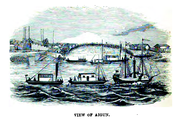
authorized Muravyov to carry the negotiations with the Chinese regarding establishing a border along the Amur River, and to transport troops to the Amur's estuary. In 1854–1858, Muravyov assisted Gennady Nevelskoy in achieving that goal. The first expedition took place in May 1854. A fleet of 77 barges and rafts, led by the Argun steamship, sailed down to the Amur's estuary. Due to the Crimean War
Crimean War
The Crimean War was a conflict fought between the Russian Empire and an alliance of the French Empire, the British Empire, the Ottoman Empire, and the Kingdom of Sardinia. The war was part of a long-running contest between the major European powers for influence over territories of the declining...
, a portion of the fleet was then sent to Kamchatka
Kamchatka Peninsula
The Kamchatka Peninsula is a peninsula in the Russian Far East, with an area of . It lies between the Pacific Ocean to the east and the Sea of Okhotsk to the west...
's Avacha Bay
Avacha Bay
Avacha Bay is a Pacific Ocean bay on the southeastern coast of Kamchatka Peninsula, Russia. It is long and wide , with a maximum depth of 26 m....
, where a series of artillery batteries
Artillery battery
In military organizations, an artillery battery is a unit of guns, mortars, rockets or missiles so grouped in order to facilitate better battlefield communication and command and control, as well as to provide dispersion for its constituent gunnery crews and their systems...
was established to defend the peninsula. The batteries played major role in defending the city of Petropavlovsk
Petropavlovsk-Kamchatsky
Petropavlovsk-Kamchatsky is the main city and the administrative, industrial, scientific, and cultural center of Kamchatka Krai, Russia. Population: .-History:It was founded by Danish navigator Vitus Bering, in the service of the Russian Navy...
(see Siege of Petropavlovsk
Siege of Petropavlovsk
The Siege of Petropavlovsk was the main operation on the Pacific Theatre of the Crimean War. The Russian casualties are estimated at 100 soldiers; the Allies lost five times as many....
), which was attacked by the English and French forces.
The 1855's expedition transported first Russian settlers to the Amur's estuary. Muravyov started negotiations with the Chinese about that time.
Treaty of Aigun
Treaty of Aigun
The Treaty of Aigun was a 1858 treaty between the Russian Empire, and the empire of the Qing Dynasty, the sinicized-Manchu rulers of China, that established much of the modern border between the Russian Far East and Manchuria , which is now known as Northeast China...
with the Qing
Qing Dynasty
The Qing Dynasty was the last dynasty of China, ruling from 1644 to 1912 with a brief, abortive restoration in 1917. It was preceded by the Ming Dynasty and followed by the Republic of China....
official
Yishan
Yishan (Manchu official)
Yishan . Manchu official and member of the Qing imperial clan. Yishan belonged to the Bordered Blue Banner in the Eight Banners and was a great-great-grandson of Yinti, who was outmaneuvered by the Yongzheng emperor...
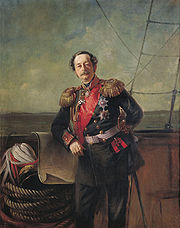
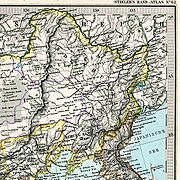
. The Chinese were initially against setting any kinds of boundaries along the Amur River, preferring the status quo of keeping the adjacent territories under joint control of Russia and China. Muravyov, however, was able to persuade the Chinese that Russia's intentions were peaceful and constructive. The Treaty of Aigun effectively recognized the Amur River as the boundary between Russia and Qing Empire and granted Russia free access to the Pacific Ocean. For this, Muravyov was granted the title of Count Amursky (i.e., "of the Amur River"). According to an article by the Russian novelist Vladimir Barayev, the signing of the treaty was celebrated by grandiose illumination in Peking
Beijing
Beijing , also known as Peking , is the capital of the People's Republic of China and one of the most populous cities in the world, with a population of 19,612,368 as of 2010. The city is the country's political, cultural, and educational center, and home to the headquarters for most of China's...
and festivities in major Siberian cities. The new territories acquired by Russia included Priamurye and most of the territories of modern Primorsky
Primorsky Krai
Primorsky Krai , informally known as Primorye , is a federal subject of Russia . Primorsky means "maritime" in Russian, hence the region is sometimes referred to as Maritime Province or Maritime Territory. Its administrative center is in the city of Vladivostok...
and Khabarovsk
Khabarovsk Krai
Khabarovsk Krai is a federal subject of Russia , located in the Russian Far East. It lies mostly in the basin of the lower Amur River, but also occupies a vast mountainous area along the coastline of the Sea of Okhotsk, an arm of the Pacific Ocean. The administrative center of the krai is the...
krai
Krai
Krai or kray was a type of an administrative division in the Russian Empire and the Russian SFSR, and is one of the types of the federal subjects of modern Russia ....
s (territories).
The Treaty of Aigun was confirmed and expanded by the provisions of the Beijing Treaty
Convention of Peking
The Convention of Peking or the First Convention of Peking is the name used for three different unequal treaties, which were concluded between Qing China and the United Kingdom, France, and Russia.-Background:...
of 1860, which granted Russia right to the Ussuri krai
Ussuri krai
Ussuri krai is an unofficial name for a part of Primorsky Krai and Khabarovsky Krai that consisted of Ussuri and South-Ussuri Okrugs. The name was often used in late Imperial Russia...
and southern parts of Primorye
Primorsky Krai
Primorsky Krai , informally known as Primorye , is a federal subject of Russia . Primorsky means "maritime" in Russian, hence the region is sometimes referred to as Maritime Province or Maritime Territory. Its administrative center is in the city of Vladivostok...
.
Baikal Cossacks
Baikal Cossacks were Cossacks of the Transbaikal Cossack Host , a Cossack host formed in 1851 in the areas beyond Lake Baikal ....
detachments to populate the area. Also unsuccessful were attempts to organize steamboat transportation on the Amur and to build a postal road.
As the main objection of the St. Petersburg officials against taking over the left bank of the Amur was lack of people to defend the new territories, Muravyov-Amursky successfully petitioned to free Nerchinsk
Nerchinsk
Nerchinsk is a town and the administrative center of Nerchinsky District of Zabaykalsky Krai, Russia, located east of Lake Baikal, east of Chita, and about west of the Chinese border on the left bank of the Nercha River, above its confluence with the Shilka River, which flows into the Amur...
peasants from mandatory works in the ore mines. With these people, a 12,000 corps of Amur Cossacks
Amur Cossacks
The Amur Cossack Host , a Cossack host created in the Amur region and Primorye in the 1850s on the basis of the Cossacks relocated from the Transbaikal region and freed miners of Nerchinsk region....
was formed and used to settle some of the lands, the military core being the Cossack
Cossack
Cossacks are a group of predominantly East Slavic people who originally were members of democratic, semi-military communities in what is today Ukraine and Southern Russia inhabiting sparsely populated areas and islands in the lower Dnieper and Don basins and who played an important role in the...
s transferred from the Transbaikalia.
Muravyov-Amursky retired from his post of Governor General in 1861 after his proposal to divide Eastern Siberia into two separate Governorates General was declined. He was appointed as a member of the State Council
State Council of Imperial Russia
The State Council was the supreme state advisory body to the Tsar in Imperial Russia.-18th century:Early Tsars' Councils were small and dealt primarily with the external politics....
. In 1868, he moved to Paris
Paris
Paris is the capital and largest city in France, situated on the river Seine, in northern France, at the heart of the Île-de-France region...
, France
France
The French Republic , The French Republic , The French Republic , (commonly known as France , is a unitary semi-presidential republic in Western Europe with several overseas territories and islands located on other continents and in the Indian, Pacific, and Atlantic oceans. Metropolitan France...
, where he lived until his death in 1881, visiting Russia only occasionally to participate in the State Council meetings.
Memory
_front.jpg)
Khabarovsk
Khabarovsk is the largest city and the administrative center of Khabarovsk Krai, Russia. It is located some from the Chinese border. It is the second largest city in the Russian Far East, after Vladivostok. The city became the administrative center of the Far Eastern Federal District of Russia...
. In 1929, it was taken off and replaced with a statue of Lenin
Vladimir Lenin
Vladimir Ilyich Lenin was a Russian Marxist revolutionary and communist politician who led the October Revolution of 1917. As leader of the Bolsheviks, he headed the Soviet state during its initial years , as it fought to establish control of Russia in the Russian Civil War and worked to create a...
, which stood there until 1989. The Muravyov-Amursky memorial was restored in 1993.
In 1992, the remains of Muravyov-Amursky were brought from Paris to be re-buried in the central part of Vladivostok
Vladivostok
The city is located in the southern extremity of Muravyov-Amursky Peninsula, which is about 30 km long and approximately 12 km wide.The highest point is Mount Kholodilnik, the height of which is 257 m...
, which stands on the Muravyov-Amursky Peninsula
Muravyov-Amursky Peninsula
The Muravyov-Amursky Peninsula is a peninsula in the Peter the Great Gulf, which it subdivides into the Amur Bay to the west and the Ussuri Bay to the east. It is approximately 30 km long and 12 km wide....
, named after this statesman.
The Khabarovsk monument—along with the Khabarovsk Bridge
Khabarovsk Bridge
Khabarovsk Bridge is a road and rail bridge built in 1999. It crosses the Amur River in eastern Russia, and connects the urban-type settlement of Imeni Telmana in the Jewish Autonomous Oblast, and city of Khabarovsk in the Khabarovsk Krai...
over the Amur River—is depicted on the 5000 ruble
Russian ruble
The ruble or rouble is the currency of the Russian Federation and the two partially recognized republics of Abkhazia and South Ossetia. Formerly, the ruble was also the currency of the Russian Empire and the Soviet Union prior to their breakups. Belarus and Transnistria also use currencies with...
banknote issued by the Central Bank of the Russian Federation
Central Bank of the Russian Federation
The Bank of Russia or the Central Bank of The Russian Federation is the central bank of The Russian Federation. Its functions are described in the Russian constitution and in the special Federal law...
on July 31, 2006.
See also
- Amur AnnexationAmur AnnexationThe Amur Annexation refers to the annexation of the southeast corner of Siberia by Russia from China in 1858–60. The two areas involved are the Priamurye between the Amur River and the Stanovoy Range to the north and the Primorye which runs down the coast from the Amur mouth to the Korean border...