

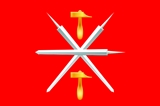
Tula Oblast

Encyclopedia
Tula Oblast is a federal subject
of Russia
(an oblast
) with its present borders formed on September 26, 1937. Its administrative center is the city of Tula
. The oblast has an area of 25700 square kilometres (9,922.8 sq mi) and a population of 1,553,874 (2010 Census preliminary results). The oblast's current governor is Vladimir Gruzdev
.
For a sketch on its early history, see Upper Oka Principalities
.
and borders Moscow
, Ryazan
, Lipetsk
, Oryol
, and Kaluga Oblast
s.
, limestone
, and deposits of lignite
(coal). The lignite deposit is part of the Moscow coal basin.
.
, ethnic Russians at 1,595,564 make up 95% of the population. Other prominent ethnicities in the oblast include Ukrainians at 22,260 (1.3%) and Tatars at 8,968 (0.5%). The rest of the residents identified themselves with 120 different ethnic groups, each group accounting for less than 0.5% of the population.
Birth rate: 7.88 (2004), being the lowest in Russia. Decreased to 7.6 in mid-2006.
. It is a prominent industrial center with metalworking
, engineering
, coalmining, and chemical industries. Major industrial cities include Novomoskovsk
and Aleksin
. Historical industries, such as firearm
, samovar
, and accordion
manufacturing, still play an important role in the region.
The oblast also has a developed agricultural sector, which ranks 33rd in Russia in agricultural production. The sector includes farming grain
(wheat
and rye
), potato
es, sugar beet
s, and vegetable growing, livestock
raising, and dairying.
 Tula Oblast has as many as 32 museums. Several are located in the administrative center of the oblast, the city of Tula
, notably the Tula State Arms Museum, the Tula Kremlin, and the Tula Samovar Museum . Another important cultural tourist attractions is the home and country estate of Leo Tolstoy
, Yasnaya Polyana
, located 12 km outside of the city of Tula.
The oblast also has four professional theaters, a philharmonic orchestra, and a circus
.
Orthodox Christianity is the dominant religion in the oblast, although the number of atheists
is also significant.
Federal subjects of Russia
Russia is a federation which, since March 1, 2008, consists of 83 federal subjects . In 1993, when the Constitution was adopted, there were 89 federal subjects listed...
of Russia
Russia
Russia or , officially known as both Russia and the Russian Federation , is a country in northern Eurasia. It is a federal semi-presidential republic, comprising 83 federal subjects...
(an oblast
Oblast
Oblast is a type of administrative division in Slavic countries, including some countries of the former Soviet Union. The word "oblast" is a loanword in English, but it is nevertheless often translated as "area", "zone", "province", or "region"...
) with its present borders formed on September 26, 1937. Its administrative center is the city of Tula
Tula, Russia
Tula is an industrial city and the administrative center of Tula Oblast, Russia. It is located south of Moscow, on the Upa River. Population: -History:...
. The oblast has an area of 25700 square kilometres (9,922.8 sq mi) and a population of 1,553,874 (2010 Census preliminary results). The oblast's current governor is Vladimir Gruzdev
Vladimir Gruzdev
Vladimir Sergeyevich Gruzdev is a Russian politician, the governor of Tula Oblast., businessman and explorer.Vladimir Gruzdev was born in 1967 in Bolshevo, Moscow oblast, to a military officer and a teacher...
.
For a sketch on its early history, see Upper Oka Principalities
Upper Oka Principalities
The Upper Oka Principalities is a term traditionally applied in Russian historiography to about dozen tiny and ephemeral polities situated along the upper course of the Oka River at the turn of the 14th and 15th centuries...
.
Geography
Tula Oblast is located in Russia's Central Federal DistrictCentral Federal District
The Central Federal District is one of the eight federal districts of Russia. The word "Central" is of political and historical meaning; geographically, the district is situated in the extreme west of Russia. The district spans an area of , with a population of 38,438,600 according to the 2010...
and borders Moscow
Moscow Oblast
Moscow Oblast , or Podmoskovye , is a federal subject of Russia . Its area, at , is relatively small compared to other federal subjects, but it is one of the most densely populated regions in the country and, with the 2010 population of 7,092,941, is the second most populous federal subject...
, Ryazan
Ryazan Oblast
Ryazan Oblast is a federal subject of Russia . Its administrative center is the city of Ryazan, which is the oblast's largest city. Population: -Geography:...
, Lipetsk
Lipetsk Oblast
Lipetsk Oblast is a federal subject of Russia which was formed on January 6, 1954. Its administrative center is the city of Lipetsk...
, Oryol
Oryol Oblast
Oryol Oblast is a federal subject of Russia . Its administrative center is the city of Oryol. Population: -Geography:It is located in the southwestern part of the Central Federal District, in the Mid-Russian Highlands. Kaluga and Tula Oblasts border it in the north, Bryansk Oblast is located to...
, and Kaluga Oblast
Kaluga Oblast
Kaluga Oblast is a federal subject of Russia . Its administrative center is the city of Kaluga.-Geography:Kaluga Oblast is located in the central part of the East European Plain. The Smolensk Highland lays in the western and north-western part of the oblast, while the Central Russian Highland -...
s.
Rivers
Tula Oblast contains more than 1,600 rivers and streams. Major rivers include:- Don RiverDon River (Russia)The Don River is one of the major rivers of Russia. It rises in the town of Novomoskovsk 60 kilometres southeast from Tula, southeast of Moscow, and flows for a distance of about 1,950 kilometres to the Sea of Azov....
- Oka RiverOka RiverOka is a river in central Russia, the largest right tributary of the Volga. It flows through the regions of Oryol, Tula, Kaluga, Moscow, Ryazan, Vladimir, and Nizhny Novgorod and is navigable over a large part of its total length, as far upstream as to the town of Kaluga. Its length exceeds...
- Upa RiverUpa RiverUpa is a river in Tula Oblast, Russia, one of the main tributaries of the Oka River.The river is 345 km long; the city of Tula is on its banks. The name of the river is of Baltic origin....
Natural resources
The oblast is rich in iron ore, clayClay
Clay is a general term including many combinations of one or more clay minerals with traces of metal oxides and organic matter. Geologic clay deposits are mostly composed of phyllosilicate minerals containing variable amounts of water trapped in the mineral structure.- Formation :Clay minerals...
, limestone
Limestone
Limestone is a sedimentary rock composed largely of the minerals calcite and aragonite, which are different crystal forms of calcium carbonate . Many limestones are composed from skeletal fragments of marine organisms such as coral or foraminifera....
, and deposits of lignite
Lignite
Lignite, often referred to as brown coal, or Rosebud coal by Northern Pacific Railroad,is a soft brown fuel with characteristics that put it somewhere between coal and peat...
(coal). The lignite deposit is part of the Moscow coal basin.
Climate
Tula Oblast has a moderate continental climateContinental climate
Continental climate is a climate characterized by important annual variation in temperature due to the lack of significant bodies of water nearby...
.
- Average temperature in January: −5.7°С
- Average temperature in June: +19.1°С
- Average Annual Precipitation: 470–575 mm
Demographics
According to the 2002 CensusRussian Census (2002)
Russian Census of 2002 was the first census of the Russian Federation carried out on October 9 through October 16, 2002. It was carried out by the Russian Federal Service of State Statistics .-Resident population:...
, ethnic Russians at 1,595,564 make up 95% of the population. Other prominent ethnicities in the oblast include Ukrainians at 22,260 (1.3%) and Tatars at 8,968 (0.5%). The rest of the residents identified themselves with 120 different ethnic groups, each group accounting for less than 0.5% of the population.
- Population: 1,675,758 (2002)
- Urban: 1,366,818 (81.6%)
- Rural: 308,940 (18.4%)
- Males: 755,057 (45.1%)
- Females: 920,701 (54.9%)
- Females per 1000 Males: 1219
- Average age : 41.7 years
- Urban : 41.5 years
- Rural : 42.8 years
- Male : 37.8 years
- Female : 44.9 years
Birth rate: 7.88 (2004), being the lowest in Russia. Decreased to 7.6 in mid-2006.
- Births (2008): 14,148
- Deaths (2008): 31,900
Economy
Tula Oblast is part of the Central economic regionCentral economic region
Central economic region is one of twelve economic regions of Russia.Area: 484,000 km²; population: 30.5 million . Average population density—63/km². Over 80% of the population is urban....
. It is a prominent industrial center with metalworking
Metalworking
Metalworking is the process of working with metals to create individual parts, assemblies, or large scale structures. The term covers a wide range of work from large ships and bridges to precise engine parts and delicate jewelry. It therefore includes a correspondingly wide range of skills,...
, engineering
Engineering
Engineering is the discipline, art, skill and profession of acquiring and applying scientific, mathematical, economic, social, and practical knowledge, in order to design and build structures, machines, devices, systems, materials and processes that safely realize improvements to the lives of...
, coalmining, and chemical industries. Major industrial cities include Novomoskovsk
Novomoskovsk, Russia
Novomoskovsk , called Bobriki before 1934 and Stalinogorsk between 1934 and 1961, is a city in Tula Oblast, Russia, located at the source of the Don and Shat Rivers. Population: 143,000 ; 107,000 ; 76,000 ....
and Aleksin
Aleksin
Aleksin is a town and the administrative center of Aleksinsky District of Tula Oblast, Russia, located northwest of Tula. Population: -History:...
. Historical industries, such as firearm
Firearm
A firearm is a weapon that launches one, or many, projectile at high velocity through confined burning of a propellant. This subsonic burning process is technically known as deflagration, as opposed to supersonic combustion known as a detonation. In older firearms, the propellant was typically...
, samovar
Samovar
A samovar is a heated metal container traditionally used to heat and boil water in and around Russia, as well as in other Central, South-Eastern, Eastern European countries,Kashmir and in the Middle-East...
, and accordion
Accordion
The accordion is a box-shaped musical instrument of the bellows-driven free-reed aerophone family, sometimes referred to as a squeezebox. A person who plays the accordion is called an accordionist....
manufacturing, still play an important role in the region.
The oblast also has a developed agricultural sector, which ranks 33rd in Russia in agricultural production. The sector includes farming grain
GRAIN
GRAIN is a small international non-profit organisation that works to support small farmers and social movements in their struggles for community-controlled and biodiversity-based food systems. Our support takes the form of independent research and analysis, networking at local, regional and...
(wheat
Wheat
Wheat is a cereal grain, originally from the Levant region of the Near East, but now cultivated worldwide. In 2007 world production of wheat was 607 million tons, making it the third most-produced cereal after maize and rice...
and rye
Rye
Rye is a grass grown extensively as a grain and as a forage crop. It is a member of the wheat tribe and is closely related to barley and wheat. Rye grain is used for flour, rye bread, rye beer, some whiskeys, some vodkas, and animal fodder...
), potato
Potato
The potato is a starchy, tuberous crop from the perennial Solanum tuberosum of the Solanaceae family . The word potato may refer to the plant itself as well as the edible tuber. In the region of the Andes, there are some other closely related cultivated potato species...
es, sugar beet
Sugar beet
Sugar beet, a cultivated plant of Beta vulgaris, is a plant whose tuber contains a high concentration of sucrose. It is grown commercially for sugar production. Sugar beets and other B...
s, and vegetable growing, livestock
Livestock
Livestock refers to one or more domesticated animals raised in an agricultural setting to produce commodities such as food, fiber and labor. The term "livestock" as used in this article does not include poultry or farmed fish; however the inclusion of these, especially poultry, within the meaning...
raising, and dairying.
Culture
Tula, Russia
Tula is an industrial city and the administrative center of Tula Oblast, Russia. It is located south of Moscow, on the Upa River. Population: -History:...
, notably the Tula State Arms Museum, the Tula Kremlin, and the Tula Samovar Museum . Another important cultural tourist attractions is the home and country estate of Leo Tolstoy
Leo Tolstoy
Lev Nikolayevich Tolstoy was a Russian writer who primarily wrote novels and short stories. Later in life, he also wrote plays and essays. His two most famous works, the novels War and Peace and Anna Karenina, are acknowledged as two of the greatest novels of all time and a pinnacle of realist...
, Yasnaya Polyana
Yasnaya Polyana
Yasnaya Polyana was the home of the writer Leo Tolstoy, where he was born, wrote War and Peace and Anna Karenina, and is buried. Tolstoy called Yasnaya Polyana his "inaccessible literary stronghold". It is located southwest of Tula, Russia and from Moscow.In 1921, the estate formally became his...
, located 12 km outside of the city of Tula.
The oblast also has four professional theaters, a philharmonic orchestra, and a circus
Circus
A circus is commonly a travelling company of performers that may include clowns, acrobats, trained animals, trapeze acts, musicians, hoopers, tightrope walkers, jugglers, unicyclists and other stunt-oriented artists...
.
Orthodox Christianity is the dominant religion in the oblast, although the number of atheists
Atheism
Atheism is, in a broad sense, the rejection of belief in the existence of deities. In a narrower sense, atheism is specifically the position that there are no deities...
is also significant.