


NeXT

Encyclopedia
Next, Inc. was an American computer
company headquartered in Redwood City, California
, that developed and manufactured a series of computer
workstation
s intended for the higher education
and business markets. NeXT was founded in 1985 by Apple Computer co-founder Steve Jobs
after he was fired from Apple the same year. NeXT introduced the first NeXT Computer
in 1988, and the smaller NeXTstation
in 1990. Sales of the NeXT computers were relatively limited, with estimates of about 50,000 units shipped in total. Nevertheless, its innovative object-oriented NeXTSTEP
operating system
and development environment were highly influential.
NeXT later released much of the NeXTstep system as a programming environment
standard called OpenStep
. NeXT withdrew from the hardware business in 1993 to concentrate on marketing OPENSTEP, its own OpenStep implementation, for several OEM
s. NeXT also developed WebObjects
, one of the first enterprise web application framework
s. WebObjects never became very popular because of its initial high price of $50,000 but remains a prominent early example of a web server based on dynamic page generation
rather than static content.
Apple purchased NeXT on December 20, 1996 for $429 million and 1.5 million shares of Apple stock, and much of the current Mac OS X
system is built on the OPENSTEP foundation.
was the head of Apple's SuperMicro division, which was responsible for the development of the Macintosh
and Lisa
personal computers. The Macintosh had been successful on university campuses in considerable part because of the Apple University Consortium
, which allowed students and institutions to buy the computers at a discount. The consortium had sold more than $50 million in computers by February 1984.
While chairman, Jobs visited university departments and faculty members to sell Macintosh. Jobs met Paul Berg
, a Nobel Laureate in chemistry, at a luncheon held in Silicon Valley
to honour François Mitterrand
, then President of France. Berg was frustrated by the expense of teaching students about recombinant DNA
from textbooks instead of in wet labs
, used for the testing and analysis of chemicals, drugs, and other materials or biological matter. Wet labs were prohibitively expensive for lower-level courses and were too complex to be simulated on personal computers of the time. Berg suggested to Jobs to use his influence at Apple to create a "3M
" workstation for higher education, featuring more than one megabyte
of random access memory (RAM), a megapixel display and megaflop performance (hence the name "3M").
Jobs was intrigued by Berg's concept of a workstation and contemplated starting a higher education computer company in the fall of 1985, amidst increasing turmoil at Apple. Jobs' division did not release upgraded versions of the Macintosh and most of the Macintosh Office
. As a result, sales plummeted, and Apple was forced to write off millions of dollars in unsold inventory. Apple's Chief Executive Officer
(CEO) John Sculley
ousted Jobs from his day-to-day role at Apple, replacing him with Jean-Louis Gassée
in 1985. Later that year, Jobs began a power struggle to regain control of the company. The board of directors sided with Sculley while Jobs took a business visit to Western Europe
and the Soviet Union
on behalf of Apple.
After several months of being sidelined at Apple, Jobs resigned on Friday, September 13, 1985. He told the board he was leaving to set up a new computer company, and that he would be taking several Apple employees from the SuperMicro division with him. He also told the board that his new company would not compete with Apple and might even consider licensing its designs back to them to market under the Macintosh brand.
Jobs was joined by former Apple employees Bud Tribble
, George Crow
, Rich Page
, Susan Barnes
, Susan Kare
, and Dan'l Lewin and named his new company Next, Inc. After consulting with major educational buyers from around the country (including a follow-up meeting with Paul Berg), a tentative specification for the workstation was drawn up. It was designed to be powerful enough to run wet lab simulations and cheap enough for college students to use in their dorm rooms. Before the specifications were finished, however, Apple sued Next for "nefarious schemes" to take advantage of the cofounders' insider information
. Jobs remarked, "It is hard to think that a $2 billion company with 4,300-plus people couldn't compete with six people in blue jeans." The suit was eventually dismissed before trial.
In 1986, Jobs recruited the famous graphic designer Paul Rand
to create a brand identity costing $100,000. Rand created a 100-page brochure detailing the brand, including the precise angle used for the logo (28°) and a new company name, NeXT. The first major outside investment was from Ross Perot
, who invested after seeing a segment about NeXT on The Entrepreneurs. In 1987, he invested $20 million in exchange for 16% of NeXT's stock and subsequently joined the board of directors in 1988.
 NeXT changed its business plan in mid-1986. The company decided to develop both computer hardware and software, instead of just a low-end workstation. A team led by Avie Tevanian
, who had joined the company after working as one of the Mach kernel
engineers at Carnegie Mellon University
, was to develop the NeXTSTEP operating system. The hardware division, led by Rich Page
, one of the cofounders who had previously led the Apple Lisa
team, designed and developed the hardware. NeXT's first factory was completed in Fremont
, California
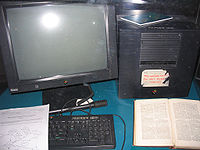
in 1987. It was capable of producing 150,000 machines per year. NeXT's first workstation was officially named the NeXT Computer
, although it was widely referred to as "the cube" because of its distinctive case, a 1 ft x 1 ft x 1 ft magnesium cube, an edict of Jobs' designed by Apple IIc
case designer Frogdesign
.
Prototype workstations were shown to standing ovations on October 12, 1988. The first machines were tested in 1989, after which NeXT started selling limited numbers to universities with a beta version of the NeXTSTEP
operating system installed. Initially the NeXT Computer was targeted at US higher education
establishments only, with a base price of $6,500.
The machine was widely reviewed in magazines, generally concentrating on the hardware. When asked if he was upset that the computer's debut was delayed by several months, Jobs responded, "Late? This computer is five years ahead of its time!"
The NeXT Computer was based on the new 25 MHz Motorola 68030
central processing unit
(CPU). The Motorola 88000
RISC
chip was originally considered, but was not available in sufficient quantities. It included between 8 and 64 MB
of random access memory (RAM), a 256 MB magneto-optical
(MO) drive, a 40 MB (swap-only), 330 MB, or 660 MB hard drive, 10Base-2 Ethernet
, NuBus
and a 17-inch MegaPixel
grayscale display measuring 1120 by 832 pixel
s. In 1989, a typical PC included 640 KB
to 4 MB
of RAM, the 8086
, 8088
, 286
or 386
CPU, a 640×350 16-color or 720×348 monochrome display, a 10 to 20 megabyte hard drive and few networking
capabilities.
It also was the first computer to ship with a general-purpose DSP chip (Motorola 56001) on the mother board. This was used to support sophisticated music and sound processing, including the Music Kit
software.
The magneto-optical drive manufactured by Canon was used as the primary mass storage
device. These drives were relatively new to the market, and the NeXT was the first computer to use them. They were cheaper than hard drives (blank media especially so: though each had a cost of $150 to Canon, Jobs' typically forthright negotiations saw Canon agree to a retail of only $50 apiece) but slower (with an average seek time of 96 ms). The design made it impossible to move files between computers without a network, since each NeXT Computer had only one MO drive and the disk could not be removed without shutting down the system. Storage options proved challenging for the first NeXT Computers. The magneto-optical media was relatively expensive and had performance and reliability problems despite being faster than a floppy drive. The drive was not sufficient to run as the primary medium running the NeXTSTEP
operating system both in terms of speed and capacity.
In 1989, NeXT struck a deal for former Compaq
reseller BusinessLand to sell NeXT computers in select markets nationwide. Selling through a retailer was a major change from NeXT's original business model of only selling directly to students and educational institutions. BusinessLand founder David Norman predicted that sales of the NeXT Computer would surpass sales of Compaq computers after 12 months.
In 1989, Canon invested US$100 million in NeXT, giving it a 16.67% stake, making NeXT worth almost $600 million. Canon invested in NeXT with the condition that it would be able to use the NeXTSTEP environment with its own workstations, which would mean a greatly expanded market for the software. After NeXT exited the hardware business, Canon produced a line of PCs, called object.station, specifically designed to run NeXTSTEP/Intel. Canon also served as NeXT's distributor in Japan.
The first NeXT computers were released on the retail market in 1990, for $9,999. NeXT's original investor Ross Perot
resigned from the board of directors in June 1991 to dedicate more time to Perot Systems
, a Plano, Texas
-based systems integrator.
 NeXT released a second generation of workstations in 1990. The new range included a revised NeXT Computer, renamed the NeXTcube
, and the NeXTstation
, nicknamed "the slab," which used a "pizza box
" case form-factor. Jobs was explicit in ensuring NeXT staff did not use the latter terminology, lest the NeXT machines be compared to competing Sun workstations. The magneto-optical drive was replaced with a 2.88 MB floppy drive to offer users a way to use their floppy disks. However, individual 2.88 MB floppies were expensive and the technology did not supplant the 1.44 MB floppy. Realizing this, NeXT utilized the CD-ROM
drive, which eventually became an industry standard for storage. Color graphics were available on the NeXTstation Color and the NeXTdimension
graphics processor
hardware for the NeXTcube. The new computers were cheaper and faster than their predecessors, with the new Motorola 68040
processor.
In 1992, NeXT launched "Turbo" variants of the NeXTcube and NeXTstation with a 33 MHz 68040 processor and maximum RAM capacity increased to 128 MB. NeXT sold 20,000 computers in 1992 (NeXT counted upgraded motherboards on back order as sales) – a small number compared with their competitors. However, the company reported sales of $140 million for the year, encouraging Canon to invest a further $30 million to keep the company afloat.
In total, 50,000 NeXT machines were sold. NeXT's long-term aim was to migrate to the RISC (Reduced Instruction Set Computing) architecture, a processor design strategy intended to increase performance. The project was known as the NeXT RISC Workstation
(NRW). Initially the NRW was to be based on the Motorola 88110
processor, but due to a lack of confidence in Motorola's commitment to the 88k architecture, it was later redesigned around dual PowerPC 601s. NeXT produced some motherboards and enclosures but exited the hardware business before full production.
used a NeXT Computer in 1991 to create the first web browser and web server; accordingly, NeXT was instrumental in the development of the World Wide Web.
In the early 1990s John Carmack used a NeXTcube to build two of his pioneering games, Wolfenstein 3D
and Doom. Other commercial programs were released for NeXT computers, including the Lotus Improv
spreadsheet
program and Mathematica
. The systems also came with a number of smaller built-in applications such as the Merriam-Webster
Collegiate Dictionary, Oxford
Quotations, the complete works of William Shakespeare
, and the Digital Librarian search engine to access them.
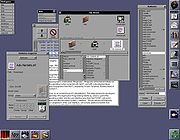 NeXT started porting
the NeXTSTEP operating system to PC compatible computers using the Intel 486 processor in 1992. The operating system was ported to Intel's architecture because of a change in NeXT's business strategy. By late 1993 this port was complete and version 3.1, also known as NeXTSTEP 486, was released. Prior to the release of NeXTSTEP, Chrysler
planned to buy 3,000 copies in 1992. NeXTSTEP 3.x was later ported to PA-RISC
and SPARC
-based platforms, for a total of four versions: NeXTSTEP/NeXT (for NeXT's 68k "black boxes"), NeXTSTEP/Intel, NeXTSTEP/PA-RISC and NeXTSTEP/SPARC. Although these ports were not widely used, NeXTSTEP gained popularity at institutions such as First Chicago NBD, Swiss Bank Corporation
, O'Connor and Company, and other organisations owing to its programming model. It was also used by many American federal agencies, such as Naval Research Laboratory, the National Security Agency
, the Advanced Research Projects Agency, the Central Intelligence Agency
and the National Reconnaissance Office
.
NeXT withdrew from the hardware
business in 1993 and the company was renamed NeXT Software Inc; subsequently 300 of the 540 staff employees were laid off. NeXT negotiated to sell the hardware business including the Fremont factory to Canon. Canon later pulled out of the deal. Work on the PowerPC machines was stopped along with all hardware production. CEO of Sun Microsystems
Scott McNealy
announced plans to invest $10 million in 1993 and use NeXT software (OpenStep) in future Sun systems. NeXT partnered with Sun to create OpenStep
which was NeXTSTEP sans the Mach-based kernel. After dropping the hardware business, NeXT returned to selling a toolkit to run on other operating systems, in effect returning to the original business plan. New products based on OpenStep were released, including OpenStep Enterprise, a version for Microsoft's Windows NT
. The company also launched WebObjects
, a platform for building large-scale dynamic web applications. Many large businesses including Dell
, Disney, WorldCom, and the BBC
used this WebObjects software for a short period of time. In the modern day, WebObjects
is used almost solely to power Apple's iTunes Store
and most of its corporate website.
. (Steve Jobs was deliberately not given cash for his part in the deal.) The main purpose of the acquisition was to use NeXTSTEP as a foundation to replace the dated Mac OS
instead of BeOS
or the in-development Copland
. Jobs returned to Apple as a consultant in 1997 and then after the 4th of July weekend the same year became interim CEO. In 2000 Jobs took the CEO position as a permanent assignment.
Several NeXT executives replaced their Apple counterparts when Steve Jobs restructured the company's board of directors. Over the next five years the NeXTSTEP operating system was ported to the PowerPC
architecture. At the same time, an Intel port and OpenStep Enterprise toolkit for Windows were both produced. The operating system was code named Rhapsody, while the toolkit for development on all platforms was called "Yellow Box". For backwards compatibility Apple added the "Blue Box" to the Macintosh, allowing existing Mac applications to be run in a self-contained cooperative multitasking environment.
A server version of the new operating system was released as Mac OS X Server 1.0
in 1999, and the first consumer version, Mac OS X 10.0
, in 2001. The OpenStep developers toolkit was renamed Cocoa
. Rhapsody's Blue Box was renamed Classic Environment
. Apple included an updated version of the original Macintosh toolbox that allowed existing Mac applications access to the environment without the constraints of Blue Box called Carbon
. Some of NeXTSTEP's interface features were used in Mac OS X, including the Dock
, the Services menu
, the Finder
's 'browser' view, and the text system NSText.
NeXTSTEP's processor-independent capabilities were retained in Mac OS X, leading to both PowerPC and Intel x86 versions (although only PowerPC versions were publicly available before 2006). Apple moved to Intel processors by August 2006.
and was determined to avoid the bureaucratic infighting that led to his resignation. He created a different corporate culture at NeXT in terms of facilities, salaries, and benefits. Jobs had experimented with some structural changes at Apple but at NeXT he abandoned conventional corporate structures, instead making a "community" with "members" instead of employees. There were only two different salaries at NeXT until the early 1990s. Team members who joined before 1986 were paid $75,000 while those who joined afterwards were paid $50,000. This caused a few awkward situations where managers were paid less than their employees. Employees were given performance reviews and raises every six months because of the spartan salary plans. To foster openness, all employees had full access to the payrolls, although few employees ever took advantage of the privilege. NeXT's health insurance
plan offered benefits to not only married couples but unmarried couples and same-sex couples, although the latter privilege was later withdrawn due to insurance complications. The payroll schedule was also very different from other companies in Silicon Valley at the time: instead of getting paid twice a month at the end of the pay period, employees would get paid once a month in advance.
Jobs found office space in Palo Alto on Deer Creek Road, occupying a glass and concrete building which featured a staircase designed by architect I. M. Pei
. The first floor used hardwood flooring and large worktables where the workstations would be assembled. To avoid inventory errors, NeXT used the just in time (JIT) inventory strategy. The company contracted out for all major components such as mainboards and cases and had the finished components shipped to the first floor for assembly. The second floor was the office space with an open floor plan. The only enclosed rooms were Jobs' office and a few conference rooms. As NeXT expanded more office space was needed. The company rented an office in Redwood City, designed by Pei. The architectural centerpiece was a "floating" staircase with no visible supports. The open floor plan was retained although furnishings became luxurious with $5,000 chairs, $10,000 sofas and Ansel Adams
prints. Temporary art exhibitions were mounted with an in-house curator; in at least one instance Jobs ordered the exhibition removed.
The first issue of NeXTWORLD magazine was printed in 1991. It was published in San Francisco by Integrated Media and edited by Michael Miley and later Dan Ruby. It was the only mainstream periodical to discuss NeXT computers, the operating system, and NeXT software. Publication was discontinued in 1994 after only four volumes were released. A NeXTWORLD Expo followed as a developer conference, held in 1991 and 1992 at the San Francisco Civic Center and in 1993 at the Moscone Center
in San Francisco, with Steve Jobs as the keynote speaker.
and graphical user interface
s became more common after the 1988 release of the NeXTcube and NeXTSTEP, when other companies started to emulate NeXT's object-oriented system. Apple started the Taligent
project in 1989, with the goal of building a NeXT-like operating system for the Macintosh, with collaboration from both HP and IBM
.
Microsoft announced the Cairo project
in 1991; the Cairo specification included similar object-oriented user interface features for a coming consumer version of Windows NT
. Although the project was ultimately abandoned, some elements were integrated into other projects. By 1994, Microsoft and NeXT were collaborating on a Windows NT-port of OpenStep; the port, however, was never released.
WebObjects
failed to achieve wide popularity partly because of the initial high price of $50,000, but it remains the first and most prominent early example of a web application server which enabled dynamic page generation based on user interactions as opposed to static content. WebObjects is now bundled with Mac OS X Server
and Xcode
.
Computer
A computer is a programmable machine designed to sequentially and automatically carry out a sequence of arithmetic or logical operations. The particular sequence of operations can be changed readily, allowing the computer to solve more than one kind of problem...
company headquartered in Redwood City, California
Redwood City, California
Redwood City is a California charter city located on the San Francisco Peninsula in Northern California, approximately 27 miles south of San Francisco, and 24 miles north of San Jose. Redwood City's history spans from its earliest inhabitation by the Ohlone people, to its tradition as a port for...
, that developed and manufactured a series of computer
Computer
A computer is a programmable machine designed to sequentially and automatically carry out a sequence of arithmetic or logical operations. The particular sequence of operations can be changed readily, allowing the computer to solve more than one kind of problem...
workstation
Workstation
A workstation is a high-end microcomputer designed for technical or scientific applications. Intended primarily to be used by one person at a time, they are commonly connected to a local area network and run multi-user operating systems...
s intended for the higher education
Higher education
Higher, post-secondary, tertiary, or third level education refers to the stage of learning that occurs at universities, academies, colleges, seminaries, and institutes of technology...
and business markets. NeXT was founded in 1985 by Apple Computer co-founder Steve Jobs
Steve Jobs
Steven Paul Jobs was an American businessman and inventor widely recognized as a charismatic pioneer of the personal computer revolution. He was co-founder, chairman, and chief executive officer of Apple Inc...
after he was fired from Apple the same year. NeXT introduced the first NeXT Computer
NeXT Computer
The NeXT Computer was a high-end workstation computer developed, manufactured and sold by Steve Jobs' company NeXT from 1988 until 1990. It ran the Unix-based NeXTSTEP operating system. The NeXT Computer was packaged in a 1-foot die-cast magnesium cube-shaped case, which led to the machine being...
in 1988, and the smaller NeXTstation
NeXTstation
NeXTstation was a high-end workstation computer developed, manufactured and sold by NeXT from 1990 until 1993. It ran the NeXTSTEP operating system. The NeXTstation was released as a more affordable alternative to the NeXTcube at about US $4,995 or about half the price...
in 1990. Sales of the NeXT computers were relatively limited, with estimates of about 50,000 units shipped in total. Nevertheless, its innovative object-oriented NeXTSTEP
NEXTSTEP
NeXTSTEP was the object-oriented, multitasking operating system developed by NeXT Computer to run on its range of proprietary workstation computers, such as the NeXTcube...
operating system
Operating system
An operating system is a set of programs that manage computer hardware resources and provide common services for application software. The operating system is the most important type of system software in a computer system...
and development environment were highly influential.
NeXT later released much of the NeXTstep system as a programming environment
Application programming interface
An application programming interface is a source code based specification intended to be used as an interface by software components to communicate with each other...
standard called OpenStep
OpenStep
OpenStep was an object-oriented application programming interface specification for an object-oriented operating system that used a non-NeXTSTEP operating system as its core, principally developed by NeXT with Sun Microsystems. OPENSTEP was a specific implementation of the OpenStep API developed...
. NeXT withdrew from the hardware business in 1993 to concentrate on marketing OPENSTEP, its own OpenStep implementation, for several OEM
Original Equipment Manufacturer
An original equipment manufacturer, or OEM, manufactures products or components that are purchased by a company and retailed under that purchasing company's brand name. OEM refers to the company that originally manufactured the product. When referring to automotive parts, OEM designates a...
s. NeXT also developed WebObjects
WebObjects
WebObjects was a Java web application server from Apple Inc., and a web application framework that ran on the server. It was available at no additional cost. Its hallmark features were its object-orientation, database connectivity, and prototyping tools...
, one of the first enterprise web application framework
Web application framework
A web application framework is a software framework that is designed to support the development of dynamic websites, web applications and web services. The framework aims to alleviate the overhead associated with common activities performed in Web development...
s. WebObjects never became very popular because of its initial high price of $50,000 but remains a prominent early example of a web server based on dynamic page generation
Dynamic web page
A dynamic web page is a kind of web page that has been prepared with fresh information , for each individual viewing. It is not static because it changes with the time , the user , the user interaction , the context A dynamic web page is a kind of web page that has been prepared with fresh...
rather than static content.
Apple purchased NeXT on December 20, 1996 for $429 million and 1.5 million shares of Apple stock, and much of the current Mac OS X
Mac OS X
Mac OS X is a series of Unix-based operating systems and graphical user interfaces developed, marketed, and sold by Apple Inc. Since 2002, has been included with all new Macintosh computer systems...
system is built on the OPENSTEP foundation.
1985–1986: Founding NeXT
In 1984, Apple founder Steve JobsSteve Jobs
Steven Paul Jobs was an American businessman and inventor widely recognized as a charismatic pioneer of the personal computer revolution. He was co-founder, chairman, and chief executive officer of Apple Inc...
was the head of Apple's SuperMicro division, which was responsible for the development of the Macintosh
Macintosh
The Macintosh , or Mac, is a series of several lines of personal computers designed, developed, and marketed by Apple Inc. The first Macintosh was introduced by Apple's then-chairman Steve Jobs on January 24, 1984; it was the first commercially successful personal computer to feature a mouse and a...
and Lisa
Apple Lisa
The Apple Lisa—also known as the Lisa—is a :personal computer designed by Apple Computer, Inc. during the early 1980s....
personal computers. The Macintosh had been successful on university campuses in considerable part because of the Apple University Consortium
Apple University Consortium
The Apple University Consortium is a partnership between Apple Australia and a number of Australian universities. Every two years it holds the AUC Academic & Developers Conference in an Australian city...
, which allowed students and institutions to buy the computers at a discount. The consortium had sold more than $50 million in computers by February 1984.
While chairman, Jobs visited university departments and faculty members to sell Macintosh. Jobs met Paul Berg
Paul Berg
Paul Berg is an American biochemist and professor emeritus at Stanford University. He was the recipient of the Nobel Prize in Chemistry in 1980, along with Walter Gilbert and Frederick Sanger. The award recognized their contributions to basic research involving nucleic acids...
, a Nobel Laureate in chemistry, at a luncheon held in Silicon Valley
Silicon Valley
Silicon Valley is a term which refers to the southern part of the San Francisco Bay Area in Northern California in the United States. The region is home to many of the world's largest technology corporations...
to honour François Mitterrand
François Mitterrand
François Maurice Adrien Marie Mitterrand was the 21st President of the French Republic and ex officio Co-Prince of Andorra, serving from 1981 until 1995. He is the longest-serving President of France and, as leader of the Socialist Party, the only figure from the left so far elected President...
, then President of France. Berg was frustrated by the expense of teaching students about recombinant DNA
Recombinant DNA
Recombinant DNA molecules are DNA sequences that result from the use of laboratory methods to bring together genetic material from multiple sources, creating sequences that would not otherwise be found in biological organisms...
from textbooks instead of in wet labs
Wet laboratory
Wet laboratories are laboratories where chemicals, drugs, or other material or biological matter are handled in liquid solutions or volatile phases, requiring direct ventilation, and specialized piped utilities...
, used for the testing and analysis of chemicals, drugs, and other materials or biological matter. Wet labs were prohibitively expensive for lower-level courses and were too complex to be simulated on personal computers of the time. Berg suggested to Jobs to use his influence at Apple to create a "3M
3M computer
3M was a goal first proposed in the early 1980s by Raj Reddy and his colleagues at Carnegie Mellon University as a minimum specification for academic/technical workstations: at least a megabyte of memory, a megapixel display and a million instructions per second processing power. It was also...
" workstation for higher education, featuring more than one megabyte
Megabyte
The megabyte is a multiple of the unit byte for digital information storage or transmission with two different values depending on context: bytes generally for computer memory; and one million bytes generally for computer storage. The IEEE Standards Board has decided that "Mega will mean 1 000...
of random access memory (RAM), a megapixel display and megaflop performance (hence the name "3M").
Jobs was intrigued by Berg's concept of a workstation and contemplated starting a higher education computer company in the fall of 1985, amidst increasing turmoil at Apple. Jobs' division did not release upgraded versions of the Macintosh and most of the Macintosh Office
Macintosh Office
The Macintosh Office was Apple's third failed attempt to enter into the business environment as a serious competitor to IBM. Consisting of three key parts, a network file server, local area network and a network Laser printer, Apple announced Macintosh Office in January 1985 with an ill-fated,...
. As a result, sales plummeted, and Apple was forced to write off millions of dollars in unsold inventory. Apple's Chief Executive Officer
Chief executive officer
A chief executive officer , managing director , Executive Director for non-profit organizations, or chief executive is the highest-ranking corporate officer or administrator in charge of total management of an organization...
(CEO) John Sculley
John Sculley
John Sculley is an American businessman. Sculley was vice-president and president of PepsiCo , until he became CEO of Apple on April 8, 1983, a position he held until leaving in 1993...
ousted Jobs from his day-to-day role at Apple, replacing him with Jean-Louis Gassée
Jean-Louis Gassée
Jean-Louis Gassée is a former executive at Apple Computer, where he worked from 1981 to 1990. He is most famous for founding Be Inc., creators of the BeOS computer operating system. After leaving Be, he became Chairman of PalmSource, Inc. in November, 2004.-1980s: Apple Computer:Gassée worked for...
in 1985. Later that year, Jobs began a power struggle to regain control of the company. The board of directors sided with Sculley while Jobs took a business visit to Western Europe
Western Europe
Western Europe is a loose term for the collection of countries in the western most region of the European continents, though this definition is context-dependent and carries cultural and political connotations. One definition describes Western Europe as a geographic entity—the region lying in the...
and the Soviet Union
Soviet Union
The Soviet Union , officially the Union of Soviet Socialist Republics , was a constitutionally socialist state that existed in Eurasia between 1922 and 1991....
on behalf of Apple.
After several months of being sidelined at Apple, Jobs resigned on Friday, September 13, 1985. He told the board he was leaving to set up a new computer company, and that he would be taking several Apple employees from the SuperMicro division with him. He also told the board that his new company would not compete with Apple and might even consider licensing its designs back to them to market under the Macintosh brand.
Jobs was joined by former Apple employees Bud Tribble
Bud Tribble
Guy L. "Bud" Tribble, MD, PhD, is Vice President of Software Technology at Apple Inc. Tribble served as the manager of the original Macintosh software development team where he helped to design the Mac OS and user interface. He was among the founders of NeXT, Inc., serving as NeXT's vice...
, George Crow
George Crow
George L. Crow Jr. was a member of the original Apple Macintosh team in 1984 at Apple Computer. Crow left Apple in 1985 to become a co-founder of Steve Jobs' NeXT. Prior to working at Apple, Crow worked at HP; after leaving NeXT he worked for SuperMac and then Truevision...
, Rich Page
Rich Page
Richard Page was an Apple Fellow at Apple Computer in the 1980s, and he later joined Steve Jobs at NeXT. In 1992 Rich Page left Next and within weeks after his resignation, several VP at Next left too....
, Susan Barnes
Susan Barnes (computing)
Susan Kelly Barnes was Controller of the Macintosh Division at Apple Computer. When Steve Jobs left Apple Computer in 1985, she joined Jobs and other Apple managers to cofound NeXT Computer, Inc. She served as Vice President and Chief Financial Officer of NeXT Computer from 1985 to 1991. As NeXT's...
, Susan Kare
Susan Kare
Susan Kare is an artist and graphic designer who created many of the interface elements for the Apple Macintosh in the 1980s. She was also one of the original employees of NeXT , working as the Creative Director.-Background:Kare was born in Ithaca, New York and is the sister of aerospace engineer...
, and Dan'l Lewin and named his new company Next, Inc. After consulting with major educational buyers from around the country (including a follow-up meeting with Paul Berg), a tentative specification for the workstation was drawn up. It was designed to be powerful enough to run wet lab simulations and cheap enough for college students to use in their dorm rooms. Before the specifications were finished, however, Apple sued Next for "nefarious schemes" to take advantage of the cofounders' insider information
Insider
An insider is a member of any group of people of limited number and generally restricted access. The term is used in the context of secret, privileged, hidden or otherwise esoteric information or knowledge: an insider is a "member of the gang" and as such knows things only people in the gang...
. Jobs remarked, "It is hard to think that a $2 billion company with 4,300-plus people couldn't compete with six people in blue jeans." The suit was eventually dismissed before trial.
In 1986, Jobs recruited the famous graphic designer Paul Rand
Paul Rand
Paul Rand Paul Rand Paul Rand (born Peretz Rosenbaum, (August 15, 1914 — November 26, 1996) was an American graphic designer, best known for his corporate logo designs, including the logos for IBM, UPS, Enron, Westinghouse, ABC, and Steve Jobs’ NeXT...
to create a brand identity costing $100,000. Rand created a 100-page brochure detailing the brand, including the precise angle used for the logo (28°) and a new company name, NeXT. The first major outside investment was from Ross Perot
Ross Perot
Henry Ross Perot is a U.S. businessman best known for running for President of the United States in 1992 and 1996. Perot founded Electronic Data Systems in 1962, sold the company to General Motors in 1984, and founded Perot Systems in 1988...
, who invested after seeing a segment about NeXT on The Entrepreneurs. In 1987, he invested $20 million in exchange for 16% of NeXT's stock and subsequently joined the board of directors in 1988.
First generation
Avie Tevanian
Avadis "Avie" Tevanian is a former Senior Vice President of Software Engineering at Apple Computer from 1997 to 2003, and a former Chief Software Technology Officer from 2003 to 2006. He is a member of the board of embedded software tools company Green Hills Software. Tevanian was responsible for...
, who had joined the company after working as one of the Mach kernel
Mach (kernel)
Mach is an operating system kernel developed at Carnegie Mellon University to support operating system research, primarily distributed and parallel computation. Although Mach is often mentioned as one of the earliest examples of a microkernel, not all versions of Mach are microkernels...
engineers at Carnegie Mellon University
Carnegie Mellon University
Carnegie Mellon University is a private research university in Pittsburgh, Pennsylvania, United States....
, was to develop the NeXTSTEP operating system. The hardware division, led by Rich Page
Rich Page
Richard Page was an Apple Fellow at Apple Computer in the 1980s, and he later joined Steve Jobs at NeXT. In 1992 Rich Page left Next and within weeks after his resignation, several VP at Next left too....
, one of the cofounders who had previously led the Apple Lisa
Apple Lisa
The Apple Lisa—also known as the Lisa—is a :personal computer designed by Apple Computer, Inc. during the early 1980s....
team, designed and developed the hardware. NeXT's first factory was completed in Fremont
Fremont, California
Fremont is a city in Alameda County, California. It was incorporated on January 23, 1956, from the merger of five smaller communities: Centerville, Niles, Irvington, Mission San Jose, and Warm Springs...
, California
California
California is a state located on the West Coast of the United States. It is by far the most populous U.S. state, and the third-largest by land area...
in 1987. It was capable of producing 150,000 machines per year. NeXT's first workstation was officially named the NeXT Computer
NeXT Computer
The NeXT Computer was a high-end workstation computer developed, manufactured and sold by Steve Jobs' company NeXT from 1988 until 1990. It ran the Unix-based NeXTSTEP operating system. The NeXT Computer was packaged in a 1-foot die-cast magnesium cube-shaped case, which led to the machine being...
, although it was widely referred to as "the cube" because of its distinctive case, a 1 ft x 1 ft x 1 ft magnesium cube, an edict of Jobs' designed by Apple IIc
Apple IIc
The Apple IIc, the fourth model in the Apple II series of personal computers, was Apple Computer’s first endeavor to produce a portable computer. The end result was a notebook-sized version of the Apple II that could be transported from place to place...
case designer Frogdesign
Frog design inc.
Frog is a global innovation firm founded in 1969 by industrial designer Hartmut Esslinger and partners Andreas Haug and Georg Spreng in Mutlangen, Germany as "Esslinger Design". Soon after it moved to Altensteig, Germany, and then to Palo Alto, California, and ultimately to its current...
.
Prototype workstations were shown to standing ovations on October 12, 1988. The first machines were tested in 1989, after which NeXT started selling limited numbers to universities with a beta version of the NeXTSTEP
NEXTSTEP
NeXTSTEP was the object-oriented, multitasking operating system developed by NeXT Computer to run on its range of proprietary workstation computers, such as the NeXTcube...
operating system installed. Initially the NeXT Computer was targeted at US higher education
Higher education
Higher, post-secondary, tertiary, or third level education refers to the stage of learning that occurs at universities, academies, colleges, seminaries, and institutes of technology...
establishments only, with a base price of $6,500.
The machine was widely reviewed in magazines, generally concentrating on the hardware. When asked if he was upset that the computer's debut was delayed by several months, Jobs responded, "Late? This computer is five years ahead of its time!"
The NeXT Computer was based on the new 25 MHz Motorola 68030
Motorola 68030
The Motorola 68030 is a 32-bit microprocessor in Motorola's 68000 family. It was released in 1987. The 68030 was the successor to the Motorola 68020, and was followed by the Motorola 68040. In keeping with general Motorola naming, this CPU is often referred to as the 030 .The 68030 features on-chip...
central processing unit
Central processing unit
The central processing unit is the portion of a computer system that carries out the instructions of a computer program, to perform the basic arithmetical, logical, and input/output operations of the system. The CPU plays a role somewhat analogous to the brain in the computer. The term has been in...
(CPU). The Motorola 88000
Motorola 88000
The 88000 is a RISC instruction set architecture developed by Motorola. The 88000 was Motorola's attempt at a home-grown RISC architecture, started in the 1980s. The 88000 arrived on the market some two years after the competing SPARC and MIPS...
RISC
Reduced instruction set computer
Reduced instruction set computing, or RISC , is a CPU design strategy based on the insight that simplified instructions can provide higher performance if this simplicity enables much faster execution of each instruction. A computer based on this strategy is a reduced instruction set computer...
chip was originally considered, but was not available in sufficient quantities. It included between 8 and 64 MB
Megabyte
The megabyte is a multiple of the unit byte for digital information storage or transmission with two different values depending on context: bytes generally for computer memory; and one million bytes generally for computer storage. The IEEE Standards Board has decided that "Mega will mean 1 000...
of random access memory (RAM), a 256 MB magneto-optical
Magneto-optical drive
A magneto-optical drive is a kind of optical disc drive capable of writing and rewriting data upon a magneto-optical disc. Both 130 mm and 90 mm form factors exist. The technology was introduced commercially in 1985...
(MO) drive, a 40 MB (swap-only), 330 MB, or 660 MB hard drive, 10Base-2 Ethernet
Ethernet
Ethernet is a family of computer networking technologies for local area networks commercially introduced in 1980. Standardized in IEEE 802.3, Ethernet has largely replaced competing wired LAN technologies....
, NuBus
NuBus
NuBus is a 32-bit parallel computer bus, originally developed at MIT as a part of the NuMachine workstation project. The first complete implementation of the NuBus and the NuMachine was done by Western Digital for their NuMachine, and for the Lisp Machines Inc. LMI-Lambda. The NuBus was later...
and a 17-inch MegaPixel
NeXT MegaPixel Display
The NeXT MegaPixel Display was a range of CRT-based computer monitors manufactured and sold by NeXT for the NeXTcube and NeXTstation workstations. It was available in 17" and 21" models that were capable of resolutions up to 1120 x 832 at 92 DPI. A microphone and speaker was also integrated into...
grayscale display measuring 1120 by 832 pixel
Pixel
In digital imaging, a pixel, or pel, is a single point in a raster image, or the smallest addressable screen element in a display device; it is the smallest unit of picture that can be represented or controlled....
s. In 1989, a typical PC included 640 KB
Kilobyte
The kilobyte is a multiple of the unit byte for digital information. Although the prefix kilo- means 1000, the term kilobyte and symbol KB have historically been used to refer to either 1024 bytes or 1000 bytes, dependent upon context, in the fields of computer science and information...
to 4 MB
Megabyte
The megabyte is a multiple of the unit byte for digital information storage or transmission with two different values depending on context: bytes generally for computer memory; and one million bytes generally for computer storage. The IEEE Standards Board has decided that "Mega will mean 1 000...
of RAM, the 8086
Intel 8086
The 8086 is a 16-bit microprocessor chip designed by Intel between early 1976 and mid-1978, when it was released. The 8086 gave rise to the x86 architecture of Intel's future processors...
, 8088
Intel 8088
The Intel 8088 microprocessor was a variant of the Intel 8086 and was introduced on July 1, 1979. It had an 8-bit external data bus instead of the 16-bit bus of the 8086. The 16-bit registers and the one megabyte address range were unchanged, however...
, 286
Intel 80286
The Intel 80286 , introduced on 1 February 1982, was a 16-bit x86 microprocessor with 134,000 transistors. Like its contemporary simpler cousin, the 80186, it could correctly execute most software written for the earlier Intel 8086 and 8088...
or 386
Intel 80386
The Intel 80386, also known as the i386, or just 386, was a 32-bit microprocessor introduced by Intel in 1985. The first versions had 275,000 transistors and were used as the central processing unit of many workstations and high-end personal computers of the time...
CPU, a 640×350 16-color or 720×348 monochrome display, a 10 to 20 megabyte hard drive and few networking
Computer network
A computer network, often simply referred to as a network, is a collection of hardware components and computers interconnected by communication channels that allow sharing of resources and information....
capabilities.
It also was the first computer to ship with a general-purpose DSP chip (Motorola 56001) on the mother board. This was used to support sophisticated music and sound processing, including the Music Kit
Music Kit
The Music Kit was a software package for the NeXT computer. First developed by David A. Jaffe and Julius O. Smith, it supported the Motorolla 56001 DSP that was included on the NeXT mother board. It was also the first architecture to unify the Music-N and MIDI paradigms...
software.
The magneto-optical drive manufactured by Canon was used as the primary mass storage
Mass storage
In computing, mass storage refers to the storage of large amounts of data in a persisting and machine-readable fashion. Devices and/or systems that have been described as mass storage include tape libraries, RAID systems, hard disk drives, magnetic tape drives, optical disc drives, magneto-optical...
device. These drives were relatively new to the market, and the NeXT was the first computer to use them. They were cheaper than hard drives (blank media especially so: though each had a cost of $150 to Canon, Jobs' typically forthright negotiations saw Canon agree to a retail of only $50 apiece) but slower (with an average seek time of 96 ms). The design made it impossible to move files between computers without a network, since each NeXT Computer had only one MO drive and the disk could not be removed without shutting down the system. Storage options proved challenging for the first NeXT Computers. The magneto-optical media was relatively expensive and had performance and reliability problems despite being faster than a floppy drive. The drive was not sufficient to run as the primary medium running the NeXTSTEP
NEXTSTEP
NeXTSTEP was the object-oriented, multitasking operating system developed by NeXT Computer to run on its range of proprietary workstation computers, such as the NeXTcube...
operating system both in terms of speed and capacity.
In 1989, NeXT struck a deal for former Compaq
Compaq
Compaq Computer Corporation is a personal computer company founded in 1982. Once the largest supplier of personal computing systems in the world, Compaq existed as an independent corporation until 2002, when it was acquired for US$25 billion by Hewlett-Packard....
reseller BusinessLand to sell NeXT computers in select markets nationwide. Selling through a retailer was a major change from NeXT's original business model of only selling directly to students and educational institutions. BusinessLand founder David Norman predicted that sales of the NeXT Computer would surpass sales of Compaq computers after 12 months.
In 1989, Canon invested US$100 million in NeXT, giving it a 16.67% stake, making NeXT worth almost $600 million. Canon invested in NeXT with the condition that it would be able to use the NeXTSTEP environment with its own workstations, which would mean a greatly expanded market for the software. After NeXT exited the hardware business, Canon produced a line of PCs, called object.station, specifically designed to run NeXTSTEP/Intel. Canon also served as NeXT's distributor in Japan.
The first NeXT computers were released on the retail market in 1990, for $9,999. NeXT's original investor Ross Perot
Ross Perot
Henry Ross Perot is a U.S. businessman best known for running for President of the United States in 1992 and 1996. Perot founded Electronic Data Systems in 1962, sold the company to General Motors in 1984, and founded Perot Systems in 1988...
resigned from the board of directors in June 1991 to dedicate more time to Perot Systems
Perot Systems
Perot Systems was an information technology services provider founded in 1988 by a group of investors led by Ross Perot and based in Plano, Texas, United States. A Fortune 1000 corporation with offices in more than 25 countries, Perot Systems employed more than 23,000 people and had an annual...
, a Plano, Texas
Plano, Texas
Plano is a city in the state of Texas, located mostly within Collin County. The city's population was 259,841 at the 2010 census, making it the ninth-largest city in Texas and the 71st most populous city in the United States. Plano is located within the metropolitan area commonly referred to as...
-based systems integrator.
Second generation
NeXTcube
The NeXTcube was a high-end workstation computer developed, manufactured and sold by NeXT from 1990 until 1993. It superseded the original NeXT Computer workstation and was housed in a similar cube-shaped magnesium enclosure. The workstation ran the NeXTSTEP operating system.- Hardware :The...
, and the NeXTstation
NeXTstation
NeXTstation was a high-end workstation computer developed, manufactured and sold by NeXT from 1990 until 1993. It ran the NeXTSTEP operating system. The NeXTstation was released as a more affordable alternative to the NeXTcube at about US $4,995 or about half the price...
, nicknamed "the slab," which used a "pizza box
Pizza box form factor
In computing, a pizza box is a style of case for computers or network switches. Cases of this type tend to be wide and flat, normally one or two rack units in height, thus resembling pizza delivery boxes....
" case form-factor. Jobs was explicit in ensuring NeXT staff did not use the latter terminology, lest the NeXT machines be compared to competing Sun workstations. The magneto-optical drive was replaced with a 2.88 MB floppy drive to offer users a way to use their floppy disks. However, individual 2.88 MB floppies were expensive and the technology did not supplant the 1.44 MB floppy. Realizing this, NeXT utilized the CD-ROM
CD-ROM
A CD-ROM is a pre-pressed compact disc that contains data accessible to, but not writable by, a computer for data storage and music playback. The 1985 “Yellow Book” standard developed by Sony and Philips adapted the format to hold any form of binary data....
drive, which eventually became an industry standard for storage. Color graphics were available on the NeXTstation Color and the NeXTdimension
NeXTdimension
NeXTdimension was an accelerated 32-bit color board manufactured and sold by NeXT from 1990 that gave the NeXTcube color capabilities with PostScript. The NeXTBus, a NuBus like implementation card was a full size card for the NeXTcube, filling one of four slots, another one being filled with the...
graphics processor
Video card
A video card, Graphics Card, or Graphics adapter is an expansion card which generates output images to a display. Most video cards offer various functions such as accelerated rendering of 3D scenes and 2D graphics, MPEG-2/MPEG-4 decoding, TV output, or the ability to connect multiple monitors...
hardware for the NeXTcube. The new computers were cheaper and faster than their predecessors, with the new Motorola 68040
Motorola 68040
The Motorola 68040 is a microprocessor from Motorola, released in 1990. It is the successor to the 68030 and is followed by the 68060. There was no 68050. In keeping with general Motorola naming, the 68040 is often referred to as simply the '040 ....
processor.
In 1992, NeXT launched "Turbo" variants of the NeXTcube and NeXTstation with a 33 MHz 68040 processor and maximum RAM capacity increased to 128 MB. NeXT sold 20,000 computers in 1992 (NeXT counted upgraded motherboards on back order as sales) – a small number compared with their competitors. However, the company reported sales of $140 million for the year, encouraging Canon to invest a further $30 million to keep the company afloat.
In total, 50,000 NeXT machines were sold. NeXT's long-term aim was to migrate to the RISC (Reduced Instruction Set Computing) architecture, a processor design strategy intended to increase performance. The project was known as the NeXT RISC Workstation
NeXT RISC Workstation
The NeXT RISC Workstation, or NRW, was an unreleased computer workstation designed by NeXT during the early 1990s as a successor to the m68k-based NeXTcube and NeXTstation...
(NRW). Initially the NRW was to be based on the Motorola 88110
Motorola 88000
The 88000 is a RISC instruction set architecture developed by Motorola. The 88000 was Motorola's attempt at a home-grown RISC architecture, started in the 1980s. The 88000 arrived on the market some two years after the competing SPARC and MIPS...
processor, but due to a lack of confidence in Motorola's commitment to the 88k architecture, it was later redesigned around dual PowerPC 601s. NeXT produced some motherboards and enclosures but exited the hardware business before full production.
Software applications
Several developers used the NeXT platform to write pioneering programs. Tim Berners-LeeTim Berners-Lee
Sir Timothy John "Tim" Berners-Lee, , also known as "TimBL", is a British computer scientist, MIT professor and the inventor of the World Wide Web...
used a NeXT Computer in 1991 to create the first web browser and web server; accordingly, NeXT was instrumental in the development of the World Wide Web.
In the early 1990s John Carmack used a NeXTcube to build two of his pioneering games, Wolfenstein 3D
Wolfenstein 3D
Wolfenstein 3D is a video game that is generally regarded by critics and gaming journalists as having both popularized the first-person shooter genre on the PC and created the basic archetype upon which all subsequent games of the same genre would be built. It was created by id Software and...
and Doom. Other commercial programs were released for NeXT computers, including the Lotus Improv
Lotus Improv
Lotus Improv was a spreadsheet program from Lotus Development that attempted to re-define the way a spreadsheet should work. Instead of treating the grid as the system for referencing data, Improv made all data exist in named ranges. Operations on the data then referred to these names, rather than...
spreadsheet
Spreadsheet
A spreadsheet is a computer application that simulates a paper accounting worksheet. It displays multiple cells usually in a two-dimensional matrix or grid consisting of rows and columns. Each cell contains alphanumeric text, numeric values or formulas...
program and Mathematica
Mathematica
Mathematica is a computational software program used in scientific, engineering, and mathematical fields and other areas of technical computing...
. The systems also came with a number of smaller built-in applications such as the Merriam-Webster
Merriam-Webster
Merriam–Webster, which was originally the G. & C. Merriam Company of Springfield, Massachusetts, is an American company that publishes reference books, especially dictionaries that are descendants of Noah Webster’s An American Dictionary of the English Language .Merriam-Webster Inc. has been a...
Collegiate Dictionary, Oxford
Oxford University Press
Oxford University Press is the largest university press in the world. It is a department of the University of Oxford and is governed by a group of 15 academics appointed by the Vice-Chancellor known as the Delegates of the Press. They are headed by the Secretary to the Delegates, who serves as...
Quotations, the complete works of William Shakespeare
William Shakespeare
William Shakespeare was an English poet and playwright, widely regarded as the greatest writer in the English language and the world's pre-eminent dramatist. He is often called England's national poet and the "Bard of Avon"...
, and the Digital Librarian search engine to access them.
1993–1996: NeXT Software
Porting
In computer science, porting is the process of adapting software so that an executable program can be created for a computing environment that is different from the one for which it was originally designed...
the NeXTSTEP operating system to PC compatible computers using the Intel 486 processor in 1992. The operating system was ported to Intel's architecture because of a change in NeXT's business strategy. By late 1993 this port was complete and version 3.1, also known as NeXTSTEP 486, was released. Prior to the release of NeXTSTEP, Chrysler
Chrysler
Chrysler Group LLC is a multinational automaker headquartered in Auburn Hills, Michigan, USA. Chrysler was first organized as the Chrysler Corporation in 1925....
planned to buy 3,000 copies in 1992. NeXTSTEP 3.x was later ported to PA-RISC
PA-RISC family
PA-RISC is an instruction set architecture developed by Hewlett-Packard. As the name implies, it is a reduced instruction set computer architecture, where the PA stands for Precision Architecture...
and SPARC
SPARC
SPARC is a RISC instruction set architecture developed by Sun Microsystems and introduced in mid-1987....
-based platforms, for a total of four versions: NeXTSTEP/NeXT (for NeXT's 68k "black boxes"), NeXTSTEP/Intel, NeXTSTEP/PA-RISC and NeXTSTEP/SPARC. Although these ports were not widely used, NeXTSTEP gained popularity at institutions such as First Chicago NBD, Swiss Bank Corporation
Swiss Bank Corporation
Swiss Bank Corporation was a large integrated financial services company located in Switzerland...
, O'Connor and Company, and other organisations owing to its programming model. It was also used by many American federal agencies, such as Naval Research Laboratory, the National Security Agency
National Security Agency
The National Security Agency/Central Security Service is a cryptologic intelligence agency of the United States Department of Defense responsible for the collection and analysis of foreign communications and foreign signals intelligence, as well as protecting U.S...
, the Advanced Research Projects Agency, the Central Intelligence Agency
Central Intelligence Agency
The Central Intelligence Agency is a civilian intelligence agency of the United States government. It is an executive agency and reports directly to the Director of National Intelligence, responsible for providing national security intelligence assessment to senior United States policymakers...
and the National Reconnaissance Office
National Reconnaissance Office
The National Reconnaissance Office , located in Chantilly, Virginia, is one of the 16 U.S. intelligence agencies. It designs, builds, and operates the spy satellites of the United States government.-Mission:...
.
NeXT withdrew from the hardware
Orphaned Technology
Orphaned technology is a descriptive term for computer products, programs, and platforms that have been abandoned by their original developers. Orphaned technology refers to software, such as abandonware and antique software, but also to hardware and practices...
business in 1993 and the company was renamed NeXT Software Inc; subsequently 300 of the 540 staff employees were laid off. NeXT negotiated to sell the hardware business including the Fremont factory to Canon. Canon later pulled out of the deal. Work on the PowerPC machines was stopped along with all hardware production. CEO of Sun Microsystems
Sun Microsystems
Sun Microsystems, Inc. was a company that sold :computers, computer components, :computer software, and :information technology services. Sun was founded on February 24, 1982...
Scott McNealy
Scott McNealy
Scott McNealy is an American business executive. He co-founded computer technology company Sun Microsystems in 1982 along with Vinod Khosla, Bill Joy, and Andy Bechtolsheim.-Biography:...
announced plans to invest $10 million in 1993 and use NeXT software (OpenStep) in future Sun systems. NeXT partnered with Sun to create OpenStep
OpenStep
OpenStep was an object-oriented application programming interface specification for an object-oriented operating system that used a non-NeXTSTEP operating system as its core, principally developed by NeXT with Sun Microsystems. OPENSTEP was a specific implementation of the OpenStep API developed...
which was NeXTSTEP sans the Mach-based kernel. After dropping the hardware business, NeXT returned to selling a toolkit to run on other operating systems, in effect returning to the original business plan. New products based on OpenStep were released, including OpenStep Enterprise, a version for Microsoft's Windows NT
Windows NT
Windows NT is a family of operating systems produced by Microsoft, the first version of which was released in July 1993. It was a powerful high-level-language-based, processor-independent, multiprocessing, multiuser operating system with features comparable to Unix. It was intended to complement...
. The company also launched WebObjects
WebObjects
WebObjects was a Java web application server from Apple Inc., and a web application framework that ran on the server. It was available at no additional cost. Its hallmark features were its object-orientation, database connectivity, and prototyping tools...
, a platform for building large-scale dynamic web applications. Many large businesses including Dell
Dell
Dell, Inc. is an American multinational information technology corporation based in 1 Dell Way, Round Rock, Texas, United States, that develops, sells and supports computers and related products and services. Bearing the name of its founder, Michael Dell, the company is one of the largest...
, Disney, WorldCom, and the BBC
BBC
The British Broadcasting Corporation is a British public service broadcaster. Its headquarters is at Broadcasting House in the City of Westminster, London. It is the largest broadcaster in the world, with about 23,000 staff...
used this WebObjects software for a short period of time. In the modern day, WebObjects
WebObjects
WebObjects was a Java web application server from Apple Inc., and a web application framework that ran on the server. It was available at no additional cost. Its hallmark features were its object-orientation, database connectivity, and prototyping tools...
is used almost solely to power Apple's iTunes Store
ITunes Store
The iTunes Store is a software-based online digital media store operated by Apple. Opening as the iTunes Music Store on April 28, 2003, with over 200,000 items to purchase, it is, as of April 2008, the number-one music vendor in the United States...
and most of its corporate website.
1996: After NeXT
Apple Computer announced an intention to acquire NeXT on December 20, 1996. Apple paid $429 million in cash which went to the initial investors and 1.5 million Apple shares which went to Steve JobsSteve Jobs
Steven Paul Jobs was an American businessman and inventor widely recognized as a charismatic pioneer of the personal computer revolution. He was co-founder, chairman, and chief executive officer of Apple Inc...
. (Steve Jobs was deliberately not given cash for his part in the deal.) The main purpose of the acquisition was to use NeXTSTEP as a foundation to replace the dated Mac OS
Mac OS
Mac OS is a series of graphical user interface-based operating systems developed by Apple Inc. for their Macintosh line of computer systems. The Macintosh user experience is credited with popularizing the graphical user interface...
instead of BeOS
BeOS
BeOS is an operating system for personal computers which began development by Be Inc. in 1991. It was first written to run on BeBox hardware. BeOS was optimized for digital media work and was written to take advantage of modern hardware facilities such as symmetric multiprocessing by utilizing...
or the in-development Copland
Copland (operating system)
Copland was a project at Apple Computer to create an updated version of the Macintosh operating system. It was to have introduced protected memory, preemptive multitasking and a number of new underlying operating system features, yet still be compatible with existing Mac software...
. Jobs returned to Apple as a consultant in 1997 and then after the 4th of July weekend the same year became interim CEO. In 2000 Jobs took the CEO position as a permanent assignment.
Several NeXT executives replaced their Apple counterparts when Steve Jobs restructured the company's board of directors. Over the next five years the NeXTSTEP operating system was ported to the PowerPC
PowerPC
PowerPC is a RISC architecture created by the 1991 Apple–IBM–Motorola alliance, known as AIM...
architecture. At the same time, an Intel port and OpenStep Enterprise toolkit for Windows were both produced. The operating system was code named Rhapsody, while the toolkit for development on all platforms was called "Yellow Box". For backwards compatibility Apple added the "Blue Box" to the Macintosh, allowing existing Mac applications to be run in a self-contained cooperative multitasking environment.
A server version of the new operating system was released as Mac OS X Server 1.0
Mac OS X Server 1.0
Mac OS X Server 1.0, released on March 16, 1999, is the first operating system released into the retail market by Apple Computer based on their acquisition of NeXT. It followed the Rhapsody series of developer releases of what was to be known as Mac OS X...
in 1999, and the first consumer version, Mac OS X 10.0
Mac OS X
Mac OS X is a series of Unix-based operating systems and graphical user interfaces developed, marketed, and sold by Apple Inc. Since 2002, has been included with all new Macintosh computer systems...
, in 2001. The OpenStep developers toolkit was renamed Cocoa
Cocoa (API)
Cocoa is Apple's native object-oriented application programming interface for the Mac OS X operating system and—along with the Cocoa Touch extension for gesture recognition and animation—for applications for the iOS operating system, used on Apple devices such as the iPhone, the iPod Touch, and...
. Rhapsody's Blue Box was renamed Classic Environment
Classic (Mac OS X)
Classic, or Classic Environment, was a hardware and software abstraction layer in Mac OS X that allowed applications compatible with Mac OS 9 to run on the Mac OS X operating system...
. Apple included an updated version of the original Macintosh toolbox that allowed existing Mac applications access to the environment without the constraints of Blue Box called Carbon
Carbon (API)
Carbon is one of Apple Inc.'s procedural application programming interfaces for the Macintosh operating system. It provides C programming language access to Macintosh system services...
. Some of NeXTSTEP's interface features were used in Mac OS X, including the Dock
Dock (computing)
The Dock is a prominent feature of the graphical user interface of the Mac OS X operating system. It is used to launch applications and switch between running applications...
, the Services menu
Services menu
The Services menu is a user interface element in a computer operating system. The services are programs that accept input from the user selection, process it, and optionally put the result back in the clipboard. The concept originated in the NeXTSTEP operating system, from which it was carried...
, the Finder
Macintosh Finder
The Finder is the default file manager used on Mac OS and Mac OS X operating systems; it is responsible for the overall user-management of files, disks, network volumes and the launching of other applications...
's 'browser' view, and the text system NSText.
NeXTSTEP's processor-independent capabilities were retained in Mac OS X, leading to both PowerPC and Intel x86 versions (although only PowerPC versions were publicly available before 2006). Apple moved to Intel processors by August 2006.
Corporate culture and community
Jobs had felt stymied by Apple's corporate structureCorporation
A corporation is created under the laws of a state as a separate legal entity that has privileges and liabilities that are distinct from those of its members. There are many different forms of corporations, most of which are used to conduct business. Early corporations were established by charter...
and was determined to avoid the bureaucratic infighting that led to his resignation. He created a different corporate culture at NeXT in terms of facilities, salaries, and benefits. Jobs had experimented with some structural changes at Apple but at NeXT he abandoned conventional corporate structures, instead making a "community" with "members" instead of employees. There were only two different salaries at NeXT until the early 1990s. Team members who joined before 1986 were paid $75,000 while those who joined afterwards were paid $50,000. This caused a few awkward situations where managers were paid less than their employees. Employees were given performance reviews and raises every six months because of the spartan salary plans. To foster openness, all employees had full access to the payrolls, although few employees ever took advantage of the privilege. NeXT's health insurance
Health insurance
Health insurance is insurance against the risk of incurring medical expenses among individuals. By estimating the overall risk of health care expenses among a targeted group, an insurer can develop a routine finance structure, such as a monthly premium or payroll tax, to ensure that money is...
plan offered benefits to not only married couples but unmarried couples and same-sex couples, although the latter privilege was later withdrawn due to insurance complications. The payroll schedule was also very different from other companies in Silicon Valley at the time: instead of getting paid twice a month at the end of the pay period, employees would get paid once a month in advance.
Jobs found office space in Palo Alto on Deer Creek Road, occupying a glass and concrete building which featured a staircase designed by architect I. M. Pei
I. M. Pei
Ieoh Ming Pei , commonly known as I. M. Pei, is a Chinese American architect, often called a master of modern architecture. Born in Canton, China and raised in Hong Kong and Shanghai, Pei drew inspiration at an early age from the gardens at Suzhou...
. The first floor used hardwood flooring and large worktables where the workstations would be assembled. To avoid inventory errors, NeXT used the just in time (JIT) inventory strategy. The company contracted out for all major components such as mainboards and cases and had the finished components shipped to the first floor for assembly. The second floor was the office space with an open floor plan. The only enclosed rooms were Jobs' office and a few conference rooms. As NeXT expanded more office space was needed. The company rented an office in Redwood City, designed by Pei. The architectural centerpiece was a "floating" staircase with no visible supports. The open floor plan was retained although furnishings became luxurious with $5,000 chairs, $10,000 sofas and Ansel Adams
Ansel Adams
Ansel Easton Adams was an American photographer and environmentalist, best known for his black-and-white photographs of the American West, especially in Yosemite National Park....
prints. Temporary art exhibitions were mounted with an in-house curator; in at least one instance Jobs ordered the exhibition removed.
The first issue of NeXTWORLD magazine was printed in 1991. It was published in San Francisco by Integrated Media and edited by Michael Miley and later Dan Ruby. It was the only mainstream periodical to discuss NeXT computers, the operating system, and NeXT software. Publication was discontinued in 1994 after only four volumes were released. A NeXTWORLD Expo followed as a developer conference, held in 1991 and 1992 at the San Francisco Civic Center and in 1993 at the Moscone Center
Moscone Center
Moscone Center is the largest convention and exhibition complex in San Francisco, California. It comprises three main halls: Two underground halls underneath Yerba Buena Gardens, known as Moscone North and Moscone South, and a three-level Moscone West exhibition hall across 4th Street...
in San Francisco, with Steve Jobs as the keynote speaker.
Influence on the computer industry
Despite NeXT's limited commercial success, the company had a wide-ranging impact on the computer industry. Object-oriented programmingObject-oriented programming
Object-oriented programming is a programming paradigm using "objects" – data structures consisting of data fields and methods together with their interactions – to design applications and computer programs. Programming techniques may include features such as data abstraction,...
and graphical user interface
Graphical user interface
In computing, a graphical user interface is a type of user interface that allows users to interact with electronic devices with images rather than text commands. GUIs can be used in computers, hand-held devices such as MP3 players, portable media players or gaming devices, household appliances and...
s became more common after the 1988 release of the NeXTcube and NeXTSTEP, when other companies started to emulate NeXT's object-oriented system. Apple started the Taligent
Taligent
Taligent was the name of an object-oriented operating system and the company dedicated to producing it...
project in 1989, with the goal of building a NeXT-like operating system for the Macintosh, with collaboration from both HP and IBM
IBM
International Business Machines Corporation or IBM is an American multinational technology and consulting corporation headquartered in Armonk, New York, United States. IBM manufactures and sells computer hardware and software, and it offers infrastructure, hosting and consulting services in areas...
.
Microsoft announced the Cairo project
Cairo (operating system)
Cairo was the code name for a project at Microsoft from 1991 to 1996. Its charter was to build technologies for a next generation operating system that would fulfill Bill Gates' vision of "information at your fingertips." Cairo never shipped, although portions of its technologies have since...
in 1991; the Cairo specification included similar object-oriented user interface features for a coming consumer version of Windows NT
Windows NT
Windows NT is a family of operating systems produced by Microsoft, the first version of which was released in July 1993. It was a powerful high-level-language-based, processor-independent, multiprocessing, multiuser operating system with features comparable to Unix. It was intended to complement...
. Although the project was ultimately abandoned, some elements were integrated into other projects. By 1994, Microsoft and NeXT were collaborating on a Windows NT-port of OpenStep; the port, however, was never released.
WebObjects
WebObjects
WebObjects was a Java web application server from Apple Inc., and a web application framework that ran on the server. It was available at no additional cost. Its hallmark features were its object-orientation, database connectivity, and prototyping tools...
failed to achieve wide popularity partly because of the initial high price of $50,000, but it remains the first and most prominent early example of a web application server which enabled dynamic page generation based on user interactions as opposed to static content. WebObjects is now bundled with Mac OS X Server
Mac OS X Server
Mac OS X Server is a Unix server operating system from Apple Inc. The server edition of Mac OS X is architecturally identical to its desktop counterpart, except that it includes work group management and administration software tools...
and Xcode
Xcode
Xcode is a suite of tools, developed by Apple, for developing software for Mac OS X and iOS. Xcode 4.2, the latest major version, is available on the Mac App Store for free for Mac OS X 10.7 , and on the Apple Developer Connection website for free to registered developers Xcode is a suite of tools,...
.