

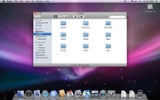
Mac OS

Encyclopedia
Mac OS is a series of graphical user interface
-based operating system
s developed by Apple Inc. (formerly Apple Computer, Inc.) for their Macintosh
line of computer systems. The Macintosh user experience is credited with popularizing the graphical user interface. The original form of what Apple would later name the "Mac OS" was the integral and unnamed system software first introduced in 1984 with the original Macintosh
, usually referred to simply as the System software.
machines, which were more technically challenging to operate.
The core of the system software was held in ROM
, with updates (which would override ROM-resident portions in RAM) typically provided free of charge by Apple dealers on floppy disk
. The user's involvement in an upgrade of the operating system was also minimized to running an installer, or simply replacing system files, the simplicity of which again differentiated the product from other offerings.
-based Macintoshes. As Apple introduced computers with PowerPC
hardware, the OS was ported to support this architecture as well. Mac OS 8.1 was the last version that could run on a "68K" processor (the 68040
). Mac OS X
, which has superseded the "Classic" Mac OS, is compatible with only PowerPC processors from version 10.0 ("Cheetah") to version 10.3 ("Panther"). PowerPC and Intel processors are supported in version 10.4 ("Tiger", Intel only supported after an update) and version 10.5 ("Leopard"). Versions 10.6 ("Snow Leopard") and later support only Intel processors.
The early Macintosh operating system initially consisted of two pieces of software, called "System" and "Finder", each with its own version number. System 7.5.1 was the first to include the Mac OS logo (a variation on the original Happy Mac startup icon), and Mac OS 7.6 was the first to be named "Mac OS".
Before the introduction of the later PowerPC G3
-based systems, significant parts of the system were stored in physical ROM
on the motherboard. The initial purpose of this was to avoid using up the limited storage of floppy disk
s on system support, given that the early Macs had no hard disk
. (Only one model of Mac was ever actually bootable using the ROM alone, the 1991 Mac Classic
model.) This architecture also allowed for a completely graphical OS interface at the lowest level without the need for a text-only console or command-line mode. Boot time errors, such as finding no functioning disk drives, were communicated to the user graphically, usually with an icon or the distinctive Chicago bitmap font and a Chime of Death or a series of beeps. This was in contrast to computers of the time, which displayed such messages in a mono-spaced font on a black background, and required the use of the keyboard, not a mouse, for input. To provide such niceties at a low level, Mac OS depended on core system software in ROM on the motherboard, a fact that later helped to ensure that only Apple computers or licensed clones (with the copyright-protected ROMs from Apple) could run Mac OS.
Mac OS can be divided into two families:
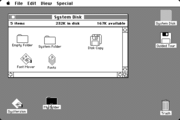 The "classic" Mac OS is characterized by its total lack of a command line; it is a completely graphical operating system. Versions of Mac OS up through System 4 only ran one application at a time. Even so, it was noted for its ease of use. Mac OS gained cooperative multitasking with System 5, which ran on the Mac SE and Macintosh II
. It was criticized for its very limited memory management
, lack of protected memory, and susceptibility to conflicts among operating system "extensions
" that provide additional functionality (such as networking) or support for a particular device. Some extensions may not work properly together, or work only when loaded in a particular order. Troubleshooting Mac OS extensions could be a time-consuming process of trial and error
.
The Macintosh originally used the Macintosh File System
(MFS), a flat file system with only one level of folders. This was quickly replaced in 1985 by the Hierarchical File System
(HFS), which had a true directory
tree. Both file systems are otherwise compatible.
Most file systems used with DOS, Unix, or other operating systems treat a file as simply a sequence of bytes, requiring an application to know which bytes represent what type of information. By contrast, MFS and HFS give files two different "forks". The data fork contains the same sort of information as other file systems, such as the text of a document or the bitmaps of an image file. The resource fork
contains other structured data such as menu definitions, graphics, sounds, or code segments. A file might consist only of resources with an empty data fork, or only a data fork with no resource fork. A word processor file could contain its text in the data fork and styling information in the resource fork, so that an application which doesn’t recognize the styling information can still read the raw text.
On the other hand, these forks would provide a challenge to interoperability with other operating systems: how does one copy a dual-forked file into a different file system, or across a file-transfer system, or embed it into email? In copying or transferring a MacOS file to a non-Mac system, the default implementations would simply strip the file of its resource fork. Most data files contained only nonessential information in their resource fork, such as window size and location, but program files would be inoperative without their resources. This necessitated such encoding schemes as BinHex
and MacBinary
, which allowed a user to encode a dual-forked file into a single stream, or take a single stream so-encoded and reconstitute it into a dual-forked file usable by MacOS.
PowerPC versions of Mac OS X up to and including Mac OS X v10.4 Tiger (support for Classic was dropped by Apple with v10.5 Leopard's release and it is no longer included) include a compatibility layer for running older Mac applications, the Classic Environment
. This runs a full copy of the older Mac OS, version 9.1 or later, in a Mac OS X process. PowerPC-based Macs shipped with Mac OS 9.2 as well as Mac OS X. Mac OS 9.2 had to be installed by the user— it was not installed by default on hardware revisions released after the release of Mac OS X 10.4 Tiger. Most well-written "classic" applications function properly under this environment, but compatibility is only assured if the software was written to be unaware of the actual hardware, and to interact solely with the operating system. The Classic Environment is not available on Intel-based Macintosh systems due to the incompatibility of Mac OS 9
with the x86 hardware.
Users of the classic Mac OS generally upgraded to Mac OS X, but many criticized it as being more difficult and less user-friendly than the original Mac OS, for the lack of certain features that had not been re-implemented in the new OS, or for being slower on the same hardware (especially older hardware), or other, sometimes serious incompatibilities with the older OS. Because drivers (for printers, scanners, tablets, etc.) written for the older Mac OS are not compatible with Mac OS X, and due to the lack of Mac OS X support for older Apple machines, a significant number of Macintosh users continued using the older classic Mac OS.
In June 2005, Steve Jobs
announced at the Worldwide Developers Conference
keynote that Apple computers would be transitioning from PowerPC to Intel processors and thus dropping compatibility on new machines for Mac OS Classic. At the same conference, Jobs announced Developer Transition Kits that included beta versions of Apple software including Mac OS X that developers could use to test their applications as they ported them to run on Intel-powered Macs. In January 2006, Apple released the first Macintosh computers with Intel processors, an iMac
and the MacBook Pro
, and in February 2006, Apple released a Mac mini
with an Intel Core Solo and Duo processor. On May 16, 2006, Apple released the MacBook
, before completing the Intel transition on August 7 with the Mac Pro
. To ease the transition for early buyers of the new machines, Intel-based Macs included an emulation technology called Rosetta
, which allows them to run Mac OS X software that was compiled for PowerPC-based Macintoshes. Rosetta runs transparently, creating a user experience identical to running the software on a PowerPC machine, though execution is typically slower than with native code. Rosetta was an optional installation in Mac OS X 10.6 Snow Leopard and is not available at all in Mac OS X 10.7 Lion.
The operating system is the successor to Mac OS 9
and the "classic" Mac OS. It is a Unix
operating system, based on the NeXTSTEP
operating system and the Mach kernel which Apple acquired after purchasing NeXT Computer
, with its CEO Steve Jobs
returning to Apple at this time. Mac OS X also makes use of the BSD code base. There have been six significant releases of the client version, the most recent being Mac OS X 10.7, referred to as Lion
.
As well as the client versions, Mac OS X has also had six significant releases as a server version, called Mac OS X Server. The first of these, Mac OS X Server 1.0
, was released in beta in 1999. The server versions are architecturally identical to the client versions, with the differentiation found in their inclusion of tools for server management, including tools for managing Mac OS X-based workgroup
s, mail servers, and web servers, amongst other tools. It was the default operating system for Xserve
(which has now been discontinued), it's an optional feature on the Mac Mini
and the Mac Pro
, and it's also installable on most other Macs. Unlike the client version, Mac OS X Server can be run in a virtual machine
using emulation software such as Parallels Desktop and VMWare Fusion
.
Mac OS X is also the basis for iOS, (previously iPhone OS) used on Apple's iPhone
, iPod Touch
, and iPad
.
with the Mac OS UI as a retort to Microsoft
's Windows 3.0
. The Apple/Novell team (fourteen engineers from the former, four from the latter) was able to get the Macintosh Finder
and some basic applications, like QuickTime
, running smoothly on Windows. Some of the code from this effort was reused later when porting the Mac OS to PowerPC.
The project was cancelled only one year later in early 1993. There are two theories for the project's short life: the first is that Apple's board canceled further development upon realizing that going with Star Trek would mean an entirely new business model and one that would likely see a notable drop in Apple's lucrative hardware sales; and the second is that an x86 Mac OS was not commercially viable in the early nineties because Microsoft
's contracts for Windows 3.1 forced PC manufacturers to pay a royalty to Microsoft for every computer shipped, regardless of what operating system it contained.
A further complication was that Star Trek was designed to be source-level compatible, not binary compatible, with the Mac OS. Mac applications would therefore have to be recompiled or rewritten by their developers to run on the x86 architecture, and there was much skepticism as to exactly how much work this would entail.
Fifteen years after Star Trek, support for the x86 architecture was officially included in Mac OS, and then Apple transitioned all desktop computers to the x86 architecture. This was not the direct result of earlier Project Star Trek efforts. The Darwin underpinning used for Mac OS X 10.0 and later included support for the x86 architecture. The remaining non-Darwin portion of Mac OS X (based on OPENSTEP
, which ran on Intel processors) was released officially with the introduction of x86 Macintosh computers.
software was never released, third-party Macintosh emulators, such as vMac
, Basilisk II
, and Executor
, eventually made it possible to run the classic Mac OS on Intel-based PCs. These emulators were restricted to emulating the 68000
series of processors, and as such most couldn't run versions of the Mac OS that succeeded 8.1, which required PowerPC processors. Most also required a Mac ROM image or a hardware interface supporting a real Mac ROM chip; those requiring an image are of dubious legal standing as the ROM image may infringe on Apple's intellectual property.
A notable exception was the Executor
commercial software product from Abacus Research & Development, the only product that used 100% reverse engineered code without the use of Apple technology. It ran extremely quickly but never achieved more than a minor subset of functionality. Few programs were completely compatible and many were extremely crash-prone if they ran at all. Executor filled a niche market for porting 68000 classic Mac applications to x86 platforms; development ceased in 2002 and the source code was released by the author in late 2008.
Emulators using Mac ROM images offered near complete Mac OS compatibility and later versions offered excellent performance as modern x86 processor performance increased exponentially.
Most of the Mac user base had already started moving to the PowerPC platform that offered backward compatibility on 8.xx & 9.xx operating systems along with faster PowerPC software support. This helped ease the transition to PowerPC-only applications while prematurely obsolescing 68000 emulators and the Classic-only applications they supported well before these emulators were refined enough to compete with a real Mac.
The PearPC
emulator is capable of emulating the PowerPC
processors required by newer versions of the Mac OS (like Mac OS X
). Unfortunately, it is still in the early stages and, like many emulators, tends to run much slower than a native operating system
would.
During the transition from PowerPC to Intel processors, Apple realized the need to incorporate a PowerPC emulator into Mac OS X in order to protect its customers' investments in software designed to run on the PowerPC. Apple's solution is an emulator called Rosetta
. Prior to the announcement of Rosetta, industry observers assumed that any PowerPC emulator running on an x86 processor would suffer a heavy performance penalty (e.g., PearPC's slow performance). Rosetta's relatively minor performance penalty therefore took many by surprise.
Another PowerPC emulator is SheepShaver
, which has been around since 1998 for BeOS
on the PowerPC platform, but in 2002 was open source
d with porting efforts beginning to get it to run on other platforms. Originally it was not designed for use on x86 platforms and required an actual PowerPC processor present in the machine it was running on similar to a hypervisor
. Although it provides PowerPC processor support, it can only run up to Mac OS 9.0.4
because it does not emulate a memory management unit
.
Other examples include ShapeShifter(by the same programmer that conceived SheepShaver
), Fusion and iFusion. The latter ran classic Mac OS with a PowerPC "coprocessor" accelerator card. Using this method has been said to equal or better the speed of a Macintosh with the same processor, especially with respect to the m68k
series due to real Macs running in MMU
trap mode, hampering performance.
, UMAX
and Motorola
. These machines normally ran various versions of classic Mac OS. Steve Jobs
ended the clone-licensing program after returning to Apple in 1997.
In 2008, a manufacturing company in Miami, FL called Psystar Corporation
, announced a $499 clone that comes with a barebones
system that can run Mac OS X 10.5 Leopard. Threatened with legal battles, Psystar originally called the system OpenMac and have since changed it to Open Computer. Apple filed a lawsuit with the company and asked that Psystar be ordered to stop producing clone systems, recall every system sold, and pay monetary damages. Eventually, Apple prevailed in court, and the Open Computer's production was ceased. Psystar itself appears to be defunct now, as the company's website is gone.
, which was a UNIX operating system
with the Mac OS look and feel. It was not very competitive for its time, due in part to the crowded Unix market. A/UX had most of its success in sales to the U.S. government
, where UNIX was a requirement that Mac OS could not meet. Mac OS X later incorporated code from the UNIX-based NeXTStep
after Steve Jobs
rejoined Apple in 1997.
MAE used the X Window System to emulate a Macintosh Finder-style graphical user interface. The last version, MAE 3.0, was compatible with System 7.5.3.
MAE was available for Sun Microsystems SPARCstation and Hewlett-Packard systems. It was discontinued on May 14, 1998.
to the PowerPC platform, and thus Macintosh computers. In the summer of 1998, the community-led MkLinux Developers Association took over development of the operating system. MkLinux is short for "Microkernel Linux," which refers to the project's adaptation of the Linux kernel
to run as a server hosted atop the Mach microkernel. MkLinux is based on version 3.0 of Mach.
that is normally present on Apple's Intel-based Macs, allowing Mac OS X to be installed on non-Apple hardware.
Graphical user interface
In computing, a graphical user interface is a type of user interface that allows users to interact with electronic devices with images rather than text commands. GUIs can be used in computers, hand-held devices such as MP3 players, portable media players or gaming devices, household appliances and...
-based operating system
Operating system
An operating system is a set of programs that manage computer hardware resources and provide common services for application software. The operating system is the most important type of system software in a computer system...
s developed by Apple Inc. (formerly Apple Computer, Inc.) for their Macintosh
Macintosh
The Macintosh , or Mac, is a series of several lines of personal computers designed, developed, and marketed by Apple Inc. The first Macintosh was introduced by Apple's then-chairman Steve Jobs on January 24, 1984; it was the first commercially successful personal computer to feature a mouse and a...
line of computer systems. The Macintosh user experience is credited with popularizing the graphical user interface. The original form of what Apple would later name the "Mac OS" was the integral and unnamed system software first introduced in 1984 with the original Macintosh
Macintosh 128K
The Macintosh 128K machine, released as the "Apple Macintosh", was the original Apple Macintosh personal computer. Its beige case contained a monitor and came with a keyboard and mouse. An indentation in the top of the case made it easier for the computer to be lifted and carried. It had a selling...
, usually referred to simply as the System software.
Conception
From the beginning, Apple deliberately sought to minimize by design the user's conceptual awareness of the operating system as such. Tasks that on other products required a more explicit working knowledge of an operating system would on a Macintosh be accomplished by intuitive mouse gestures and manipulation of graphical control panels. The intention was that the product would thus be more user-friendly and so more easily mastered. This would differentiate it from devices using other operating environments, such as MS-DOSMS-DOS
MS-DOS is an operating system for x86-based personal computers. It was the most commonly used member of the DOS family of operating systems, and was the main operating system for IBM PC compatible personal computers during the 1980s to the mid 1990s, until it was gradually superseded by operating...
machines, which were more technically challenging to operate.
The core of the system software was held in ROM
Read-only memory
Read-only memory is a class of storage medium used in computers and other electronic devices. Data stored in ROM cannot be modified, or can be modified only slowly or with difficulty, so it is mainly used to distribute firmware .In its strictest sense, ROM refers only...
, with updates (which would override ROM-resident portions in RAM) typically provided free of charge by Apple dealers on floppy disk
Floppy disk
A floppy disk is a disk storage medium composed of a disk of thin and flexible magnetic storage medium, sealed in a rectangular plastic carrier lined with fabric that removes dust particles...
. The user's involvement in an upgrade of the operating system was also minimized to running an installer, or simply replacing system files, the simplicity of which again differentiated the product from other offerings.
Versions
Early versions of the Mac OS were compatible only with Motorola 68000Motorola 68000
The Motorola 68000 is a 16/32-bit CISC microprocessor core designed and marketed by Freescale Semiconductor...
-based Macintoshes. As Apple introduced computers with PowerPC
PowerPC
PowerPC is a RISC architecture created by the 1991 Apple–IBM–Motorola alliance, known as AIM...
hardware, the OS was ported to support this architecture as well. Mac OS 8.1 was the last version that could run on a "68K" processor (the 68040
Motorola 68040
The Motorola 68040 is a microprocessor from Motorola, released in 1990. It is the successor to the 68030 and is followed by the 68060. There was no 68050. In keeping with general Motorola naming, the 68040 is often referred to as simply the '040 ....
). Mac OS X
Mac OS X
Mac OS X is a series of Unix-based operating systems and graphical user interfaces developed, marketed, and sold by Apple Inc. Since 2002, has been included with all new Macintosh computer systems...
, which has superseded the "Classic" Mac OS, is compatible with only PowerPC processors from version 10.0 ("Cheetah") to version 10.3 ("Panther"). PowerPC and Intel processors are supported in version 10.4 ("Tiger", Intel only supported after an update) and version 10.5 ("Leopard"). Versions 10.6 ("Snow Leopard") and later support only Intel processors.
The early Macintosh operating system initially consisted of two pieces of software, called "System" and "Finder", each with its own version number. System 7.5.1 was the first to include the Mac OS logo (a variation on the original Happy Mac startup icon), and Mac OS 7.6 was the first to be named "Mac OS".
Before the introduction of the later PowerPC G3
PowerPC G3
The PowerPC 7xx is a family of third generation 32-bit PowerPC microprocessors designed and manufactured by IBM and Motorola . This family is called the PowerPC G3 by its well-known customer Apple Computer...
-based systems, significant parts of the system were stored in physical ROM
Read-only memory
Read-only memory is a class of storage medium used in computers and other electronic devices. Data stored in ROM cannot be modified, or can be modified only slowly or with difficulty, so it is mainly used to distribute firmware .In its strictest sense, ROM refers only...
on the motherboard. The initial purpose of this was to avoid using up the limited storage of floppy disk
Floppy disk
A floppy disk is a disk storage medium composed of a disk of thin and flexible magnetic storage medium, sealed in a rectangular plastic carrier lined with fabric that removes dust particles...
s on system support, given that the early Macs had no hard disk
Hard disk
A hard disk drive is a non-volatile, random access digital magnetic data storage device. It features rotating rigid platters on a motor-driven spindle within a protective enclosure. Data is magnetically read from and written to the platter by read/write heads that float on a film of air above the...
. (Only one model of Mac was ever actually bootable using the ROM alone, the 1991 Mac Classic
Macintosh Classic
The Macintosh Classic was a personal computer manufactured by Apple Computer. Introduced on October 15, 1990, it was the first Apple Macintosh to sell for less than US$1,000. Production of the Classic was prompted by the success of the Macintosh Plus and the SE...
model.) This architecture also allowed for a completely graphical OS interface at the lowest level without the need for a text-only console or command-line mode. Boot time errors, such as finding no functioning disk drives, were communicated to the user graphically, usually with an icon or the distinctive Chicago bitmap font and a Chime of Death or a series of beeps. This was in contrast to computers of the time, which displayed such messages in a mono-spaced font on a black background, and required the use of the keyboard, not a mouse, for input. To provide such niceties at a low level, Mac OS depended on core system software in ROM on the motherboard, a fact that later helped to ensure that only Apple computers or licensed clones (with the copyright-protected ROMs from Apple) could run Mac OS.
Mac OS can be divided into two families:
- The Mac OS Classic family, which was based on Apple's own code
- The Mac OS X operating system, developed from Mac OS Classic family, and NeXTSTEPNEXTSTEPNeXTSTEP was the object-oriented, multitasking operating system developed by NeXT Computer to run on its range of proprietary workstation computers, such as the NeXTcube...
, which was UNIXUnixUnix is a multitasking, multi-user computer operating system originally developed in 1969 by a group of AT&T employees at Bell Labs, including Ken Thompson, Dennis Ritchie, Brian Kernighan, Douglas McIlroy, and Joe Ossanna...
-based.
"Classic" Mac OS (1984–2001)
Macintosh II
The Apple Macintosh II was the first personal computer model of the Macintosh II series in the Apple Macintosh line and the first Macintosh to support a color display.- History :...
. It was criticized for its very limited memory management
Mac OS memory management
Historically, the Mac OS used a form of memory management that has fallen out of favour in modern systems. Criticism of this approach was one of the key areas addressed by the change to Mac OS X....
, lack of protected memory, and susceptibility to conflicts among operating system "extensions
Extension (Mac OS)
On the Apple Macintosh operating system prior to Mac OS X, extensions were small pieces of code that extended the system's functionality. They were run initially at start-up time, and operated by a variety of mechanisms, including trap patching and other code modifying techniques. Initially an...
" that provide additional functionality (such as networking) or support for a particular device. Some extensions may not work properly together, or work only when loaded in a particular order. Troubleshooting Mac OS extensions could be a time-consuming process of trial and error
Trial and error
Trial and error, or trial by error, is a general method of problem solving, fixing things, or for obtaining knowledge."Learning doesn't happen from failure itself but rather from analyzing the failure, making a change, and then trying again."...
.
The Macintosh originally used the Macintosh File System
Macintosh File System
Macintosh File System is a volume format created by Apple Computer for storing files on 400K floppy disks. MFS was introduced with the Macintosh 128K in January 1984....
(MFS), a flat file system with only one level of folders. This was quickly replaced in 1985 by the Hierarchical File System
Hierarchical File System
Hierarchical File System is a file system developed by Apple Inc. for use in computer systems running Mac OS. Originally designed for use on floppy and hard disks, it can also be found on read-only media such as CD-ROMs...
(HFS), which had a true directory
Directory (file systems)
In computing, a folder, directory, catalog, or drawer, is a virtual container originally derived from an earlier Object-oriented programming concept by the same name within a digital file system, in which groups of computer files and other folders can be kept and organized.A typical file system may...
tree. Both file systems are otherwise compatible.
Most file systems used with DOS, Unix, or other operating systems treat a file as simply a sequence of bytes, requiring an application to know which bytes represent what type of information. By contrast, MFS and HFS give files two different "forks". The data fork contains the same sort of information as other file systems, such as the text of a document or the bitmaps of an image file. The resource fork
Resource fork
The resource fork is a construct of the Mac OS operating system used to store structured data in a file, alongside unstructured data stored within the data fork. A resource fork stores information in a specific form, such as icons, the shapes of windows, definitions of menus and their contents, and...
contains other structured data such as menu definitions, graphics, sounds, or code segments. A file might consist only of resources with an empty data fork, or only a data fork with no resource fork. A word processor file could contain its text in the data fork and styling information in the resource fork, so that an application which doesn’t recognize the styling information can still read the raw text.
On the other hand, these forks would provide a challenge to interoperability with other operating systems: how does one copy a dual-forked file into a different file system, or across a file-transfer system, or embed it into email? In copying or transferring a MacOS file to a non-Mac system, the default implementations would simply strip the file of its resource fork. Most data files contained only nonessential information in their resource fork, such as window size and location, but program files would be inoperative without their resources. This necessitated such encoding schemes as BinHex
BinHex
BinHex, short for "binary-to-hexadecimal", is a binary-to-text encoding system that was used on the Mac OS for sending binary files through e-mail. It is similar to Uuencode, but combined both "forks" of the Mac file system together, along with extended file information...
and MacBinary
MacBinary
Due to the metadata-rich nature of the Macintosh Hierarchical File System, transferring Mac OS files to platforms that do not support HFS can be problematic. MacBinary was developed as a means of preserving this structure without sacrificing portability. It combines the data and resource forks...
, which allowed a user to encode a dual-forked file into a single stream, or take a single stream so-encoded and reconstitute it into a dual-forked file usable by MacOS.
PowerPC versions of Mac OS X up to and including Mac OS X v10.4 Tiger (support for Classic was dropped by Apple with v10.5 Leopard's release and it is no longer included) include a compatibility layer for running older Mac applications, the Classic Environment
Classic (Mac OS X)
Classic, or Classic Environment, was a hardware and software abstraction layer in Mac OS X that allowed applications compatible with Mac OS 9 to run on the Mac OS X operating system...
. This runs a full copy of the older Mac OS, version 9.1 or later, in a Mac OS X process. PowerPC-based Macs shipped with Mac OS 9.2 as well as Mac OS X. Mac OS 9.2 had to be installed by the user— it was not installed by default on hardware revisions released after the release of Mac OS X 10.4 Tiger. Most well-written "classic" applications function properly under this environment, but compatibility is only assured if the software was written to be unaware of the actual hardware, and to interact solely with the operating system. The Classic Environment is not available on Intel-based Macintosh systems due to the incompatibility of Mac OS 9
Mac OS 9
Mac OS 9 is the final major release of Apple's Mac OS before the launch of Mac OS X. Introduced on October 23, 1999, Apple positioned it as "The Best Internet Operating System Ever," highlighting Sherlock 2's Internet search capabilities, integration with Apple's free online services known as...
with the x86 hardware.
Users of the classic Mac OS generally upgraded to Mac OS X, but many criticized it as being more difficult and less user-friendly than the original Mac OS, for the lack of certain features that had not been re-implemented in the new OS, or for being slower on the same hardware (especially older hardware), or other, sometimes serious incompatibilities with the older OS. Because drivers (for printers, scanners, tablets, etc.) written for the older Mac OS are not compatible with Mac OS X, and due to the lack of Mac OS X support for older Apple machines, a significant number of Macintosh users continued using the older classic Mac OS.
In June 2005, Steve Jobs
Steve Jobs
Steven Paul Jobs was an American businessman and inventor widely recognized as a charismatic pioneer of the personal computer revolution. He was co-founder, chairman, and chief executive officer of Apple Inc...
announced at the Worldwide Developers Conference
Worldwide Developers Conference
The Apple Worldwide Developers Conference, commonly abbreviated WWDC, is a conference held annually in California by Apple Inc. The conference is primarily used by Apple to showcase its new software and technologies for developers, as well as offering hands-on labs and feedback sessions...
keynote that Apple computers would be transitioning from PowerPC to Intel processors and thus dropping compatibility on new machines for Mac OS Classic. At the same conference, Jobs announced Developer Transition Kits that included beta versions of Apple software including Mac OS X that developers could use to test their applications as they ported them to run on Intel-powered Macs. In January 2006, Apple released the first Macintosh computers with Intel processors, an iMac
IMac
The iMac is a range of all-in-one Macintosh desktop computers built by Apple. It has been the primary part of Apple's consumer desktop offerings since its introduction in 1998, and has evolved through five distinct forms....
and the MacBook Pro
MacBook Pro
The MacBook Pro is a line of Macintosh portable computers introduced in January 2006 by Apple. It replaced the PowerBook G4 and was the second model, after the iMac, to be announced in the Apple–Intel transition...
, and in February 2006, Apple released a Mac mini
Mac Mini
The Mac Mini is a small form factor desktop computer manufactured by Apple Inc. Like earlier mini-ITX PC designs, it is uncommonly small for a desktop computer: 7.7 inches square and 1.4 inches tall. It weighs 2.7 pounds...
with an Intel Core Solo and Duo processor. On May 16, 2006, Apple released the MacBook
MacBook
The MacBook was a brand of Macintosh notebook computers built by Apple Inc. First introduced in May 2006, it replaced the iBook and 12-inch PowerBook series of notebooks as a part of the Apple–Intel transition. Positioned as the low end of the MacBook family, the Apple MacBook was aimed at the...
, before completing the Intel transition on August 7 with the Mac Pro
Mac Pro
The Mac Pro is a workstation computer manufactured by Apple Inc. The machines are based on Xeon microprocessors, but are similar to the Power Mac G5 they replaced in terms of outward appearance and expansion capabilities...
. To ease the transition for early buyers of the new machines, Intel-based Macs included an emulation technology called Rosetta
Rosetta (software)
Rosetta was a lightweight and dynamic binary translator for Mac OS X which Apple released in 2006 when it transitioned the Macintosh from PowerPC to Intel processors. It allowed pre-existing software to run on the new systems without modification....
, which allows them to run Mac OS X software that was compiled for PowerPC-based Macintoshes. Rosetta runs transparently, creating a user experience identical to running the software on a PowerPC machine, though execution is typically slower than with native code. Rosetta was an optional installation in Mac OS X 10.6 Snow Leopard and is not available at all in Mac OS X 10.7 Lion.
Mac OS X
Mac OS X is the newest of Apple Inc.'s Mac OS line of operating systems. Although it is officially designated as simply "version 10" of the Mac OS, it has a history largely independent of the earlier Mac OS releases.The operating system is the successor to Mac OS 9
Mac OS 9
Mac OS 9 is the final major release of Apple's Mac OS before the launch of Mac OS X. Introduced on October 23, 1999, Apple positioned it as "The Best Internet Operating System Ever," highlighting Sherlock 2's Internet search capabilities, integration with Apple's free online services known as...
and the "classic" Mac OS. It is a Unix
Unix
Unix is a multitasking, multi-user computer operating system originally developed in 1969 by a group of AT&T employees at Bell Labs, including Ken Thompson, Dennis Ritchie, Brian Kernighan, Douglas McIlroy, and Joe Ossanna...
operating system, based on the NeXTSTEP
NEXTSTEP
NeXTSTEP was the object-oriented, multitasking operating system developed by NeXT Computer to run on its range of proprietary workstation computers, such as the NeXTcube...
operating system and the Mach kernel which Apple acquired after purchasing NeXT Computer
NeXT Computer
The NeXT Computer was a high-end workstation computer developed, manufactured and sold by Steve Jobs' company NeXT from 1988 until 1990. It ran the Unix-based NeXTSTEP operating system. The NeXT Computer was packaged in a 1-foot die-cast magnesium cube-shaped case, which led to the machine being...
, with its CEO Steve Jobs
Steve Jobs
Steven Paul Jobs was an American businessman and inventor widely recognized as a charismatic pioneer of the personal computer revolution. He was co-founder, chairman, and chief executive officer of Apple Inc...
returning to Apple at this time. Mac OS X also makes use of the BSD code base. There have been six significant releases of the client version, the most recent being Mac OS X 10.7, referred to as Lion
Mac OS X Lion
Mac OS X Lion is the eighth and current major release of Mac OS X, Apple's desktop and server operating system for Macintosh computers....
.
As well as the client versions, Mac OS X has also had six significant releases as a server version, called Mac OS X Server. The first of these, Mac OS X Server 1.0
Mac OS X Server 1.0
Mac OS X Server 1.0, released on March 16, 1999, is the first operating system released into the retail market by Apple Computer based on their acquisition of NeXT. It followed the Rhapsody series of developer releases of what was to be known as Mac OS X...
, was released in beta in 1999. The server versions are architecturally identical to the client versions, with the differentiation found in their inclusion of tools for server management, including tools for managing Mac OS X-based workgroup
Workgroup (Computer networking)
A workgroup is Microsoft's terminology for a peer-to-peer Windows computer network.Microsoft operating systems in the same workgroup may allow each other access to their files, printers, or Internet connection...
s, mail servers, and web servers, amongst other tools. It was the default operating system for Xserve
Xserve
Xserve was a line of rack unit computers designed by Apple Inc. for use as servers. When the Xserve was introduced in 2002, it was Apple's first designated server hardware design since the Apple Network Server in 1996...
(which has now been discontinued), it's an optional feature on the Mac Mini
Mac Mini
The Mac Mini is a small form factor desktop computer manufactured by Apple Inc. Like earlier mini-ITX PC designs, it is uncommonly small for a desktop computer: 7.7 inches square and 1.4 inches tall. It weighs 2.7 pounds...
and the Mac Pro
Mac Pro
The Mac Pro is a workstation computer manufactured by Apple Inc. The machines are based on Xeon microprocessors, but are similar to the Power Mac G5 they replaced in terms of outward appearance and expansion capabilities...
, and it's also installable on most other Macs. Unlike the client version, Mac OS X Server can be run in a virtual machine
Virtual machine
A virtual machine is a "completely isolated guest operating system installation within a normal host operating system". Modern virtual machines are implemented with either software emulation or hardware virtualization or both together.-VM Definitions:A virtual machine is a software...
using emulation software such as Parallels Desktop and VMWare Fusion
VMware Fusion
VMware Fusion is a virtual machine software product developed by VMware for Macintosh computers with Intel processors. Fusion allows Intel-based Macs to run x86 and x86-64 "guest" operating systems, such as Microsoft Windows, Linux, NetWare and Solaris as virtual machines simultaneously with Mac OS...
.
Mac OS X is also the basis for iOS, (previously iPhone OS) used on Apple's iPhone
IPhone
The iPhone is a line of Internet and multimedia-enabled smartphones marketed by Apple Inc. The first iPhone was unveiled by Steve Jobs, then CEO of Apple, on January 9, 2007, and released on June 29, 2007...
, iPod Touch
IPod Touch
The iPod Touch is a portable media player, personal digital assistant, handheld game console, and Wi-Fi mobile device designed and marketed by Apple Inc. The iPod Touch adds the multi-touch graphical user interface to the iPod line...
, and iPad
IPad
The iPad is a line of tablet computers designed, developed and marketed by Apple Inc., primarily as a platform for audio-visual media including books, periodicals, movies, music, games, and web content. The iPad was introduced on January 27, 2010 by Apple's then-CEO Steve Jobs. Its size and...
.
Star Trek
Star Trek (as in "to boldly go where no Mac has gone before") was a relatively unknown secret prototype Apple started work on in 1992, which goal was to create a version of the classic Mac OS that would run on Intel-compatible x86 personal computers. The project was instigated by Novell, Inc., who were looking to integrate their DR-DOSDR-DOS
DR-DOS is an MS-DOS-compatible operating system for IBM PC-compatible personal computers, originally developed by Gary Kildall's Digital Research and derived from Concurrent PC DOS 6.0, which was an advanced successor of CP/M-86...
with the Mac OS UI as a retort to Microsoft
Microsoft
Microsoft Corporation is an American public multinational corporation headquartered in Redmond, Washington, USA that develops, manufactures, licenses, and supports a wide range of products and services predominantly related to computing through its various product divisions...
's Windows 3.0
Windows 3.0
Windows 3.0, a graphical environment, is the third major release of Microsoft Windows, and was released on 22 May 1990. It became the first widely successful version of Windows and a rival to Apple Macintosh and the Commodore Amiga on the GUI front...
. The Apple/Novell team (fourteen engineers from the former, four from the latter) was able to get the Macintosh Finder
Macintosh Finder
The Finder is the default file manager used on Mac OS and Mac OS X operating systems; it is responsible for the overall user-management of files, disks, network volumes and the launching of other applications...
and some basic applications, like QuickTime
QuickTime
QuickTime is an extensible proprietary multimedia framework developed by Apple Inc., capable of handling various formats of digital video, picture, sound, panoramic images, and interactivity. The classic version of QuickTime is available for Windows XP and later, as well as Mac OS X Leopard and...
, running smoothly on Windows. Some of the code from this effort was reused later when porting the Mac OS to PowerPC.
The project was cancelled only one year later in early 1993. There are two theories for the project's short life: the first is that Apple's board canceled further development upon realizing that going with Star Trek would mean an entirely new business model and one that would likely see a notable drop in Apple's lucrative hardware sales; and the second is that an x86 Mac OS was not commercially viable in the early nineties because Microsoft
Microsoft
Microsoft Corporation is an American public multinational corporation headquartered in Redmond, Washington, USA that develops, manufactures, licenses, and supports a wide range of products and services predominantly related to computing through its various product divisions...
's contracts for Windows 3.1 forced PC manufacturers to pay a royalty to Microsoft for every computer shipped, regardless of what operating system it contained.
A further complication was that Star Trek was designed to be source-level compatible, not binary compatible, with the Mac OS. Mac applications would therefore have to be recompiled or rewritten by their developers to run on the x86 architecture, and there was much skepticism as to exactly how much work this would entail.
Fifteen years after Star Trek, support for the x86 architecture was officially included in Mac OS, and then Apple transitioned all desktop computers to the x86 architecture. This was not the direct result of earlier Project Star Trek efforts. The Darwin underpinning used for Mac OS X 10.0 and later included support for the x86 architecture. The remaining non-Darwin portion of Mac OS X (based on OPENSTEP
OpenStep
OpenStep was an object-oriented application programming interface specification for an object-oriented operating system that used a non-NeXTSTEP operating system as its core, principally developed by NeXT with Sun Microsystems. OPENSTEP was a specific implementation of the OpenStep API developed...
, which ran on Intel processors) was released officially with the introduction of x86 Macintosh computers.
68000 emulation
Although the Star TrekStar Trek project
Star Trek was the code name given to a prototype project at Apple Computer and Novell during 1992 and 1993. The project was named after the Star Trek science fiction franchise with the slogan "To boldly go where no Mac has gone before."...
software was never released, third-party Macintosh emulators, such as vMac
VMac
vMac was an open source emulator for Mac OS, Windows, MS-DOS, OS/2, NeXTSTEP, Linux / Unix, and other platforms. Although vMac has been abandoned, Mini vMac, an improved spinoff of vMac, is currently developed. vMac and Mini vMac emulate a Macintosh Plus and can run Apple Macintosh System versions...
, Basilisk II
Basilisk II
Basilisk II is an open source software emulator which emulates the 680x0-based Apple Macintosh computer on a variety of operating systems, including BeOS, Linux, AmigaOS, Windows NT, Mac OS X and even on the Sony PSP....
, and Executor
Executor (software)
Executor is software for x86-based PCs that allows older 68k-based Apple Macintosh programs to be run under various x86-based operating systems. Executor was created by ARDI...
, eventually made it possible to run the classic Mac OS on Intel-based PCs. These emulators were restricted to emulating the 68000
Motorola 68000
The Motorola 68000 is a 16/32-bit CISC microprocessor core designed and marketed by Freescale Semiconductor...
series of processors, and as such most couldn't run versions of the Mac OS that succeeded 8.1, which required PowerPC processors. Most also required a Mac ROM image or a hardware interface supporting a real Mac ROM chip; those requiring an image are of dubious legal standing as the ROM image may infringe on Apple's intellectual property.
A notable exception was the Executor
Executor (software)
Executor is software for x86-based PCs that allows older 68k-based Apple Macintosh programs to be run under various x86-based operating systems. Executor was created by ARDI...
commercial software product from Abacus Research & Development, the only product that used 100% reverse engineered code without the use of Apple technology. It ran extremely quickly but never achieved more than a minor subset of functionality. Few programs were completely compatible and many were extremely crash-prone if they ran at all. Executor filled a niche market for porting 68000 classic Mac applications to x86 platforms; development ceased in 2002 and the source code was released by the author in late 2008.
Emulators using Mac ROM images offered near complete Mac OS compatibility and later versions offered excellent performance as modern x86 processor performance increased exponentially.
Most of the Mac user base had already started moving to the PowerPC platform that offered backward compatibility on 8.xx & 9.xx operating systems along with faster PowerPC software support. This helped ease the transition to PowerPC-only applications while prematurely obsolescing 68000 emulators and the Classic-only applications they supported well before these emulators were refined enough to compete with a real Mac.
PowerPC emulation
At the time of 68000-emulator development, PowerPC support was difficult to justify not only due to the emulation code itself but also the anticipated wide performance overhead of an emulated PowerPC architecture vs. a real PowerPC based Mac. This would later prove correct with the start of the PearPC project even years later despite the availability of 7th & 8th generation x86 processors employing similar architecture paradigms present in the PowerPC. Many application developers were also creating and releasing both 68000 Classic and PowerPC versions concurrently helping to negate the need for PowerPC emulation. PowerPC Mac users who could technically run either obviously chose the faster PowerPC applications. Soon Apple was no longer selling 68000-based Macs and the existing installed base started to quickly evaporate. Despite the eventual excellent 68000-emulation technology available they proved never to be even a minor threat to real Macs due to their late arrival and immaturity even several years after the release of much more compelling PowerPC based Macs.The PearPC
PearPC
PearPC is an architecture-independent PowerPC platform emulator capable of running many PowerPC operating systems, including Mac OS X, Darwin and Linux. It is released under the terms of the GNU General Public License . It can be executed on Microsoft Windows, Linux, FreeBSD and other systems based...
emulator is capable of emulating the PowerPC
PowerPC
PowerPC is a RISC architecture created by the 1991 Apple–IBM–Motorola alliance, known as AIM...
processors required by newer versions of the Mac OS (like Mac OS X
Mac OS X
Mac OS X is a series of Unix-based operating systems and graphical user interfaces developed, marketed, and sold by Apple Inc. Since 2002, has been included with all new Macintosh computer systems...
). Unfortunately, it is still in the early stages and, like many emulators, tends to run much slower than a native operating system
Operating system
An operating system is a set of programs that manage computer hardware resources and provide common services for application software. The operating system is the most important type of system software in a computer system...
would.
During the transition from PowerPC to Intel processors, Apple realized the need to incorporate a PowerPC emulator into Mac OS X in order to protect its customers' investments in software designed to run on the PowerPC. Apple's solution is an emulator called Rosetta
Rosetta (software)
Rosetta was a lightweight and dynamic binary translator for Mac OS X which Apple released in 2006 when it transitioned the Macintosh from PowerPC to Intel processors. It allowed pre-existing software to run on the new systems without modification....
. Prior to the announcement of Rosetta, industry observers assumed that any PowerPC emulator running on an x86 processor would suffer a heavy performance penalty (e.g., PearPC's slow performance). Rosetta's relatively minor performance penalty therefore took many by surprise.
Another PowerPC emulator is SheepShaver
SheepShaver
SheepShaver is an open source PowerPC Apple Macintosh emulator originally designed for BeOS and Linux. The name is a play on ShapeShifter, a Macintosh II emulator for AmigaOS , which is in turn not to be confused with a third-party preference pane for Mac OS X with the same name...
, which has been around since 1998 for BeOS
BeOS
BeOS is an operating system for personal computers which began development by Be Inc. in 1991. It was first written to run on BeBox hardware. BeOS was optimized for digital media work and was written to take advantage of modern hardware facilities such as symmetric multiprocessing by utilizing...
on the PowerPC platform, but in 2002 was open source
Open source
The term open source describes practices in production and development that promote access to the end product's source materials. Some consider open source a philosophy, others consider it a pragmatic methodology...
d with porting efforts beginning to get it to run on other platforms. Originally it was not designed for use on x86 platforms and required an actual PowerPC processor present in the machine it was running on similar to a hypervisor
Hypervisor
In computing, a hypervisor, also called virtual machine manager , is one of many hardware virtualization techniques that allow multiple operating systems, termed guests, to run concurrently on a host computer. It is so named because it is conceptually one level higher than a supervisory program...
. Although it provides PowerPC processor support, it can only run up to Mac OS 9.0.4
Mac OS 9
Mac OS 9 is the final major release of Apple's Mac OS before the launch of Mac OS X. Introduced on October 23, 1999, Apple positioned it as "The Best Internet Operating System Ever," highlighting Sherlock 2's Internet search capabilities, integration with Apple's free online services known as...
because it does not emulate a memory management unit
Memory management unit
A memory management unit , sometimes called paged memory management unit , is a computer hardware component responsible for handling accesses to memory requested by the CPU...
.
Other examples include ShapeShifter(by the same programmer that conceived SheepShaver
SheepShaver
SheepShaver is an open source PowerPC Apple Macintosh emulator originally designed for BeOS and Linux. The name is a play on ShapeShifter, a Macintosh II emulator for AmigaOS , which is in turn not to be confused with a third-party preference pane for Mac OS X with the same name...
), Fusion and iFusion. The latter ran classic Mac OS with a PowerPC "coprocessor" accelerator card. Using this method has been said to equal or better the speed of a Macintosh with the same processor, especially with respect to the m68k
Motorola 68000
The Motorola 68000 is a 16/32-bit CISC microprocessor core designed and marketed by Freescale Semiconductor...
series due to real Macs running in MMU
Memory management unit
A memory management unit , sometimes called paged memory management unit , is a computer hardware component responsible for handling accesses to memory requested by the CPU...
trap mode, hampering performance.
Macintosh clones
Several computer manufacturers over the years have made Macintosh clones capable of running Mac OS, notably Power ComputingPower Computing
Power Computing Corporation was the first company selected by Apple Inc to create Macintosh-compatible computers . Stephen “Steve” Kahng, a computer engineer best known for his design of the Leading Edge Model D, founded the company in November 1993...
, UMAX
Umax
UMAX Technologies is a manufacturer of computer products, including scanners, mice, and flash drives, based in Taiwan. The company also uses the Yamada and Vaova brand names.-History:...
and Motorola
Motorola
Motorola, Inc. was an American multinational telecommunications company based in Schaumburg, Illinois, which was eventually divided into two independent public companies, Motorola Mobility and Motorola Solutions on January 4, 2011, after losing $4.3 billion from 2007 to 2009...
. These machines normally ran various versions of classic Mac OS. Steve Jobs
Steve Jobs
Steven Paul Jobs was an American businessman and inventor widely recognized as a charismatic pioneer of the personal computer revolution. He was co-founder, chairman, and chief executive officer of Apple Inc...
ended the clone-licensing program after returning to Apple in 1997.
In 2008, a manufacturing company in Miami, FL called Psystar Corporation
Psystar Corporation
Psystar Corporation was a Miami, Florida based company which sold "Open Computers". These computers, first announced in April 2008, had the option to be pre-installed with Mac OS X Leopard, making them the first commercially distributed "hackintosh" computers. In November 2009, a U.S...
, announced a $499 clone that comes with a barebones
Barebone computer
A barebone computer is a partially assembled platform or an unassembled kit of computer parts allowing more customization and lower costs than a retail computer system. They are available for desktop computer, notebook and server purposes, and in nearly any form factor...
system that can run Mac OS X 10.5 Leopard. Threatened with legal battles, Psystar originally called the system OpenMac and have since changed it to Open Computer. Apple filed a lawsuit with the company and asked that Psystar be ordered to stop producing clone systems, recall every system sold, and pay monetary damages. Eventually, Apple prevailed in court, and the Open Computer's production was ceased. Psystar itself appears to be defunct now, as the company's website is gone.
A/UX
In 1988, Apple released its first UNIX-based OS, A/UXA/UX
A/UX was Apple Computer’s implementation of the Unix operating system for some of their Macintosh computers. The later versions of A/UX ran on the Macintosh II, Quadra and Centris series of machines as well as the SE/30. A/UX was first released in 1988, with the final version released in 1995...
, which was a UNIX operating system
Operating system
An operating system is a set of programs that manage computer hardware resources and provide common services for application software. The operating system is the most important type of system software in a computer system...
with the Mac OS look and feel. It was not very competitive for its time, due in part to the crowded Unix market. A/UX had most of its success in sales to the U.S. government
Federal government of the United States
The federal government of the United States is the national government of the constitutional republic of fifty states that is the United States of America. The federal government comprises three distinct branches of government: a legislative, an executive and a judiciary. These branches and...
, where UNIX was a requirement that Mac OS could not meet. Mac OS X later incorporated code from the UNIX-based NeXTStep
NEXTSTEP
NeXTSTEP was the object-oriented, multitasking operating system developed by NeXT Computer to run on its range of proprietary workstation computers, such as the NeXTcube...
after Steve Jobs
Steve Jobs
Steven Paul Jobs was an American businessman and inventor widely recognized as a charismatic pioneer of the personal computer revolution. He was co-founder, chairman, and chief executive officer of Apple Inc...
rejoined Apple in 1997.
MAE
The Macintosh Application Environment (MAE) was a software package introduced by Apple Computer in 1994 which allowed users of certain Unix-based computer workstations to run Apple Macintosh application software.MAE used the X Window System to emulate a Macintosh Finder-style graphical user interface. The last version, MAE 3.0, was compatible with System 7.5.3.
MAE was available for Sun Microsystems SPARCstation and Hewlett-Packard systems. It was discontinued on May 14, 1998.
MkLinux
Announced at The 1996 World Wide Developers Conference (WWDC), MkLinux is an open source computer operating system started by the OSF Research Institute and Apple Computer in February 1996 to port LinuxLinux
Linux is a Unix-like computer operating system assembled under the model of free and open source software development and distribution. The defining component of any Linux system is the Linux kernel, an operating system kernel first released October 5, 1991 by Linus Torvalds...
to the PowerPC platform, and thus Macintosh computers. In the summer of 1998, the community-led MkLinux Developers Association took over development of the operating system. MkLinux is short for "Microkernel Linux," which refers to the project's adaptation of the Linux kernel
Linux kernel
The Linux kernel is an operating system kernel used by the Linux family of Unix-like operating systems. It is one of the most prominent examples of free and open source software....
to run as a server hosted atop the Mach microkernel. MkLinux is based on version 3.0 of Mach.
Mac OS on non Apple-labeled computers
Though a violation of Apple's EULA, running Mac OS X operating systems compiled for x86 on a non-Apple PC is possible using various kernel modifications, third-party and community drivers, and emulation methods. For example, the PC-EFI project emulates the Extensible Firmware InterfaceExtensible Firmware Interface
The Unified Extensible Firmware Interface is a specification that defines a software interface between an operating system and platform firmware...
that is normally present on Apple's Intel-based Macs, allowing Mac OS X to be installed on non-Apple hardware.
External links
- Mac OS X – Official site
- Mac 101 – Apple's introductory guide to the Mac OS.
- Folklore.org – A site of anecdoteAnecdoteAn anecdote is a short and amusing or interesting story about a real incident or person. It may be as brief as the setting and provocation of a bon mot. An anecdote is always presented as based on a real incident involving actual persons, whether famous or not, usually in an identifiable place...
s shared by the creators of the first Macintosh. - The Vintage Mac Museum: – Old Mac System - From System1 to System7
- MacUser.my – Web community dedicated to the Mac OS platform of Borneo, Malaysia