

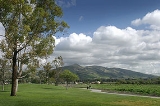
Fremont, California

Encyclopedia
Fremont is a city in Alameda County
, California
. It was incorporated on January 23, 1956, from the merger of five smaller communities: Centerville, Niles, Irvington, Mission San Jose, and Warm Springs. The city is named after John Charles Frémont, "the Great Pathfinder."
Located in the southeast section of the San Francisco Bay Area
in the East Bay
region primarily, Fremont is now the fourth most populous city in the San Francisco Bay Area
, and the largest suburb in the metropolis. It is the closest Alameda County city to Silicon Valley
, and is thus sometimes associated with it.
The area consisting of Fremont, Newark
(an enclave of Fremont), and Union City
was formerly known as Washington Township, and is now known as the Tri-City Area.
Fremont is the sister city to Elizabeth, South Australia
; Puerto Peñasco
, Mexico; Fukaya
, Japan; Horta
, Azores
, Portugal; Lipa City
, Philippines; and Jaipur
, India.
was 2,443.7 people per square mile (943.5/km²). The racial makeup of Fremont was 70,320 (32.8%) White, 7,103 (3.3%) African American, 976 (0.5%) Native American, 108,332 (50.6%) Asian (18.1% Indian
, 17.7% Chinese
, 6.7% Filipino
, 2.5% Vietnamese
, 1.4% Korean
, 1.0% Pakistani
, 0.8% Japanese
, 0.6% Burmese
), 1,169 (0.5%) Pacific Islander, 13,605 (6.4%) from other races
, and 12,584 (5.9%) from two or more races. Hispanic or Latino of any race were 31,698 persons (14.8%). Among the Hispanic population, 11.0% are Mexican
, 0.6% Puerto Rican
, and 0.5% Salvadoran
.
The Census reported that 212,438 people (99.2% of the population) lived in households, 969 (0.5%) lived in non-institutionalized group quarters, and 682 (0.3%) were institutionalized.
There were 71,004 households, out of which 31,070 (43.8%) had children under the age of 18 living in them, 45,121 (63.5%) were opposite-sex married couples
living together, 7,070 (10.0%) had a female householder with no husband present, 3,382 (4.8%) had a male householder with no wife present. There were 2,779 (3.9%) unmarried opposite-sex partnerships
, and 444 (0.6%) same-sex married couples or partnerships. 11,576 households (16.3%) were made up of individuals and 3,697 (5.2%) had someone living alone who was 65 years of age or older. The average household size was 2.99. There were 55,573 families
(78.3% of all households); the average family size was 3.36.
The population was spread out with 53,216 people (24.9%) under the age of 18, 15,610 people (7.3%) aged 18 to 24, 66,944 people (31.3%) aged 25 to 44, 56,510 people (26.4%) aged 45 to 64, and 21,809 people (10.2%) who were 65 years of age or older. The median age was 36.8 years. For every 100 females there were 98.9 males. For every 100 females age 18 and over, there were 96.4 males.
There were 73,989 housing units at an average density of 844.5 per square mile (326.1/km²), of which 44,463 (62.6%) were owner-occupied, and 26,541 (37.4%) were occupied by renters. The homeowner vacancy rate was 1.3%; the rental vacancy rate was 4.5%. 136,606 people (63.8% of the population) lived in owner-occupied housing units and 75,832 people (35.4%) lived in rental housing units.
in the United States. This is noted in Khaled Hosseini
's 2003 novel Kite Runner
. In addition, Fremont has a notable concentration of South Asians, predominantly employed in Silicon Valley's technology sector.
Among the Asian community of Fremont, the largest ethnic groups are Chinese
, Indian
s, and Filipinos
. Fremont and nearby Union City
have fairly large numbers of Pacific Islanders, Cubans
and Puerto Ricans
, Spanish
and Portuguese
, and a small miniscule number of American Indians
.
Fremont also has a large deaf community, in large part because it is home of the Northern California campus of the California School for the Deaf
. The school district is called the Fremont Unified School District
which also serves parts of Union City and Hayward
.
There were 68,237 households out of which 40.2% had children under the age of 18 living with them, 62.7% were married couples living together, 9.2% had a female householder with no husband present, and 23.5% were non-families. 16.5% of all households were made up of individuals and 4.1% had someone living alone who was 65 years of age or older. The average household size was 2.96 and the average family size was 3.34.
In the city the population was spread out with 25.8% under the age of 18, 7.7% from 18 to 24, 36.8% from 25 to 44, 21.4% from 45 to 64, and 8.3% who are 65 years of age or older. The median age is 34 years. For every 100 females there were 101.1 males. For every 100 females age 18 and over, there were 99.2 males.
According to a 2007 estimate, the median income for a household in the city is $93,342, and the median income for a family was $103,846. Males have a median household income
of $59,274 versus $40,625 for females. The per capita income
for the city was $31,411. About 3.6% of families and 5.4% of the population were below the poverty line, including 5.9% of those under age 18 and 6.2% of those age 65 or over.
Politically, Fremont leans strongly to the Democratic Party.
At the 2008 census the ancestry of city (and county portions) of Fremont residents was:
and lies within the Ohlone Community College District.
The Fremont Unified School District has five comprehensive high schools for students in grades 9–12: American
, Irvington
, Kennedy, Mission San Jose
and Washington. These five high schools, along with James Logan High School
in Union City
and Newark Memorial High School
in Newark
, make up the Mission Valley Athletic League (M.V.A.L.)
.
In addition to the five comprehensive high schools, the district has a continuation high school (Robertson); two independent study programs (Vista and COIL); an adult school; five junior high schools
for grades 7–8 (Centerville, Hopkins
, Horner, Thornton and Walters); and
29 elementary schools (K-6). The district operates the Mission Valley Regional Occupational Program jointly with Newark and New Haven Unified School Districts.
The main campus of Ohlone College
is located in Fremont, with a smaller center in Newark. The University of California, Berkeley
has an extension campus located in Fremont, and the University of Phoenix
Bay Area Campus and Northwestern Polytechnic University
and DeVry University
offer undergraduate and graduate programs in technology and management areas.
The city is also home to Fremont Christian School
and California School for the Deaf, Fremont
, which serves Northern California
. It shares its campus with the Statewide California School for the Blind.
The Alameda County Library
has its headquarters in Fremont. The Fremont Main Library is the largest building and has the highest circulation in the Alameda County Library family and shares its building with the Alameda County Library Administration. The current building was dedicated in 1989 and is home to the Maurice Marks Center for Local and California History, and the Fukaya public meeting rooms. There are also three branch libraries in Fremont: Centerville, Irvington, and Niles.
village of Oroysom. On their second day in the area, the Mission party killed a grizzly bear
in Niles Canyon
. The first English-speaking visitor to Fremont was the renowned trapper and explorer Jedediah Smith
in 1827. The Mission prospered, eventually reaching a population of 1,886 inhabitants in 1831. The influence of the missionaries declined after 1834, when the Mexican government enacted secularization
.
José de Jesus Vallejo, brother of Mariano Vallejo, was the grantee of the Rancho Arroyo de la Alameda
Mexican land grant
. His family was influential in the Fremont area in the late colonial era, and owned and built a flour mill
at the mouth of Niles Canyon
. In 1846 they were visited by the town's namesake John C. Frémont
, who mapped a trail through Mission Pass to provide access for American settlers into the southeastern San Francisco Bay Area. The Fremont area grew rapidly at the time of the Gold Rush
. Agriculture dominated the economy with grapes, nursery plants and olives as leading crops. In 1868 the 6.8-magnitude Hayward earthquake
on the Hayward Fault collapsed buildings throughout the Fremont area, ruining Mission San José and its outbuildings. Until the 1906 San Francisco earthquake
caused its destruction, the Fremont area's Palmdale Winery was the largest in California. The ruins of the Palmdale Winery are still visible near the Five Corners in Irvington.
From 1912 to 1916 the Niles section of the Fremont area was the earliest home of California's motion picture industry. Charlie Chaplin
filmed several movies in the Fremont area, most notably The Tramp
.
Fremont was incorporated under the leadership of Wally Pond in 1956, when five towns in the area, Irvington, Centerville, Mission San Jose, Niles and Warm Springs came together to form a city.
Fremont became more industrialized in the 1950s and 1960s. A boom in high-tech employment in the 1980s to the late 1990s, especially in the Warm Springs District, caused rapid development in the city. The General Motors automotive assembly plant in South Fremont was the town's largest employer, and Fremont was known for its drag strip. In the 1980s the GM plant became a joint venture automotive assembly plant of Toyota and General Motors called NUMMI
. Toyota and NUMMI shut down its operations in early 2010. Part of the plant was acquired in June 2010 by Tesla Motors as its primary production plant, known as the Tesla Factory
. Tesla is expected to roll out its high end electric vehicles sometime in 2012. Solyndra
, a solar panel manufacturer, was personally promoted in 2010 by President Barack Obama
as a model for government investment in green technology
after his administration approved a $535-million Department of Energy
loan and the company built a $733 million state-of-the-art robotic facility, but in 2011 the company filed for Chapter 11 bankruptcy and laid-off 1,000 workers.
The first Fremont post office opened in 1956.
The City of Fremont directly provides services related to public safety, land use regulation, infrastructure maintenance, parks and recreation, and local social services. To provide these services, the city government is organized into 22 departments, from Animal Services to Transportation Engineering. The Fremont City Hall is located at 3300 Capitol Ave in the Central District.
According to the city’s most recent Comprehensive Annual Financial Report, the city’s various funds had $275.8 million in Revenues, $201.9 million in expenditures, $1,184.1 million in total assets, $259.7 million in total liabilities, and $335.2 million in cash and investments.
For the past years, the City Council has always adopted a balanced budget by July 1, even though it has proven not to be sustainable in the long term. Over time, the community has endured service cuts, while the City organization has reduced its staffing and labor groups have agreed to wage concessions — yet there still remains a financial problem that must be dealt with at the City level.
Schools are managed by the Fremont Unified School District
. The School District is not part of the City government organization, but the two entities work in partnership on selected issues.
Water and sewer services are provided by special districts, which are legally constituted government entities that are neither cities nor counties. They are established for the purpose of carrying on specific activities within their borders. Water services are provided by Alameda County Water District
, and sewer services are provided by Union Sanitary District. Electricity, natural gas, and cable are provided by private organizations, like Pacific Gas and Electric and Comcast
. Garbage collection and recycling services are contracted out, currently with Allied Waste.
Alameda County is one of 58 counties in the State of California
. The State is responsible for functions that are more particular to regional interests, such as educational funding, transportation, utility regulation, working conditions, and driver licenses. Most cities, including Fremont, are subdivisions of the State and exercise powers according to provisions of State law.
The Federal government deals with issues that cross state and national boundaries, including national defense, foreign relations and trade, and monetary policy. The Federal government also has a significant role in transportation, health funding and policy, and education funding.
declined to join Fremont, and is now an enclave of it. Since incorporation, Fremont has created six more districts, which it calls "community plan areas" for planning purposes. These include Central, North Fremont, South Fremont, and Bayside. The two other districts, Baylands and the Hill Areas, are primarily open space.
contains the burial places of many of the city's founding pioneers.
Centerville is also known as the focal point of a sizable Afghan
community, and the area is informally referred to in some circles as "Little Kabul". The best-selling novel The Kite Runner
is partly set in Fremont's Afghan community. Centerville can also be traced back to its native American roots.
For city planning purposes, Centerville was enlarged to encompass most of the north central residential section of Fremont, from Mowry Ave to Decoto Rd, from I-880 to the BART line. This Centerville community plan area includes the sprawling subdivisions of Glenmoor Gardens
developed in the 1950s and 1960s, bounded by Central Avenue, Fremont Boulevard, Mowry Avenue, and the I-880 freeway. It also includes the Cabrillo neighborhood, the Brookvale subdivisions, the Quarry Lakes Regional Park, and part of Parkmont. The area is served by two high schools, American High School and Washington High School. It also has two junior high schools, Centerville Junior High School and Thornton Junior High School.
) to the east and north, Alameda Creek to the south, Union Pacific Railroad
to the west and southeast, and the Quarry Lakes to the southwest. The hills of Niles are lower than those of the area south of the Alameda Creek in Mission San Jose. Old Town Niles features its own library, post office, and silent movie theater as well as a large number of antique and craft stores. The town is named after Addison Niles
. Niles is located at 37°34′44"N 121°58′40"W. It lies at an elevation of 112 feet (34 m).
Niles was the home of one of the first West Coast motion picture companies, Essanay Studios
. Charlie Chaplin
and Broncho Billy Anderson
filmed some of their most famous silent movies in Niles. Scenic Niles Canyon
stretches between Niles and Sunol
. The nonprofit Niles Essanay Film Museum offers both artifacts of Niles' early years, and each Saturday evening, screenings of early-twentieth-century silent films, many of which were filmed locally.
The Niles Canyon Railway
runs along Alameda Creek
, and carries passengers on weekend excursions, including a holiday 'train of lights' which is extremely popular – tickets for these trains typically sell out by early October. The Niles Canyon Railroad has a small but well-maintained collection of historic rail stock.
Of special note is the annual antique fair and flea market
which takes place on the last Sunday in August. The entire town turns out with things to sell as early as Saturday morning, with bargain hunters from the Bay Area and beyond visiting in search of bargains. Niles is also home to the Fremont Gurdwara, which serves the large American Sikh
community of Fremont as a religious shrine open to not only the Sikhs but to everyone regardless of their caste and religion. For more information on Niles, please visit The Niles Main Street Association Page. There is also a convience store called Mikeys.
The place was originally known as Vallejo's Mills for Vallejo Flour Mill
built there. Niles was named by the Central Pacific Railroad
in 1869 for Judge Addison C. Niles, who later was elected to the California Supreme Court. A post office was opened at Niles in 1873.
Part of historic Niles is Mayhew Spring, also known as Mayhew's Sulphur Spring, which was located 600 feet (182.9 m) north of the Niles railroad depot. The facility was owned by H.A. Meyhew.
The coast to coast completion of Transcontinental Railroad is contributed to have occurred in nearby Niles Canyon. In September, 1869, four months after the famous golden spike ceremony at Promontory Summit, Utah, the Central Pacific Railroad completed the transcontinental rail link between Sacramento and the San Francisco Bay, finishing the track through the canyon. The Central Pacific had acquired the Western Pacific and other local railroads and built track to connect them at a waterfront terminal at Alameda Point.
Also part of Niles is Niles Junction on the Western Pacific Railroad
, located at 37°34′35"N 121°58′17"W, and situated at an elevation of 79 feet (24 m).
In 1884, realizing the need for a proper township name, local inhabitants selected the name of Irving. The name was chosen in honor of Judge Irving, the local traveling circuit judge of the time. Later as the railroad came through the area, the published train schedule pamphlets erroneously listed the Irving train depot as Irvington. The township protested to the railroad about the error. The railroad company notified the township that it was too costly for them to replace the train schedule pamphlets (over $100,000.00) and in 1887 following the recommendation, the people of Irving changed the township name to Irvington.
The Irvington district has two main neighborhoods: Irvington Woods and the Irvington Square. The neighborhood is ethnically mixed and is primarily working class. For city planning purposes, the Irvington area was enlarged to encompass most of the south central residential section of Fremont, from Auto Mall Pkwy to Mowry Ave, from I-880 to roughly the BART line (excluding the Central District described below). This Irvington community plan area includes the Sundale neighborhood, the South Sundale neighborhood, 28 Palms, Blacow, and Grimmer subdivisions. The area is served by three high schools: Irvington High School
, Robertson High School, and John F. Kennedy High School.
. Mission San Jose district lies close to the northern two peaks, Mission Peak
and Mount Allison
. Mission Peak is very distinctive and is one of Fremont's emblems. These peaks go from 2,517 to 2604 ft (793.7 m), taller than Mount Tamalpais
, a great height for the San Francisco Bay Area. They see some deep snow occasionally.
Fremont's community college, Ohlone College
, is situated one block away from the mission and serves over 12,000 students.
Mission San Jose has the highest concentration of Asian American
s in Fremont – over 50% of the population as of the 2000 census. The local high school is Mission San Jose High School
. The median family income for the Mission San Jose area (ZIP code
94539) exceeded $114,595 in 2005. Owing to an influx of professionals and other affluent families seeking access to the top-performing local public schools, Mission San Jose's median home value reached $831,000 in 2006, earning the community a rank of 237 on Forbes
magazine's list of the 500 most affluent communities in the United States.
In 2001 an attempt by community organizations in the Mission San Jose district to withdraw from the Fremont Unified School District
caused state-wide controversy and led to accusations of racism from both sides. The attempt was prompted by a re-drawing of the school enrollment areas, under which some Mission San Jose residents would send their children to Horner Junior High and Irvington High
schools. The controversial effort to secede was dropped later that year. Fremont's public schools continue to rank among the best in California.
A post office was opened at Mission San Jose in 1850.
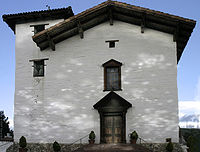 Nestled at the base of Fremont's rolling hills is the Mission San José, one of the oldest of the historic Spanish missions in California
, for which this district is named. The church building that exists today is a re-construction (dedicated in 1985 for daily Mass and tours) of the original 1809 adobe church that was destroyed by the 1868 Hayward-fault earthquake. One side of the original mission quadrangle remains and houses a museum. Mission San Jose is located at 37°31′59"N 121°55′13"W; and lies at an elevation of 305 feet (93 m).
, Lam Research
, Corsair Memory
and Lexar
of the US as well as foreign high-tech companies such as Elitegroup Computer Systems
, and Asus
. The district is also home to blue-collar industry.
Warm Springs also serves as commercial center for the mainly residential Mission San Jose district, especially since the construction of Pacific Commons
, a large, modern regional shopping center. The Oakland Athletics are also in talks to move their stadium to this area. The large Asian population in Mission San Jose comes to Warm Springs for authentic Asian stores such as the 99 Ranch & Marina Food
supermarkets, as well as more traditional supermarket
s such as Safeway
. It is also home to one of the SF Bay Area's only two coffee houses to employ baristas who wear bikinis, Your Coffee Cups
, a concept that's gained some controversy from Bay Area newspapers and news stations.
Construction of a 5.4 miles (8.7 km) BART extension to Warm Springs began in 2010. Currently, the southern terminus of the system is in Fremont's Centerville district. The extension will consist of an aerial track structure immediately south of the existing Fremont station
, a subway of approximately one mile under Fremont Central Park and Lake Elizabeth
, and at-grade tracks that will parallel Union Pacific tracks through the Irvington and Warm Springs districts.
In addition to the Warm Springs station
, the City is also planning a station in Irvington, mid-way between the Fremont and Warm Springs stations. All three Fremont BART stations are expected to incorporate Transit Oriented Development components in the immediate station areas.
Warm Springs is located on Rancho Agua Caliente
and is so named for the springs that are located there. In early times, there was a settlement called Harrisburgh (also, Harrisburg and Peacock's) a short distance east from the small settlement of Warm Springs. A post office opened in Harrisburgh in 1865 and changed its name to Warm Springs in 1885. The name Harrisburgh commemorated Abram Harris, who settled there in 1858. The name Peacock's commemorated George W. Peacock, its first postmaster. The post office name changed to Warmsprings in 1895 and reverted to Warm Springs in 1950.
station, several health care centers, the California School for the Blind and the Deaf, the Cherry/Guardino neighborhood, and Central Park
and Lake Elizabeth. It has been designated as the location of Fremont's future downtown.
. A 99 Ranch Market
is one of many East Asian businesses in the North Fremont community plan area.
auto plant as well as the site of the future Warm Springs BART station.
.
.
, Lam Research
, Fremont Bank
, Oplink Communications, Silicon Graphics International
, SYNNEX, S3 Graphics
and Volterra Semiconductor
.
since 1996. There are approximately 55,000 trees in City parks, streets, and landscaped boulevard areas. The city operates the Olive Hyde Art Gallery, adjacent to Mission San Jose, which has featured Bay Area artists such as Wendy Yoshimura
, the California Society of Printmakers
and the Etsy
collective. The public gallery is housed in a former home of Olive Hyde, descendent of early San Francisco Mayor George Hyde.
In addition to water-oriented activities, it will provide picnic areas for group activities.
The water park has been open since May 2009.
, a large forest
and a mansion
now called the Patterson House which was first constructed in 1857 by the farm's original owner, George Washington Patterson.
and Monument Peak. The slopes are covered with oak woodland and chaparral and attracts a large crowd of Fremont locals. There is usually a few inches of snow that melts too fast and falls too lightly each winter to be noticed. Whenever a good snowfall falls (about every three to five years), it causes considerable excitement.
is a film museum located in Niles, California on the former site of the Essanay Studios
where Broncho Billy and Charlie Chaplin
made films in the 1910s. It shows silent films weekly.
with the following cities:
 Fremont is served by Interstate 880
(Nimitz Freeway) and Interstate 680
(Sinclair Freeway). Though they do not intersect, they are connected in the Warm Springs district via a very busy one-mile segment of Mission Boulevard which is SR 262
. In addition, it is served by SR 84
and the segment of Mission Boulevard which is SR 238
. The city is the eastern terminus of the Dumbarton Bridge
.
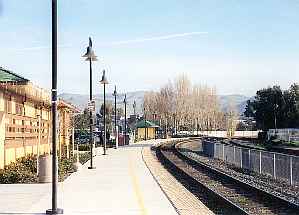
Regional rail transportation is provided by BART
and the Altamont Commuter Express
(ACE). Fremont's BART station
serves as the southernmost terminus for the BART system (a 5.4 miles (8.7 km) BART extensions to the Warm Springs district is under construction and a southward extension into San Jose
is in the planning stages). Centerville station provides a stopping point for ACE service which travels from Stockton
to San Jose. Bus service is provided by AC Transit
locally. Santa Clara Valley Transportation Authority
provides express bus service to various points in Silicon Valley
, including downtown San Jose
and California's Great America (seasonally) in Santa Clara
, thus providing an alternative to the already heavy traffic on I-880 and I-680.
Elevated sound levels
exist in some areas of Fremont, especially along Interstate 880
. Since the 1980s efforts have been made by Caltrans and the city to mitigate sound levels
by construction of noise barrier
s. The federal design level for freeway noise is 67 Leq, which standard has been used in analysis of the proper sound wall height.
is planning a Dumbarton
rail that would run between the Peninsula and Alameda County
. This project would add four stations to the Caltrain system: Union City
, Fremont-Centerville, Newark
, and Menlo Park
/East Palo Alto
. Dumbarton Rail is currently undergoing environmental and engineering review.
Alameda County, California
Alameda County is a county in the U.S. state of California. It occupies most of the East Bay region of the San Francisco Bay Area. As of the 2010 census it had a population of 1,510,271, making it the 7th most populous county in the state...
, California
California
California is a state located on the West Coast of the United States. It is by far the most populous U.S. state, and the third-largest by land area...
. It was incorporated on January 23, 1956, from the merger of five smaller communities: Centerville, Niles, Irvington, Mission San Jose, and Warm Springs. The city is named after John Charles Frémont, "the Great Pathfinder."
Located in the southeast section of the San Francisco Bay Area
San Francisco Bay Area
The San Francisco Bay Area, commonly known as the Bay Area, is a populated region that surrounds the San Francisco and San Pablo estuaries in Northern California. The region encompasses metropolitan areas of San Francisco, Oakland, and San Jose, along with smaller urban and rural areas...
in the East Bay
East Bay (San Francisco Bay Area)
The East Bay is a commonly used, informal term for the lands on the eastern side of the San Francisco Bay, in the San Francisco Bay Area, in California, United States...
region primarily, Fremont is now the fourth most populous city in the San Francisco Bay Area
San Francisco Bay Area
The San Francisco Bay Area, commonly known as the Bay Area, is a populated region that surrounds the San Francisco and San Pablo estuaries in Northern California. The region encompasses metropolitan areas of San Francisco, Oakland, and San Jose, along with smaller urban and rural areas...
, and the largest suburb in the metropolis. It is the closest Alameda County city to Silicon Valley
Silicon Valley
Silicon Valley is a term which refers to the southern part of the San Francisco Bay Area in Northern California in the United States. The region is home to many of the world's largest technology corporations...
, and is thus sometimes associated with it.
The area consisting of Fremont, Newark
Newark, California
Newark is a city in Alameda County, California, United States. It was incorporated as a city in September 1955. Newark is an enclave, completely surrounded by the city of Fremont. Its population was 42,573 at the 2010 census.-Geography:...
(an enclave of Fremont), and Union City
Union City, California
Union City is a city in Alameda County, California, United States. It was incorporated in 1959, combining the communities of Alvarado and Decoto. Alvarado was the original county seat of Alameda County, and the site of the first county courthouse is a California Historical Landmark . The city...
was formerly known as Washington Township, and is now known as the Tri-City Area.
Fremont is the sister city to Elizabeth, South Australia
Elizabeth, South Australia
Elizabeth is a northern suburb of Adelaide, South Australia. It is located in the City of Playford.-History:Elizabeth was established in 1955 as part of a planned satellite town by the South Australian Housing Trust on rural land between the older towns of Salisbury and...
; Puerto Peñasco
Puerto Peñasco
Puerto Peñasco is a city and municipality located in the northwest of the state of Sonora about 100 km from the Arizona border. It is located on the small strip of land that joins the peninsula of Baja California with the rest of Mexico. The area is part of the Altar Desert, one of the driest...
, Mexico; Fukaya
Fukaya, Saitama
is a city located in the north of Saitama Prefecture, Japan. In the Edo era, it was an inn-town on the Nakasendō , and grew during this period. It is in the prefecture's leading agricultural area, and claim's to be the biggest producer of leeks in Japan. Fukaya negi are famous. Shibusawa Eiichi,...
, Japan; Horta
Horta (Azores)
Horta is a single municipality and city in the western part of the Archipealgo of the Azores, encompassing the island of Faial. Horta has a population of about approximately 15,038 people and an area of 173.1 square kilometers. The population density is about 88 persons per square kilometer...
, Azores
Azores
The Archipelago of the Azores is composed of nine volcanic islands situated in the middle of the North Atlantic Ocean, and is located about west from Lisbon and about east from the east coast of North America. The islands, and their economic exclusion zone, form the Autonomous Region of the...
, Portugal; Lipa City
Lipa City
The Lipa City /Li-pâ/ is a first class city in the province of Batangas, Philippines. It is one of the three component cities of Batangas province...
, Philippines; and Jaipur
Jaipur
Jaipur , also popularly known as the Pink City, is the capital and largest city of the Indian state of Rajasthan. Founded on 18 November 1727 by Maharaja Sawai Jai Singh II, the ruler of Amber, the city today has a population of more than 3.1 million....
, India.
Demographics
2010
The 2010 United States Census reported that Fremont had a population of 214,089. The population densityPopulation density
Population density is a measurement of population per unit area or unit volume. It is frequently applied to living organisms, and particularly to humans...
was 2,443.7 people per square mile (943.5/km²). The racial makeup of Fremont was 70,320 (32.8%) White, 7,103 (3.3%) African American, 976 (0.5%) Native American, 108,332 (50.6%) Asian (18.1% Indian
Indian American
Indian Americans are Americans whose ancestral roots lie in India. The U.S. Census Bureau popularized the term Asian Indian to avoid confusion with Indigenous peoples of the Americas who are commonly referred to as American Indians.-The term: Indian:...
, 17.7% Chinese
Chinese American
Chinese Americans represent Americans of Chinese descent. Chinese Americans constitute one group of overseas Chinese and also a subgroup of East Asian Americans, which is further a subgroup of Asian Americans...
, 6.7% Filipino
Filipino American
Filipino Americans are Americans of Filipino ancestry. Filipino Americans, often shortened to "Fil-Ams", or "Pinoy",Filipinos in what is now the United States were first documented in the 16th century, with small settlements beginning in the 18th century...
, 2.5% Vietnamese
Vietnamese American
A Vietnamese American is an American of Vietnamese descent. They make up about half of all overseas Vietnamese and are the fourth-largest Asian American group....
, 1.4% Korean
Korean American
Korean Americans are Americans of Korean descent, mostly from South Korea, with a small minority from North Korea...
, 1.0% Pakistani
Pakistani American
A Pakistani American is any citizen or resident of the United States who has Pakistani heritage.- History in the United States :Muslim immigrants from areas that are now part of Pakistan have been migrating to America and first entered the United States as early as the eighteenth century, working...
, 0.8% Japanese
Japanese American
are American people of Japanese heritage. Japanese Americans have historically been among the three largest Asian American communities, but in recent decades have become the sixth largest group at roughly 1,204,205, including those of mixed-race or mixed-ethnicity...
, 0.6% Burmese
Burmese American
Burmese Americans are Americans of Burmese descent. The term encompasses people of all ethnic backgrounds with ancestry in the present-day Myanmar . Burmese Americans are a subgroup of Asian Americans...
), 1,169 (0.5%) Pacific Islander, 13,605 (6.4%) from other races
Race (United States Census)
Race and ethnicity in the United States Census, as defined by the Federal Office of Management and Budget and the United States Census Bureau, are self-identification data items in which residents choose the race or races with which they most closely identify, and indicate whether or not they are...
, and 12,584 (5.9%) from two or more races. Hispanic or Latino of any race were 31,698 persons (14.8%). Among the Hispanic population, 11.0% are Mexican
Mexican American
Mexican Americans are Americans of Mexican descent. As of July 2009, Mexican Americans make up 10.3% of the United States' population with over 31,689,000 Americans listed as of Mexican ancestry. Mexican Americans comprise 66% of all Hispanics and Latinos in the United States...
, 0.6% Puerto Rican
Puerto Rican people
A Puerto Rican is a person who was born in Puerto Rico.Puerto Ricans born and raised in the continental United States are also sometimes referred to as Puerto Ricans, although they were not born in Puerto Rico...
, and 0.5% Salvadoran
Salvadoran American
Salvadorian Americans are citizens or residents of the United States of Salvadoran descent. As of 2010 there are 1.6 million Salvadoran Americans in the United States, the fourth-largest Hispanic community by nation of ancestry.They are also known as the nicknamed Salvi people in the USA,...
.
The Census reported that 212,438 people (99.2% of the population) lived in households, 969 (0.5%) lived in non-institutionalized group quarters, and 682 (0.3%) were institutionalized.
There were 71,004 households, out of which 31,070 (43.8%) had children under the age of 18 living in them, 45,121 (63.5%) were opposite-sex married couples
Marriage
Marriage is a social union or legal contract between people that creates kinship. It is an institution in which interpersonal relationships, usually intimate and sexual, are acknowledged in a variety of ways, depending on the culture or subculture in which it is found...
living together, 7,070 (10.0%) had a female householder with no husband present, 3,382 (4.8%) had a male householder with no wife present. There were 2,779 (3.9%) unmarried opposite-sex partnerships
POSSLQ
POSSLQ is an abbreviation for "Persons of Opposite Sex Sharing Living Quarters," a term coined in the late 1970s by the United States Census Bureau as part of an effort to more accurately gauge the prevalence of cohabitation in American households....
, and 444 (0.6%) same-sex married couples or partnerships. 11,576 households (16.3%) were made up of individuals and 3,697 (5.2%) had someone living alone who was 65 years of age or older. The average household size was 2.99. There were 55,573 families
Family (U.S. Census)
A family or family household is defined by the United States Census Bureau for statistical purposes as "a householder and one or more other people related to the householder by birth, marriage, or adoption. They do not include same-sex married couples even if the marriage was performed in a state...
(78.3% of all households); the average family size was 3.36.
The population was spread out with 53,216 people (24.9%) under the age of 18, 15,610 people (7.3%) aged 18 to 24, 66,944 people (31.3%) aged 25 to 44, 56,510 people (26.4%) aged 45 to 64, and 21,809 people (10.2%) who were 65 years of age or older. The median age was 36.8 years. For every 100 females there were 98.9 males. For every 100 females age 18 and over, there were 96.4 males.
There were 73,989 housing units at an average density of 844.5 per square mile (326.1/km²), of which 44,463 (62.6%) were owner-occupied, and 26,541 (37.4%) were occupied by renters. The homeowner vacancy rate was 1.3%; the rental vacancy rate was 4.5%. 136,606 people (63.8% of the population) lived in owner-occupied housing units and 75,832 people (35.4%) lived in rental housing units.
2000
Fremont is the home to the largest concentration of AfghansAfghanistan
Afghanistan , officially the Islamic Republic of Afghanistan, is a landlocked country located in the centre of Asia, forming South Asia, Central Asia and the Middle East. With a population of about 29 million, it has an area of , making it the 42nd most populous and 41st largest nation in the world...
in the United States. This is noted in Khaled Hosseini
Khaled Hosseini
Khaled Hosseini , is an Afghan-born American novelist and physician of ethnic Tajik origin. He is a citizen of the United States where he has lived since he was fifteen years old. His 2003 debut novel, The Kite Runner, was an international bestseller, selling more than 12 million copies worldwide....
's 2003 novel Kite Runner
Kite runner
Kite runner may refer to:*A person whose hobby is Kite running*The Kite Runner, a novel by Khaled Hosseini*The Kite Runner , a 2007 film based on Khaled Hosseini's book...
. In addition, Fremont has a notable concentration of South Asians, predominantly employed in Silicon Valley's technology sector.
Among the Asian community of Fremont, the largest ethnic groups are Chinese
Chinese American
Chinese Americans represent Americans of Chinese descent. Chinese Americans constitute one group of overseas Chinese and also a subgroup of East Asian Americans, which is further a subgroup of Asian Americans...
, Indian
Indian American
Indian Americans are Americans whose ancestral roots lie in India. The U.S. Census Bureau popularized the term Asian Indian to avoid confusion with Indigenous peoples of the Americas who are commonly referred to as American Indians.-The term: Indian:...
s, and Filipinos
Filipino American
Filipino Americans are Americans of Filipino ancestry. Filipino Americans, often shortened to "Fil-Ams", or "Pinoy",Filipinos in what is now the United States were first documented in the 16th century, with small settlements beginning in the 18th century...
. Fremont and nearby Union City
Union City, California
Union City is a city in Alameda County, California, United States. It was incorporated in 1959, combining the communities of Alvarado and Decoto. Alvarado was the original county seat of Alameda County, and the site of the first county courthouse is a California Historical Landmark . The city...
have fairly large numbers of Pacific Islanders, Cubans
Cubans
Cubans or Cuban people are the inhabitants or citizens of Cuba. Cuba is a multi-ethnic nation, home to people of different ethnic and national backgrounds...
and Puerto Ricans
Puerto Rico
Puerto Rico , officially the Commonwealth of Puerto Rico , is an unincorporated territory of the United States, located in the northeastern Caribbean, east of the Dominican Republic and west of both the United States Virgin Islands and the British Virgin Islands.Puerto Rico comprises an...
, Spanish
Spanish people
The Spanish are citizens of the Kingdom of Spain. Within Spain, there are also a number of vigorous nationalisms and regionalisms, reflecting the country's complex history....
and Portuguese
Portuguese people
The Portuguese are a nation and ethnic group native to the country of Portugal, in the west of the Iberian peninsula of south-west Europe. Their language is Portuguese, and Roman Catholicism is the predominant religion....
, and a small miniscule number of American Indians
Indigenous peoples of the Americas
The indigenous peoples of the Americas are the pre-Columbian inhabitants of North and South America, their descendants and other ethnic groups who are identified with those peoples. Indigenous peoples are known in Canada as Aboriginal peoples, and in the United States as Native Americans...
.
Fremont also has a large deaf community, in large part because it is home of the Northern California campus of the California School for the Deaf
California School for the Deaf, Fremont
The California School for the Deaf, Fremont is a school for deaf children in Fremont, California. The school educates deaf children from all over Northern California...
. The school district is called the Fremont Unified School District
Fremont Unified School District
Fremont Unified School District is a primary and secondary education school district located in Fremont, California.The District has 28 elementary school campuses, 5 junior high campuses, and 5 high school campuses, as well as one alternative school campus.-School campuses and attendance areas:The...
which also serves parts of Union City and Hayward
Hayward, California
Hayward is a city located in the East Bay in Alameda County, California. With a population of 144,186, Hayward is the sixth largest city in the San Francisco Bay Area and the third largest in Alameda County. Hayward was ranked as the 37th most populous municipality in California. It is included in...
.
There were 68,237 households out of which 40.2% had children under the age of 18 living with them, 62.7% were married couples living together, 9.2% had a female householder with no husband present, and 23.5% were non-families. 16.5% of all households were made up of individuals and 4.1% had someone living alone who was 65 years of age or older. The average household size was 2.96 and the average family size was 3.34.
In the city the population was spread out with 25.8% under the age of 18, 7.7% from 18 to 24, 36.8% from 25 to 44, 21.4% from 45 to 64, and 8.3% who are 65 years of age or older. The median age is 34 years. For every 100 females there were 101.1 males. For every 100 females age 18 and over, there were 99.2 males.
According to a 2007 estimate, the median income for a household in the city is $93,342, and the median income for a family was $103,846. Males have a median household income
Median household income
The median household income is commonly used to generate data about geographic areas and divides households into two equal segments with the first half of households earning less than the median household income and the other half earning more...
of $59,274 versus $40,625 for females. The per capita income
Per capita income
Per capita income or income per person is a measure of mean income within an economic aggregate, such as a country or city. It is calculated by taking a measure of all sources of income in the aggregate and dividing it by the total population...
for the city was $31,411. About 3.6% of families and 5.4% of the population were below the poverty line, including 5.9% of those under age 18 and 6.2% of those age 65 or over.
Politically, Fremont leans strongly to the Democratic Party.
At the 2008 census the ancestry of city (and county portions) of Fremont residents was:
- GermanGermansThe Germans are a Germanic ethnic group native to Central Europe. The English term Germans has referred to the German-speaking population of the Holy Roman Empire since the Late Middle Ages....
7.8% - EnglishEnglish peopleThe English are a nation and ethnic group native to England, who speak English. The English identity is of early mediaeval origin, when they were known in Old English as the Anglecynn. England is now a country of the United Kingdom, and the majority of English people in England are British Citizens...
5.4% - IrishIrish peopleThe Irish people are an ethnic group who originate in Ireland, an island in northwestern Europe. Ireland has been populated for around 9,000 years , with the Irish people's earliest ancestors recorded having legends of being descended from groups such as the Nemedians, Fomorians, Fir Bolg, Tuatha...
4.6% - ItalianItalian peopleThe Italian people are an ethnic group that share a common Italian culture, ancestry and speak the Italian language as a mother tongue. Within Italy, Italians are defined by citizenship, regardless of ancestry or country of residence , and are distinguished from people...
2.5% - PortuguesePortuguese peopleThe Portuguese are a nation and ethnic group native to the country of Portugal, in the west of the Iberian peninsula of south-west Europe. Their language is Portuguese, and Roman Catholicism is the predominant religion....
2.4% - ScottishScottish peopleThe Scottish people , or Scots, are a nation and ethnic group native to Scotland. Historically they emerged from an amalgamation of the Picts and Gaels, incorporating neighbouring Britons to the south as well as invading Germanic peoples such as the Anglo-Saxons and the Norse.In modern use,...
1.7% - FrenchFrench peopleThe French are a nation that share a common French culture and speak the French language as a mother tongue. Historically, the French population are descended from peoples of Celtic, Latin and Germanic origin, and are today a mixture of several ethnic groups...
1.3% - Russian 1.3%
- AmericanUnited StatesThe United States of America is a federal constitutional republic comprising fifty states and a federal district...
1.2% - Swedish 1.2%
- PolishPolesthumb|right|180px|The state flag of [[Poland]] as used by Polish government and diplomatic authoritiesThe Polish people, or Poles , are a nation indigenous to Poland. They are united by the Polish language, which belongs to the historical Lechitic subgroup of West Slavic languages of Central Europe...
1.1% - Scottish-Irish 1.0%
- DutchDutch peopleThe Dutch people are an ethnic group native to the Netherlands. They share a common culture and speak the Dutch language. Dutch people and their descendants are found in migrant communities worldwide, notably in Suriname, Chile, Brazil, Canada, Australia, South Africa, New Zealand, and the United...
0.9% - Norwegian 0.7%
- SpanishSpanish AmericanA Spanish American is a citizen or resident of the United States whose ancestors originate from the southwestern European nation of Spain. Spanish Americans are the earliest European American group, with a continuous presence since 1565.-Immigration waves:...
0.5-1.5% (estimated).
Education
Fremont is home to the Fremont Unified School DistrictFremont Unified School District
Fremont Unified School District is a primary and secondary education school district located in Fremont, California.The District has 28 elementary school campuses, 5 junior high campuses, and 5 high school campuses, as well as one alternative school campus.-School campuses and attendance areas:The...
and lies within the Ohlone Community College District.
The Fremont Unified School District has five comprehensive high schools for students in grades 9–12: American
American High School (Fremont, California)
American High School is a public secondary school located in Fremont, California. It is one of five public high schools within the Fremont Unified School District. The school receives its students through the American High School attendance area boundary set by the district...
, Irvington
Irvington High School (Fremont, California)
Irvington High School is an American public high school located in Fremont, California. It is one of five public high schools in the Fremont Unified School District.-Campus:...
, Kennedy, Mission San Jose
Mission San Jose High School
Mission San Jose High School , is a public, co-educational, four-year secondary school founded in 1964 and located in the Mission San Jose district of Fremont, California, United States...
and Washington. These five high schools, along with James Logan High School
James Logan High School
James Logan High School is a public secondary school in Union City, California, United States. The school is administrated by the New Haven Unified School District and has an enrollment of more than 4000 students.-Demographics:...
in Union City
Union City, California
Union City is a city in Alameda County, California, United States. It was incorporated in 1959, combining the communities of Alvarado and Decoto. Alvarado was the original county seat of Alameda County, and the site of the first county courthouse is a California Historical Landmark . The city...
and Newark Memorial High School
Newark Memorial High School
Newark Memorial High School is a comprehensive high school in Newark, California. It is located to the southeast of Newark's business district, between I-880 and San Francisco Bay.- History :...
in Newark
Newark, California
Newark is a city in Alameda County, California, United States. It was incorporated as a city in September 1955. Newark is an enclave, completely surrounded by the city of Fremont. Its population was 42,573 at the 2010 census.-Geography:...
, make up the Mission Valley Athletic League (M.V.A.L.)
Mission Valley Athletic League
The Mission Valley Athletic League is a collaboration of 7 schools in the Tri-Cities area of Fremont, Newark and Union City, California. The MVAL is part of the Bay Shore Conference in the North Coast Section ....
.
In addition to the five comprehensive high schools, the district has a continuation high school (Robertson); two independent study programs (Vista and COIL); an adult school; five junior high schools
Middle school
Middle School and Junior High School are levels of schooling between elementary and high schools. Most school systems use one term or the other, not both. The terms are not interchangeable...
for grades 7–8 (Centerville, Hopkins
Hopkins Junior High School
Hopkins Junior High School is a secondary school in Fremont, California, serving the seventh and eighth grades. It is one of five junior high schools in the city belonging to the Fremont Unified School District. Graduates from four local elementary schools attend Hopkins Junior High. Students...
, Horner, Thornton and Walters); and
29 elementary schools (K-6). The district operates the Mission Valley Regional Occupational Program jointly with Newark and New Haven Unified School Districts.
The main campus of Ohlone College
Ohlone College
Ohlone College is a community college located in Fremont, California. It was established in 1965. Ohlone College is a single college, multi campus district serving the areas of Fremont, Newark, and Union City with its main campus and district office in Fremont...
is located in Fremont, with a smaller center in Newark. The University of California, Berkeley
University of California, Berkeley
The University of California, Berkeley , is a teaching and research university established in 1868 and located in Berkeley, California, USA...
has an extension campus located in Fremont, and the University of Phoenix
University of Phoenix
The University of Phoenix is a for-profit institution of higher learning. It is a wholly owned subsidiary of Apollo Group Inc. which is publicly traded , an S&P 500 corporation based in Phoenix, Arizona...
Bay Area Campus and Northwestern Polytechnic University
Northwestern Polytechnic University
Northwestern Polytechnic University is a private institution of higher education located in Fremont, California, USA.The school, founded in 1984, awards Bachelor's, Master's and Doctorate degrees in science, technology and management.-Facilities:...
and DeVry University
DeVry University
DeVry University and DeVry Institute of Technology are divisions of DeVry Inc , a proprietary, for-profit higher education organization that is also the parent organization for Keller Graduate School of Management, Ross University, American University of the Caribbean, Apollo College, Western...
offer undergraduate and graduate programs in technology and management areas.
The city is also home to Fremont Christian School
Fremont Christian School
Fremont Christian School , is a private Evangelical Christian School located in Fremont, California, USA. The school was founded in 1967. It serves preschool through 12th grade. The current secondary principal is Dr. Meyer. The school is located on Thornton Ave. The typical schedule of a secondary...
and California School for the Deaf, Fremont
California School for the Deaf, Fremont
The California School for the Deaf, Fremont is a school for deaf children in Fremont, California. The school educates deaf children from all over Northern California...
, which serves Northern California
Northern California
Northern California is the northern portion of the U.S. state of California. The San Francisco Bay Area , and Sacramento as well as its metropolitan area are the main population centers...
. It shares its campus with the Statewide California School for the Blind.
The Alameda County Library
Alameda County Library
The Alameda County Library, in Alameda County, California, is a public library system that provides services from ten branch libraries in the cities of Albany, Dublin, Fremont, Newark and Union City and the unincorporated communities of Castro Valley and San Lorenzo...
has its headquarters in Fremont. The Fremont Main Library is the largest building and has the highest circulation in the Alameda County Library family and shares its building with the Alameda County Library Administration. The current building was dedicated in 1989 and is home to the Maurice Marks Center for Local and California History, and the Fukaya public meeting rooms. There are also three branch libraries in Fremont: Centerville, Irvington, and Niles.
History
The recorded history of the Fremont area began on June 9, 1797, when Mission San José was founded by the Spaniard Father Fermin de Lasuen. The Mission was established at the site of the OhloneOhlone
The Ohlone people, also known as the Costanoan, are a Native American people of the central California coast. When Spanish explorers and missionaries arrived in the late 18th century, the Ohlone inhabited the area along the coast from San Francisco Bay through Monterey Bay to the lower Salinas Valley...
village of Oroysom. On their second day in the area, the Mission party killed a grizzly bear
Grizzly Bear
The grizzly bear , also known as the silvertip bear, the grizzly, or the North American brown bear, is a subspecies of brown bear that generally lives in the uplands of western North America...
in Niles Canyon
Niles Canyon
Niles Canyon is a canyon in the San Francisco Bay Area formed by Alameda Creek. The canyon is largely in an unincorporated area of Alameda County, while the western portion of the canyon lies within the city limits of Fremont and Union City...
. The first English-speaking visitor to Fremont was the renowned trapper and explorer Jedediah Smith
Jedediah Smith
Jedediah Strong Smith was a hunter, trapper, fur trader, trailblazer, author, cartographer, cattleman, and explorer of the Rocky Mountains, the American West Coast and the Southwest during the 19th century...
in 1827. The Mission prospered, eventually reaching a population of 1,886 inhabitants in 1831. The influence of the missionaries declined after 1834, when the Mexican government enacted secularization
Secularization
Secularization is the transformation of a society from close identification with religious values and institutions toward non-religious values and secular institutions...
.
José de Jesus Vallejo, brother of Mariano Vallejo, was the grantee of the Rancho Arroyo de la Alameda
Rancho Arroyo de la Alameda
Rancho Arroyo de la Alameda was a Mexican land grant in present day Alameda County, California given in 1842 by Governor Juan B. Alvarado to José de Jesús Vallejo...
Mexican land grant
Ranchos of California
The Spanish, and later the Méxican government encouraged settlement of territory now known as California by the establishment of large land grants called ranchos, from which the English ranch is derived. Devoted to raising cattle and sheep, the owners of the ranchos attempted to pattern themselves...
. His family was influential in the Fremont area in the late colonial era, and owned and built a flour mill
Vallejo Flour Mill
The Vallejo Flour Mill in Fremont, California, was built in 1850 by José de Jesús Vallejo, elder brother of General Mariano Guadalupe Vallejo on his Rancho Arroyo de la Alameda...
at the mouth of Niles Canyon
Niles Canyon
Niles Canyon is a canyon in the San Francisco Bay Area formed by Alameda Creek. The canyon is largely in an unincorporated area of Alameda County, while the western portion of the canyon lies within the city limits of Fremont and Union City...
. In 1846 they were visited by the town's namesake John C. Frémont
John C. Frémont
John Charles Frémont , was an American military officer, explorer, and the first candidate of the anti-slavery Republican Party for the office of President of the United States. During the 1840s, that era's penny press accorded Frémont the sobriquet The Pathfinder...
, who mapped a trail through Mission Pass to provide access for American settlers into the southeastern San Francisco Bay Area. The Fremont area grew rapidly at the time of the Gold Rush
Gold rush
A gold rush is a period of feverish migration of workers to an area that has had a dramatic discovery of gold. Major gold rushes took place in the 19th century in Australia, Brazil, Canada, South Africa, and the United States, while smaller gold rushes took place elsewhere.In the 19th and early...
. Agriculture dominated the economy with grapes, nursery plants and olives as leading crops. In 1868 the 6.8-magnitude Hayward earthquake
1868 Hayward earthquake
The 1868 Hayward earthquake was the last large earthquake to occur on the Hayward Fault Zone in the San Francisco Bay Area, California, United States. It caused significant damage throughout the region, and was known as the "Great San Francisco Earthquake" prior to the 1906 San Francisco earthquake...
on the Hayward Fault collapsed buildings throughout the Fremont area, ruining Mission San José and its outbuildings. Until the 1906 San Francisco earthquake
1906 San Francisco earthquake
The San Francisco earthquake of 1906 was a major earthquake that struck San Francisco, California, and the coast of Northern California at 5:12 a.m. on Wednesday, April 18, 1906. The most widely accepted estimate for the magnitude of the earthquake is a moment magnitude of 7.9; however, other...
caused its destruction, the Fremont area's Palmdale Winery was the largest in California. The ruins of the Palmdale Winery are still visible near the Five Corners in Irvington.
From 1912 to 1916 the Niles section of the Fremont area was the earliest home of California's motion picture industry. Charlie Chaplin
Charlie Chaplin
Sir Charles Spencer "Charlie" Chaplin, KBE was an English comic actor, film director and composer best known for his work during the silent film era. He became the most famous film star in the world before the end of World War I...
filmed several movies in the Fremont area, most notably The Tramp
The Tramp (film)
The Tramp is Charlie Chaplin's sixth film for Essanay Studios in 1915. Directed by Chaplin, it was the fifth and last film made at Essanay's Niles, California studio. The Tramp marked the beginning of The Tramp character most known today, even though Chaplin played the character in earlier films...
.
Fremont was incorporated under the leadership of Wally Pond in 1956, when five towns in the area, Irvington, Centerville, Mission San Jose, Niles and Warm Springs came together to form a city.
Fremont became more industrialized in the 1950s and 1960s. A boom in high-tech employment in the 1980s to the late 1990s, especially in the Warm Springs District, caused rapid development in the city. The General Motors automotive assembly plant in South Fremont was the town's largest employer, and Fremont was known for its drag strip. In the 1980s the GM plant became a joint venture automotive assembly plant of Toyota and General Motors called NUMMI
NUMMI
New United Motor Manufacturing, Inc. was an automobile manufacturing plant in Fremont, California, opened in 1984 and closed in 2010. On October 27, 2010 it reopened as a 100% Tesla Motors-owned production facility, known as the Tesla Factory...
. Toyota and NUMMI shut down its operations in early 2010. Part of the plant was acquired in June 2010 by Tesla Motors as its primary production plant, known as the Tesla Factory
Tesla Factory
The Tesla Factory is an automobile manufacturing plant in Fremont, California owned and operated by Tesla Motors. The facility was formerly known as New United Motor Manufacturing, Inc. , a joint venture between General Motors and Toyota...
. Tesla is expected to roll out its high end electric vehicles sometime in 2012. Solyndra
Solyndra
Solyndra was a manufacturer of cylindrical panels of CIGS thin-film solar cells based in Fremont, California. Although the company was once touted for its unusual technology, plummeting silicon prices led to the company being unable to compete with more conventional solar panels...
, a solar panel manufacturer, was personally promoted in 2010 by President Barack Obama
Barack Obama
Barack Hussein Obama II is the 44th and current President of the United States. He is the first African American to hold the office. Obama previously served as a United States Senator from Illinois, from January 2005 until he resigned following his victory in the 2008 presidential election.Born in...
as a model for government investment in green technology
Environmental technology
Environmental technology or green technology or clean technology is the application of one or more of environmental science, green chemistry, environmental monitoring and electronic devices to monitor, model and conserve the natural environment and resources, and to curb the negative impacts of...
after his administration approved a $535-million Department of Energy
United States Department of Energy
The United States Department of Energy is a Cabinet-level department of the United States government concerned with the United States' policies regarding energy and safety in handling nuclear material...
loan and the company built a $733 million state-of-the-art robotic facility, but in 2011 the company filed for Chapter 11 bankruptcy and laid-off 1,000 workers.
The first Fremont post office opened in 1956.
Local government
The Fremont city government is headed by the mayor, who is elected by the citizens of Fremont to a four-year term. The next mayoral election is in 2012. The mayor chairs the City Council, which consists of the mayor and four elected council members. This council adopts the City's budget and makes all major policy decisions. The City Council appoints a City Manager, who hires all City staff and manages the day-to-day business of the City. Advisory bodies work with the City Council and identify issues before the Council makes final decisions. Advisory body members are appointed by the Mayor, subject to the approval of a majority of the Council. Most members serve four-year terms of office. Advisory body members serve without pay with the exception of Planning Commissioners.The City of Fremont directly provides services related to public safety, land use regulation, infrastructure maintenance, parks and recreation, and local social services. To provide these services, the city government is organized into 22 departments, from Animal Services to Transportation Engineering. The Fremont City Hall is located at 3300 Capitol Ave in the Central District.
According to the city’s most recent Comprehensive Annual Financial Report, the city’s various funds had $275.8 million in Revenues, $201.9 million in expenditures, $1,184.1 million in total assets, $259.7 million in total liabilities, and $335.2 million in cash and investments.
For the past years, the City Council has always adopted a balanced budget by July 1, even though it has proven not to be sustainable in the long term. Over time, the community has endured service cuts, while the City organization has reduced its staffing and labor groups have agreed to wage concessions — yet there still remains a financial problem that must be dealt with at the City level.
Schools are managed by the Fremont Unified School District
Fremont Unified School District
Fremont Unified School District is a primary and secondary education school district located in Fremont, California.The District has 28 elementary school campuses, 5 junior high campuses, and 5 high school campuses, as well as one alternative school campus.-School campuses and attendance areas:The...
. The School District is not part of the City government organization, but the two entities work in partnership on selected issues.
Water and sewer services are provided by special districts, which are legally constituted government entities that are neither cities nor counties. They are established for the purpose of carrying on specific activities within their borders. Water services are provided by Alameda County Water District
Alameda County Water District
The Alameda County Water District is a public agency in Alameda County, California, USA, which has responsibilities for managing and protecting certain groundwater resources within Alameda County. While not an administrative unit of the county government, this water district derives certain of...
, and sewer services are provided by Union Sanitary District. Electricity, natural gas, and cable are provided by private organizations, like Pacific Gas and Electric and Comcast
Comcast
Comcast Corporation is the largest cable operator, home Internet service provider, and fourth largest home telephone service provider in the United States, providing cable television, broadband Internet, and telephone service to both residential and commercial customers in 39 states and the...
. Garbage collection and recycling services are contracted out, currently with Allied Waste.
County, State, and Federal Government
Fremont is one of 14 cities in Alameda County. Alameda County has a variety of functions, including supervision of elections, law enforcement, property assessment, public health, social services, and libraries.Alameda County is one of 58 counties in the State of California
California
California is a state located on the West Coast of the United States. It is by far the most populous U.S. state, and the third-largest by land area...
. The State is responsible for functions that are more particular to regional interests, such as educational funding, transportation, utility regulation, working conditions, and driver licenses. Most cities, including Fremont, are subdivisions of the State and exercise powers according to provisions of State law.
The Federal government deals with issues that cross state and national boundaries, including national defense, foreign relations and trade, and monetary policy. The Federal government also has a significant role in transportation, health funding and policy, and education funding.
Districts
Centerville, Niles, Irvington, Mission San Jose, and Warm Springs were the original five small independent towns that combined and incorporated to form Fremont in 1956. Today, these places have greatly expanded, are no longer separate communities, and are considered districts or community plan areas of the more or less developed city of Fremont. The town of NewarkNewark, California
Newark is a city in Alameda County, California, United States. It was incorporated as a city in September 1955. Newark is an enclave, completely surrounded by the city of Fremont. Its population was 42,573 at the 2010 census.-Geography:...
declined to join Fremont, and is now an enclave of it. Since incorporation, Fremont has created six more districts, which it calls "community plan areas" for planning purposes. These include Central, North Fremont, South Fremont, and Bayside. The two other districts, Baylands and the Hill Areas, are primarily open space.
Centerville District
Centerville was perhaps the main town in Washington Township. Centerville is located at 37°33′15"N 121°59′57"W. It lies at an elevation of 52 feet (16 m). Centerville was started by George Lloyd who started selling cold beer to stage passengers from a tent in 1850. Capt. George Bond set up a general store and the name Centerville was chosen. The post office opened Centreville post office in 1855 and changed the spelling to Centerville in 1893. The Centerville Pioneer CemeteryCenterville Pioneer Cemetery
The Centerville Pioneer Cemetery, also known as the Centerville Presbyterian Cemetery, is located at the corner of Post Street and Bonde Way in Fremont, California and was officially designated a state cemetery in 1858 or 1859 depending upon the source...
contains the burial places of many of the city's founding pioneers.
Centerville is also known as the focal point of a sizable Afghan
Afghanistan
Afghanistan , officially the Islamic Republic of Afghanistan, is a landlocked country located in the centre of Asia, forming South Asia, Central Asia and the Middle East. With a population of about 29 million, it has an area of , making it the 42nd most populous and 41st largest nation in the world...
community, and the area is informally referred to in some circles as "Little Kabul". The best-selling novel The Kite Runner
The Kite Runner
The Kite Runner is a novel by Khaled Hosseini. Published in 2003 by Riverhead Books, it is Hosseini's first novel, and was adapted into a film of the same name in 2007....
is partly set in Fremont's Afghan community. Centerville can also be traced back to its native American roots.
For city planning purposes, Centerville was enlarged to encompass most of the north central residential section of Fremont, from Mowry Ave to Decoto Rd, from I-880 to the BART line. This Centerville community plan area includes the sprawling subdivisions of Glenmoor Gardens
Glenmoor Gardens
Glenmoor Gardens is a neighborhood of nearly 1,900 homes in central Fremont, California and is Fremont's largest subdivision. The neighborhood is bounded, approximately, by I-880 on the west, Mowry Avenue to the south, Central Avenue to the north, and Fremont Boulevard on the east.In the 19th...
developed in the 1950s and 1960s, bounded by Central Avenue, Fremont Boulevard, Mowry Avenue, and the I-880 freeway. It also includes the Cabrillo neighborhood, the Brookvale subdivisions, the Quarry Lakes Regional Park, and part of Parkmont. The area is served by two high schools, American High School and Washington High School. It also has two junior high schools, Centerville Junior High School and Thornton Junior High School.
Niles District
Niles retains a small town feel anchored by a tight-knit community. Geography partly explains the community's cohesion; in addition to sitting against the base of Fremont's hills, the town is physically divided from other parts of Fremont and neighboring Union City by Mission Boulevard (State Route 238California State Route 238
State Route 238 is a north–south highway in the U.S. state of California. The route is a divided multilane surface highway in the southeastern part of the San Francisco Bay Area. SR 238 connects Interstate 580 in Castro Valley and Interstate 680 in Fremont.-Route description:SR 238 goes...
) to the east and north, Alameda Creek to the south, Union Pacific Railroad
Union Pacific Railroad
The Union Pacific Railroad , headquartered in Omaha, Nebraska, is the largest railroad network in the United States. James R. Young is president, CEO and Chairman....
to the west and southeast, and the Quarry Lakes to the southwest. The hills of Niles are lower than those of the area south of the Alameda Creek in Mission San Jose. Old Town Niles features its own library, post office, and silent movie theater as well as a large number of antique and craft stores. The town is named after Addison Niles
Addison Niles
Addison Cook Niles was an Associate Justice on the Supreme Court of California from 1872-1880. The town of Niles in Fremont, California is named after Addison Niles, who was once a railroad attorney for the Western Pacific Railroad....
. Niles is located at 37°34′44"N 121°58′40"W. It lies at an elevation of 112 feet (34 m).
Niles was the home of one of the first West Coast motion picture companies, Essanay Studios
Essanay Studios
The Essanay Film Manufacturing Company was an American motion picture studio. It is best known today for its series of Charlie Chaplin comedies of 1915.-Founding:...
. Charlie Chaplin
Charlie Chaplin
Sir Charles Spencer "Charlie" Chaplin, KBE was an English comic actor, film director and composer best known for his work during the silent film era. He became the most famous film star in the world before the end of World War I...
and Broncho Billy Anderson
Broncho Billy Anderson
Gilbert M. "Broncho Billy" Anderson was an American actor, writer, film director, and film producer, who is best known as the first star of the Western film genre.-Early life:...
filmed some of their most famous silent movies in Niles. Scenic Niles Canyon
Niles Canyon
Niles Canyon is a canyon in the San Francisco Bay Area formed by Alameda Creek. The canyon is largely in an unincorporated area of Alameda County, while the western portion of the canyon lies within the city limits of Fremont and Union City...
stretches between Niles and Sunol
Sunol, California
Sunol is an unincorporated census-designated place in Alameda County, California, United States. The population was 913 at the 2010 census....
. The nonprofit Niles Essanay Film Museum offers both artifacts of Niles' early years, and each Saturday evening, screenings of early-twentieth-century silent films, many of which were filmed locally.
The Niles Canyon Railway
Niles Canyon Railway
The Niles Canyon Railway is a heritage railway running through Niles Canyon, between Sunol and the Niles district of Fremont in the East Bay of the San Francisco Bay Area, in California, USA. The railway is listed on the National Register of Historic Places as the Niles Canyon Transcontinental...
runs along Alameda Creek
Alameda Creek
Alameda Creek is a large perennial stream in the San Francisco Bay Area. The creek runs for from a lake northeast of Packard Ridge to the eastern shore San Francisco Bay by way of Niles Canyon and a flood control channel.-History:...
, and carries passengers on weekend excursions, including a holiday 'train of lights' which is extremely popular – tickets for these trains typically sell out by early October. The Niles Canyon Railroad has a small but well-maintained collection of historic rail stock.
Of special note is the annual antique fair and flea market
Flea market
A flea market or swap meet is a type of bazaar where inexpensive or secondhand goods are sold or bartered. It may be indoors, such as in a warehouse or school gymnasium; or it may be outdoors, such as in a field or under a tent...
which takes place on the last Sunday in August. The entire town turns out with things to sell as early as Saturday morning, with bargain hunters from the Bay Area and beyond visiting in search of bargains. Niles is also home to the Fremont Gurdwara, which serves the large American Sikh
Sikh
A Sikh is a follower of Sikhism. It primarily originated in the 15th century in the Punjab region of South Asia. The term "Sikh" has its origin in Sanskrit term शिष्य , meaning "disciple, student" or शिक्ष , meaning "instruction"...
community of Fremont as a religious shrine open to not only the Sikhs but to everyone regardless of their caste and religion. For more information on Niles, please visit The Niles Main Street Association Page. There is also a convience store called Mikeys.
The place was originally known as Vallejo's Mills for Vallejo Flour Mill
Vallejo Flour Mill
The Vallejo Flour Mill in Fremont, California, was built in 1850 by José de Jesús Vallejo, elder brother of General Mariano Guadalupe Vallejo on his Rancho Arroyo de la Alameda...
built there. Niles was named by the Central Pacific Railroad
Central Pacific Railroad
The Central Pacific Railroad is the former name of the railroad network built between California and Utah, USA that formed part of the "First Transcontinental Railroad" in North America. It is now part of the Union Pacific Railroad. Many 19th century national proposals to build a transcontinental...
in 1869 for Judge Addison C. Niles, who later was elected to the California Supreme Court. A post office was opened at Niles in 1873.
Part of historic Niles is Mayhew Spring, also known as Mayhew's Sulphur Spring, which was located 600 feet (182.9 m) north of the Niles railroad depot. The facility was owned by H.A. Meyhew.
The coast to coast completion of Transcontinental Railroad is contributed to have occurred in nearby Niles Canyon. In September, 1869, four months after the famous golden spike ceremony at Promontory Summit, Utah, the Central Pacific Railroad completed the transcontinental rail link between Sacramento and the San Francisco Bay, finishing the track through the canyon. The Central Pacific had acquired the Western Pacific and other local railroads and built track to connect them at a waterfront terminal at Alameda Point.
Also part of Niles is Niles Junction on the Western Pacific Railroad
Western Pacific Railroad
The Western Pacific Railroad was a Class I railroad in the United States. It was formed in 1903 as an attempt to break the near-monopoly the Southern Pacific Railroad had on rail service into northern California...
, located at 37°34′35"N 121°58′17"W, and situated at an elevation of 79 feet (24 m).
Irvington District
This area has gone through a series of name changes. Originally, shortly after the US Civil war, a freed male black slave left the southern United States and traveled to California reportedly in search of wealth, likely in gold. During his travels he came across a very busy crossroads. People traveling towards Oakland, San Francisco, San Jose, Livermore, and even Sacramento would pass through this cross roads, since the Transcontinental Rail Road ended in Sacramento until later years. Realizing the financial possibilities of the area, this former slave constructed the first building at the cross roads, a tavern with an inn. For many years due to a lack of a formal name, sadly the cross roads area was only known as "Nigger’s Corner". This corner, now the intersection of Fremont and Washington Boulevards, Union and Bay Streets, is now known as "Five Corners" or Irvington Square. Irvington Square’s marker, Irvington Plaza park, is located at 37°31′22"N 121°58′18"W. The inn and several of the other original buildings were demolished by the city of Fremont in the early 1980's. The corner was soon home to Washington College, the first industrial educational institution in California. As a result, The US Postal Service established a post office called Washington Corners at the college in 1870.In 1884, realizing the need for a proper township name, local inhabitants selected the name of Irving. The name was chosen in honor of Judge Irving, the local traveling circuit judge of the time. Later as the railroad came through the area, the published train schedule pamphlets erroneously listed the Irving train depot as Irvington. The township protested to the railroad about the error. The railroad company notified the township that it was too costly for them to replace the train schedule pamphlets (over $100,000.00) and in 1887 following the recommendation, the people of Irving changed the township name to Irvington.
The Irvington district has two main neighborhoods: Irvington Woods and the Irvington Square. The neighborhood is ethnically mixed and is primarily working class. For city planning purposes, the Irvington area was enlarged to encompass most of the south central residential section of Fremont, from Auto Mall Pkwy to Mowry Ave, from I-880 to roughly the BART line (excluding the Central District described below). This Irvington community plan area includes the Sundale neighborhood, the South Sundale neighborhood, 28 Palms, Blacow, and Grimmer subdivisions. The area is served by three high schools: Irvington High School
Irvington High School (Fremont, California)
Irvington High School is an American public high school located in Fremont, California. It is one of five public high schools in the Fremont Unified School District.-Campus:...
, Robertson High School, and John F. Kennedy High School.
Mission San Jose District
The district, like Niles, is surrounded by hills. The hills are higher and steeper than Niles, with the highest points being on the Mission RidgeMission Peak
Mission Peak is a peak east of Fremont, California. It is part of a ridge that includes Mount Allison and Monument Peak. Mission Peak is located in the Mission Peak Regional Preserve and is a part of the East Bay Regional Park District. There is regular snowfall every winter, but it is typically...
. Mission San Jose district lies close to the northern two peaks, Mission Peak
Mission Peak
Mission Peak is a peak east of Fremont, California. It is part of a ridge that includes Mount Allison and Monument Peak. Mission Peak is located in the Mission Peak Regional Preserve and is a part of the East Bay Regional Park District. There is regular snowfall every winter, but it is typically...
and Mount Allison
Mount Allison
Mount Allison is a peak southeast of Fremont, California. It is part of a ridge that includes Mission Peak and Monument Peak. Unlike the former two peaks, Mount Allison is located on unincorporated private property owned by a broadcasting company....
. Mission Peak is very distinctive and is one of Fremont's emblems. These peaks go from 2,517 to 2604 ft (793.7 m), taller than Mount Tamalpais
Mount Tamalpais
Mount Tamalpais is a peak in Marin County, California, United States, often considered symbolic of Marin County. Much of Mount Tamalpais is protected within public lands such as Mount Tamalpais State Park and the Mount Tamalpais Watershed.-Geography:...
, a great height for the San Francisco Bay Area. They see some deep snow occasionally.
Fremont's community college, Ohlone College
Ohlone College
Ohlone College is a community college located in Fremont, California. It was established in 1965. Ohlone College is a single college, multi campus district serving the areas of Fremont, Newark, and Union City with its main campus and district office in Fremont...
, is situated one block away from the mission and serves over 12,000 students.
Mission San Jose has the highest concentration of Asian American
Asian American
Asian Americans are Americans of Asian descent. The U.S. Census Bureau definition of Asians as "Asian” refers to a person having origins in any of the original peoples of the Far East, Southeast Asia, or the Indian subcontinent, including, for example, Cambodia, China, India, Indonesia, Japan,...
s in Fremont – over 50% of the population as of the 2000 census. The local high school is Mission San Jose High School
Mission San Jose High School
Mission San Jose High School , is a public, co-educational, four-year secondary school founded in 1964 and located in the Mission San Jose district of Fremont, California, United States...
. The median family income for the Mission San Jose area (ZIP code
ZIP Code
ZIP codes are a system of postal codes used by the United States Postal Service since 1963. The term ZIP, an acronym for Zone Improvement Plan, is properly written in capital letters and was chosen to suggest that the mail travels more efficiently, and therefore more quickly, when senders use the...
94539) exceeded $114,595 in 2005. Owing to an influx of professionals and other affluent families seeking access to the top-performing local public schools, Mission San Jose's median home value reached $831,000 in 2006, earning the community a rank of 237 on Forbes
Forbes
Forbes is an American publishing and media company. Its flagship publication, the Forbes magazine, is published biweekly. Its primary competitors in the national business magazine category are Fortune, which is also published biweekly, and Business Week...
magazine's list of the 500 most affluent communities in the United States.
In 2001 an attempt by community organizations in the Mission San Jose district to withdraw from the Fremont Unified School District
Fremont Unified School District
Fremont Unified School District is a primary and secondary education school district located in Fremont, California.The District has 28 elementary school campuses, 5 junior high campuses, and 5 high school campuses, as well as one alternative school campus.-School campuses and attendance areas:The...
caused state-wide controversy and led to accusations of racism from both sides. The attempt was prompted by a re-drawing of the school enrollment areas, under which some Mission San Jose residents would send their children to Horner Junior High and Irvington High
Irvington High School (Fremont, California)
Irvington High School is an American public high school located in Fremont, California. It is one of five public high schools in the Fremont Unified School District.-Campus:...
schools. The controversial effort to secede was dropped later that year. Fremont's public schools continue to rank among the best in California.
A post office was opened at Mission San Jose in 1850.
Mission San Jose
Spanish missions in California
The Spanish missions in California comprise a series of religious and military outposts established by Spanish Catholics of the Franciscan Order between 1769 and 1823 to spread the Christian faith among the local Native Americans. The missions represented the first major effort by Europeans to...
, for which this district is named. The church building that exists today is a re-construction (dedicated in 1985 for daily Mass and tours) of the original 1809 adobe church that was destroyed by the 1868 Hayward-fault earthquake. One side of the original mission quadrangle remains and houses a museum. Mission San Jose is located at 37°31′59"N 121°55′13"W; and lies at an elevation of 305 feet (93 m).
Warm Springs District
The Warm Springs district is the southernmost portion of Fremont whose hub is the Warm Springs and Mission Boulevard intersection. It is located at 37°29′14"N 121°55′45"W, and lies at an elevation of 62 feet (19 m). Due to its proximity to the center of Silicon Valley, Warm Springs has attracted the headquarters of many high-tech companies including Nielsen Norman GroupNielsen Norman Group
Nielsen Norman Group is a usability consulting company created by user experience experts Donald Norman, Jakob Nielsen, and Bruce Tognazzini. Besides these three principals, there are many lesser known experts in the company....
, Lam Research
Lam Research
Lam Research Corporation engages in the design, manufacture, marketing, and service of semiconductor processing equipment used in the fabrication of integrated circuits. Its products include etch systems, including dielectric etch products, conductor etch products, and resist strip products, as...
, Corsair Memory
Corsair Memory
Corsair Memory is a computer peripherals and hardware company headquartered in Fremont, California. Corsair designs and sells a range of products for computers, including high-speed DRAM modules, ATX power supplies , USB flash drives , CPU and memory cooling solutions, computer cases, solid-state...
and Lexar
Lexar
Lexar Media, Inc. is an American manufacturer of digital media products based in Fremont, CA. Products manufactured by Lexar include SD cards, Memory Sticks, keydrives, CompactFlash cards and card readers. Lexar's Memory Stick Duos also have versions adapted for the PSP which includes a version of...
of the US as well as foreign high-tech companies such as Elitegroup Computer Systems
Elitegroup Computer Systems
Elitegroup Computer Systems Co., Ltd , is a Taiwan-based electronics firm. It is the fifth largest PC motherboard manufacturer in the world , with production reaching 24 million units in 2002...
, and Asus
ASUS
ASUSTeK Computer Incorporated is a multinational computer technology and consumer electronics product manufacturer headquartered in Taipei, Taiwan. Its product range includes motherboards, desktops, laptops, monitors, tablet PCs, servers and mobile phones...
. The district is also home to blue-collar industry.
Warm Springs also serves as commercial center for the mainly residential Mission San Jose district, especially since the construction of Pacific Commons
Pacific Commons
Pacific Commons is a master-planned, mixed-use development consisting of 840 acres in Fremont, California currently in development by Catellus Development Corporation. It sits on the site of a former airport and Baylands Raceway Park...
, a large, modern regional shopping center. The Oakland Athletics are also in talks to move their stadium to this area. The large Asian population in Mission San Jose comes to Warm Springs for authentic Asian stores such as the 99 Ranch & Marina Food
Marina Food
Marina Food is an Asian American supermarket chain located in the San Francisco Bay Area.Marina Food has several locations in cities such as Cupertino, San Mateo , Union City, and the Warm Springs district of Fremont....
supermarkets, as well as more traditional supermarket
Supermarket
A supermarket, a form of grocery store, is a self-service store offering a wide variety of food and household merchandise, organized into departments...
s such as Safeway
Safeway Inc.
Safeway Inc. , a Fortune 500 company, is North America's second largest supermarket chain after The Kroger Co., with, as of December 2010, 1,694 stores located throughout the western and central United States and western Canada. It also operates some stores in the Mid-Atlantic region of the Eastern...
. It is also home to one of the SF Bay Area's only two coffee houses to employ baristas who wear bikinis, Your Coffee Cups
Your Coffee Cups
Your Coffee Cups is a coffee shop based in the Warm Springs district of Fremont, California. Opened in the summer of 2010, the coffee houses have baristas wear bikinis...
, a concept that's gained some controversy from Bay Area newspapers and news stations.
Construction of a 5.4 miles (8.7 km) BART extension to Warm Springs began in 2010. Currently, the southern terminus of the system is in Fremont's Centerville district. The extension will consist of an aerial track structure immediately south of the existing Fremont station
Fremont (BART station)
Fremont is a Bay Area Rapid Transit station that serves Fremont, California. The elevated island platform serves as the southernmost terminal station of BART's Fremont line, which is served by trains on the Fremont - Daly City Line, which runs daytimes Monday-Saturday, and the Richmond - Fremont...
, a subway of approximately one mile under Fremont Central Park and Lake Elizabeth
Lake Elizabeth (Fremont, California)
Lake Elizabeth, located in Fremont, California, is a man made lake. When at average capacity, water rises to a depth of about seven feet.-About:...
, and at-grade tracks that will parallel Union Pacific tracks through the Irvington and Warm Springs districts.
In addition to the Warm Springs station
Warm Springs (BART station)
Warm Springs will be an at-grade BART station in Fremont. Construction on the station began in fall 2010; it is scheduled to open in late 2015....
, the City is also planning a station in Irvington, mid-way between the Fremont and Warm Springs stations. All three Fremont BART stations are expected to incorporate Transit Oriented Development components in the immediate station areas.
Warm Springs is located on Rancho Agua Caliente
Rancho Agua Caliente (Higuera)
Rancho Agua Caliente was a Mexican land grant in present day Alameda County, California given in 1836 by Governor Nicolás Gutiérrez to Antonio Suñol and Fulgencio Higuera, and confirmed in 1839 by Governor Juan Alvarado to Fulgencio Higuera. The name means "warm water" and refers to the warm...
and is so named for the springs that are located there. In early times, there was a settlement called Harrisburgh (also, Harrisburg and Peacock's) a short distance east from the small settlement of Warm Springs. A post office opened in Harrisburgh in 1865 and changed its name to Warm Springs in 1885. The name Harrisburgh commemorated Abram Harris, who settled there in 1858. The name Peacock's commemorated George W. Peacock, its first postmaster. The post office name changed to Warmsprings in 1895 and reverted to Warm Springs in 1950.
Central District
For city planning purposes, the Central District is roughly the center of Fremont, surrounded by Centerville, Niles, Mission San Jose, and Irvington community plan areas. The Central District contains many retail shopping centers (e.g., the Fremont Hub), the Fremont Bay Area Rapid TransitBay Area Rapid Transit
Bay Area Rapid Transit is a rapid transit system serving the San Francisco Bay Area. The heavy-rail public transit and subway system connects San Francisco with cities in the East Bay and suburbs in northern San Mateo County. BART operates five lines on of track with 44 stations in four counties...
station, several health care centers, the California School for the Blind and the Deaf, the Cherry/Guardino neighborhood, and Central Park
Fremont Central Park
Fremont Central Park is a park that lies in the central area of Fremont, California. The park is on Paseo Padre Parkway at Stevenson Boulevard and is easily accessible from both I-880 & I-680. It began development in 1960. In the park lies Lake Elizabeth, an man made lake that serves as a...
and Lake Elizabeth. It has been designated as the location of Fremont's future downtown.
North Fremont District
For city planning purposes, North Fremont is the primarily residential district between the Decoto Rd and the Centerville community plan area to the south and Union City to the north. It's a growing community that includes the Lakes and Birds neighborhood, the Ardenwood subdivisions, and the Northgate subdivisions. It is the site of the Ardenwood Historic FarmArdenwood Historic Farm
Ardenwood Historic Farm is a Regional Historic Landmark in Fremont, California.-Description:Officially opened to the public on July 28, 1985, the entire park includes a farm, a large forest and a mansion now called the Patterson House which was first constructed in 1857 by the farm's original...
. A 99 Ranch Market
99 Ranch Market
Although most of its customers are ethnic Chinese Americans and Taiwanese Americans, shoppers also include recent immigrants from China, ethnic Chinese from Vietnam, and others. The chain sells a wide range of imported food products and merchandise from Hong Kong, Japan, Mainland China, Taiwan, ...
is one of many East Asian businesses in the North Fremont community plan area.
South Fremont District
South Fremont is a primarily industrial district, east of Interstate 880 and west of Interstate 680, south of Auto Mall Parkway and north of Brown Rd. It is sandwiched between the Irvington and Warm Springs community plan areas. It is noted as the site of the former NUMMINUMMI
New United Motor Manufacturing, Inc. was an automobile manufacturing plant in Fremont, California, opened in 1984 and closed in 2010. On October 27, 2010 it reopened as a 100% Tesla Motors-owned production facility, known as the Tesla Factory...
auto plant as well as the site of the future Warm Springs BART station.
Bayside Industrial District
Bayside Industrial is a primarily industrial and commercial district, west of Interstate 880 between Newark and Milpitas.Baylands District
Baylands is an open space (bay and land) district that stretches from the Bay and engulfs the western edge of North Fremont, Newark, and Bayside Industrial. It is the site of the headquarters and visitor center of the Don Edwards San Francisco Bay National Wildlife RefugeDon Edwards San Francisco Bay National Wildlife Refuge
Don Edwards San Francisco Bay National Wildlife Refuge is a US National Wildlife Refuge located in the southern part of San Francisco Bay, California. The Refuge headquarters and visitor center is located in the Baylands district of Fremont, next to Coyote Hills Regional Park, in Alameda County. ...
.
Hill Area District
Hill Area is an open land district that forms the eastern edge of Fremont. It is the site of Mission PeakMission Peak
Mission Peak is a peak east of Fremont, California. It is part of a ridge that includes Mount Allison and Monument Peak. Mission Peak is located in the Mission Peak Regional Preserve and is a part of the East Bay Regional Park District. There is regular snowfall every winter, but it is typically...
.
Economy
Companies headquartered in Fremont include Ikanos CommunicationsIkanos Communications
Ikanos Communications Inc. is a leading provider of advanced broadband semiconductor and software products for the digital home...
, Lam Research
Lam Research
Lam Research Corporation engages in the design, manufacture, marketing, and service of semiconductor processing equipment used in the fabrication of integrated circuits. Its products include etch systems, including dielectric etch products, conductor etch products, and resist strip products, as...
, Fremont Bank
Fremont Bank
Fremont Bank is a commercial bank that serves the San Francisco Bay Area in California. Founded in 1964, it is one of the oldest, largest and independently owned banks that surrounds the Bay area...
, Oplink Communications, Silicon Graphics International
Silicon Graphics International
Silicon Graphics International Corp. , is an American manufacturer of computer hardware and software, including high-performance computing solutions, x86-based servers for datacenter deployment, and visualization products...
, SYNNEX, S3 Graphics
S3 Graphics
S3 Graphics, Ltd is an American company specializing in graphics chipsets. Although they do not have the large market share that they once had, they still produce graphics accelerators for home computers under the "S3 Chrome" brand name.-History:...
and Volterra Semiconductor
Volterra Semiconductor
Volterra Semiconductor, commonly known as "Volterra," is a fabless semiconductor company that designs and manufactures mixed-signal integrated circuits used in power management applications...
.
Top employers
According to the City's 2010 Comprehensive Annual Financial Report, the top employers in the city are:| # | Employer | # of Employees |
|---|---|---|
| 1 | Fremont Unified School District Fremont Unified School District Fremont Unified School District is a primary and secondary education school district located in Fremont, California.The District has 28 elementary school campuses, 5 junior high campuses, and 5 high school campuses, as well as one alternative school campus.-School campuses and attendance areas:The... |
3,000 |
| 2 | Washington Hospital | 1,800 |
| 3 | Boston Scientific Boston Scientific The Boston Scientific Corporation , is a worldwide developer, manufacturer and marketer of medical devices whose products are used in a range of interventional medical specialties, including interventional cardiology, peripheral interventions, neuromodulation, neurovascular intervention,... |
1,800 |
| 4 | Western Digital Western Digital Western Digital Corporation is one of the largest computer hard disk drive manufacturers in the world. It has a long history in the electronics industry as an integrated circuit maker and a storage products company. Western Digital was founded on April 23, 1970 by Alvin B... |
1,800 |
| 5 | Seagate Seagate Technology Seagate Technology is one of the world's largest manufacturers of hard disk drives. Incorporated in 1978 as Shugart Technology, Seagate is currently incorporated in Dublin, Ireland and has its principal executive offices in Scotts Valley, California, United States.-1970s:On November 1, 1979... Magnetics |
1,050 |
| 6 | AXT Inc. | 950 |
| 7 | Lam Research Lam Research Lam Research Corporation engages in the design, manufacture, marketing, and service of semiconductor processing equipment used in the fabrication of integrated circuits. Its products include etch systems, including dielectric etch products, conductor etch products, and resist strip products, as... |
950 |
| 8 | Oplink Communications | 900 |
| 9 | Solyndra Solyndra was a manufacturer of cylindrical panels of CIGS thin-film solar cells based in Fremont, California. Although the company was once touted for its unusual technology, plummeting silicon prices led to the company being unable to compete with more conventional solar panels... |
800 |
| 10 | Sysco SYSCO Sysco Corporation is the global leader in marketing and distributing food products to restaurants, healthcare and educational facilities, hotels and inns, and other foodservice and hospitality businesses... San Francisco |
750 |
Culture and recreation
The City of Fremont has been a Tree City USATree City USA
Tree City USA is a tree planting and tree care program sponsored by the National Arbor Day Foundation for cities and towns in the United States.- Requirements :...
since 1996. There are approximately 55,000 trees in City parks, streets, and landscaped boulevard areas. The city operates the Olive Hyde Art Gallery, adjacent to Mission San Jose, which has featured Bay Area artists such as Wendy Yoshimura
Wendy Yoshimura
Wendy Masako Yoshimura is an American still life watercolor painter better known for her involvement with the Symbionese Liberation Army. She was born in a World War II-era California internment camp, and raised in Japan and the Central Valley...
, the California Society of Printmakers
California Society of Printmakers
California Society of Printmakers is the oldest continuously operating association of printmakers and friends of printmakers in the United States. CSP is a non-profit arts organization with an international membership of print artists and supporters of the art of fine printmaking...
and the Etsy
Etsy
Etsy is an e-commerce website focused on handmade or vintage items as well as art and craft supplies. These items cover a wide range including art, photography, clothing, jewelry, edibles, bath & beauty products, quilts, knick-knacks and toys. Many individuals also sell craft supplies like beads,...
collective. The public gallery is housed in a former home of Olive Hyde, descendent of early San Francisco Mayor George Hyde.
Fremont Central Park and Lake Elizabeth
Fremont Central Park is a 450 acres (1.8 km²) park that lies in the Central district of the city of Fremont, California. The park is on Paseo Padre Parkway between Grimmer Road and Stevenson Boulevard and is easily accessible from both I-880 and I-680. It began development in 1960. In the park lies Lake Elizabeth, an 83 acres (335,889.4 m²) man-made lake that serves as a scenic picture for the residents who come to picnic, play sports, walk or tour the vicinity. The lake was dedicated in 1969 to Fremont's Sister City, Elizabeth, South Australia. For other recreation, the northeastern side of the park consists of the large Fremont Park Golf Course.Aqua Adventure
The water park has two open and two enclosed forty-foot water slides with water gates called run-outs. Another facility offered is a 700 square feet (65 m²), 3 foot (0.9144 m) lazy river that surrounds the complex. There is also a splash zone with water features such as jets and sprays. Also in the park, there is a 25 yards (22.9 m) utility pool with five lanes for swimming. For younger children, there is a zero depth entry to the water course and a water bucket spray area only a foot deep. There are twelve shade structures that provide relief from the sun.In addition to water-oriented activities, it will provide picnic areas for group activities.
The water park has been open since May 2009.
Ardenwood Historic Farm
Ardenwood is a regional historic landmark in Fremont. Open in 1985 to the general public, the entire park includes a farmFarm
A farm is an area of land, or, for aquaculture, lake, river or sea, including various structures, devoted primarily to the practice of producing and managing food , fibres and, increasingly, fuel. It is the basic production facility in food production. Farms may be owned and operated by a single...
, a large forest
Forest
A forest, also referred to as a wood or the woods, is an area with a high density of trees. As with cities, depending where you are in the world, what is considered a forest may vary significantly in size and have various classification according to how and what of the forest is composed...
and a mansion
Mansion
A mansion is a very large dwelling house. U.S. real estate brokers define a mansion as a dwelling of over . A traditional European mansion was defined as a house which contained a ballroom and tens of bedrooms...
now called the Patterson House which was first constructed in 1857 by the farm's original owner, George Washington Patterson.
Edwards National Wildlife Refuge
The headquarters and visitor center of the Don Edwards San Francisco Bay National Wildlife Refuge is located in Fremont in the Baylands District, on Marshlands Rd off Thornton Ave. From there, the visitor can access trails winding through the Refuge.Mission Peak Regional Preserve
Mission Peak is a 2517 feet (767.2 m) mountain summit that makes up the northern third of the Mission Ridge, along with Mount AllisonMount Allison
Mount Allison is a peak southeast of Fremont, California. It is part of a ridge that includes Mission Peak and Monument Peak. Unlike the former two peaks, Mount Allison is located on unincorporated private property owned by a broadcasting company....
and Monument Peak. The slopes are covered with oak woodland and chaparral and attracts a large crowd of Fremont locals. There is usually a few inches of snow that melts too fast and falls too lightly each winter to be noticed. Whenever a good snowfall falls (about every three to five years), it causes considerable excitement.
Niles Essanay Silent Film Museum
The Niles Essanay Silent Film MuseumNiles Essanay Silent Film Museum
The Niles Essanay Silent Film Museum is a film museum located in Niles, California on the former site of the Niles Essanay Studios where Broncho Billy and Charlie Chaplin made films in the 1910s. It is dedicated to preserving and showing silent films and their history...
is a film museum located in Niles, California on the former site of the Essanay Studios
Essanay Studios
The Essanay Film Manufacturing Company was an American motion picture studio. It is best known today for its series of Charlie Chaplin comedies of 1915.-Founding:...
where Broncho Billy and Charlie Chaplin
Charlie Chaplin
Sir Charles Spencer "Charlie" Chaplin, KBE was an English comic actor, film director and composer best known for his work during the silent film era. He became the most famous film star in the world before the end of World War I...
made films in the 1910s. It shows silent films weekly.
Climate
Sister cities
Fremont is twinnedTown twinning
Twin towns and sister cities are two of many terms used to describe the cooperative agreements between towns, cities, and even counties in geographically and politically distinct areas to promote cultural and commercial ties.- Terminology :...
with the following cities:
| City | Subdivision | Country | Date |
|---|---|---|---|
| Puerto Peñasco Puerto Peñasco Puerto Peñasco is a city and municipality located in the northwest of the state of Sonora about 100 km from the Arizona border. It is located on the small strip of land that joins the peninsula of Baja California with the rest of Mexico. The area is part of the Altar Desert, one of the driest... |
 Sonora Sonora |
 Mexico Mexico |
|
| Fukaya Fukaya, Saitama is a city located in the north of Saitama Prefecture, Japan. In the Edo era, it was an inn-town on the Nakasendō , and grew during this period. It is in the prefecture's leading agricultural area, and claim's to be the biggest producer of leeks in Japan. Fukaya negi are famous. Shibusawa Eiichi,... |
Saitama Prefecture Saitama Prefecture is a prefecture of Japan located in the Kantō region of the island of Honshu. The capital is the city of Saitama.This prefecture is part of the Greater Tokyo Area, and most of Saitama's cities can be described as suburbs of Tokyo, to which a large amount of residents commute each day.- History... |
 Japan Japan |
|
| Horta |  Azores Azores |
 Portugal Portugal |
|
| Lipa City | Batangas Batangas Batangas is a first class province of the Philippines located on the southwestern part of Luzon in the CALABARZON region. Its capital is Batangas City and it is bordered by the provinces of Cavite and Laguna to the north and Quezon to the east. Across the Verde Island Passages to the south is the... |
 Philippines Philippines |
|
| Jaipur Jaipur Jaipur , also popularly known as the Pink City, is the capital and largest city of the Indian state of Rajasthan. Founded on 18 November 1727 by Maharaja Sawai Jai Singh II, the ruler of Amber, the city today has a population of more than 3.1 million.... |
Rajasthan Rajasthan Rājasthān the land of Rajasthanis, , is the largest state of the Republic of India by area. It is located in the northwest of India. It encompasses most of the area of the large, inhospitable Great Indian Desert , which has an edge paralleling the Sutlej-Indus river valley along its border with... |
 India India |
Transportation
Interstate 880
Interstate 880 is an Interstate Highway in the San Francisco Bay Area connecting San Jose and Oakland, running parallel to the southeastern shore of San Francisco Bay...
(Nimitz Freeway) and Interstate 680
Interstate 680 (California)
Interstate 680 is a north–south Interstate Highway in Northern California. It curves around the eastern cities of the San Francisco Bay Area from San Jose to Interstate 80 at Cordelia, bypassing cities along the eastern shore of San Francisco Bay such as Oakland and Richmond while serving...
(Sinclair Freeway). Though they do not intersect, they are connected in the Warm Springs district via a very busy one-mile segment of Mission Boulevard which is SR 262
California State Route 262
State Route 262 is a state highway in the U.S. state of California. More commonly known as Mission Boulevard, SR 262 is a very short state highway that connects two Interstate highways in the San Francisco Bay Area.-Route description:...
. In addition, it is served by SR 84
California State Route 84
State Route 84 is a split-section California State Highway consisting of two sections. The first section is an east–west arterial road running from San Gregorio to Menlo Park, across the Dumbarton Bridge through Fremont and Newark and ending at I-580 in Livermore. The route overlaps the...
and the segment of Mission Boulevard which is SR 238
California State Route 238
State Route 238 is a north–south highway in the U.S. state of California. The route is a divided multilane surface highway in the southeastern part of the San Francisco Bay Area. SR 238 connects Interstate 580 in Castro Valley and Interstate 680 in Fremont.-Route description:SR 238 goes...
. The city is the eastern terminus of the Dumbarton Bridge
Dumbarton Bridge (California)
The Dumbarton Bridge is the southernmost of the highway bridges that span the San Francisco Bay in California. Carrying over 81,000 vehicles daily, it is also the shortest bridge across San Francisco Bay at 1.63 miles...
.
Regional rail transportation is provided by BART
Bay Area Rapid Transit
Bay Area Rapid Transit is a rapid transit system serving the San Francisco Bay Area. The heavy-rail public transit and subway system connects San Francisco with cities in the East Bay and suburbs in northern San Mateo County. BART operates five lines on of track with 44 stations in four counties...
and the Altamont Commuter Express
Altamont Commuter Express
The Altamont Commuter Express is a regional rail service in California connecting Stockton with San Jose....
(ACE). Fremont's BART station
Fremont (BART station)
Fremont is a Bay Area Rapid Transit station that serves Fremont, California. The elevated island platform serves as the southernmost terminal station of BART's Fremont line, which is served by trains on the Fremont - Daly City Line, which runs daytimes Monday-Saturday, and the Richmond - Fremont...
serves as the southernmost terminus for the BART system (a 5.4 miles (8.7 km) BART extensions to the Warm Springs district is under construction and a southward extension into San Jose
San Jose, California
San Jose is the third-largest city in California, the tenth-largest in the U.S., and the county seat of Santa Clara County which is located at the southern end of San Francisco Bay...
is in the planning stages). Centerville station provides a stopping point for ACE service which travels from Stockton
Stockton, California
Stockton, California, the seat of San Joaquin County, is the fourth-largest city in the Central Valley of the U.S. state of California. With a population of 291,707 at the 2010 census, Stockton ranks as this state's 13th largest city...
to San Jose. Bus service is provided by AC Transit
AC Transit
AC Transit is an Oakland-based regional public transit agency serving the western half of Alameda County and parts of western Contra Costa County in the western, Bay-side area of the East Bay of the San Francisco Bay Area...
locally. Santa Clara Valley Transportation Authority
Santa Clara Valley Transportation Authority
The Santa Clara Valley Transportation Authority is a special-purpose district responsible for public transit services, congestion management, specific highway improvement projects, and countywide transportation planning for Santa Clara County, California, United States...
provides express bus service to various points in Silicon Valley
Silicon Valley
Silicon Valley is a term which refers to the southern part of the San Francisco Bay Area in Northern California in the United States. The region is home to many of the world's largest technology corporations...
, including downtown San Jose
Downtown San Jose
Downtown San Jose is the central business district of San Jose, California, United States. The area is generally located north of Interstate 280 and east of Guadalupe Parkway, which roughly parallels the Guadalupe River. The region is bound to the north by U.S...
and California's Great America (seasonally) in Santa Clara
Santa Clara, California
Santa Clara , founded in 1777 and incorporated in 1852, is a city in Santa Clara County, in the U.S. state of California. The city is the site of the eighth of 21 California missions, Mission Santa Clara de Asís, and was named after the mission. The Mission and Mission Gardens are located on the...
, thus providing an alternative to the already heavy traffic on I-880 and I-680.
Elevated sound levels
Noise pollution
Noise pollution is excessive, displeasing human, animal or machine-created environmental noise that disrupts the activity or balance of human or animal life...
exist in some areas of Fremont, especially along Interstate 880
Interstate 880
Interstate 880 is an Interstate Highway in the San Francisco Bay Area connecting San Jose and Oakland, running parallel to the southeastern shore of San Francisco Bay...
. Since the 1980s efforts have been made by Caltrans and the city to mitigate sound levels
Noise mitigation
Noise mitigation is a set of strategies to reduce noise pollution. The main areas of noise mitigation or abatement are: transportation noise control, architectural design, and occupational noise control...
by construction of noise barrier
Noise barrier
A noise barrier is an exterior structure designed to protect sensitive land uses from noise pollution...
s. The federal design level for freeway noise is 67 Leq, which standard has been used in analysis of the proper sound wall height.
Future rail
CaltrainCaltrain
Caltrain is a California commuter rail line on the San Francisco Peninsula and in the Santa Clara Valley in the United States. The northern terminus of the rail line is in San Francisco, at 4th and King streets; its southern terminus is in Gilroy...
is planning a Dumbarton
Dumbarton Bridge (California)
The Dumbarton Bridge is the southernmost of the highway bridges that span the San Francisco Bay in California. Carrying over 81,000 vehicles daily, it is also the shortest bridge across San Francisco Bay at 1.63 miles...
rail that would run between the Peninsula and Alameda County
Alameda County, California
Alameda County is a county in the U.S. state of California. It occupies most of the East Bay region of the San Francisco Bay Area. As of the 2010 census it had a population of 1,510,271, making it the 7th most populous county in the state...
. This project would add four stations to the Caltrain system: Union City
Union City, California
Union City is a city in Alameda County, California, United States. It was incorporated in 1959, combining the communities of Alvarado and Decoto. Alvarado was the original county seat of Alameda County, and the site of the first county courthouse is a California Historical Landmark . The city...
, Fremont-Centerville, Newark
Newark, California
Newark is a city in Alameda County, California, United States. It was incorporated as a city in September 1955. Newark is an enclave, completely surrounded by the city of Fremont. Its population was 42,573 at the 2010 census.-Geography:...
, and Menlo Park
Menlo Park, California
Menlo Park, California is a city at the eastern edge of San Mateo County, in the San Francisco Bay Area of California, in the United States. It is bordered by San Francisco Bay on the north and east; East Palo Alto, Palo Alto, and Stanford to the south; Atherton, North Fair Oaks, and Redwood City...
/East Palo Alto
East Palo Alto, California
East Palo Alto is a city in San Mateo County, California, United States.-Overview:As of the 2010 census, the population of East Palo Alto was 28,155. It is situated on the San Francisco Peninsula, roughly halfway between the cities of San Francisco and San Jose...
. Dumbarton Rail is currently undergoing environmental and engineering review.