


Wolfenstein 3D

Encyclopedia
Wolfenstein 3D is a video game that is generally regarded by critics and gaming journalists as having both popularized the first-person shooter
genre on the PC
and created the basic archetype upon which all subsequent games of the same genre would be built. It was created by id Software
and published by Apogee Software
. Released on May 5, 1992 for DOS
, the game was inspired by the 1980s Muse Software
computer games Castle Wolfenstein
and Beyond Castle Wolfenstein
.
In Wolfenstein 3D, the player assumes the role of an American soldier of Polish descent, named William "B.J." Blazkowicz, attempting to escape from the Nazi
stronghold of Castle Wolfenstein. After the initial escape episode, the player carries out five other episodes also organized against Nazi operations. Throughout the game numerous armed guards, attack dogs, and mutant soldiers oppose the player. The buildings traversed contain health supplies in the form of food and medical kits
, various treasures, and hidden rooms. There are four weapons (a knife and three guns) available throughout each episode for the player's defense.
Wolfenstein 3D was released as shareware
, which allowed it to be copied widely. The shareware release contains one episode, consisting of 10 missions (levels
). The commercial release consists of three episodes, which includes the shareware episode and its two subsequent episodes. Later releases included a three episode mission pack
called "The Nocturnal Missions". Like the shareware episode, each commercial episode contains 10 levels, bringing the game to a total of 60 missions. The game was originally released on the PC and subsequently ported to a wide range of computer systems and consoles. The source code
of the game was published by id Software on July 21, 1995, while the artwork data, music and software tools of the game remain under copyright.
 The first three episodes of the game focus on William "B.J." Blazkowicz's attempts to escape from Castle Wolfenstein and overthrow the Nazi regime.
In the first episode, Escape from Castle Wolfenstein, B.J., an Allied
spy, has been captured while trying to find the plans for Operation Eisenfaust, and was imprisoned in Castle Wolfenstein. Initially armed only with a knife and a Walther P38 (obtained by overpowering the guard in his cell), B.J. tries to escape the castle prison. Taking on SS guards, he eventually finds himself face to face with head prison guard Hans Grosse.
In the second episode, Operation: Eisenfaust, B.J. finds out that the operation is real, and that Nazis are creating an army of undead mutants in Castle Hollehammer. B.J. enters the castle and confronts the mad scientist Dr. Schabbs, creator of the mutants. His defeat signals the end of this biological war.
Die, Führer, Die! is, chronologically, the final episode. Fighting through Nazi soldiers, and attacking the bunker under the Reichstag, he finds himself up against Adolf Hitler
, who is equipped with a robotic suit and 4 Gatling guns.
"The Nocturnal Missions" form a prequel storyline, focusing on the Germans' plans for chemical warfare
(Giftkrieg). A Dark Secret deals with the initial pursuit of the scientist responsible for developing the weaponry; B.J.'s task is to enter the weapons research facility and hunt down another mad scientist, Dr. Otto Giftmacher (Poison Maker).
Trail of the Madman takes place in Castle Erlangen
. B.J.'s goal is to find the maps and plans of the chemical war, guarded by Gretel Grosse (Hans' sister).
The story comes to a close in Confrontation, set in Castle Offenbach. The final battle is fought between B.J. and the leader of the chemical war initiative, General Fettgesicht (Fat Face).
Each episode features nine levels (or "maps") which have to be finished sequentially. Levels are completed by reaching an elevator which leads to the next level. The player must combat numerous guards and other enemies while maintaining ammunition and health supplies. If the player's health is reduced to zero, one of the player's lives as well as all guns and ammo (except a pistol with 8 rounds) are lost. The player begins each episode with three lives, and more lives can be acquired by finding extra-life tokens or earning 40,000 points. The game allows saves at any point. In addition to completing levels, the players can collect various treasures scattered in the levels to increase their score; the player can also search for secret push walls which lead to caches of treasure or ammunition. Percentages for treasures collected, enemies eliminated, and secrets discovered are displayed at the end of every level. Earning a 100% kill, secret, or treasure ratio, or completing the level in below-par time results in additional bonus points.
There is also one "secret" level per episode that can only be accessed by the player uncovering a hidden elevator. The secret level of the third episode was notable in that it recreated one of the original Pac-Man
levels, complete with ghosts, seen by the player from Pac-Man's perspective.
Each episode has a different boss who has to be killed in the final mission to complete the episode. Unlike normal enemies, boss enemies are drawn from one angle instead of eight, so the player cannot sneak up on them or take them by surprise; when first encountered they are always facing the player. Bosses also won't notice the player or become active until they see the player. When most bosses are killed, a replay (called a "deathcam") of the boss's death is shown; the episode then ends. In other levels, behind the boss is an exit from the stronghold; entering it causes the camera to rotate around to face Blazkowicz and show him running out and jumping in elation (complete with a freeze frame
of him in mid-air).
Despite the historical setting, and the presence of Hitler as an episode boss, the game bears no resemblance to any actual Nazi plans or structures. Indeed, many of the level designs are highly fanciful; at least three levels heavily feature swastika
-shaped room layouts and maps, going as far as having one level (episode 6, map 3) built entirely of a tessellation
of them (see Controversy).
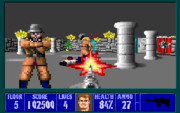 John Carmack's technical achievements with the Catacomb 3-D engine were a strong starting point for the game concept. Game development began in late 1991 after id decided on a vastly reworked Castle Wolfenstein
title. The team was able to use the Wolfenstein title as Muse Software
had let the trademark name lapse. Id pitched this concept to Scott Miller
, founder of Apogee Software
, who promised the id team $100,000 in funding to deliver a shareware title. Carmack also bought a NeXT machine
to aid development.
The early concept of the game included some innovative stealth concepts—dragging dead bodies, swapping uniforms with fallen guards, silent attacks, etc., like in the earlier Wolfenstein games, which focused more on stealth than action. These ideas were dropped however, since they drastically slowed the game down and made the controls complicated. Secret walls, which were sections of the wall a player could push to reveal a hidden area, were similarly debated in development. Designers Tom Hall
and John Romero
pushed repeatedly for this feature on the grounds that secrets were integral to a good game. Carmack initially resisted the idea, but succeeded in implementing push walls to his satisfaction late in development.
Visually, Wolfenstein 3D was originally designed to the same 16-color EGA
graphics palette as prior 3D titles such as Hovertank 3D
and Catacomb 3-D. At the suggestion of Scott Miller however, the team moved to the 256-color VGA
graphics palette. Adrian Carmack
drew each sprite frame on computer by hand.
Id planned to release one shareware episode and allow gamers to buy the full trilogy, following the shareware model profitably executed with the Commander Keen, Invasion of the Vorticons games. Scott Miller, after learning the time it took to make a Wolfenstein level (a single day), successfully argued the id team to produce another trilogy for the eager gamer to buy. This led to producing "The Nocturnal Missions".
Wolfenstein 3D supports the following sound technologies: for sound effects, PC speaker
, AdLib, Disney Sound Source
, and Sound Blaster
; and for music, Adlib and Sound Blaster. The game marks id's first use of digital sound, composed by Bobby Prince
.
, the game uses ray casting
. This method emits one ray for each column of pixels, checks if it intersects a wall, and draws textures
on the screen accordingly, creating a one dimensional depth buffer
against which to clip the scaled sprites
that represent enemies, powerups, and props.
Before Wolfenstein 3D, the technology had already been used by id Software in 1991 to create Hovertank 3D
and Catacomb 3-D for Softdisk
. Other games using the Wolfenstein 3D game engine
or derivatives of it were also produced, including Blake Stone
, Corridor 7: Alien Invasion, Operation Body Count
, Super 3D Noah's Ark
, Rise of the Triad
, and Hellraiser, an unreleased Color Dreams
game planned for the PC and the Nintendo Entertainment System
.
According to id Software programmer John Carmack, the game's engine was inspired by a technology demo of Looking Glass Studios
' and Origin Systems
's first-person
CRPG, Ultima Underworld: The Stygian Abyss
from 1991. Carmack claimed he could make a faster renderer. In this he was successful. The Wolfenstein engine lacks many features present in the Underworld engine, such as ceiling or floor height changes, sloped floors and lighting, but it ran well on relatively weak hardware.
The secret behind engine's performance is vertical scanline scaling algorithm. Unlike later engines and hardware rasterizers, the texture coordinate for the pixel is not calculated at runtime. Instead, a fixed set of several hundred rendering functions is generated during game startup (or viewport size change) where all memory offsets are fixed. To keep the number of these procedures small, height is quantized, which can be easily seen when player is close to the wall, but not looking at it at a right angle.
. All Game Guide gave the game 4½ out of 5 stars, and HonestGamers gave the game 7 out of 10. Both of these modern reviews praised the game's moody soundtrack, evocative sound design, and tense gameplay, while also remarking on the similarity of the game's numerous levels, which can lead to tedium after extended play.
Wolfenstein 3D won the 1993 Best Arcade/Action Game Software and Information Industry Association
CODiE award, and the 1993 Best Action/Arcade Game award for the Shareware Industry Awards. It was placed in Computer Gaming World
's "150 Best Games of All Time" for its 15th anniversary issue.
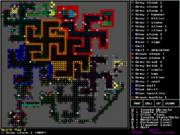 Due to its use of Nazi symbols such as the Swastika
and the anthem of the Nazi Party, Horst-Wessel-Lied
, as theme music, the PC version of the game was withdrawn from circulation in Germany in 1994, following a verdict by the Amtsgericht München on January 25, 1994 (Az. 2 Gs 167/94). Despite the fact that Nazis are portrayed as the enemy in Wolfenstein, the use of those symbols is a federal offense in Germany unless certain circumstances apply (see Strafgesetzbuch section 86a). Similarly, the Atari Jaguar
version was confiscated following a verdict by the Amtsgericht Berlin Tiergarten on December 7, 1994 (Az. 351 Gs 5509/94).
Due to concerns from Nintendo
of America, the Super NES
version was heavily edited as well. All swastikas and Nazi references were removed. Adolf Hitler
, a boss character in the game, had his moustache removed and was renamed "Staatmeister." Blood was replaced with sweat to make the game seem less violent (for SNES copies distributed in Germany, the enemy blood was turned green). Attack dogs were also replaced by giant mutant rats. Employees of id Software are quoted in The Official DOOM Player Guide about the reaction to Wolfenstein, claiming it to be ironic that it was morally acceptable to shoot people and rats, but not dogs. The opening music, originally the anthem Horst-Wessel-Lied, was changed as well.
." This was to have been part of a contest, where the first person to find the sign and carry out its instructions would have won a prize. While no prize was ever decided, preliminary discussion suggested the prize may be registered copies of all Apogee games for life.
However, because level editors and cheat programs for the game were released within days of the full version of Wolfenstein 3D, many players were able to find the sign with minimal effort. Additionally, a cheat code was soon discovered and published that allowed the player to view all of the in-game sprites, including the "Aardwolf" sign. As a result, the planned contest was abandoned before it was ever officially announced, or the prize even settled upon. The maze and the sign were left in the game as Easter egg
s; a text file included with the registered version explained the story behind the "Aardwolf" sign and asked gamers not to call in and say it (many did anyway). A 1997 commercial re-release by Activision
removed the sign and replaced it with graphics depicting a pile of bones.
After completing an episode, the player is given a three-letter code in addition to a total score and time. This was part of a high-score contest that was abandoned for similar reasons to the "Aardwolf" one; the code would have been used to verify that a player got that score legitimately, without use of cheat codes.
s, as it established the fast-paced action and technical prowess commonly expected in the genre, while also bolstering the popularity of the genre itself. It has also been acknowledged as solidifying shareware distribution as a serious and profitable business strategy. By the end of 1993, sales of Wolfenstein 3D had reached over 100,000 units, vastly exceeding the shareware game sales record set by the developer's earlier Commander Keen series and providing id with a significantly higher profit margin than sales of the retail counterpart, Spear of Destiny. The release of id Software's hugely popular game Doom the year after Wolfenstein 3D served as an additional impetus for a wave of imitators. Most of these games were distributed via the same shareware strategy as Wolfenstein 3D.
Wolfenstein 3D introduced a fresh formula to the personal computer game
market that blended together disparate elements from both computer and arcade game
genres. Wolfenstein 3D successfully combined the fast pace and quick reflexes of arcade action game
s (such as Space Invaders
, Pac-Man
and Altered Beast
) that pit the player against multiple enemies that come in increasing waves of speed and complexity, with the first-person perspective
of traditional role-playing video game
s (such as Wizardry
) that attempted to provide players with an immersive experience. While prior computer shooter game
s were most often scrolling shooters, Wolfenstein 3D helped move the computer market away from scrolling shooters toward first-person shooters.
Hitler was proclaimed the 15th greatest video game boss in videogame history by The Phoenix
, and was recognized by 1UP.com
as an exceptional boss fight in videogames. Wolfenstein 3D was also the first game to use the ExMx map/level naming convention.
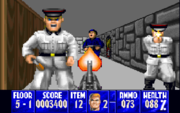 Wolfenstein 3D has been commercially ported and sold on over a dozen platforms, ranging from early releases on platforms such as the Super NES
to newer releases on mobile platforms such as the iPad
. These ports include the Super NES
(1994), Atari Jaguar
(1994), Mac OS
(1994), Acorn Archimedes
(1994), 3DO
(1995), Apple IIGS
(1998), and the PC-98 (1998). Later releases include the Game Boy Advance
(2002), Steam, Xbox Live Arcade and PSN (2009), the iPhone
and iPod Touch
(2009), the iPad (2010), and Android (2011).
These ports can vary from the original in their audio, graphics and levels, but the core gameplay and aesthetic is retained.
Outside of commercial sale, enthusiasts of the game have created ports or reworked versions for other platforms, such as Symbian
, the TI-83 series
, Maemo
, the PSP
, Wii
, Dreamcast, the Dingoo A320, and the Amiga
. The fan community has also developed numerous add-ons and enhancements for the game.
to Wolfenstein 3D, was released shortly after the original game and used the same engine. A mission pack called "Wolfenstein 3D Super Upgrades" was released in 1993 using the Wolfenstein 3D engine. This release can be downloaded from the 3D Realms Wolfenstein 3D site. The pack contains 815 new maps, along with a random map generator, a level editor/creator, and replacement game files for the original game. However, the pack will not work with the Steam version of the game or on DOSBox unless numerous modifications are made.
The first person shooter Rise of the Triad
was originally planned as an expansion pack to Wolfenstein 3D which would use the original game's engine with added features. However the idea was postponed and the game took off in a different direction.
Return to Castle Wolfenstein
, a first-person shooter reboot to Wolfenstein 3D, was released in 2001. The gameplay and the setting are similar to the original, but the graphics and audio elements receive an update due to the Quake III Arena
rendering engine. Like the original, Return to Castle Wolfenstein begins as an escape mission from Castle Wolfenstein, but from there the two games' stories diverge. Wolfenstein: Enemy Territory
is a spinoff to Return to Castle Wolfenstein, released in 2003. It is a free full-version multiplayer-only game.
Wolfenstein, created for Microsoft Windows
, Xbox 360
and PlayStation 3
, was released in 2009. It was developed by Raven Software
, developer of Quake 4
, and uses the id Tech 4 engine.
Wolfenstein RPG
, a RPG continuation of the Wolfenstein franchise, previewed at QuakeCon
2008. It is a full version game released for mobile phones in November 2008 and again for the iPhone and iPod Touch in 2009.
First-person shooter
First-person shooter is a video game genre that centers the gameplay on gun and projectile weapon-based combat through first-person perspective; i.e., the player experiences the action through the eyes of a protagonist. Generally speaking, the first-person shooter shares common traits with other...
genre on the PC
IBM PC compatible
IBM PC compatible computers are those generally similar to the original IBM PC, XT, and AT. Such computers used to be referred to as PC clones, or IBM clones since they almost exactly duplicated all the significant features of the PC architecture, facilitated by various manufacturers' ability to...
and created the basic archetype upon which all subsequent games of the same genre would be built. It was created by id Software
Id Software
Id Software is an American video game development company with its headquarters in Richardson, Texas. The company was founded in 1991 by four members of the computer company Softdisk: programmers John Carmack and John Romero, game designer Tom Hall, and artist Adrian Carmack...
and published by Apogee Software
3D Realms
3D Realms is a current video game publisher and former video game developer based in Garland, Texas, United States, established in 1987...
. Released on May 5, 1992 for DOS
DOS
DOS, short for "Disk Operating System", is an acronym for several closely related operating systems that dominated the IBM PC compatible market between 1981 and 1995, or until about 2000 if one includes the partially DOS-based Microsoft Windows versions 95, 98, and Millennium Edition.Related...
, the game was inspired by the 1980s Muse Software
Muse Software
Muse Software was a software and computer game publisher and developer for the first generation of home computers. They first published for the Apple II, and later expanded to the Commodore 64, Atari, and the IBM PC....
computer games Castle Wolfenstein
Castle Wolfenstein
Castle Wolfenstein is an early stealth-based action-adventure shooter computer game developed by Muse Software for the Apple II. It was first released in 1981 and later ported to DOS, the Atari 8-bit family, and the Commodore 64.- Description :...
and Beyond Castle Wolfenstein
Beyond Castle Wolfenstein
Beyond Castle Wolfenstein is a 1984 computer game by Muse Software. It is the sequel to the innovative and successful Castle Wolfenstein, a prototypical stealth game...
.
In Wolfenstein 3D, the player assumes the role of an American soldier of Polish descent, named William "B.J." Blazkowicz, attempting to escape from the Nazi
Wehrmacht
The Wehrmacht – from , to defend and , the might/power) were the unified armed forces of Nazi Germany from 1935 to 1945. It consisted of the Heer , the Kriegsmarine and the Luftwaffe .-Origin and use of the term:...
stronghold of Castle Wolfenstein. After the initial escape episode, the player carries out five other episodes also organized against Nazi operations. Throughout the game numerous armed guards, attack dogs, and mutant soldiers oppose the player. The buildings traversed contain health supplies in the form of food and medical kits
First aid kit
A first aid kit is a collection of supplies and equipment for use in giving first aid, and can put together for the purpose , or purchased complete...
, various treasures, and hidden rooms. There are four weapons (a knife and three guns) available throughout each episode for the player's defense.
Wolfenstein 3D was released as shareware
Shareware
The term shareware is a proprietary software that is provided to users without payment on a trial basis and is often limited by any combination of functionality, availability, or convenience. Shareware is often offered as a download from an Internet website or as a compact disc included with a...
, which allowed it to be copied widely. The shareware release contains one episode, consisting of 10 missions (levels
Level (video gaming)
A level, map, area, or world in a video game is the total space available to the player during the course of completing a discrete objective...
). The commercial release consists of three episodes, which includes the shareware episode and its two subsequent episodes. Later releases included a three episode mission pack
Expansion pack
An expansion pack, expansion set, or supplement is an addition to an existing role-playing game, tabletop game or video game. These add-ons usually add new game areas, weapons, objects, and/or an extended storyline to a complete and already released game...
called "The Nocturnal Missions". Like the shareware episode, each commercial episode contains 10 levels, bringing the game to a total of 60 missions. The game was originally released on the PC and subsequently ported to a wide range of computer systems and consoles. The source code
Source code
In computer science, source code is text written using the format and syntax of the programming language that it is being written in. Such a language is specially designed to facilitate the work of computer programmers, who specify the actions to be performed by a computer mostly by writing source...
of the game was published by id Software on July 21, 1995, while the artwork data, music and software tools of the game remain under copyright.
Story
In the first episode, Escape from Castle Wolfenstein, B.J., an Allied
Allies of World War II
The Allies of World War II were the countries that opposed the Axis powers during the Second World War . Former Axis states contributing to the Allied victory are not considered Allied states...
spy, has been captured while trying to find the plans for Operation Eisenfaust, and was imprisoned in Castle Wolfenstein. Initially armed only with a knife and a Walther P38 (obtained by overpowering the guard in his cell), B.J. tries to escape the castle prison. Taking on SS guards, he eventually finds himself face to face with head prison guard Hans Grosse.
In the second episode, Operation: Eisenfaust, B.J. finds out that the operation is real, and that Nazis are creating an army of undead mutants in Castle Hollehammer. B.J. enters the castle and confronts the mad scientist Dr. Schabbs, creator of the mutants. His defeat signals the end of this biological war.
Die, Führer, Die! is, chronologically, the final episode. Fighting through Nazi soldiers, and attacking the bunker under the Reichstag, he finds himself up against Adolf Hitler
Adolf Hitler
Adolf Hitler was an Austrian-born German politician and the leader of the National Socialist German Workers Party , commonly referred to as the Nazi Party). He was Chancellor of Germany from 1933 to 1945, and head of state from 1934 to 1945...
, who is equipped with a robotic suit and 4 Gatling guns.
"The Nocturnal Missions" form a prequel storyline, focusing on the Germans' plans for chemical warfare
Chemical warfare
Chemical warfare involves using the toxic properties of chemical substances as weapons. This type of warfare is distinct from Nuclear warfare and Biological warfare, which together make up NBC, the military acronym for Nuclear, Biological, and Chemical...
(Giftkrieg). A Dark Secret deals with the initial pursuit of the scientist responsible for developing the weaponry; B.J.'s task is to enter the weapons research facility and hunt down another mad scientist, Dr. Otto Giftmacher (Poison Maker).
Trail of the Madman takes place in Castle Erlangen
Erlangen
Erlangen is a Middle Franconian city in Bavaria, Germany. It is located at the confluence of the river Regnitz and its large tributary, the Untere Schwabach.Erlangen has more than 100,000 inhabitants....
. B.J.'s goal is to find the maps and plans of the chemical war, guarded by Gretel Grosse (Hans' sister).
The story comes to a close in Confrontation, set in Castle Offenbach. The final battle is fought between B.J. and the leader of the chemical war initiative, General Fettgesicht (Fat Face).
Gameplay
- The following section describes aspects of the original DOS versions. The various ports often implemented changes.
Each episode features nine levels (or "maps") which have to be finished sequentially. Levels are completed by reaching an elevator which leads to the next level. The player must combat numerous guards and other enemies while maintaining ammunition and health supplies. If the player's health is reduced to zero, one of the player's lives as well as all guns and ammo (except a pistol with 8 rounds) are lost. The player begins each episode with three lives, and more lives can be acquired by finding extra-life tokens or earning 40,000 points. The game allows saves at any point. In addition to completing levels, the players can collect various treasures scattered in the levels to increase their score; the player can also search for secret push walls which lead to caches of treasure or ammunition. Percentages for treasures collected, enemies eliminated, and secrets discovered are displayed at the end of every level. Earning a 100% kill, secret, or treasure ratio, or completing the level in below-par time results in additional bonus points.
There is also one "secret" level per episode that can only be accessed by the player uncovering a hidden elevator. The secret level of the third episode was notable in that it recreated one of the original Pac-Man
Pac-Man
is an arcade game developed by Namco and licensed for distribution in the United States by Midway, first released in Japan on May 22, 1980. Immensely popular from its original release to the present day, Pac-Man is considered one of the classics of the medium, virtually synonymous with video games,...
levels, complete with ghosts, seen by the player from Pac-Man's perspective.
Each episode has a different boss who has to be killed in the final mission to complete the episode. Unlike normal enemies, boss enemies are drawn from one angle instead of eight, so the player cannot sneak up on them or take them by surprise; when first encountered they are always facing the player. Bosses also won't notice the player or become active until they see the player. When most bosses are killed, a replay (called a "deathcam") of the boss's death is shown; the episode then ends. In other levels, behind the boss is an exit from the stronghold; entering it causes the camera to rotate around to face Blazkowicz and show him running out and jumping in elation (complete with a freeze frame
Freeze frame shot
A freeze frame shot is used when one shot is printed in a single frame several times, in order to make an interesting illusion of a still photograph....
of him in mid-air).
Despite the historical setting, and the presence of Hitler as an episode boss, the game bears no resemblance to any actual Nazi plans or structures. Indeed, many of the level designs are highly fanciful; at least three levels heavily feature swastika
Swastika
The swastika is an equilateral cross with its arms bent at right angles, in either right-facing form in counter clock motion or its mirrored left-facing form in clock motion. Earliest archaeological evidence of swastika-shaped ornaments dates back to the Indus Valley Civilization of Ancient...
-shaped room layouts and maps, going as far as having one level (episode 6, map 3) built entirely of a tessellation
Tessellation
A tessellation or tiling of the plane is a pattern of plane figures that fills the plane with no overlaps and no gaps. One may also speak of tessellations of parts of the plane or of other surfaces. Generalizations to higher dimensions are also possible. Tessellations frequently appeared in the art...
of them (see Controversy).
Development
Castle Wolfenstein
Castle Wolfenstein is an early stealth-based action-adventure shooter computer game developed by Muse Software for the Apple II. It was first released in 1981 and later ported to DOS, the Atari 8-bit family, and the Commodore 64.- Description :...
title. The team was able to use the Wolfenstein title as Muse Software
Muse Software
Muse Software was a software and computer game publisher and developer for the first generation of home computers. They first published for the Apple II, and later expanded to the Commodore 64, Atari, and the IBM PC....
had let the trademark name lapse. Id pitched this concept to Scott Miller
Scott Miller (programmer)
Scott Miller is an American entrepreneur best known for founding Apogee Software, Ltd. in 1987.- Personal life :...
, founder of Apogee Software
Apogee Software
Apogee Software, LLC is a video game publisher based in Garland, Texas, established in 2008 as a spin-off of 3D Realms .- History :The original Apogee Software was established in 1987 as Apogee Software Ltd. In 1994, Apogee established its 3D Realms brand for publishing 3D video games distributed...
, who promised the id team $100,000 in funding to deliver a shareware title. Carmack also bought a NeXT machine
NeXT Computer
The NeXT Computer was a high-end workstation computer developed, manufactured and sold by Steve Jobs' company NeXT from 1988 until 1990. It ran the Unix-based NeXTSTEP operating system. The NeXT Computer was packaged in a 1-foot die-cast magnesium cube-shaped case, which led to the machine being...
to aid development.
The early concept of the game included some innovative stealth concepts—dragging dead bodies, swapping uniforms with fallen guards, silent attacks, etc., like in the earlier Wolfenstein games, which focused more on stealth than action. These ideas were dropped however, since they drastically slowed the game down and made the controls complicated. Secret walls, which were sections of the wall a player could push to reveal a hidden area, were similarly debated in development. Designers Tom Hall
Tom Hall
Tom A. Hall is a game designer born in Wisconsin. He attended the University of Wisconsin–Madison, where he received a B.S. in Computer Science. In 1987, he worked at Softdisk Inc., where he was both a programmer and the editor of Softdisk, a software bundle delivered monthly...
and John Romero
John Romero
Alfonso John Romero is a game designer, programmer, and developer in the video game industry. He is best known as a co-founder of id Software and was a designer for many of their games, including Wolfenstein 3D, Dangerous Dave, Doom and Quake...
pushed repeatedly for this feature on the grounds that secrets were integral to a good game. Carmack initially resisted the idea, but succeeded in implementing push walls to his satisfaction late in development.
Visually, Wolfenstein 3D was originally designed to the same 16-color EGA
Enhanced Graphics Adapter
The Enhanced Graphics Adapter is the IBM PC computer display standard specification which is between CGA and VGA in terms of color and space resolution. Introduced in October 1984 by IBM shortly after its new PC/AT, EGA produces a display of 16 simultaneous colors from a palette of 64 at a...
graphics palette as prior 3D titles such as Hovertank 3D
Hovertank 3D
Hovertank 3D is a vehicular combat game developed by id Software and published by Softdisk in April, 1991. It is considered a significant precursor of the first-person shooter genre, made popular by id Software's subsequent releases, Wolfenstein 3D and DOOM...
and Catacomb 3-D. At the suggestion of Scott Miller however, the team moved to the 256-color VGA
Video Graphics Array
Video Graphics Array refers specifically to the display hardware first introduced with the IBM PS/2 line of computers in 1987, but through its widespread adoption has also come to mean either an analog computer display standard, the 15-pin D-subminiature VGA connector or the 640×480 resolution...
graphics palette. Adrian Carmack
Adrian Carmack
Adrian Carmack is one of the four founders of id Software, along with Tom Hall, John Romero, and John D. Carmack . He had worked there as an artist. He was a major stock owner of id Software until he left the company....
drew each sprite frame on computer by hand.
Id planned to release one shareware episode and allow gamers to buy the full trilogy, following the shareware model profitably executed with the Commander Keen, Invasion of the Vorticons games. Scott Miller, after learning the time it took to make a Wolfenstein level (a single day), successfully argued the id team to produce another trilogy for the eager gamer to buy. This led to producing "The Nocturnal Missions".
Wolfenstein 3D supports the following sound technologies: for sound effects, PC speaker
PC speaker
A PC speaker is a loudspeaker, built into some IBM PC compatible computers. The first IBM Personal Computer, model 5150, employed a standard 2.25 inch magnetic driven speaker. More recent computers use a piezoelectric speaker instead. The speaker allows software and firmware to provide...
, AdLib, Disney Sound Source
Covox Speech Thing
The Covox Speech Thing was an external audio device attached to the computer to output digital sound. It was composed of the most primitive 8-bit DAC using a resistor ladder and an analogue signal output, and plugged in to the printer port of the PC.The circuit was marketed around 1986 by Covox,...
, and Sound Blaster
Sound Blaster
The Sound Blaster family of sound cards was the de facto standard for consumer audio on the IBM PC compatible system platform, until the widespread transition to Microsoft Windows 95, which standardized the programming interface at application level , and the evolution in PC design led to onboard...
; and for music, Adlib and Sound Blaster. The game marks id's first use of digital sound, composed by Bobby Prince
Robert Prince
Robert Prince, also known as Bobby Prince, is a composer and sound designer. He has worked as an independent contractor for several gaming companies, most notably id Software and Apogee/3D Realms....
.
Engine technology
To render the walls in pseudo-3D2.5D
2.5D , 3/4 perspective and pseudo-3D are terms used to describe either:* 2D graphical projections and techniques which cause a series of images or scenes to fake or appear to be three-dimensional when in fact they are not, or* gameplay in an otherwise three-dimensional video game that is...
, the game uses ray casting
Ray casting
Ray casting is the use of ray-surface intersection tests to solve a variety of problems in computer graphics. It enables spatial selections of objects in ascene by providing users a virtual beam as a visual cue extending...
. This method emits one ray for each column of pixels, checks if it intersects a wall, and draws textures
Texture mapping
Texture mapping is a method for adding detail, surface texture , or color to a computer-generated graphic or 3D model. Its application to 3D graphics was pioneered by Dr Edwin Catmull in his Ph.D. thesis of 1974.-Texture mapping:...
on the screen accordingly, creating a one dimensional depth buffer
Z-buffering
In computer graphics, z-buffering is the management of image depth coordinates in three-dimensional graphics, usually done in hardware, sometimes in software. It is one solution to the visibility problem, which is the problem of deciding which elements of a rendered scene are visible, and which...
against which to clip the scaled sprites
Sprite (computer graphics)
In computer graphics, a sprite is a two-dimensional image or animation that is integrated into a larger scene...
that represent enemies, powerups, and props.
Before Wolfenstein 3D, the technology had already been used by id Software in 1991 to create Hovertank 3D
Hovertank 3D
Hovertank 3D is a vehicular combat game developed by id Software and published by Softdisk in April, 1991. It is considered a significant precursor of the first-person shooter genre, made popular by id Software's subsequent releases, Wolfenstein 3D and DOOM...
and Catacomb 3-D for Softdisk
Softdisk
Softdisk is a software and Internet company based in Shreveport, Louisiana. Founded in 1981, its original products were disk magazines...
. Other games using the Wolfenstein 3D game engine
Game engine
A game engine is a system designed for the creation and development of video games. There are many game engines that are designed to work on video game consoles and personal computers...
or derivatives of it were also produced, including Blake Stone
Blake Stone: Aliens of Gold
Blake Stone: Aliens of Gold is a first-person shooter computer game created by JAM Productions and published by Apogee Software. It uses the Wolfenstein 3D game engine to render graphics in first person, while adding many features....
, Corridor 7: Alien Invasion, Operation Body Count
Operation Body Count
Operation Body Count is a 1994 first-person shooter that used the Wolfenstein 3D ray casting engine. It was developed and published by Capstone Software.- Plot :...
, Super 3D Noah's Ark
Super 3D Noah's Ark
Super Noah's Ark 3D is an unlicensed video game for the Super Nintendo Entertainment System and for DOS. It was released by the biblical video game producer Wisdom Tree in 1994, and was the only commercial SNES game that was not officially sanctioned by Nintendo...
, Rise of the Triad
Rise of the Triad
Rise of the Triad: Dark War is a first-person shooter video game that was first released on February 17, 1995 and developed by Apogee Software . The members of the development team involved referred to themselves as "The Developers of Incredible Power"...
, and Hellraiser, an unreleased Color Dreams
Color Dreams
Color Dreams was a company that developed video games for the 8-bit Nintendo Entertainment System . While most companies that developed NES games obtained an official license from Nintendo to produce game cartridges, Color Dreams was unusual in that it developed NES games without an official license...
game planned for the PC and the Nintendo Entertainment System
Nintendo Entertainment System
The Nintendo Entertainment System is an 8-bit video game console that was released by Nintendo in North America during 1985, in Europe during 1986 and Australia in 1987...
.
According to id Software programmer John Carmack, the game's engine was inspired by a technology demo of Looking Glass Studios
Looking Glass Studios
Looking Glass Studios was a computer game development company during the 1990s.The company originally formed as Looking Glass Technologies, when Blue Sky Productions and Lerner Research merged....
' and Origin Systems
Origin Systems
Origin Systems, Inc. was a computer game developer based in Austin, Texas that was active from 1983 to 2004...
's first-person
First person (video games)
In video games, first person refers to a graphical perspective rendered from the viewpoint of the player character. In many cases, this may be the viewpoint from the cockpit of a vehicle. Many different genres have made use of first-person perspectives, ranging from adventure games to flight...
CRPG, Ultima Underworld: The Stygian Abyss
Ultima Underworld: The Stygian Abyss
Ultima Underworld: The Stygian Abyss is a first-person role-playing video game developed by Blue Sky Productions and published by Origin Systems...
from 1991. Carmack claimed he could make a faster renderer. In this he was successful. The Wolfenstein engine lacks many features present in the Underworld engine, such as ceiling or floor height changes, sloped floors and lighting, but it ran well on relatively weak hardware.
The secret behind engine's performance is vertical scanline scaling algorithm. Unlike later engines and hardware rasterizers, the texture coordinate for the pixel is not calculated at runtime. Instead, a fixed set of several hundred rendering functions is generated during game startup (or viewport size change) where all memory offsets are fixed. To keep the number of these procedures small, height is quantized, which can be easily seen when player is close to the wall, but not looking at it at a right angle.
Reviews and awards
Wolfenstein 3D has been generally well received by reviewers over the years. The game twice received 5 out of 5 stars in DragonDragon (magazine)
Dragon is one of the two official magazines for source material for the Dungeons & Dragons role-playing game and associated products, the other being Dungeon. TSR, Inc. originally launched the monthly printed magazine in 1976 to succeed the company's earlier publication, The Strategic Review. The...
. All Game Guide gave the game 4½ out of 5 stars, and HonestGamers gave the game 7 out of 10. Both of these modern reviews praised the game's moody soundtrack, evocative sound design, and tense gameplay, while also remarking on the similarity of the game's numerous levels, which can lead to tedium after extended play.
Wolfenstein 3D won the 1993 Best Arcade/Action Game Software and Information Industry Association
Software and Information Industry Association
The Software & Information Industry Association is a United States based software trade association. The organization lobbies United States policy makers as well as conducting surveys and research and many conferences and webcasts....
CODiE award, and the 1993 Best Action/Arcade Game award for the Shareware Industry Awards. It was placed in Computer Gaming World
Computer Gaming World
Computer Gaming World was a computer game magazine founded in 1981 by Russell Sipe as a bimonthly publication. Early issues were typically 40-50 pages in length, written in a newsletter style, including submissions by game designers such as Joel Billings , Dan Bunten , and Chris Crawford...
's "150 Best Games of All Time" for its 15th anniversary issue.
Controversy
Swastika
The swastika is an equilateral cross with its arms bent at right angles, in either right-facing form in counter clock motion or its mirrored left-facing form in clock motion. Earliest archaeological evidence of swastika-shaped ornaments dates back to the Indus Valley Civilization of Ancient...
and the anthem of the Nazi Party, Horst-Wessel-Lied
Horst-Wessel-Lied
The Horst-Wessel-Lied , also known as Die Fahne hoch from its opening line, was the anthem of the Nazi Party from 1930 to 1945...
, as theme music, the PC version of the game was withdrawn from circulation in Germany in 1994, following a verdict by the Amtsgericht München on January 25, 1994 (Az. 2 Gs 167/94). Despite the fact that Nazis are portrayed as the enemy in Wolfenstein, the use of those symbols is a federal offense in Germany unless certain circumstances apply (see Strafgesetzbuch section 86a). Similarly, the Atari Jaguar
Atari Jaguar
The Atari Jaguar is a video game console that was released by Atari Corporation in 1993. It was the last to be marketed under the Atari brand until the release of the Atari Flashback in 2004. It was designed to surpass the Mega Drive/Genesis, Super Nintendo Entertainment System, and the Panasonic...
version was confiscated following a verdict by the Amtsgericht Berlin Tiergarten on December 7, 1994 (Az. 351 Gs 5509/94).
Due to concerns from Nintendo
Nintendo
is a multinational corporation located in Kyoto, Japan. Founded on September 23, 1889 by Fusajiro Yamauchi, it produced handmade hanafuda cards. By 1963, the company had tried several small niche businesses, such as a cab company and a love hotel....
of America, the Super NES
Super Nintendo Entertainment System
The Super Nintendo Entertainment System is a 16-bit video game console that was released by Nintendo in North America, Europe, Australasia , and South America between 1990 and 1993. In Japan and Southeast Asia, the system is called the , or SFC for short...
version was heavily edited as well. All swastikas and Nazi references were removed. Adolf Hitler
Adolf Hitler
Adolf Hitler was an Austrian-born German politician and the leader of the National Socialist German Workers Party , commonly referred to as the Nazi Party). He was Chancellor of Germany from 1933 to 1945, and head of state from 1934 to 1945...
, a boss character in the game, had his moustache removed and was renamed "Staatmeister." Blood was replaced with sweat to make the game seem less violent (for SNES copies distributed in Germany, the enemy blood was turned green). Attack dogs were also replaced by giant mutant rats. Employees of id Software are quoted in The Official DOOM Player Guide about the reaction to Wolfenstein, claiming it to be ironic that it was morally acceptable to shoot people and rats, but not dogs. The opening music, originally the anthem Horst-Wessel-Lied, was changed as well.
Aborted contest attempts
Level E2M8 features a giant hidden "pushwall" maze consisting of 181 nearly identical rooms. Depending on the path taken, the player can find treasure, an extra life, a surprise encounter with the Hans Grosse boss, or a sign reading "Call Apogee Say AardwolfAardwolf
The aardwolf is a small, insectivorous mammal, native to Eastern and Southern Africa. The name means "earth wolf" in Afrikaans/Dutch. It is also called "maanhaar jackal". It is related to hyenas, but unlike its relatives, it does not hunt large prey. This unusual animal preys on insects...
." This was to have been part of a contest, where the first person to find the sign and carry out its instructions would have won a prize. While no prize was ever decided, preliminary discussion suggested the prize may be registered copies of all Apogee games for life.
However, because level editors and cheat programs for the game were released within days of the full version of Wolfenstein 3D, many players were able to find the sign with minimal effort. Additionally, a cheat code was soon discovered and published that allowed the player to view all of the in-game sprites, including the "Aardwolf" sign. As a result, the planned contest was abandoned before it was ever officially announced, or the prize even settled upon. The maze and the sign were left in the game as Easter egg
Easter egg (media)
Image:Carl Oswald Rostosky - Zwei Kaninchen und ein Igel 1861.jpg|250px|thumb|right|Example of Easter egg hidden within imagerect 467 383 539 434 desc none...
s; a text file included with the registered version explained the story behind the "Aardwolf" sign and asked gamers not to call in and say it (many did anyway). A 1997 commercial re-release by Activision
Activision
Activision is an American publisher, majority owned by French conglomerate Vivendi SA. Its current CEO is Robert Kotick. It was founded on October 1, 1979 and was the world's first independent developer and distributor of video games for gaming consoles...
removed the sign and replaced it with graphics depicting a pile of bones.
After completing an episode, the player is given a three-letter code in addition to a total score and time. This was part of a high-score contest that was abandoned for similar reasons to the "Aardwolf" one; the code would have been used to verify that a player got that score legitimately, without use of cheat codes.
Legacy
Wolfenstein 3D has been termed the "grandfather of 3D shooters", specifically first-person shooterFirst-person shooter
First-person shooter is a video game genre that centers the gameplay on gun and projectile weapon-based combat through first-person perspective; i.e., the player experiences the action through the eyes of a protagonist. Generally speaking, the first-person shooter shares common traits with other...
s, as it established the fast-paced action and technical prowess commonly expected in the genre, while also bolstering the popularity of the genre itself. It has also been acknowledged as solidifying shareware distribution as a serious and profitable business strategy. By the end of 1993, sales of Wolfenstein 3D had reached over 100,000 units, vastly exceeding the shareware game sales record set by the developer's earlier Commander Keen series and providing id with a significantly higher profit margin than sales of the retail counterpart, Spear of Destiny. The release of id Software's hugely popular game Doom the year after Wolfenstein 3D served as an additional impetus for a wave of imitators. Most of these games were distributed via the same shareware strategy as Wolfenstein 3D.
Wolfenstein 3D introduced a fresh formula to the personal computer game
Personal computer game
A PC game, also known as a computer game, is a video game played on a personal computer, rather than on a video game console or arcade machine...
market that blended together disparate elements from both computer and arcade game
Arcade game
An arcade game is a coin-operated entertainment machine, usually installed in public businesses such as restaurants, bars, and amusement arcades. Most arcade games are video games, pinball machines, electro-mechanical games, redemption games, and merchandisers...
genres. Wolfenstein 3D successfully combined the fast pace and quick reflexes of arcade action game
Action game
Action game is a video game genre that emphasizes physical challenges, including hand–eye coordination and reaction-time. The genre includes diverse subgenres such as fighting games, shooter games, and platform games, which are widely considered the most important action games, though some...
s (such as Space Invaders
Space Invaders
is an arcade video game designed by Tomohiro Nishikado, and released in 1978. It was originally manufactured and sold by Taito in Japan, and was later licensed for production in the United States by the Midway division of Bally. Space Invaders is one of the earliest shooting games and the aim is to...
, Pac-Man
Pac-Man
is an arcade game developed by Namco and licensed for distribution in the United States by Midway, first released in Japan on May 22, 1980. Immensely popular from its original release to the present day, Pac-Man is considered one of the classics of the medium, virtually synonymous with video games,...
and Altered Beast
Altered Beast
Altered Beast is a 1988 beat 'em up arcade game developed and manufactured by Sega. The game is set in Ancient Greece, and follows a centurion who is resurrected by Zeus to rescue his daughter Athena, and to do so become able to turn into beasts such as the werewolf with usage of power-ups...
) that pit the player against multiple enemies that come in increasing waves of speed and complexity, with the first-person perspective
First person (video games)
In video games, first person refers to a graphical perspective rendered from the viewpoint of the player character. In many cases, this may be the viewpoint from the cockpit of a vehicle. Many different genres have made use of first-person perspectives, ranging from adventure games to flight...
of traditional role-playing video game
Role-playing video game
Role-playing video games are a video game genre with origins in pen-and-paper role-playing games such as Dungeons & Dragons, using much of the same terminology, settings and game mechanics. The player in RPGs controls one character, or several adventuring party members, fulfilling one or many quests...
s (such as Wizardry
Wizardry
Wizardry is a series of computer role-playing games, developed by Sir-Tech, which were highly influential in the development of modern console and computer role playing games. The original Wizardry was a significant influence to early console RPGs, such as Dragon Warrior and Final Fantasy. ...
) that attempted to provide players with an immersive experience. While prior computer shooter game
Shooter game
Shooter games are a sub-genre of action game, which often test the player's speed and reaction time. It includes many subgenres that have the commonality of focusing "on the actions of the avatar using some sort of weapon. Usually this weapon is a gun, or some other long-range weapon". A common...
s were most often scrolling shooters, Wolfenstein 3D helped move the computer market away from scrolling shooters toward first-person shooters.
Hitler was proclaimed the 15th greatest video game boss in videogame history by The Phoenix
The Phoenix (newspaper)
The Phoenix is the name of several alternative weekly newspapers published in the United States by Phoenix Media/Communications Group of Boston, Massachusetts including the Boston Phoenix, the Providence Phoenix, the Portland Phoenix and the now-defunct Worcester Phoenix...
, and was recognized by 1UP.com
1UP.com
1UP.com is a video game website owned by IGN Entertainment, a division of News Corporation. Previously, the site was owned by Ziff Davis before being sold to UGO Entertainment in 2009....
as an exceptional boss fight in videogames. Wolfenstein 3D was also the first game to use the ExMx map/level naming convention.
Ports
Super Nintendo Entertainment System
The Super Nintendo Entertainment System is a 16-bit video game console that was released by Nintendo in North America, Europe, Australasia , and South America between 1990 and 1993. In Japan and Southeast Asia, the system is called the , or SFC for short...
to newer releases on mobile platforms such as the iPad
IPad
The iPad is a line of tablet computers designed, developed and marketed by Apple Inc., primarily as a platform for audio-visual media including books, periodicals, movies, music, games, and web content. The iPad was introduced on January 27, 2010 by Apple's then-CEO Steve Jobs. Its size and...
. These ports include the Super NES
Super Nintendo Entertainment System
The Super Nintendo Entertainment System is a 16-bit video game console that was released by Nintendo in North America, Europe, Australasia , and South America between 1990 and 1993. In Japan and Southeast Asia, the system is called the , or SFC for short...
(1994), Atari Jaguar
Atari Jaguar
The Atari Jaguar is a video game console that was released by Atari Corporation in 1993. It was the last to be marketed under the Atari brand until the release of the Atari Flashback in 2004. It was designed to surpass the Mega Drive/Genesis, Super Nintendo Entertainment System, and the Panasonic...
(1994), Mac OS
Mac OS
Mac OS is a series of graphical user interface-based operating systems developed by Apple Inc. for their Macintosh line of computer systems. The Macintosh user experience is credited with popularizing the graphical user interface...
(1994), Acorn Archimedes
Acorn Archimedes
The Acorn Archimedes was Acorn Computers Ltd's first general purpose home computer to be based on their own ARM architecture.Using a RISC design with a 32-bit CPU, at its launch in June 1987, the Archimedes was stated as running at 4 MIPS, with a claim of 18 MIPS during tests.The name is commonly...
(1994), 3DO
3DO Interactive Multiplayer
The 3DO Interactive Multiplayer is a video game console originally produced by Panasonic in 1993. Further renditions of the hardware were released in 1994 by Sanyo and Goldstar. The consoles were manufactured according to specifications created by The 3DO Company, and were originally designed by...
(1995), Apple IIGS
Apple IIGS
The Apple , the fifth and most powerful model in the Apple II series of personal computers produced by Apple Computer. The "GS" in the name stands for Graphics and Sound, referring to its enhanced graphics and sound capabilities, both of which greatly surpassed previous models of the line...
(1998), and the PC-98 (1998). Later releases include the Game Boy Advance
Game Boy Advance
The is a 32-bit handheld video game console developed, manufactured, and marketed by Nintendo. It is the successor to the Game Boy Color. It was released in Japan on March 21, 2001; in North America on June 11, 2001; in Australia and Europe on June 22, 2001; and in the People's Republic of China...
(2002), Steam, Xbox Live Arcade and PSN (2009), the iPhone
IPhone
The iPhone is a line of Internet and multimedia-enabled smartphones marketed by Apple Inc. The first iPhone was unveiled by Steve Jobs, then CEO of Apple, on January 9, 2007, and released on June 29, 2007...
and iPod Touch
IPod Touch
The iPod Touch is a portable media player, personal digital assistant, handheld game console, and Wi-Fi mobile device designed and marketed by Apple Inc. The iPod Touch adds the multi-touch graphical user interface to the iPod line...
(2009), the iPad (2010), and Android (2011).
These ports can vary from the original in their audio, graphics and levels, but the core gameplay and aesthetic is retained.
Outside of commercial sale, enthusiasts of the game have created ports or reworked versions for other platforms, such as Symbian
Symbian
Symbian is a mobile operating system and computing platform designed for smartphones and currently maintained by Accenture. The Symbian platform is the successor to Symbian OS and Nokia Series 60; unlike Symbian OS, which needed an additional user interface system, Symbian includes a user...
, the TI-83 series
TI-83 series
The TI-83 series of graphing calculators is manufactured by Texas Instruments.The original TI-83 is itself an upgraded version of the TI-82. Released in 1996, it is one of the most used graphing calculators for students...
, Maemo
Maemo
Maemo is a software platform developed by the Maemo community for smartphones and Internet tablets. It is based on the Debian Linux distribution, but has no relation to it...
, the PSP
PlayStation Portable
The is a handheld game console manufactured and marketed by Sony Corporation Development of the console was announced during E3 2003, and it was unveiled on , 2004, at a Sony press conference before E3 2004...
, Wii
Wii
The Wii is a home video game console released by Nintendo on November 19, 2006. As a seventh-generation console, the Wii primarily competes with Microsoft's Xbox 360 and Sony's PlayStation 3. Nintendo states that its console targets a broader demographic than that of the two others...
, Dreamcast, the Dingoo A320, and the Amiga
Amiga
The Amiga is a family of personal computers that was sold by Commodore in the 1980s and 1990s. The first model was launched in 1985 as a high-end home computer and became popular for its graphical, audio and multi-tasking abilities...
. The fan community has also developed numerous add-ons and enhancements for the game.
Sequels and Related Products
Wolfenstein 3D has been followed by several games based on its protagonist and settings. Spear of Destiny, a prequelPrequel
A prequel is a work that supplements a previously completed one, and has an earlier time setting.The widely recognized term was a 20th-century neologism, and a portmanteau from pre- and sequel...
to Wolfenstein 3D, was released shortly after the original game and used the same engine. A mission pack called "Wolfenstein 3D Super Upgrades" was released in 1993 using the Wolfenstein 3D engine. This release can be downloaded from the 3D Realms Wolfenstein 3D site. The pack contains 815 new maps, along with a random map generator, a level editor/creator, and replacement game files for the original game. However, the pack will not work with the Steam version of the game or on DOSBox unless numerous modifications are made.
The first person shooter Rise of the Triad
Rise of the Triad
Rise of the Triad: Dark War is a first-person shooter video game that was first released on February 17, 1995 and developed by Apogee Software . The members of the development team involved referred to themselves as "The Developers of Incredible Power"...
was originally planned as an expansion pack to Wolfenstein 3D which would use the original game's engine with added features. However the idea was postponed and the game took off in a different direction.
Return to Castle Wolfenstein
Return to Castle Wolfenstein
Return to Castle Wolfenstein is a first person shooter video game published by Activision and originally released on November 19, 2001 for Microsoft Windows. It was made available on Steam on August 3, 2007. The single player game was developed by Gray Matter Interactive and Nerve Software...
, a first-person shooter reboot to Wolfenstein 3D, was released in 2001. The gameplay and the setting are similar to the original, but the graphics and audio elements receive an update due to the Quake III Arena
Quake III Arena
Quake III Arena , is a multiplayer first-person shooter video game released on December 2, 1999. The game was developed by id Software and featured music composed by Sonic Mayhem and Front Line Assembly...
rendering engine. Like the original, Return to Castle Wolfenstein begins as an escape mission from Castle Wolfenstein, but from there the two games' stories diverge. Wolfenstein: Enemy Territory
Wolfenstein: Enemy Territory
Wolfenstein: Enemy Territory is a free and open source multiplayer first-person shooter video game set during World War II...
is a spinoff to Return to Castle Wolfenstein, released in 2003. It is a free full-version multiplayer-only game.
Wolfenstein, created for Microsoft Windows
Microsoft Windows
Microsoft Windows is a series of operating systems produced by Microsoft.Microsoft introduced an operating environment named Windows on November 20, 1985 as an add-on to MS-DOS in response to the growing interest in graphical user interfaces . Microsoft Windows came to dominate the world's personal...
, Xbox 360
Xbox 360
The Xbox 360 is the second video game console produced by Microsoft and the successor to the Xbox. The Xbox 360 competes with Sony's PlayStation 3 and Nintendo's Wii as part of the seventh generation of video game consoles...
and PlayStation 3
PlayStation 3
The is the third home video game console produced by Sony Computer Entertainment and the successor to the PlayStation 2 as part of the PlayStation series. The PlayStation 3 competes with Microsoft's Xbox 360 and Nintendo's Wii as part of the seventh generation of video game consoles...
, was released in 2009. It was developed by Raven Software
Raven Software
Raven Software is an American video game developer. The company was founded in 1990 by brothers Brian and Steve Raffel. In 1997, Raven made an exclusive publishing deal with Activision and was subsequently acquired by them...
, developer of Quake 4
Quake 4
Quake 4 is the fourth title in the series of Quake first-person shooter computer games. The game was developed by Raven Software and published by Activision. Raven Software has collaborated with id Software, the creators and historical developers of preceding Quake games...
, and uses the id Tech 4 engine.
Wolfenstein RPG
Wolfenstein RPG
Wolfenstein RPG is a mobile and iOS game developed by id Software. The two versions are nearly the same, but the higher end version has better graphics and one extra level involving driving a car.-Features:...
, a RPG continuation of the Wolfenstein franchise, previewed at QuakeCon
QuakeCon
QuakeCon is a bring-your-own-computer computer gaming event with a competitive tournament held every year in Dallas, Texas, USA. The event, which is named after id Software's game Quake, sees thousands of gamers from all over the world attend every year to celebrate the company's gaming dynasty...
2008. It is a full version game released for mobile phones in November 2008 and again for the iPhone and iPod Touch in 2009.
See also
- 3D Monster Maze3D Monster Maze3D Monster Maze is a computer game developed from an idea by J.K.Greye and programmed by Malcolm Evans in 1981 for the Sinclair ZX81 platform with the 16 KB memory expansion. The game was initially released by J. K. Greye Software in early 1982 and re-released later the same year by...
(1981) — credited as the original first person perspective game released for a home/personal computer. - Catacomb 3-D (1991) — id's second first person shooter, and the game that Wolfenstein 3D engine is based on.
- Doom (1993) — a first person shooter game by id Software for DOS.
- Hovertank 3DHovertank 3DHovertank 3D is a vehicular combat game developed by id Software and published by Softdisk in April, 1991. It is considered a significant precursor of the first-person shooter genre, made popular by id Software's subsequent releases, Wolfenstein 3D and DOOM...
(1991) — id Software's first 3D game. - Ken's LabyrinthKen's LabyrinthKen's Labyrinth is a first-person shooter DOS game, released in 1993 by Epic Megagames . It was mostly coded by Ken Silverman, who went on to design the Build engine that was used for rendering a first-person viewpoint in Apogee Software's Duke Nukem 3D...
(1993) — a game written during the same time, independently, to mimic the Wolfenstein 3D engine graphics before the source was released. - Maze WarMaze WarMaze War is a video game.Maze War originated or disseminated a number of concepts used in thousands of games to follow, and is considered one of the earliest examples of, or progenitor of, a first-person shooter...
(1973) — the first FPS style game, written for the Xerox AltoXerox AltoThe Xerox Alto was one of the first computers designed for individual use , making it arguably what is now called a personal computer. It was developed at Xerox PARC in 1973...
. - Super 3D Noah's ArkSuper 3D Noah's ArkSuper Noah's Ark 3D is an unlicensed video game for the Super Nintendo Entertainment System and for DOS. It was released by the biblical video game producer Wisdom Tree in 1994, and was the only commercial SNES game that was not officially sanctioned by Nintendo...
(1994) — a clone of Wolfenstein 3D for the SNESSuper Nintendo Entertainment SystemThe Super Nintendo Entertainment System is a 16-bit video game console that was released by Nintendo in North America, Europe, Australasia , and South America between 1990 and 1993. In Japan and Southeast Asia, the system is called the , or SFC for short...
, only altered weapons, enemies, and characters. - SpasimSpasimSpasim was a 32-player 3D networked computer game by Jim Bowery involving 4 planetary systems with up to 8 players per planetary system, released in March 1974...
(1974) — a first-person shooter computer game, played on the PLATO network.
External links
- Wolfenstein 3D at 3D Realms3D Realms3D Realms is a current video game publisher and former video game developer based in Garland, Texas, United States, established in 1987...
- Wolfenstein 3D at MobyGamesMobyGames-Platforms not yet included:- Further reading :* Rusel DeMaria, Johnny L. Wilson, High Score!: The Illustrated History of Electronic Games, McGraw-Hill/Osborne Media; 2 edition , ISBN 0-07-223172-6...