


National Autonomous University of Mexico

Encyclopedia
The Universidad Nacional Autónoma de México (UNAM) (National Autonomous University of Mexico) is a university in Mexico. UNAM was founded on 22 September 1910 by Justo Sierra
as a liberal alternative to the Roman Catholic
-sponsored Royal and Pontifical University of Mexico
(founded on 21 September 1551 by a royal decree of Charles V, Holy Roman Emperor
and brought to a definitive closure in 1867 by the liberals). UNAM's autonomy, granted in the 1920s, has given it the freedom to define its own curriculum and manage its own budget without interference from the government. This has had a profound effect on academic life at the university, which some claim boosts academic freedom and independence.
The UNAM generates a number of different publications in diverse areas, such as mathematics, physics and history. It is also the only university in Mexico with Nobel Prize
laureates among its alumni: Alfonso García Robles
(Peace
), Octavio Paz
(Literature), and Mario Molina (Chemistry
).
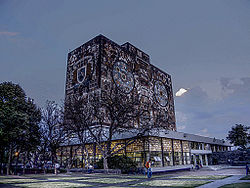
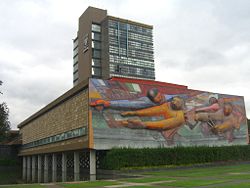
Besides being one of the most recognized universities in Latin America, it is one of the largest and the most artistically detailed. Its main campus is a World Heritage site that was designed by some of Mexico's best-known architects of the 20th century. Murals in the main campus were painted by some of the most recognized artists in Mexican history, such as Diego Rivera
and David Alfaro Siqueiros
.
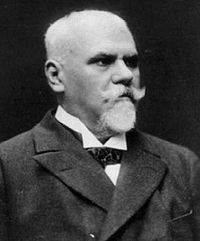 The university was founded on 22 September 1910 by Justo Sierra
, then Minister of Education in the Porfirio Díaz
regime, who sought to create a very different institution from its 19th century precursor, the Royal and Pontifical University of Mexico
, which had been founded on 21 September 1551 by a royal decree signed by Crown Prince
Phillip
on behalf of Charles I of Spain
and brought to a definitive closure in 1867 by Benito Juárez
and his fellow Liberals
. Instead of reviving what he saw as an anachronistic institution with strong ties to the Roman Catholic Church
, he aimed to create a new university, secular in nature and national in scope, that could reorganize higher education within the country, serve as a model of positivism
and encompass the ideas of the dominant Mexican liberalism.
The project initially unified the Fine Arts, Business, Political Science, Jurisprudence, Engineering, Medicine, Normal
and the National Preparatory
schools; its first rector
was Joaquin Eguía y Lis.
The new university's challenges were mostly political, due to the ongoing Mexican Revolution
and the fact that the federal government had direct control over the university's policies and curriculum; some resisted its establishment on philosophical grounds. This opposition led to disruptions in the function of the university when political instability forced resignations in the government, including that of President Díaz. Internally, the first student strike occurred in 1912 to protest examination methods introduced by the director of the School of Jurisprudence, Luis Cabrera
. By July of that year, a majority of the law students decided to abandon the university and join the newly-created Free School of Law
.
In 1914, initial efforts to gain autonomy for the university failed. In 1920, José Vasconcelos
became rector. In 1921, he created the school's coat-of-arms: the image of an eagle and a condor surrounding a map of Latin America, from Mexico's northern border to Tierra del Fuego
, and the motto, "The Spirit shall speak for my race." Efforts to gain autonomy for the university continued in the early 1920s. In the mid-1920s, a second wave of student strikes opposed a new grading system. The strikes included major classroom walkouts in the law school and confrontation with police at the medical school. The striking students were supported by many professors and subsequent negotiations eventually led to autonomy for the university. The institution was no longer a dependency of the Secretariat of Public Education; the university rector became the final authority, eliminating much of the confusing overlap in authority.
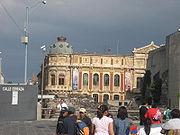 In 1943, initial decisions were made to move the university from the various buildings it occupied in the city center to a new and consolidated university campus; the new Ciudad Universitaria
(lit. University City) would be in San Ángel
, to the south of the city. The first stone laid was that of the faculty of Sciences, the first building of Ciudad Universitaria. President Miguel Alemán Valdés
participated in the ceremony on 20 November 1952. The University Olympic Stadium was inaugurated on the same day. In 1957, the Doctorate Council was created to regulate and organize graduate studies.
Another major student strike, again over examination regulations, occurred in 1966. Students invaded the rectorate and forced the rector to resign. The Board of Regents did not accept this resignation, so the professors went on strike, paralyzing the university and forcing the Board's acceptance. In the summer, violent outbreaks occurred on a number of the campuses of the University-affiliated preparatory schools; police took over a number of high school campuses, with injuries. During August 1968, protests formed on the main campus against the police actions on the main campus and in the center of the city. The protests grew into a student movement that demanded the resignation of the police chief, among other things. More protests followed in September, gaining frequency and numbers. During a meeting of the student leaders, the army fired on the Chihuahua building in Tlatelolco
, where the student organization supposedly was. They also fired on the crowd that was outside
, with many dead, wounded and detained. Protests continued after that. Only ten days later, the 1968 Olympic Games
opened at the University Stadium. The University was shut down for the duration. Finally, some progress was made toward restoring order.
The 1970s and 1980s saw the opening of satellite campuses in other parts of Mexico and nearby areas, to decentralize the system. There were some minor student strikes, mostly concerning grading and tuition. The last major student strike
at the university occurred in 1999–2000 when students shut down the campus for almost a year to protest a proposal to charge students the equivalent of US$150 per semester for those who could afford it. Referendums were held by both the university and the strikers, but neither side accepted the others' results. Acting on a judge's order, the police stormed the buildings held by strikers on 7 February 2000, putting an end to the strike.
In 2009, the university was awarded the Prince of Asturias Award for Communication and Humanities and began the celebration of its centennial anniversary with several activities that will last until 2011.
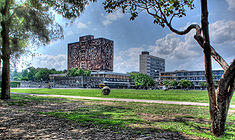 "Ciudad Universitaria" (University City) is UNAM's main campus, located within the Coyoacán
borough in the southern part of Mexico City. It was designed by architects Mario Pani
, Enrique del Moral, Domingo García Ramos
, Armando Franco Rovira and others, and it encloses the Estadio Olímpico Universitario
, about 40 faculties and institutes, the Cultural Center, an ecological reserve, the Central Library
, and a few museums. It was built during the 1950s on an ancient solidified lava bed to replace the scattered buildings in downtown Mexico City
, where classes were given. It was completed in 1954, and is almost a separate region within Mexico City, with its own regulations, councils, and police (to some extent), in a more fundamental way than most universities around the world.
In June 2007, its main campus, Ciudad Universitaria
, was declared a UNESCO
World Heritage Site
.
(Acatlán, Aragón, Cuautitlán, Iztacala, and Zaragoza), as well as many others in several locations across Mexico (in Santiago de Querétaro
, Morelia
, Mérida
, Ensenada
, Cuernavaca
and Leon
), mainly aimed at research and graduate studies. It has also four small foreign campuses in the United States and Canada, focusing on the Spanish language
and Mexican culture: UNAM San Antonio, Texas; Chicago; Los Angeles; Gatineau, Quebec.
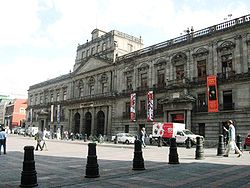 Under the care of UNAM's Engineering Faculty, the Colonial Palace of Mining is located in the historical center of Mexico City. Formerly the School of Engineering, it has three floors, and hosts the International Book Expo ("Feria Internacional del Libro" or "FIL") and the International Day of Computing Security Congress ("DISC"). It also has a permanent exhibition of historical books, mostly topographical and naturalist works of 19th century Mexican scientists, in the former library of the School of Engineers. It also contains several exhibitions related to mining, the prime engineering occupation during the Spanish colonization. It is considered to be one of the most significant examples of Mexican architecture of its period.
, is a place devoted to cultural activities, including dancing, theatre plays and ballet. It also serves as meeting place for university-related organizations and committees.
movement. San Ildefonso began as a prestigious Jesuit boarding school, and after the Reform War
, it gained educational prestige again as National Preparatory School
, which was closely linked to the founding of UNAM. This school, and the building, closed completely in 1978, then reopened as a museum and cultural center in 1994, administered jointly by UNAM, the National Council for Culture and Arts and the government of the Federal District of Mexico City. The museum has permanent and temporary art and archaeological exhibitions, in addition to the many murals painted on its walls by José Clemente Orozco
, Diego Rivera
and others. The complex is located between San Ildefonso Street and Justo Sierra Street in the historic center of Mexico City
.
. It opened with part of the collection of the now-defunct Public Museum of Natural History, Archeology and History, which eventually became the National Museum of Cultures. It served the National Museum of Natural History for almost 50 years, and is now devoted to the temporary exhibitions of visual arts.
mountain range in Baja California
, about 130 km south of United States-Mexican border. It has been in operation since 1970, and it currently has three large reflecting telescopes.
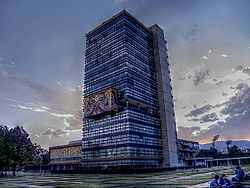 UNAM is organized in faculties, rather than departments
. Both undergraduate and graduate
studies are available. UNAM is also responsible for the Escuela Nacional Preparatoria
(ENP) (National Preparatory School), and the Colegio de Ciencias y Humanidades (CCH)
(Science and Humanities College), which consist of several high school
s, in Mexico City
. Counting ENEP, CCH, FES (Facultad de Estudios Profesionales) undergraduate and graduate students, UNAM has over 314,557 students, making it one of the world's largest universities
.
, the University is the 190th best-ranked university in the world and the second best in Ibero-America
. According to the 2008 Academic Ranking of World Universities
, developed by the Institute of Higher Education of Shanghai Jiao Tong University
, UNAM is ranked in the 152–200 tier, and holds second place among Ibero-American universities in a tie between the University of Buenos Aires
and Brazilian University, below the University of São Paulo
(101–151 tier). The university was also ranked joint 169th with University of São Paulo
in the 2011 QS World University Rankings
.
 UNAM has excelled in many areas of research and houses many of Mexico's premiere research institutions. In recent years, it has attracted students and hired professional scientists from all over the world (most notably from Russia, India and the United States), which has created a unique and diverse scientific community.
Scientific research at UNAM is divided between faculties, institutes, centers and schools, and covers a range of disciplines in Latin America. Some of the more noted institutes include: the Institute of Astronomy, the Institute of Biotechnology, the Institute of Nuclear Sciences, the Institute of Ecology, the Institute of Physics, the Institute of Cell Physiology, the Institute of Geophysics, the Institute of Engineering, the Institute of Materials Research, the Institute of Chemistry, the Institute of Biomedical Sciences, and the Applied Mathematics and Systems Research Institute.
Research centers tend to focus on multidisciplinary problems particularly relevant to Mexico and the developing world, most notably, the Center of Applied Sciences and Technological Development, which focuses on connecting the sciences to real-world problems (e.g., optics, nanosciences), and Center of Energy Research, which conducts world-class research in alternative energies.
All research centers are open to students from Mexico and around the world. The UNAM holds a number of programs for students within the country, using scientific internships to encourage research in the country.
UNAM's scientific output continues to grow; despite numerous attempts by the Mexican government to curtail its budget, the University currently produces 60% of all scientific publications in Mexico.
As for basic sciences, UNAM currently has two Howard Hughes Medical Institute
Scholars and an endowment from the NIH extramural research program.
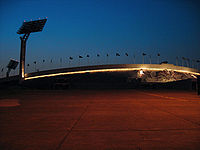 UNAM's football
team, Club Universidad Nacional
, participates in the Primera División de México
of the Mexican Football League Division. The club became two-time consecutive champions of the Apertura, and the Clausura in 2004. Their home ground is the Estadio Olímpico Universitario
stadium.
all over the main square of Ciudad Universitaria
. Each school builds an ofrenda, and in the center, there is usually a large ofrenda made according to a theme corresponding to the festivities of the University for that year.
.
Many of the most prominent figures in the economical, political, scientific and artistic life in Mexico were members of the UNAM alumni or faculty:
Justo Sierra
Justo Sierra Méndez , was a prominent Mexican writer, journalist, poet and political figure of the second half of the nineteenth century. He was the son of Mexican novelist Justo Sierra O'Reilly, who is credited with inspiring his son with the spirit of literature...
as a liberal alternative to the Roman Catholic
Roman Catholic Church
The Catholic Church, also known as the Roman Catholic Church, is the world's largest Christian church, with over a billion members. Led by the Pope, it defines its mission as spreading the gospel of Jesus Christ, administering the sacraments and exercising charity...
-sponsored Royal and Pontifical University of Mexico
Royal and Pontifical University of Mexico
The Royal and Pontifical University of Mexico was founded on 21 September 1551 by Royal Decree signed by Charles I of Spain, in Valladolid, Spain. It is generally considered the first university officially founded in North America and second in the Americas.After the Mexican War of Independence it...
(founded on 21 September 1551 by a royal decree of Charles V, Holy Roman Emperor
Charles V, Holy Roman Emperor
Charles V was ruler of the Holy Roman Empire from 1519 and, as Charles I, of the Spanish Empire from 1516 until his voluntary retirement and abdication in favor of his younger brother Ferdinand I and his son Philip II in 1556.As...
and brought to a definitive closure in 1867 by the liberals). UNAM's autonomy, granted in the 1920s, has given it the freedom to define its own curriculum and manage its own budget without interference from the government. This has had a profound effect on academic life at the university, which some claim boosts academic freedom and independence.
The UNAM generates a number of different publications in diverse areas, such as mathematics, physics and history. It is also the only university in Mexico with Nobel Prize
Nobel Prize
The Nobel Prizes are annual international awards bestowed by Scandinavian committees in recognition of cultural and scientific advances. The will of the Swedish chemist Alfred Nobel, the inventor of dynamite, established the prizes in 1895...
laureates among its alumni: Alfonso García Robles
Alfonso García Robles
Alfonso García Robles was a Mexican diplomat and politician who, in conjunction with Sweden's Alva Myrdal, received the Nobel Peace Prize in 1982....
(Peace
Nobel Peace Prize
The Nobel Peace Prize is one of the five Nobel Prizes bequeathed by the Swedish industrialist and inventor Alfred Nobel.-Background:According to Nobel's will, the Peace Prize shall be awarded to the person who...
), Octavio Paz
Octavio Paz
Octavio Paz Lozano was a Mexican writer, poet, and diplomat, and the winner of the 1990 Nobel Prize for Literature.-Early life and writings:...
(Literature), and Mario Molina (Chemistry
Nobel Prize in Chemistry
The Nobel Prize in Chemistry is awarded annually by the Royal Swedish Academy of Sciences to scientists in the various fields of chemistry. It is one of the five Nobel Prizes established by the will of Alfred Nobel in 1895, awarded for outstanding contributions in chemistry, physics, literature,...
).
Besides being one of the most recognized universities in Latin America, it is one of the largest and the most artistically detailed. Its main campus is a World Heritage site that was designed by some of Mexico's best-known architects of the 20th century. Murals in the main campus were painted by some of the most recognized artists in Mexican history, such as Diego Rivera
Diego Rivera
Diego María de la Concepción Juan Nepomuceno Estanislao de la Rivera y Barrientos Acosta y Rodríguez was a prominent Mexican painter born in Guanajuato, Guanajuato, an active communist, and husband of Frida Kahlo . His large wall works in fresco helped establish the Mexican Mural Movement in...
and David Alfaro Siqueiros
David Alfaro Siqueiros
José David Alfaro Siqueiros was a social realist painter, known for his large murals in fresco that helped establish the Mexican Mural Renaissance, together with works by Diego Rivera and José Clemente Orozco, and also a member of the Mexican Communist Party who participated in an...
.
History
Justo Sierra
Justo Sierra Méndez , was a prominent Mexican writer, journalist, poet and political figure of the second half of the nineteenth century. He was the son of Mexican novelist Justo Sierra O'Reilly, who is credited with inspiring his son with the spirit of literature...
, then Minister of Education in the Porfirio Díaz
Porfirio Díaz
José de la Cruz Porfirio Díaz Mori was a Mexican-American War volunteer and French intervention hero, an accomplished general and the President of Mexico continuously from 1876 to 1911, with the exception of a brief term in 1876 when he left Juan N...
regime, who sought to create a very different institution from its 19th century precursor, the Royal and Pontifical University of Mexico
Royal and Pontifical University of Mexico
The Royal and Pontifical University of Mexico was founded on 21 September 1551 by Royal Decree signed by Charles I of Spain, in Valladolid, Spain. It is generally considered the first university officially founded in North America and second in the Americas.After the Mexican War of Independence it...
, which had been founded on 21 September 1551 by a royal decree signed by Crown Prince
Crown Prince
A crown prince or crown princess is the heir or heiress apparent to the throne in a royal or imperial monarchy. The wife of a crown prince is also titled crown princess....
Phillip
Philip II of Spain
Philip II was King of Spain, Portugal, Naples, Sicily, and, while married to Mary I, King of England and Ireland. He was lord of the Seventeen Provinces from 1556 until 1581, holding various titles for the individual territories such as duke or count....
on behalf of Charles I of Spain
Charles V, Holy Roman Emperor
Charles V was ruler of the Holy Roman Empire from 1519 and, as Charles I, of the Spanish Empire from 1516 until his voluntary retirement and abdication in favor of his younger brother Ferdinand I and his son Philip II in 1556.As...
and brought to a definitive closure in 1867 by Benito Juárez
Benito Juárez
Benito Juárez born Benito Pablo Juárez García, was a Mexican lawyer and politician of Zapotec origin from Oaxaca who served five terms as president of Mexico: 1858–1861 as interim, 1861–1865, 1865–1867, 1867–1871 and 1871–1872...
and his fellow Liberals
Mexican Liberal Party
The Mexican Liberal Party was an anarchist group co-founded by Ricardo Flores Magón in 1906, in opposition to the rule of Porfirio Díaz. The MLP was involved in strikes and uprisings in Mexico from 1906 to 1911. The party controlled most parts of Baja California in 1911, including Tijuana,...
. Instead of reviving what he saw as an anachronistic institution with strong ties to the Roman Catholic Church
Roman Catholic Church
The Catholic Church, also known as the Roman Catholic Church, is the world's largest Christian church, with over a billion members. Led by the Pope, it defines its mission as spreading the gospel of Jesus Christ, administering the sacraments and exercising charity...
, he aimed to create a new university, secular in nature and national in scope, that could reorganize higher education within the country, serve as a model of positivism
Positivism
Positivism is a a view of scientific methods and a philosophical approach, theory, or system based on the view that, in the social as well as natural sciences, sensory experiences and their logical and mathematical treatment are together the exclusive source of all worthwhile information....
and encompass the ideas of the dominant Mexican liberalism.
The project initially unified the Fine Arts, Business, Political Science, Jurisprudence, Engineering, Medicine, Normal
Normal school
A normal school is a school created to train high school graduates to be teachers. Its purpose is to establish teaching standards or norms, hence its name...
and the National Preparatory
Escuela Nacional Preparatoria
The Escuela Nacional Preparatoria , the oldest senior high school system in Mexico, belonging to the National Autonomous University of Mexico , opened its doors on February 1, 1868. It was founded by Gabino Barreda, M.D., following orders of then President of Mexico Benito Juárez...
schools; its first rector
Rector
The word rector has a number of different meanings; it is widely used to refer to an academic, religious or political administrator...
was Joaquin Eguía y Lis.
The new university's challenges were mostly political, due to the ongoing Mexican Revolution
Mexican Revolution
The Mexican Revolution was a major armed struggle that started in 1910, with an uprising led by Francisco I. Madero against longtime autocrat Porfirio Díaz. The Revolution was characterized by several socialist, liberal, anarchist, populist, and agrarianist movements. Over time the Revolution...
and the fact that the federal government had direct control over the university's policies and curriculum; some resisted its establishment on philosophical grounds. This opposition led to disruptions in the function of the university when political instability forced resignations in the government, including that of President Díaz. Internally, the first student strike occurred in 1912 to protest examination methods introduced by the director of the School of Jurisprudence, Luis Cabrera
Luis Cabrera Lobato
Luis Vicente Cabrera Lobato was a Mexican lawyer, politician and writer. His pen name for his political essays was "Lic...
. By July of that year, a majority of the law students decided to abandon the university and join the newly-created Free School of Law
Escuela Libre de Derecho
Escuela Libre de Derecho is a prestigious law school in Mexico. Founded in 1912, it has among its alumni some of the most distinguished Mexican attorneys...
.
In 1914, initial efforts to gain autonomy for the university failed. In 1920, José Vasconcelos
José Vasconcelos
José Vasconcelos Calderón was a Mexican writer, philosopher and politician. He is one of the most influential and controversial personalities in the development of modern Mexico. His philosophy of "indigenismo" affected all aspects of Mexican sociocultural, political, and economic...
became rector. In 1921, he created the school's coat-of-arms: the image of an eagle and a condor surrounding a map of Latin America, from Mexico's northern border to Tierra del Fuego
Tierra del Fuego
Tierra del Fuego is an archipelago off the southernmost tip of the South American mainland, across the Strait of Magellan. The archipelago consists of a main island Isla Grande de Tierra del Fuego divided between Chile and Argentina with an area of , and a group of smaller islands including Cape...
, and the motto, "The Spirit shall speak for my race." Efforts to gain autonomy for the university continued in the early 1920s. In the mid-1920s, a second wave of student strikes opposed a new grading system. The strikes included major classroom walkouts in the law school and confrontation with police at the medical school. The striking students were supported by many professors and subsequent negotiations eventually led to autonomy for the university. The institution was no longer a dependency of the Secretariat of Public Education; the university rector became the final authority, eliminating much of the confusing overlap in authority.
Ciudad Universitaria
Ciudad Universitaria , Mexico, is UNAM's main campus, located in Coyoacán borough in the southern part of Mexico City. Designed by architects Mario Pani and Enrique del Moral, it encloses the Olympic Stadium, about 40 faculties and institutes, the Cultural Center, an ecological reserve, the Central...
(lit. University City) would be in San Ángel
San Ángel
San Ángel is a colonia or neighborhood of Mexico City, located in the southwest in Álvaro Óbregon borough. Historically, it was a rural community, called Tenanitla in the pre Hispanic period. Its current name is derived from the El Carmen monastery school called San Ángel Mártir...
, to the south of the city. The first stone laid was that of the faculty of Sciences, the first building of Ciudad Universitaria. President Miguel Alemán Valdés
Miguel Alemán Valdés
Miguel Alemán Valdés served as the President of Mexico from 1946 to 1952.-Life:Alemán was born in Sayula in the state of Veracruz as the son of General Miguel Alemán González and Tomasa Valdés Ledezma...
participated in the ceremony on 20 November 1952. The University Olympic Stadium was inaugurated on the same day. In 1957, the Doctorate Council was created to regulate and organize graduate studies.
Another major student strike, again over examination regulations, occurred in 1966. Students invaded the rectorate and forced the rector to resign. The Board of Regents did not accept this resignation, so the professors went on strike, paralyzing the university and forcing the Board's acceptance. In the summer, violent outbreaks occurred on a number of the campuses of the University-affiliated preparatory schools; police took over a number of high school campuses, with injuries. During August 1968, protests formed on the main campus against the police actions on the main campus and in the center of the city. The protests grew into a student movement that demanded the resignation of the police chief, among other things. More protests followed in September, gaining frequency and numbers. During a meeting of the student leaders, the army fired on the Chihuahua building in Tlatelolco
Tlatelolco (Mexico City)
Tlatelolco is an area in the Cuauhtémoc borough of Mexico City, centered on the Plaza de las Tres Culturas, a square surrounded on three sides by an excavated Aztec archaeological site, a 17th century church called Templo de Santiago, a former convent, and office complexes that used to belong to...
, where the student organization supposedly was. They also fired on the crowd that was outside
Tlatelolco massacre
The Tlatelolco massacre, also known as The Night of Tlatelolco , was a government massacre of student and civilian protesters and bystanders that took place during the afternoon and night of October 2, 1968, in the Plaza de las Tres Culturas in the Tlatelolco section of Mexico City...
, with many dead, wounded and detained. Protests continued after that. Only ten days later, the 1968 Olympic Games
1968 Summer Olympics
The 1968 Summer Olympics, officially known as the Games of the XIX Olympiad, were an international multi-sport event held in Mexico City, Mexico in October 1968. The 1968 Games were the first Olympic Games hosted by a developing country, and the first Games hosted by a Spanish-speaking country...
opened at the University Stadium. The University was shut down for the duration. Finally, some progress was made toward restoring order.
The 1970s and 1980s saw the opening of satellite campuses in other parts of Mexico and nearby areas, to decentralize the system. There were some minor student strikes, mostly concerning grading and tuition. The last major student strike
1999 UNAM strike
The 1999 strike at the UNAM had its origins in the January 1999 announcement by its rector that tuition would increase from about 0.02 dollars to about $150 a semester. A group of students declared a strike and blockaded the main campus...
at the university occurred in 1999–2000 when students shut down the campus for almost a year to protest a proposal to charge students the equivalent of US$150 per semester for those who could afford it. Referendums were held by both the university and the strikers, but neither side accepted the others' results. Acting on a judge's order, the police stormed the buildings held by strikers on 7 February 2000, putting an end to the strike.
In 2009, the university was awarded the Prince of Asturias Award for Communication and Humanities and began the celebration of its centennial anniversary with several activities that will last until 2011.
University City
Coyoacán
Coyoacán refers to one of the sixteen boroughs of the Federal District of Mexico City as well as the former village which is now the borough’s “historic center.” The name comes from Nahuatl and most likely means “place of coyotes,” when the Aztecs named a pre-Hispanic village on the southern shore...
borough in the southern part of Mexico City. It was designed by architects Mario Pani
Mario Pani
Mario Pani Darqui was a Mexican architect and urbanist, one of the most active under the rule of president Miguel Alemán Valdés...
, Enrique del Moral, Domingo García Ramos
Domingo García Ramos
Domingo García Ramos was a prominent Mexican architect. He is the author of several books:* Iniciación al Urbanismo * Arquitectura y artes decorativas...
, Armando Franco Rovira and others, and it encloses the Estadio Olímpico Universitario
Estadio Olímpico Universitario
Estadio Olímpico Universitario is a stadium located in Ciudad Universitaria, Mexico City. It was built in 1952 and at that time was the largest stadium in Mexico. This stadium has a capacity of 63,186 . During the 50s and the 60s this stadium was used mostly for college American football matches...
, about 40 faculties and institutes, the Cultural Center, an ecological reserve, the Central Library
Central Library (UNAM)
Central Library , is the main library in the Ciudad Universitaria Campus of the National Autonomous University of Mexico . It holds one of the largest collections in Mexico...
, and a few museums. It was built during the 1950s on an ancient solidified lava bed to replace the scattered buildings in downtown Mexico City
Mexico City
Mexico City is the Federal District , capital of Mexico and seat of the federal powers of the Mexican Union. It is a federal entity within Mexico which is not part of any one of the 31 Mexican states but belongs to the federation as a whole...
, where classes were given. It was completed in 1954, and is almost a separate region within Mexico City, with its own regulations, councils, and police (to some extent), in a more fundamental way than most universities around the world.
In June 2007, its main campus, Ciudad Universitaria
Ciudad Universitaria
Ciudad Universitaria , Mexico, is UNAM's main campus, located in Coyoacán borough in the southern part of Mexico City. Designed by architects Mario Pani and Enrique del Moral, it encloses the Olympic Stadium, about 40 faculties and institutes, the Cultural Center, an ecological reserve, the Central...
, was declared a UNESCO
UNESCO
The United Nations Educational, Scientific and Cultural Organization is a specialized agency of the United Nations...
World Heritage Site
World Heritage Site
A UNESCO World Heritage Site is a place that is listed by the UNESCO as of special cultural or physical significance...
.
Satellite campuses
Apart from Ciudad Universitaria, UNAM has several campi in the Metropolitan Area of Mexico CityGreater Mexico City
Greater Mexico City refers to the conurbation around Mexico City, officially called Mexico City Metropolitan Area , constituted by the Federal District—itself composed of 16 boroughs—and 41 adjacent municipalities of the states of Mexico and Hidalgo...
(Acatlán, Aragón, Cuautitlán, Iztacala, and Zaragoza), as well as many others in several locations across Mexico (in Santiago de Querétaro
Santiago de Querétaro
Santiago de Querétaro is the capital and largest city of the state of Querétaro, located in central Mexico. It is located 213 km northwest of Mexico City, 96 km southeast of San Miguel de Allende and 200 km south of San Luis Potosí...
, Morelia
Morelia
Morelia is a city and municipality in the north central part of the state of Michoacán in central Mexico. The city is in the Guayangareo Valley and is the capital of the state. The main pre-Hispanic cultures here were the P'urhépecha and the Matlatzinca, but no major cities were founded in the...
, Mérida
Mérida, Yucatán
Mérida is the capital and largest city of the Mexican state of Yucatán and the Yucatán Peninsula. It is located in the northwest part of the state, about from the Gulf of Mexico coast...
, Ensenada
Ensenada, Baja California
Ensenada is a coastal city in Mexico and the third-largest city in Baja California. It is located south of San Diego on the Baja California Peninsula. The city is locally referred to as La Cenicienta del Pacífico, or, The Cinderella of the Pacific...
, Cuernavaca
Cuernavaca
Cuernavaca is the capital and largest city of the state of Morelos in Mexico. It was established at the archeological site of Gualupita I by the Olmec, "the mother culture" of Mesoamerica, approximately 3200 years ago...
and Leon
León, Guanajuato
The city of León, formally León de los Aldama is the sixth most populous city in Mexico and the first in the state of Guanajuato. It is also the seat of the municipality of León...
), mainly aimed at research and graduate studies. It has also four small foreign campuses in the United States and Canada, focusing on the Spanish language
Spanish language
Spanish , also known as Castilian , is a Romance language in the Ibero-Romance group that evolved from several languages and dialects in central-northern Iberia around the 9th century and gradually spread with the expansion of the Kingdom of Castile into central and southern Iberia during the...
and Mexican culture: UNAM San Antonio, Texas; Chicago; Los Angeles; Gatineau, Quebec.
Palacio de Minería
Casa del Lago
The House of the Lake, in Chapultepec ParkChapultepec
Chapultepec Park, more commonly called the "Bosque de Chapultepec" in Mexico City, is the largest city park in Latin America, measuring in total just over 686 hectares. Centered on a rock formation called Chapultepec Hill, one of the park's main functions is to be an ecological space in the vast...
, is a place devoted to cultural activities, including dancing, theatre plays and ballet. It also serves as meeting place for university-related organizations and committees.
Museum of San Ildefonso
This museum and cultural center is considered to be the birthplace of the Mexican muralismMexican Muralism
Mexican muralism is a Mexican art movement. The most important period of this movement took place primarily from the 1920s to the 1960s, though it exerted an influence on later generations of Mexican artists...
movement. San Ildefonso began as a prestigious Jesuit boarding school, and after the Reform War
Reform War
The Reform War in Mexico is one of the episodes of the long struggle between Liberal and Conservative forces that dominated the country’s history in the 19th century. The Liberals wanted a federalist government, limiting traditional Catholic Church and military influence in the country...
, it gained educational prestige again as National Preparatory School
Escuela Nacional Preparatoria
The Escuela Nacional Preparatoria , the oldest senior high school system in Mexico, belonging to the National Autonomous University of Mexico , opened its doors on February 1, 1868. It was founded by Gabino Barreda, M.D., following orders of then President of Mexico Benito Juárez...
, which was closely linked to the founding of UNAM. This school, and the building, closed completely in 1978, then reopened as a museum and cultural center in 1994, administered jointly by UNAM, the National Council for Culture and Arts and the government of the Federal District of Mexico City. The museum has permanent and temporary art and archaeological exhibitions, in addition to the many murals painted on its walls by José Clemente Orozco
José Clemente Orozco
José Clemente Orozco was a Mexican social realist painter, who specialized in bold murals that established the Mexican Mural Renaissance together with murals by Diego Rivera, David Alfaro Siqueiros, and others...
, Diego Rivera
Diego Rivera
Diego María de la Concepción Juan Nepomuceno Estanislao de la Rivera y Barrientos Acosta y Rodríguez was a prominent Mexican painter born in Guanajuato, Guanajuato, an active communist, and husband of Frida Kahlo . His large wall works in fresco helped establish the Mexican Mural Movement in...
and others. The complex is located between San Ildefonso Street and Justo Sierra Street in the historic center of Mexico City
Mexico City
Mexico City is the Federal District , capital of Mexico and seat of the federal powers of the Mexican Union. It is a federal entity within Mexico which is not part of any one of the 31 Mexican states but belongs to the federation as a whole...
.
Chopo University Museum
The Chopo University Museum possesses an artistic architecture, large crystal panels and two iron towers designed by Gustave EiffelGustave Eiffel
Alexandre Gustave Eiffel was a French structural engineer from the École Centrale Paris, an architect, an entrepreneur and a specialist of metallic structures...
. It opened with part of the collection of the now-defunct Public Museum of Natural History, Archeology and History, which eventually became the National Museum of Cultures. It served the National Museum of Natural History for almost 50 years, and is now devoted to the temporary exhibitions of visual arts.
National Astronomical Observatory
The National Astronomical Observatory is located in the Sierra San Pedro MártirSierra San Pedro Mártir
Sierra de San Pedro Mártir is a mountain range that is one of the Peninsular Ranges of the Baja California peninsula, Mexico. At , the highest peak is the Picacho del Diablo, also known as Cerro de la Encantada or Picacho la Providencia...
mountain range in Baja California
Baja California
Baja California officially Estado Libre y Soberano de Baja California is one of the 31 states which, with the Federal District, comprise the 32 Federal Entities of Mexico. It is both the northernmost and westernmost state of Mexico. Before becoming a state in 1953, the area was known as the North...
, about 130 km south of United States-Mexican border. It has been in operation since 1970, and it currently has three large reflecting telescopes.
Organization
Academic department
An academic department is a division of a university or school faculty devoted to a particular academic discipline. This article covers United States usage at the university level....
. Both undergraduate and graduate
Postgraduate education
Postgraduate education involves learning and studying for degrees or other qualifications for which a first or Bachelor's degree generally is required, and is normally considered to be part of higher education...
studies are available. UNAM is also responsible for the Escuela Nacional Preparatoria
Escuela Nacional Preparatoria
The Escuela Nacional Preparatoria , the oldest senior high school system in Mexico, belonging to the National Autonomous University of Mexico , opened its doors on February 1, 1868. It was founded by Gabino Barreda, M.D., following orders of then President of Mexico Benito Juárez...
(ENP) (National Preparatory School), and the Colegio de Ciencias y Humanidades (CCH)
(Science and Humanities College), which consist of several high school
High school
High school is a term used in parts of the English speaking world to describe institutions which provide all or part of secondary education. The term is often incorporated into the name of such institutions....
s, in Mexico City
Mexico City
Mexico City is the Federal District , capital of Mexico and seat of the federal powers of the Mexican Union. It is a federal entity within Mexico which is not part of any one of the 31 Mexican states but belongs to the federation as a whole...
. Counting ENEP, CCH, FES (Facultad de Estudios Profesionales) undergraduate and graduate students, UNAM has over 314,557 students, making it one of the world's largest universities
World's largest universities
This list of largest universities by enrollment includes total active enrollment across all campuses . Enrollment numbers listed are the sum of undergraduate and graduate students in active enrollment...
.
Faculties and National Schools
UNAM recognizes two different types of university schools: Faculties and National Schools. Only faculties have postgraduate studies. Currently, most of the schools, either inside or outside the University City, have this title. A National School is an institution that cannot offer all postgraduate studies (Master's degrees and Doctorates). This is the case of the National School of Music, the National School of Arts, the National School of Nursery and Obstetrics, and the National School of Social Work.List of Faculties, National Schools and Institutes
- Faculties
- Faculty of Accounting and Administration
- Faculty of Architecture
- Faculty of Chemistry
- Faculty of EconomicsFaculty of Economics (UNAM)The Faculty of Economics of the National Autonomous University of Mexico has its predecessor in the then named National School of Economics- History :...
- Faculty of EngineeringFaculty of Engineering (UNAM)The Faculty of Engineering at the National Autonomous University of Mexico is one of the most prestigious engineering schools in Mexico. At the undergraduate level, it offers twelve different majors. The faculty also offers some graduate programs...
- Faculty of High Studies (FES) Aragón
- Faculty of High Studies (FES) Acatlán
- Faculty of High Studies (FES) Cuautitlán
- Faculty of High Studies (FES) Iztacala
- Faculty of High Studies (FES) Zaragoza
- Faculty of Law
- Faculty of MedicineFaculty of Medicine (UNAM)The UNAM Faculty of Medicine is the responsible of imparting studies of medicine in the UNAM, it holds Undergraduate and Graduate studies, the later ones being some of them joint teaching with some other faculties, most commonly the Faculty of Science...
- Faculty of Odontology
- Faculty of Philosophy and LiteratureFaculty of Philosophy and Literature (UNAM)The Faculty of Philosophy and Literature at the National Autonomous University of Mexico is responsible for administering 11 humanism and science based majors; it has both Undergraduate and Graduate studies....
- Faculty of Political and Social SciencesFaculty of Political and Social Sciences (UNAM)The Facultad de Ciencias Políticas y Sociales is a faculty within Mexico's Universidad Nacional Autónoma de México , responsible for directing research and teaching programs in the fields of political science and social science...
- Faculty of Psychology
- Faculty of SciencesFaculty of Sciences (UNAM)The Faculty of Sciences at the National Autonomous University of Mexico is the entity where natural and exact science-based majors are taught...
- Faculty of Veterinarian Medicine
- National Schools
- National School of Plastic Arts
- National School of Music
- National School of Nursery and Obstetrics
- National School of Social Work
- National Preparatory School (with 9 high schools)
- College of Sciences and Humanities (with 5 high schools)
- Institute of Aesthetic Research
- Center for Genomic Sciences (CCG)
Rankings
According to the 2009 THES - QS World University RankingsTHES - QS World University Rankings
The term Times Higher Education–QS World University Rankings refers to rankings published jointly between 2004 and 2009 by Times Higher Education and Quacquarelli Symonds . After QS and Times Higher Education had ended their collaboration, the methodology for these rankings continues to be used by...
, the University is the 190th best-ranked university in the world and the second best in Ibero-America
Ibero-America
Ibero-America is a term used since the second half of the 19th century to refer collectively to the countries in the Americas that were formerly colonies of Spain or Portugal. Spain and Portugal are themselves included in some definitions, such as that of the Ibero-American Summit and the...
. According to the 2008 Academic Ranking of World Universities
Academic Ranking of World Universities
The Academic Ranking of World Universities , commonly known as the Shanghai ranking, is a publication that was founded and compiled by the Shanghai Jiaotong University to rank universities globally. The rankings have been conducted since 2003 and updated annually...
, developed by the Institute of Higher Education of Shanghai Jiao Tong University
Shanghai Jiao Tong University
Shanghai Jiao Tong University or SJTU), sometimes referred to as Shanghai Jiaotong University , is a top public research university located in Shanghai, China. Shanghai Jiao Tong University is known as one of the oldest and most prestigious universities in China...
, UNAM is ranked in the 152–200 tier, and holds second place among Ibero-American universities in a tie between the University of Buenos Aires
University of Buenos Aires
The University of Buenos Aires is the largest university in Argentina and the largest university by enrollment in Latin America. Founded on August 12, 1821 in the city of Buenos Aires, it consists of 13 faculties, 6 hospitals, 10 museums and is linked to 4 high schools: Colegio Nacional de Buenos...
and Brazilian University, below the University of São Paulo
University of São Paulo
Universidade de São Paulo is a public university in the Brazilian state of São Paulo. It is the largest Brazilian university and one of the country's most prestigious...
(101–151 tier). The university was also ranked joint 169th with University of São Paulo
University of São Paulo
Universidade de São Paulo is a public university in the Brazilian state of São Paulo. It is the largest Brazilian university and one of the country's most prestigious...
in the 2011 QS World University Rankings
QS World University Rankings
The QS World University Rankings is a ranking of the world’s top 500 universities by Quacquarelli Symonds using a method that has published annually since 2004....
.
Research
Scientific research at UNAM is divided between faculties, institutes, centers and schools, and covers a range of disciplines in Latin America. Some of the more noted institutes include: the Institute of Astronomy, the Institute of Biotechnology, the Institute of Nuclear Sciences, the Institute of Ecology, the Institute of Physics, the Institute of Cell Physiology, the Institute of Geophysics, the Institute of Engineering, the Institute of Materials Research, the Institute of Chemistry, the Institute of Biomedical Sciences, and the Applied Mathematics and Systems Research Institute.
Research centers tend to focus on multidisciplinary problems particularly relevant to Mexico and the developing world, most notably, the Center of Applied Sciences and Technological Development, which focuses on connecting the sciences to real-world problems (e.g., optics, nanosciences), and Center of Energy Research, which conducts world-class research in alternative energies.
All research centers are open to students from Mexico and around the world. The UNAM holds a number of programs for students within the country, using scientific internships to encourage research in the country.
UNAM's scientific output continues to grow; despite numerous attempts by the Mexican government to curtail its budget, the University currently produces 60% of all scientific publications in Mexico.
As for basic sciences, UNAM currently has two Howard Hughes Medical Institute
Howard Hughes Medical Institute
Howard Hughes Medical Institute is a United States non-profit medical research organization based in Chevy Chase, Maryland. It was founded by the American businessman Howard Hughes in 1953. It is one of the largest private funding organizations for biological and medical research in the United...
Scholars and an endowment from the NIH extramural research program.
Professional football team
Football (soccer)
Association football, more commonly known as football or soccer, is a sport played between two teams of eleven players with a spherical ball...
team, Club Universidad Nacional
Club Universidad Nacional
Club Universidad Nacional A.C., more commonly known as Pumas de la UNAM, or just Pumas, is a Mexican professional football club based in Mexico City...
, participates in the Primera División de México
Primera División de México
The Primera División Profesional , known simply as the Primera División, is the top level of the Mexican football league system and is administered by the Mexican Football Federation. It was established in 1943 and as of 2011 has 18 clubs. Up to June 2011, it was divided into three groups competing...
of the Mexican Football League Division. The club became two-time consecutive champions of the Apertura, and the Clausura in 2004. Their home ground is the Estadio Olímpico Universitario
Estadio Olímpico Universitario
Estadio Olímpico Universitario is a stadium located in Ciudad Universitaria, Mexico City. It was built in 1952 and at that time was the largest stadium in Mexico. This stadium has a capacity of 63,186 . During the 50s and the 60s this stadium was used mostly for college American football matches...
stadium.
Cultural traditions
The University has as an annual tradition to make a large display of OfrendasDay of the Dead
Day of the Dead is a Mexican holiday celebrated throughout Mexico and around the world in many cultures. The holiday focuses on gatherings of family and friends to pray for and remember friends and family members who have died. It is particularly celebrated in Mexico, where it attains the quality...
all over the main square of Ciudad Universitaria
Ciudad Universitaria
Ciudad Universitaria , Mexico, is UNAM's main campus, located in Coyoacán borough in the southern part of Mexico City. Designed by architects Mario Pani and Enrique del Moral, it encloses the Olympic Stadium, about 40 faculties and institutes, the Cultural Center, an ecological reserve, the Central...
. Each school builds an ofrenda, and in the center, there is usually a large ofrenda made according to a theme corresponding to the festivities of the University for that year.
Political activism
UNAM students and professors are regarded throughout Mexico as very politically-aware and sometimes intensely politically active. While most of its students usually adhere to left-wing political ideologies and movements, the University has also borne a number of prominent right-wing and neo-liberal politicians, including Carlos Salinas de Gortari and Manuel Gómez MorínManuel Gómez Morín
Manuel Gómez Morín was a Mexican politician. He was a founding member of the National Action Party, and one of its theoreticians...
.
Student associations
The UNAM contains several associations of current students and alumni that provide extra-curricular activities to the whole community, enriching the University's activities with cultural, social and scientific events.- Fundacion UNAM
- Nibiru Sociedad AstronomicaNibiru Sociedad AstronomicaNibiru-Astronomical Society is a non - profit academic and student astronomical society created at the Faculty of Sciences of the National Autonomous University of Mexico in 2001....
- SAFIRSafirSir Safir is a Knight of the Round Table and the youngest son of the Saracen king Esclabor in the Arthurian legend. Both his brothers, Segwarides and Palamedes, also belong to the Round Table. He is a courageous and loyal knight and was, in his time, a fairly popular character, showing up in the...
Noted alumni
- See also :Category:National Autonomous University of Mexico alumni
Many of the most prominent figures in the economical, political, scientific and artistic life in Mexico were members of the UNAM alumni or faculty:
Heads of state
- Miguel Alemán ValdésMiguel Alemán ValdésMiguel Alemán Valdés served as the President of Mexico from 1946 to 1952.-Life:Alemán was born in Sayula in the state of Veracruz as the son of General Miguel Alemán González and Tomasa Valdés Ledezma...
(President of Mexico 1946–1952) - Miguel de la Madrid Hurtado (President of Mexico 1982–1988)
- Luis Echeverría ÁlvarezLuis EcheverríaLuis Echeverría Álvarez served as President of Mexico from 1970 to 1976.-Early history:Echeverría joined the faculty of the National Autonomous University of Mexico in 1947 and taught political theory...
(President of Mexico 1970–1976) - José López Portillo y Pacheco (President of Mexico 1976–1982)
- Abel Pacheco de la Espriella (President of Costa RicaCosta RicaCosta Rica , officially the Republic of Costa Rica is a multilingual, multiethnic and multicultural country in Central America, bordered by Nicaragua to the north, Panama to the southeast, the Pacific Ocean to the west and the Caribbean Sea to the east....
2002–2006) - Alfonso PortilloAlfonso PortilloAlfonso Antonio Portillo Cabrera is a Guatemalan politician. He served as the President of the Republic of Guatemala from 2000 to 2004....
(President of GuatemalaGuatemalaGuatemala is a country in Central America bordered by Mexico to the north and west, the Pacific Ocean to the southwest, Belize to the northeast, the Caribbean to the east, and Honduras and El Salvador to the southeast...
2000–2004) - Carlos Salinas de Gortari (President of Mexico 1988–1994)
Politicians
- Antonio Carrillo FloresAntonio Carrillo FloresAntonio Carrillo Flores was a Mexican statesman, born in Mexico City. He was the second son of composer Julián Carrillo Trujillo....
(Cabinet Minister in several previous administrations, 1929, 1950) - Alfonso Caso y Andrade (a very noted archaeologist)
- Alan CranstonAlan CranstonAlan MacGregor Cranston was an American journalist and Democratic Senator from California.-Education:Cranston earned his high school diploma from the old Mountain View High School, where among other things, he was a track star...
(U.S. Senator from CaliforniaUnited States SenateThe United States Senate is the upper house of the bicameral legislature of the United States, and together with the United States House of Representatives comprises the United States Congress. The composition and powers of the Senate are established in Article One of the U.S. Constitution. Each...
) - Carlos Mendoza DavisCarlos Mendoza DavisCarlos "El Picore" Mendoza Davis , is a Mexican public official. A lawyer by profession, he has attained two master's degrees and has held several positions in the federal government...
(Baja California Sur politician) - Álvaro García LineraÁlvaro García LineraÁlvaro Marcelo García Linera is a Bolivian politician who has been Vice President of Bolivia since 2006.-Biography:He was born in Cochabamba and graduated from San Agustín High School. Then, he studied at the National Autonomous University of Mexico in Mexico City and became a mathematician...
(Vice-President of BoliviaBoliviaBolivia officially known as Plurinational State of Bolivia , is a landlocked country in central South America. It is the poorest country in South America...
) - Andrés Manuel López ObradorAndrés Manuel López ObradorAndrés Manuel López Obrador , also known as AMLO or El Peje, is a Mexican politician who held the position of Head of Government of the Federal District from 2000 to 2005, before resigning in July 2005 to contend the 2006 presidential election, representing the unsuccessful Coalition for the Good...
(Head of GovernmentHead of Government of the Federal DistrictThe Head of Government wields executive power in the Mexican Federal District.The Head of Government serves a six-year term, running concurrently with that of the President of the Republic....
of the Federal District from 2000 to 2005, candidate for the Presidency of Mexico in 2006) - Abel PachecoAbel PachecoAbel Pacheco de la Espriella was president of Costa Rica between 2002 and 2006, representing the Social Christian Unity Party ...
(President of Costa RicaCosta RicaCosta Rica , officially the Republic of Costa Rica is a multilingual, multiethnic and multicultural country in Central America, bordered by Nicaragua to the north, Panama to the southeast, the Pacific Ocean to the west and the Caribbean Sea to the east....
) - Alfonso PortilloAlfonso PortilloAlfonso Antonio Portillo Cabrera is a Guatemalan politician. He served as the President of the Republic of Guatemala from 2000 to 2004....
(President of GuatemalaGuatemalaGuatemala is a country in Central America bordered by Mexico to the north and west, the Pacific Ocean to the southwest, Belize to the northeast, the Caribbean to the east, and Honduras and El Salvador to the southeast...
) - Veton SurroiVeton SurroiVeton Surroi is a popular Kosovo Albanian publicist and politician. Surroi is the founder and former leader of the ORA reformist political party, and was a member of Kosovo assembly from 2004 to 2008...
(KosovoKosovoKosovo is a region in southeastern Europe. Part of the Ottoman Empire for more than five centuries, later the Autonomous Province of Kosovo and Metohija within Serbia...
publicist and leader of the Kosovar Party ORAReformist Party ORAReformist Party ORA was a social-democratic centre-left political party in Kosovo. The party stood for an independent, free and democratic Kosovo.The party was normally referred to as ORA, which in Albanian means the Hour....
) - Fernando Baeza Melendez (Mexico, Senator from Chihuahua, Ex-Head of Government of Chihuahua, Politician)
- Luis Félix LópezLuis Félix LópezLuis Ramón Félix López was a medical, political and recognized Ecuadorian writer who during his lifetime he held senior positions in public life of their country.- Early Life :...
(Secretary of Government of EcuadorEcuadorEcuador , officially the Republic of Ecuador is a representative democratic republic in South America, bordered by Colombia on the north, Peru on the east and south, and by the Pacific Ocean to the west. It is one of only two countries in South America, along with Chile, that do not have a border...
)
Diplomats
- Narciso BassolsNarciso BassolsNarciso Bassols García was a Mexican lawyer, socialist politician, ambassador to France, Russia, and the United Kingdom, and professor of law at the National University of Mexico. He co-founded the Popular Party , and the League of Political Action...
(former ambassador to Russia, France, and Great Britain; former director of UNAM's School of Law) - Antonio Carrillo FloresAntonio Carrillo FloresAntonio Carrillo Flores was a Mexican statesman, born in Mexico City. He was the second son of composer Julián Carrillo Trujillo....
(Ministry of Mexican Foreign AffairsSecretary of Foreign Affairs (Mexico)In Mexico, the Secretary of Foreign Affairs is a member of the federal executive cabinet with responsibility for implementing the country's foreign policy. The secretary is appointed by the President of the Republic and heads the Secretariat of Foreign Affairs ...
during the Díaz OrdazGustavo Díaz OrdazGustavo Díaz Ordaz Bolaños served as the President of Mexico from 1964 to 1970.- Political career :Díaz Ordaz was born in San Andrés Chalchícomula . His father, Ramón Díaz Ordaz Redonet, worked as an accountant, while his mother, Sabina Bolaños Cacho de Díaz Ordaz, worked as a school teacher...
administration) - Alfonso García RoblesAlfonso García RoblesAlfonso García Robles was a Mexican diplomat and politician who, in conjunction with Sweden's Alva Myrdal, received the Nobel Peace Prize in 1982....
(a Nobel Peace PrizeNobel Peace PrizeThe Nobel Peace Prize is one of the five Nobel Prizes bequeathed by the Swedish industrialist and inventor Alfred Nobel.-Background:According to Nobel's will, the Peace Prize shall be awarded to the person who...
laureate) - Antonio Gómez Robledo (Ministry of Mexican Foreign AffairsSecretary of Foreign Affairs (Mexico)In Mexico, the Secretary of Foreign Affairs is a member of the federal executive cabinet with responsibility for implementing the country's foreign policy. The secretary is appointed by the President of the Republic and heads the Secretariat of Foreign Affairs ...
during the López PortilloJosé López PortilloJosé López Portillo y Pacheco was the President of Mexico from 1976 to 1982.Born in Mexico City, López Portillo studied Law at the National Autonomous University of Mexico before beginning his political career with the Institutional Revolutionary Party in 1959.He held several positions in the...
administration) - Rosario GreenRosario GreenMaría del Rosario Green Macías is a Mexican economist, diplomat and politician.She is a former Secretary of Foreign Affairs in the cabinet of Ernesto Zedillo María del Rosario Green Macías (b. 1941 in Mexico City) is a Mexican economist, diplomat and politician.She is a former Secretary of...
(Ministry of Mexican Foreign AffairsSecretary of Foreign Affairs (Mexico)In Mexico, the Secretary of Foreign Affairs is a member of the federal executive cabinet with responsibility for implementing the country's foreign policy. The secretary is appointed by the President of the Republic and heads the Secretariat of Foreign Affairs ...
during the ZedilloErnesto ZedilloErnesto Zedillo Ponce de León is a Mexican economist and politician. He served as President of Mexico from December 1, 1994 to November 30, 2000, as the last of the uninterrupted seventy year line of Mexican presidents from the Institutional Revolutionary Party...
administration) - Jorge Alvarez Fuentes (Currently ambassador to Lebanon, Qatar and UAE. Previous posting in New Zealand from 1999 - 2004)
Artists, writers and humanists
- Carmen AristeguiCarmen AristeguiCarmen Aristegui is a Mexican journalist born in Mexico City. She graduated from Mexico's Universidad Nacional Autónoma with a degree in communication sciences...
, journalist - William F. Buckley (writer and political philosopher; attended in 1943 prior to being commissioned in the US Army during the World War II)
- Alfonso CasoAlfonso CasoAlfonso Caso y Andrade was an archaeologist who made important contributions to pre-Columbian studies in his native Mexico. Caso believed that the systematic study of ancient Mexican civilizations was an important way to understand Mexican cultural roots...
(archaeologist) - Salvador ElizondoSalvador ElizondoSalvador Elizondo Alcalde was a Mexican writer of the 60s Generation of Mexican literature.Regarded as one of the creators of the most influential cult noirè, experimental, intelligent style literature in Latin America, he wrote as a novelist, poet, critic, playwright, and journalist...
(writer and a member of El Colegio Nacional) - Bolívar EcheverríaBolívar EcheverríaBolívar Echeverría was a philosopher, economist and cultural critic, born in Ecuador and later nationalized mexican...
(Ecuadorian writer and philosopher) - Carlos FuentesCarlos FuentesCarlos Fuentes Macías is a Mexican writer and one of the best-known living novelists and essayists in the Spanish-speaking world. He has influenced contemporary Latin American literature, and his works have been widely translated into English and other languages.-Biography:Fuentes was born in...
(writer, essayist and a member of El Colegio Nacional) - Alfonso García RoblesAlfonso García RoblesAlfonso García Robles was a Mexican diplomat and politician who, in conjunction with Sweden's Alva Myrdal, received the Nobel Peace Prize in 1982....
(a Nobel Peace Prize laureate) - Enrique KrauzeEnrique KrauzeEnrique Krauze Kleinbort is a Mexican historian, essayist and publisher. He is president of the publisher Editorial Clío and director of the cultural magazine ....
(historian, essayist and publisher, director of Letras LibresLetras LibresLetras Libres is a literary magazine published monthly by Editorial Vuelta, a prominent publishing company co-founded by the Nobel Prize laureate in Literature, Octavio Paz...
journal) - Agustín Landa VerdugoAgustín Landa VerdugoAgustín Landa Verdugo was a Mexican architect and urban planner, born in Mexico City. He studied architecture in the National University of Mexico . In 1945 he established a firm with his brother Enrique, with whom he designed hundreds of public and private buildings during four decades of...
(architect and urban planner) - Audre LordeAudre LordeAudre Lorde was a Caribbean-American writer, poet and activist.-Life:...
(writer, poet and activist) - Horst Matthai QuelleHorst Matthai QuelleHorst Matthai Quelle was a Spanish language German philosopher.-Biography:Quelle was born in Hanover, Germany in 1912....
(philosopher) - Carlos MonsiváisCarlos MonsiváisCarlos Monsiváis Aceves was a Mexican writer, critic, political activist, and journalist. of French decent He also wrote political opinion columns in leading newspapers and was considered to be an opinion leader within the country's progressive sectors. His generation of writers includes Elena...
(editorialist and writer) - José Emilio PachecoJosé Emilio PachecoJosé Emilio Pacheco Berny is a Mexican essayist, novelist and short story writer. He is regarded as one of the major Mexican poets of the second half of the 20th century....
(writer and a member of El Colegio Nacional) - Eduardo Pareyón MorenoEduardo Pareyón MorenoEduardo Luis Pareyón Moreno was a Mexican architect and archaeologist. He was a pioneer researcher in several aspects of modern Mexican archaeology...
(archaeologist) - Fernando del PasoFernando del PasoFernando del Paso Morante is a Mexican novelist, essayist and poet.Del Paso was born in Mexico City and took two years in economics at the Universidad Nacional Autónoma de México...
(writer) - Octavio PazOctavio PazOctavio Paz Lozano was a Mexican writer, poet, and diplomat, and the winner of the 1990 Nobel Prize for Literature.-Early life and writings:...
(poet and essayist; Literature Nobel Prize laureate) - Elena PoniatowskaElena PoniatowskaElena Poniatowska is a Mexican journalist and author. Her generation of writers include Carlos Fuentes, José Emilio Pacheco and Carlos Monsiváis.-Life:Poniatowska was born in Paris to Prince Jean Joseph Evremont Sperry Poniatowski and Paula Amor Yturbe...
(journalist and writer) - Alfonso ReyesAlfonso ReyesAlfonso Reyes Ochoa was a Mexican writer, philosopher and diplomat.-Early life:Alfonso Reyes parents were Bernardo Reyes and Aurelia Ochoa...
(writer, philosopher and diplomat) - Alejandro RossiAlejandro RossiAlejandro Rossi was a Mexican writer....
(philosopher and writer) - Jaime SabinesJaime SabinesJaime Sabines Gutiérrez was a Mexican contemporary poet. Known as “the sniper of Literature” as he formed part of a group that transformed literature into reality, he wrote ten volumes of poetry, and his work has been translated into more than twelve languages...
(poet) - Adolfo Sánchez VázquezAdolfo Sánchez VázquezAdolfo Sánchez Vázquez was a Spanish-born Mexican philosopher, writer and professor born in Algeciras, Andalucia....
(philosopher and writer) - Enrique Semo (historian, writer, activist, Mexico City Secretary of Culture)
- Jaime Torres BodetJaime Torres BodetJaime Torres Bodet was a prominent Mexican politician and writer who served in the executive cabinet of three Presidents of Mexico....
(writer and politician) - Ayako TsuruAyako TsuruAyako Tsuru is a contemporary artist from Mexico City.She studied at the National school of fine Arts from 1959 to 1963, before moving on to the International Summer Academy of Fine Arts of Salzburg, Austria in 1968, and the Kyoto National Museum of Modern Art in Kyoto from 1970 to 1971.-Early...
(mural artist) - Jorge VolpiJorge VolpiJorge Luis Volpi Escalante is a Mexican author best known for his 1999 novel En busca de Klingsor. Volpi was born in Mexico City. He studied law and literature at the National Autonomous University of Mexico and received a PhD in Spanish philology at the University of Salamanca in Spain...
(novelist and essayist; current director of Canal 22 in Mexican free television) - Maruxa VilaltaMaruxa VilaltaMaruxa Vilalta is a Mexican playwright and a theatre director.Her plays have been translated, published and produced in numerous countries. She has won the critic’s prize for the best play of the year ten times....
(dramaturg) - Jacobo ZabludovskyJacobo ZabludovskyJacobo Zabludovsky Kraveski is a Mexican journalist. He was the first anchorman in Mexican television and his TV news program, 24 Horas was for decades the most important in the country.-Biography:...
(lawyer, journalist and first TV anchorman in Mexico) - Juan García EsquivelJuan García EsquivelJuan García Esquivel often simply known as Esquivel!, was a Mexican band leader, pianist, and composer for television and films. He is recognized today as one of the foremost exponents of a sophisticated style of largely instrumental music that combines elements of lounge music and jazz with Latin...
(musician)
Physicians and surgeons
- Carlos Fernández del Castillo (specialist in pancreatic diseasePancreatic disease-Pancreatitis:Pancreatitis is inflammation of the pancreas. There are two forms of pancreatitis, which are different in causes and symptoms, and require different treatment:...
s, pancreatobiliary surgery, gastrointestinal surgery at Massachusetts General HospitalMassachusetts General HospitalMassachusetts General Hospital is a teaching hospital and biomedical research facility in the West End neighborhood of Boston, Massachusetts...
, USA) http://web.mit.edu/medical/staff/s-fernandezdelcastillo.html - Guillermo Soberón Acevedo (biochemist, member of El Colegio Nacional)
- Jorge Calles-EscandónJorge Calles-EscandónJorge Calles-Escandon is a Mexican physician and researcher who practices at Wake Forest University Baptist Medical Center in Winston-Salem, North Carolina. Calles-Escandon is a prominent endocrinologist, researcher, educator, and speaker. He is recognized as the medical voice of North Carolina's...
(endocrinologist, specializing in thyroid biopsy, type 1 diabetes, type 2 diabetes and insulin pumpInsulin pumpThe insulin pump is a medical device used for the administration of insulin in the treatment of diabetes mellitus, also known as continuous subcutaneous insulin infusion therapy.The device includes:...
s at Wake Forest University Baptist Medical CenterWake Forest University Baptist Medical CenterWake Forest Baptist Medical Center is a teaching hospital located in Winston-Salem, North Carolina. It is the largest employer in Forsyth County with over 11,000 employees at its main location, and a total of 100 buildings on , including a 196-acre research farm and a research center downtown.The...
, USA) - Ignacio ChávezIgnacio Chávez SánchezDr. Ignacio Chávez Sánchez was a prominent Mexican physician.-Education and professional career:...
(Prominent Mexican physician, founded the first cardiology area in the General Hospital of Mexico. He was the rector of the National Autonomous University of Mexico (1965–1966). Founded several Mexican institutions in Cardiology and he was appointed honorary doctor or rector of 95 universities around the world. He was a founding member of El Colegio Nacional (1943).) - Jorge Soní Cassani
- Fernando Antonio Bermudez AriasFernando Antonio Bermúdez AriasFernando Antonio Bermúdez Arias is one of Venezuela’s most prolific doctor, cardiologist, scientist, writer, teacher, historian, artist and social defender...
(prominent physician, cardiologist, scientist, writer, teacher, historian, artist and social defender) - Jorge Eduardo Cortes-Franco (prominent hematologist at Houston, Texas' M.D. Anderson Cancer Center and Hospital)
Scientists
- Miguel AlcubierreMiguel AlcubierreMiguel Alcubierre Moya is a Mexican theoretical physicist. Born in Mexico City, he obtained a degree in physics, and a Master of Science in theoretical physics at the School of Science of Universidad Nacional Autónoma de México ....
(theoretical and computational physicist; see Alcubierre metric) - Nabor Carrillo FloresNabor Carrillo FloresNabor Carrillo Flores is the third son of Mexican composer Julián Carrillo Trujillo. He did his first studies in Mexico City and he continued them in New York. On his return to Mexico, he made his studies of preparatory and those of civil engineering at the National University , where he graduated...
(a soil mechanics expert, a nuclear energy advisor and former president of UNAM) - Carlos FrenkCarlos FrenkProfessor Carlos Silvestre Frenk is a Mexican-British cosmologist. His main interests lie in the field of cosmology, galaxy formation and computer simulations of cosmic structure formation....
(astronomer, a pioneer in simulations of large-scale structures) - Guillermo HaroGuillermo HaroProfessor Guillermo Haro was born in Mexico City where he grew during the time of the Mexican Revolution. He studied philosophy at the National Autonomous University of Mexico...
(astronomer, co-discoverer of Herbig–Haro objects) - Miguel de IcazaMiguel de IcazaMiguel de Icaza is a Mexican free software programmer, best known for starting the GNOME and Mono projects.-Early years:Miguel de Icaza was born in Mexico City and studied at the Universidad Nacional Autonoma de México but never received a degree. He came from a family of scientists in which his...
(free software programmer) - Antonio LazcanoAntonio LazcanoAntonio Lazcano is a Mexican biology researcher and professor of the School of Sciences at the National Autonomous University of Mexico in Mexico City. He has studied the origin and early evolution of life for more than 35 years....
(a notable biologist working in the field of origin of life; a current member of the group of scientists working to understand and fight against the A/H1N1 virus) - Luis E. MiramontesLuis E. MiramontesLuis Ernesto Miramontes Cárdenas , was a Mexican chemist known as the co-inventor of the progestin used in one of the first two oral contraceptives....
(co-inventor of the contraceptive pill) - Mario J. Molina (a Chemistry Nobel Prize laureate)
- Marcos MoshinskyMarcos MoshinskyMarcos Moshinsky was a Mexican physicist of Ukrainian origin whose work in the field of elementary particles won him the Prince of Asturias Prize for Scientific and Technical Investigation in 1988 and the UNESCO Science Prize in 1997....
(a theoretical physicist) - Rodolfo Neri VelaRodolfo Neri VelaRodolfo Neri Vela is a Mexican scientist and astronaut who flow aboard a NASA Space Shuttle mission in 1985. He is the first and only Mexican, and then the second Latin-American, to have traveled to space.-Personal :...
(the first Mexican in space) - Víctor Neumann-LaraVíctor Neumann-LaraVíctor Neumann-Lara was a Mexican mathematician, pioneer in the field of graph theory in Mexico. His work also covers general topology, game theory and combinatorics...
(a pioneer in graph theoryGraph theoryIn mathematics and computer science, graph theory is the study of graphs, mathematical structures used to model pairwise relations between objects from a certain collection. A "graph" in this context refers to a collection of vertices or 'nodes' and a collection of edges that connect pairs of...
in Mexico) - Ruy Pérez Tamayo (a pathologist and a member of El Colegio Nacional)
- Miguel Reyes Mugica (noted pediatric pathologist and expert on children's cancer)
- Constantino Reyes-ValerioConstantino Reyes-ValerioConstantino Reyes-Valerio was a prominent Mexican scholarof pre-Columbian Mesoamerican cultures, particularly the Aztec and the Maya as well as the Colonial Art....
(chemist and historian who coined the term arte indocristianoIndocristianoIndochristian art or is a type of Latin American art.Spanish Franciscans, Dominicans and Augustinians in the 16th century introduced the native Indians to not only their religious beliefs, but the European arts and aesthetics...
and contributed to the discovery of the production of Maya blueMaya BlueMaya Blue is a unique bright azure blue pigment manufactured by cultures of pre-Columbian Mesoamerica, such as the Maya and Aztec.-Manufacture:...
pigment) - Jerzy RzedowskiJerzy RzedowskiJerzy Rzedowski Rotter is a Mexican botanist. He was born in Lwów, Poland .While he was young he was made prisoner by the Germans. He remained in a concentration camp until World War II finished and he was liberated by the Allies...
(plant scientist; pioneer in the field of Neotropical florsitics) - Salvador ZubiránSalvador ZubiranSalvador Zubirán Anchondo was one of Mexico's most prominent physicians and nutritionists.-Biography:...
(a physician, founder of the National Institute of Nutrition)
Businesspeople
- Gilberto Borja Navarrete (engineer, founder of Grupo ICA, one of the main national and international building companies)
- Carlos Slim HelúCarlos Slim HelúCarlos Slim Helú is a Mexican business magnate and philanthropist who as of 2011 is the richest person in the world, for the second year in a row...
(businessman and the richest person in the worldForbes list of billionairesForbes list of billionaires is based on an annual assessment of wealth and assets compiled and published by Forbes magazine on March 10, 2011.-Forbes list of billionaires :...
)
Sports stars
- Hugo Sánchez MárquezHugo SánchezHugo Sánchez Márquez , popularly nicknamed Pentapichichi, or Hugol, is a Mexican football coach and former striker. He played for four European clubs, including Real Madrid. Sanchez is considered the first highly talented Mexican player. He was also a member of the Mexico national team, and...
(one of Mexico's most acknowledged football players; former Mexican National football team and AlmeriaAlmeríaAlmería is a city in Andalusia, Spain, on the Mediterranean Sea. It is the capital of the province of the same name.-Toponym:Tradition says that the name Almería stems from the Arabic المرية Al-Mariyya: "The Mirror", comparing it to "The Mirror of the Sea"...
manager) - María Eugenia "Cuca" Huerta (one of Mexico's top female football flag players and multiple champion at local and international leagues)
Noted faculty
- See also :Category:National Autonomous University of Mexico faculty
- Jorge González Reyna, architect.
- Max CettoMax CettoMax Ludwig Cetto was a German-Mexican architect, historian of architecture, and professor.Born in Koblenz, Germany, Max Cetto studied at the Darmstadt University of Technology, Munich and Berlin. At the latter he studied with Hans Poelzig, graduating as an engineer–architect in 1926...
, architect. - Alejandro CorichiAlejandro CorichiAlejandro Corichi is a theoretical physicist working at the Quantum Gravity group of the National Autonomous University of Mexico . He obtained his bachelor degree at UNAM and his PhD at Pennsylvania State University ....
, astrophysicist. - Axel Didriksson Takanayagui, a writer education researcher and current Secretary of Education working for the Government of Mexico City.
- Erich FrommErich FrommErich Seligmann Fromm was a Jewish German-American social psychologist, psychoanalyst, sociologist, humanistic philosopher, and democratic socialist. He was associated with what became known as the Frankfurt School of critical theory.-Life:Erich Fromm was born on March 23, 1900, at Frankfurt am...
, a German-born philosopher and psychoanalystPsychoanalysisPsychoanalysis is a psychological theory developed in the late 19th and early 20th centuries by Austrian neurologist Sigmund Freud. Psychoanalysis has expanded, been criticized and developed in different directions, mostly by some of Freud's former students, such as Alfred Adler and Carl Gustav...
, founder of the Mexican Institute of Psychoanalysis. - José GaosJosé GaosJosé Gaos was a Spanish-born philosopher who obtained political asylum in Mexico during the Spanish Civil War....
, philosopher. - Pablo González Casanova , sociologist and former president of the UNAM.
- Jorge González TorresJorge González TorresJorge González Torres is a Mexican politician, founder of the Ecologist Green Party of Mexico. He was also the co-president of the Federation of Green Parties of the Americas.-References:...
, politician, former presidential candidate. - Paul KirchhoffPaul KirchhoffPaul Kirchhoff was a German-Mexican anthropologist, most noted for his seminal work in defining and elaborating the culture area of Mesoamerica, a term he coined....
, anthropologist and ethnohistorian, one of the founders of anthropological studies at UNAM. - José Miguel InsulzaJosé Miguel InsulzaJosé Miguel Insulza Salinas is a Chilean politician and statesman. He is currently the Secretary General of the Organization of American States. He is nicknamed El Panzer, for his tank-like drive and reputation due to his ability to take political heat with little apparent damage...
, a ChileChileChile ,officially the Republic of Chile , is a country in South America occupying a long, narrow coastal strip between the Andes mountains to the east and the Pacific Ocean to the west. It borders Peru to the north, Bolivia to the northeast, Argentina to the east, and the Drake Passage in the far...
an politician, secretary of the Organization of American StatesOrganization of American StatesThe Organization of American States is a regional international organization, headquartered in Washington, D.C., United States...
. - Larry LaudanLarry LaudanLarry Laudan is a contemporary philosopher of science and epistemologist. He has strongly criticized the traditions of positivism, realism, and relativism, and he has defended a view of science as a privileged and progressive institution against popular challenges...
, philosopher - Miguel León-PortillaMiguel León-PortillaMiguel León-Portilla is a Mexican anthropologist and historian, and a prime authority on Nahuatl thought and literature.He wrote a doctoral thesis on Nahua philosophy under the tutelage of Fr...
, historian and náhuatl languageNahuatlNahuatl is thought to mean "a good, clear sound" This language name has several spellings, among them náhuatl , Naoatl, Nauatl, Nahuatl, Nawatl. In a back formation from the name of the language, the ethnic group of Nahuatl speakers are called Nahua...
researcher. - Florian Luca, mathematician
- Rodolfo Neri VelaRodolfo Neri VelaRodolfo Neri Vela is a Mexican scientist and astronaut who flow aboard a NASA Space Shuttle mission in 1985. He is the first and only Mexican, and then the second Latin-American, to have traveled to space.-Personal :...
, the first Mexican astronaut to go into space. - Edmundo O'GormanEdmundo O'GormanEdmundo O'Gorman O'Gorman was an Irish-Mexican writer, historian and philosopher....
, historian and writer. - Imanol Ordorika, a specialist in education.
- Kiyoto OtaKiyoto Otais a Japanese-Mexican sculptor.Kiyoto Ota studied at* the School of Democratic Art of the Japanese Artistic Association in Tokyo * the Escuela Nacional de Pintura, Escultura y Grabado "La Esmeralda" of the INBA...
, sculptor. - Arturo RosenbluethArturo RosenbluethArturo Rosenblueth Stearns was a Mexican researcher, physician and physiologist, who is known as one of the pioneers of cybernetics.- Biography:...
, physiologist. - Adolfo Sánchez VázquezAdolfo Sánchez VázquezAdolfo Sánchez Vázquez was a Spanish-born Mexican philosopher, writer and professor born in Algeciras, Andalucia....
, a Spanish-born philosopher. - Manuel Sandoval Vallarta, physicist and cosmic rayCosmic rayCosmic rays are energetic charged subatomic particles, originating from outer space. They may produce secondary particles that penetrate the Earth's atmosphere and surface. The term ray is historical as cosmic rays were thought to be electromagnetic radiation...
researcher. - Sara SefchovichSara SefchovichDra. Sara Sefchovich is a Mexican writerShe studied sociology at the National Autonomous University of Mexico , earning a master's degree in 1987 and a doctorate degree in 2005 in History of Mexico...
, writer. - Surendra Pal Verma, Volcanologist
- John S. Armstrong-Altrin, Sedimentologist
See also
- XHUNAM-TVXHUNAM-TVXHUNAM low power channel 20 digital, also known as "Teveunam", is an educational television station owned and operated by the National Autonomous University of Mexico in Mexico City....
("TVunam", UNAM's educational and cultural television channel) - DGSCADGSCADGSCA , a.k.a Computo Academico UNAM, previously known as PUC...
(Dirección General de Servicios de Cómputo Académico, Hub of Computer Sciences/Engineering in UNAM)