
All Topics  
Sod

 
Sod

   Email Print
   Bookmark   Link


Sod


Sod or turf is grass and the part of the soil
Soil

Soil is the naturally occurring, unconsolidated or loose covering on the Earth's surface. Soil is composed of particles of broken rock that have been altered by chemical and environmental processes including weathering and erosion....
 beneath it held together by the root
Root

In vascular plants, the root is the organ of a plant body that typically lies below the surface of the soil. This is not always the case, however, since a root can also be aerial root or aerating ....
s, or a piece of this material.

The term sod may be used to mean turf grown and cut specifically for the establishment of lawn
Lawn

A lawn is an area of recreational or amenity land planted with Poaceae, and sometimes clover and other plants, which are maintained at a low, even height....
s. However, in British English
British English

British English or UK English is the broad term used to distinguish the forms of the English language used in the United Kingdom from forms used elsewhere....
 such material is more usually known as turf, and the word "sod" is limited mainly to agricultural senses (for example for turf when ploughed), or avoided altogether, due to the alternative offensive meaning of the word "sod
Sodomy

Sodomy is a term used today predominantly in law to describe the act of anal intercourse, oral intercourse, as well as bestiality. When used in a religious context, it has a negative connotation....
".

Sod (or turf) for lawns is grown on specialist farms. It is usually grown locally to avoid long transport and drying out and heat buildup of the product.


Discussion
Ask a question about 'Sod'
Start a new discussion about 'Sod'
Answer questions from other users
Full Discussion Forum


Recent Posts


Encyclopedia


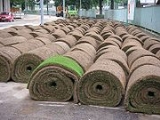
Rollrasen 01
Sod or turf is grass and the part of the soil
Soil

Soil is the naturally occurring, unconsolidated or loose covering on the Earth's surface. Soil is composed of particles of broken rock that have been altered by chemical and environmental processes including weathering and erosion....
 beneath it held together by the root
Root

In vascular plants, the root is the organ of a plant body that typically lies below the surface of the soil. This is not always the case, however, since a root can also be aerial root or aerating ....
s, or a piece of this material.

The term sod may be used to mean turf grown and cut specifically for the establishment of lawn
Lawn

A lawn is an area of recreational or amenity land planted with Poaceae, and sometimes clover and other plants, which are maintained at a low, even height....
s. However, in British English
British English

British English or UK English is the broad term used to distinguish the forms of the English language used in the United Kingdom from forms used elsewhere....
 such material is more usually known as turf, and the word "sod" is limited mainly to agricultural senses (for example for turf when ploughed), or avoided altogether, due to the alternative offensive meaning of the word "sod
Sodomy

Sodomy is a term used today predominantly in law to describe the act of anal intercourse, oral intercourse, as well as bestiality. When used in a religious context, it has a negative connotation....
".

Sod (or turf) for lawns is grown on specialist farms. It is usually grown locally to avoid long transport and drying out and heat buildup of the product. It is sold to landscapers
Landscaping

Landscaping refers to any activity that modifies the visible features of an area of land, including but not limited to:# living organism, such as flora or fauna; or what is commonly referred to as gardening, the art and craft of growing plants with a goal of creating a beautiful environment within the landscape....
, home builders or home owners who use it to establish a lawn quickly and avoid soil erosion. The farms that produce this grass may have many varieties of grass grown in one location to best suit the consumer's use and preference of appearance. It is usually harvested 10 to 18 months after planting. On the farm it undergoes fertilization, frequent watering, frequent mowing and subsequent vacuuming to remove the clippings. It is harvested using specialized equipment, precision cut to standardized sizes. Sod is typically harvested in small square slabs, rolled rectangles, or large 4-foot wide rolls. Some large sod farms may export internationally. Because of the product's short life after harvest, the sod may be washed clean of the soil down to the bare roots (or sprigs) which makes shipping lighter and cheaper. Sod can be used to repair a small area of lawn that has died.

Sodding vs. Seeding


Seed may be blown about by the wind, eaten by birds, or fail due to drought. It takes some weeks to form a visually appealing lawn, and further time before it is robust enough for use.

Turf largely avoids these problems, and with proper care, newly laid sod is usually fully functional within 30 days of installation and its root system is comparable to that of a seeding lawn two or three years older.

Turf is however more expensive, and requires considerably more water for its establishment.

Erosion after seeding may be a concern in some areas near water. Sod reduces erosion by stabilizing the soil in these type of areas.

Cost

Different types of sod will have different pricing. The availability of sod grasses is generally dependent on where the lawn is located climate-wise. For the United States, landscapers in the northern states will generally sod a lawn with either Kentucky bluegrass or tall fescue (Festuca arundinacea).Kentucky bluegrass has a nice deep green color to it, while tall fescue though not as deep green is excellent for areas that receive medium to heavy traffic since it can resist a lot of abuse. The best, some claim, is a compromise between the two, namely, a grass mixture. Mixtures are also preferred for another reason: disease. "Most [grass] diseases will only strike one type of grass, so the damage will probably be limited [when the lawn was built based on a grass mixture]." Mixed grass sod is sold containing a percentage of Kentucky bluegrass, tall fescue, and/or ryegrass to fill this need.

Tilling technique
Using this method the existing lawn is first tilled (rotovated) thoroughly before the sod is applied There are two variations of the tiller technique.

In the first variation, called the tiller-to-the-grass technique, only the top grass is tilled off and the tilled grass is hauled away leaving just soil on which to apply the sod – no grass remains. The remaining soil may be retilled. This creates a smooth and loose bed on which to install the sod. Some landscapers prefer this smooth and loose bed.

In the second variation, called the till-it-all technique, existing grass as well as the soil underneath holding the grass are tilled together. The old grass is in effect mixed in with the existing soil creating the surface on which the sod will be installed. Some landscapers prefer this method because it creates the bed on which the sod is installed upfront and without further effort.

Some prefer not to use a tiller to prepare the area to be sodded. They claim that if a neighbor or children were to walk over the newly established sod in the first few days after the installation, the turf would become uneven. The claim is that the soil underneath is still very loose.

Herbicide application
This technique involves the application of a herbicide to the existing lawn prior to applying the sod. The chemical kills the existing lawn thoroughly within seven to ten days. The landscaper then simply rakes off the dead grass and disposes of it, leaving nothing but plain soil in the area to be sodded. If the soil left behind is not of high quality, a layer or two of top soil may be applied prior to the installation of the sod. The soil is then nicely graded and the sod is installed on top of it.

Application over the existing lawn
With this technique, sod is simply installed over the existing lawn. Since the existing grass is blocked from receiving sunlight, it starts to die within a few days. Sod can be applied over an existing lawn without much concern about the existing grass underneath – it decomposes and becomes fertilizer for the new sod on top of it. This type of sod installation generally costs significantly less than others, since there is no need to haul away the old lawn. When applying over existing lawn it is preferred, though by no means necessary, to remove a strip about four inches wide by two inches deep of the existing lawn beside the edges of sidewalks and other hardscape structures, to reduce the level of the new lawn somewhat at these points, thus concealing the edges of the newly laid turf.

Some don't like this technique out of concern that any weeds that existed in the previous lawn may remain to affect the new lawn. Also some fear that the existing lawn will need to be aerated so the roots of the sod will have somewhere to "catch" on to. However, the technique is used with equally successful results, or better, as the other three sod application methods.

Post Installation Care


Fertilizer
Immediately after sod has been applied, it is important to fertilize it so as to give it a good, robust start. When applying sod, application of starter fertilizer with a 1-1-1 ratio of Nitrogen, Phosphorus, and Potassium may be recommended. The Phosphorus will assist with root development which is important for the successful establishment of sod. Lightly raking the fertilizer into the soil will help minimize the fertilizer from coming in contact directly with the roots and causing possible root burning. When applying sod to slopes, it is best to lay the sod perpendicular to the direction of the slope. This will help prevent rain water from washing out the sod. Sod staples may be applied to hold the sod in place, but are only required on slopes or in ditches. Freshly-installed sod will need regular watering (without over-watering) to encourage the roots to "look" for water on their own and grow into the soil.

Lime and grub killer
For best long-term results, it is important to test the pH of the soil and to apply limestone
Limestone

File:Limestone Formation In Waitomo.jpgLimestone is a sedimentary rock composed largely of the mineral calcite . The deposition of limestone strata is often a by-product and indicator of biological activity in the geology record....
 powder (to the installed sod) if the soil is acidic. Most lawn grasses thrive in 6.0-7.0 pH soil. Root-eating insect larvae may infest the newly-installed turf, and if this happens they can kill the lawn in a week or two. Insecticide may be used to prevent this happening.

Watering
Except in wet weather, newly installed sod will require two waterings per day, for at least three months, and so this technique for lawn establishment is both expensive and wasteful of water. If not watered regularly before the grass has rooted into the soil beneath the turf, the turf may die, either at the edges, in patches, or overall. Constant care and inspection is required during the first year after installation.

As a Building Material

Sod House 1901
Sod has occasionally been cut out in blocks to use as a building material
Building material

Building material is any raw material which is used for a construction purpose. Many naturally occurring substances, such as clay, sand, wood and rocks, even twigs and leaves have been used to construct buildings....
, especially in grassland
Grassland

Grasslands are areas where the vegetation is dominated by grasses and other herbaceous plants . However, sedge and rush families can also be found....
s where grass is plentiful and few other materials are available. For use as a building material, sods are cut out in regular block shapes and laid like brickwork
Brickwork

Brickwork masonry is produced when a bricklayer uses bricks and Mortar to build up structures such as walls, bridges and chimneys. Brickwork is also used to finish openings such as doors or windows in buildings made of other materials....
, although for strength blocks of sod are usually much longer and wider than typical brick
Brick

A brick is a block of ceramic material used in masonry construction, usually laid using mortar ....
s. This construction was common during nineteenth century settlements of the Canadian
Canada

Canada is a country occupying most of northern North America, extending from the Atlantic Ocean in the east to the Pacific Ocean in the west and northward into the Arctic Ocean....
 and American
United States

The United States of America is a Federal government constitutional republic comprising U.S. state and a federal district. The country is situated mostly in central North America, where its Contiguous United States and Washington, D.C., the Capital districts and territories, lie between the Pacific Ocean and Atlantic Oceans, Borders of the U...
 prairie
Prairie

Prairie refers to temperate grasslands of North America. These are areas of low topographic relief that historically supported grasses and herbs, with few or no trees, having a generally mesic habitat climate....
s. Common dimensions of sod blocks used in these pioneer abodes were 2 ft by 1 ft by 6 in (600 × 300 × 150 mm). Cutting sods for building may be done with a spade
Spade

A spade is a tool designed primarily for the purpose of digging or removing earth. The first spade was made of riven wood. After the art of metalworking was discovered, spades were made with sharper tips of metal....
 and axe
Axe

The axe, or ax, is an implement that has been used for Millennium to shape, split and cut wood, harvest Lumber, as a weapon and a ceremony or Heraldry symbol....
, but for large scale work a modified plough
Plough

The plough is a tool used in farming for initial cultivation of soil in preparation for sowing seed or planting. It has been a basic instrument for most of recorded history, and represents one of the major advances in agriculture....
 is used.

The bare sod is prone to damage from rain
Rain

Rain is liquid precipitation . On Earth, it is the condensation of atmospheric water vapor into droplet heavy enough to fall, often making it to the surface....
 or being knocked down, so the outer walls are usually protected with a layer of stucco
Stucco

Stucco or render is a material made of an Construction aggregate, a binder , and water. Stucco is applied wet and hardens to a very dense solid....
 or wood paneling. Similarly, bare sod inside is dirty, so the interior may be lined with canvas
Canvas

Canvas is an extremely heavy-duty plain weave cloth used for making sails, tents, marquees, backpacks, and other functions where sturdiness is required....
, tarpaper, or plaster
Plaster

The term plaster can refer to plaster of Paris, lime plaster, or cement plaster. This article deals mainly with plaster of Paris.Plaster of Paris is a type of building material based on calcium sulfate Hydrate, nominally CaSO4?0.5H2O....
. A variety of roofing methods can be used, and the house can be fitted with conventional window
Window

File:OldShipWindows.jpgA window is an opening in a wall that allows the passage of light and, if not closed or sealed, air and sound. Windows are usually glazed or covered in some other transparency or translucent material....
s and door
Door

A door is a moveable barrier used to cover an opening. Doors are used widely and are found in walls or partitions of a building or space, furniture such as cupboards, cage s, vehicles, and containers....
s. Sod houses have the advantages of being very cheap, and well insulated
Thermal insulation

The term thermal insulation can refer to materials used to reduce the rate of heat transfer, or the methods and processes used to reduce heat transfer....
, so that they are cool in summer and warm in winter. The main disadvantages are that they tend to be damp, and deteriorate quickly unless maintained.

Sod has also been used in fortification
Fortification

Fortifications are military constructions and buildings designed for defense in warfare and military bases. Humans have constructed defensive works for many thousands of years, in a variety of increasingly complex designs....
. Blockhouse
Blockhouse

In military science, a blockhouse is a small, isolated fort in the form of a single building. It is intended to serve as a defensive strongpoint against any enemy which does not possess siege equipment or, in modern times, artillery....
s have been constructed from sod, and it has also been used to make very effective berm
Berm

A berm is a level space, shelf, or raised barrier separating two areas. Berm is a loanword from Dutch language....
s or low defensive wall
Defensive wall

A defensive wall is a fortification used to defend a city or settlement from potential aggressors. In ancient to modern times, they were used to enclose settlements....
s. The Roman-built Antonine Wall
Antonine Wall

The Antonine Wall also known as the Severan Wall, is a rock and sod fortification, built by the Roman Empire across what is now the central belt of Scotland and is also known as the Clyde-Forth frontier line....
 in Scotland
Scotland

conventional_long_name = ScotlandAlba|common_name= Scotland|image_flag = Flag of Scotland.svg|flag_width = 130px...
 was largely made from sod.

Because of its cheapness and availability, sod walls could easily be made thick enough to be bullet
Bullet

A bullet is a hard projectile propelled by a firearm, Sling , or air gun and is normally made from metal. A bullet does not contain explosives, but damages the intended target by tissue or mechanical disruption through impact or penetration....
proof.

See also

  • Cob (building)
    Cob (building)

    Cob is a building material consisting of clay, sand, straw, water, and soil, similar to adobe. Cob is fireproof, resistant to seismic activity, and inexpensive....
  • Sod house
    Sod house

    The sod house or "Soddy" was a corollary to the log cabin during frontier settlement of the United States and Canada. The prairie lacked standard building materials such as wood or stone; however, sod from thickly-rooted prairie grass was abundant....
  • Divot
  • Peat
    Peat

    Peat is an accumulation of partially decayed vegetation biological tissue. Peat forms in wetlands or peatlands, variously called bogs, Moorland, muskegs, pocosins, mires, and peat swamp forests....