

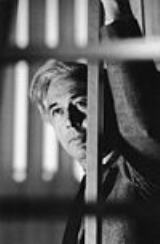
Robert Bresson

Encyclopedia
Robert Bresson was a French film director
known for his spiritual, ascetic style.
, Puy-de-Dôme
, the son of Marie-Élisabeth (née Clausels) and Léon Bresson. Little is known of his early life and the year of his birth, 1901 or 1907, varies depending on the source. He was educated at Lycée Lakanal
in Sceaux, Hauts-de-Seine
, close to Paris, and turned to painting after graduating. Three formative influences in his early life seem to have a mark on his films - Catholicism
, art and his experiences as a prisoner of war
.
Initially also a photographer, Bresson made his first short film, Les Affaires publiques (Public Affairs) in 1934. During World War II, he spent over a year in a prisoner-of-war camp - an experience which informs Un condamné à mort s'est échappé ou Le vent souffle où il veut
(A Man Escaped). In a career that spanned fifty years, Bresson made only 13 feature-length films. This reflects his meticulous approach to the filmmaking process and his non-commercial preoccupations. Difficulty finding funding for his projects was also a factor.
upbringing and belief system lie behind the thematic structure of most of his films. Recurring themes under this interpretation include salvation
, redemption, defining and revealing the human soul, and metaphysical transcendence of a limiting and materialistic world. An example is his 1956 feature A Man Escaped
, where a seemingly simple plot of a prisoner of war's escape can be read as a metaphor
for the mysterious process of salvation.
Bresson's films can also be understood as critiques of French society and the wider world, with each revealing the director's sympathetic if unsentimental view on its victims. That the main characters of Bresson's most contemporary films, L'Argent
and The Devil, Probably (1977), reach similarly unsettling conclusions about life indicates to some the director's feelings towards the culpability of modern society in the dissolution of individuals. Indeed, of an earlier protagonist he said, "Mouchette offers evidence of misery and cruelty. She is found everywhere: wars, concentration camps, tortures, assassinations." In 1975, Bresson published Notes sur le Cinématographe (most commonly translated as "notes on cinematography"), in which he argues for a unique sense of the term, "cinematography
". For Bresson, cinematography is the higher function of cinema. Whereas a movie is in essence "only" filmed theatre, cinematography is an attempt to create a new language of moving images and sounds.
of cinema, not only for the strong Catholic themes found throughout his oeuvre, but also for his notable contributions to the art of film. His style can be detected through his use of sound, associating selected sounds with images or characters; paring dramatic form to its essentials by the spare use of music; and through his infamous 'actor-model' methods of directing his almost exclusively non-professional actors. He has influenced a number of other filmmakers, including Andrei Tarkovsky
, Michael Haneke
, Jim Jarmusch
, the Dardenne brothers
and Paul Schrader
, whose book Transcendental Style in Film: Ozu
, Bresson, Dreyer
(ISBN 0-306-80335-6) includes a detailed critical analysis.
Bresson's book Notes on Cinematography (1975) is one of the most respected books on film theory and criticism. His theories about film greatly influenced other filmmakers such as the French New Wave
directors.
"Don't run after poetry. It penetrates unaided through the cracks." -Robert Bresson
Film director
A film director is a person who directs the actors and film crew in filmmaking. They control a film's artistic and dramatic nathan roach, while guiding the technical crew and actors.-Responsibilities:...
known for his spiritual, ascetic style.
Life and career
Bresson was born at Bromont-LamotheBromont-Lamothe
Bromont-Lamothe is a commune in the Puy-de-Dôme department in Auvergne in central France.-References:*...
, Puy-de-Dôme
Puy-de-Dôme
Puy-de-Dôme is a department in the centre of France named after the famous dormant volcano, the Puy-de-Dôme.Inhabitants were called Puydedomois until December 2005...
, the son of Marie-Élisabeth (née Clausels) and Léon Bresson. Little is known of his early life and the year of his birth, 1901 or 1907, varies depending on the source. He was educated at Lycée Lakanal
Lycée Lakanal
Lycée Lakanal is a secondary public school in Sceaux, France. It was named after Joseph Lakanal, a French politician, and an original member of the Institut de France. The school also offers a middle school and highly ranked "classes préparatoires" undergraduate training...
in Sceaux, Hauts-de-Seine
Sceaux, Hauts-de-Seine
Sceaux is a commune in the southern suburbs of Paris, France. It is located from the center of Paris.-Wealth:Sceaux is famous for the Château of Sceaux, set in its large park , designed by André Le Nôtre, measuring...
, close to Paris, and turned to painting after graduating. Three formative influences in his early life seem to have a mark on his films - Catholicism
Catholicism
Catholicism is a broad term for the body of the Catholic faith, its theologies and doctrines, its liturgical, ethical, spiritual, and behavioral characteristics, as well as a religious people as a whole....
, art and his experiences as a prisoner of war
Prisoner of war
A prisoner of war or enemy prisoner of war is a person, whether civilian or combatant, who is held in custody by an enemy power during or immediately after an armed conflict...
.
Initially also a photographer, Bresson made his first short film, Les Affaires publiques (Public Affairs) in 1934. During World War II, he spent over a year in a prisoner-of-war camp - an experience which informs Un condamné à mort s'est échappé ou Le vent souffle où il veut
A Man Escaped
A Man Escaped or: The Wind Bloweth Where It Listeth is a 1956 French film directed by Robert Bresson. It is based on the memoirs of André Devigny, a prisoner of war held at Fort Montluc during World War II. The protagonist of the film is called Fontaine...
(A Man Escaped). In a career that spanned fifty years, Bresson made only 13 feature-length films. This reflects his meticulous approach to the filmmaking process and his non-commercial preoccupations. Difficulty finding funding for his projects was also a factor.
Themes
Bresson's early artistic focus was to separate the language of cinema from the theatre, which often heavily involves the actor's performance to drive the work. With his 'actor-model' technique, Bresson's actors were required to repeat multiple takes of each scene until all semblances of 'performance' were stripped away, leaving a stark effect that registers as both subtle and raw, and one that can only be found in the cinema. Some feel that Bresson's CatholicRoman Catholic Church
The Catholic Church, also known as the Roman Catholic Church, is the world's largest Christian church, with over a billion members. Led by the Pope, it defines its mission as spreading the gospel of Jesus Christ, administering the sacraments and exercising charity...
upbringing and belief system lie behind the thematic structure of most of his films. Recurring themes under this interpretation include salvation
Salvation
Within religion salvation is the phenomenon of being saved from the undesirable condition of bondage or suffering experienced by the psyche or soul that has arisen as a result of unskillful or immoral actions generically referred to as sins. Salvation may also be called "deliverance" or...
, redemption, defining and revealing the human soul, and metaphysical transcendence of a limiting and materialistic world. An example is his 1956 feature A Man Escaped
A Man Escaped
A Man Escaped or: The Wind Bloweth Where It Listeth is a 1956 French film directed by Robert Bresson. It is based on the memoirs of André Devigny, a prisoner of war held at Fort Montluc during World War II. The protagonist of the film is called Fontaine...
, where a seemingly simple plot of a prisoner of war's escape can be read as a metaphor
Metaphor
A metaphor is a literary figure of speech that uses an image, story or tangible thing to represent a less tangible thing or some intangible quality or idea; e.g., "Her eyes were glistening jewels." Metaphor may also be used for any rhetorical figures of speech that achieve their effects via...
for the mysterious process of salvation.
Bresson's films can also be understood as critiques of French society and the wider world, with each revealing the director's sympathetic if unsentimental view on its victims. That the main characters of Bresson's most contemporary films, L'Argent
L'Argent (1983 film)
L'Argent is a 1983 French drama film directed by Robert Bresson. It is loosely inspired by the first part of Leo Tolstoy's nouvelle The Forged Coupon. It was Bresson's last film. It earned its maker the Director's Prize at the 1983 Cannes Film Festival.-Plot:A young man enters his father's study...
and The Devil, Probably (1977), reach similarly unsettling conclusions about life indicates to some the director's feelings towards the culpability of modern society in the dissolution of individuals. Indeed, of an earlier protagonist he said, "Mouchette offers evidence of misery and cruelty. She is found everywhere: wars, concentration camps, tortures, assassinations." In 1975, Bresson published Notes sur le Cinématographe (most commonly translated as "notes on cinematography"), in which he argues for a unique sense of the term, "cinematography
Cinematography
Cinematography is the making of lighting and camera choices when recording photographic images for cinema. It is closely related to the art of still photography...
". For Bresson, cinematography is the higher function of cinema. Whereas a movie is in essence "only" filmed theatre, cinematography is an attempt to create a new language of moving images and sounds.
Legacy
Bresson is often referred to as a patron saintPatron saint
A patron saint is a saint who is regarded as the intercessor and advocate in heaven of a nation, place, craft, activity, class, clan, family, or person...
of cinema, not only for the strong Catholic themes found throughout his oeuvre, but also for his notable contributions to the art of film. His style can be detected through his use of sound, associating selected sounds with images or characters; paring dramatic form to its essentials by the spare use of music; and through his infamous 'actor-model' methods of directing his almost exclusively non-professional actors. He has influenced a number of other filmmakers, including Andrei Tarkovsky
Andrei Tarkovsky
Andrei Arsenyevich Tarkovsky was a Soviet and Russian filmmaker, writer, film editor, film theorist, theatre and opera director, widely regarded as one of the finest filmmakers of the 20th century....
, Michael Haneke
Michael Haneke
Michael Haneke is a German born Austrian filmmaker and writer best known for his bleak and disturbing style. His films often document problems and failures in modern society. Haneke has worked in television‚ theatre and cinema. He is also known for raising social issues in his work...
, Jim Jarmusch
Jim Jarmusch
James R. "Jim" Jarmusch is an American independent film director, screenwriter, actor, producer, editor and composer. Jarmusch has been a major proponent of independent cinema, particularly during the 1980s and 1990s.-Early life:...
, the Dardenne brothers
Dardenne brothers
Brothers Jean-Pierre Dardenne and Luc Dardenne are a Belgian filmmaking duo...
and Paul Schrader
Paul Schrader
Paul Joseph Schrader is an American screenwriter, film director, and former film critic. Apart from his credentials as a director, Schrader is most notably known for his screenplays for Martin Scorsese’s Taxi Driver and Raging Bull....
, whose book Transcendental Style in Film: Ozu
Yasujiro Ozu
was a prominent Japanese film director and script writer. He is known for his distinctive technical style, developed during the silent era. Marriage and family, especially the relationships between the generations, are among the most persistent themes in his body of work...
, Bresson, Dreyer
Carl Theodor Dreyer
Carl Theodor Dreyer, Jr. was a Danish film director. He is regarded by many critics and filmmakers as one of the greatest directors in cinema.-Life:Dreyer was born illegitimate in Copenhagen, Denmark...
(ISBN 0-306-80335-6) includes a detailed critical analysis.
Bresson's book Notes on Cinematography (1975) is one of the most respected books on film theory and criticism. His theories about film greatly influenced other filmmakers such as the French New Wave
French New Wave
The New Wave was a blanket term coined by critics for a group of French filmmakers of the late 1950s and 1960s, influenced by Italian Neorealism and classical Hollywood cinema. Although never a formally organized movement, the New Wave filmmakers were linked by their self-conscious rejection of...
directors.
Quotes
"My movie is born first in my head, dies on paper; is resuscitated by the living persons and real objects I use, which are killed on film but, placed in a certain order and projected on to a screen, come to life again like flowers in water." - Robert Bresson"Don't run after poetry. It penetrates unaided through the cracks." -Robert Bresson
Awards and nominations
Robert Bresson was given the Career Golden Lion in 1989 by the Venice Film FestivalVenice Film Festival
The Venice International Film Festival is the oldest international film festival in the world. Founded by Count Giuseppe Volpi in 1932 as the "Esposizione Internazionale d'Arte Cinematografica", the festival has since taken place every year in late August or early September on the island of the...
- Journal d'un curé de campagne (1951) - Diary of a Country Priest
- Venice Film FestivalVenice Film FestivalThe Venice International Film Festival is the oldest international film festival in the world. Founded by Count Giuseppe Volpi in 1932 as the "Esposizione Internazionale d'Arte Cinematografica", the festival has since taken place every year in late August or early September on the island of the...
International Award Winner - Venice Film Festival Italian Film Critics Award Winner
- Venice Film Festival OCIC Award Winner
- Venice Film Festival
- Un condamné à mort s'est échappé ou Le vent souffle où il veutA Man EscapedA Man Escaped or: The Wind Bloweth Where It Listeth is a 1956 French film directed by Robert Bresson. It is based on the memoirs of André Devigny, a prisoner of war held at Fort Montluc during World War II. The protagonist of the film is called Fontaine...
(1956) - A Man Escaped- Cannes Film FestivalCannes Film FestivalThe Cannes International Film Festival , is an annual film festival held in Cannes, France, which previews new films of all genres including documentaries from around the world. Founded in 1946, it is among the world's most prestigious and publicized film festivals...
Prix de la mise en scène Winner
- Cannes Film Festival
- PickpocketPickpocket (film)Pickpocket is a 1959 film by the French director Robert Bresson. It starred Martin LaSalle, who was a nonprofessional actor at the time, in the title role, with Marika Green as the ingénue...
(1959) - Pickpocket- Berlin Film Festival10th Berlin International Film FestivalThe 10th annual Berlin International Film Festival was held from 24 June to 5 July 1960.-Jury:* Harold Lloyd * Georges Auric* Henry Reed* Sohrab Modi* Floris Luigi Ammannati* Hidemi Ima* Joaquín de Entrambasaguas* Frank Wisbar...
Golden Bear Nominee
- Berlin Film Festival
- Procès de Jeanne d'ArcProcès de Jeanne d'ArcThe Trial of Joan of Arc is a 1962 historical film by the French director Robert Bresson. Joan of Arc is played by Florence Delay.As usual in Bresson's mature films, The Trial of Joan of Arc stars non-professional performers and is filmed in an extremely spare, restrained style...
(1962) - The Trial of Joan of Arc- Cannes Film Festival Special Prix du Jury Winner
- Cannes Film Festival OCIC Award Winner
- Au hasard BalthazarAu hasard BalthazarAu hasard Balthazar, , also known as Balthazar, is a 1966 French film directed by Robert Bresson, starring Anne Wiazemsky.-Plot:...
(1966) - Balthazar- Venice Film Festival OCIC Award Winner
- Venice Film Festival Jury Hommage
- MouchetteMouchetteMouchette is a 1967 French film directed by Robert Bresson, starring Nadine Nortier, and Jean-Claude Guilbert. It is based on the novel by Georges Bernanos. "Mouchette" means "little fly" in French...
(1967)- Cannes Film Festival OCIC Award Winner
- Venice Film Festival Pasinetti Award Winner
- Quatre nuits d'un rêveurFour Nights of a DreamerFour Nights of a Dreamer is a 1971 French drama film directed by Robert Bresson and starring Isabelle Weingarten. The film was entered into the 21st Berlin International Film Festival...
(1971) - Four Nights of a Dreamer- Berlin Film Festival21st Berlin International Film FestivalThe 21st annual Berlin International Film Festival was held from June 26 to July 6, 1971.-Jury:* Bjørn Rasmussen * Ida Ehre* Walter Albuquerque Mello* Paul Claudon* Kenneth Harper* Mani Kaul* Charlotte Kerr* Rex Reed* Giancarlo Zagni...
OCIC Award Winner
- Berlin Film Festival
- Lancelot du LacLancelot du Lac (film)Lancelot du Lac is 1974 film that was written and directed by Robert Bresson. It relates the story of Lancelot and Guinevere's love as Camelot and the Round Table fall apart...
(1974)- Lancelot of the Lake- Cannes Film Festival FIPRESCI Prize Winner (Bresson refused this award)
- Le diable probablement (1977) - The Devil Probably
- Berlin Film Festival27th Berlin International Film FestivalThe 27th annual Berlin International Film Festival was held from June 24 to July 5, 1977.-Jury:* Senta Berger * Ellen Burstyn* Helène Vager* Rainer Werner Fassbinder* Derek Malcolm* Andrej Michaolkow-Kontschalowski* Ousmane Sembène...
Silver Bear - Special Jury PrizeJury Grand PrixThe Jury Grand Prix is a Silver Bear award given by the jury at the Berlin International Film Festival to one of the feature films in competition...
. - Berlin Film Festival Interfilm Award Winner
- Berlin Film Festival OCIC Award Winner
- Berlin Film Festival
- L'argentL'Argent (1983 film)L'Argent is a 1983 French drama film directed by Robert Bresson. It is loosely inspired by the first part of Leo Tolstoy's nouvelle The Forged Coupon. It was Bresson's last film. It earned its maker the Director's Prize at the 1983 Cannes Film Festival.-Plot:A young man enters his father's study...
(1983) - Money- Cannes Film Festival Prix de la mise en scène Winner
Feature films
- Les Anges du péché (1943)
- Angels of the Streets
- Les dames du Bois de BoulogneLes dames du Bois de BoulogneLes dames du Bois de Boulogne is a 1945 French film directed by Robert Bresson. It is a modern adaptation of a section of Denis Diderot's Jacques le fataliste , telling the story of a man who is tricked into marrying a former prostitute.Les Dames was Bresson's second feature...
(1945)- The Ladies of the Bois de Boulogne
- Journal d'un curé de campagne (1951)
- Diary of a Country Priest
- Un condamné à mort s'est échappé ou Le vent souffle où il veutA Man EscapedA Man Escaped or: The Wind Bloweth Where It Listeth is a 1956 French film directed by Robert Bresson. It is based on the memoirs of André Devigny, a prisoner of war held at Fort Montluc during World War II. The protagonist of the film is called Fontaine...
(1956)- A Man Escaped
- PickpocketPickpocket (film)Pickpocket is a 1959 film by the French director Robert Bresson. It starred Martin LaSalle, who was a nonprofessional actor at the time, in the title role, with Marika Green as the ingénue...
(1959) - Procès de Jeanne d'ArcProcès de Jeanne d'ArcThe Trial of Joan of Arc is a 1962 historical film by the French director Robert Bresson. Joan of Arc is played by Florence Delay.As usual in Bresson's mature films, The Trial of Joan of Arc stars non-professional performers and is filmed in an extremely spare, restrained style...
(1962)- The Trial of Joan of Arc
- Au hasard BalthazarAu hasard BalthazarAu hasard Balthazar, , also known as Balthazar, is a 1966 French film directed by Robert Bresson, starring Anne Wiazemsky.-Plot:...
(1966)- Balthazar
- MouchetteMouchetteMouchette is a 1967 French film directed by Robert Bresson, starring Nadine Nortier, and Jean-Claude Guilbert. It is based on the novel by Georges Bernanos. "Mouchette" means "little fly" in French...
(1967) - Une femme douce (1969)
- A Gentle Woman
- Quatre nuits d'un rêveur (1971)
- Four Nights of a Dreamer
- Lancelot du LacLancelot du Lac (film)Lancelot du Lac is 1974 film that was written and directed by Robert Bresson. It relates the story of Lancelot and Guinevere's love as Camelot and the Round Table fall apart...
(1974)- Lancelot of the Lake
- Le diable probablement (1977)
- The Devil Probably
- L'argentL'Argent (1983 film)L'Argent is a 1983 French drama film directed by Robert Bresson. It is loosely inspired by the first part of Leo Tolstoy's nouvelle The Forged Coupon. It was Bresson's last film. It earned its maker the Director's Prize at the 1983 Cannes Film Festival.-Plot:A young man enters his father's study...
(1983)- Money
By Robert Bresson
- Notes sur le Cinématographe – translated as Notes on Cinematography and Notes on the Cinematographer in different English editions.
About Robert Bresson
- Robert Bresson: A Passion for Film by Tony Pipolo (Oxford University Press; 407 pages; 2010) pays particular attention to psychosexual aspects of the French filmmaker's 13 features, from Les Anges du peche (1943) to L'Argent (1983).
- La politique des auteurs, edited by André BazinAndré BazinAndré Bazin was a renowned and influential French film critic and film theorist.-Life:Bazin was born in Angers, France, in 1918...
. - Robert Bresson (Cinematheque Ontario Monographs, No. 2), edited by James Quandt
- Transcendental Style in Film: Bresson, Ozu, Dreyer by Paul SchraderPaul SchraderPaul Joseph Schrader is an American screenwriter, film director, and former film critic. Apart from his credentials as a director, Schrader is most notably known for his screenplays for Martin Scorsese’s Taxi Driver and Raging Bull....
- Robert Bresson: A Spiritual Style in Film, by Joseph Cunneen
- Robert Bresson, by Philippe Arnauld, Cahiers du cinema, 1986
- The Films of Robert Bresson, Ian Cameron (ed.), New York: Praeger Publishers, 1969.
- Robert Bresson, by Keith Reader, Manchester University Press, 2000.
- "Robert Bresson", a poem by Patti Smith from her 1978 book BabelBabel (book)Babel is a book by Patti Smith, published in 1978, and contains Smith's poems along with her prose, lyrics, pictures and drawings.- Radio Ethiopia :# "Notice"# "Italy"# "The Tapper Extracts"# "Grant"# "Street of the Guides"# "Rimbaud Dead"# "Sohl"...
- "Spiritual style in the films of Robert Bresson", a chapter in Susan SontagSusan SontagSusan Sontag was an American author, literary theorist, feminist and political activist whose works include On Photography and Against Interpretation.-Life:...
's Against Interpretation and other essaysAgainst InterpretationAgainst Interpretation and Other Essays is a collection of essays by Susan Sontag which was published in 1966. It includes some of Sontag's best-known works, including "On Style", "Notes on 'Camp'", and the titular essay "Against Interpretation"...
, New York: Picador, 1966.
Informational
- Robert-Bresson.com: Resource dedicated to Bresson's films
- A Bresson bibliography (2008)
- Article about the cinema of Robert Bresson
- RobertBresson.org: Videos, Books, Notes... (French)