

Middle Passage

Encyclopedia
Triangular trade
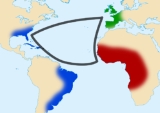
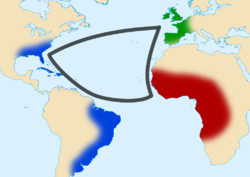
Triangular trade, or triangle trade, is a historical term indicating among three ports or regions. Triangular trade usually evolves when a region has export commodities that are not required in the region from which its major imports come...
in which millions of people from Africa
Africa
Africa is the world's second largest and second most populous continent, after Asia. At about 30.2 million km² including adjacent islands, it covers 6% of the Earth's total surface area and 20.4% of the total land area...
were shipped to the New World
New World
The New World is one of the names used for the Western Hemisphere, specifically America and sometimes Oceania . The term originated in the late 15th century, when America had been recently discovered by European explorers, expanding the geographical horizon of the people of the European middle...
, as part of the Atlantic slave trade
Atlantic slave trade
The Atlantic slave trade, also known as the trans-atlantic slave trade, refers to the trade in slaves that took place across the Atlantic ocean from the sixteenth through to the nineteenth centuries...
. Ships departed Europe
Europe
Europe is, by convention, one of the world's seven continents. Comprising the westernmost peninsula of Eurasia, Europe is generally 'divided' from Asia to its east by the watershed divides of the Ural and Caucasus Mountains, the Ural River, the Caspian and Black Seas, and the waterways connecting...
for African markets with manufactured goods, which were traded for purchased or kidnapped Africans, who were transported across the Atlantic as slaves; the slaves were then sold or traded for raw materials, which would be transported back to Europe to complete the voyage. A single voyage on the Middle Passage was a large financial undertaking, and they were generally organized by companies or groups of investors rather than individuals.
Traders from the Americas
Americas
The Americas, or America , are lands in the Western hemisphere, also known as the New World. In English, the plural form the Americas is often used to refer to the landmasses of North America and South America with their associated islands and regions, while the singular form America is primarily...
and Caribbean
Caribbean
The Caribbean is a crescent-shaped group of islands more than 2,000 miles long separating the Gulf of Mexico and the Caribbean Sea, to the west and south, from the Atlantic Ocean, to the east and north...
received the enslaved Africans. European powers such as Portugal
Portugal
Portugal , officially the Portuguese Republic is a country situated in southwestern Europe on the Iberian Peninsula. Portugal is the westernmost country of Europe, and is bordered by the Atlantic Ocean to the West and South and by Spain to the North and East. The Atlantic archipelagos of the...
, England
England
England is a country that is part of the United Kingdom. It shares land borders with Scotland to the north and Wales to the west; the Irish Sea is to the north west, the Celtic Sea to the south west, with the North Sea to the east and the English Channel to the south separating it from continental...
, Spain
Spain
Spain , officially the Kingdom of Spain languages]] under the European Charter for Regional or Minority Languages. In each of these, Spain's official name is as follows:;;;;;;), is a country and member state of the European Union located in southwestern Europe on the Iberian Peninsula...
, France
France
The French Republic , The French Republic , The French Republic , (commonly known as France , is a unitary semi-presidential republic in Western Europe with several overseas territories and islands located on other continents and in the Indian, Pacific, and Atlantic oceans. Metropolitan France...
, the Netherlands
Netherlands
The Netherlands is a constituent country of the Kingdom of the Netherlands, located mainly in North-West Europe and with several islands in the Caribbean. Mainland Netherlands borders the North Sea to the north and west, Belgium to the south, and Germany to the east, and shares maritime borders...
, Denmark
Denmark
Denmark is a Scandinavian country in Northern Europe. The countries of Denmark and Greenland, as well as the Faroe Islands, constitute the Kingdom of Denmark . It is the southernmost of the Nordic countries, southwest of Sweden and south of Norway, and bordered to the south by Germany. Denmark...
, Sweden
Sweden
Sweden , officially the Kingdom of Sweden , is a Nordic country on the Scandinavian Peninsula in Northern Europe. Sweden borders with Norway and Finland and is connected to Denmark by a bridge-tunnel across the Öresund....
, and Brandenburg
Brandenburg
Brandenburg is one of the sixteen federal-states of Germany. It lies in the east of the country and is one of the new federal states that were re-created in 1990 upon the reunification of the former West Germany and East Germany. The capital is Potsdam...
, as well as traders from Brazil
Brazil
Brazil , officially the Federative Republic of Brazil , is the largest country in South America. It is the world's fifth largest country, both by geographical area and by population with over 192 million people...
and North America
North America
North America is a continent wholly within the Northern Hemisphere and almost wholly within the Western Hemisphere. It is also considered a northern subcontinent of the Americas...
, took part in this trade. The enslaved Africans came mostly from eight regions: Senegambia, Upper Guinea
Upper Guinea
Upper Guinea or la Haute-Guinée is a large plain covering eastern Guinea, Sierra Leone, Liberia and extending into north western Côte d'Ivoire. Mostly forming the upper watershed of the River Niger, it is sparsely populated and is home to the Haut Niger National Park.Upper Guinea can also refer to...
, Windward Coast, Gold Coast
Gold Coast (British colony)
The Gold Coast was a British colony on the Gulf of Guinea in west Africa that became the independent nation of Ghana in 1957.-Overview:The first Europeans to arrive at the coast were the Portuguese in 1471. They encountered a variety of African kingdoms, some of which controlled substantial...
, Bight of Benin
Bight of Benin
The Bight of Benin is a bight on the western African coast that extends eastward for about 400 miles from Cape St. Paul to the Nun outlet of the Niger River. To the east it is continued by the Bight of Bonny . The bight is part of the Gulf of Guinea...
, Bight of Biafra, West Central Africa and Southeastern Africa.
An estimated 15% of the Africans died at sea, with mortality rate
Mortality rate
Mortality rate is a measure of the number of deaths in a population, scaled to the size of that population, per unit time...
s considerably higher in Africa itself in the process of capturing and transporting indigenous peoples to the ships. The total number of African deaths directly attributable to the Middle Passage voyage is estimated at up to two million; a broader look at African deaths directly attributable to the institution of slavery from 1500 to 1900 suggests up to four million African deaths.
For two hundred years, 1440–1640, Portuguese slavers had a near monopoly on the export of slaves from Africa. During the eighteenth century, when the slave trade transported about 6 million Africans, British slavers carried almost 2.5 million.
Journey
The duration of the transatlantic voyage varied widely, from one to six months depending on weather conditions. The journey became more efficient over the centuries; while an average transatlantic journey of the early sixteenth century lasted several months, by the nineteenth century the crossing often required fewer than six weeks.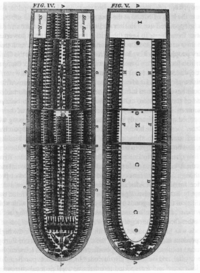
Most contemporary historians estimate that between 9.4 and 12 million Africans arrived in the New World. Disease and starvation due to the length of the passage were the main contributors to the death toll with amoebic dysentery
Amoebic dysentery
Amoebic dysentery is a type of dysentery caused primarily by the amoeba Entamoeba histolytica. Amoebic dysentery is transmitted through contaminated food and water. Amoebae spread by forming infective cysts which can be found in stools, and spread if whoever touches them does not sanitize their...
and scurvy
Scurvy
Scurvy is a disease resulting from a deficiency of vitamin C, which is required for the synthesis of collagen in humans. The chemical name for vitamin C, ascorbic acid, is derived from the Latin name of scurvy, scorbutus, which also provides the adjective scorbutic...
causing the majority of deaths. Additionally, outbreaks of smallpox
Smallpox
Smallpox was an infectious disease unique to humans, caused by either of two virus variants, Variola major and Variola minor. The disease is also known by the Latin names Variola or Variola vera, which is a derivative of the Latin varius, meaning "spotted", or varus, meaning "pimple"...
, syphilis
Syphilis
Syphilis is a sexually transmitted infection caused by the spirochete bacterium Treponema pallidum subspecies pallidum. The primary route of transmission is through sexual contact; however, it may also be transmitted from mother to fetus during pregnancy or at birth, resulting in congenital syphilis...
, measles
Measles
Measles, also known as rubeola or morbilli, is an infection of the respiratory system caused by a virus, specifically a paramyxovirus of the genus Morbillivirus. Morbilliviruses, like other paramyxoviruses, are enveloped, single-stranded, negative-sense RNA viruses...
, and other diseases spread rapidly in the close-quarter compartments. The rate of death increased with the length of the voyage, since the incidence of dysentery and of scurvy increased with longer stints at sea as the quality and amount of food and water diminished. In addition to physical sickness, many slaves became too depressed to eat or function efficiently due to loss of freedom, family, security, and their own humanity.
Slave treatment and resistance
While treatment of slaves on the passage was varied, slaves' treatment was often horrific because the captured African men and women were considered less than human; they were "cargo," or "goods" and treated as such; they were transported for marketing. For example, the ZongZong Massacre
The Zong Massacre was a mass-killing of African slaves that took place on November 29th, 1781, on the Zong, a British slave ship owned by James Gregson and colleagues in a Liverpool slave-trading firm....
, a British slaver, took too many slaves on its voyage to the New World. Overcrowding combined with malnutrition and disease killed several crew members and around 60 slaves. Bad weather made the Zongs voyage slow; the captain decided to drown his slaves at sea, so the owners could collect insurance on the slaves. Over 100 slaves were killed and a number of slaves chose to kill themselves. The Zong incident became fuel for the abolitionist movement and a major court case, as the insurance company refused to compensate for the loss.
While slaves were generally kept fed and supplied with drink, as healthy slaves were more valuable, if resources ran low on the long, unpredictable voyages, the crew received preferential treatment. Slave punishment was very common, as on the voyage the crew had to turn independent people into obedient slaves. Whipping and use of the cat o' nine tails
Cat o' nine tails
The cat o' nine tails, commonly shortened to the cat, is a type of multi-tailed whipping device that originated as an implement for severe physical punishment, notably in the Royal Navy and Army of the United Kingdom, and also as a judicial punishment in Britain and some other...
was a common occurrence; sometimes slaves were beaten for “melancholy.” The worst punishments were for rebelling; in one instance a captain punished a failed rebellion by killing one involved slave immediately, and forcing two other slaves to eat his heart and liver.
Slaves resisted in a variety of ways. The two most common types of resistance were refusal to eat and suicide. Suicide was a frequent occurrence, often by refusal of food or medicine or jumping overboard, as well as by a variety of other opportunistic means. Over the centuries, some African peoples, such as the Kru, came to be understood as holding substandard value as slaves, because they developed a reputation for being too proud for slavery, and for attempting suicide immediately upon losing their freedom. Both suicide and self-starving were prevented as much as possible by slaver crews; slaves were often force-fed or tortured until they ate, some still managed to starve themselves to death; slaves were kept away from means of suicide, and the sides of the deck were often netted. Slaves were still successful, especially at jumping overboard. Often when an uprising failed, the mutineers would jump en masse into the sea. Slaves generally believed that if they jumped overboard, they would be returned to their family and friends in their village, or to their ancestors in the afterlife. Suicide by jumping overboard was such a problem that captains had to address it directly in many cases. They used the sharks that followed the ships as a terror weapon. One captain, who had a rash of suicides on his ship, took a woman and lowered her into the water on a rope, and pulled her out as fast as possible. When she came in view, the sharks had already killed her—and bitten off the lower half of her body.
Slave uprisings were fairly common, but few were successful (notably that on the Amistad
Amistad (1841)
The Amistad, also known as United States v. Libellants and Claimants of the Schooner Amistad, 40 U.S. 518 , was a United States Supreme Court case resulting from the rebellion of slaves on board the Spanish schooner Amistad in 1839...
, which had a key effect on abolition in the US):
When we found ourselves at last taken away, death was more preferable than life, and a plan was concerted amongst us, that we might burn and blow up the ship, and to perish all together in the flames.
The number of participants varied widely, often the uprisings would end with the death of a few slaves and crew, and the surviving rebels were punished or executed to be made examples to the rest of the slaves on board.
Slaves also resisted through certain manifestations of their religions
African Traditional Religion
The traditional religions indigenous to Africa have, for most of their existence, been orally rather than scripturally transmitted. They are generally associated with animism. Most have ethno-based creations stories...
and mythology. They would appeal to their gods for protection and vengeance upon their captors, and would also try to curse and otherwise harm the crew using idols
Cult image
In the practice of religion, a cult image is a human-made object that is venerated for the deity, spirit or daemon that it embodies or represents...
and fetishes
Fetishism
A fetish is an object believed to have supernatural powers, or in particular, a man-made object that has power over others...
. One crew found fetishes in their water supply, placed by slaves who thought it would kill all who drank from it.
Sailors and crew
The sailors experienced subpar conditions and were often employed through coercion. Sailors knew and hated the slave trade, so, at port towns, recruiters and tavern owners would get sailors very drunk (and indebted), and then offer to relieve their debt if they signed contracts with slave ships. If they did not, they would be imprisoned. Sailors in prison had a hard time getting jobs outside of the slave ship industry, since most other maritime industries would not hire “jail-birds,” so they were forced to go to the slave ships anyway.See also
- AbolitionismAbolitionismAbolitionism is a movement to end slavery.In western Europe and the Americas abolitionism was a movement to end the slave trade and set slaves free. At the behest of Dominican priest Bartolomé de las Casas who was shocked at the treatment of natives in the New World, Spain enacted the first...
- Atlantic slave tradeAtlantic slave tradeThe Atlantic slave trade, also known as the trans-atlantic slave trade, refers to the trade in slaves that took place across the Atlantic ocean from the sixteenth through to the nineteenth centuries...
- European colonization of the AmericasEuropean colonization of the AmericasThe start of the European colonization of the Americas is typically dated to 1492. The first Europeans to reach the Americas were the Vikings during the 11th century, who established several colonies in Greenland and one short-lived settlement in present day Newfoundland...
- History of AfricaHistory of AfricaThe history of Africa begins with the prehistory of Africa and the emergence of Homo sapiens in East Africa, continuing into the present as a patchwork of diverse and politically developing nation states. Agriculture began about 10,000 BCE and metallurgy in about 4000 BCE. The history of early...
- MaafaMaafaThe Maafa refers to the 500 years of suffering of Africans and the African diaspora, through slavery, imperialism, colonialism, invasion, oppression, dehumanization and exploitation...
- Press gangPress gangPress gang may refer to:*Impressment, the practice of 'pressing' men into military service*Press Gang, the British children's television series...
- Slave shipSlave shipSlave ships were large cargo ships specially converted for the purpose of transporting slaves, especially newly purchased African slaves to Americas....
- Triangular tradeTriangular tradeTriangular trade, or triangle trade, is a historical term indicating among three ports or regions. Triangular trade usually evolves when a region has export commodities that are not required in the region from which its major imports come...