

Metric expansion of space

Encyclopedia
The metric expansion of space is the increase of distance between distant parts of the universe with time. It is an intrinsic
expansion—that is, it is defined by the relative separation of parts of the universe and not by motion "outward" into preexisting space. In other words, the universe is not expanding "into" anything outside of itself, although a frequently used analogy is the expansion of the surface of an expanding rubber balloon. If this analogy is used, this surface should be seen as an intrinsic manifold.
Metric expansion is a key feature of Big Bang cosmology and is modeled mathematically with the FLRW metric. This model is valid in the present era only at relatively large scales (roughly the scale of galactic superclusters and above). At smaller scales matter has clumped together under the influence of gravitational attraction and these clumps do not individually expand, though they continue to recede from one another. The expansion is due partly to inertia (that is, the matter in the universe is separating because it was separating in the past) and partly to the repulsive force of dark energy
, which is of a hypothetical nature, but it may be the cosmological constant
. Inertia dominated the expansion in the early universe, and according to the Lambda-CDM model (ΛCDM model) the cosmological constant will dominate in the future. In the present era they contribute in roughly equal proportions.
While special relativity
constrains objects in the universe from moving faster than the speed of light with respect to each other, there is no such theoretical constraint when space itself is expanding. It is thus possible for two very distant objects to be expanding away from each other at a speed greater than the speed of light
. Since the parts of the universe cannot be seen after their speed of expansion away from us exceeds the speed of light, the size of the entire universe could be greater than the size of the observable universe
.
It is also possible for a distance to exceed the speed of light times the age of the universe, which means that light from one part of space generated near the beginning of the Universe might still be arriving at distant locations (hence the cosmic microwave background radiation
). These details are a frequent source of confusion among amateurs and even professional physicists.
Interpretations of the metric expansion of space are an ongoing subject of debate.
is highly curved at cosmological scales , and as a result the expansion of the universe is inherently general relativistic
; it cannot be understood with special relativity
alone. The images to the right show two views of the large-scale geometry of the universe according to the ΛCDM cosmological model. Two of the dimensions of space are omitted, leaving one dimension of space and one of time. The narrow circular end of the diagram corresponds to a cosmological time of 700 million years after the big bang; the wide end is a cosmological time of 18 billion years, where one can see the beginning of the accelerating expansion
which eventually dominates in this model. The purple grid lines mark off cosmological time at intervals of one billion years from the big bang. The cyan grid lines mark off comoving distance
at intervals of one billion light years. Note that the circular curling of the surface is an artifact of the embedding with no physical significance; space does not actually curl around on itself. (A similar effect can be seen in the tubular shape of the pseudosphere
.)
The brown line on the diagram is the worldline of the Earth (or, at earlier times, of the matter which condensed to form the Earth). The yellow line is the worldline of the most distant known quasar
. The red line is the path of a light beam emitted by the quasar about 13 billion years ago and reaching the Earth in the present day. The orange line shows the present-day distance between the quasar and the Earth, about 28 billion light years.
According to the equivalence principle
of general relativity, the rules of special relativity are locally valid in small regions of spacetime that are approximately flat. In particular, light always travels locally at the speed c; in our diagram, this means that light beams always makes an angle of 45° with the local grid lines. It does not follow, however, that light travels a distance ct in a time t, as the red worldline illustrates. While it always moves locally at c, its time in transit (about 13 billion years) is not related to the distance traveled in any simple way. In fact the distance traveled is inherently ambiguous because of the changing scale of the universe. Nevertheless, we can single out two distances which appear to be physically meaningful: the distance between the Earth and the quasar when the light was emitted, and the distance between them in the present era. The former distance is about 4 billion light years, much smaller than ct. The latter distance (shown by the orange line) is about 28 billion light years, much larger than ct. Note that the light took much longer than 4 billion years to reach us though it was emitted from only 4 billion light years away. In fact, we can see from the diagram that the light was moving away from the Earth when it was first emitted, in the sense that the metric distance to the Earth increased with cosmological time for the first few billion years of its travel time. None of this surprising behavior originates from a special property of metric expansion, but simply from local principles of special relativity integrated
over a curved surface.
, the space
that makes up the universe
is expanding. The words 'space
' and 'universe
', sometimes used interchangeably, have distinct meanings in this context. Here 'space' is a mathematical concept and 'universe' refers to all the matter and energy that exist. The expansion of space is in reference to internal dimensions only; that is, the description involves no structures such as extra dimensions or an exterior universe.
Finite space theory does not suppose space has an edge, but rather that space wraps around on itself. If it were possible to travel the entire length of space without going faster than light, one would simply end up back in the same place, like going all the way around the surface of a balloon (or a planet like the Earth) .
The notion of more space is local, not global; we do not know how much space there is in total. The embedding diagram has been arbitrarily cut off a few billion years past the Earth and the quasar, but it could be extended indefinitely, even infinitely, provided we imagine it as curling into a spiral of constant radius rather than a circle. Even if the overall spatial extent is infinite we still say that space is expanding because, locally, the characteristic distance between objects is increasing.
, it is not an accurate picture of the phenomenon of expansion in general. For much of the universe's history the expansion has been due mainly to inertia
. The matter in the very early universe was flying apart for unknown reasons (most likely as a result of cosmic inflation
) and has simply continued to do so, though at an ever-decreasing rate due to the attractive effect of gravity. In addition to slowing the overall expansion, gravity causes local clumping of matter into stars and galaxies. These stars and galaxies do not subsequently expand, there being no force compelling them to do so. There is no essential difference between the inertial expansion of the universe and the inertial separation of nearby objects in a vacuum; the former is simply a large-scale extrapolation of the latter. A uniform local "explosion" of matter can be locally described by the FLRW geometry, the same geometry which describes the expansion of the universe as a whole. In particular, general relativity predicts that light will move at the speed c with respect to the local motion of the exploding matter, a phenomenon analogous to frame dragging.
This situation changes somewhat with the introduction of a cosmological constant. A cosmological constant has the effect of a repulsive force between objects which is proportional (not inversely proportional) to distance. Unlike inertia it actively "pulls" on objects which have clumped together under the influence of gravity, and even on individual atoms. However this does not cause the objects to grow steadily or to disintegrate; unless they are very weakly bound, they will simply settle into an equilibrium state which is slightly (undetectably) larger than it would otherwise have been. As the universe expands and the matter in it thins, the gravitational attraction decreases (since it is proportional to the density), while the cosmological repulsion increases; thus the ultimate fate of the ΛCDM universe is a near vacuum expanding at an ever increasing rate under the influence of the cosmological constant. However the only locally visible effect of the accelerating expansion
is the disappearance (by runaway redshift
) of distant galaxies; gravitationally bound objects like the Milky Way do not expand.
In the "ant on a rubber rope
model" one imagines an ant (idealized as pointlike) crawling at a constant speed on a perfectly elastic rope which is constantly stretching. If we stretch the rope in accordance with the ΛCDM scale factor and think of the ant's speed as the speed of light, then this analogy is numerically accurate—the ant's position over time will match the path of the red line on the embedding diagram above.
In the "rubber sheet model" one replaces the rope with a flat two-dimensional rubber sheet which expands uniformly in all directions. The addition of a second spatial dimension raises the possibility of showing local perturbations of the spatial geometry by local curvature in the sheet.
In the "balloon model" the flat sheet is replaced by a spherical balloon which is inflated from an initial size of zero (representing the big bang). A balloon has positive Gaussian curvature while observations suggest that the real universe is spatially flat, but this inconsistency can be eliminated by making the balloon very large so that it is locally flat to within the limits of observation. This analogy is potentially confusing since it wrongly suggests that the big bang took place at the center of the balloon. In fact points off the surface of the balloon have no meaning, even if they were occupied by the balloon at an earlier time.
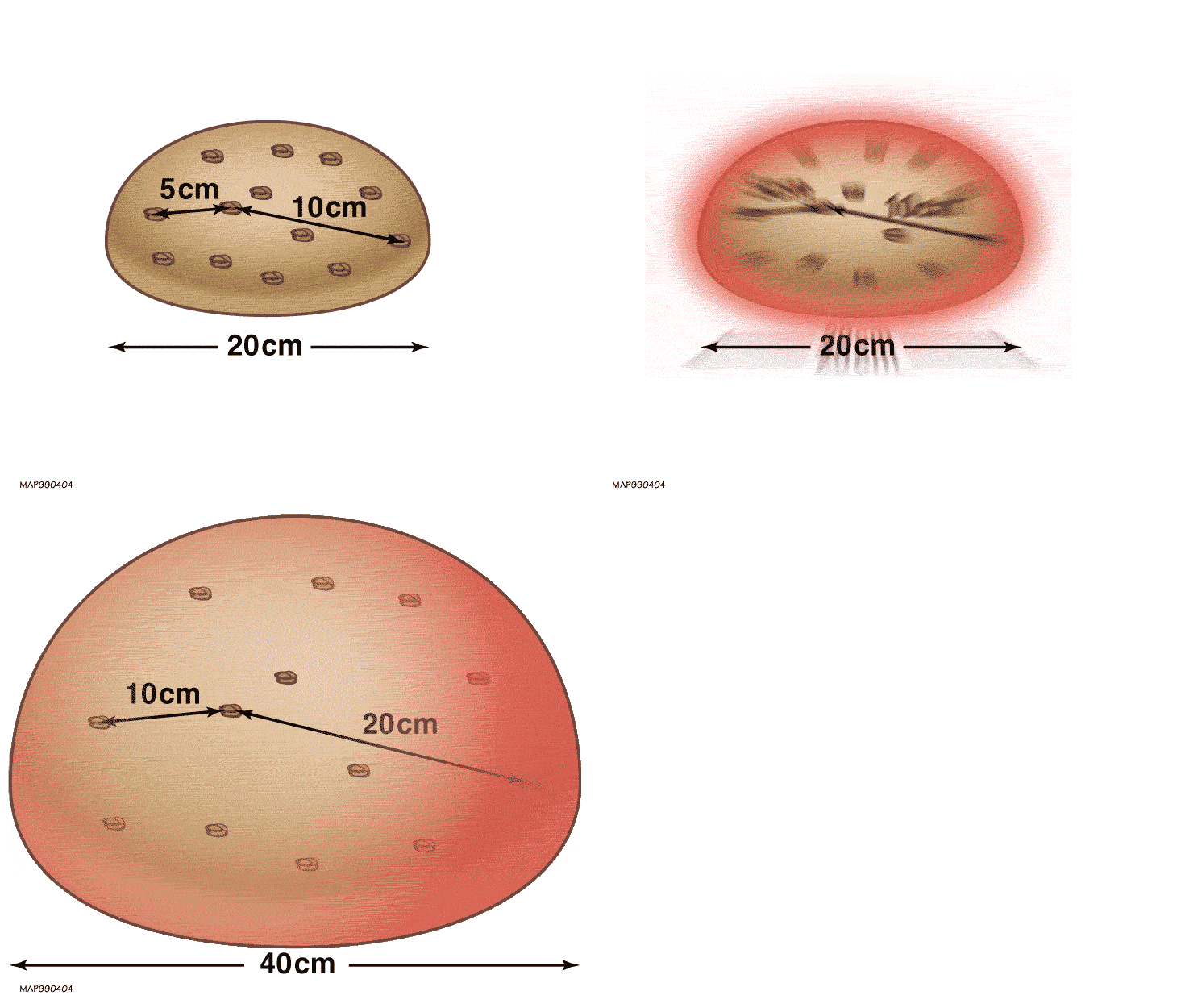 In the "raisin bread model" one imagines a loaf of raisin bread expanding in the oven. The loaf (space) expands as a whole, but the raisins (gravitationally bound objects) do not expand; they merely grow farther away from each other.
All of these models have the conceptual problem of requiring an outside force acting on the "space" at all times to make it expand. Unlike real cosmological matter, sheets of rubber and loaves of bread are bound together electromagnetically and will not continue to expand on their own after an initial tug.
defines how a distance
can be measured between two nearby points in space, in terms of the coordinates of those points. A coordinate system locates points in a space (of whatever number of dimension
s) by assigning unique numbers known as coordinates, to each point. The metric is then a formula
which converts coordinates of two points into distances.
. Because the surface of the Earth is two-dimensional, points on the surface of the earth can be specified by two coordinates—for example, the latitude and longitude. Specification of a metric requires that one first specify the coordinates used. In our simple example of the surface of the Earth, we could choose any kind of coordinate system we wish, for example latitude
and longitude
, or X-Y-Z Cartesian coordinates
. Once we have chosen a specific coordinate system, the numerical values of the co-ordinates of any two points are uniquely determined, and based upon the properties of the space being discussed, the appropriate metric is mathematically established too. On the curved surface of the Earth, we can see this effect in long-haul airline
flights where the distance between two points is measured based upon a Great circle
, and not along the straight line that passes through the Earth. While there is always an effect due to this curvature, at short distances the effect is so small as to be unnoticeable.
of general relativity
, and distance is measured using the Lorentz interval. This explains observations which indicate that galaxies
that are more distant from us are receding
faster than galaxies that are closer to us (Hubble's law
).
into his theories to balance out the contraction, in order to obtain a static universe solution. But in 1922 Alexander Friedman derived a set of equations known as the Friedmann equations
, showing that the universe might expand and presenting the expansion speed in this case. The observations of Edwin Hubble
in 1929 suggested that distant galaxies were all apparently moving away from us, so that many scientists came to accept that the universe was expanding.
, the expansion of the universe became a general feature resulting from vacuum decay
. Accordingly, the question "why is the universe expanding?" is now answered by understanding the details of the inflation decay process which occurred in the first 10−32 seconds
of the existence of our universe. It is suggested that in this time the metric itself changed exponentially
, causing space to change from smaller than an atom
to around 100 million light years across.

The metric only defines the distance between nearby points. In order to define the distance between arbitrarily distant points, one must specify both the points and a specific curve connecting them. The distance between the points can then be found by finding the length of this connecting curve. Comoving distance defines this connecting curve to be a curve of constant cosmological time. Operationally, comoving distances cannot be directly measured by a single Earth-bound observer. To determine the distance of distant objects, astronomers generally measure luminosity of standard candles
, or the redshift factor 'z' of distant galaxies, and then convert these measurements into distances based on some particular model of space-time, such as the Lambda-CDM model
. Unfortunately, there is no evidence for any 'slowing down' of the expansion.
Scientists have tested carefully whether these assumptions are valid and borne out by observation. Observational cosmologists
have discovered evidence - very strong in some cases - that supports these assumptions, and as a result, metric expansion of space is considered by cosmologists to be an observed feature on the basis that although we cannot see it directly, scientist
s have tested the properties of the universe and observation provides compelling confirmation. Sources of this confidence and confirmation include:
Taken together, these phenomena overwhelmingly support models that rely on space expanding through a change in metric. Interestingly, it was not until the discovery in the year 2000 of direct observational evidence for the changing temperature of the cosmic microwave background that more bizarre constructions could be ruled out. Until that time, it was based purely on an assumption that the universe did not behave as one with the Milky Way
sitting at the middle of a fixed-metric with a universal explosion of galaxies in all directions (as seen in, for example, an early model proposed by Milne
). Yet before this evidence, many rejected the Milne viewpoint based on the mediocrity principle
.
The spatial and temporal universality of physical law
s was until very recently taken as a fundamental philosophical assumption that is now tested to the observational limits of time and space.
Using standard candles
with known intrinsic brightness, the acceleration
in the expansion of the universe has been measured using redshift as H0
= 73.8 ± 2.4 (km/s)/Mpc. For every million parsec
s of distance from the observer, the rate of expansion increases by about 74 kilometers per second.
Intrinsic and extrinsic properties (philosophy)
An intrinsic property is a property that an object or a thing has of itself, independently of other things, including its context. An extrinsic property is a property that depends on a thing's relationship with other things...
expansion—that is, it is defined by the relative separation of parts of the universe and not by motion "outward" into preexisting space. In other words, the universe is not expanding "into" anything outside of itself, although a frequently used analogy is the expansion of the surface of an expanding rubber balloon. If this analogy is used, this surface should be seen as an intrinsic manifold.
Metric expansion is a key feature of Big Bang cosmology and is modeled mathematically with the FLRW metric. This model is valid in the present era only at relatively large scales (roughly the scale of galactic superclusters and above). At smaller scales matter has clumped together under the influence of gravitational attraction and these clumps do not individually expand, though they continue to recede from one another. The expansion is due partly to inertia (that is, the matter in the universe is separating because it was separating in the past) and partly to the repulsive force of dark energy
Dark energy
In physical cosmology, astronomy and celestial mechanics, dark energy is a hypothetical form of energy that permeates all of space and tends to accelerate the expansion of the universe. Dark energy is the most accepted theory to explain recent observations that the universe appears to be expanding...
, which is of a hypothetical nature, but it may be the cosmological constant
Cosmological constant
In physical cosmology, the cosmological constant was proposed by Albert Einstein as a modification of his original theory of general relativity to achieve a stationary universe...
. Inertia dominated the expansion in the early universe, and according to the Lambda-CDM model (ΛCDM model) the cosmological constant will dominate in the future. In the present era they contribute in roughly equal proportions.
While special relativity
Special relativity
Special relativity is the physical theory of measurement in an inertial frame of reference proposed in 1905 by Albert Einstein in the paper "On the Electrodynamics of Moving Bodies".It generalizes Galileo's...
constrains objects in the universe from moving faster than the speed of light with respect to each other, there is no such theoretical constraint when space itself is expanding. It is thus possible for two very distant objects to be expanding away from each other at a speed greater than the speed of light
Speed of light
The speed of light in vacuum, usually denoted by c, is a physical constant important in many areas of physics. Its value is 299,792,458 metres per second, a figure that is exact since the length of the metre is defined from this constant and the international standard for time...
. Since the parts of the universe cannot be seen after their speed of expansion away from us exceeds the speed of light, the size of the entire universe could be greater than the size of the observable universe
Observable universe
In Big Bang cosmology, the observable universe consists of the galaxies and other matter that we can in principle observe from Earth in the present day, because light from those objects has had time to reach us since the beginning of the cosmological expansion...
.
It is also possible for a distance to exceed the speed of light times the age of the universe, which means that light from one part of space generated near the beginning of the Universe might still be arriving at distant locations (hence the cosmic microwave background radiation
Cosmic microwave background radiation
In cosmology, cosmic microwave background radiation is thermal radiation filling the observable universe almost uniformly....
). These details are a frequent source of confusion among amateurs and even professional physicists.
Interpretations of the metric expansion of space are an ongoing subject of debate.
Understanding the expansion of Universe
SpacetimeSpacetime
In physics, spacetime is any mathematical model that combines space and time into a single continuum. Spacetime is usually interpreted with space as being three-dimensional and time playing the role of a fourth dimension that is of a different sort from the spatial dimensions...
is highly curved at cosmological scales , and as a result the expansion of the universe is inherently general relativistic
General relativity
General relativity or the general theory of relativity is the geometric theory of gravitation published by Albert Einstein in 1916. It is the current description of gravitation in modern physics...
; it cannot be understood with special relativity
Special relativity
Special relativity is the physical theory of measurement in an inertial frame of reference proposed in 1905 by Albert Einstein in the paper "On the Electrodynamics of Moving Bodies".It generalizes Galileo's...
alone. The images to the right show two views of the large-scale geometry of the universe according to the ΛCDM cosmological model. Two of the dimensions of space are omitted, leaving one dimension of space and one of time. The narrow circular end of the diagram corresponds to a cosmological time of 700 million years after the big bang; the wide end is a cosmological time of 18 billion years, where one can see the beginning of the accelerating expansion
Accelerating universe
The accelerating universe is the observation that the universe appears to be expanding at an increasing rate, which in formal terms means that the cosmic scale factor a has a positive second derivative, implying that the velocity at which a given galaxy is receding from us should be continually...
which eventually dominates in this model. The purple grid lines mark off cosmological time at intervals of one billion years from the big bang. The cyan grid lines mark off comoving distance
Comoving distance
In standard cosmology, comoving distance and proper distance are two closely related distance measures used by cosmologists to define distances between objects...
at intervals of one billion light years. Note that the circular curling of the surface is an artifact of the embedding with no physical significance; space does not actually curl around on itself. (A similar effect can be seen in the tubular shape of the pseudosphere
Pseudosphere
In geometry, the term pseudosphere is used to describe various surfaces with constant negative gaussian curvature. Depending on context, it can refer to either a theoretical surface of constant negative curvature, to a tractricoid, or to a hyperboloid....
.)
The brown line on the diagram is the worldline of the Earth (or, at earlier times, of the matter which condensed to form the Earth). The yellow line is the worldline of the most distant known quasar
Quasar
A quasi-stellar radio source is a very energetic and distant active galactic nucleus. Quasars are extremely luminous and were first identified as being high redshift sources of electromagnetic energy, including radio waves and visible light, that were point-like, similar to stars, rather than...
. The red line is the path of a light beam emitted by the quasar about 13 billion years ago and reaching the Earth in the present day. The orange line shows the present-day distance between the quasar and the Earth, about 28 billion light years.
According to the equivalence principle
Equivalence principle
In the physics of general relativity, the equivalence principle is any of several related concepts dealing with the equivalence of gravitational and inertial mass, and to Albert Einstein's assertion that the gravitational "force" as experienced locally while standing on a massive body is actually...
of general relativity, the rules of special relativity are locally valid in small regions of spacetime that are approximately flat. In particular, light always travels locally at the speed c; in our diagram, this means that light beams always makes an angle of 45° with the local grid lines. It does not follow, however, that light travels a distance ct in a time t, as the red worldline illustrates. While it always moves locally at c, its time in transit (about 13 billion years) is not related to the distance traveled in any simple way. In fact the distance traveled is inherently ambiguous because of the changing scale of the universe. Nevertheless, we can single out two distances which appear to be physically meaningful: the distance between the Earth and the quasar when the light was emitted, and the distance between them in the present era. The former distance is about 4 billion light years, much smaller than ct. The latter distance (shown by the orange line) is about 28 billion light years, much larger than ct. Note that the light took much longer than 4 billion years to reach us though it was emitted from only 4 billion light years away. In fact, we can see from the diagram that the light was moving away from the Earth when it was first emitted, in the sense that the metric distance to the Earth increased with cosmological time for the first few billion years of its travel time. None of this surprising behavior originates from a special property of metric expansion, but simply from local principles of special relativity integrated
Integral
Integration is an important concept in mathematics and, together with its inverse, differentiation, is one of the two main operations in calculus...
over a curved surface.
What space is the universe expanding into?
Over timeTime
Time is a part of the measuring system used to sequence events, to compare the durations of events and the intervals between them, and to quantify rates of change such as the motions of objects....
, the space
Space
Space is the boundless, three-dimensional extent in which objects and events occur and have relative position and direction. Physical space is often conceived in three linear dimensions, although modern physicists usually consider it, with time, to be part of a boundless four-dimensional continuum...
that makes up the universe
Universe
The Universe is commonly defined as the totality of everything that exists, including all matter and energy, the planets, stars, galaxies, and the contents of intergalactic space. Definitions and usage vary and similar terms include the cosmos, the world and nature...
is expanding. The words 'space
Space
Space is the boundless, three-dimensional extent in which objects and events occur and have relative position and direction. Physical space is often conceived in three linear dimensions, although modern physicists usually consider it, with time, to be part of a boundless four-dimensional continuum...
' and 'universe
Universe
The Universe is commonly defined as the totality of everything that exists, including all matter and energy, the planets, stars, galaxies, and the contents of intergalactic space. Definitions and usage vary and similar terms include the cosmos, the world and nature...
', sometimes used interchangeably, have distinct meanings in this context. Here 'space' is a mathematical concept and 'universe' refers to all the matter and energy that exist. The expansion of space is in reference to internal dimensions only; that is, the description involves no structures such as extra dimensions or an exterior universe.
Finite space theory does not suppose space has an edge, but rather that space wraps around on itself. If it were possible to travel the entire length of space without going faster than light, one would simply end up back in the same place, like going all the way around the surface of a balloon (or a planet like the Earth) .
The notion of more space is local, not global; we do not know how much space there is in total. The embedding diagram has been arbitrarily cut off a few billion years past the Earth and the quasar, but it could be extended indefinitely, even infinitely, provided we imagine it as curling into a spiral of constant radius rather than a circle. Even if the overall spatial extent is infinite we still say that space is expanding because, locally, the characteristic distance between objects is increasing.
Local perturbations
The expansion of space is sometimes described as a force which acts to push objects apart. Though this is an accurate description of the effect of the cosmological constantCosmological constant
In physical cosmology, the cosmological constant was proposed by Albert Einstein as a modification of his original theory of general relativity to achieve a stationary universe...
, it is not an accurate picture of the phenomenon of expansion in general. For much of the universe's history the expansion has been due mainly to inertia
Inertia
Inertia is the resistance of any physical object to a change in its state of motion or rest, or the tendency of an object to resist any change in its motion. It is proportional to an object's mass. The principle of inertia is one of the fundamental principles of classical physics which are used to...
. The matter in the very early universe was flying apart for unknown reasons (most likely as a result of cosmic inflation
Cosmic inflation
In physical cosmology, cosmic inflation, cosmological inflation or just inflation is the theorized extremely rapid exponential expansion of the early universe by a factor of at least 1078 in volume, driven by a negative-pressure vacuum energy density. The inflationary epoch comprises the first part...
) and has simply continued to do so, though at an ever-decreasing rate due to the attractive effect of gravity. In addition to slowing the overall expansion, gravity causes local clumping of matter into stars and galaxies. These stars and galaxies do not subsequently expand, there being no force compelling them to do so. There is no essential difference between the inertial expansion of the universe and the inertial separation of nearby objects in a vacuum; the former is simply a large-scale extrapolation of the latter. A uniform local "explosion" of matter can be locally described by the FLRW geometry, the same geometry which describes the expansion of the universe as a whole. In particular, general relativity predicts that light will move at the speed c with respect to the local motion of the exploding matter, a phenomenon analogous to frame dragging.
This situation changes somewhat with the introduction of a cosmological constant. A cosmological constant has the effect of a repulsive force between objects which is proportional (not inversely proportional) to distance. Unlike inertia it actively "pulls" on objects which have clumped together under the influence of gravity, and even on individual atoms. However this does not cause the objects to grow steadily or to disintegrate; unless they are very weakly bound, they will simply settle into an equilibrium state which is slightly (undetectably) larger than it would otherwise have been. As the universe expands and the matter in it thins, the gravitational attraction decreases (since it is proportional to the density), while the cosmological repulsion increases; thus the ultimate fate of the ΛCDM universe is a near vacuum expanding at an ever increasing rate under the influence of the cosmological constant. However the only locally visible effect of the accelerating expansion
Accelerating universe
The accelerating universe is the observation that the universe appears to be expanding at an increasing rate, which in formal terms means that the cosmic scale factor a has a positive second derivative, implying that the velocity at which a given galaxy is receding from us should be continually...
is the disappearance (by runaway redshift
Redshift
In physics , redshift happens when light seen coming from an object is proportionally increased in wavelength, or shifted to the red end of the spectrum...
) of distant galaxies; gravitationally bound objects like the Milky Way do not expand.
Other models of expansion
The expansion of space is often illustrated with models which show only the size of space at a particular time, leaving the dimension of time implicit.In the "ant on a rubber rope
Ant on a rubber rope
Ant on a rubber rope is a mathematical puzzle with a solution that appears counter-intuitive or paradoxical. It is sometimes given as a worm, or inchworm, on a rubber or elastic band, but the principles of the puzzle remain the same....
model" one imagines an ant (idealized as pointlike) crawling at a constant speed on a perfectly elastic rope which is constantly stretching. If we stretch the rope in accordance with the ΛCDM scale factor and think of the ant's speed as the speed of light, then this analogy is numerically accurate—the ant's position over time will match the path of the red line on the embedding diagram above.
In the "rubber sheet model" one replaces the rope with a flat two-dimensional rubber sheet which expands uniformly in all directions. The addition of a second spatial dimension raises the possibility of showing local perturbations of the spatial geometry by local curvature in the sheet.
In the "balloon model" the flat sheet is replaced by a spherical balloon which is inflated from an initial size of zero (representing the big bang). A balloon has positive Gaussian curvature while observations suggest that the real universe is spatially flat, but this inconsistency can be eliminated by making the balloon very large so that it is locally flat to within the limits of observation. This analogy is potentially confusing since it wrongly suggests that the big bang took place at the center of the balloon. In fact points off the surface of the balloon have no meaning, even if they were occupied by the balloon at an earlier time.
All of these models have the conceptual problem of requiring an outside force acting on the "space" at all times to make it expand. Unlike real cosmological matter, sheets of rubber and loaves of bread are bound together electromagnetically and will not continue to expand on their own after an initial tug.
Overview of metrics
Metric expansion is not something that most humans are aware of, on a day to day basis. To understand the expansion of the universe, it is helpful to discuss briefly, what a metric is, and how metric expansion works.Definition of a metric
A metricMetric (mathematics)
In mathematics, a metric or distance function is a function which defines a distance between elements of a set. A set with a metric is called a metric space. A metric induces a topology on a set but not all topologies can be generated by a metric...
defines how a distance
Distance
Distance is a numerical description of how far apart objects are. In physics or everyday discussion, distance may refer to a physical length, or an estimation based on other criteria . In mathematics, a distance function or metric is a generalization of the concept of physical distance...
can be measured between two nearby points in space, in terms of the coordinates of those points. A coordinate system locates points in a space (of whatever number of dimension
Dimension
In physics and mathematics, the dimension of a space or object is informally defined as the minimum number of coordinates needed to specify any point within it. Thus a line has a dimension of one because only one coordinate is needed to specify a point on it...
s) by assigning unique numbers known as coordinates, to each point. The metric is then a formula
Formula
In mathematics, a formula is an entity constructed using the symbols and formation rules of a given logical language....
which converts coordinates of two points into distances.
Metric for Earth's surface
For example, consider the measurement of distance between two places on the surface of the Earth. This is a simple, familiar example of spherical geometrySpherical geometry
Spherical geometry is the geometry of the two-dimensional surface of a sphere. It is an example of a geometry which is not Euclidean. Two practical applications of the principles of spherical geometry are to navigation and astronomy....
. Because the surface of the Earth is two-dimensional, points on the surface of the earth can be specified by two coordinates—for example, the latitude and longitude. Specification of a metric requires that one first specify the coordinates used. In our simple example of the surface of the Earth, we could choose any kind of coordinate system we wish, for example latitude
Latitude
In geography, the latitude of a location on the Earth is the angular distance of that location south or north of the Equator. The latitude is an angle, and is usually measured in degrees . The equator has a latitude of 0°, the North pole has a latitude of 90° north , and the South pole has a...
and longitude
Longitude
Longitude is a geographic coordinate that specifies the east-west position of a point on the Earth's surface. It is an angular measurement, usually expressed in degrees, minutes and seconds, and denoted by the Greek letter lambda ....
, or X-Y-Z Cartesian coordinates
Cartesian coordinate system
A Cartesian coordinate system specifies each point uniquely in a plane by a pair of numerical coordinates, which are the signed distances from the point to two fixed perpendicular directed lines, measured in the same unit of length...
. Once we have chosen a specific coordinate system, the numerical values of the co-ordinates of any two points are uniquely determined, and based upon the properties of the space being discussed, the appropriate metric is mathematically established too. On the curved surface of the Earth, we can see this effect in long-haul airline
Airline
An airline provides air transport services for traveling passengers and freight. Airlines lease or own their aircraft with which to supply these services and may form partnerships or alliances with other airlines for mutual benefit...
flights where the distance between two points is measured based upon a Great circle
Great circle
A great circle, also known as a Riemannian circle, of a sphere is the intersection of the sphere and a plane which passes through the center point of the sphere, as opposed to a general circle of a sphere where the plane is not required to pass through the center...
, and not along the straight line that passes through the Earth. While there is always an effect due to this curvature, at short distances the effect is so small as to be unnoticeable.
Hubble's law
Technically, the metric expansion of space is a feature of many solutions to the Einstein field equationsEinstein field equations
The Einstein field equations or Einstein's equations are a set of ten equations in Albert Einstein's general theory of relativity which describe the fundamental interaction of gravitation as a result of spacetime being curved by matter and energy...
of general relativity
General relativity
General relativity or the general theory of relativity is the geometric theory of gravitation published by Albert Einstein in 1916. It is the current description of gravitation in modern physics...
, and distance is measured using the Lorentz interval. This explains observations which indicate that galaxies
Galaxy
A galaxy is a massive, gravitationally bound system that consists of stars and stellar remnants, an interstellar medium of gas and dust, and an important but poorly understood component tentatively dubbed dark matter. The word galaxy is derived from the Greek galaxias , literally "milky", a...
that are more distant from us are receding
Recessional velocity
Recessional Velocity is a term used to describe the rate at which an object is moving away, typically from Earth.-Application to Cosmology:This term is generally only used in reference to distant Galaxies. The most common reason for the use of this term is Hubble's Law, which states that the...
faster than galaxies that are closer to us (Hubble's law
Hubble's law
Hubble's law is the name for the astronomical observation in physical cosmology that: all objects observed in deep space are found to have a doppler shift observable relative velocity to Earth, and to each other; and that this doppler-shift-measured velocity, of various galaxies receding from...
).
Cosmological constant and the Friedman equations
The first general relativistic models predicted that a universe which was dynamical and contained ordinary gravitational matter would contract rather than expand. Einstein's first proposal for a solution to this problem involved adding a cosmological constantCosmological constant
In physical cosmology, the cosmological constant was proposed by Albert Einstein as a modification of his original theory of general relativity to achieve a stationary universe...
into his theories to balance out the contraction, in order to obtain a static universe solution. But in 1922 Alexander Friedman derived a set of equations known as the Friedmann equations
Friedmann equations
The Friedmann equations are a set of equations in physical cosmology that govern the expansion of space in homogeneous and isotropic models of the universe within the context of general relativity...
, showing that the universe might expand and presenting the expansion speed in this case. The observations of Edwin Hubble
Edwin Hubble
Edwin Powell Hubble was an American astronomer who profoundly changed the understanding of the universe by confirming the existence of galaxies other than the Milky Way - our own galaxy...
in 1929 suggested that distant galaxies were all apparently moving away from us, so that many scientists came to accept that the universe was expanding.
Hubble's personal opinion upon interpretation of the data
These scientists however did not include Hubble himself. While the metric expansion of space reading of Hubble's 1929 observations is viewed today by most scientists as the correct reading of the data, Hubble wrote six years later:Inflation as an explanation for expansion
While Hubble's words were forgotten, the notion of the expansion of the universe became consensus. Until the theoretical developments in the 1980s no one had an explanation for why this seemed to be the case, but with the development of models of cosmic inflationCosmic inflation
In physical cosmology, cosmic inflation, cosmological inflation or just inflation is the theorized extremely rapid exponential expansion of the early universe by a factor of at least 1078 in volume, driven by a negative-pressure vacuum energy density. The inflationary epoch comprises the first part...
, the expansion of the universe became a general feature resulting from vacuum decay
False vacuum
In quantum field theory, a false vacuum is a metastable sector of space that appears to be a perturbative vacuum, but is unstable due to instanton effects that may tunnel to a lower energy state. This tunneling can be caused by quantum fluctuations or the creation of high-energy particles...
. Accordingly, the question "why is the universe expanding?" is now answered by understanding the details of the inflation decay process which occurred in the first 10−32 seconds
Inflationary epoch
In physical cosmology the inflationary epoch was the period in the evolution of the early universe when, according to inflation theory, the universe underwent an extremely rapid exponential expansion...
of the existence of our universe. It is suggested that in this time the metric itself changed exponentially
Exponential growth
Exponential growth occurs when the growth rate of a mathematical function is proportional to the function's current value...
, causing space to change from smaller than an atom
Atom
The atom is a basic unit of matter that consists of a dense central nucleus surrounded by a cloud of negatively charged electrons. The atomic nucleus contains a mix of positively charged protons and electrically neutral neutrons...
to around 100 million light years across.
Measuring distance in a metric space
In expanding space, distance is a dynamical quantity which changes with time. There are several different ways of defining distance in cosmology, known as distance measures, but the most common is comoving distance.The metric only defines the distance between nearby points. In order to define the distance between arbitrarily distant points, one must specify both the points and a specific curve connecting them. The distance between the points can then be found by finding the length of this connecting curve. Comoving distance defines this connecting curve to be a curve of constant cosmological time. Operationally, comoving distances cannot be directly measured by a single Earth-bound observer. To determine the distance of distant objects, astronomers generally measure luminosity of standard candles
Standard Candles
Standard Candles is a compilation of short stories by American science fiction author Jack McDevitt. The sixteen stories in the anthology were originally published in various magazines from 1982 to 1996...
, or the redshift factor 'z' of distant galaxies, and then convert these measurements into distances based on some particular model of space-time, such as the Lambda-CDM model
Lambda-CDM model
ΛCDM or Lambda-CDM is an abbreviation for Lambda-Cold Dark Matter, which is also known as the cold dark matter model with dark energy...
. Unfortunately, there is no evidence for any 'slowing down' of the expansion.
Observational evidence
Theoretical cosmologists developing models of the universe have drawn upon a small number of reasonable assumptions in their work. These workings have led to models in which the metric expansion of space is a likely feature of the universe. Chief among the underlying principles that result in models including metric expansion as a feature are:- the Cosmological PrincipleCosmological PrincipleIn modern physical cosmology, the cosmological principle is the working assumption that observers on Earth do not occupy an unusual or privileged location within the universe as a whole, judged as observers of the physical phenomena produced by uniform and universal laws of physics...
which demands that the universe looks the same way in all directions (isotropic) and has roughly the same smooth mixture of material (homogeneous). - the Copernican PrincipleCopernican principleIn physical cosmology, the Copernican principle, named after Nicolaus Copernicus, states that the Earth is not in a central, specially favored position. More recently, the principle has been generalized to the relativistic concept that humans are not privileged observers of the universe...
which demands that no place in the universe is preferred (that is, the universe has no "starting point").
Scientists have tested carefully whether these assumptions are valid and borne out by observation. Observational cosmologists
Observational cosmology
Observational cosmology is the study of the structure, the evolution and the origin of the universe through observation, using instruments such as telescopes and cosmic ray detectors.-Early observations:...
have discovered evidence - very strong in some cases - that supports these assumptions, and as a result, metric expansion of space is considered by cosmologists to be an observed feature on the basis that although we cannot see it directly, scientist
Scientist
A scientist in a broad sense is one engaging in a systematic activity to acquire knowledge. In a more restricted sense, a scientist is an individual who uses the scientific method. The person may be an expert in one or more areas of science. This article focuses on the more restricted use of the word...
s have tested the properties of the universe and observation provides compelling confirmation. Sources of this confidence and confirmation include:
- Hubble demonstrated that all galaxies and distant astronomical objects were moving away from us, as predicted by a universal expansion. Using the redshiftRedshiftIn physics , redshift happens when light seen coming from an object is proportionally increased in wavelength, or shifted to the red end of the spectrum...
of their electromagnetic spectraElectromagnetic spectrumThe electromagnetic spectrum is the range of all possible frequencies of electromagnetic radiation. The "electromagnetic spectrum" of an object is the characteristic distribution of electromagnetic radiation emitted or absorbed by that particular object....
to determine the distance and speed of remote objects in space, he showed that all objects are moving away from us, and that their speed is proportional to their distance, a feature of metric expansion. Further studies have since shown the expansion to be extremely isotropic and homogeneous, that is, it does not seem to have a special point as a "center", but appears universal and independent of any fixed central point. - In studies of large-scale structure of the cosmos taken from redshift surveyRedshift surveyIn astronomy, a redshift survey, or galaxy survey, is a survey of a section of the sky to measure the redshift of astronomical objects. Using Hubble's law, the redshift can be used to calculate the distance of an object from Earth. By combining redshift with angular position data, a redshift...
s a so-called "End of Greatness" was discovered at the largest scales of the universe. Until these scales were surveyed, the universe appeared "lumpy" with clumps of galaxy clusterGalaxy clusterA galaxy cluster is a compact cluster of galaxies. Basic difference between a galaxy group and a galaxy cluster is that there are many more galaxies in a cluster than in a group. Also, galaxies in a cluster are more compact and have higher velocity dispersion. One of the key features of cluster is...
s and superclusterSuperclusterSuperclusters are large groups of smaller galaxy groups and clusters and are among the largest known structures of the cosmos. They are so large that they are not gravitationally bound and, consequently, partake in the Hubble expansion.-Existence:...
s and filaments which were anything but isotropic and homogeneous. This lumpiness disappears into a smooth distribution of galaxies at the largest scales. - The isotropic distribution across the sky of distant gamma-ray bursts and supernovaSupernovaA supernova is a stellar explosion that is more energetic than a nova. It is pronounced with the plural supernovae or supernovas. Supernovae are extremely luminous and cause a burst of radiation that often briefly outshines an entire galaxy, before fading from view over several weeks or months...
e is another confirmation of the Cosmological Principle. - The Copernican Principle was not truly tested on a cosmological scale until measurements of the effects of the cosmic microwave background radiation on the dynamics of distant astrophysical systems were made. A group of astronomers at the European Southern ObservatoryEuropean Southern ObservatoryThe European Southern Observatory is an intergovernmental research organisation for astronomy, supported by fifteen countries...
noticed, by measuring the temperature of a distant intergalactic cloud in thermal equilibrium with the cosmic microwave background, that the radiation from the Big Bang was demonstrably warmer at earlier times. Uniform cooling of the cosmic microwave background over billions of years is strong and direct observational evidence for metric expansion.
Taken together, these phenomena overwhelmingly support models that rely on space expanding through a change in metric. Interestingly, it was not until the discovery in the year 2000 of direct observational evidence for the changing temperature of the cosmic microwave background that more bizarre constructions could be ruled out. Until that time, it was based purely on an assumption that the universe did not behave as one with the Milky Way
Milky Way
The Milky Way is the galaxy that contains the Solar System. This name derives from its appearance as a dim un-resolved "milky" glowing band arching across the night sky...
sitting at the middle of a fixed-metric with a universal explosion of galaxies in all directions (as seen in, for example, an early model proposed by Milne
Milne model
The Milne model was a special relativistic cosmological model proposed by Edward Arthur Milne in 1935. It is mathematically equivalent to a special case of the FLRW model in the limit of zero energy density , and it obeys the cosmological principle...
). Yet before this evidence, many rejected the Milne viewpoint based on the mediocrity principle
Mediocrity principle
The mediocrity principle is the notion in philosophy of science that there is nothing very unusual about the evolution of our solar system, the Earth, any one nation, or humans. It is a heuristic in the vein of the Copernican principle, and is sometimes used as a philosophical statement about the...
.
The spatial and temporal universality of physical law
Physical law
A physical law or scientific law is "a theoretical principle deduced from particular facts, applicable to a defined group or class of phenomena, and expressible by the statement that a particular phenomenon always occurs if certain conditions be present." Physical laws are typically conclusions...
s was until very recently taken as a fundamental philosophical assumption that is now tested to the observational limits of time and space.
Using standard candles
Cosmic distance ladder
The cosmic distance ladder is the succession of methods by which astronomers determine the distances to celestial objects. A real direct distance measurement of an astronomical object is possible only for those objects that are "close enough" to Earth...
with known intrinsic brightness, the acceleration
Accelerating universe
The accelerating universe is the observation that the universe appears to be expanding at an increasing rate, which in formal terms means that the cosmic scale factor a has a positive second derivative, implying that the velocity at which a given galaxy is receding from us should be continually...
in the expansion of the universe has been measured using redshift as H0
Hubble's law
Hubble's law is the name for the astronomical observation in physical cosmology that: all objects observed in deep space are found to have a doppler shift observable relative velocity to Earth, and to each other; and that this doppler-shift-measured velocity, of various galaxies receding from...
= 73.8 ± 2.4 (km/s)/Mpc. For every million parsec
Parsec
The parsec is a unit of length used in astronomy. It is about 3.26 light-years, or just under 31 trillion kilometres ....
s of distance from the observer, the rate of expansion increases by about 74 kilometers per second.
Printed references
- Eddington, Arthur. The Expanding Universe: Astronomy's 'Great Debate', 1900-1931. Press Syndicate of the University of Cambridge, 1933.
- Liddle, Andrew R. and David H. Lyth. Cosmological Inflation and Large-Scale Structure. Cambridge University Press, 2000.
- Lineweaver, Charles H. and Tamara M. Davis, "Misconceptions about the Big Bang", Scientific AmericanScientific AmericanScientific American is a popular science magazine. It is notable for its long history of presenting science monthly to an educated but not necessarily scientific public, through its careful attention to the clarity of its text as well as the quality of its specially commissioned color graphics...
, March 2005. - Mook, Delo E. and Thomas Vargish. Inside Relativity. Princeton University Press, 1991.
External links
- Swenson, Jim Answer to a question about the expanding universe
- Felder, Gary, "The Expanding universe".
- NASANASAThe National Aeronautics and Space Administration is the agency of the United States government that is responsible for the nation's civilian space program and for aeronautics and aerospace research...
's WMAP team offers an "Explanation of the universal expansion" at a very elementary level - Hubble Tutorial from the University of Wisconsin Physics Department
- Expanding raisin bread from the University of Winnipeg: an illustration, but no explanation
- "Ant on a balloon" analogy to explain the expanding universe at "Ask an Astronomer". (The astronomer who provides this explanation is not specified.)
- Researched Essay: "The Big Bang" - Proof that the Universe is Expanding