

Medzhybizh

Encyclopedia
Medzhybizh, previously known as Mezhybozhe, population 1731, (Census 2001) ' onMouseout='HidePop("43367")' href="/topics/Romanization_of_Russian">Translit:
Medzhibozh, , , , translit. Mezhbizh) is a town
in the Khmelnytskyi Oblast
(province
) of western Ukraine
. It is located in the Letychivsky Raion (district
), 25 kilometres from the Khmelnytskyi
on the main highway between Khmelnytskyi and Vinnytsia
at the confluence of the Southern Buh and Buzhok rivers. Medzhybizh was once a prominent town in the former Podolia
Province. Its name is derived from "mezhbuzhye" which means "between the Buzhenka (and the Buh
) Rivers". It is known as the birth-place of the Jewish Hasidic
mystical religious movement.

 Medzhybizh is first mentioned in chronicles as an estate in Kievan Rus. It was given to Prince Svyatoslav
by the prince of Kiev
in the year 1146. In 1148, ownership transferred to Rostyslav
, the son of Yuri Dolgoruky. The wooden fortress that stood there was destroyed in 1255. After the Mongol incursion, by 1360, the town and surrounding territory passed into the hands of the Lithuanians
. The town suffered from numerous attacks by the Tatars
in 1453, 1506, 1516, 1546, 1558, 1566, and 1615. In 1444 the town was incorporated into lands administered by Poland. In the 16th century, the territory was controlled by the Sieniawski and Potocki
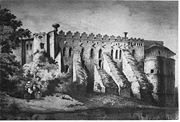
Polish noble families. In 1511 work began to replace the wooden palisades with massive stone fortifications, many of which can still be seen today. A dam was built across the Southern Bug
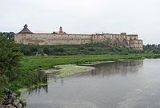
river to provide a defensive lake, and a rhomboid Medzhybizh Castle with four towers was built. The state-of-the-art fortifications made Medzhybizh one of the strongest military sites in the region and led to the rise of its prosperity in the next three centuries.
-
In 1571 a census was recorded, listing the population as being made up of 95 Ruthenians
, 35 Jews, and 30 Poles. In 1593 Adam Sienawski gave the town Magdeburg rights
.
In the mid-16th century the Zasławski family, a Polish noble family, turned Medzhybizh into an impregnable fortress. The Zaslavskys used Medzhybizh as their base from which to defend the southern borders from the incursions of the Ottoman Turks
and Crimean Tartars.
captured the town 3 times and held the region for the period of 1 year. At the time, there were approximately 12,000 residents living in Medzhybizh and its environs. Of this number there were 2500 Jews living in Medzhibozh in the year 1648
out of a total Jewish population of Podolia of 4000 souls (spread between 18
communities). The massacre of Jews by the cossacks under the command of Danylo Nechay
and Maxym Kryvonis
(a cossack of Scottish ethnicity - originally Cameron) occurred July 20, 1648 in Medzhybizh, almost all 2500 Jews were either killed or taken into captivity at the time of the massacre. The Jewish population in Medzhybizh was virtually eradicated, and there were no burials recorded for several years after 1648, consistent with depopulation.
Jan Casimir and Khmelnitsky
negotiated a treaty in 1649, however the hostilities continued in 1651 and 1653. In 1657 the Hungarian Prince Rákóczi took the city, ceding it to the Turks in 1672. It remained under their administration until 1682. By 1661, only a handful of Jews remained in Medzhybizh. In the 1678 census their numbers increased to 275 souls.
was invaded and occupied by Turkey
in 1672. Medzhybizh became part of the Turkish Ejalet of Kamieniecki as "Mejibuji" and was a sanjak centre. In 1682, Medzhybizh was recaptured by the Poles under Jan Sobieski. However, Poles didn't regain full control until 1699 because the town was frequently ravaged by ongoing struggles between the Poles and Turks.
After Medzhybizh was recaptured from the Turks, it went through what many consider its golden age during the 17th and 18th century. Under the Sieniawski family and later the Czartoryski family, the town prospered. Medzhybizh successfully defended itself from several Haidamak attacks. By the mid 18th century, Medzhybizh was the seat of power in Podilia Province. It had a population of nearly 5,000 of which there were 2,500 Jews.
. The Czartoryski family continued to own the town until Prince Adam Czartoryski
was forced into exile in 1831. During Russian rule, the seat of power for Podilia moved from Medzhybizh to Kamianets-Podilskyi
. The economy of Medzhybizh deteriorated because the railroad line bypassed the town to the south. The nearby town of Letychiv
however flourished.
In the late 1880s through World War I, Medzhybizh became a centre of military activity, housing an important garrison within its castle grounds.
A commemorative plaque marks the place where the famous Ukrainian poet Taras Shevchenko
stayed in October 1846 participating in an Archeological expedition. It is here that he composed his famous poem "Rozryta mohyla" - The Ransacked Grave.
, the territory was occupied by German and Hungarian troops until the end of World War I. Medzhybizh was the scene of numerous pogroms during the Russian Civil War
(Ukrainian Civil War) of 1919–1922. The town changed hands many times as different militia units from either the Bolshevik
s, Ukrainian Nationalists, Poles, or Whites
gained temporary control. What little wealth was left was stripped in these pogroms turning the entire area into ruins.
Under Soviet rule starting 1922, the region's economy improved. Electricity, schools, roads and other infrastructure were built. Several kolkhoz
i (collective farms) were established near Medzhybizh.
In the early 1930s, pressure from the government to break the peasant resistance to collectivization resulted in famines throughout Ukraine
. Recently a museum dedicated to the memory of the many local inhabitants who died during the Holodomor
was opened in Medzhybizh containing original documents from the area relating to the shooting of all villagers who opposed entering the kolhoz collective farms.
 Medzhybizh fell to Nazi
forces during Operation Barbarossa
on July 8, 1941 with relatively light resistance. It remained in Nazi hands until it was liberated by Soviet troops on March 24, 1944.
Medzhybizh was astride an important east-west supply road that the Nazis wanted to expand into an autobahn-like highway. This road led directly between the city of Proskuriv (now Khmelnytskyi) and routes westward into Germany and the city of Vinnytsia
with routes to the eastern front. Vinnytsia was the site of Hitler's
headquarters bunker
in Soviet territory where he personally directed the war between 1942 and 1943.
The Nazis set up Jewish ghettos
in Medzhybizh and in Letychiv
to assist Organisation Todt in providing slave labor for the road building project. Because of this special road project, Medzhybizh retained its Jewish population longer than most of the surrounding communities, where Einsatzgruppen
units executed entire populations of Jews shortly after Nazi occupation. When the road project was completed in the summer of 1942, the Einsatzgruppen units were called in and three separate mass shootings of Jews occurred between August 21, 1942 and October 31, 1942 that murdered all Jews in the ghetto. Soviet authorities reported that a total of 2,558 Jews were murdered in ravines to the west of town.
, commander of the Nachtigall Battalion
who stopped in Medzhybizh and there refused to fight against the Soviets for the Nazis until Yaroslav Stetsko
was released from custody. The Battalion was disarmed and sent to Germany.
Currently a large museum in memory of the victims of the Holodomor
is planned to open in October 2008.
The castle houses a small museum devoted to the Ukrainian history of the town.
Several Jewish sites are either being restored or were recently renovated as they have become an important Jewish tourist attraction. The old Jewish cemetery is the site of ongoing restoration efforts. The location of its famous graves are now protected by a modern building. The Apter Rov's shul is currently undergoing renovation. A complete re-creation of the Besht's shul was recently constructed on its original site.

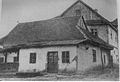
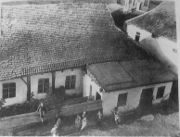
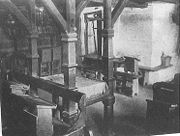 Medzhybizh was the center of Jewish culture in its region in Ukraine
. The first records of Jews in Medzhybizh date back to the early 16th century. These records state that various Jews were granted special privileges by the Polish kings, including a proclamation in 1566 by King Sigismund II Augustus
that the Jews of Medzhybizh were exempt from paying taxes in perpetuity. The earliest known burial in the Jewish cemetery dates from 1555.
Many key rabbinic leaders lived in Medzhybizh during the 17th through 20th centuries. The earliest important rabbi to make Medzhybizh home was Rabbi Joel Sirkes (1561–1640), a key figure in Judaism at that time. He lived in Medzhybizh from 1604-12.
The most important rabbi
from Medzyhbizh was Rabbi Israel ben Eliezer Baal Shem Tov "Besht" (1698–1760), the founder of Hasidism
. He lived in Medzhybizh from about 1742 until his death in 1760. His grave can be viewed today in the Medzhybizh old Jewish cemetery.
The Baal Shem Tov is considered one of the key Jewish personalities of the 18th century who has shaped Judaism into what it is today. His work led to the founding the Hasidic movement, established by his disciples, some of whom also lived in Medzhybizh, but most of whom traveled from all over Eastern Europe
, sometimes from great distances, to visit and learn from him. In Medzhybizh, the Baal Shem Tov was also known as a "doktor" and healer to both Jews and non-Jews. He was known to have been given a special tax-free dispensation by the Czartoryski family and his house shows up on several town censuses.
There were two fundamentally different rabbinic leaders in the town, those who were Hasidic and those who were not. In general, both groups got along, but the followers of the Hasidic leaders believed they had a special connection with God
and were cult-like in their devotion to their "rebbe". The non-Hasidic leaders tended to follow a scholarly path and were more responsible for the Jewish institutions, such as observance of kashrut
, the social structure of the town, liaison with the town's nobles, and control of the Jewish court
.
Hasidic leaders included Rabbi Boruch of Medzhybizh
(1757–1811), the Baal Shem Tov's grandson. Rabbi Boruch was notable for his principle of malkhus ("royalty") and conducted his court accordingly. He was also known for his "melancholy" and he had a fiery temper. Many of his grandfather's disciples and the great Hasidic leaders of the time, regularly visited Rabbi Boruch, including the Magid of Chernobyl
, the Magid of Mezritch, Rabbi Shneur Zalman of Liadi (founder of the Chabad
Hasidic movement), and others.
In an attempt to remedy Rabbi Boruch's melancholy, his followers brought in Hershel of Ostropol as a "court jester" of sorts. Hershel was one of the first documented Jewish comedians and his exploits are legendary within both the Jewish and non-Jewish communities. Hershel is also buried in the old Jewish cemetery in Medzhybizh, though his grave is unmarked. One legend has it that in a fit of rage Rabbi Boruch himself was responsible for Hershel's death.
Rabbi Nachman of Breslav (1772–1810), the Baal Shem Tov's great-grandson, was born in Medzhybizh but left at an early age. He became the founder of the Breslover
Hasidim.
Another Hasidic leader, Rabbi Avraham Yehoshua Heshel
of Apt
(1748–1825) "The Apter Rov", made Medzhybizh his home from 1813 until his death in 1825. The Apter Rov is also buried in the old Jewish cemetery in Medzhybizh, very close to the Baal Shem Tov's grave. The Heshel family became one the foremost Hasidic rabbinic dynasties and various descendants remained in Medzhybizh well into the 20th century.
The non-Hasidic rabbinic leadership of Medzhybizh was controlled by the Rapoport-Bick dynasty
, the most important of all the non-Hasidic rabbinic dynasties of Medzhybizh. Rabbi Dov Berish Rapoport (d. 1823) was the first to make Medzhybizh his home. He was the grandson of Rabbi Chaim haCohen Rapoport of Lviv
(d. 1771), a notable sage during the mid 18th century. Dov Berish Rapoport's grave can be seen today at the old Jewish cemetery in Medzhybizh. Other rabbis of this dynasty include Rabbi Isaac Bick (1864–1934) who immigrated to America in 1925 and founded a synagogue in Rhode Island
. Rabbi Chaim Yekhiel Mikhel Bick (1887–1964) was the last known rabbi to reside in Medzhybizh. He left Medzhybizh for New York in 1925. It is not known whether Medzhybizh had another rabbi when it served as a Jewish ghetto in World War II.
The Rapoport Dynasty
traces its roots back to Rabbi Jacob Emden
(1697–1776) who was involved in the Frankist
debates and his father Rabbi Tsvi Hirsh Ashkenazi
, known as the Chacham Tsvi (1660–1718). The Rapoports themselves are a long distinguished rabbinic family who traces their roots back to Central Europe
and Northern Italy
in the 15th century. The first Rapoport rabbi to make his home in Medzhybizh was Rabbi Dov Berish Rapoport (d. 1823). He was the grandson of Rabbi Chaim haCohen Rapoport of Lviv
(d. 1771), who was also involved in the Frankist
debates. Rabbi Dov Berish became the head of the Jewish court (Av Beth Din
) and leader of the entire Jewish community of Medzhybizh. However, in a dispute with Rabbi Moshe Chaim Ephraim, the Baal Shem Tov's grandson around the year 1800, the non-Hasidic and the Hasidic communities separated into two leadership groups. The Rapoport/Bick family continued to control the town's Jewish religious court. The Hasidic community at the time chose Rabbi Issachar Dov-Ber Landa to represent them in official matters. Interestingly, both Rabbis Rapoport and Landa are buried side-by-side in the Medzhybizh Jewish cemetery, just a few steps away from the Baal Shem Tov's grave.
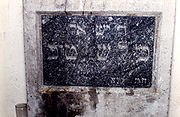 Medzhybizh was the home to at least two synagogue
buildings and numerous small minyan
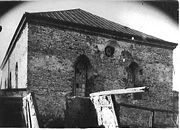
im. One synagogue still stands today but is used for other purposes. It was the synagogue of R. Avraham Yehoshua Heshel, the Apter Rov. In early 2008, it was bought by the Ohalei Zaddikim organization and is slated for reconstruction. The other synagogue, the Baal Shem Tov's old wooden synagogue, was torn down for firewood during World War II. It has recently been rebuilt according to plan.
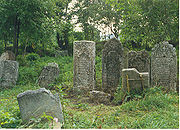
Medzhybizh also contains two Jewish cemeteries. The old Jewish cemetery contains the grave of the Baal Shem Tov and other famous and notable Jews. It has turned into something of a tourist attraction, a magnet for Hasidic Jews from all over the world. The new Jewish cemetery has graves from the early 19th century through to the 1980s. A Nazi mass killing site outside of town holds the graves of almost 3,000 Jews in 3 different trenches.
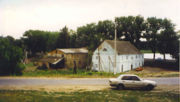
Just outside the castle, the dam and the lake are still in working order. Adjacent to the dam are two old mill buildings that are no longer used but used to be a valuable concession (arenda) during Tsarist and Polish times.
North of town is the old Jewish cemetery, which has turned into a tourist attraction primarily for Hasidic Jews making a pilgrimage to see the Baal Shem Tov's grave. Legend has it that this cemetery remained protected and well-preserved during World War II because the local Ukrainian population remembered the Baal Shem Tov's healing powers during his lifetime and they were afraid of his powerful magic even beyond the grave. The old Jewish cemetery contains a modern building over the graves of the important Jewish dignitaries. Other gravestones in this cemetery are worth visiting as the artwork on many stones shows a level of cultural achievement matching the rise of importance of the town. The oldest burial in this cemetery dates from 1555.
Toward the central western portion of town is the new Jewish cemetery, which is only in fair condition. Here Jews are buried from the early 19th century through modern times.
Outside of town to the west, and adjacent to the Southern Bug river, is the Nazi mass killing site where approximately 3,000 Jews were buried. A monument marks the site. The three ravines that holds the graves are covered in concrete.
Анатолий Хаеш. Несостоявшееся выселение евреев из Меджибожа (1843-1852 гг.) (Anatoly Haesh: The Exile of Jews from Medzhibizh that Never Happened)
Romanization of Russian
Romanization of the Russian alphabet is the process of transliterating the Russian language from the Cyrillic alphabet into the Latin alphabet...
Medzhibozh, , , , translit. Mezhbizh) is a town
Urban-type settlement
Urban-type settlement ; , selyshche mis'koho typu ) is an official designation for a type of locality used in some of the countries of the former Soviet Union...
in the Khmelnytskyi Oblast
Khmelnytskyi Oblast
Khmelnytskyi Oblast is an oblast of western Ukraine. The administrative center of the oblast is the city of Khmelnytskyi.The current estimated population is around 1,401,140 .-Geography:...
(province
Oblast
Oblast is a type of administrative division in Slavic countries, including some countries of the former Soviet Union. The word "oblast" is a loanword in English, but it is nevertheless often translated as "area", "zone", "province", or "region"...
) of western Ukraine
Ukraine
Ukraine is a country in Eastern Europe. It has an area of 603,628 km², making it the second largest contiguous country on the European continent, after Russia...
. It is located in the Letychivsky Raion (district
Raion
A raion is a type of administrative unit of several post-Soviet countries. The term, which is from French rayon 'honeycomb, department,' describes both a type of a subnational entity and a division of a city, and is commonly translated in English as "district"...
), 25 kilometres from the Khmelnytskyi
Khmelnytskyi, Ukraine
Khmelnytskyi is a city in Ukraine in the region of Podillia. It is located on the Southern Buh River and about from the Ukrainian capital, Kiev. The town's original name was Płoskirów, later Proskurov, but in 1954 was renamed Khmelnytskyi. It is the center of the Khmelnytskyi Oblast in western...
on the main highway between Khmelnytskyi and Vinnytsia
Vinnytsia
Vinnytsia is a city located on the banks of the Southern Bug, in central Ukraine. It is the administrative center of Vinnytsia Oblast.-Names:...
at the confluence of the Southern Buh and Buzhok rivers. Medzhybizh was once a prominent town in the former Podolia
Podolia
The region of Podolia is an historical region in the west-central and south-west portions of present-day Ukraine, corresponding to Khmelnytskyi Oblast and Vinnytsia Oblast. Northern Transnistria, in Moldova, is also a part of Podolia...
Province. Its name is derived from "mezhbuzhye" which means "between the Buzhenka (and the Buh
Southern Bug
The Southern Bug, also called Southern Buh), is a river located in Ukraine. The source of the river is in the west of Ukraine, in the Volyn-Podillia Upland, about 145 km from the Polish border, and flows southeasterly into the Bug Estuary through the southern steppes...
) Rivers". It is known as the birth-place of the Jewish Hasidic
Hasidic Judaism
Hasidic Judaism or Hasidism, from the Hebrew —Ḥasidut in Sephardi, Chasidus in Ashkenazi, meaning "piety" , is a branch of Orthodox Judaism that promotes spirituality and joy through the popularisation and internalisation of Jewish mysticism as the fundamental aspects of the Jewish faith...
mystical religious movement.
Earliest history
Sviatoslav II of Kiev
Sviatoslav Iaroslavich was the Prince of Chernihiv from 1054 to 1073 and Grand Prince of Kiev from 1073 until his death...
by the prince of Kiev
Kiev
Kiev or Kyiv is the capital and the largest city of Ukraine, located in the north central part of the country on the Dnieper River. The population as of the 2001 census was 2,611,300. However, higher numbers have been cited in the press....
in the year 1146. In 1148, ownership transferred to Rostyslav
Rostislav I of Kiev
Rostislav Mstislavich , Kniaz' of Smolensk , Novgorod and Velikiy Kniaz of Kiev . He was the son of Mstislav I of Kiev and Christina Ingesdotter of Sweden....
, the son of Yuri Dolgoruky. The wooden fortress that stood there was destroyed in 1255. After the Mongol incursion, by 1360, the town and surrounding territory passed into the hands of the Lithuanians
History of Lithuania
The history of Lithuania dates back to at least 1009, the first recorded written use of the term. Lithuanians, a branch of the Baltic peoples, later conquered neighboring lands, establishing the Grand Duchy of Lithuania and in the 13th century the short-lived Kingdom of Lithuania. The Grand Duchy...
. The town suffered from numerous attacks by the Tatars
Tatars
Tatars are a Turkic speaking ethnic group , numbering roughly 7 million.The majority of Tatars live in the Russian Federation, with a population of around 5.5 million, about 2 million of which in the republic of Tatarstan.Significant minority populations are found in Uzbekistan, Kazakhstan,...
in 1453, 1506, 1516, 1546, 1558, 1566, and 1615. In 1444 the town was incorporated into lands administered by Poland. In the 16th century, the territory was controlled by the Sieniawski and Potocki
Potocki
Potocki is the surname of a Polish noble family.-History:The Potocki family is a great artistocratic family originated from Potok in the Kraków Voivodeship; their family name derives from that place name. The family is heavily entwined with the cultural development and history of Poland's Eastern...
Polish noble families. In 1511 work began to replace the wooden palisades with massive stone fortifications, many of which can still be seen today. A dam was built across the Southern Bug
Southern Bug
The Southern Bug, also called Southern Buh), is a river located in Ukraine. The source of the river is in the west of Ukraine, in the Volyn-Podillia Upland, about 145 km from the Polish border, and flows southeasterly into the Bug Estuary through the southern steppes...
river to provide a defensive lake, and a rhomboid Medzhybizh Castle with four towers was built. The state-of-the-art fortifications made Medzhybizh one of the strongest military sites in the region and led to the rise of its prosperity in the next three centuries.
-
In 1571 a census was recorded, listing the population as being made up of 95 Ruthenians
Ruthenians
The name Ruthenian |Rus']]) is a culturally loaded term and has different meanings according to the context in which it is used. Initially, it was the ethnonym used for the East Slavic peoples who lived in Rus'. Later it was used predominantly for Ukrainians...
, 35 Jews, and 30 Poles. In 1593 Adam Sienawski gave the town Magdeburg rights
Magdeburg rights
Magdeburg Rights or Magdeburg Law were a set of German town laws regulating the degree of internal autonomy within cities and villages granted by a local ruler. Modelled and named after the laws of the German city of Magdeburg and developed during many centuries of the Holy Roman Empire, it was...
.
In the mid-16th century the Zasławski family, a Polish noble family, turned Medzhybizh into an impregnable fortress. The Zaslavskys used Medzhybizh as their base from which to defend the southern borders from the incursions of the Ottoman Turks
Growth of the Ottoman Empire
The Growth of the Ottoman Empire is the period followed after the Rise of the Ottoman Empire in which the Ottoman state reached the Pax Ottomana. In this period, the Ottoman Empire expanded southwestwards into North Africa and battled with the re-emergent Persian Shi'ia Safavid Empire to the east...
and Crimean Tartars.
The Cossack uprising of 1648
In 1648 the cossack uprising led by Bohdan KhmelnytskyKhmelnytsky Uprising
The Khmelnytsky Uprising, was a Cossack rebellion in the Ukraine between the years 1648–1657 which turned into a Ukrainian war of liberation from Poland...
captured the town 3 times and held the region for the period of 1 year. At the time, there were approximately 12,000 residents living in Medzhybizh and its environs. Of this number there were 2500 Jews living in Medzhibozh in the year 1648
out of a total Jewish population of Podolia of 4000 souls (spread between 18
communities). The massacre of Jews by the cossacks under the command of Danylo Nechay
Danylo Nechay
Danylo Nechay was a Cossack military commander and activist, a leader during the Cossack-Polish War, Colonel of Bratslav from 1648–51 and the brother of Ivan Nechay....
and Maxym Kryvonis
Maxym Kryvonis
Maksym Kryvonis was one of the Cossack leaders of Khmelnytsky Uprising. In the first stage of the uprising he was the leader of the most radical faction of the rebels who rejected all compromises with the Polish-Lithuanian Commonwealth and wanted to drive all Catholics and Jews out of...
(a cossack of Scottish ethnicity - originally Cameron) occurred July 20, 1648 in Medzhybizh, almost all 2500 Jews were either killed or taken into captivity at the time of the massacre. The Jewish population in Medzhybizh was virtually eradicated, and there were no burials recorded for several years after 1648, consistent with depopulation.
Jan Casimir and Khmelnitsky
Bohdan Khmelnytsky
Bohdan Zynoviy Mykhailovych Khmelnytsky was a hetman of the Zaporozhian Cossack Hetmanate of Polish–Lithuanian Commonwealth . He led an uprising against the Commonwealth and its magnates which resulted in the creation of a Cossack state...
negotiated a treaty in 1649, however the hostilities continued in 1651 and 1653. In 1657 the Hungarian Prince Rákóczi took the city, ceding it to the Turks in 1672. It remained under their administration until 1682. By 1661, only a handful of Jews remained in Medzhybizh. In the 1678 census their numbers increased to 275 souls.
Turkish rule and later Polish period
Weakened by the cossack uprising, PodoliaPodolia
The region of Podolia is an historical region in the west-central and south-west portions of present-day Ukraine, corresponding to Khmelnytskyi Oblast and Vinnytsia Oblast. Northern Transnistria, in Moldova, is also a part of Podolia...
was invaded and occupied by Turkey
Turkey
Turkey , known officially as the Republic of Turkey , is a Eurasian country located in Western Asia and in East Thrace in Southeastern Europe...
in 1672. Medzhybizh became part of the Turkish Ejalet of Kamieniecki as "Mejibuji" and was a sanjak centre. In 1682, Medzhybizh was recaptured by the Poles under Jan Sobieski. However, Poles didn't regain full control until 1699 because the town was frequently ravaged by ongoing struggles between the Poles and Turks.
After Medzhybizh was recaptured from the Turks, it went through what many consider its golden age during the 17th and 18th century. Under the Sieniawski family and later the Czartoryski family, the town prospered. Medzhybizh successfully defended itself from several Haidamak attacks. By the mid 18th century, Medzhybizh was the seat of power in Podilia Province. It had a population of nearly 5,000 of which there were 2,500 Jews.
Russian rule
In 1792 Medzhybizh fell into Russian hands during the second partition of PolandSecond Partition of Poland
The 1793 Second Partition of the Polish-Lithuanian Commonwealth was the second of three partitions that ended the existence of the Polish-Lithuanian Commonwealth by 1795. The second partition occurred in the aftermath of the War in Defense of the Constitution and the Targowica Confederation of 1792...
. The Czartoryski family continued to own the town until Prince Adam Czartoryski
Adam Jerzy Czartoryski
Prince Adam Jerzy Czartoryski was a Polish-Lithuanian noble, statesman and author. He was the son of Prince Adam Kazimierz Czartoryski and Izabela Fleming....
was forced into exile in 1831. During Russian rule, the seat of power for Podilia moved from Medzhybizh to Kamianets-Podilskyi
Kamianets-Podilskyi
Kamyanets-Podilsky or Kamienets-Podolsky is a city located on the Smotrych River in western Ukraine, to the north-east of Chernivtsi...
. The economy of Medzhybizh deteriorated because the railroad line bypassed the town to the south. The nearby town of Letychiv
Letychiv
Letychiv is a town in the eastern part of Khmelnytskyi Oblast of western Ukraine. 51 km from Khmelnytskyi and 33 km from the railway station Derazhnya. Administrative center since Tsarist times, formerly in Podolia Province. Population: 11,081 inhabitants . There are brickworks, dairy,...
however flourished.
In the late 1880s through World War I, Medzhybizh became a centre of military activity, housing an important garrison within its castle grounds.
A commemorative plaque marks the place where the famous Ukrainian poet Taras Shevchenko
Taras Shevchenko
Taras Hryhorovych Shevchenko -Life:Born into a serf family of Hryhoriy Ivanovych Shevchenko and Kateryna Yakymivna Shevchenko in the village of Moryntsi, of Kiev Governorate of the Russian Empire Shevchenko was orphaned at the age of eleven...
stayed in October 1846 participating in an Archeological expedition. It is here that he composed his famous poem "Rozryta mohyla" - The Ransacked Grave.
Soviet rule
After the 1917 Bolshevik RevolutionRussian Revolution of 1917
The Russian Revolution is the collective term for a series of revolutions in Russia in 1917, which destroyed the Tsarist autocracy and led to the creation of the Soviet Union. The Tsar was deposed and replaced by a provisional government in the first revolution of February 1917...
, the territory was occupied by German and Hungarian troops until the end of World War I. Medzhybizh was the scene of numerous pogroms during the Russian Civil War
Russian Civil War
The Russian Civil War was a multi-party war that occurred within the former Russian Empire after the Russian provisional government collapsed to the Soviets, under the domination of the Bolshevik party. Soviet forces first assumed power in Petrograd The Russian Civil War (1917–1923) was a...
(Ukrainian Civil War) of 1919–1922. The town changed hands many times as different militia units from either the Bolshevik
Bolshevik
The Bolsheviks, originally also Bolshevists , derived from bol'shinstvo, "majority") were a faction of the Marxist Russian Social Democratic Labour Party which split apart from the Menshevik faction at the Second Party Congress in 1903....
s, Ukrainian Nationalists, Poles, or Whites
White movement
The White movement and its military arm the White Army - known as the White Guard or the Whites - was a loose confederation of Anti-Communist forces.The movement comprised one of the politico-military Russian forces who fought...
gained temporary control. What little wealth was left was stripped in these pogroms turning the entire area into ruins.
Under Soviet rule starting 1922, the region's economy improved. Electricity, schools, roads and other infrastructure were built. Several kolkhoz
Kolkhoz
A kolkhoz , plural kolkhozy, was a form of collective farming in the Soviet Union that existed along with state farms . The word is a contraction of коллекти́вное хозя́йство, or "collective farm", while sovkhoz is a contraction of советское хозяйство...
i (collective farms) were established near Medzhybizh.
In the early 1930s, pressure from the government to break the peasant resistance to collectivization resulted in famines throughout Ukraine
Holodomor
The Holodomor was a man-made famine in the Ukrainian SSR between 1932 and 1933. During the famine, which is also known as the "terror-famine in Ukraine" and "famine-genocide in Ukraine", millions of Ukrainians died of starvation in a peacetime catastrophe unprecedented in the history of...
. Recently a museum dedicated to the memory of the many local inhabitants who died during the Holodomor
Holodomor
The Holodomor was a man-made famine in the Ukrainian SSR between 1932 and 1933. During the famine, which is also known as the "terror-famine in Ukraine" and "famine-genocide in Ukraine", millions of Ukrainians died of starvation in a peacetime catastrophe unprecedented in the history of...
was opened in Medzhybizh containing original documents from the area relating to the shooting of all villagers who opposed entering the kolhoz collective farms.
World War II
Nazism
Nazism, the common short form name of National Socialism was the ideology and practice of the Nazi Party and of Nazi Germany...
forces during Operation Barbarossa
Operation Barbarossa
Operation Barbarossa was the code name for Germany's invasion of the Soviet Union during World War II that began on 22 June 1941. Over 4.5 million troops of the Axis powers invaded the USSR along a front., the largest invasion in the history of warfare...
on July 8, 1941 with relatively light resistance. It remained in Nazi hands until it was liberated by Soviet troops on March 24, 1944.
Medzhybizh was astride an important east-west supply road that the Nazis wanted to expand into an autobahn-like highway. This road led directly between the city of Proskuriv (now Khmelnytskyi) and routes westward into Germany and the city of Vinnytsia
Vinnytsia
Vinnytsia is a city located on the banks of the Southern Bug, in central Ukraine. It is the administrative center of Vinnytsia Oblast.-Names:...
with routes to the eastern front. Vinnytsia was the site of Hitler's
Adolf Hitler
Adolf Hitler was an Austrian-born German politician and the leader of the National Socialist German Workers Party , commonly referred to as the Nazi Party). He was Chancellor of Germany from 1933 to 1945, and head of state from 1934 to 1945...
headquarters bunker
Wehrwolf
Führerhauptquartier Werwolf was the codename used for one of Adolf Hitler's World War II Eastern Front military headquarters located in a pine forest about north of Vinnytsia in Ukraine that was used between 1942 and 1943...
in Soviet territory where he personally directed the war between 1942 and 1943.
The Nazis set up Jewish ghettos
Ghettos in occupied Europe 1939-1944
During World War II, ghettos in Nazi-occupied Europe were set up by the Third Reich in order to confine Jews and sometimes Gypsies into tightly packed areas of the cities...
in Medzhybizh and in Letychiv
Letychiv
Letychiv is a town in the eastern part of Khmelnytskyi Oblast of western Ukraine. 51 km from Khmelnytskyi and 33 km from the railway station Derazhnya. Administrative center since Tsarist times, formerly in Podolia Province. Population: 11,081 inhabitants . There are brickworks, dairy,...
to assist Organisation Todt in providing slave labor for the road building project. Because of this special road project, Medzhybizh retained its Jewish population longer than most of the surrounding communities, where Einsatzgruppen
Einsatzgruppen
Einsatzgruppen were SS paramilitary death squads that were responsible for mass killings, typically by shooting, of Jews in particular, but also significant numbers of other population groups and political categories...
units executed entire populations of Jews shortly after Nazi occupation. When the road project was completed in the summer of 1942, the Einsatzgruppen units were called in and three separate mass shootings of Jews occurred between August 21, 1942 and October 31, 1942 that murdered all Jews in the ghetto. Soviet authorities reported that a total of 2,558 Jews were murdered in ravines to the west of town.
Post World War II Soviet rule
In 1959 the main Uspenska Cathedral was destroyed and the stones used for roads to the various farms around the city. In 1965 the Dominican Cathedral was blown up.Medzhybizh today
A monument is planned to be erected to Hero of Ukrainian Roman ShukhevychRoman Shukhevych
Roman Taras Yosypovych Shukhevych was a Ukrainian politician and military leader, the general of the Ukrainian Insurgent Army.-Childhood:Roman Taras Yosypovych Shukhevych was born in the city of Krakovets, Jaworow powiat, in Kingdom of Galicia and Lodomeria which is located today between Lviv and...
, commander of the Nachtigall Battalion
Nachtigall Battalion
The Nachtigall Battalion , officially known as Special Group Nachtigall, was the subunit under command of the Abwehr special operation unit Lehrregiment "Brandenburg" z.b.V. 800...
who stopped in Medzhybizh and there refused to fight against the Soviets for the Nazis until Yaroslav Stetsko
Yaroslav Stetsko
Yaroslav Stetsko was the leader of the Bandera's Organization of Ukrainian Nationalists , from 1968 until death. In 1941, during Nazi Germany invasion into the Soviet Union he was self-proclaimed temporary head of the self-proclaimed Ukrainian statehood...
was released from custody. The Battalion was disarmed and sent to Germany.
Currently a large museum in memory of the victims of the Holodomor
Holodomor
The Holodomor was a man-made famine in the Ukrainian SSR between 1932 and 1933. During the famine, which is also known as the "terror-famine in Ukraine" and "famine-genocide in Ukraine", millions of Ukrainians died of starvation in a peacetime catastrophe unprecedented in the history of...
is planned to open in October 2008.
The castle houses a small museum devoted to the Ukrainian history of the town.
Several Jewish sites are either being restored or were recently renovated as they have become an important Jewish tourist attraction. The old Jewish cemetery is the site of ongoing restoration efforts. The location of its famous graves are now protected by a modern building. The Apter Rov's shul is currently undergoing renovation. A complete re-creation of the Besht's shul was recently constructed on its original site.
Jewish history and culture
Ukraine
Ukraine is a country in Eastern Europe. It has an area of 603,628 km², making it the second largest contiguous country on the European continent, after Russia...
. The first records of Jews in Medzhybizh date back to the early 16th century. These records state that various Jews were granted special privileges by the Polish kings, including a proclamation in 1566 by King Sigismund II Augustus
Sigismund II Augustus
Sigismund II Augustus I was King of Poland and Grand Duke of Lithuania, the only son of Sigismund I the Old, whom Sigismund II succeeded in 1548...
that the Jews of Medzhybizh were exempt from paying taxes in perpetuity. The earliest known burial in the Jewish cemetery dates from 1555.
Many key rabbinic leaders lived in Medzhybizh during the 17th through 20th centuries. The earliest important rabbi to make Medzhybizh home was Rabbi Joel Sirkes (1561–1640), a key figure in Judaism at that time. He lived in Medzhybizh from 1604-12.
The most important rabbi
Rabbi
In Judaism, a rabbi is a teacher of Torah. This title derives from the Hebrew word רבי , meaning "My Master" , which is the way a student would address a master of Torah...
from Medzyhbizh was Rabbi Israel ben Eliezer Baal Shem Tov "Besht" (1698–1760), the founder of Hasidism
Hasidic Judaism
Hasidic Judaism or Hasidism, from the Hebrew —Ḥasidut in Sephardi, Chasidus in Ashkenazi, meaning "piety" , is a branch of Orthodox Judaism that promotes spirituality and joy through the popularisation and internalisation of Jewish mysticism as the fundamental aspects of the Jewish faith...
. He lived in Medzhybizh from about 1742 until his death in 1760. His grave can be viewed today in the Medzhybizh old Jewish cemetery.
The Baal Shem Tov is considered one of the key Jewish personalities of the 18th century who has shaped Judaism into what it is today. His work led to the founding the Hasidic movement, established by his disciples, some of whom also lived in Medzhybizh, but most of whom traveled from all over Eastern Europe
Eastern Europe
Eastern Europe is the eastern part of Europe. The term has widely disparate geopolitical, geographical, cultural and socioeconomic readings, which makes it highly context-dependent and even volatile, and there are "almost as many definitions of Eastern Europe as there are scholars of the region"...
, sometimes from great distances, to visit and learn from him. In Medzhybizh, the Baal Shem Tov was also known as a "doktor" and healer to both Jews and non-Jews. He was known to have been given a special tax-free dispensation by the Czartoryski family and his house shows up on several town censuses.
There were two fundamentally different rabbinic leaders in the town, those who were Hasidic and those who were not. In general, both groups got along, but the followers of the Hasidic leaders believed they had a special connection with God
Names of God in Judaism
In Judaism, the name of God is more than a distinguishing title; it represents the Jewish conception of the divine nature, and of the relationship of God to the Jewish people and to the world. To demonstrate the sacredness of the names of God, and as a means of showing respect and reverence for...
and were cult-like in their devotion to their "rebbe". The non-Hasidic leaders tended to follow a scholarly path and were more responsible for the Jewish institutions, such as observance of kashrut
Kashrut
Kashrut is the set of Jewish dietary laws. Food in accord with halakha is termed kosher in English, from the Ashkenazi pronunciation of the Hebrew term kashér , meaning "fit" Kashrut (also kashruth or kashrus) is the set of Jewish dietary laws. Food in accord with halakha (Jewish law) is termed...
, the social structure of the town, liaison with the town's nobles, and control of the Jewish court
Beth din
A beth din, bet din, beit din or beis din is a rabbinical court of Judaism. In ancient times, it was the building block of the legal system in the Biblical Land of Israel...
.
Hasidic leaders included Rabbi Boruch of Medzhybizh
Boruch of Medzhybizh
Rabbi Boruch of Medzhybizh , was a grandson of the Baal Shem Tov.Reb Boruch was the first major "rebbe" of the Hasidic movement to hold court in Mezhbizh in his grandfather's hometown and Beis Medrash, which he inherited.As recorded in the early Hasidic work...
(1757–1811), the Baal Shem Tov's grandson. Rabbi Boruch was notable for his principle of malkhus ("royalty") and conducted his court accordingly. He was also known for his "melancholy" and he had a fiery temper. Many of his grandfather's disciples and the great Hasidic leaders of the time, regularly visited Rabbi Boruch, including the Magid of Chernobyl
Chernobyl (Hasidic dynasty)
Chernobyl is a Hasidic dynasty that was founded by Grand Rabbi Menachem Nachum Twersky, known by the name of his work as the "Meor Einayim Chernobyl is a Hasidic dynasty that was founded by Grand Rabbi Menachem Nachum Twersky, known by the name of his work as the "Meor Einayim Chernobyl is a...
, the Magid of Mezritch, Rabbi Shneur Zalman of Liadi (founder of the Chabad
Chabad
Chabad or Chabad-Lubavitch is a major branch of Hasidic Judaism.Chabad may also refer to:*Chabad-Strashelye, a defunct branch of the Chabad school of Hasidic Judaism*Chabad-Kapust or Kapust, a defunct branch of the Chabad school of Hasidic Judaism...
Hasidic movement), and others.
In an attempt to remedy Rabbi Boruch's melancholy, his followers brought in Hershel of Ostropol as a "court jester" of sorts. Hershel was one of the first documented Jewish comedians and his exploits are legendary within both the Jewish and non-Jewish communities. Hershel is also buried in the old Jewish cemetery in Medzhybizh, though his grave is unmarked. One legend has it that in a fit of rage Rabbi Boruch himself was responsible for Hershel's death.
Rabbi Nachman of Breslav (1772–1810), the Baal Shem Tov's great-grandson, was born in Medzhybizh but left at an early age. He became the founder of the Breslover
Breslov (Hasidic dynasty)
Breslov is a branch of Hasidic Judaism founded by Rebbe Nachman of Breslov a great-grandson of the Baal Shem Tov, founder of Hasidism...
Hasidim.
Another Hasidic leader, Rabbi Avraham Yehoshua Heshel
Avraham Yehoshua Heshel
Rabbi Avraham Yehoshua Heshel of Apt, popularly known as the Apter Rebbe or Apter Rov, was born in Żmigród, Poland in 1748 and died in Mezhbizh, Russian Empire in 1825.-Rabbinical career:...
of Apt
Opatów
Opatów is a town in Poland, in Świętokrzyskie Voivodeship. It is the capital of Opatów County. Its population is 7,833 .Tourist attractions include a 12th century Collegiate Church of St...
(1748–1825) "The Apter Rov", made Medzhybizh his home from 1813 until his death in 1825. The Apter Rov is also buried in the old Jewish cemetery in Medzhybizh, very close to the Baal Shem Tov's grave. The Heshel family became one the foremost Hasidic rabbinic dynasties and various descendants remained in Medzhybizh well into the 20th century.
The non-Hasidic rabbinic leadership of Medzhybizh was controlled by the Rapoport-Bick dynasty
Rapoport-Bick (rabbinic dynasty)
The Rapoport-Bick dynasty was the most important of all the non-chasidic rabbinic dynasties of Medzhybizh, in Ukraine. The Rapoport dynasty traces its roots back to Rabbi Jacob Emden who was involved in the Frankist debates of 1757 and his father Rabbi Tsvi Hirsh Ashkenazi, known as the Chacham Tsvi...
, the most important of all the non-Hasidic rabbinic dynasties of Medzhybizh. Rabbi Dov Berish Rapoport (d. 1823) was the first to make Medzhybizh his home. He was the grandson of Rabbi Chaim haCohen Rapoport of Lviv
Lviv
Lviv is a city in western Ukraine. The city is regarded as one of the main cultural centres of today's Ukraine and historically has also been a major Polish and Jewish cultural center, as Poles and Jews were the two main ethnicities of the city until the outbreak of World War II and the following...
(d. 1771), a notable sage during the mid 18th century. Dov Berish Rapoport's grave can be seen today at the old Jewish cemetery in Medzhybizh. Other rabbis of this dynasty include Rabbi Isaac Bick (1864–1934) who immigrated to America in 1925 and founded a synagogue in Rhode Island
Rhode Island
The state of Rhode Island and Providence Plantations, more commonly referred to as Rhode Island , is a state in the New England region of the United States. It is the smallest U.S. state by area...
. Rabbi Chaim Yekhiel Mikhel Bick (1887–1964) was the last known rabbi to reside in Medzhybizh. He left Medzhybizh for New York in 1925. It is not known whether Medzhybizh had another rabbi when it served as a Jewish ghetto in World War II.
The Rapoport Dynasty
Rapoport-Bick (rabbinic dynasty)
The Rapoport-Bick dynasty was the most important of all the non-chasidic rabbinic dynasties of Medzhybizh, in Ukraine. The Rapoport dynasty traces its roots back to Rabbi Jacob Emden who was involved in the Frankist debates of 1757 and his father Rabbi Tsvi Hirsh Ashkenazi, known as the Chacham Tsvi...
traces its roots back to Rabbi Jacob Emden
Jacob Emden
Jacob Emden also known as Ya'avetz, , was a leading German rabbi and talmudist who championed Orthodox Judaism in the face of the growing influence of the Sabbatean movement...
(1697–1776) who was involved in the Frankist
Jacob Frank
Jacob Frank was an 18th century Jewish religious leader who claimed to be the reincarnation of the self-proclaimed messiah Sabbatai Zevi and also of the biblical patriarch Jacob...
debates and his father Rabbi Tsvi Hirsh Ashkenazi
Tzvi Ashkenazi
Rabbi Tzvi Hirsch ben Yaakov Ashkenazi , known as the Chacham Tzvi , for some time rabbi of Amsterdam, was a resolute opponent of the followers of the false messiah, Sabbatai Zevi. He had a chequered career, owing to his independence of character...
, known as the Chacham Tsvi (1660–1718). The Rapoports themselves are a long distinguished rabbinic family who traces their roots back to Central Europe
Central Europe
Central Europe or alternatively Middle Europe is a region of the European continent lying between the variously defined areas of Eastern and Western Europe...
and Northern Italy
Northern Italy
Northern Italy is a wide cultural, historical and geographical definition, without any administrative usage, used to indicate the northern part of the Italian state, also referred as Settentrione or Alta Italia...
in the 15th century. The first Rapoport rabbi to make his home in Medzhybizh was Rabbi Dov Berish Rapoport (d. 1823). He was the grandson of Rabbi Chaim haCohen Rapoport of Lviv
Lviv
Lviv is a city in western Ukraine. The city is regarded as one of the main cultural centres of today's Ukraine and historically has also been a major Polish and Jewish cultural center, as Poles and Jews were the two main ethnicities of the city until the outbreak of World War II and the following...
(d. 1771), who was also involved in the Frankist
Jacob Frank
Jacob Frank was an 18th century Jewish religious leader who claimed to be the reincarnation of the self-proclaimed messiah Sabbatai Zevi and also of the biblical patriarch Jacob...
debates. Rabbi Dov Berish became the head of the Jewish court (Av Beth Din
Beth din
A beth din, bet din, beit din or beis din is a rabbinical court of Judaism. In ancient times, it was the building block of the legal system in the Biblical Land of Israel...
) and leader of the entire Jewish community of Medzhybizh. However, in a dispute with Rabbi Moshe Chaim Ephraim, the Baal Shem Tov's grandson around the year 1800, the non-Hasidic and the Hasidic communities separated into two leadership groups. The Rapoport/Bick family continued to control the town's Jewish religious court. The Hasidic community at the time chose Rabbi Issachar Dov-Ber Landa to represent them in official matters. Interestingly, both Rabbis Rapoport and Landa are buried side-by-side in the Medzhybizh Jewish cemetery, just a few steps away from the Baal Shem Tov's grave.
Jewish institutions in Medzhybizh
Synagogue
A synagogue is a Jewish house of prayer. This use of the Greek term synagogue originates in the Septuagint where it sometimes translates the Hebrew word for assembly, kahal...
buildings and numerous small minyan
Minyan
A minyan in Judaism refers to the quorum of ten Jewish adults required for certain religious obligations. According to many non-Orthodox streams of Judaism adult females count in the minyan....
im. One synagogue still stands today but is used for other purposes. It was the synagogue of R. Avraham Yehoshua Heshel, the Apter Rov. In early 2008, it was bought by the Ohalei Zaddikim organization and is slated for reconstruction. The other synagogue, the Baal Shem Tov's old wooden synagogue, was torn down for firewood during World War II. It has recently been rebuilt according to plan.
Medzhybizh also contains two Jewish cemeteries. The old Jewish cemetery contains the grave of the Baal Shem Tov and other famous and notable Jews. It has turned into something of a tourist attraction, a magnet for Hasidic Jews from all over the world. The new Jewish cemetery has graves from the early 19th century through to the 1980s. A Nazi mass killing site outside of town holds the graves of almost 3,000 Jews in 3 different trenches.
Sites to see
Today, Medzhybizh is dominated by a castle and fortifications built during the Polish period. Many of these fortifications are deteriorating, however inside the castle is a museum which describes some of the history of the area. The castle itself consists of four towers and overlooks the main road and the dam.Just outside the castle, the dam and the lake are still in working order. Adjacent to the dam are two old mill buildings that are no longer used but used to be a valuable concession (arenda) during Tsarist and Polish times.
North of town is the old Jewish cemetery, which has turned into a tourist attraction primarily for Hasidic Jews making a pilgrimage to see the Baal Shem Tov's grave. Legend has it that this cemetery remained protected and well-preserved during World War II because the local Ukrainian population remembered the Baal Shem Tov's healing powers during his lifetime and they were afraid of his powerful magic even beyond the grave. The old Jewish cemetery contains a modern building over the graves of the important Jewish dignitaries. Other gravestones in this cemetery are worth visiting as the artwork on many stones shows a level of cultural achievement matching the rise of importance of the town. The oldest burial in this cemetery dates from 1555.
Toward the central western portion of town is the new Jewish cemetery, which is only in fair condition. Here Jews are buried from the early 19th century through modern times.
Outside of town to the west, and adjacent to the Southern Bug river, is the Nazi mass killing site where approximately 3,000 Jews were buried. A monument marks the site. The three ravines that holds the graves are covered in concrete.
Famous people associated with Medzhybizh
- Rabbi Joel Sirkes (1561–1640), a prominent rabbi of his generation
- Rabbi Israel ben Eliezar Baal Shem Tov (1698–1760), founder of Chasidism
- Rabbi Boruch of MedzhybizhBoruch of MedzhybizhRabbi Boruch of Medzhybizh , was a grandson of the Baal Shem Tov.Reb Boruch was the first major "rebbe" of the Hasidic movement to hold court in Mezhbizh in his grandfather's hometown and Beis Medrash, which he inherited.As recorded in the early Hasidic work...
(1757–1811), son of Udl the daughter of the Baal Shem Tov - Rabbi Nachman of Breslav (1772–1810), Great Grandson of the Baal Shem Tov and founder of the BreslovBreslov (Hasidic dynasty)Breslov is a branch of Hasidic Judaism founded by Rebbe Nachman of Breslov a great-grandson of the Baal Shem Tov, founder of Hasidism...
Hasidic dynasty - Rabbi Ze'ev Wolf KitzesZe'ev Wolf KitzesZe'ev Wolf Kitzes וואלף קיצעס was a noted Hassidic rabbi.He was the rabbi of the Tulchin community. Later he moved to Medzhibozh where he, together with Rabbi David Purkes, stood at the head of the group of Chassidim that preceded the Baal Shem Tov...
(~1685-1788), disciple of the Baal Shem Tov. Buried next to the Baal Shem Tov in Medzhybizh. - Hershel of Ostropol (early 19th century), Jewish comedy figure
- Rabbi Avraham Yehoshua HeshelAvraham Yehoshua HeshelRabbi Avraham Yehoshua Heshel of Apt, popularly known as the Apter Rebbe or Apter Rov, was born in Żmigród, Poland in 1748 and died in Mezhbizh, Russian Empire in 1825.-Rabbinical career:...
of AptOpatówOpatów is a town in Poland, in Świętokrzyskie Voivodeship. It is the capital of Opatów County. Its population is 7,833 .Tourist attractions include a 12th century Collegiate Church of St...
(1748–1825), the "Apter Rov" and founder of the Apt/Mezhbizh/Zinkover Chasidic rabbinic dynasty - Micha Josef BerdyczewskiMicha Josef BerdyczewskiMicha Josef Berdyczewski , or Mikhah Yosef Bin-Gorion was a Ukrainian-born writer of Hebrew, a journalist, and a scholar...
(Micha Bin Goryon) (1865–1921), Hebrew author - Joseph BarondessJoseph BarondessJoseph Barondess was a labor leader and political figure in New York City's Lower East Side Jewish community in the late nineteenth century and early twentieth century. Known as the "King of the Cloakmakers", whose union he led, he carried himself like an actor, a career he had tried but failed at...
(1867–1928), after living with his wife in Medzhibozh, immigrated to the US in 1888 and became an important labor leader and politician - Leonid Afanasyevich Berdichevski (1908–1944), son of Micha Josef BerdyczewskiMicha Josef BerdyczewskiMicha Josef Berdyczewski , or Mikhah Yosef Bin-Gorion was a Ukrainian-born writer of Hebrew, a journalist, and a scholar...
, rose to the rank of Lt. Colonel in the Soviet army during World War II. Was awarded "Hero of the Soviet Union" because of a heroic stand where he was mortally wounded in a tank battle near Yelgava. - Milton Shprintzen (1912–2007), born in Medzhybizh, escaped pogroms to emigrate first to Montreal and then to New York in the 1920s. Beginning work as a laborer in textile companies, he worked his way to partnership in a textile firm in New York City and after retiring from that business, he started a new career in finance working until he was past 90.
- Abraham Colfin (1912–1992) born Abraham Chalfin Ha-Cohen in Medzhybizh, escaped with his mother and two brothers, emigrating first to Romania and then to New York in 1922. Began working in Merchant Marine and then as a cutter and Union Organizer with Local 10 of the ILGWU. Retired as a dress cutter and grader for Kasper of Leslie Fay.
- Charles Colfin (1915–1988) born Yehoshua Chalfin Ha-Cohen, escaped with family, served with the 34th Infantry Division during World War II from North Africa through the invasions of Italy and Southern France. Received Bronze Star with Oak Leaf Clusters.
- Ilya Isaacovich Frenkel (1917–2006) World War II veteran, protagonist in Hershel Polianker's novel "Teacher from Medzhibozh."
External links
- Pictures of Medzhybizh - Sights, cities and maps of Ukraine on Map of Ukraine
- About Medzhybizh
- Medzhybizh information
- Where is Medzhybizh? Map

Анатолий Хаеш. Несостоявшееся выселение евреев из Меджибожа (1843-1852 гг.) (Anatoly Haesh: The Exile of Jews from Medzhibizh that Never Happened)