


Magnolia

Encyclopedia
Magnolia is a large genus
of about 210 flowering plant
species
in the subfamily Magnolioideae of the family
Magnoliaceae
. It is named after French
botanist Pierre Magnol
.
Magnolia is an ancient genus. Having evolved before bee
s appeared, the flowers developed to encourage pollination
by beetle
s. To avoid damage from pollinating beetles, the carpels of Magnolia flowers are extremely tough. Fossil
ised specimens of Magnolia acuminata have been found dating to 20 million years ago, and of plants identifiably belonging to the Magnoliaceae dating to 95 million years ago. Another primitive aspect of Magnolias is their lack of distinct sepal
s or petal
s: Magnolias possess undifferentiated flower parts for which the term "tepals" was coined.
The natural range of Magnolia species is a disjunct distribution
, with a main centre in east and southeast Asia
and a secondary centre in eastern North America
, Central America
, the West Indies, and some species in South America
.
(1646–1704) described a flowering tree from the island of Martinique
in his Genera
. He gave the species, known locally as "talauma", the genus name Magnolia, after Pierre Magnol
. The English botanist William Sherard
, who studied botany in Paris under Joseph Pitton de Tournefort
, a pupil of Magnol, was most probably the first after Plumier to adopt the genus name Magnolia. He was at least responsible for the taxonomic part of Johann Jacob Dillenius
's Hortus Elthamensis and of Mark Catesby
's Natural History of Carolina, Florida and the Bahama Islands. These were the first works after Plumier's Genera that used the name Magnolia, this time for some species of flowering trees from temperate
North America.
Carolus Linnaeus
, who was familiar with Plumier's Genera, adopted the genus name Magnolia in 1735 in his first edition of Systema naturae
, without a description but with a reference to Plumier's work. In 1753, he took up Plumier's Magnolia in the first edition of Species plantarum
. Since Linnaeus never saw an herbarium specimen (if there ever was one) of Plumier's Magnolia and had only his description and a rather poor picture at hand, he must have taken it for the same plant which was described by Catesby in his 1730 Natural History of Carolina. He placed it in the synonymy of Magnolia virginiana var. fœtida, the taxon
now known as Magnolia grandiflora.
The species that Plumier originally named Magnolia was later described as Annona dodecapetala by Lamarck, and has since been named Magnolia plumieri and Talauma plumieri (and still a number of other names) but is now known as Magnolia dodecapetala.
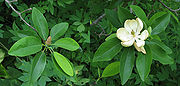 When Linnaeus
took up Magnolia in his Species plantarum
(1753), he created a genus
of only one species: Magnolia virginiana. Under that species he described five varieties (glauca, fœtida, grisea, tripetala and acuminata). In the tenth edition of Systema naturae
(1759), he merged grisea with glauca, and raised the four remaining varieties to species status.
By the end of the 18th century, botanists and plant hunters exploring Asia began to name and describe the Magnolia species from China and Japan. The first Asiatic species to be described by western botanists were Magnolia denudata and Magnolia liliiflora, and Magnolia coco and Magnolia figo
. Soon after that, in 1794, Carl Peter Thunberg
collected and described Magnolia obovata from Japan and at roughly the same time Magnolia kobus was also first collected.
With the number of species increasing, the genus was divided into the two subgenera Magnolia and Yulania. Magnolia contains the American evergreen species Magnolia grandiflora, which is of horticultural
importance, especially in the United States
, and Magnolia virginiana, the type species. Yulania contains several deciduous
Asiatic species, such as Magnolia denudata and Magnolia kobus, which have become horticulturally important in their own right and as parents in hybrids. Classified in Yulania, is also the American deciduous Magnolia acuminata (Cucumber tree), which has recently attained greater status as the parent which is responsible for the yellow flower colour in many new hybrids.
Relations in the family Magnoliaceae have been puzzling taxonomists for a long time. Because the family is quite old and has survived many geological events (such as ice ages, mountain formation and continental drift), its distribution has become scattered. Some species or groups of species have been isolated for a long time, while others could stay in close contact. To create divisions in the family (or even within the genus Magnolia), solely based upon morphological characters, has proven to be a nearly impossible task.
By the end of the 20th century, DNA sequencing
had become available as a method of large scale research on phylogenetic relationships
. Several studies, including studies on many species in the family Magnoliaceae, were carried out to investigate relationships. What these studies all revealed was that genus Michelia
and Magnolia subgenus Yulania were far more closely allied to each other than either one of them was to Magnolia subgenus Magnolia. These phylogenetic studies were supported by morphological data.
As nomenclature
is supposed to reflect relationships, the situation with the species names in Michelia and Magnolia subgenus Yulania was undesirable. Taxonomically there are three choices; 1: to join Michelia and Yulania species in a common genus, not being Magnolia (for which the name Michelia has priority); 2: to raise subgenus Yulania to generic rank, leaving Michelia names and subgenus Magnolia names untouched; or 3: to join Michelia with genus Magnolia into genus Magnolia s.l. (a big genus). Magnolia subgenus Magnolia can not be renamed because it contains Magnolia virginiana, the type species of the genus and of the family.
Not many Michelia species have so far become horticulturally or economically important, apart for their wood. Both subgenus Magnolia and subgenus Yulania include species of major horticultural importance, and a change of name would be very undesirable for many people, especially in the horticultural branch. In Europe, Magnolia even is more or less a synonym for Yulania, since most of the cultivated species on this continent have Magnolia (Yulania) denudata as one of their parents. Most taxonomists who acknowledge close relations between Yulania and Michelia therefore support the third option and join Michelia with Magnolia.
The same goes, mutatis mutandis, for the (former) genera Talauma
and Dugandiodendron, which are then placed in subgenus Magnolia, and genus Manglietia
, which could be joined with subgenus Magnolia or may even earn the status of an extra subgenus. Elmerrillia
seems to be closely related to Michelia and Yulania, in which case it will most likely be treated in the same way as Michelia is now. The precise nomenclatural status of small or monospecific genera like Kmeria, Parakmeria, Pachylarnax, Manglietiastrum, Aromadendron, Woonyoungia, Alcimandra, Paramichelia and Tsoongiodendron remains uncertain. Taxonomists who merge Michelia into Magnolia tend to merge these small genera into Magnolia s.l. as well. Botanists do not yet agree on whether to recognize a big Magnolia genus or the different small genera. For example, Flora of China offers two choices: a large Magnolia which includes about 300 species, everything in the Magnoliaceae
except Liriodendron
(tulip tree), or 16 different genera, some of them recently split out or re-recognized, each of which contains up to 50 species. The western co-author favors the big Magnolia genus, whereas the Chinese co-authors recognize the different small genera.
The list is presented as three subgenera
, 12 sections, and 13 subsections.
Each species entry follows the following pattern:
Botanical name Naming auth. - Common name(s), if any (REGION FOUND)
or evergreen
. Flower
s produced after the leaves
.
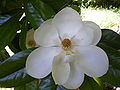


), flower quite early in the spring, before the leaves open. Others flower in late spring or early summer, including the sweetbay magnolia (Magnolia virginiana) and the Southern magnolia (Magnolia grandiflora).
Hybridisation has been immensely successful in combining the best aspects of different species to give plants which flower at an earlier age than the species themselves, as well as having more impressive flowers. One of the most popular garden magnolias, saucer magnolia (Magnolia × soulangeana
), is a hybrid of Magnolia liliiflora and Magnolia denudata.
, where it is known as hou po (厚朴). In Japan, kōboku, Magnolia obovata has been used in a similar manner.Bioactive ingredients include magnolol, honokiol, 4-O-methylhonokiol and obovatol. The aromatic bark contains magnolol
and honokiol
, two polyphenolic compounds that may have demonstrated anti-anxiety and anti-angiogenic properties. Magnolia bark also may have been shown to reduce allergic and asthmatic reactions. They have also been shown to protect against neuronal cell death in vitro
.
Magnolia has attracted the interest of the dental research community because magnolia bark extract inhibits many of the bacteria responsible for caries
and periodontal disease
. In addition, the constituent magnolol interferes with the action of glucosyltransferase, an enzyme
needed for the formation of bacterial plaque.
are used for wrapping food and as cooking dishes.
Magnolias are used as food plants by the larva
e of some Lepidoptera
species, including Giant Leopard Moth
.
and Louisiana
. The flower's abundance in Mississippi is reflected in its nickname of "Magnolia State". The magnolia is also the official state tree of Mississippi. Historically, magnolias have been associated with the Southern United States
. Siebold's Magnolia (Magnolia sieboldii) is the national flower of North Korea
. The Grateful Dead's second most live played song is Sugar Magnolia. Paul Thomas Anderson
created a movie titled Magnolia
. Magnolia is also a song by Jorge Ben Jor
.
Genus
In biology, a genus is a low-level taxonomic rank used in the biological classification of living and fossil organisms, which is an example of definition by genus and differentia...
of about 210 flowering plant
Flowering plant
The flowering plants , also known as Angiospermae or Magnoliophyta, are the most diverse group of land plants. Angiosperms are seed-producing plants like the gymnosperms and can be distinguished from the gymnosperms by a series of synapomorphies...
species
Species
In biology, a species is one of the basic units of biological classification and a taxonomic rank. A species is often defined as a group of organisms capable of interbreeding and producing fertile offspring. While in many cases this definition is adequate, more precise or differing measures are...
in the subfamily Magnolioideae of the family
Family (biology)
In biological classification, family is* a taxonomic rank. Other well-known ranks are life, domain, kingdom, phylum, class, order, genus, and species, with family fitting between order and genus. As for the other well-known ranks, there is the option of an immediately lower rank, indicated by the...
Magnoliaceae
Magnoliaceae
The Magnoliaceae, or Magnolia Family, is a flowering plant family in the order Magnoliales. It consists of two subfamilies:*Magnolioideae, of which Magnolia is the most well-known genus....
. It is named after French
French people
The French are a nation that share a common French culture and speak the French language as a mother tongue. Historically, the French population are descended from peoples of Celtic, Latin and Germanic origin, and are today a mixture of several ethnic groups...
botanist Pierre Magnol
Pierre Magnol
Pierre Magnol was a French botanist. He was born in the city of Montpellier, where he lived and worked for the biggest part of his life. He eventually became Professor of Botany and Director of the Royal Botanic Garden of Montpellier and even held a seat in the Académie Royale des Sciences de...
.
Magnolia is an ancient genus. Having evolved before bee
Bee
Bees are flying insects closely related to wasps and ants, and are known for their role in pollination and for producing honey and beeswax. Bees are a monophyletic lineage within the superfamily Apoidea, presently classified by the unranked taxon name Anthophila...
s appeared, the flowers developed to encourage pollination
Pollination
Pollination is the process by which pollen is transferred in plants, thereby enabling fertilisation and sexual reproduction. Pollen grains transport the male gametes to where the female gamete are contained within the carpel; in gymnosperms the pollen is directly applied to the ovule itself...
by beetle
Beetle
Coleoptera is an order of insects commonly called beetles. The word "coleoptera" is from the Greek , koleos, "sheath"; and , pteron, "wing", thus "sheathed wing". Coleoptera contains more species than any other order, constituting almost 25% of all known life-forms...
s. To avoid damage from pollinating beetles, the carpels of Magnolia flowers are extremely tough. Fossil
Fossil
Fossils are the preserved remains or traces of animals , plants, and other organisms from the remote past...
ised specimens of Magnolia acuminata have been found dating to 20 million years ago, and of plants identifiably belonging to the Magnoliaceae dating to 95 million years ago. Another primitive aspect of Magnolias is their lack of distinct sepal
Sepal
A sepal is a part of the flower of angiosperms . Collectively the sepals form the calyx, which is the outermost whorl of parts that form a flower. Usually green, sepals have the typical function of protecting the petals when the flower is in bud...
s or petal
Petal
Petals are modified leaves that surround the reproductive parts of flowers. They often are brightly colored or unusually shaped to attract pollinators. Together, all of the petals of a flower are called a corolla. Petals are usually accompanied by another set of special leaves called sepals lying...
s: Magnolias possess undifferentiated flower parts for which the term "tepals" was coined.
The natural range of Magnolia species is a disjunct distribution
Disjunct distribution
In biology, a taxon with a disjunct distribution is one that has two or more groups that are related but widely separated from each other geographically...
, with a main centre in east and southeast Asia
Asia
Asia is the world's largest and most populous continent, located primarily in the eastern and northern hemispheres. It covers 8.7% of the Earth's total surface area and with approximately 3.879 billion people, it hosts 60% of the world's current human population...
and a secondary centre in eastern North America
North America
North America is a continent wholly within the Northern Hemisphere and almost wholly within the Western Hemisphere. It is also considered a northern subcontinent of the Americas...
, Central America
Central America
Central America is the central geographic region of the Americas. It is the southernmost, isthmian portion of the North American continent, which connects with South America on the southeast. When considered part of the unified continental model, it is considered a subcontinent...
, the West Indies, and some species in South America
South America
South America is a continent situated in the Western Hemisphere, mostly in the Southern Hemisphere, with a relatively small portion in the Northern Hemisphere. The continent is also considered a subcontinent of the Americas. It is bordered on the west by the Pacific Ocean and on the north and east...
.
Origin of the name Magnolia
In 1703 Charles PlumierCharles Plumier
Charles Plumier was a French botanist, after whom the Frangipani genus Plumeria is named. Plumier is considered one of the most important of the botanical explorers of his time...
(1646–1704) described a flowering tree from the island of Martinique
Martinique
Martinique is an island in the eastern Caribbean Sea, with a land area of . Like Guadeloupe, it is an overseas region of France, consisting of a single overseas department. To the northwest lies Dominica, to the south St Lucia, and to the southeast Barbados...
in his Genera
Genera
Genera is a commercial operating system and development environment for Lisp machines developed by Symbolics. It is essentially a fork of an earlier operating system originating on the MIT AI Lab's Lisp machines which Symbolics had used in common with LMI and Texas Instruments...
. He gave the species, known locally as "talauma", the genus name Magnolia, after Pierre Magnol
Pierre Magnol
Pierre Magnol was a French botanist. He was born in the city of Montpellier, where he lived and worked for the biggest part of his life. He eventually became Professor of Botany and Director of the Royal Botanic Garden of Montpellier and even held a seat in the Académie Royale des Sciences de...
. The English botanist William Sherard
William Sherard
William Sherard was an English botanist. Next to John Ray, he was considered to be one of the outstanding English botanists of his day.-Life:...
, who studied botany in Paris under Joseph Pitton de Tournefort
Joseph Pitton de Tournefort
Joseph Pitton de Tournefort was a French botanist, notable as the first to make a clear definition of the concept of genus for plants.- Biography :...
, a pupil of Magnol, was most probably the first after Plumier to adopt the genus name Magnolia. He was at least responsible for the taxonomic part of Johann Jacob Dillenius
Johann Jacob Dillenius
Johann Jacob Dillen Dillenius was a German botanist.Dillen was born at Darmstadt and was educated at the University of Giessen, where he wrote several botanical papers for the Ephemerides naturae curiosorum, and printed, in 1719, his Catalogus plantarum sponte circa Gissam nascentium, illustrated...
's Hortus Elthamensis and of Mark Catesby
Mark Catesby
Mark Catesby was an English naturalist. Between 1731 and 1743 Catesby published his Natural History of Carolina, Florida and the Bahama Islands, the first published account of the flora and fauna of North America...
's Natural History of Carolina, Florida and the Bahama Islands. These were the first works after Plumier's Genera that used the name Magnolia, this time for some species of flowering trees from temperate
Temperate
In geography, temperate or tepid latitudes of the globe lie between the tropics and the polar circles. The changes in these regions between summer and winter are generally relatively moderate, rather than extreme hot or cold...
North America.
Carolus Linnaeus
Carolus Linnaeus
Carl Linnaeus , also known after his ennoblement as , was a Swedish botanist, physician, and zoologist, who laid the foundations for the modern scheme of binomial nomenclature. He is known as the father of modern taxonomy, and is also considered one of the fathers of modern ecology...
, who was familiar with Plumier's Genera, adopted the genus name Magnolia in 1735 in his first edition of Systema naturae
Systema Naturae
The book was one of the major works of the Swedish botanist, zoologist and physician Carolus Linnaeus. The first edition was published in 1735...
, without a description but with a reference to Plumier's work. In 1753, he took up Plumier's Magnolia in the first edition of Species plantarum
Species Plantarum
Species Plantarum was first published in 1753, as a two-volume work by Carl Linnaeus. Its prime importance is perhaps that it is the primary starting point of plant nomenclature as it exists today. This means that the first names to be considered validly published in botany are those that appear...
. Since Linnaeus never saw an herbarium specimen (if there ever was one) of Plumier's Magnolia and had only his description and a rather poor picture at hand, he must have taken it for the same plant which was described by Catesby in his 1730 Natural History of Carolina. He placed it in the synonymy of Magnolia virginiana var. fœtida, the taxon
Taxon
|thumb|270px|[[African elephants]] form a widely-accepted taxon, the [[genus]] LoxodontaA taxon is a group of organisms, which a taxonomist adjudges to be a unit. Usually a taxon is given a name and a rank, although neither is a requirement...
now known as Magnolia grandiflora.
The species that Plumier originally named Magnolia was later described as Annona dodecapetala by Lamarck, and has since been named Magnolia plumieri and Talauma plumieri (and still a number of other names) but is now known as Magnolia dodecapetala.
Nomenclature and classification
Carolus Linnaeus
Carl Linnaeus , also known after his ennoblement as , was a Swedish botanist, physician, and zoologist, who laid the foundations for the modern scheme of binomial nomenclature. He is known as the father of modern taxonomy, and is also considered one of the fathers of modern ecology...
took up Magnolia in his Species plantarum
Species Plantarum
Species Plantarum was first published in 1753, as a two-volume work by Carl Linnaeus. Its prime importance is perhaps that it is the primary starting point of plant nomenclature as it exists today. This means that the first names to be considered validly published in botany are those that appear...
(1753), he created a genus
Genus
In biology, a genus is a low-level taxonomic rank used in the biological classification of living and fossil organisms, which is an example of definition by genus and differentia...
of only one species: Magnolia virginiana. Under that species he described five varieties (glauca, fœtida, grisea, tripetala and acuminata). In the tenth edition of Systema naturae
Systema Naturae
The book was one of the major works of the Swedish botanist, zoologist and physician Carolus Linnaeus. The first edition was published in 1735...
(1759), he merged grisea with glauca, and raised the four remaining varieties to species status.
By the end of the 18th century, botanists and plant hunters exploring Asia began to name and describe the Magnolia species from China and Japan. The first Asiatic species to be described by western botanists were Magnolia denudata and Magnolia liliiflora, and Magnolia coco and Magnolia figo
Michelia figo
The Banana Shrub or Port Wine Magnolia is an evergreen tree growing to 3-4 m tall. It is native to China.Initially described as by Portuguese missionary and naturalist João de Loureiro as Liriodendron figo, it was reclassified as Michelia figo by German botanist Curt Polycarp Joachim Sprengel...
. Soon after that, in 1794, Carl Peter Thunberg
Carl Peter Thunberg
Carl Peter Thunberg aka Carl Pehr Thunberg aka Carl Per Thunberg was a Swedish naturalist and an apostle of Carl Linnaeus. He has been called "the father of South African botany" and the "Japanese Linnaeus"....
collected and described Magnolia obovata from Japan and at roughly the same time Magnolia kobus was also first collected.
With the number of species increasing, the genus was divided into the two subgenera Magnolia and Yulania. Magnolia contains the American evergreen species Magnolia grandiflora, which is of horticultural
Horticulture
Horticulture is the industry and science of plant cultivation including the process of preparing soil for the planting of seeds, tubers, or cuttings. Horticulturists work and conduct research in the disciplines of plant propagation and cultivation, crop production, plant breeding and genetic...
importance, especially in the United States
United States
The United States of America is a federal constitutional republic comprising fifty states and a federal district...
, and Magnolia virginiana, the type species. Yulania contains several deciduous
Deciduous
Deciduous means "falling off at maturity" or "tending to fall off", and is typically used in reference to trees or shrubs that lose their leaves seasonally, and to the shedding of other plant structures such as petals after flowering or fruit when ripe...
Asiatic species, such as Magnolia denudata and Magnolia kobus, which have become horticulturally important in their own right and as parents in hybrids. Classified in Yulania, is also the American deciduous Magnolia acuminata (Cucumber tree), which has recently attained greater status as the parent which is responsible for the yellow flower colour in many new hybrids.
Relations in the family Magnoliaceae have been puzzling taxonomists for a long time. Because the family is quite old and has survived many geological events (such as ice ages, mountain formation and continental drift), its distribution has become scattered. Some species or groups of species have been isolated for a long time, while others could stay in close contact. To create divisions in the family (or even within the genus Magnolia), solely based upon morphological characters, has proven to be a nearly impossible task.
By the end of the 20th century, DNA sequencing
DNA sequencing
DNA sequencing includes several methods and technologies that are used for determining the order of the nucleotide bases—adenine, guanine, cytosine, and thymine—in a molecule of DNA....
had become available as a method of large scale research on phylogenetic relationships
Phylogenetics
In biology, phylogenetics is the study of evolutionary relatedness among groups of organisms , which is discovered through molecular sequencing data and morphological data matrices...
. Several studies, including studies on many species in the family Magnoliaceae, were carried out to investigate relationships. What these studies all revealed was that genus Michelia
Michelia
Michelia is a genus of flowering plants belonging to the Magnolia family . The genus includes about 50 species of evergreen trees and shrubs, native to tropical and subtropical south and southeast Asia , including southern China.-Description:The Magnoliaceae are an ancient family; fossil plants...
and Magnolia subgenus Yulania were far more closely allied to each other than either one of them was to Magnolia subgenus Magnolia. These phylogenetic studies were supported by morphological data.
As nomenclature
Nomenclature
Nomenclature is a term that applies to either a list of names or terms, or to the system of principles, procedures and terms related to naming - which is the assigning of a word or phrase to a particular object or property...
is supposed to reflect relationships, the situation with the species names in Michelia and Magnolia subgenus Yulania was undesirable. Taxonomically there are three choices; 1: to join Michelia and Yulania species in a common genus, not being Magnolia (for which the name Michelia has priority); 2: to raise subgenus Yulania to generic rank, leaving Michelia names and subgenus Magnolia names untouched; or 3: to join Michelia with genus Magnolia into genus Magnolia s.l. (a big genus). Magnolia subgenus Magnolia can not be renamed because it contains Magnolia virginiana, the type species of the genus and of the family.
Not many Michelia species have so far become horticulturally or economically important, apart for their wood. Both subgenus Magnolia and subgenus Yulania include species of major horticultural importance, and a change of name would be very undesirable for many people, especially in the horticultural branch. In Europe, Magnolia even is more or less a synonym for Yulania, since most of the cultivated species on this continent have Magnolia (Yulania) denudata as one of their parents. Most taxonomists who acknowledge close relations between Yulania and Michelia therefore support the third option and join Michelia with Magnolia.
The same goes, mutatis mutandis, for the (former) genera Talauma
Talauma
Talauma is a genus of plant in family Magnoliaceae. It contains the following species :* Talauma dixonii, Little* Talauma neilii, Lozano...
and Dugandiodendron, which are then placed in subgenus Magnolia, and genus Manglietia
Manglietia
Manglietia is a genus of plant in family Magnoliaceae. It contains the following species :* Manglietia aromatica, Dandy* Manglietia grandis, Hu & Cheng* Manglietia megaphylla, Hu & Cheng...
, which could be joined with subgenus Magnolia or may even earn the status of an extra subgenus. Elmerrillia
Elmerrillia
Elmerrillia is a genus of flowering plants belonging to the Magnolia family . The genus includes five species of evergreen trees, which range across the Indian subcontinent, Indochina, and Malesia....
seems to be closely related to Michelia and Yulania, in which case it will most likely be treated in the same way as Michelia is now. The precise nomenclatural status of small or monospecific genera like Kmeria, Parakmeria, Pachylarnax, Manglietiastrum, Aromadendron, Woonyoungia, Alcimandra, Paramichelia and Tsoongiodendron remains uncertain. Taxonomists who merge Michelia into Magnolia tend to merge these small genera into Magnolia s.l. as well. Botanists do not yet agree on whether to recognize a big Magnolia genus or the different small genera. For example, Flora of China offers two choices: a large Magnolia which includes about 300 species, everything in the Magnoliaceae
Magnoliaceae
The Magnoliaceae, or Magnolia Family, is a flowering plant family in the order Magnoliales. It consists of two subfamilies:*Magnolioideae, of which Magnolia is the most well-known genus....
except Liriodendron
Liriodendron
Liriodendron is a genus of two species of characteristically large deciduous trees in the magnolia family .These trees are widely known by the common name tulip tree or tuliptree for their large flowers superficially resembling tulips, but are closely related to magnolias rather than lilies, the...
(tulip tree), or 16 different genera, some of them recently split out or re-recognized, each of which contains up to 50 species. The western co-author favors the big Magnolia genus, whereas the Chinese co-authors recognize the different small genera.
Selected species
This nearly comprehensive species list has been adapted from the one used by the Magnolia Society. It does not represent the last word on the subclassification of the genus Magnolia (see above), as a clear consensus has not yet been reached.The list is presented as three subgenera
Subgenus
In biology, a subgenus is a taxonomic rank directly below genus.In zoology, a subgeneric name can be used independently or included in a species name, in parentheses, placed between the generic name and the specific epithet: e.g. the Tiger Cowry of the Indo-Pacific, Cypraea tigris Linnaeus, which...
, 12 sections, and 13 subsections.
Each species entry follows the following pattern:
Botanical name Naming auth. - Common name(s), if any (REGION FOUND)
Subgenus Magnolia
Anthers open by splitting at the front facing the centre of the flower. DeciduousDeciduous
Deciduous means "falling off at maturity" or "tending to fall off", and is typically used in reference to trees or shrubs that lose their leaves seasonally, and to the shedding of other plant structures such as petals after flowering or fruit when ripe...
or evergreen
Evergreen
In botany, an evergreen plant is a plant that has leaves in all seasons. This contrasts with deciduous plants, which completely lose their foliage during the winter or dry season.There are many different kinds of evergreen plants, both trees and shrubs...
. Flower
Flower
A flower, sometimes known as a bloom or blossom, is the reproductive structure found in flowering plants . The biological function of a flower is to effect reproduction, usually by providing a mechanism for the union of sperm with eggs...
s produced after the leaves
Leaf
A leaf is an organ of a vascular plant, as defined in botanical terms, and in particular in plant morphology. Foliage is a mass noun that refers to leaves as a feature of plants....
.
Section Magnolia
- Magnolia grandiflora L. - Southern magnolia or Bull bay (SE US)
- Magnolia guatemalensis Donn. Sm. - Guatemalan magnolia or Mamey (GUATEMALA, HONDURAS, EL SALVADOR)
- Magnolia guatemalensis ssp. guatemalensis Guatemalan magnolia or Mamey (GUATEMALA)
- Magnolia guatemalensis ssp. hondurensis (Molina) Vazquez Honduran magnolia (HONDURAS, EL SALVADOR)
- Magnolia iltisianaMagnolia iltisianaMagnolia iltisiana is a species of plant in the Magnoliaceae family. It is endemic to Mexico.-Sources:* World Conservation Monitoring Centre 1998. . Downloaded on 22 August 2007....
Vazquez . (W MEXICO) - Magnolia pacifica Vazquez . (W MEXICO)
- Magnolia pacifica ssp. pacifica . (W MEXICO)
- Magnolia pacifica ssp. pugana Iltis & Vazquez . (W MEXICO)
- Magnolia pacifica ssp. tarahumara Vazquez . (W MEXICO)
- Magnolia panamensisMagnolia panamensisMagnolia panamensis is a species of plant in the Magnoliaceae family. It is endemic to Panama. It is threatened by habitat loss.-Sources:* Mitré, M. 1998. . Downloaded on 22 August 2007....
Vazquez & Iltis . (PANAMA) - Magnolia poasanaMagnolia poasanaMagnolia poasana is a sub-tropical to tropical, subcanopy tree, growing in areas of montane rainforest. The names "Poas", and "poasana" originate from the Poás Volcano in Costa Rica where, along with Panama and Southern Mexico they grow in the wild...
(Pittier) Dandy - Poas magnolia (COSTA RICA, PANAMA) - Magnolia schiedeanaMagnolia schiedeanaMagnolia schiedeana is a species of plant in the Magnoliaceae family. It is endemic to Mexico.-Sources:* Ramirez-Marcial, N. & González-Espinosa, M. 1998. . Downloaded on 22 August 2007....
Schltdl. . (E MEXICO) - Magnolia sharpii Meranda - Sharp's magnolia (CHIAPAS MEXICO)
- Magnolia sororum Seibert - Sister magnolia (COSTA RICA, PANAMA)
- Magnolia sororum ssp. lutea Vazquez . (COSTA RICA, PANAMA)
- Magnolia sororum ssp. sororum . (PANAMA)
- Magnolia tamaulipana Vazquez - Mexican evergreen magnolia (NE MEXICO)
- Magnolia virginiana Linn - Sweetbay magnolia, Sweet magnolia, Sweet bay, Swamp bay, Swamp magnolia, Swamp laurel, Laurel magnolia, White bay, or Beaver tree (SOUTHEAST US)
- Magnolia yoroconteMagnolia yoroconteMagnolia yoroconte is a species of plant in the Magnoliaceae family. It is found in Belize, Guatemala, Honduras, and Mexico.-Source:* World Conservation Monitoring Centre 1998. . Downloaded on 22 August 2007....
Dandy - Yoroconte magnolia (HONDURAS)
Subsection Gwillimia
- Magnolia albosericea Chun & Tsoong. . (HAINAN IS.)
- Magnolia championii Benth - Champion's magnolia (S & SE CHINA)
- Magnolia coco (Lour.) DC. - Coconut magnolia (SE CHINA)
- Magnolia delavayi Franchet - Chinese evergreen magnolia or Delavay's magnolia (YUNNAN (CHINA))
- Magnolia fistulosa (Finet & Gagnep.) Dandy . (SE YUNNAN (CHINA))
- Magnolia henryiMagnolia henryiMagnolia henryi is a species of plant in the Magnoliaceae family. It is found in China, Laos, Myanmar, and Thailand. It is threatened by habitat loss.-Sources:* World Conservation Monitoring Centre 1998. . Downloaded on 22 August 2007....
Dunn - Henry's magnolia (YUNNAN (CHINA)) - Magnolia nana Dandy - Dwarf magnolia (VIETNAM)
- Magnolia odoratissima Law et Zhou . (S CHINA)
- Magnolia pterocarpa Roxb. . (NEPAL, BURMA)
Subsection Blumiana
- Magnolia gigantifolia (Miq.) Noot. . (BORNEO, SUMATRA)
- Magnolia hodgsoniiMagnolia hodgsoniiMagnolia hodgsonii , known in Chinese as Gai lie mu is a species of Magnolia native to the forests of the Himalaya and southeastern Asia, occurring in Bhutan, southwestern China , northeastern India, northern Myanmar, Nepal, and Thailand...
(Hook.f. & Thom.) H.Keng - Gai lie mu (NEPAL, BURMA) - Magnolia lasia Noot. . (BORNEO)
- Magnolia liliifera (L.) Baillon - Egg magnolia (SE ASIA, BORNEO, PHILIPPINES, SINGAPORE, SUMATRA)
- Magnolia liliifera var. angatensis (Blanco) Noot. . (PHILIPPINES)
- Magnolia liliifera var. beccarii (RidleyHenry Nicholas RidleyHenry Nicholas Ridley CMG , MA , FRS, FLS, F.R.H.S. was an English botanist and geologist.Born at West Harling Hall, Norfolk, England...
) Noot. . (BORNEO) - Magnolia liliifera var. liliifera . (SE ASIA)
- Magnolia liliifera var. obovata (Korth.) Govaerts . (BORNEO)
- Magnolia liliifera var. singapurensis (Ridley) Noot. . (SINGAPORE, SUMATRA)
- Magnolia mariusjacobsia Noot. . (BORNEO)
- Magnolia persuaveolens Dandy - Fragrant magnolia (BORNEO)
- Magnolia persuaveolens ssp. persuaveolens . (BORNEO)
- Magnolia persuaveolens ssp. rigida Noot. . (BORNEO)
- Magnolia sarawakensis (Agostini) Noot. . (BORNEO)
- Magnolia villosa (Miq.) H.Keng . (SUMATRA, BORNEO)
Subsection Talauma
- Magnolia allenii Standl. . (PANAMA)
- Magnolia amazonicaMagnolia amazonicaMagnolia amazonica is a flowering evergreen tree of the Magnoliaceae family native to the lower western Amazon River Basin, including Peru and Brazil.-Description:...
Ducke . (BRAZIL, PERU) - Magnolia arcabucoana (Lozano) Govaerts . (COLOMBIA)
- Magnolia bolivianaMagnolia bolivianaMagnolia boliviana is a tree in the Magnoliaceae family native to the rainforests of the eastern Andean foothills from central Bolivia between 200 - 500 m.a.s.l. It can reach a height of 30 meters and the trunk can be 50 - 75 cm of diameter. The smooth ovate-elliptic leaves are 12 - 29 cm long and...
(M.Nee) Govaerts . (BOLIVIA) - Magnolia caricifragransMagnolia caricifragransMagnolia caricifragrans is a species of plant in the Magnoliaceae family. It is endemic to Colombia.-Sources:* Calderon, E. 1998. . Downloaded on 22 August 2007....
(Lozano) Govaerts . (COLOMBIA) - Magnolia cespedesiiMagnolia cespedesiiMagnolia cespedesii is a species of plant in the Magnoliaceae family. It is endemic to Colombia.-Sources:* Calderon, E. 1998. . Downloaded on 22 August 2007....
(Triana & Planch) Govaerts . (COLOMBIA) - Magnolia chocoensis (Lozano) Govaerts . (COLOMBIA)
- Magnolia dixonii (Little) Govaerts . (ECUADOR)
- Magnolia dodecapetala (Lam.) Govaerts . (LESSER ANTILLES)
- Magnolia espinaliiMagnolia espinaliiMagnolia espinalii is a species of plant in the Magnoliaceae family. It is endemic to Colombia but critically endangered. According to López-A et al., as of 2008 there were only 23 known surviving trees in the wild.-Sources:...
(Lozano) Govaerts . (COLOMBIA) - Magnolia georgiiMagnolia georgiiMagnolia georgii is a species of plant in the Magnoliaceae family. It is endemic to Colombia.-Sources:* Calderon, E. 1998. . Downloaded on 22 August 2007....
(Lozano) Govaerts . (COLOMBIA) - Magnolia gilbertoiMagnolia gilbertoiMagnolia gilbertoi is a species of plant in the Magnoliaceae family. It is endemic to Colombia.-Sources:* Calderon, E. 1998. . Downloaded on 22 August 2007....
(Lozano) Govaerts . (COLOMBIA) - Magnolia gloriensis (Pittier) Govaerts . (CENTRAL AMERICA)
- Magnolia hernandeziiMagnolia hernandeziiMagnolia hernandezii is a species of plant in the Magnoliaceae family. It is endemic to Colombia.-Sources:* Calderon, E. 1998. . Downloaded on 22 August 2007....
(Lozano) Govaerts . (COLOMBIA) - Magnolia irwiniana (Lozano) Govaerts . (BRAZIL)
- Magnolia katiorumMagnolia katiorumMagnolia katiorum is a species of plant in the Magnoliaceae family. It is endemic to Colombia.-Sources:* Calderon, E. 1998. . Downloaded on 22 August 2007....
(Lozano) Govaerts . (COLOMBIA) - Magnolia mexicana DC. . (MEXICO)
- Magnolia minorMagnolia minorMagnolia minor is a species of plant in the Magnoliaceae family. It is endemic to Cuba. It is threatened by habitat loss.-Sources:* Areces-Mallea, A.E. 1998. . Downloaded on 22 August 2007....
(Urb.) Govaerts . (CUBA) - Magnolia morii (Lozano) Govaerts . (PANAMA)
- Magnolia narinensisMagnolia narinensisMagnolia narinensis is a species of plant in the Magnoliaceae family. It is endemic to Colombia.-Sources:* Calderon, E. 1998. . Downloaded on 22 August 2007....
(Lozano) Govaerts . (COLOMBIA) - Magnolia neillii (Lozano) Govaerts . (ECUADOR)
- Magnolia ovata (A.St.-Hil.) Spreng. . (BRAZIL)
- Magnolia polyhypsophilla (Lozano) Govaerts . (COLOMBIA)
- Magnolia rimachiiMagnolia rimachiiMagnolia rimachii is a small to medium sized tree of the Magnoliaceae family commonly reaching 8 to 15 m high. It is found in the western lowland Amazon Basin tropical forest, in Ecuador and Peru, between in elevation.-Description:...
(Lozano) Govaerts . (PERU, ECUADOR) - Magnolia sambuensisMagnolia sambuensisMagnolia sambuensis is a species of plant in the Magnoliaceae family. It is found in Colombia and Panama. It is threatened by habitat loss.-Sources:* Mitré, M. 1998. . Downloaded on 22 August 2007....
(Pittier) Govaerts . (PANAMA, COLOMBIA) - Magnolia santanderianaMagnolia santanderianaMagnolia santanderiana is a species of plant in the Magnoliaceae family. It is endemic to Colombia.-Sources:* Calderon, E. 1998. . Downloaded on 22 August 2007....
(Lozano) Govaerts . (COLOMBIA) - Magnolia sellowiana (A.St.-Hil.) Govaerts . (BRAZIL)
- Magnolia silvioi (Lozano) Govaerts . (COLOMBIA)
- Magnolia venezuelensis (Lozano) Govaerts . (VENEZUELA)
- Magnolia virolinensisMagnolia virolinensisMagnolia virolinensis is a species of plant in the Magnoliaceae family. It is endemic to Colombia.-Sources:* Calderon, E. 1998. . Downloaded on 22 August 2007....
(Lozano) Govaerts . (COLOMBIA) - Magnolia wolfiiMagnolia wolfiiMagnolia wolfii is a species of plant in the Magnoliaceae family. It is endemic to Colombia.-Sources:* Calderon, E. 1998. . Downloaded on 22 August 2007....
(Lozano) Govaerts . (COLOMBIA)
Subsection Dugandiodendron
- Magnolia argyrothricha (Lozano) Govaerts . (COLOMBIA)
- Magnolia calimaensisMagnolia calimaensisMagnolia calimaensis is a species of plant in the Magnoliaceae family. It is endemic to Colombia.-Sources:* Calderon, E. 1998. . Downloaded on 22 August 2007....
(Lozano) Govaerts . (COLOMBIA) - Magnolia calophyllaMagnolia calophyllaMagnolia calophylla is a species of plant in the Magnoliaceae family. It is endemic to Colombia.- Sources :* Calderon, E. 1998. . Downloaded on 22 August 2007....
(Lozano) Govaerts . (COLOMBIA) - Magnolia cararensisMagnolia cararensisMagnolia cararensis is a species of plant in the Magnoliaceae family. It is endemic to Colombia.-Source:* Calderon, E. 1998. . Downloaded on 22 August 2007....
(Lozano) Govaerts . (COLOMBIA) - Magnolia chimantensis Steyermark & Maguire - Chimanta magnolia (VENEZUELA)
- Magnolia colombianaMagnolia colombianaMagnolia colombiana is a species of plant in the Magnoliaceae family. It is endemic to Colombia.- Sources :* Calderon, E. 1998. . Downloaded on 22 August 2007....
(Little) Govaerts . (COLOMBIA) - Magnolia guatapensisMagnolia guatapensisMagnolia guatapensis is a species of plant in the Magnoliaceae family. It is endemic to Colombia.-Sources:* Calderon, E. 1998. . Downloaded on 22 August 2007....
(Lozano) Govaerts . (COLOMBIA) - Magnolia lenticellata (Lozano) Govaerts . (COLOMBIA)
- Magnolia magnifolia (Lozano) Govaerts . (COLOMBIA)
- Magnolia mahechaeMagnolia mahechaeMagnolia mahechae is a species of plant in the Magnoliaceae family. It is endemic to Colombia.-Sources:* Calderon, E. 1998. . Downloaded on 22 August 2007....
(Lozano) Govaerts . (COLOMBIA) - Magnolia ptaritepuiana Steyermark - Ptari-tepui magnolia (VENEZUELA)
- Magnolia striatifolia Little . (COLOMBIA, ECUADOR)
- Magnolia urraoenseMagnolia urraoenseMagnolia urraoense is a species of plant in the Magnoliaceae family. It is endemic to Colombia.-Sources:* Calderon, E. 1998. . Downloaded on 22 August 2007....
(Lozano) Govaerts . (COLOMBIA) - Magnolia yarumalenseMagnolia yarumalenseMagnolia yarumalense is a species of plant in the Magnoliaceae family. It is endemic to Colombia.-Source:* Calderon, E. 1998. . Downloaded on 22 August 2007....
(Lozano) Govaerts . (COLOMBIA)
Subsection Cubenses
- Magnolia cacuminoides Bisse . (CUBA)
- Magnolia cristalensis Bisse . (CUBA)
- Magnolia cubensis Urb. - Cuban magnolia (CUBA)
- Magnolia domingensis Urb. - Dominican magnolia (HAITI)
- Magnolia ekmannii Urb. . (HAITI)
- Magnolia emarginata Urb. & Ekman - Small-notched magnolia (HAITI)
- Magnolia hamorii Howard - Hamor's magnolia (DOM. REP.)
- Magnolia pallescens Urb. & Ekman - Pale magnolia (DOM. REP.)
- Magnolia portoricensis Bello - Puerto Rico magnolia (PUERTO RICO)
- Magnolia splendensMagnolia splendensMagnolia splendens, commonly known as the Laurel magnolia, Shining Magnolia or locally as the laurel sabino, is a magnolia native to the eastern Puerto Rico. It is a medium to large evergreen tree 16-80 ft tall with dark green leaves and showy cream or white flowers. The wood is aromatic, giving...
Urban - Shining magnolia or Laurel magnolia (PUERTO RICO)
Section Manglietia
- Magnolia aromatica (Dandy) V.S.Kumar . (S CHINA)
- Magnolia blaoensis (Gagnep.) Dandy . (VIETNAM)
- Magnolia blumeiMagnolia blumeiMagnolia blumei is a species of magnolia that is endemic to Indonesia. It is found on the islands of Sumatra and Java....
Prantl . (SUMATRA, JAVA)- Magnolia blumei var. blumei . (SUMATRA, JAVA)
- Magnolia blumei var. sumatrana (Miq.) Figlar & Noot. . (W SUMATRA)
- Magnolia calophylloides Figlar & Noot. . (W SUMATRA)
- Magnolia caveana (Hook.f. & Thoms.) D.C.Raju & M.P.Nayer . (ASSAM, N BURMA)
- Magnolia chevalieri (Dandy) V.S.Kumar . (VIETNAM, LAOS)
- Magnolia conifera (Dandy) V.S.Kumar . (SE CHINA, VIETNAM)
- Magnolia conifera var. chingii (Dandy) V.S.Kumar . (SE CHINA)
- Magnolia conifera var. conifera . (SE CHINA, VIETNAM)
- Magnolia crassipes (Y.W.Law) V.S.Kumar . (GUANGDONG (CHINA))
- Magnolia dandyi (Gapnep.) Dandy . (S CHINA, VIETNAM, LAOS)
- Magnolia decidua (Q.Y.Zheng) V.S.Kumar . (JIANGXI (CHINA))
- Magnolia dolichogyna (Dandy ex Noot.) Figlar & Noot. . (BORNEO, MALAY PENIN.)
- Magnolia duclouxii Finet & Gagnep. . (VIETNAM, SW CHINA)
- Magnolia figlarii V.S.Kumar . (SICHUAN (CHINA))
- Magnolia fordiana (Oliv.) Hu . (VIETNAM, S CHINA)
- Magnolia fordiana var. calcarea (X.H.Song) Chen & Noot. . (GUIZHOU (CHINA))
- Magnolia fordiana var. fordiana . (VIETNAM, S CHINA)
- Magnolia fordiana var. forrestii (W.W.Sm. Ex Dandy) Chen & Noot. . (SW CHINA)
- Magnolia fordiana var. kwangtungensis (Merr.) Chen & Noot. . (SE CHINA)
- Magnolia garrettii (Craib) V.S.Kumar . (SW CHINA, VIETNAM, THAILAND)
- Magnolia grandis (Hu & W.C.Cheng) V.S.Kumar . (YUNNAN (CHINA))
- Magnolia hookeri Cubitt & W.W.Sm. . (SW CHINA, N BURMA, THAILAND)
- Magnolia insignis (Wall.) Blume . (S CHINA, NEPAL, BURMA)
- Magnolia lanuginosoides Figlar & Noot. . (SUMATRA)
- Magnolia lucida (B.L.Chen & S.C.Yang) V.S.Kumar . (SW CHINA)
- Magnolia megaphylla (Hu & W.C.Cheng) V.S.Kumar . (YUNNAN (CHINA))
- Magnolia moto (Dandy) V.S.Kumar . (SE CHINA)
- Magnolia obovalifolia (C.Y.Yu & Law) V.S.Kumar . (YUNNAN (CHINA))
- Magnolia ovoidea (H.T.Chang & B.L.Chen) V.S.Kumar . (YUNNAN (CHINA))
- Magnolia phuthoensis (Dandy ex Gapnep.) V.S.Kumar . (VIETNAM)
- Magnolia rufibarbata (Dandy) V.S.Kumar . (VIETNAM)
- Magnolia sabahensis (Dandy ex Noot.) Figlar & Noot. . (BORNEO)
- Magnolia tibetica V.S.Kumar . (TIBET)
- Magnolia utilis (Dandy) V.S.Kumar . (N BURMA, THAILAND)
- Magnolia ventii (N.V.Tiep) V.S.Kumar . (YUNNAN (CHINA))
- Magnolia yuyuanensis (Y.W.Law) V.S.Kumar . (E CHINA)
Section Kmeria
- Magnolia duperreana Pierre . (VIETNAM, CAMBODIA)
- Magnolia kwangsiensis Figlar & Noot. . (YUNNAN, GUANGXI (CHINA))
- Magnolia thailandica Noot. & Chalermglin . (THAILAND)
Section Rhytidospermum
Subsection Rhytidospermum
- Magnolia obovataMagnolia obovataMagnolia obovata is a species of Magnolia, native to Japan and the adjacent Kurile Islands of Russia. It grows at altitudes of sea level up to 1,800 m in mixed broadleaf forest.-Description:It is a medium-sized deciduous tree 15–30 m tall, with slate grey bark...
Thunb. - Japanese bigleaf magnolia or Japanese whitebark magnolia (JAPAN) - Magnolia officinalis Rehd. & Wilson - Houpu magnolia or Magnolia-bark (W CHINA)
- Magnolia officinalis ssp. biloba Cheng & Law - Aoyehoupo magnolia (E CHINA)
- Magnolia officinalis ssp. officinalis - Houpu magnolia or Magnolia-bark (E CHINA)
- Magnolia rostrataMagnolia rostrataMagnolia rostrata, common name is Beaked magnolia, is a species of plant in the Magnoliaceae family.It is found in China and Myanmar-Burma. It is an IUCN Red List vulnerable species, threatened by habitat loss.-Description:...
W.W.Smith - Beaked magnolia (SW CHINA) - Magnolia tripetala (L.) L. - Umbrella magnolia or Umbrella-tree (SE US)
Subsection Oyama
- Magnolia globosa Hook.f. & Thoms. - Globe magnolia or Hen magnolia (NEPAL, BURMA)
- Magnolia sieboldii K.Koch - Siebold's magnolia or Oyama magnolia (KOREA, E CHINA)
- Magnolia sieboldii ssp. japonica K.Ueda . (JAPAN, CENTRAL CHINA)
- Magnolia sieboldii ssp. sieboldii Siebold's magnolia or Oyama magnolia (JAPAN)
- Magnolia sieboldii ssp. sinensis (Rehd. & Wilson) Spongberg - Chinese Oyama magnolia or Floreplena magnolia (CENTRAL CHINA)
- Magnolia wilsonii (Finet. & Gagnep.) Rehd. - Wilson's magnolia (SW CHINA)
Section Auriculata
- Magnolia fraseri Walt. - Fraser magnolia or Ear-leaved magnolia (SE US)
- Magnolia fraseri var. fraseri - Fraser magnolia or Ear-leaved magnolia (SE US)
- Magnolia fraseri var. pyramidata (Bartram) Pampanini - Pyramid magnolia (SE US)
Section Macrophylla
- Magnolia macrophylla Michx. - Bigleaf magnolia (SE US, E MEXICO)
- Magnolia macrophylla var. ashei (Weatherby) D.Johnson - Ashe magnolia (SE US)
- Magnolia macrophylla var. dealbata (Zuccarini) D.Johnson - Mexican bigleaf magnolia or Cloudforest magnolia (E MEXICO)
- Magnolia macrophylla var. macrophylla - Bigleaf magnolia (SE US)
Subgenus Yulania
Anthers open by splitting at the sides. Deciduous. Flowers mostly produced before leaves (except Magnolia acuminata).Section Yulania
Subsection Yulania
- Magnolia amoenaMagnolia amoenaMagnolia amoena is a species of plant in the Magnoliaceae family. It is endemic to China. It is threatened by habitat loss.-Source:...
W.C.Cheng - Tianmu magnolia or Tienmu magnolia (E CHINA) - Magnolia biondii Pampan - Spring hope magnolia (E CHINA)
- Magnolia campbellii Hook.f. & Thomson - Campbell's magnolia (W CHINA, HIMALAYAS)
- Magnolia campbellii var. alba Treseder . (HIMALAYAS)
- Magnolia campbellii var. campbellii . (HIMALAYAS)
- Magnolia campbellii var. mollicomata (W.W.Smith) F.Kingdon-Ward . (W CHINA, HIMALAYAS)
- Magnolia cylindricaMagnolia cylindricaMagnolia cylindrica, or the Huangshan magnolia , is a species of plant in the Magnoliaceae family. It is endemic to China. It is threatened by habitat loss.-Sources:...
Wilson - Huangshan magnolia (E CHINA) - Magnolia dawsoniana Rehd. & Wilson - Dawson's magnolia (SICHUAN (CHINA))
- Magnolia denudata Desr. - Yulan magnolia or Lilytree (E CHINA)
- Magnolia kobusMagnolia kobusMagnolia kobus, known as the Kobushi Magnolia, is a species of Magnolia native to Japan and occasionally cultivated in temperate areas...
DC. - Kobushi magnolia (JAPAN, KOREA) - Magnolia liliiflora Desr. - Mulan magnolia, Purple magnolia, Red magnolia or Woody-orchid (C CHINA)
- Magnolia salicifolia (Sieb. & Zucc.) Maxim. - Willow-leafed magnolia (JAPAN)
- Magnolia sargentiana Rehd. & Wilson - Sargent's magnolia (W CHINA)
- Magnolia sargentiana var. robusta Rehd. & Wilson . (SICHUAN (CHINA))
- Magnolia sargentiana var. sargentiana . (W CHINA)
- Magnolia sprengeri Pampan - Sprenger's magnolia (SICHUAN (CHINA))
- Magnolia sprengeri var. elongata (Rehd. & Wilson) Johnstone . (SICHUAN (CHINA))
- Magnolia sprengeri var. sprengeri . (SICHUAN (CHINA))
- Magnolia stellata (Sieb. & Zucc.) Maxim. - Star magnolia (JAPAN)
- Magnolia × soulangeanaMagnolia × soulangeanaMagnolia × soulangeana is a hybrid plant in the genus Magnolia and family Magnoliaceae. It is a deciduous tree with large, early-blooming flowers in various shades of white, pink, and purple...
Thiéb.-Bern. - Saucer magnolia (HYBRID ORIGIN) - Magnolia zeniiMagnolia zeniiMagnolia zenii is a species of plant in the Magnoliaceae family. It is endemic to China.-Sources:* World Conservation Monitoring Centre 1998. . Downloaded on 22 August 2007....
Cheng - Zen magnolia (E CHINA)
Subsection Tulipastrum
- Magnolia acuminata (L.) L. - Cucumber tree or Blue magnolia (E NORTH AMERICA)
- Magnolia acuminata var. acuminata - Cucumber tree or Blue magnolia (E NORTH AMERICA)
- Magnolia acuminata var. subcordata (Spach) Dandy - Yellow cucumber tree (SE US)
Section Michelia
Subsection Michelia
- Magnolia × albaMagnolia × albaMagnolia × alba, commonly known as the white champaca, is a flowering plant of hybrid origin found nowhere in the wild and cultivated for ornamental use...
(DC.) Figlar & Noot. - White champaca (HYBRID ORIGIN) - Magnolia angustioblonga (Law & Wu) Figlar . (SW CHINA)
- Magnolia baillonii Pierre . (SW CHINA, VIETNAM)
- Magnolia balansae A.DC. . (S CHINA, VIETNAM)
- Magnolia banghamii (Noot.) Figlar & Noot. . (MALAYSIA, SUMATRA)
- Magnolia braianensis (Gagnep.) Figlar . (VIETNAM)
- Magnolia cavaleriei (Finet & Gagnep.) Figlar . (S CHINA)
- Magnolia champaca (L.) Baillon ex Pierre . (S INDIA, LESSER SUNDA IS., JAVA, MALAY PENIN.)
- Magnolia champaca var. champaca . (S INDIA, LESSER SUNDA IS.)
- Magnolia champaca var. pubinervia (Blume) Figlar & Noot. . (JAVA, MALAY PENIN.)
- Magnolia chapensis (Dandy) Sima . (S CHINA, N VIETNAM)
- Magnolia compressa Maxim. . (JAPAN, SW CHINA)
- Magnolia coriacea (H.T.Chang & B.L.Chen) Figlar . (SE YUNNAN (CHINA))
- Magnolia dianica Sima & Figlar . (SW CHINA)
- Magnolia doltsopa (Buch.-Ham. Ex DC.) Figlar . (SW CHINA, HIMALAYAS)
- Magnolia elliptilimba (B.L.Chen & Noot.) Figlar . (YUNNAN (CHINA))
- Magnolia ernestii Figlar . (SICHUAN (CHINA))
- Magnolia ernestii ssp. ernestii . (SICHUAN (CHINA))
- Magnolia ernestii ssp. szechuanica (Dandy) Sima & Figlar . (SICHUAN (CHINA))
- Magnolia figo (Lour.) DC. - Banana-shrub or Chenille copperleaf (SE CHINA)
- Magnolia figo var. crassipes (Law) Figlar & Noot. . (SE CHINA)
- Magnolia figo var. figo . (SE CHINA)
- Magnolia figo var. skinneriana ined. . (SE CHINA)
- Magnolia flaviflora (Law & Wu) Figlar . (VIETNAM, SW CHINA)
- Magnolia floribunda (Finet & Gagnep.) Figlar . (S CHINA, VIETNAM)
- Magnolia foveolata (Merr. Ex Dandy) Figlar . (S CHINA, VIETNAM)
- Magnolia fujianensis (Q.F.Zheng) Figlar . (SE CHINA)
- Magnolia fulva (H.T.Chang & B.L.Chen) Figlar . (YUNNAN (CHINA), VIET.?)
- Magnolia fulva var. calcicola Sima & Yu . (YUNNAN (CHINA))
- Magnolia fulva var. fulva . (YUNNAN (CHINA), VIET.?)
- Magnolia guangxiensis (Law & R.Z.Zhou) Sima . (GUANGXI (CHINA))
- Magnolia hypolampra (Dandy) Figlar . (S CHINA, VIETNAM)
- Magnolia ingrata (B.L.Chen & S.C.Lang) Figlar . (YUNNAN (CHINA))
- Magnolia jiangxiensis (H.T.Chang & B.L.Chen) Figlar . (JIANGXI (CHINA))
- Magnolia kingii (Dandy) Figlar . (BANGLADESH, ASSAM)
- Magnolia kisopa (Bush.-Ham. ex DC.) Figlar . (VIETNAM, NEPAL)
- Magnolia koordersiana (Noot.) Figlar . (MALAYSIA, W SUMATRA)
- Magnolia lacei (W.W.Smith) Figlar . (SW CHINA, VIETNAM)
- Magnolia lanuginosa (Wall.) Figlar & Noot. . (YUNNAN (CHINA), NEPAL)
- Magnolia leveilleana (Dandy) Figlar . (SW CHINA)
- Magnolia macclurei (Dandy) Figlar . (S CHINA, N VIETNAM)
- Magnolia macclurei var. macclurei . (S CHINA, N VIETNAM)
- Magnolia macclurei var. sublanea Dandy . (GUANGDONG (CHINA))
- Magnolia mannii (King) King . (ASSAM)
- Magnolia martinii H.Lev. . (SE CHINA, VIETNAM)
- Magnolia masticata (Dandy) Figlar . (YUNNAN (CHINA), LAOS)
- Magnolia maudiae (Dunn) Figlar . (SE CHINA, HAINAN IS.)
- Magnolia maudiae var. hunanensis (C.L.Peng & L.H.Yan) Sima . (HUNAN (CHINA))
- Magnolia maudiae var. maudiae . (SE CHINA, HAINAN IS.)
- Magnolia maudiae var. platypetala (Hand.-Mazz.) Sima . (S-CENTRAL CHINA)
- Magnolia mediocris (Dandy) Figlar . (S CHINA, VIETNAM)
- Magnolia microcarpa (B.L.Chen & S.C.Yang) Sima . (S CHINA)
- Magnolia microtricha (Hand.-Mazz.) Figlar . (YUNNAN (CHINA))
- Magnolia montanaMagnolia montanaMagnolia montana is a species of Magnolia native to the Western Malesia region of the Indomalaya ecozone.- See also :*Magnolia × alba*Magnolia champaca*Michelia-External links:* from the Magnolia Society.*...
(Blume) Figlar & Noot. . (MALAYSIA to BORNEO) - Magnolia nilagirica (Zenker) Figlar . (S INDIA, SRI LANKA)
- Magnolia oblonga (Wall. Ex Hook.f. & Thomson) Figlar . (ASSAM)
- Magnolia odora (Chun) Figlar & Noot. . (SE CHINA, N VIETNAM)
- Magnolia opipara (H.T.Chang & B.L.Chen) Sima . (YUNNAN (CHINA))
- Magnolia philippinensis P.Pharm . (PHILIPPINES)
- Magnolia punduana (Hook.f. & Thoms.) Figlar . (ASSAM)
- Magnolia rajaniana (Craib.) Figlar . (THAILAND)
- Magnolia scortechinii (King) Figlar & Noot. . (MALAY PENIN., W SUMATRA)
- Magnolia shiluensis (Chun & Y.F.Wu) Figlar . (HAINAN IS.)
- Magnolia sirindhorniae Noot. & Chalermglin - Princess Sirindhorn's magnolia (THAILAND)
- Magnolia sphaerantha (C.Y.Wu ex Z.S.Yue) Sima . (SW CHINA)
- Magnolia subulifera (Dandy) Figlar . (VIETNAM)
- Magnolia sumatrae (Dandy) Figlar & Noot. . (MALAYSIA, SUMATRA)
- Magnolia xanthantha (C.Y.Wu ex Law & Y.F.Wu) Figlar . (YUNNAN (CHINA))
Subsection Elmerrillia
- Magnolia platyphylla (Merr.) Figlar & Noot. . (PHILIPPINES)
- Magnolia pubescens (Merr.) Figlar & Noot. . (PHILIPPINES)
- Magnolia tsiampacca (L.) Figlar & Noot. . (SUMATRA, NEW GUINEA, MALAYSIA, BORNEO)
- Magnolia tsiampacca ssp. mollis (Dandy) Figlar & Noot. . (SUMATRA, BORNEO)
- Magnolia tsiampacca ssp. tsiampacca . (SUMATRA, NEW GUINEA, MALAYSIA)
- Magnolia tsiampacca ssp. tsiampacca var. glaberrima (Dandy) Figlar & Noot. . (MALAYSIA, NEW GUINEA)
- Magnolia tsiampacca ssp. tsiampacca var. tsiampacca . (SUMATRA, NEW GUINEA)
- Magnolia vrieseana (Miq.) Baill. Ex Pierre . (SULAWESI, MOLUCCAS)
Subsection Maingola
- Magnolia annamensis Dandy . (VIETNAM)
- Magnolia carsonii Dandy ex Noot. . (BORNEO, CELEBES)
- Magnolia carsonii var. carsonii . (BORNEO)
- Magnolia carsonii var. drymifolia Noot. . (BORNEO)
- Magnolia carsonii var. phaulanta (Dandy ex Noot.) S.Kim . (CELEBES)
- Magnolia cathcartii (Hook.f. & Thoms.) Noot. . (SW CHINA, BURMA)
- Magnolia griffithiiMagnolia griffithiiMagnolia griffithii is a species of plant in the Magnoliaceae family. It is found in India and Myanmar.-Sources:* World Conservation Monitoring Centre 1998. . Downloaded on 22 August 2007....
King . (INDIA, ASSAM) - Magnolia gustavii King - Gustav's magnolia (INDIA, ASSAM)
- Magnolia macklottii (Korth.) Dandy . (W JAVA, BORNEO, SUMATRA)
- Magnolia macklottii var. beccariana (Agostini) Noot. . (SUMATRA)
- Magnolia macklottii var. macklottii . (W JAVA, BORNEO)
- Magnolia pealiana King . (ASSAM)
Subsection Aromadendron
- Magnolia ashtonii Dandy ex. Noot. . (SUMATRA, BORNEO)
- Magnolia bintuluensis (Agostini) Noot. . (SUMATRA, BORNEO)
- Magnolia borneensis Noot. . (BORNEO, PHILIPPINES)
- Magnolia elegans (Blume) Keng . (SUMATRA, JAVA)
- Magnolia pahangensis Noot. . (BORNEO, PHILIPPINES)
Section Gynopodium
- Magnolia kachirachiraiMagnolia kachirachiraiMagnolia kachirachirai is a species of plant in the Magnoliaceae family. It is endemic to Taiwan. It is threatened by habitat loss.-External links:-References:* Lu, S.Y. & Pan, F.J. 1998. . Downloaded on 22 August 2007....
(Kanehira & Yamamoto) Dandy . (TAIWAN) - Magnolia lotungensis Chun & Tsoon . (S CHINA)
- Magnolia nitida W.W.Smith - Glossy magnolia (NW YUNNAN (CHINA))
- Magnolia omeiensisMagnolia omeiensisMagnolia omeiensis is a species of plant in the Magnoliaceae family. It is endemic to China. It is threatened by habitat loss.-Sources:* World Conservation Monitoring Centre 1998. . Downloaded on 22 August 2007....
(Hu & Cheng) Dandy . (SICHUAN (CHINA)) - Magnolia yunnanensis (Hu) Noot. . (SE YUNNAN (CHINA))
Section Manglietiastrum
- Magnolia pleiocarpa (Dandy) Figlar & Noot. . (ASSAM)
- Magnolia praecalva (Dandy) Figlar & Noot. . (VIETNAM, MALAY PENIN.)
- Magnolia sinica (Law) Noot. . (SE YUNNAN (CHINA))
Horticultural uses
In general, Magnolia is a genus which has attracted a lot of horticultural interest. Some, such as the star magnolia (Magnolia stellata) and the saucer magnolia (Magnolia × soulangeanaMagnolia × soulangeana
Magnolia × soulangeana is a hybrid plant in the genus Magnolia and family Magnoliaceae. It is a deciduous tree with large, early-blooming flowers in various shades of white, pink, and purple...
), flower quite early in the spring, before the leaves open. Others flower in late spring or early summer, including the sweetbay magnolia (Magnolia virginiana) and the Southern magnolia (Magnolia grandiflora).
Hybridisation has been immensely successful in combining the best aspects of different species to give plants which flower at an earlier age than the species themselves, as well as having more impressive flowers. One of the most popular garden magnolias, saucer magnolia (Magnolia × soulangeana
Magnolia × soulangeana
Magnolia × soulangeana is a hybrid plant in the genus Magnolia and family Magnoliaceae. It is a deciduous tree with large, early-blooming flowers in various shades of white, pink, and purple...
), is a hybrid of Magnolia liliiflora and Magnolia denudata.
Medicinal uses
The bark, and flower buds, of Magnolia from Magnolia officinalis has long been used in traditional Chinese medicineTraditional Chinese medicine
Traditional Chinese Medicine refers to a broad range of medicine practices sharing common theoretical concepts which have been developed in China and are based on a tradition of more than 2,000 years, including various forms of herbal medicine, acupuncture, massage , exercise , and dietary therapy...
, where it is known as hou po (厚朴). In Japan, kōboku, Magnolia obovata has been used in a similar manner.Bioactive ingredients include magnolol, honokiol, 4-O-methylhonokiol and obovatol. The aromatic bark contains magnolol
Magnolol
Magnolol is a bioactive compound found in the bark of the Houpu magnolia . It is known to act on the GABAA receptors in rats, as well as having antifungal properties.-References:*...
and honokiol
Honokiol
Honokiol is a biphenolic compound present in the cones, bark, and leaves of Magnolia grandiflora that has been used in the traditional Japanese medicine Saiboku-to as an anxiolytic, antithrombotic, anti-depressant, anti-emetic, and anti-bacterial...
, two polyphenolic compounds that may have demonstrated anti-anxiety and anti-angiogenic properties. Magnolia bark also may have been shown to reduce allergic and asthmatic reactions. They have also been shown to protect against neuronal cell death in vitro
In vitro
In vitro refers to studies in experimental biology that are conducted using components of an organism that have been isolated from their usual biological context in order to permit a more detailed or more convenient analysis than can be done with whole organisms. Colloquially, these experiments...
.
Magnolia has attracted the interest of the dental research community because magnolia bark extract inhibits many of the bacteria responsible for caries
Caries
Caries is a progressive destruction of any kind of bone structure, including the skull, ribs and other bones, or the teeth. Caries can be caused by osteomyelitis, which is a microorganism disease. A disease that involves caries is mastoiditis, an inflammation of the mastoid process, in which the...
and periodontal disease
Periodontal disease
Periodontitis is a set of inflammatory diseases affecting the periodontium, i.e., the tissues that surround and support the teeth. Periodontitis involves progressive loss of the alveolar bone around the teeth, and if left untreated, can lead to the loosening and subsequent loss of teeth...
. In addition, the constituent magnolol interferes with the action of glucosyltransferase, an enzyme
Enzyme
Enzymes are proteins that catalyze chemical reactions. In enzymatic reactions, the molecules at the beginning of the process, called substrates, are converted into different molecules, called products. Almost all chemical reactions in a biological cell need enzymes in order to occur at rates...
needed for the formation of bacterial plaque.
Other uses
In parts of Japan, the leaves of magnolia obovataMagnolia obovata
Magnolia obovata is a species of Magnolia, native to Japan and the adjacent Kurile Islands of Russia. It grows at altitudes of sea level up to 1,800 m in mixed broadleaf forest.-Description:It is a medium-sized deciduous tree 15–30 m tall, with slate grey bark...
are used for wrapping food and as cooking dishes.
Magnolias are used as food plants by the larva
Larva
A larva is a distinct juvenile form many animals undergo before metamorphosis into adults. Animals with indirect development such as insects, amphibians, or cnidarians typically have a larval phase of their life cycle...
e of some Lepidoptera
Lepidoptera
Lepidoptera is a large order of insects that includes moths and butterflies . It is one of the most widespread and widely recognizable insect orders in the world, encompassing moths and the three superfamilies of butterflies, skipper butterflies, and moth-butterflies...
species, including Giant Leopard Moth
Giant Leopard Moth
The Giant Leopard Moth or Eyed Tiger Moth is a moth of the family Arctiidae. It is distributed throughout the Southern and Eastern United States from New England to Mexico. The obsolete name Ecpantheria scribonia is still occasionally encountered.This species has a wingspan of 3 inches...
.
Popular culture
Magnolia grandiflora is the official state flower of both MississippiMississippi
Mississippi is a U.S. state located in the Southern United States. Jackson is the state capital and largest city. The name of the state derives from the Mississippi River, which flows along its western boundary, whose name comes from the Ojibwe word misi-ziibi...
and Louisiana
Louisiana
Louisiana is a state located in the southern region of the United States of America. Its capital is Baton Rouge and largest city is New Orleans. Louisiana is the only state in the U.S. with political subdivisions termed parishes, which are local governments equivalent to counties...
. The flower's abundance in Mississippi is reflected in its nickname of "Magnolia State". The magnolia is also the official state tree of Mississippi. Historically, magnolias have been associated with the Southern United States
Southern United States
The Southern United States—commonly referred to as the American South, Dixie, or simply the South—constitutes a large distinctive area in the southeastern and south-central United States...
. Siebold's Magnolia (Magnolia sieboldii) is the national flower of North Korea
North Korea
The Democratic People’s Republic of Korea , , is a country in East Asia, occupying the northern half of the Korean Peninsula. Its capital and largest city is Pyongyang. The Korean Demilitarized Zone serves as the buffer zone between North Korea and South Korea...
. The Grateful Dead's second most live played song is Sugar Magnolia. Paul Thomas Anderson
Paul Thomas Anderson
Paul Thomas Anderson is an American film director, screenwriter, and producer. He has written and directed five feature films: Hard Eight , Boogie Nights , Magnolia , Punch-Drunk Love and There Will Be Blood...
created a movie titled Magnolia
Magnolia (film)
Magnolia is a 1999 American drama film written, produced, and directed by Paul Thomas Anderson, narrated by Ricky Jay, and starring Tom Cruise, Philip Baker Hall, Philip Seymour Hoffman, William H. Macy, Julianne Moore, John C. Reilly, and Jason Robards in his last feature film appearance...
. Magnolia is also a song by Jorge Ben Jor
Jorge Ben Jor
Jorge Ben Jor is a Brazilian popular musician. His characteristic style fuses samba, funk, and rock into samba-rock, with lyrics that blend humor and satire with often esoteric subject matter.-Early life and career:...
.
Book sources
- Callaway, D.J. (1994). The World of Magnolias. Portland, Oregon, Timber Press. ISBN 0-88192-236-6
- Hunt, D. (ed). (1998). Magnolias and Their Allies. International Dendrology Society & Magnolia Society. ISBN 0-9517234-8-0
- Johnstone, G.H. (1955). Asiatic Magnolias in cultivation. London, The Royal Horticultural Society.
- Law, Y.W. (= Liu, Y.H.) (2004). Magnolias of China. Hong-Kong, Beijing Science & Technology Press. ISBN 7-5304-2765-2
- Treseder, N.G. (1978). Magnolias. London/Boston, Faber & Faber. ISBN 0-571-09619-0
Further reading
- Cicuzza, D., Newton, A. and Oldfield, S. 2007. The Red List of Magnoliaceae Fauna & Flora International and Botanic Gardens Conservation International report
External links
- Caerhays Castle Garden (UK), holders of the NCCPG National Magnolia Collection
- Conserving threatened Magnolia species Background information, reports, images and related articles on the Botanic Gardens Conservation International (BGCI) website
- Magnolia Society
- "Magnolias Threatened by Logging, Development" from National Public Radio
- Selecting Trees for your Home – Magnolia Trees University of Illinois Extension