

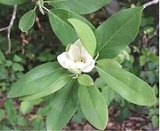
Magnoliaceae

Encyclopedia
The Magnoliaceae, or Magnolia Family, is a flowering plant family in the order
Magnoliales
. It consists of two subfamilies:
Unlike most angiosperms, whose flower
parts are in rings, the Magnoliaceae have their stamens and pistils in spirals on a conical receptacle. This arrangement is found in some fossil plants and is believed to be a basal
or early condition for angiosperms. The flowers also have parts not distinctly differentiated into sepal
s and petal
s, while angiosperms that evolved later tend to have distinctly differentiated sepals and petals. The poorly differentiated perianth
parts that occupy both positions are known as tepal
s.
The family has approximately 225 species in 7 genera, although some classification systems include all of subfamily Magnoioideae in genus Magnolia. The family ranges across eastern North America
, Mexico
and Central America
, the West Indies, tropical South America
, southern and eastern India
, Sri Lanka
, Indochina
, Malesia
, China
, Japan
, and Korea
.
of Magnoliaceae is supported by a number of shared morphological characters among the various genera included in the family. Most have flowers that are bisexual (with the exception of Kmeria and some species of Magnolia section Gynopodium),showy, fragrant, radial, and with an elongate receptacle. Leaves are alternate, simple, and sometimes lobed. The inflorescence
is a solitary, showy flower with indistinguishable petals and sepals. Sepals range from six to many; stamens are numerous and feature short filaments which are poorly differentiated from the anthers. Carpels are usually numerous, distinct, and on an elongate receptacle or torus. The fruit
is an etario of follicles which usually become closely appressed as they mature and open along the abaxial surface. Seeds have a fleshy coat and color that ranges from red to orange (except Liriodendron). Magnoliaceae flowers are beetle
pollinated, except for Liriodendron, which is bee
pollinated. The carpels of Magnolia flowers are especially thick to avoid damage by beetles who, land, crawl, and feast on them. The seeds of Magnolioideae are bird dispersed while the seeds of Liriodendron are wind dispersed.
or fragmented as a result of major geologic events such as ice age
s, continental drift
, and mountain formation
. This distribution pattern has isolated some species while keeping others in close contact.
Extant species of Magnoliaceae are widely distributed in temperate and tropical Asia from the Himalayas
to Japan and southwest through Malaysia and New Guinea. Asia is home to approximately two thirds of the species in Magnoliaceae, with the remainder of the family spread across the Americas with temperate species extending into southern Canada and tropical elements extending into Brazil and the West Indies.
sequencing at the end of the twentieth century had a profound impact on the research of phylogenetic relationships within the family.
The employment of ndhF and cpDNA sequences has refuted many of the traditionally accepted phylogenetic relationships within Magnoliaceae. For example, it has shown the genera Magnolia and Michelia to be paraphyletic when the remaining four genera of Magnolioideae are split out. In fact, even many of the subgenera (Magnolia subg. Magnolia, Magnolia subg. Talauma) have been found to be paraphyletic. Although no completely resolved phylogeny for the family has yet been determined, these technological advances have allowed systematists to broadly circumscribe major lineages.
Order (biology)
In scientific classification used in biology, the order is# a taxonomic rank used in the classification of organisms. Other well-known ranks are life, domain, kingdom, phylum, class, family, genus, and species, with order fitting in between class and family...
Magnoliales
Magnoliales
Magnoliales is an order of flowering plants.-Classification:The Magnoliales includes six families:* Annonaceae...
. It consists of two subfamilies:
- Magnolioideae, of which MagnoliaMagnoliaMagnolia is a large genus of about 210 flowering plant species in the subfamily Magnolioideae of the family Magnoliaceae. It is named after French botanist Pierre Magnol....
is the most well-known genus. - Liriodendroidae, a monogeneric subfamily, of which LiriodendronLiriodendronLiriodendron is a genus of two species of characteristically large deciduous trees in the magnolia family .These trees are widely known by the common name tulip tree or tuliptree for their large flowers superficially resembling tulips, but are closely related to magnolias rather than lilies, the...
(Tulip trees) is the only genus.
Unlike most angiosperms, whose flower
Flower
A flower, sometimes known as a bloom or blossom, is the reproductive structure found in flowering plants . The biological function of a flower is to effect reproduction, usually by providing a mechanism for the union of sperm with eggs...
parts are in rings, the Magnoliaceae have their stamens and pistils in spirals on a conical receptacle. This arrangement is found in some fossil plants and is believed to be a basal
Basal (phylogenetics)
In phylogenetics, a basal clade is the earliest clade to branch in a larger clade; it appears at the base of a cladogram.A basal group forms an outgroup to the rest of the clade, such as in the following example:...
or early condition for angiosperms. The flowers also have parts not distinctly differentiated into sepal
Sepal
A sepal is a part of the flower of angiosperms . Collectively the sepals form the calyx, which is the outermost whorl of parts that form a flower. Usually green, sepals have the typical function of protecting the petals when the flower is in bud...
s and petal
Petal
Petals are modified leaves that surround the reproductive parts of flowers. They often are brightly colored or unusually shaped to attract pollinators. Together, all of the petals of a flower are called a corolla. Petals are usually accompanied by another set of special leaves called sepals lying...
s, while angiosperms that evolved later tend to have distinctly differentiated sepals and petals. The poorly differentiated perianth
Perianth
The term perianth has two similar but separate meanings in botany:* In flowering plants, the perianth are the outer, sterile whorls of a flower...
parts that occupy both positions are known as tepal
Tepal
Tepals are elements of the perianth, or outer part of a flower, which include the petals or sepals. The term tepal is more often applied specifically when all segments of the perianth are of similar shape and color, or undifferentiated, which is called perigone...
s.
The family has approximately 225 species in 7 genera, although some classification systems include all of subfamily Magnoioideae in genus Magnolia. The family ranges across eastern North America
North America
North America is a continent wholly within the Northern Hemisphere and almost wholly within the Western Hemisphere. It is also considered a northern subcontinent of the Americas...
, Mexico
Mexico
The United Mexican States , commonly known as Mexico , is a federal constitutional republic in North America. It is bordered on the north by the United States; on the south and west by the Pacific Ocean; on the southeast by Guatemala, Belize, and the Caribbean Sea; and on the east by the Gulf of...
and Central America
Central America
Central America is the central geographic region of the Americas. It is the southernmost, isthmian portion of the North American continent, which connects with South America on the southeast. When considered part of the unified continental model, it is considered a subcontinent...
, the West Indies, tropical South America
South America
South America is a continent situated in the Western Hemisphere, mostly in the Southern Hemisphere, with a relatively small portion in the Northern Hemisphere. The continent is also considered a subcontinent of the Americas. It is bordered on the west by the Pacific Ocean and on the north and east...
, southern and eastern India
India
India , officially the Republic of India , is a country in South Asia. It is the seventh-largest country by geographical area, the second-most populous country with over 1.2 billion people, and the most populous democracy in the world...
, Sri Lanka
Sri Lanka
Sri Lanka, officially the Democratic Socialist Republic of Sri Lanka is a country off the southern coast of the Indian subcontinent. Known until 1972 as Ceylon , Sri Lanka is an island surrounded by the Indian Ocean, the Gulf of Mannar and the Palk Strait, and lies in the vicinity of India and the...
, Indochina
Indochina
The Indochinese peninsula, is a region in Southeast Asia. It lies roughly southwest of China, and east of India. The name has its origins in the French, Indochine, as a combination of the names of "China" and "India", and was adopted when French colonizers in Vietnam began expanding their territory...
, Malesia
Malesia
Malesia is a biogeographical region straddling the boundaries of the Indomalaya ecozone and Australasia ecozone, and also a phytogeographical floristic region in the Paleotropical Kingdom.-Floristic province:...
, China
China
Chinese civilization may refer to:* China for more general discussion of the country.* Chinese culture* Greater China, the transnational community of ethnic Chinese.* History of China* Sinosphere, the area historically affected by Chinese culture...
, Japan
Japan
Japan is an island nation in East Asia. Located in the Pacific Ocean, it lies to the east of the Sea of Japan, China, North Korea, South Korea and Russia, stretching from the Sea of Okhotsk in the north to the East China Sea and Taiwan in the south...
, and Korea
Korea
Korea ) is an East Asian geographic region that is currently divided into two separate sovereign states — North Korea and South Korea. Located on the Korean Peninsula, Korea is bordered by the People's Republic of China to the northwest, Russia to the northeast, and is separated from Japan to the...
.
Description
The monophylyMonophyly
In common cladistic usage, a monophyletic group is a taxon which forms a clade, meaning that it contains all the descendants of the possibly hypothetical closest common ancestor of the members of the group. The term is synonymous with the uncommon term holophyly...
of Magnoliaceae is supported by a number of shared morphological characters among the various genera included in the family. Most have flowers that are bisexual (with the exception of Kmeria and some species of Magnolia section Gynopodium),showy, fragrant, radial, and with an elongate receptacle. Leaves are alternate, simple, and sometimes lobed. The inflorescence
Inflorescence
An inflorescence is a group or cluster of flowers arranged on a stem that is composed of a main branch or a complicated arrangement of branches. Strictly, it is the part of the shoot of seed plants where flowers are formed and which is accordingly modified...
is a solitary, showy flower with indistinguishable petals and sepals. Sepals range from six to many; stamens are numerous and feature short filaments which are poorly differentiated from the anthers. Carpels are usually numerous, distinct, and on an elongate receptacle or torus. The fruit
Fruit
In broad terms, a fruit is a structure of a plant that contains its seeds.The term has different meanings dependent on context. In non-technical usage, such as food preparation, fruit normally means the fleshy seed-associated structures of certain plants that are sweet and edible in the raw state,...
is an etario of follicles which usually become closely appressed as they mature and open along the abaxial surface. Seeds have a fleshy coat and color that ranges from red to orange (except Liriodendron). Magnoliaceae flowers are beetle
Beetle
Coleoptera is an order of insects commonly called beetles. The word "coleoptera" is from the Greek , koleos, "sheath"; and , pteron, "wing", thus "sheathed wing". Coleoptera contains more species than any other order, constituting almost 25% of all known life-forms...
pollinated, except for Liriodendron, which is bee
Bee
Bees are flying insects closely related to wasps and ants, and are known for their role in pollination and for producing honey and beeswax. Bees are a monophyletic lineage within the superfamily Apoidea, presently classified by the unranked taxon name Anthophila...
pollinated. The carpels of Magnolia flowers are especially thick to avoid damage by beetles who, land, crawl, and feast on them. The seeds of Magnolioideae are bird dispersed while the seeds of Liriodendron are wind dispersed.
Biogeography
Due to its great age, the geographical distribution of Magnoliaceae has become disjunctDisjunct distribution
In biology, a taxon with a disjunct distribution is one that has two or more groups that are related but widely separated from each other geographically...
or fragmented as a result of major geologic events such as ice age
Ice age
An ice age or, more precisely, glacial age, is a generic geological period of long-term reduction in the temperature of the Earth's surface and atmosphere, resulting in the presence or expansion of continental ice sheets, polar ice sheets and alpine glaciers...
s, continental drift
Continental drift
Continental drift is the movement of the Earth's continents relative to each other. The hypothesis that continents 'drift' was first put forward by Abraham Ortelius in 1596 and was fully developed by Alfred Wegener in 1912...
, and mountain formation
Orogeny
Orogeny refers to forces and events leading to a severe structural deformation of the Earth's crust due to the engagement of tectonic plates. Response to such engagement results in the formation of long tracts of highly deformed rock called orogens or orogenic belts...
. This distribution pattern has isolated some species while keeping others in close contact.
Extant species of Magnoliaceae are widely distributed in temperate and tropical Asia from the Himalayas
Himalayas
The Himalaya Range or Himalaya Mountains Sanskrit: Devanagari: हिमालय, literally "abode of snow"), usually called the Himalayas or Himalaya for short, is a mountain range in Asia, separating the Indian subcontinent from the Tibetan Plateau...
to Japan and southwest through Malaysia and New Guinea. Asia is home to approximately two thirds of the species in Magnoliaceae, with the remainder of the family spread across the Americas with temperate species extending into southern Canada and tropical elements extending into Brazil and the West Indies.
Systematics
Due to this great deal of family wide morphological similarity, no consensus has yet emerged on the number of genera in the family. The development of DNADNA
Deoxyribonucleic acid is a nucleic acid that contains the genetic instructions used in the development and functioning of all known living organisms . The DNA segments that carry this genetic information are called genes, but other DNA sequences have structural purposes, or are involved in...
sequencing at the end of the twentieth century had a profound impact on the research of phylogenetic relationships within the family.
The employment of ndhF and cpDNA sequences has refuted many of the traditionally accepted phylogenetic relationships within Magnoliaceae. For example, it has shown the genera Magnolia and Michelia to be paraphyletic when the remaining four genera of Magnolioideae are split out. In fact, even many of the subgenera (Magnolia subg. Magnolia, Magnolia subg. Talauma) have been found to be paraphyletic. Although no completely resolved phylogeny for the family has yet been determined, these technological advances have allowed systematists to broadly circumscribe major lineages.
Economic Significance
As a whole, Magnoliaceae is not an economically significant family. With the exception of a great deal of ornamental cultivation, the economic significance of Magnolias is generally confined to the use of wood from certain timber species and the use of bark and flowers from several species believed to possess medicinal qualities. Magnolias have a rich cultural tradition in China where references to their healing qualities go back thousands of years. The Chinese have long used the bark of Magnolia officinalis, a magnolia native to the mountains of China with large leaves and fragrant white flowers, as a remedy for cramps, abdominal pain, nausea, diarrhea, and indigestion. Certain magnolia flowers, such as the buds of Magnolia liliiflora, have been used to treat chronic respiratory infections, sinus infections, and lung congestion. Recently, magnolia bark has become incorporated into alternative medicine in the west where tablets made from the bark of M. officinalis have been marketed as an aid for anxiety, allergies, asthma, and weight-loss. Preliminary studies have suggested that compounds found in magnolia bark might have antibacterial and antifungal properties. To this day, however, there has never been a large scale study on the health effects of magnolia bark or flowers.Further reading
- Cicuzza, D., Newton, A. and Oldfield, S. 2007. The Red List of Magnoliaceae Flora & Fauna International (FFI) and Botanic Gardens Conservation International (BGCI) report. ISBN: 9781 903703 23 6