

Liriodendron

Encyclopedia
Liriodendron ˌ is a genus
of two species
of characteristically large deciduous
tree
s in the magnolia family (Magnoliaceae)
.
These trees are widely known by the common name tulip tree or tuliptree for their large flowers superficially resembling tulip
s, but are closely related to magnolia
s rather than lilies
, the plant family to which true tulips belong.
The tulip tree is sometimes called "tulip poplar" or "yellow poplar", and the wood simply "poplar," although Liriodendron is not closely related to the true poplars of the genus Populus. The tree is also called canoewood, saddle-leaf tree and white wood. The Onondaga tribe calls it Ko-yen-ta-ka-ah-tas (the white tree).
Two species of Liriodendron are known extant. Liriodendron tulipifera
is native to eastern North America
, while Liriodendron chinense
is native to China
and Vietnam
. Both species often grow to great size, sometimes exceeding 32 m or 100 feet
in height. The American species is commonly used horticulturally
, and hybrids have been produced between these two allopatrically distributed species.
Various extinct species of Liriodendron have been described from the fossil record.
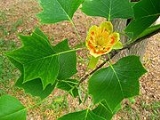
, which are distinctive, having four lobes in most cases and a cross-cut notched or straight apex. Leaf size varies from 8–22 cm long and 6–25 cm wide.
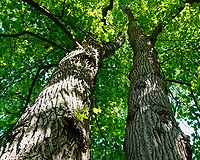
The tulip tree is often a large tree, 18–32 m high and 60–120 cm in diameter. Its trunk is usually columnar, with a long, branch-free bole forming a compact, rather than open, conical crown of slender branches. It has deep roots that spread widely.
Leaves are slightly larger in Liriodendron chinense, compared to L. tulipifera, but with considerable overlap between the species; the petiole
is 4–18 cm long. Leaves on young trees tend to be more deeply lobed and larger size than those on mature trees. In autumn, the leaves turn yellow, or brown and yellow. Both species grow rapidly in rich, moist soils of temperate climates. They hybridize easily, and the progeny often grow faster than either parent.
Flower
s are 3–10 cm in diameter and have nine tepal
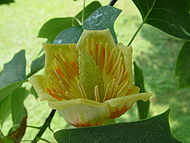
s — three green outer sepals and six inner petals which are yellow-green with an orange flare at the base. They start forming after around 15 years and are superficially similar to a tulip
in shape, hence the tree's name. Flowers of L. tulipifera have a faint cucumber
odor. The stamen
s and pistils are arranged spirally around a central spike or gynaecium; the stamens fall off, and the pistils become the samara
s. The fruit
is a cone-like aggregate of samaras 4–9 cm long, each of which has a roughly tetrahedral seed with one edge attached to the central conical spike and the other edge attached to the wing.
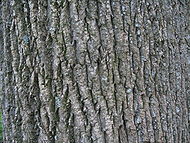
In the Appalachian cove forests, trees 150 to 165 feet in height are common, and trees from 166 to nearly 180 feet are also found. More Liriodendron over 170 feet in height have been measured by the Eastern Native Tree Society
than for any other eastern species. The current height champion is approximately 178.5 feet in height and grows along Baxter Creek in the Great Smoky Mountains National Park
. The tallest tulip trees on record probably reached 190 feet in height, taller than any other eastern hardwood. Today the tulip tree is rivaled in eastern forests only by white pine
, loblolly pine
, and eastern hemlock
. There are reports of tulip trees over 200 feet in height, but none of the measurements have been confirmed by the Eastern Native Tree Society. Most reflect measurement errors attributable to not accurately locating the highest crown point relative to the base of the tree—a common error made by the users employing only clinometers/hypsometers when measuring height.
Maximum circumferences for the species are between 24 and 30 feet at breast height, although a few historical specimens may have been slightly larger. Today the Great Smoky Mountains National Park has the greatest population of tulip trees 20-feet and over in circumference. The largest-volume tulip tree known anywhere is the Sag Branch Giant, which has a trunk and limb volume approaching 4000 ft3.
and early Tertiary
of North America and central Asia. It is known widely as Tertiary
age fossil
s in Europe and well outside its present day range in Asia and North America, showing a once circumpolar northern distribution. Like many "Arcto-Tertiary"
genera, Liriodendron apparently became extinct in Europe
due to large-scale glaciation and aridity of climate during glacial phases (the name should not be confused with Lepidodendron
, an important group of long-extinct pteridophyte
s in the phylum Lycopodiophyta
common as Paleozoic
coal-age
fossils).
climate, sun or part shade, and deep, fertile
, well drained and slightly acidic soil
. Propagation is via seed or grafting
. Plants grown from seed may take more than eight years to flower. Grafted plants will flower earlier depending on the age of the scion
plant.
The wood of the North American species (called poplar or Tulipwood
) is fine grained and stable. It is easy to work and commonly used for cabinet and furniture framing, i.e. internal structural members and sub-surfaces for veneering
. Additionally, much inexpensive furniture, described for sales purposes simply as "hardwood", is in fact primarily stained poplar. In the literature of American furniture manufacturers from the first half of the 20th century, it is often referred to as "gum wood". The wood is only moderately rot resistant and is not commonly used in shipbuilding, but has found some recent use in light craft construction. The wood is readily available and when air dried has a density of approximately 24 lb/cuft.
The name canoewood probably refers to the tree's use for construction of dugout canoes by Eastern Native Americans, for which its fine grain and large trunk size is eminently suited.
Tulip tree leaves are eaten by the caterpillar
s of some Lepidoptera
, for example the Eastern tiger swallowtail
(Papilio glaucus).
 Liriodendron tulipifera
Liriodendron chinense
Liriodendron 'Chapel Hill' and 'Doc Deforce's Delight' are hybrids of the above two species
L. tulipifera 'Ardis' is a small-leaf, compact cultivar that is rarely seen
L. tulipifera 'Aureomarginatum' is variegated with yellow-margined leaves
L. tulipifera 'Fastigiatum' grows with an erect or columnar habit (fastigiate)
L. tulipifera 'Glen Gold' bears yellow-gold colored leaves
L. tulipifera 'Mediopictum' is a variegated cultivar with gold-centered leaves
~ Tulip Tree
Genus
In biology, a genus is a low-level taxonomic rank used in the biological classification of living and fossil organisms, which is an example of definition by genus and differentia...
of two species
Species
In biology, a species is one of the basic units of biological classification and a taxonomic rank. A species is often defined as a group of organisms capable of interbreeding and producing fertile offspring. While in many cases this definition is adequate, more precise or differing measures are...
of characteristically large deciduous
Deciduous
Deciduous means "falling off at maturity" or "tending to fall off", and is typically used in reference to trees or shrubs that lose their leaves seasonally, and to the shedding of other plant structures such as petals after flowering or fruit when ripe...
tree
Tree
A tree is a perennial woody plant. It is most often defined as a woody plant that has many secondary branches supported clear of the ground on a single main stem or trunk with clear apical dominance. A minimum height specification at maturity is cited by some authors, varying from 3 m to...
s in the magnolia family (Magnoliaceae)
Magnoliaceae
The Magnoliaceae, or Magnolia Family, is a flowering plant family in the order Magnoliales. It consists of two subfamilies:*Magnolioideae, of which Magnolia is the most well-known genus....
.
These trees are widely known by the common name tulip tree or tuliptree for their large flowers superficially resembling tulip
Tulip
The tulip is a perennial, bulbous plant with showy flowers in the genus Tulipa, which comprises 109 species and belongs to the family Liliaceae. The genus's native range extends from as far west as Southern Europe, North Africa, Anatolia, and Iran to the Northwest of China. The tulip's centre of...
s, but are closely related to magnolia
Magnolia
Magnolia is a large genus of about 210 flowering plant species in the subfamily Magnolioideae of the family Magnoliaceae. It is named after French botanist Pierre Magnol....
s rather than lilies
Liliaceae
The Liliaceae, or the lily family, is a family of monocotyledons in the order Liliales. Plants in this family have linear leaves, mostly with parallel veins but with several having net venation , and flower arranged in threes. Several have bulbs, while others have rhizomes...
, the plant family to which true tulips belong.
The tulip tree is sometimes called "tulip poplar" or "yellow poplar", and the wood simply "poplar," although Liriodendron is not closely related to the true poplars of the genus Populus. The tree is also called canoewood, saddle-leaf tree and white wood. The Onondaga tribe calls it Ko-yen-ta-ka-ah-tas (the white tree).
Two species of Liriodendron are known extant. Liriodendron tulipifera
Liriodendron tulipifera
Liriodendron tulipifera, commonly known as the tulip tree, American tulip tree, tuliptree, tulip poplar or yellow poplar, is the Western Hemisphere representative of the two-species genus Liriodendron, and the tallest eastern hardwood...
is native to eastern North America
North America
North America is a continent wholly within the Northern Hemisphere and almost wholly within the Western Hemisphere. It is also considered a northern subcontinent of the Americas...
, while Liriodendron chinense
Liriodendron chinense
Liriodendron chinense, the Chinese tulip tree, is Asia's native species in the Liriodendron genus. This native of central and southern China grows in the provinces of Anhui, Guangxi, Jiangsu, Fujian, Guizhou, Hubei, Hunan, Jiangxi, Shaanxi, Zhejiang, Sichuan and Yunnan, and also locally in northern...
is native to China
China
Chinese civilization may refer to:* China for more general discussion of the country.* Chinese culture* Greater China, the transnational community of ethnic Chinese.* History of China* Sinosphere, the area historically affected by Chinese culture...
and Vietnam
Vietnam
Vietnam – sometimes spelled Viet Nam , officially the Socialist Republic of Vietnam – is the easternmost country on the Indochina Peninsula in Southeast Asia. It is bordered by China to the north, Laos to the northwest, Cambodia to the southwest, and the South China Sea –...
. Both species often grow to great size, sometimes exceeding 32 m or 100 feet
Foot
The foot is an anatomical structure found in many vertebrates. It is the terminal portion of a limb which bears weight and allows locomotion. In many animals with feet, the foot is a separate organ at the terminal part of the leg made up of one or more segments or bones, generally including claws...
in height. The American species is commonly used horticulturally
Horticulture
Horticulture is the industry and science of plant cultivation including the process of preparing soil for the planting of seeds, tubers, or cuttings. Horticulturists work and conduct research in the disciplines of plant propagation and cultivation, crop production, plant breeding and genetic...
, and hybrids have been produced between these two allopatrically distributed species.
Various extinct species of Liriodendron have been described from the fossil record.
Description
Liriodendron trees are easily recognized by their leavesLeaf
A leaf is an organ of a vascular plant, as defined in botanical terms, and in particular in plant morphology. Foliage is a mass noun that refers to leaves as a feature of plants....
, which are distinctive, having four lobes in most cases and a cross-cut notched or straight apex. Leaf size varies from 8–22 cm long and 6–25 cm wide.
The tulip tree is often a large tree, 18–32 m high and 60–120 cm in diameter. Its trunk is usually columnar, with a long, branch-free bole forming a compact, rather than open, conical crown of slender branches. It has deep roots that spread widely.
Leaves are slightly larger in Liriodendron chinense, compared to L. tulipifera, but with considerable overlap between the species; the petiole
Petiole (botany)
In botany, the petiole is the stalk attaching the leaf blade to the stem. The petiole usually has the same internal structure as the stem. Outgrowths appearing on each side of the petiole are called stipules. Leaves lacking a petiole are called sessile, or clasping when they partly surround the...
is 4–18 cm long. Leaves on young trees tend to be more deeply lobed and larger size than those on mature trees. In autumn, the leaves turn yellow, or brown and yellow. Both species grow rapidly in rich, moist soils of temperate climates. They hybridize easily, and the progeny often grow faster than either parent.
Flower
Flower
A flower, sometimes known as a bloom or blossom, is the reproductive structure found in flowering plants . The biological function of a flower is to effect reproduction, usually by providing a mechanism for the union of sperm with eggs...
s are 3–10 cm in diameter and have nine tepal
Tepal
Tepals are elements of the perianth, or outer part of a flower, which include the petals or sepals. The term tepal is more often applied specifically when all segments of the perianth are of similar shape and color, or undifferentiated, which is called perigone...
s — three green outer sepals and six inner petals which are yellow-green with an orange flare at the base. They start forming after around 15 years and are superficially similar to a tulip
Tulip
The tulip is a perennial, bulbous plant with showy flowers in the genus Tulipa, which comprises 109 species and belongs to the family Liliaceae. The genus's native range extends from as far west as Southern Europe, North Africa, Anatolia, and Iran to the Northwest of China. The tulip's centre of...
in shape, hence the tree's name. Flowers of L. tulipifera have a faint cucumber
Cucumber
The cucumber is a widely cultivated plant in the gourd family Cucurbitaceae, which includes squash, and in the same genus as the muskmelon. The plant is a creeping vine which bears cylindrical edible fruit when ripe. There are three main varieties of cucumber: "slicing", "pickling", and...
odor. The stamen
Stamen
The stamen is the pollen producing reproductive organ of a flower...
s and pistils are arranged spirally around a central spike or gynaecium; the stamens fall off, and the pistils become the samara
Samara (fruit)
A samara is a type of fruit in which a flattened wing of fibrous, papery tissue develops from the ovary wall. A samara is a simple dry fruit and indehiscent . It is a winged achene...
s. The fruit
Fruit
In broad terms, a fruit is a structure of a plant that contains its seeds.The term has different meanings dependent on context. In non-technical usage, such as food preparation, fruit normally means the fleshy seed-associated structures of certain plants that are sweet and edible in the raw state,...
is a cone-like aggregate of samaras 4–9 cm long, each of which has a roughly tetrahedral seed with one edge attached to the central conical spike and the other edge attached to the wing.
Distribution
Liriodendron trees are also easily recognized by their general shape, with the higher branches sweeping together in one direction, and they are also recognizable by their height, as the taller ones usually protrude above the canopy of oaks, maples, and other trees—more markedly with the American species. Appalachian cove forests often contain several tuliptrees of height and girth not seen in other species of eastern hardwoods.In the Appalachian cove forests, trees 150 to 165 feet in height are common, and trees from 166 to nearly 180 feet are also found. More Liriodendron over 170 feet in height have been measured by the Eastern Native Tree Society
Eastern Native Tree Society
Eastern Native Tree Society : A not-for-profit Internet interest group formally established in 1996 to celebrate trees in the arts, science, mythology, medicine, and related areas. Present ENTS membership is around 250...
than for any other eastern species. The current height champion is approximately 178.5 feet in height and grows along Baxter Creek in the Great Smoky Mountains National Park
Great Smoky Mountains National Park
Great Smoky Mountains National Park is a United States National Park and UNESCO World Heritage Site that straddles the ridgeline of the Great Smoky Mountains, part of the Blue Ridge Mountains, which are a division of the larger Appalachian Mountain chain. The border between Tennessee and North...
. The tallest tulip trees on record probably reached 190 feet in height, taller than any other eastern hardwood. Today the tulip tree is rivaled in eastern forests only by white pine
Eastern White Pine
Pinus strobus, commonly known as the eastern white pine, is a large pine native to eastern North America, occurring from Newfoundland west to Minnesota and southeastern Manitoba, and south along the Appalachian Mountains to the northern edge of Georgia.It is occasionally known as simply white pine,...
, loblolly pine
Loblolly Pine
Pinus taeda is one of several pines native to the Southeastern United States, from central Texas east to Florida, and north to Delaware. It is particularly dominant in the eastern half of North Carolina, where there are huge expanses consisting solely of Loblolly Pine trees...
, and eastern hemlock
Eastern Hemlock
Tsuga canadensis, also known as eastern or Canadian hemlock, and in the French-speaking regions of Canada as pruche du Canada, is a coniferous tree native to eastern North America. It ranges from northeastern Minnesota eastward through southern Quebec to Nova Scotia, and south in the Appalachian...
. There are reports of tulip trees over 200 feet in height, but none of the measurements have been confirmed by the Eastern Native Tree Society. Most reflect measurement errors attributable to not accurately locating the highest crown point relative to the base of the tree—a common error made by the users employing only clinometers/hypsometers when measuring height.
Maximum circumferences for the species are between 24 and 30 feet at breast height, although a few historical specimens may have been slightly larger. Today the Great Smoky Mountains National Park has the greatest population of tulip trees 20-feet and over in circumference. The largest-volume tulip tree known anywhere is the Sag Branch Giant, which has a trunk and limb volume approaching 4000 ft3.
Fossils
Liriodendron has been reported as fossils from the late CretaceousCretaceous
The Cretaceous , derived from the Latin "creta" , usually abbreviated K for its German translation Kreide , is a geologic period and system from circa to million years ago. In the geologic timescale, the Cretaceous follows the Jurassic period and is followed by the Paleogene period of the...
and early Tertiary
Tertiary
The Tertiary is a deprecated term for a geologic period 65 million to 2.6 million years ago. The Tertiary covered the time span between the superseded Secondary period and the Quaternary...
of North America and central Asia. It is known widely as Tertiary
Tertiary
The Tertiary is a deprecated term for a geologic period 65 million to 2.6 million years ago. The Tertiary covered the time span between the superseded Secondary period and the Quaternary...
age fossil
Fossil
Fossils are the preserved remains or traces of animals , plants, and other organisms from the remote past...
s in Europe and well outside its present day range in Asia and North America, showing a once circumpolar northern distribution. Like many "Arcto-Tertiary"
Arcto-Tertiary Geoflora
The Arcto-Tertiary Geoflora is a hypothesized floral assemblage that once covered the Northern Hemisphere, from roughly the late Mesozoic to mid Cenozoic Eras.-Origins:First proposed by the paleobotanists J.S. Gardner and C...
genera, Liriodendron apparently became extinct in Europe
Europe
Europe is, by convention, one of the world's seven continents. Comprising the westernmost peninsula of Eurasia, Europe is generally 'divided' from Asia to its east by the watershed divides of the Ural and Caucasus Mountains, the Ural River, the Caspian and Black Seas, and the waterways connecting...
due to large-scale glaciation and aridity of climate during glacial phases (the name should not be confused with Lepidodendron
Lepidodendron
Lepidodendron is an extinct genus of primitive, vascular, arborescent plant related to the Lycopsids . It was part of the coal forest flora. They sometimes reached heights of over , and the trunks were often over in diameter, and thrived during the Carboniferous period...
, an important group of long-extinct pteridophyte
Pteridophyte
The pteridophytes are vascular plants that produce neither flowers nor seeds, and are hence called vascular cryptogams. Instead, they reproduce and disperse only via spores. Pteridophytes include horsetails, ferns, club mosses, and quillworts...
s in the phylum Lycopodiophyta
Lycopodiophyta
The Division Lycopodiophyta is a tracheophyte subdivision of the Kingdom Plantae. It is the oldest extant vascular plant division at around 410 million years old, and includes some of the most "primitive" extant species...
common as Paleozoic
Paleozoic
The Paleozoic era is the earliest of three geologic eras of the Phanerozoic eon, spanning from roughly...
coal-age
Carboniferous
The Carboniferous is a geologic period and system that extends from the end of the Devonian Period, about 359.2 ± 2.5 Mya , to the beginning of the Permian Period, about 299.0 ± 0.8 Mya . The name is derived from the Latin word for coal, carbo. Carboniferous means "coal-bearing"...
fossils).
Cultivation and use
Liriodendron trees prefer a temperateTemperate
In geography, temperate or tepid latitudes of the globe lie between the tropics and the polar circles. The changes in these regions between summer and winter are generally relatively moderate, rather than extreme hot or cold...
climate, sun or part shade, and deep, fertile
Fertile
The term fertile describes a condition whereby organisms are able to produce physically healthy offspring.Fertile may also refer to:...
, well drained and slightly acidic soil
Soil
Soil is a natural body consisting of layers of mineral constituents of variable thicknesses, which differ from the parent materials in their morphological, physical, chemical, and mineralogical characteristics...
. Propagation is via seed or grafting
Grafting
Grafting is a horticultural technique whereby tissues from one plant are inserted into those of another so that the two sets of vascular tissues may join together. This vascular joining is called inosculation...
. Plants grown from seed may take more than eight years to flower. Grafted plants will flower earlier depending on the age of the scion
Grafting
Grafting is a horticultural technique whereby tissues from one plant are inserted into those of another so that the two sets of vascular tissues may join together. This vascular joining is called inosculation...
plant.
The wood of the North American species (called poplar or Tulipwood
Tulipwood
Most commonly, tulipwood is the pinkish yellowish wood yielded from the tuliptree, found on the Eastern side of North America and also in some parts of China. In the United States, it is commonly known as tulip poplar or yellow poplar, even though the tree is not related to the poplars. In fact,...
) is fine grained and stable. It is easy to work and commonly used for cabinet and furniture framing, i.e. internal structural members and sub-surfaces for veneering
Wood veneer
In woodworking, veneer refers to thin slices of wood, usually thinner than 3 mm , that are typically glued onto core panels to produce flat panels such as doors, tops and panels for cabinets, parquet floors and parts of furniture. They are also used in marquetry...
. Additionally, much inexpensive furniture, described for sales purposes simply as "hardwood", is in fact primarily stained poplar. In the literature of American furniture manufacturers from the first half of the 20th century, it is often referred to as "gum wood". The wood is only moderately rot resistant and is not commonly used in shipbuilding, but has found some recent use in light craft construction. The wood is readily available and when air dried has a density of approximately 24 lb/cuft.
The name canoewood probably refers to the tree's use for construction of dugout canoes by Eastern Native Americans, for which its fine grain and large trunk size is eminently suited.
Tulip tree leaves are eaten by the caterpillar
Caterpillar
Caterpillars are the larval form of members of the order Lepidoptera . They are mostly herbivorous in food habit, although some species are insectivorous. Caterpillars are voracious feeders and many of them are considered to be pests in agriculture...
s of some Lepidoptera
Lepidoptera
Lepidoptera is a large order of insects that includes moths and butterflies . It is one of the most widespread and widely recognizable insect orders in the world, encompassing moths and the three superfamilies of butterflies, skipper butterflies, and moth-butterflies...
, for example the Eastern tiger swallowtail
Eastern tiger swallowtail
The Eastern Tiger Swallowtail is a species of swallowtail butterfly native to North America. It is one of the most familiar butterflies in the eastern United States, where it is common in many different habitats. It flies from spring to fall, during which it produces two to three broods...
(Papilio glaucus).
Species and cultivars
Liriodendron tulipifera
Liriodendron tulipifera, commonly known as the tulip tree, American tulip tree, tuliptree, tulip poplar or yellow poplar, is the Western Hemisphere representative of the two-species genus Liriodendron, and the tallest eastern hardwood...
Liriodendron chinense
Liriodendron chinense
Liriodendron chinense, the Chinese tulip tree, is Asia's native species in the Liriodendron genus. This native of central and southern China grows in the provinces of Anhui, Guangxi, Jiangsu, Fujian, Guizhou, Hubei, Hunan, Jiangxi, Shaanxi, Zhejiang, Sichuan and Yunnan, and also locally in northern...
Liriodendron 'Chapel Hill' and 'Doc Deforce's Delight' are hybrids of the above two species
L. tulipifera 'Ardis' is a small-leaf, compact cultivar that is rarely seen
L. tulipifera 'Aureomarginatum' is variegated with yellow-margined leaves
L. tulipifera 'Fastigiatum' grows with an erect or columnar habit (fastigiate)
L. tulipifera 'Glen Gold' bears yellow-gold colored leaves
L. tulipifera 'Mediopictum' is a variegated cultivar with gold-centered leaves
External links
- Hunt, D. (ed). 1998. Magnolias and their allies. International Dendrology Society & Magnolia Society. (ISBN 0-9517234-8-0)
- Parks, C.R., Wendel, J.F., Sewell, M.M., & Qiu, Y.-L. (1994). The significance of allozyme variation and introgression in the Liriodendron tulipifera complex (Magnoliaceae). Amer. J. Bot. 81 (7): 878-889 abstract and first page
- Parks, C.R., Miller, N.G., Wendel, J.F. and McDougal, K.M. (1983). Genetic diversity within the genus Liriodendron (Magnoliaceae). Annals of the Missouri Botanical Garden 70 (4): 658-666
- Collingwood, G.H., Brush, W.D. (1984) Knowing your trees. American Forestry Association. (L.O.C. card no. 78-52994):286-287
- abstract and first page
- Moriaty, William. The Tulip Tree in Central Florida
- Liriodendron chinense
- Liriodendron chinense trunk and flowers
- Kew: Plants: Tulip Trees, Liriodendron tulipifera & Liriodendron chinense
- Flora of China draft account of Magnoliaceae (site currently down; see google cache)
- Liriodendron tulipifera images at bioimages.vanderbilt.edu
- Botanicas Trees & Shrubs, Random House, Sydney, 2005
- http://hazardkentucky.com/more/tuliptree.htm
~ Tulip Tree