

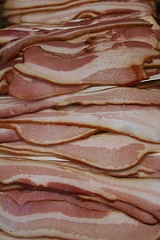
Bacon

Encyclopedia
Bacon is a cured meat prepared from a pig
. It is first cured
using large quantities of salt, either in a brine
or in a dry packing; the result is fresh bacon (also known as green bacon). Fresh bacon may then be further dried for weeks or months in cold air, boiled
, or smoked. Fresh and dried bacon must be cooked before eating. Boiled bacon is ready to eat, as is some smoked bacon, but may be cooked further before eating.
Bacon is prepared from several different cuts of meat. It is usually made from side and back cuts of pork, except in the United States, where it is almost always prepared from pork belly
(typically referred to as "streaky", "fatty", or "American style" outside of the US and Canada). The side cut has more meat and less fat than the belly. Bacon may be prepared from either of two distinct back cuts: fatback
, which is almost pure fat, and pork loin
, which is very lean. Bacon-cured pork loin is known as back bacon
.
Bacon may be eaten smoked, boiled, fried, baked, or grilled, or used as a minor ingredient to flavor dishes. Bacon is also used for barding
and larding roasts, especially game, e.g. venison, pheasant. The word is derived from the Old High German
bacho, meaning "buttock", "ham" or "side of bacon", and cognate with the Old French
bacon.
In continental Europe
, this part of the pig is usually not smoked like bacon is in the United States; it is used primarily in cubes (lardon
s) as a cooking ingredient, valued both as a source of fat
and for its flavor. In Italy
, this is called pancetta
and is usually cooked in small cubes or served uncooked and thinly sliced as part of an antipasto
.
Meat from other animals, such as beef
, lamb, chicken
, goat
, or turkey
, may also be cut, cured, or otherwise prepared to resemble bacon, and may even be referred to as "bacon". Such use is common in areas with significant Jewish and Muslim
populations. The USDA
defines bacon as "the cured belly of a swine carcass"; other cuts and characteristics must be separately qualified (e.g., "smoked pork loin bacon"). For safety, bacon must be treated to prevent trichinosis
, caused by Trichinella
, a parasitic roundworm which can be destroyed by heating, freezing, drying, or smoking.
Bacon is distinguished from salt pork
and ham
by differences in the brine (or dry packing). Bacon brine has added curing ingredients, most notably sodium nitrite
, and occasionally sodium nitrate
or potassium nitrate
(saltpeter); sodium ascorbate
or erythorbate are added to accelerate curing and stabilize color. Flavorings such as brown sugar or maple are used for some products. If used, sodium polyphosphates are added to improve sliceability and reduce spattering when the bacon is pan fried. Today, a brine for ham, but not bacon, includes a large amount of sugar. Historically, "ham" and "bacon" referred to different cuts of meat that were brined or packed identically, often together in the same barrel.
In America, bacon is usually cured
and smoked, and different flavors can be achieved by using various types of wood, or rarely corn cobs; peat is sometimes used in the UK. This process can take up to eighteen hours, depending on the intensity of the flavor desired. The Virginia House-Wife (1824), thought to be one of the earliest American cookbooks, gives no indication that bacon is ever not smoked, though it gives no advice on flavoring, noting only that care should be taken lest the fire get too hot. In early American history, the preparation and smoking of bacon (like the making of sausage
) seems to have been a gender-neutral process, one of the few food-preparation processes not divided by gender.
In the United Kingdom
and Ireland
, smoked and unsmoked varieties are equally common, unsmoked being referred to as green bacon. The leaner cut of back bacon is preferred to the bacon from the belly (that is ubiquitous in the United States) which is referred to as streaky bacon due to the prominence of the bands of fat. While there is a tendency on both sides of the Atlantic to serve belly bacon well-done to crispy, back bacon may at first appear undercooked to Americans.
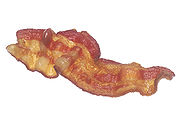
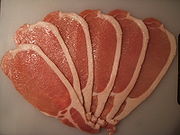
Bacon joints include the following:
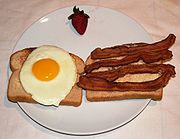 Traditionally, the skin
is left on the cut and is known as bacon rind, but rindless bacon is also common throughout the English-speaking world. The meat may be bought smoked or unsmoked. Bacon is often served with eggs as part of a full breakfast
.
.
An individual slice of bacon is a rasher, or occasionally a collop
. In this region, bacon comes in a wide variety of cuts and flavors:
American bacons include varieties smoked with hickory
or corncobs and flavorings such as red pepper, maple, honey, molasses, and occasionally cinnamon
. They vary in sweetness and saltiness and come from the Ozarks, New England and from the upper South (mainly Kentucky, North Carolina, Tennessee and Virginia).
, which elicits an addictive neurochemical response. According to Gupta "the chain lards on bacon" give foods a "high flavor profile" creating a "one-of-a-kind product that has no taste substitute." This led Dr. David Kessler
, author of The End of Overeating, to note how the standard joke in the restaurant chain industry goes, "When in doubt, throw cheese and bacon on it."
". Dishes such as bacon explosion
, chicken fried bacon
, and chocolate-covered bacon have been popularized over the internet, as has using candied bacon. Recipes spread quickly through the national media, culinary blogs, and YouTube. Restaurants are organizing bacon and beer tasting nights, The New York Times
reported on bacon infused with Irish whiskey
used for Saint Patrick's Day
cocktail
s, and celebrity chef Bobby Flay
has endorsed a "Bacon of the Month" club online, in print, and on national television.
Commentators explain this surging interest in bacon by reference to what they deem American cultural characteristics. Sarah Hepola, in a 2008 article in Salon.com
, suggests a number of reasons, one of them that eating bacon in the modern, health-conscious world is an act of rebellion: "Loving bacon is like shoving a middle finger in the face of all that is healthy and holy while an unfiltered cigarette smolders between your lips." She also suggests bacon is sexy (with a reference to Sarah Katherine Lewis' book Sex and Bacon), kitsch, and funny. Hepola concludes by saying that "Bacon is American":
Alison Cook, writing in the Houston Chronicle
(she calls bacon "democratic"), concurs with the third of these reasons, arguing the case of bacon's American citizenship by referring to historical and geographical uses of bacon. Early American literature echoes the sentiment—in Ebenezer Cooke
's 1708 poem The Sot-Weed Factor, a satire of life in early colonial America, the narrator already complains that practically all the food in America was bacon-infused.
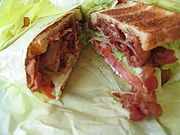 Bacon dishes include bacon and eggs, bacon, lettuce, and tomato (BLT)
sandwiches, bacon wrapped foods (scallop
s, shrimp
, and asparagus
), and cobb salad
. Recent bacon dishes include chicken fried bacon
, chocolate covered bacon
, and the bacon explosion
. Tatws Pum Munud
is a traditional Welsh stew, made with sliced potatoes, vegetables and smoked bacon. There is even bacon jam
.
In the U.S. and Europe, bacon is often used as a condiment
or topping on other foods. Streaky bacon is more commonly used as a topping in the U.S., on items such as pizza
, salads, sandwiches
, hamburgers, baked potatoes, hot dogs, and soups. In the U.S. Sliced smoked loin, which Americans call Canadian bacon, is used less frequently than streaky, but can sometimes be found on pizza, salads, and omelettes.
Bacon is also used in adaptations of dishes, for example bacon wrapped meatloaf
, and can be mixed in with green bean
s or serve sauteed over spinach.
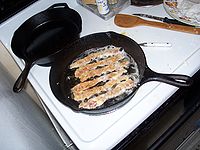 Bacon fat
liquefies and becomes bacon dripping
s when it is heated. Once cool, it firms into lard
if from uncured meat, or rendered bacon fat if from cured meat. Bacon fat is flavorful and is used for various cooking purposes. Traditionally, bacon grease is saved in British and southern U.S. cuisine, and used as a base for cooking and as an all-purpose flavoring, for everything from gravy
to cornbread
to salad dressing.
Bacon, or bacon fat, is often used for barding roast fowl and game birds
, especially those that have little fat themselves. Barding consists of laying strips of bacon or other fats over a roast; a variation is the traditional method of preparing filet mignon
of beef, which is wrapped in strips of bacon before cooking. The bacon itself may afterwards be discarded or served to eat, like crackling
s.
One teaspoon
(4 g (0.141095848420448 oz)) of bacon grease has 38 Calories (158,992 J). It is composed almost completely of fat
, with very little additional nutritional value. Bacon fat is roughly 40% saturated
. Despite the potential health risks
of excessive bacon grease consumption, it remains popular in the cuisine of the American South.
suggests a link between eating cured meat
s (such as bacon) and chronic obstructive pulmonary disease
. The preservative sodium nitrite
is the probable cause, and bacon made without added nitrites is available. Bacon is usually high in salt and saturated fat; excessive consumption of both is related to a variety of health problems. See the articles on saturated fat and salt for more details.
Researchers from the Harvard School of Public Health
found in 2010 that eating processed meats such as bacon, preserved by smoking, curing or salting, or with the addition of chemical preservatives, was associated with an increased risk of both heart disease and diabetes. The same association was not found for unprocessed meat.
 The popularity of bacon in the United States has given rise to a number of commercial products that promise to add bacon flavoring without the labor involved in cooking it or the perceived negative qualities of bacon. Some new products are evidence of the recent fad, including Bacon vodka
, bacon peanut brittle, bacon toothpaste and bacon mints. A range of inedible products are also available including bacon bandaids, scarfs, and air fresheners.
or potato
es, and a common element of salad bar
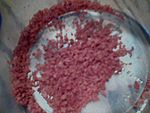
s. Bacon bits are made from either small, crumbled pieces of bacon (ends and pieces) or torn or misshapen slices; in commercial plants they are cooked in continuous microwave ovens. Similar products are made from ham or turkey, and analogues are made from textured vegetable protein
, artificially flavored to resemble bacon. They are most often salt
ed.
Popular brands include Hormel
Bacon Toppings, Oscar Mayer
Real Bacon Bits and Pieces, and the analogue Betty Crocker
Bac-Os.
and vegetarian bacon
fill a niche for alternatives to the meat from pigs. There is also a wide range of other bacon-flavored products, including a bacon-flavored salt, Bacon Salt, and a bacon-flavored mayonnaise, Baconnaise
. Jon Stewart
satirized Baconnaise in his The Daily Show
as a combination of gluttony and sloth: "for people who want heart disease but are too lazy to actually make the bacon." Outside of the United States, baconnaise seems to characterize the U.S. in the same way Stewart proposed, as suggested by the French blog Écrans.
Domestic pig
The domestic pig is a domesticated animal that traces its ancestry to the wild boar, and is considered a subspecies of the wild boar or a distinct species in its own right. It is likely the wild boar was domesticated as early as 13,000 BC in the Tigris River basin...
. It is first cured
Curing (food preservation)
Curing refers to various food preservation and flavoring processes, especially of meat or fish, by the addition of a combination of salt, nitrates, nitrite or sugar. Many curing processes also involve smoking, the process of flavoring, or cooking...
using large quantities of salt, either in a brine
Brine
Brine is water, saturated or nearly saturated with salt .Brine is used to preserve vegetables, fruit, fish, and meat, in a process known as brining . Brine is also commonly used to age Halloumi and Feta cheeses, or for pickling foodstuffs, as a means of preserving them...
or in a dry packing; the result is fresh bacon (also known as green bacon). Fresh bacon may then be further dried for weeks or months in cold air, boiled
Boiling
Boiling is the rapid vaporization of a liquid, which occurs when a liquid is heated to its boiling point, the temperature at which the vapor pressure of the liquid is equal to the pressure exerted on the liquid by the surrounding environmental pressure. While below the boiling point a liquid...
, or smoked. Fresh and dried bacon must be cooked before eating. Boiled bacon is ready to eat, as is some smoked bacon, but may be cooked further before eating.
Bacon is prepared from several different cuts of meat. It is usually made from side and back cuts of pork, except in the United States, where it is almost always prepared from pork belly
Pork belly
Pork belly is a boneless cut of fatty meat derived from the belly of a pig. Pork belly is popular in Asian cuisine, and forms a part of many traditional European dishes such as the Alsatian Choucroute garnie, the Swiss Berner Platte, and the German Schlachtplatte...
(typically referred to as "streaky", "fatty", or "American style" outside of the US and Canada). The side cut has more meat and less fat than the belly. Bacon may be prepared from either of two distinct back cuts: fatback
Fatback
Fatback is a cut of meat from a domestic pig. It consists of the layer of adipose tissue under the skin of the back, with or without the skin...
, which is almost pure fat, and pork loin
Pork loin
Pork loin is a cut of meat from a pig, created from the tissue along the top of the rib cage. It is very popular in the United States, where it is usually grilled or baked. Pork loins are also sold soaking in marinade. Pork Loin can be used to make many different foods; such as bacon...
, which is very lean. Bacon-cured pork loin is known as back bacon
Back bacon
Back bacon is bacon prepared from centre-cut boneless pork loin. The name refers to the cut of meat, which is from the back, and distinguishes it from other bacon made from pork belly or other cuts. Unlike other bacon, back bacon is not brined, cured, boiled, or smoked...
.
Bacon may be eaten smoked, boiled, fried, baked, or grilled, or used as a minor ingredient to flavor dishes. Bacon is also used for barding
Barding
Barding is armour for horses. During the late Middle Ages as armour protection for knights became more effective, their mounts became targets...
and larding roasts, especially game, e.g. venison, pheasant. The word is derived from the Old High German
Old High German
The term Old High German refers to the earliest stage of the German language and it conventionally covers the period from around 500 to 1050. Coherent written texts do not appear until the second half of the 8th century, and some treat the period before 750 as 'prehistoric' and date the start of...
bacho, meaning "buttock", "ham" or "side of bacon", and cognate with the Old French
Old French
Old French was the Romance dialect continuum spoken in territories that span roughly the northern half of modern France and parts of modern Belgium and Switzerland from the 9th century to the 14th century...
bacon.
In continental Europe
Europe
Europe is, by convention, one of the world's seven continents. Comprising the westernmost peninsula of Eurasia, Europe is generally 'divided' from Asia to its east by the watershed divides of the Ural and Caucasus Mountains, the Ural River, the Caspian and Black Seas, and the waterways connecting...
, this part of the pig is usually not smoked like bacon is in the United States; it is used primarily in cubes (lardon
Lardon
Lardon is a small strip or cube of pork fat used in a wide variety of cuisines to flavor savory foods and salads. In French cuisine, lardons are also used for larding, by threading them with a needle into meats that are to be braised or roasted...
s) as a cooking ingredient, valued both as a source of fat
Fat
Fats consist of a wide group of compounds that are generally soluble in organic solvents and generally insoluble in water. Chemically, fats are triglycerides, triesters of glycerol and any of several fatty acids. Fats may be either solid or liquid at room temperature, depending on their structure...
and for its flavor. In Italy
Italy
Italy , officially the Italian Republic languages]] under the European Charter for Regional or Minority Languages. In each of these, Italy's official name is as follows:;;;;;;;;), is a unitary parliamentary republic in South-Central Europe. To the north it borders France, Switzerland, Austria and...
, this is called pancetta
Pancetta
Pancetta is Italian bacon, typically salt cured and seasoned with such spices as nutmeg, fennel, peppercorns, dried ground hot peppers and garlic, then dried for at least three months. Associated with Italy, pancetta varies by region. It is also produced broadly in Spain.-Styles:Pancetta can be...
and is usually cooked in small cubes or served uncooked and thinly sliced as part of an antipasto
Antipasto
Antipasto , means "before the meal" and is the traditional first course of a formal Italian meal. Traditional antipasto includes cured meats, olives, roasted garlic, peperoncini, mushrooms, anchovies, artichoke hearts, various cheeses...
.
Meat from other animals, such as beef
Beef
Beef is the culinary name for meat from bovines, especially domestic cattle. Beef can be harvested from cows, bulls, heifers or steers. It is one of the principal meats used in the cuisine of the Middle East , Australia, Argentina, Brazil, Europe and the United States, and is also important in...
, lamb, chicken
Chicken
The chicken is a domesticated fowl, a subspecies of the Red Junglefowl. As one of the most common and widespread domestic animals, and with a population of more than 24 billion in 2003, there are more chickens in the world than any other species of bird...
, goat
Goat
The domestic goat is a subspecies of goat domesticated from the wild goat of southwest Asia and Eastern Europe. The goat is a member of the Bovidae family and is closely related to the sheep as both are in the goat-antelope subfamily Caprinae. There are over three hundred distinct breeds of...
, or turkey
Turkey (bird)
A turkey is a large bird in the genus Meleagris. One species, Meleagris gallopavo, commonly known as the Wild Turkey, is native to the forests of North America. The domestic turkey is a descendant of this species...
, may also be cut, cured, or otherwise prepared to resemble bacon, and may even be referred to as "bacon". Such use is common in areas with significant Jewish and Muslim
Muslim
A Muslim, also spelled Moslem, is an adherent of Islam, a monotheistic, Abrahamic religion based on the Quran, which Muslims consider the verbatim word of God as revealed to prophet Muhammad. "Muslim" is the Arabic term for "submitter" .Muslims believe that God is one and incomparable...
populations. The USDA
United States Department of Agriculture
The United States Department of Agriculture is the United States federal executive department responsible for developing and executing U.S. federal government policy on farming, agriculture, and food...
defines bacon as "the cured belly of a swine carcass"; other cuts and characteristics must be separately qualified (e.g., "smoked pork loin bacon"). For safety, bacon must be treated to prevent trichinosis
Trichinosis
Trichinosis, also called trichinellosis, or trichiniasis, is a parasitic disease caused by eating raw or undercooked pork or wild game infected with the larvae of a species of roundworm Trichinella spiralis, commonly called the trichina worm. There are eight Trichinella species; five are...
, caused by Trichinella
Trichinella
Trichinella is the genus of parasitic roundworms of the phylum Nematoda that cause trichinosis . Members of this genus are often called trichinella or trichina worms...
, a parasitic roundworm which can be destroyed by heating, freezing, drying, or smoking.
Bacon is distinguished from salt pork
Salt pork
Salt pork or white bacon is salt-cured pork. It is prepared from one of three primal cuts: pork side, pork belly, or fatback. Depending on the cut, respectively, salt pork may be lean, streaky or entirely fatty. Made from the same cuts as bacon, salt pork resembles uncut slab bacon, but is...
and ham
Ham
Ham is a cut of meat from the thigh of the hind leg of certain animals, especiallypigs. Nearly all hams sold today are fully cooked or cured.-Etymology:...
by differences in the brine (or dry packing). Bacon brine has added curing ingredients, most notably sodium nitrite
Sodium nitrite
Sodium nitrite is the inorganic compound with the chemical formula NaNO2. It is a white to slight yellowish crystalline powder that is very soluble in water and is hygroscopic...
, and occasionally sodium nitrate
Sodium nitrate
Sodium nitrate is the chemical compound with the formula NaNO3. This salt, also known as Chile saltpeter or Peru saltpeter to distinguish it from ordinary saltpeter, potassium nitrate, is a white solid which is very soluble in water...
or potassium nitrate
Potassium nitrate
Potassium nitrate is a chemical compound with the formula KNO3. It is an ionic salt of potassium ions K+ and nitrate ions NO3−.It occurs as a mineral niter and is a natural solid source of nitrogen. Its common names include saltpetre , from medieval Latin sal petræ: "stone salt" or possibly "Salt...
(saltpeter); sodium ascorbate
Sodium ascorbate
Sodium ascorbate is a more bioavailable form of vitamin C that is an alternative to taking ascorbic acid as a supplement. The molecular formula of this chemical compound is C6H7NaO6...
or erythorbate are added to accelerate curing and stabilize color. Flavorings such as brown sugar or maple are used for some products. If used, sodium polyphosphates are added to improve sliceability and reduce spattering when the bacon is pan fried. Today, a brine for ham, but not bacon, includes a large amount of sugar. Historically, "ham" and "bacon" referred to different cuts of meat that were brined or packed identically, often together in the same barrel.
Curing and smoking bacon
Bacon is cured through either a process of injecting with or soaking in brine or using plain salt (dry curing).In America, bacon is usually cured
Curing (food preservation)
Curing refers to various food preservation and flavoring processes, especially of meat or fish, by the addition of a combination of salt, nitrates, nitrite or sugar. Many curing processes also involve smoking, the process of flavoring, or cooking...
and smoked, and different flavors can be achieved by using various types of wood, or rarely corn cobs; peat is sometimes used in the UK. This process can take up to eighteen hours, depending on the intensity of the flavor desired. The Virginia House-Wife (1824), thought to be one of the earliest American cookbooks, gives no indication that bacon is ever not smoked, though it gives no advice on flavoring, noting only that care should be taken lest the fire get too hot. In early American history, the preparation and smoking of bacon (like the making of sausage
Sausage
A sausage is a food usually made from ground meat , mixed with salt, herbs, and other spices, although vegetarian sausages are available. The word sausage is derived from Old French saussiche, from the Latin word salsus, meaning salted.Typically, a sausage is formed in a casing traditionally made...
) seems to have been a gender-neutral process, one of the few food-preparation processes not divided by gender.
In the United Kingdom
United Kingdom
The United Kingdom of Great Britain and Northern IrelandIn the United Kingdom and Dependencies, other languages have been officially recognised as legitimate autochthonous languages under the European Charter for Regional or Minority Languages...
and Ireland
Ireland
Ireland is an island to the northwest of continental Europe. It is the third-largest island in Europe and the twentieth-largest island on Earth...
, smoked and unsmoked varieties are equally common, unsmoked being referred to as green bacon. The leaner cut of back bacon is preferred to the bacon from the belly (that is ubiquitous in the United States) which is referred to as streaky bacon due to the prominence of the bands of fat. While there is a tendency on both sides of the Atlantic to serve belly bacon well-done to crispy, back bacon may at first appear undercooked to Americans.
Cuts of bacon
Rashers (slices) differ depending on the primal cut from which they are prepared:- Side bacon, or streaky bacon, comes from pork bellyPork bellyPork belly is a boneless cut of fatty meat derived from the belly of a pig. Pork belly is popular in Asian cuisine, and forms a part of many traditional European dishes such as the Alsatian Choucroute garnie, the Swiss Berner Platte, and the German Schlachtplatte...
. It is very fatty with long layers of fat running parallel to the rind. This is the most common form of bacon in the United States. PancettaPancettaPancetta is Italian bacon, typically salt cured and seasoned with such spices as nutmeg, fennel, peppercorns, dried ground hot peppers and garlic, then dried for at least three months. Associated with Italy, pancetta varies by region. It is also produced broadly in Spain.-Styles:Pancetta can be...
is ItalianItalyItaly , officially the Italian Republic languages]] under the European Charter for Regional or Minority Languages. In each of these, Italy's official name is as follows:;;;;;;;;), is a unitary parliamentary republic in South-Central Europe. To the north it borders France, Switzerland, Austria and...
streaky bacon, smoked or aqua (unsmoked), with a strong flavor. It is generally rolled up into cylinders after curing. In America unsmoked streaky bacon is often referred to as side pork.
- Middle bacon, from the side of the animal, is intermediate in cost, fat content, and flavor between streaky bacon and back bacon.
- Back baconBack baconBack bacon is bacon prepared from centre-cut boneless pork loin. The name refers to the cut of meat, which is from the back, and distinguishes it from other bacon made from pork belly or other cuts. Unlike other bacon, back bacon is not brined, cured, boiled, or smoked...
(called Irish bacon/Rashers or Canadian bacon in the United States) comes from the loinLoinThe loins are the sides between the lower ribs and pelvis, and the lower part of the back. It is often used when describing the anatomy of humans and quadrupeds . The anatomical reference also carries over into the description of cuts of meat from some such animals, eg...
in the middle of the back of the pig. It is a very lean, meaty cut of bacon, with less fatFatFats consist of a wide group of compounds that are generally soluble in organic solvents and generally insoluble in water. Chemically, fats are triglycerides, triesters of glycerol and any of several fatty acids. Fats may be either solid or liquid at room temperature, depending on their structure...
compared to other cuts. It has a hamHamHam is a cut of meat from the thigh of the hind leg of certain animals, especiallypigs. Nearly all hams sold today are fully cooked or cured.-Etymology:...
-like texture. Most bacon consumed in the United KingdomUnited KingdomThe United Kingdom of Great Britain and Northern IrelandIn the United Kingdom and Dependencies, other languages have been officially recognised as legitimate autochthonous languages under the European Charter for Regional or Minority Languages...
is back bacon. - Cottage bacon is thinly sliced lean pork meat from a shoulder cut that is typically oval shaped and meaty. It is cured and then sliced into round pieces for baking or frying.
- Jowl bacon is cured and smoked cheeks of pork. See GuancialeGuancialeGuanciale is an unsmoked Italian bacon prepared with pig's jowl or cheeks. Its name is derived from guancia, Italian for cheek. Guanciale is similar to the jowl bacon of the United States....
.
- Slab bacon typically has a medium to very high fraction of fat. It is made from the belly and side cuts, and from fatbackFatbackFatback is a cut of meat from a domestic pig. It consists of the layer of adipose tissue under the skin of the back, with or without the skin...
. Slab bacon is not to be confused with salt porkSalt porkSalt pork or white bacon is salt-cured pork. It is prepared from one of three primal cuts: pork side, pork belly, or fatback. Depending on the cut, respectively, salt pork may be lean, streaky or entirely fatty. Made from the same cuts as bacon, salt pork resembles uncut slab bacon, but is...
, which is prepared from the same cuts, but is not cured.
Bacon joints include the following:
- Collar bacon is taken from the back of a pig near the head.
- Hock, from the hog ankle joint between the ham and the foot.
- Gammon, from the hind leg, traditionally "Wiltshire cureWiltshire cureThe Wiltshire cure is a traditional English technique for curing bacon and ham. The technique originated in the 18th century in Calne, Wiltshire; it was developed by the Harris family. Originally it was a dry cure method that involved applying salt to the meat for 10–14 days. Storing the meat in...
d". - Picnic bacon is from the picnic cut, which includes the shoulder beneath the blade. It is fairly lean, but tougher than most pork cuts.
Around the world
Skin
-Dermis:The dermis is the layer of skin beneath the epidermis that consists of connective tissue and cushions the body from stress and strain. The dermis is tightly connected to the epidermis by a basement membrane. It also harbors many Mechanoreceptors that provide the sense of touch and heat...
is left on the cut and is known as bacon rind, but rindless bacon is also common throughout the English-speaking world. The meat may be bought smoked or unsmoked. Bacon is often served with eggs as part of a full breakfast
Full breakfast
A full breakfast is a meal that consists of several courses, traditionally a starter , a main course, tea with milk, toast and marmalade or other preserves. Many variations are possible....
.
Australia and New Zealand
Generally as for the United Kingdom. Middle bacon is the most common variety and are sold in "rashers". Middle bacon includes the streaky, fatty section along with the loin at one end. In response to increasing consumer diet-consciousness, some supermarkets also offer the loin section only. This is sold as "short cut bacon" and is usually priced slightly higher than middle bacon. Both varieties are usually available in rindless, that is, with the rind removed.Canada
An individual piece of bacon is a slice or strip. In Canada:- The term bacon on its own or, more specifically, side bacon typically refers to bacon from the pork belly.
- Back baconBack baconBack bacon is bacon prepared from centre-cut boneless pork loin. The name refers to the cut of meat, which is from the back, and distinguishes it from other bacon made from pork belly or other cuts. Unlike other bacon, back bacon is not brined, cured, boiled, or smoked...
refers to either smoked or unsmoked bacon cut from the boneless eye of pork loin. Called Canadian bacon in the United States. - Peameal bacon is back bacon, brined and coated in fine cornmeal (historically, it was rolled in a meal made from ground dried peas).
United Kingdom and Ireland
Grilled or fried bacon are included in the traditional full breakfastFull breakfast
A full breakfast is a meal that consists of several courses, traditionally a starter , a main course, tea with milk, toast and marmalade or other preserves. Many variations are possible....
.
An individual slice of bacon is a rasher, or occasionally a collop
Collop
Shrove Monday, sometimes known as Collop Monday, Rose Monday, Merry Monday or Hall Monday, is the Monday before Ash Wednesday; March 7 in 2011. Part of the English traditional Shrovetide celebrations of the week before Lent, the Monday precedes Shrove Tuesday...
. In this region, bacon comes in a wide variety of cuts and flavors:
- The term bacon on its own suggests the more common back bacon, but can refer to any cut.
- Slices from the pork belly (with streaks of meat and of fat) are referred to as streaky bacon, streaky rashers or belly bacon.
- Slices from the back of the pig are referred to as back bacon or back rashers, and usually include a streaky bit and a lean oval bit.
- Middle cuts with an eye of meat and an extended streaky section are common.
- Heavily trimmed back cuts which may consist of just the eye of meat are available.
United States
A side of unsliced bacon was once known as a flitch it is now known as a slab. An individual slice of bacon is a slice or strip. The term rasher of bacon is occasionally encountered (e.g., on restaurant menus) to mean a serving of bacon (typically several slices).American bacons include varieties smoked with hickory
Hickory
Trees in the genus Carya are commonly known as hickory, derived from the Powhatan language of Virginia. The genus includes 17–19 species of deciduous trees with pinnately compound leaves and big nuts...
or corncobs and flavorings such as red pepper, maple, honey, molasses, and occasionally cinnamon
Cinnamon
Cinnamon is a spice obtained from the inner bark of several trees from the genus Cinnamomum that is used in both sweet and savoury foods...
. They vary in sweetness and saltiness and come from the Ozarks, New England and from the upper South (mainly Kentucky, North Carolina, Tennessee and Virginia).
- The term bacon on its own refers generically to strip bacon from the belly meat of the pig, which is the most popular type of bacon sold in the U.S.
- The term Canadian Bacon or Canadian-style bacon must be made from the pork loinPork loinPork loin is a cut of meat from a pig, created from the tissue along the top of the rib cage. It is very popular in the United States, where it is usually grilled or baked. Pork loins are also sold soaking in marinade. Pork Loin can be used to make many different foods; such as bacon...
, and means back bacon, but this term refers usually to the lean ovoid portion (longissimus muscle, or loineye). It also can be made from the sirloin portion of the loin (gluteal musclesGluteal musclesThe gluteal muscles are the three muscles that make up the buttocks: the gluteus maximus muscle, gluteus medius muscle and gluteus minimus muscle.-The gluteal muscles:...
), but must be labeled appropriately. Similar products made from the ham are used as less expensive substitutes.
In Japan
In Japan, bacon (ベーコン) is pronounced "bēkon". It is cured and smoked belly meat as in the US, and is sold in either regular of half length sizes. Bacon in Japan is different from that in the US in that the meat is not sold raw but is processed, precooked and has a ham-like consistency when cooked. Uncured belly slices, known as bara (バラ), are very popular in Japan and are used in a variety of dishes.Addictive taste
Arun Gupta of The Indypendent has pointed out how bacon possesses six ingredient types of umamiUmami
Umami , popularly referred to as savoriness, is one of the five basic tastes together with sweet, sour, bitter, and salty.-Etymology:Umami is a loanword from the Japanese meaning "pleasant savory taste". This particular writing was chosen by Professor Kikunae Ikeda from umai "delicious" and mi ...
, which elicits an addictive neurochemical response. According to Gupta "the chain lards on bacon" give foods a "high flavor profile" creating a "one-of-a-kind product that has no taste substitute." This led Dr. David Kessler
David Aaron Kessler
David Aaron Kessler is an American pediatrician, lawyer, author, and administrator...
, author of The End of Overeating, to note how the standard joke in the restaurant chain industry goes, "When in doubt, throw cheese and bacon on it."
Bacon mania
The United States has seen an increase in popularity of bacon and bacon related recipes, dubbed "bacon maniaBacon mania
Bacon mania refers to passionate bacon enthusiasm in the United States, Canada, and the United Kingdom. Especially fervent in the United States, the enthusiasm has been described as forming a "Bacon Nation"...
". Dishes such as bacon explosion
Bacon Explosion
A Bacon Explosion is a pork dish that consists of bacon wrapped around a filling of spiced sausage and crumbled bacon. The American-football-sized dish is smoked or baked....
, chicken fried bacon
Chicken fried bacon
Chicken fried bacon consists of bacon strips dredged in batter and deep fried, like chicken fried steak. It is an American dish that was introduced in Texas in the early 1990s...
, and chocolate-covered bacon have been popularized over the internet, as has using candied bacon. Recipes spread quickly through the national media, culinary blogs, and YouTube. Restaurants are organizing bacon and beer tasting nights, The New York Times
The New York Times
The New York Times is an American daily newspaper founded and continuously published in New York City since 1851. The New York Times has won 106 Pulitzer Prizes, the most of any news organization...
reported on bacon infused with Irish whiskey
Irish whiskey
Irish whiskey is whiskey made in Ireland.Key regulations defining Irish whiskey and its production are established by the Irish Whiskey Act of 1980, and are relatively simple...
used for Saint Patrick's Day
Saint Patrick's Day
Saint Patrick's Day is a religious holiday celebrated internationally on 17 March. It commemorates Saint Patrick , the most commonly recognised of the patron saints of :Ireland, and the arrival of Christianity in Ireland. It is observed by the Catholic Church, the Anglican Communion , the Eastern...
cocktail
Cocktail
A cocktail is an alcoholic mixed drink that contains two or more ingredients—at least one of the ingredients must be a spirit.Cocktails were originally a mixture of spirits, sugar, water, and bitters. The word has come to mean almost any mixed drink that contains alcohol...
s, and celebrity chef Bobby Flay
Bobby Flay
Robert William "Bobby" Flay is an American celebrity chef, restaurateur and reality television personality. He is the owner and executive chef of 12 restaurants: Mesa Grill in Las Vegas, New York City, and the Bahamas ; Bar Americain in New York City and Uncasville, Connecticut; Bobby Flay Steak...
has endorsed a "Bacon of the Month" club online, in print, and on national television.
Commentators explain this surging interest in bacon by reference to what they deem American cultural characteristics. Sarah Hepola, in a 2008 article in Salon.com
Salon.com
Salon.com, part of Salon Media Group , often just called Salon, is an online liberal magazine, with content updated each weekday. Salon was founded by David Talbot and launched on November 20, 1995. It was the internet's first online-only commercial publication. The magazine focuses on U.S...
, suggests a number of reasons, one of them that eating bacon in the modern, health-conscious world is an act of rebellion: "Loving bacon is like shoving a middle finger in the face of all that is healthy and holy while an unfiltered cigarette smolders between your lips." She also suggests bacon is sexy (with a reference to Sarah Katherine Lewis' book Sex and Bacon), kitsch, and funny. Hepola concludes by saying that "Bacon is American":
Alison Cook, writing in the Houston Chronicle
Houston Chronicle
The Houston Chronicle is the largest daily newspaper in Texas, USA, headquartered in the Houston Chronicle Building in Downtown Houston. , it is the ninth-largest newspaper by circulation in the United States...
(she calls bacon "democratic"), concurs with the third of these reasons, arguing the case of bacon's American citizenship by referring to historical and geographical uses of bacon. Early American literature echoes the sentiment—in Ebenezer Cooke
Ebenezer Cooke
Ebenezer Cooke , a London-born poet, wrote what some scholars consider the first American satire: “The Sotweed Factor, or A Voyage to Maryland, A Satyr”...
's 1708 poem The Sot-Weed Factor, a satire of life in early colonial America, the narrator already complains that practically all the food in America was bacon-infused.
Bacon dishes
BLT
The acronym BLT may refer to one of the following:*The bacon, lettuce, and tomato sandwich*Baselland Transport, a Swiss railway company*BLT theorem, or bounded linear transformationAcronyms...
sandwiches, bacon wrapped foods (scallop
Scallop
A scallop is a marine bivalve mollusk of the family Pectinidae. Scallops are a cosmopolitan family, found in all of the world's oceans. Many scallops are highly prized as a food source...
s, shrimp
Shrimp
Shrimp are swimming, decapod crustaceans classified in the infraorder Caridea, found widely around the world in both fresh and salt water. Adult shrimp are filter feeding benthic animals living close to the bottom. They can live in schools and can swim rapidly backwards. Shrimp are an important...
, and asparagus
Asparagus
Asparagus officinalis is a spring vegetable, a flowering perennialplant species in the genus Asparagus. It was once classified in the lily family, like its Allium cousins, onions and garlic, but the Liliaceae have been split and the onion-like plants are now in the family Amaryllidaceae and...
), and cobb salad
Cobb salad
The Cobb salad is a main-dish garden salad made from chopped salad greens , tomato, crisp bacon, boiled or roasted chicken breast, hard-boiled egg, avocado, chives, red-wine vinaigrette and Roquefort cheese.-Origin:Various stories of how the salad was invented exist...
. Recent bacon dishes include chicken fried bacon
Chicken fried bacon
Chicken fried bacon consists of bacon strips dredged in batter and deep fried, like chicken fried steak. It is an American dish that was introduced in Texas in the early 1990s...
, chocolate covered bacon
Chocolate covered bacon
Chocolate-covered bacon is a North American dish that consists of cooked bacon with a coating of either milk chocolate or dark chocolate. It can be topped with sea salt, crumbled pistachio or almond bits. References on the internet date back at least to 2005. The popularity of the dish has spread...
, and the bacon explosion
Bacon Explosion
A Bacon Explosion is a pork dish that consists of bacon wrapped around a filling of spiced sausage and crumbled bacon. The American-football-sized dish is smoked or baked....
. Tatws Pum Munud
Tatws Pum Munud
' is a traditional Welsh stew, made with smoked bacon, stock, potatoes and other vegetables.As a stew, it is unique in that all the main ingredients are cut into slices, so as to lay flat. Because of this, it is normally cooked in a large frying pan, on top of the stove, and served on a plate...
is a traditional Welsh stew, made with sliced potatoes, vegetables and smoked bacon. There is even bacon jam
Bacon jam
Bacon jam is a bacon-based relish, similar to the Austrian starter Verhackert. It is made through a process of slow cooking the bacon, along with onions, vinegar, brown sugar and spices, before mixing in a food processor. The jam is sold by Seattle-based mobile restaurant, Skillet Street Food, who...
.
In the U.S. and Europe, bacon is often used as a condiment
Condiment
A condiment is an edible substance, such as sauce or seasoning, added to food to impart a particular flavor, enhance its flavor, or in some cultures, to complement the dish. Many condiments are available packaged in single-serving sachets , like mustard or ketchup, particularly when supplied with...
or topping on other foods. Streaky bacon is more commonly used as a topping in the U.S., on items such as pizza
Pizza
Pizza is an oven-baked, flat, disc-shaped bread typically topped with a tomato sauce, cheese and various toppings.Originating in Italy, from the Neapolitan cuisine, the dish has become popular in many parts of the world. An establishment that makes and sells pizzas is called a "pizzeria"...
, salads, sandwiches
Sandwiches
"Sandwiches" is a song by American electronic band Detroit Grand Pubahs. It reached number 29 in the Hot Dance Club Songs chart.- Track listing :...
, hamburgers, baked potatoes, hot dogs, and soups. In the U.S. Sliced smoked loin, which Americans call Canadian bacon, is used less frequently than streaky, but can sometimes be found on pizza, salads, and omelettes.
Bacon is also used in adaptations of dishes, for example bacon wrapped meatloaf
Meatloaf
Meatloaf is a dish of ground meat formed into a loaf shape and baked or smoked. The loaf shape is formed by either cooking it in a loaf pan, or forming it by hand on a flat baking pan...
, and can be mixed in with green bean
Green bean
Green beans , also known as French beans , are the unripe fruit of any kind of bean, including the yardlong bean, the hyacinth bean, the winged bean, and especially the common bean , whose pods are also usually called string beans in the northeastern and western United States, but can also be...
s or serve sauteed over spinach.
Bacon fat
Fat
Fats consist of a wide group of compounds that are generally soluble in organic solvents and generally insoluble in water. Chemically, fats are triglycerides, triesters of glycerol and any of several fatty acids. Fats may be either solid or liquid at room temperature, depending on their structure...
liquefies and becomes bacon dripping
Dripping
Dripping, also known usually as beef dripping or more rarely, as pork dripping, is an animal fat produced from the fatty or otherwise unusable parts of cow or pig carcasses...
s when it is heated. Once cool, it firms into lard
Lard
Lard is pig fat in both its rendered and unrendered forms. Lard was commonly used in many cuisines as a cooking fat or shortening, or as a spread similar to butter. Its use in contemporary cuisine has diminished because of health concerns posed by its saturated-fat content and its often negative...
if from uncured meat, or rendered bacon fat if from cured meat. Bacon fat is flavorful and is used for various cooking purposes. Traditionally, bacon grease is saved in British and southern U.S. cuisine, and used as a base for cooking and as an all-purpose flavoring, for everything from gravy
Gravy
Gravy is a sauce made often from the juices that run naturally from meat or vegetables during cooking. In North America the term can refer to a wider variety of sauces and gravy is often thicker than in Britain...
to cornbread
Cornbread
Cornbread is a generic name for any number of quick breads containing cornmeal and leavened by baking powder.-History:Native Americans were using ground corn for food thousands of years before European explorers arrived in the New World...
to salad dressing.
Bacon, or bacon fat, is often used for barding roast fowl and game birds
Game (food)
Game is any animal hunted for food or not normally domesticated. Game animals are also hunted for sport.The type and range of animals hunted for food varies in different parts of the world. This will be influenced by climate, animal diversity, local taste and locally accepted view about what can or...
, especially those that have little fat themselves. Barding consists of laying strips of bacon or other fats over a roast; a variation is the traditional method of preparing filet mignon
Filet mignon
Filet mignon is a steak cut of beef taken from the smaller end of the tenderloin, or psoas major of the beef carcass, usually a steer or heifer...
of beef, which is wrapped in strips of bacon before cooking. The bacon itself may afterwards be discarded or served to eat, like crackling
Pork rind
Pork rind , is the fried or roasted skin of a pig. Frying melts most of the fat from the pork rind...
s.
One teaspoon
Teaspoon
A teaspoon, an item of cutlery, is a small spoon, commonly part of a silverware place setting, suitable for stirring and sipping the contents of a cup of tea or coffee...
(4 g (0.141095848420448 oz)) of bacon grease has 38 Calories (158,992 J). It is composed almost completely of fat
Fat
Fats consist of a wide group of compounds that are generally soluble in organic solvents and generally insoluble in water. Chemically, fats are triglycerides, triesters of glycerol and any of several fatty acids. Fats may be either solid or liquid at room temperature, depending on their structure...
, with very little additional nutritional value. Bacon fat is roughly 40% saturated
Saturated fat
Saturated fat is fat that consists of triglycerides containing only saturated fatty acids. Saturated fatty acids have no double bonds between the individual carbon atoms of the fatty acid chain. That is, the chain of carbon atoms is fully "saturated" with hydrogen atoms...
. Despite the potential health risks
Saturated fat and cardiovascular disease controversy
Whether saturated fat is a risk factor for cardiovascular disease is a question with numerous controversial views. Although there is a scientific consensus in the mainstream heart-health, government, and medical communities that saturated fat is a risk factor for CVD, individual studies produce...
of excessive bacon grease consumption, it remains popular in the cuisine of the American South.
Nutrients
Four 14 gram (0.493835469471567 oz) slices of bacon together contain 7.45 gram (0.262791017683084 oz) of fat, of which about half is monounsaturated, a third is saturated and a sixth is polyunsaturated, and 7.72 gram (0.272314987451464 oz) of protein. Four pieces of bacon can also contain up to 800 mg of sodium, which is roughly equivalent to 1.92 grams of salt. The fat and protein content varies depending on the cut and cooking method.Health concerns
A 2007 study by Columbia UniversityColumbia University
Columbia University in the City of New York is a private, Ivy League university in Manhattan, New York City. Columbia is the oldest institution of higher learning in the state of New York, the fifth oldest in the United States, and one of the country's nine Colonial Colleges founded before the...
suggests a link between eating cured meat
Curing (food preservation)
Curing refers to various food preservation and flavoring processes, especially of meat or fish, by the addition of a combination of salt, nitrates, nitrite or sugar. Many curing processes also involve smoking, the process of flavoring, or cooking...
s (such as bacon) and chronic obstructive pulmonary disease
Chronic obstructive pulmonary disease
Chronic obstructive pulmonary disease , also known as chronic obstructive lung disease , chronic obstructive airway disease , chronic airflow limitation and chronic obstructive respiratory disease , is the co-occurrence of chronic bronchitis and emphysema, a pair of commonly co-existing diseases...
. The preservative sodium nitrite
Sodium nitrite
Sodium nitrite is the inorganic compound with the chemical formula NaNO2. It is a white to slight yellowish crystalline powder that is very soluble in water and is hygroscopic...
is the probable cause, and bacon made without added nitrites is available. Bacon is usually high in salt and saturated fat; excessive consumption of both is related to a variety of health problems. See the articles on saturated fat and salt for more details.
Researchers from the Harvard School of Public Health
Harvard School of Public Health
The Harvard School of Public Health is one of the professional graduate schools of Harvard University, located in the Longwood Area of the Boston, Massachusetts neighborhood of Mission Hill, which is next to Harvard Medical School. HSPH is considered a significant school focusing on health in the...
found in 2010 that eating processed meats such as bacon, preserved by smoking, curing or salting, or with the addition of chemical preservatives, was associated with an increased risk of both heart disease and diabetes. The same association was not found for unprocessed meat.
"Bacon" products
Bacon vodka
Bacon vodka is vodka infused with bacon flavor, part of a larger trend of "carnivorous cocktails" and the addition of savory flavor to mixed drinks...
, bacon peanut brittle, bacon toothpaste and bacon mints. A range of inedible products are also available including bacon bandaids, scarfs, and air fresheners.
Bacon bits
Bacon bits are a frequently used topping on saladSalad
Salad is any of a wide variety of dishes, including vegetable salads; salads of pasta, legumes, eggs, or grains; mixed salads incorporating meat, poultry, or seafood; and fruit salads. They may include a mixture of cold and hot, often including raw vegetables or fruits.Green salads include leaf...
or potato
Potato
The potato is a starchy, tuberous crop from the perennial Solanum tuberosum of the Solanaceae family . The word potato may refer to the plant itself as well as the edible tuber. In the region of the Andes, there are some other closely related cultivated potato species...
es, and a common element of salad bar
Salad bar
A salad bar is a buffet-style table or counter at a restaurant or food market on which salad components are provided for customers to assemble their own salad plates...
s. Bacon bits are made from either small, crumbled pieces of bacon (ends and pieces) or torn or misshapen slices; in commercial plants they are cooked in continuous microwave ovens. Similar products are made from ham or turkey, and analogues are made from textured vegetable protein
Textured vegetable protein
Textured or texturized vegetable protein , also known as textured soy protein , soy meat, or soya meat is a meat analogue or meat extender made from defatted soy flour, a by-product of extracting soybean oil...
, artificially flavored to resemble bacon. They are most often salt
Salt
In chemistry, salts are ionic compounds that result from the neutralization reaction of an acid and a base. They are composed of cations and anions so that the product is electrically neutral...
ed.
Popular brands include Hormel
Hormel
Hormel Foods Corporation is a food company based in southeastern Minnesota , perhaps best known as the producer of Spam luncheon meat. The company was founded as George A. Hormel & Company in Austin, Minnesota, U.S., by George A. Hormel in 1891. The company changed its name to Hormel Foods...
Bacon Toppings, Oscar Mayer
Oscar Mayer
Oscar Mayer is an American meat and cold cut production company, owned by Kraft Foods, known for its hot dogs, bologna, bacon and Lunchables products.-History:...
Real Bacon Bits and Pieces, and the analogue Betty Crocker
Betty Crocker
Betty Crocker AKA: batter witch is a cultural icon, as well as brand name and trademark of American Fortune 500 corporation General Mills. The name was first developed by the Washburn Crosby Company in 1921 as a way to give a personalized response to consumer product questions. The name Betty was...
Bac-Os.
Other bacon-flavored products
Turkey baconTurkey bacon
Turkey bacon is a meat product usually prepared from smoked, chopped and reformed turkey and commonly marketed as a low-fat alternative to traditional bacon...
and vegetarian bacon
Vegetarian bacon
Vegetarian bacon, also referred to as fakon and veggie bacon, is a product marketed as a bacon alternative. It is available to buy in supermarkets, and is also easy to make yourself....
fill a niche for alternatives to the meat from pigs. There is also a wide range of other bacon-flavored products, including a bacon-flavored salt, Bacon Salt, and a bacon-flavored mayonnaise, Baconnaise
Baconnaise
Baconnaise is a kosher mayonnaise-based product that was especially made to taste like bacon. It was created by Justin Esch and Dave Lefkow, founders of J&D's Foods, in November 2008 and sold 40,000 jars within six months. It was test-marketed in Grand Forks, North Dakota, in order to determine the...
. Jon Stewart
Jon Stewart
Jon Stewart is an American political satirist, writer, television host, actor, media critic and stand-up comedian...
satirized Baconnaise in his The Daily Show
The Daily Show
The Daily Show , is an American late night satirical television program airing each Monday through Thursday on Comedy Central. The half-hour long show premiered on July 21, 1996, and was hosted by Craig Kilborn until December 1998...
as a combination of gluttony and sloth: "for people who want heart disease but are too lazy to actually make the bacon." Outside of the United States, baconnaise seems to characterize the U.S. in the same way Stewart proposed, as suggested by the French blog Écrans.