
All Topics  
Aluminium foil

 
Aluminium Foil

   Email Print
   Bookmark   Link


Aluminium foil


Aluminium foil (known as aluminum foil in North America
North America

North America is the northern continent of the Americas, situated in the Earth's northern hemisphere and almost totally in the western hemisphere....
) is aluminium
Aluminium

Aluminium or aluminum is a silvery white and ductile member of the boron group of chemical elements. It has the symbol Al; its atomic number is 13....
 prepared in thin metal leaf
Metal leaf

Metal leaf, also called composition leaf or schlagmetal, is a thin foil used for decoration. Metal leaf can come in many different shades....
s, with a thickness less than 0.2 mm / 0.008 in, although much thinner gauges down to 0.006 mm are commonly used. As a result of this, the foil
Foil (chemistry)

A foil is a very thin sheet of metal, usually made by hammering or rolling a piece of metal. Foils are most easily made with malleable metals, such as aluminium, copper, tin, and gold....
 is extremely pliable, and can be bent or wrapped around objects with ease.


Discussion
Ask a question about 'Aluminium foil'
Start a new discussion about 'Aluminium foil'
Answer questions from other users
Full Discussion Forum


Recent Posts


Encyclopedia


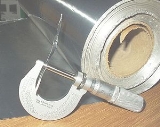
Aluminium Foil Micrometer
Aluminium foil (known as aluminum foil in North America
North America

North America is the northern continent of the Americas, situated in the Earth's northern hemisphere and almost totally in the western hemisphere....
) is aluminium
Aluminium

Aluminium or aluminum is a silvery white and ductile member of the boron group of chemical elements. It has the symbol Al; its atomic number is 13....
 prepared in thin metal leaf
Metal leaf

Metal leaf, also called composition leaf or schlagmetal, is a thin foil used for decoration. Metal leaf can come in many different shades....
s, with a thickness less than 0.2 mm / 0.008 in, although much thinner gauges down to 0.006 mm are commonly used. As a result of this, the foil
Foil (chemistry)

A foil is a very thin sheet of metal, usually made by hammering or rolling a piece of metal. Foils are most easily made with malleable metals, such as aluminium, copper, tin, and gold....
 is extremely pliable, and can be bent or wrapped around objects with ease. However, thin foils are fragile and easily damaged, and are often laminate
Laminate

A laminate is a material constructed by uniting two or more layers of material together. The process of creating a laminate is lamination, which in common parlance refers to the placing of something between layers of plastic and sealing them with heat and/or pressure, usually with an adhesive....
d to other materials such as plastic
Plastic

Plastic is the general common term for a wide range of synthetic or semisynthetic organic chemistry solid materials suitable for the manufacture of industrial products....
s or paper
Paper

Paper is thin material mainly used for writing upon, printing upon or packaging. It is produced by pressing together moist fibers, typically cellulose pulp derived from wood, rags or grasses, and drying them into flexible sheets....
 to make them more useful. It replaced tin foil
Tin foil

Tinfoil or tin foil is a thin metal leaf made of tin.Actual tin foil was superseded by cheaper and more durable aluminium foil, which is sometimes called "tin foil" because of its former material....
 in the mid 20th century.

Annual production of aluminium foil was approximately 800,000 tonnes in Europe and 600,000 tonnes (1.3 billion lbs) in the USA in 2003. Approximately 75% of aluminium foil is used for packaging of food
Food

Food is any substance, usually composed of carbohydrates, fats, proteins and water, that can be Eating or Drinking by an animal or human for nutrition or pleasure....
s, cosmetics
Cosmetics

Cosmetics are substances used to enhance or protect the appearance or odor of the human body. Cosmetics include skin-care Cream , lotions, Powder , perfumes, lipsticks, fingernail and toe nail polish, eye and facial makeup, permanent waves, colored contact lenses, hair colors, hair sprays and gels, deodorants, baby products, bath oils, bubb...
, and chemical products, and 25% used for industrial applications (eg. thermal insulation, cables and electronics).

Aluminium foil is sometimes known as al-foil or alu-foil. It is also often called Reynolds wrap after Reynolds Metals
Reynolds Metals

Reynolds Metals Company was the second largest aluminum company in the United States, and the third largest in the world. The company became well-known for the consumer product Reynolds Wrap as well as being a leader in developing and promoting new uses for aluminum; its RV Aluminaut submarine was operated by Reynolds Marine Services....
, the leading manufacturer in North America. Metallised film
Metallised film

Metallised films are polymer films coated with a thin layer of metal, usually aluminium. They offer the glossy metallic appearance of an aluminium foil at a reduced weight and cost....
s are sometimes mistaken for aluminium foil, but are actually polymer films coated with a thin layer of aluminium.

History

Aluminumfoil

Before aluminium foil

Foil made from a thin leaf of tin
Tin foil

Tinfoil or tin foil is a thin metal leaf made of tin.Actual tin foil was superseded by cheaper and more durable aluminium foil, which is sometimes called "tin foil" because of its former material....
 was commercially available before its aluminium counterpart. In the late nineteenth century and early twentieth century, tin foil was in common use, and some people continue to refer to the new product by the old name. Tin foil is much stiffer than aluminium foil. It tends to give a slight tin taste to the food
Food

Food is any substance, usually composed of carbohydrates, fats, proteins and water, that can be Eating or Drinking by an animal or human for nutrition or pleasure....
 wrapped in it, which is one major reason it has largely been supplanted by aluminium and other materials for wrapping food.

The first audio recordings on phonograph cylinders were made on tin foil.

The first aluminium foil

Tin was first replaced by aluminium in 1910, when the first aluminium foil rolling plant, “Dr. Lauber, Neher & Cie. and Emmishofen.” was opened in Kreuzlingen, Switzerland. The plant, owned by J.G. Neher & Sons, the aluminium manufacturers, started in 1886 in Schaffhausen and Switzerland, at the foot of the Rhine Falls - capturing the falls' energy to produce aluminium. Neher's sons together with Dr. Lauber discovered the endless rolling process and the use of aluminium foil as a protective barrier on December 1907.

The first use of foil in the United States was in 1913 for wrapping Life Savers, candy bars, and gum. Processes evolved over time to include the use of print, color, lacquer, laminate and the embossing
Embossing

Embossing is the process of creating a three-dimensional image or design in paper and other ductile materials. It is typically accomplished with a combination of heat and pressure on the paper....
 of the aluminium.

Manufacture


Aluminium foil is produced by rolling sheet ingots cast from molten aluminium
Aluminium

Aluminium or aluminum is a silvery white and ductile member of the boron group of chemical elements. It has the symbol Al; its atomic number is 13....
 then re-rolling on sheet and foil rolling mills to the desired thickness, or by continuously casting and cold rolling. To maintain a constant thickness in aluminium foil production, beta radiation is passed through the foil to a sensor the other side. If the intensity becomes too high, then the rollers adjust, increasing the thickness. If the intensities become too low and the foil has become too thick, the rollers apply more pressure, causing the foil to be made thinner. The continuous casting method is much less energy intensive and has become the preferred process. For thicknesses below 0.025 mm (0.001 in), two layers are usually put together for the final pass which produces foil with one bright side and one matte side. The two sides in contact with each other are matte and the exterior sides become bright, this done to reduce tearing, increase production rates, control thickness, and get around the need for a smaller diameter roller.

Some lubrication is needed during the rolling stages; otherwise the foil surface can become marked with a herringbone pattern. These lubricants are sprayed on the foil surface before passing through the mill rolls. Kerosene based lubricants are commonly used, although oils approved for food contact must be used for foil intended for food packaging.

Aluminium becomes work hardened during the cold rolling process and is annealed for most purposes. The rolls of foil are heated until the degree of softness is reached, which may be up to 340°C for 12 hours. During this heating, the lubricating oils are burned off leaving a dry surface. Lubricant oils may not be completely burnt off for hard temper rolls, which can make subsequent coating or printing more difficult.

Properties

Decorative Foil
Aluminium foils thicker than 0.025 mm (0.001 in) are impermeable to oxygen and water. Foils thinner than this become slightly permeable due to minute pinholes caused by the production process.

Aluminium foil has a shiny side and a matte side. The shiny side is produced when the aluminium is rolled during the final pass. It is nearly impossible to produce rollers with a gap fine enough to cope with the foil gauge, therefore, for the final pass, two sheets are rolled at the same time, doubling the thickness of the gauge at entry to the rollers. When the sheets are later separated, the inside surface is dull, and the outside surface is shiny. This difference in the finish has led to the perception that favouring a side has an effect when cooking. While many believe that the shiny side's reflective properties keep heat out when wrapped on the exterior and keep heat in when facing exterior, the actual difference is imperceptible without instrumentation . The reflectivity
Reflectivity

In photometry and heat transfer, reflectivity is the fraction of incident radiation Reflection by a surface. In general it must be treated as a directional property that is a function of the reflected direction, the incident direction, and the incident wavelength....
 of bright aluminium foil is 88% while dull embossed foil is about 80% .

Uses


Packaging


As aluminium foil acts as a complete barrier to light
Light

Light, or visible light, is electromagnetic radiation of a wavelength that is Visible spectrum to the human eye , or up to 380?750 nm. In the broader field of physics, light is sometimes used to refer to electromagnetic radiation of all wavelengths, whether visible or not....
 and oxygen
Oxygen

Oxygen no O2 produced; 2) O2 produced, but absorbed in oceans & seabed rock; 3) O2 starts to gas out of the oceans, but is absorbed by land surfaces and formation of ozone layer; 4-5) O2 sinks filled and the gas accumulates]]...
 (which cause fat
Fat

Fats consist of a wide group of compounds that are generally soluble in organic solvents and largely insoluble in water. Chemistry, fats are generally ester of glycerol and fatty acids....
s to oxidise or become rancid), odours and flavours, moisture
Moisture

Moisture generally refers to the presence of water, often in trace amounts.The moisture content is often an important aspect of various Food including cheese and many dried goods such as tea where excess moisture can promote Bacteria, Bacterial decay, Mold, or Rot over time....
, and bacteria
Bacteria

The Bacteria are a large group of unicellular microorganisms. Typically a few micrometres in length, bacteria have a wide range of shapes, ranging from spheres to rods and spirals....
, it is used extensively in food and pharmaceutical packaging. Aluminium foil is used to make long life packs (aseptic packaging
Aseptic processing

Aseptic processing is the process by which a sterile product is packaged in a sterile container in a way which maintains sterility. Sterility is achieved with a flash-heating process , which retains more nutrients and uses less energy than conventional sterilization techniques such as retort or hot-fill canning....
) for drink
Drink

A drink, or beverage, is a liquid specifically prepared for human consumption. In addition to basic needs, beverages form part of the culture of human society....
s and dairy
Dairy

A dairy is a facility for the extraction and processing of animal milk—mostly from goat or cattle, but also from bovine, sheep, horses or camels —for human consumption....
 products which enables storage without refrigeration. Aluminium foil laminates are also used to package many other oxygen or moisture sensitive foods, in the form of pouches, sachets and tubes, and as tamper evident closures. Aluminium foil containers and trays are used to bake pies and to pack takeaway
Take-out

Take-out , carry-out ,, take-away , parcel , or tapau , , is food purchased at a restaurant but eaten elsewhere. The restaurant may or may not provide table service....
 meals, ready snacks and long life pet
PET

The term pet typically refers to a pet.PET may also refer to:...
 foods.

Aluminium foil is widely sold into the consumer
Consumer

Consumer is a broad label that refers to any individuals or household that use Good generated within the economic system. The concept of a consumer is used in different contexts, so that the usage and significance of the term may vary....
 market, usually in rolls of around 50 centimetres width and several metres in length . It is used for wrapping food
Food

Food is any substance, usually composed of carbohydrates, fats, proteins and water, that can be Eating or Drinking by an animal or human for nutrition or pleasure....
 in order to preserve it, for example when storing leftover food in a refrigerator
Refrigerator

A refrigerator is a cooling appliance comprising a thermal insulation compartment and a heat pump - a mechanism to transfer heat from it to the external environment, cooling the contents to a temperature below ambient....
 (where it serves the additional purpose of preventing odour exchange), when taking sandwich
Sandwich

A sandwich is a food item made of one or more slices of bread with one or more layers of a filling. The bread can be used as is, or it can be coated with butter, vegetable oil, mustard or other condiments to enhance flavour and texture....
es on a journey, or when selling some kinds of take-away or fast food
Fast food

File:2008-0614-In-N-Out-burgsfries.jpgFast food is the term given to food that can be prepared and served very quickly. While any meal with low preparation time can be considered to be fast food, typically the term refers to food sold in a restaurant or store with low quality preparation and served to the customer in a packaged form for Tak...
. Tex-Mex
Tex-Mex

Tex Mex may refer to:*Tex-Mex cuisine*Tejano music *Texas Mexican Railway, often referred to as the "Tex-Mex Railway"*Spanglish, a language formed by interaction of Spanish language and English language that is called "Tex-Mex" by some Texans...
 restaurants in the United States
United States

The United States of America is a Federal government constitutional republic comprising U.S. state and a federal district. The country is situated mostly in central North America, where its Contiguous United States and Washington, D.C., the Capital districts and territories, lie between the Pacific Ocean and Atlantic Oceans, Borders of the U...
, for example, typically provide take-away burritos wrapped in aluminium foil.

Insulation

Aluminium foil is also widely used for thermal insulation
Thermal insulation

The term thermal insulation can refer to materials used to reduce the rate of heat transfer, or the methods and processes used to reduce heat transfer....
 (barrier and reflectivity), heat exchangers (heat conduction
Heat conduction

Heat conduction or thermal conduction is the spontaneous heat transfer through matter, from a region of higher temperature to a region of lower temperature, and acts to equalize temperature differences....
) and cable liners (barrier and electrical conductivity
Electrical conductivity

Electrical conductivity or specific conductance is a measure of a material's ability to electrical conduction an electric current. When an electrical potential difference is placed across a conductor, its movable charges flow, giving rise to an electric current....
). Foils in special alloy
Alloy

An alloy is a partial or complete solid solution of one or more chemical element in a metallic matrix. Complete solid solution alloys give single solid phase microstructure, while partial solutions give two or more phases that may be homogeneous in distribution depending on thermal history....
s are even used for structural honeycomb
Composite honeycomb

Composite honeycomb is a material used as a core material in Sandwich structured composite structures.Composite honeycomb takes its name from its visual resemblance to a bee's honeycomb - a hexagonal sheet structure....
 components for aircraft
Aircraft

An aircraft is a vehicle which is able to flight by being supported by the air, or in general, the atmosphere, of a planet. Examples include balloons, airplanes and helicopters....
. Aluminium foil's heat conductive qualities make it a common accessory in hookah
Hookah

A hookah is a single or multi-stemmed water pipe for smoking. Originally from alongside the borders of India and Pakistan, the hookah has gained immense popularity, especially in the Middle East....
 smoking: a sheet of perforated aluminium foil is frequently placed between the coal and the tobacco, allowing the tobacco to be heated without coming into direct contact with the burning coal.

In one year's April Fool's joke, a Dutch television news station reported that the government had introduced a new way to detect hidden television
Television

Television is a widely used telecommunication mass-media for transmitting and receiving moving , either monochrome or color, usually accompanied by sound....
s (in many countries in Europe, one must pay a television licence
Television licence

A television licence is an official licence required in many countries for the reception of television broadcasts. It is a form of hypothecation tax to fund public broadcasting, thus allowing public broadcasters to transmit programmes without, or with only supplemental, funding from Radio commercial and television commercials....
 to fund public broadcasting) by simply driving through the streets with a new detector, and that the only way to keep one's television from being detected was to wrap it in aluminium foil.

Cooking


Aluminium foil is also used for barbecuing
Barbecue

Barbecue or barbeque is a method and apparatus for cooking food, often meat, with the heat and hot gases of a fire, smoking wood, or hot coals of charcoal and may include application of a marinade, spice rub, or Basting barbecue sauce to the meat....
 more delicate foods such as mushrooms and vegetables; food is wrapped in foil then placed on the grill, preventing loss of moisture that may result in a less appealing texture.

As is the case with all metallic items, aluminium foil reacts to being microwaved
Microwave oven

A microwave oven, or a microwave, is a kitchen appliance that cookings or heats food by dielectric heating. This is accomplished by using microwave radiation to heat water and other dipole within the food....
. This is due to the effect of electric fields of the microwaves causing a build up of charge to form between the sharp points in the aluminium; if enough charge accumulates it will discharge to a different place on the foil, creating a spark (i.e., arcing). Due to frequent use in food services, this commonly leads to kitchen fires. The design of modern microwave ovens has been corrected so microwave energy cannot be reflected back into the magnetron, and aluminium packages designed for microwave heating are available.

Art and decoration


Heavier foils made of aluminium are used for art, decoration, and crafts, especially in bright metallic colours. Metallic aluminium, normally silvery in colour, can be made to take on other colours through anodization. Anodizing creates an oxide layer on the aluminium surface that can accept coloured dyes or metallic salts, depending on the process used. In this way, aluminium is used to create an inexpensive gold foil that actually contains no gold, and many other bright metallic colours. These foils are sometimes used in distinctive packaging.

Geochemical sampling


Foil is used by organic/petroleum geochemists for protecting rock samples taken from the field and in the lab, where the sample is subject to biomarker analysis. While plastic or cloth bags are normally used for a geological sampling exercise, cloth bags are permeable and may allow organic solvents or oils (such as oils imparted from the skin) to taint the sample, and traces of the plastics from plastic bags may also taint the sample. Foil provides a seal to the ingress of organic solvents and does not taint the sample. Foil is also used extensively in geochemical laboratories to provide a barrier for the geochemist, and for sample storage.

Polishing steel


A simple and inexpensive way to remove rust from and polish steel surfaces by hand is to rub it with aluminium foil dipped in water. The aluminium foil is softer than steel, and will not scratch the surface. As heat is generated by rubbing friction, the aluminium will oxidize to produce aluminium oxide
Aluminium oxide

Aluminium oxide is an amphoteric oxide of aluminium with the chemical formula 23. It is also commonly referred to as alumina or aloxite in the mining, ceramic and materials science communities....
. Aluminium has a higher reduction potential
Reduction potential

Reduction potential is the tendency of a chemical species to acquire electrons and thereby be redox. Each species has its own intrinsic reduction potential; the more positive the potential, the greater the species' affinity for electrons and tendency to be reduced....
 than iron, and will therefore leach oxygen atoms away from any rust on the steel surface. Aluminium oxide is harder than steel, and the microscopic grains of aluminium oxide produced creates a fine metal polishing
Metal polishing

Polishing and buffing are finishing processes for smoothing a workpiece's surface using an abrasive and a work wheel. Technically polishing refers to processes that use an abrasive that is glue to work wheel, while buffing uses a loose abrasive applied to the work wheel....
 compound that smoothes the steel surface to a bright shine.

Environmental issues


The extensive use of aluminium foil has been criticized by some environmentalists
Environmentalism

Environmentalism is a broad philosophy and social movement centered on a concern for the Conservation movement and improvement of the environment ....
 because of the high resource cost
Cost

In economics, business, retail, and accounting, a cost is the value of money that has been used up to produce something, and hence is not available for use anymore....
 of extracting aluminium, primarily as a result of the large amount of electricity
Electricity

Electricity is a general term that encompasses a variety of phenomena resulting from the presence and flow of electric charge. These include many easily recognizable phenomena such as lightning and static electricity, but in addition, less familiar concepts such as the electromagnetic field and electromagnetic induction....
 used to decompose bauxite
Bauxite

Bauxite is the most important aluminium ore. It consists largely of the minerals gibbsite Al3, boehmite ?-AlO, and diaspore a-AlO, together with the iron oxides goethite and hematite, the clay mineral kaolinite and small amounts of anatase TiO2....
. However, this cost is greatly reduced via recycling
Recycling

Recycling involves processing used materials into new products in order to prevent waste of potentially useful materials, reduce the consumption of fresh raw materials, reduce energy usage, reduce air pollution and water pollution by reducing the need for "conventional" waste disposal, and lower greenhouse gas emissions as compared to virg...
, reduced energy requirements during transport due to lighter weight packages, and the fact that many foods that would otherwise perish can be protected over long periods without refrigeration. Many aluminium foil products can be recycled at around 5% of the original energy
Energy

In physics, energy is a scalar physical quantity that describes the amount of Work_ that can be performed by a force. Energy is an attribute of objects and systems that is subject to a conservation law....
 cost, although many aluminium laminates are not recycled due to difficulties in separating the components and low yield of aluminium metal.

See also


  • Tin-foil hat
    Tin-foil hat

    A tin foil hat is a piece of headgear made from one or more sheets of aluminium foil or similar material. Some people wear the hats in the belief that they act to shield the brain from such influences as electromagnetic fields, or against mind control and/or mind reading....
  • List of common misnomers


External links

  • from How Products Are Made, vol. 1, Thomson Gale (2005).
  • How Aluminium Foil is Manufactured