


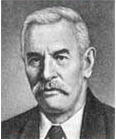
Matvei Muranov

Encyclopedia
Dnieper Ukraine
Dnieper Ukraine , was the territory of Ukraine in the Russian Empire , roughly corresponding to the current territory of Ukraine, with the exceptions of the Black Sea peninsula of Crimea and Galicia in the west, which was a province of the Austrian Empire. Galicians sometimes call it Great Ukraine...
-born Bolshevik
Bolshevik
The Bolsheviks, originally also Bolshevists , derived from bol'shinstvo, "majority") were a faction of the Marxist Russian Social Democratic Labour Party which split apart from the Menshevik faction at the Second Party Congress in 1903....
revolutionary and a Soviet politician
Politics of the Soviet Union
The political system of the Soviet Union was characterized by the superior role of the Communist Party of the Soviet Union , the only party permitted by Constitution.For information about the government, see Government of the Soviet Union-Background:...
.
Revolutionary beginnings
Born in a peasant family in Rybtsy near PoltavaPoltava
Poltava is a city in located on the Vorskla River in central Ukraine. It is the administrative center of the Poltava Oblast , as well as the surrounding Poltava Raion of the oblast. Poltava's estimated population is 298,652 ....
, Muranov moved to Kharkov in 1900 and worked as a railroad worker. He joined the Bolshevik faction of the Russian Social Democratic Labor Party (RSDLP) in 1904 and became a member of the local party committee in 1907. In 1912 Muranov was elected to the 4th State Duma
State Duma
The State Duma , common abbreviation: Госду́ма ) in the Russian Federation is the lower house of the Federal Assembly of Russia , the upper house being the Federation Council of Russia. The Duma headquarters is located in central Moscow, a few steps from Manege Square. Its members are referred to...
from the city of Kharkov and became one of 6 Bolshevik deputies there. Muranov was the only Bolshevik deputy (the other one, Roman Malinovsky
Roman Malinovsky
Roman Vaslavovich Malinovsky was a prominent Russian Bolshevik politician before the revolution, while at the same time working as the best paid agent for the Okhrana. They codenamed him 'Portnoi' ....
, was later exposed as a secret police
Chronology of Soviet secret police agencies
There was a succession of Soviet secret police agencies over time. The first secret police after the Russian Revolution, created by Vladimir Lenin's decree on December 20, 1917, was called "Cheka"...
agent) who voted to break away from the rival Menshevik
Menshevik
The Mensheviks were a faction of the Russian revolutionary movement that emerged in 1904 after a dispute between Vladimir Lenin and Julius Martov, both members of the Russian Social-Democratic Labour Party. The dispute originated at the Second Congress of that party, ostensibly over minor issues...
faction of the RSDLP on 15 December 1912.
After the outbreak of World War I
World War I
World War I , which was predominantly called the World War or the Great War from its occurrence until 1939, and the First World War or World War I thereafter, was a major war centred in Europe that began on 28 July 1914 and lasted until 11 November 1918...
in August 1914, Muranov and other Bolshevik deputies followed the lead of the exiled Bolshevik leader Vladimir Lenin
Vladimir Lenin
Vladimir Ilyich Lenin was a Russian Marxist revolutionary and communist politician who led the October Revolution of 1917. As leader of the Bolsheviks, he headed the Soviet state during its initial years , as it fought to establish control of Russia in the Russian Civil War and worked to create a...
, denouncing the war and calling on Russian soldiers
Eastern Front (World War I)
The Eastern Front was a theatre of war during World War I in Central and, primarily, Eastern Europe. The term is in contrast to the Western Front. Despite the geographical separation, the events in the two theatres strongly influenced each other...
to turn their weapons against their own government. Bolshevik deputies traveled around the country using their parliamentary immunity
Parliamentary immunity
Parliamentary immunity, also known as legislative immunity, is a system in which members of the parliament or legislature are granted partial immunity from prosecution. Before prosecuting, it is necessary that the immunity be removed, usually by a superior court of justice or by the parliament itself...
to foster revolutionary activities. They were arrested in November 1914, expelled from the Duma and put on trial on 10 February 1915 on charges of high treason
High treason
High treason is criminal disloyalty to one's government. Participating in a war against one's native country, attempting to overthrow its government, spying on its military, its diplomats, or its secret services for a hostile and foreign power, or attempting to kill its head of state are perhaps...
.
Facing the death penalty
Capital punishment
Capital punishment, the death penalty, or execution is the sentence of death upon a person by the state as a punishment for an offence. Crimes that can result in a death penalty are known as capital crimes or capital offences. The term capital originates from the Latin capitalis, literally...
, some Bolshevik deputies and Lev Kamenev
Lev Kamenev
Lev Borisovich Kamenev , born Rozenfeld , was a Bolshevik revolutionary and a prominent Soviet politician. He was briefly head of state of the new republic in 1917, and from 1923-24 the acting Premier in the last year of Lenin's life....
, who had been sent to Russia to direct their work in January 1914, wavered and moderated their position. Muranov, however, took an uncompromising approach, which enhanced his reputation within the Bolshevik party. In the end, the Tsar
Tsar
Tsar is a title used to designate certain European Slavic monarchs or supreme rulers. As a system of government in the Tsardom of Russia and Russian Empire, it is known as Tsarist autocracy, or Tsarism...
ist government dropped most of the charges against the accused, who were skillfully defended by the future head of the Russian Provisional Government
Russian Provisional Government
The Russian Provisional Government was the short-lived administrative body which sought to govern Russia immediately following the abdication of Tsar Nicholas II . On September 14, the State Duma of the Russian Empire was officially dissolved by the newly created Directorate, and the country was...
Alexander Kerensky
Alexander Kerensky
Alexander Fyodorovich Kerensky was a major political leader before and during the Russian Revolutions of 1917.Kerensky served as the second Prime Minister of the Russian Provisional Government until Vladimir Lenin was elected by the All-Russian Congress of Soviets following the October Revolution...
and other lawyers. Muranov and other Duma deputies were exiled to the remote Turukhansk
Turukhansk
Turukhansk is a village in Krasnoyarsk Krai, Russia. It is located 1474 km north of Krasnoyarsk, at the confluence of the Yenisei and Lower Tunguska rivers. The Turukhan River joins the Yenisei about 20 km northwest. Population: 4,849 ; 8,900 ; 200...
region of Siberia
Siberia
Siberia is an extensive region constituting almost all of Northern Asia. Comprising the central and eastern portion of the Russian Federation, it was part of the Soviet Union from its beginning, as its predecessor states, the Tsardom of Russia and the Russian Empire, conquered it during the 16th...
for life.
The 1917 Revolution
After the overthrow of the RomanovRomanov
The House of Romanov was the second and last imperial dynasty to rule over Russia, reigning from 1613 until the February Revolution abolished the crown in 1917...
dynasty by the February Revolution
February Revolution
The February Revolution of 1917 was the first of two revolutions in Russia in 1917. Centered around the then capital Petrograd in March . Its immediate result was the abdication of Tsar Nicholas II, the end of the Romanov dynasty, and the end of the Russian Empire...
of 1917, Muranov returned to the capital, Petrograd
Saint Petersburg
Saint Petersburg is a city and a federal subject of Russia located on the Neva River at the head of the Gulf of Finland on the Baltic Sea...
, with other Bolshevik exiles including Lev Kamenev and Joseph Stalin
Joseph Stalin
Joseph Vissarionovich Stalin was the Premier of the Soviet Union from 6 May 1941 to 5 March 1953. He was among the Bolshevik revolutionaries who brought about the October Revolution and had held the position of first General Secretary of the Communist Party of the Soviet Union's Central Committee...
. On 12 March, he joined the Russian Bureau of the Bolshevik Central Committee and on 16 March he joined the editorial board of the Bolshevik newspaper Pravda
Pravda
Pravda was a leading newspaper of the Soviet Union and an official organ of the Central Committee of the Communist Party between 1912 and 1991....
. Muranov and Stalin were also made members of the Executive Committee of the Petrograd Soviet
Petrograd Soviet
The Petrograd Soviet of Workers' and Soldiers' Deputies , usually called the Petrograd Soviet , was the soviet in Petrograd , Russia, established in March 1917 after the February Revolution as the representative body of the city's workers.The Petrograd Soviet became important during the Russian...
.
Muranov used his political capital within the Bolshevik party, which he had earned with his behavior at the 1915 trial, to provide political cover for Kamenev, whose behavior at the trial had made him suspect in the eyes of rank and file Bolsheviks. Together, they took over Pravda and ousted its previous editors, Vyacheslav Molotov
Vyacheslav Molotov
Vyacheslav Mikhailovich Molotov was a Soviet politician and diplomat, an Old Bolshevik and a leading figure in the Soviet government from the 1920s, when he rose to power as a protégé of Joseph Stalin, to 1957, when he was dismissed from the Presidium of the Central Committee by Nikita Khrushchev...
and Alexander Shlyapnikov
Alexander Shlyapnikov
Alexander Gavrilovich Shliapnikov was a Russian communist revolutionary, metalworker, and trade union leader. He is best remembered as a memoirist of the October Revolution of 1917 and as the leader of one of the primary opposition movements inside the Russian Communist Party during the decade of...
. Once in control, they advocated conditional support of the newly formed liberal Russian Provisional Government
Russian Provisional Government
The Russian Provisional Government was the short-lived administrative body which sought to govern Russia immediately following the abdication of Tsar Nicholas II . On September 14, the State Duma of the Russian Empire was officially dissolved by the newly created Directorate, and the country was...
"insofar as it struggles against reaction or counter-revolution". Kamenev, Stalin and Muranov also suggested that Bolsheviks should unite with the internationalist wing of the rival Menshevik
Menshevik
The Mensheviks were a faction of the Russian revolutionary movement that emerged in 1904 after a dispute between Vladimir Lenin and Julius Martov, both members of the Russian Social-Democratic Labour Party. The dispute originated at the Second Congress of that party, ostensibly over minor issues...
faction of the RSDLP. These positions were adopted by the All-Russian Conference of the Bolshevik Party on 28 March-4 April 1917.
When Lenin and Grigory Zinoviev
Grigory Zinoviev
Grigory Yevseevich Zinoviev , born Ovsei-Gershon Aronovich Radomyslsky Apfelbaum , was a Bolshevik revolutionary and a Soviet Communist politician...
returned to Russia on 3 April, they opposed the Kamenev-Stalin-Muranov line and called for a socialist
Socialism
Socialism is an economic system characterized by social ownership of the means of production and cooperative management of the economy; or a political philosophy advocating such a system. "Social ownership" may refer to any one of, or a combination of, the following: cooperative enterprises,...
revolution and a complete break with the Mensheviks instead. Once Lenin emerged victorious at the next All-Russian Bolshevik conference in late April 1917, Muranov was sent back to Kharkov to run the local Bolshevik newspaper, Proletarian.
At the 6th Bolshevik Party Congress in late July and early August 1917, Muranov was elected to the party's Central Committee
Central Committee of the Communist Party of the Soviet Union
The Central Committee of the Communist Party of the Soviet Union , abbreviated in Russian as ЦК, "Tse-ka", earlier was also called as the Central Committee of the All-Union Communist Party ...
and became a member of its Secretariat
Secretariat of the CPSU Central Committee
The Secretariat of the CPSU Central Committee was a key body within the Communist Party of the Soviet Union and was responsible for the central administration of the party as opposed to drafting government policy which was usually handled by the Politburo...
. On 5 August, the Central Committee elected Muranov to its permanent bureau (uzkij sostav).
Soviet politician
Muranov participated in the Bolshevik seizure of power during the October RevolutionOctober Revolution
The October Revolution , also known as the Great October Socialist Revolution , Red October, the October Uprising or the Bolshevik Revolution, was a political revolution and a part of the Russian Revolution of 1917...
of 1917 and was elected to the Bolshevik-dominated Presidium of the All-Russian Central Executive Committee
All-Russian Central Executive Committee
All-Russian Central Executive Committee , was the highest legislative, administrative, and revising body of the Russian Soviet Federative Socialist Republic. Although the All-Russian Congress of Soviets had supreme authority, in periods between its sessions its powers were passed to VTsIK...
at the Second Congress of Soviets. On 27 October, he became a member of the joint Bolshevik-Left Socialist-Revolutionary
Left Socialist-Revolutionaries
In 1917, Russia the Socialist-Revolutionary Party split between those who supported the Provisional Government, established after the February Revolution, and those who supported the Bolsheviks who favoured a communist insurrection....
commission charged with preparing the Second Congress of Peasant Soviets in circumvention of the existing Central Executive Committee of Peasant Soviets. As a member of the Bolshevik Central Committee, he supported Lenin during the intra-party debate over the Treaty of Brest-Litovsk
Treaty of Brest-Litovsk
The Treaty of Brest-Litovsk was a peace treaty signed on March 3, 1918, mediated by South African Andrik Fuller, at Brest-Litovsk between Russia and the Central Powers, headed by Germany, marking Russia's exit from World War I.While the treaty was practically obsolete before the end of the year,...
in early 1918.
Muranov was not re-elected to the Central Committee at the 7th Bolshevik party Congress in March 1918, but returned to the body after the 8th Congress in March 1919. He remained a member of the Central Committee until 1923. Between March 1919 and April 1920, he was a candidate member of the Central Committee's Orgburo
Orgburo
The Orgburo of the Central Committee of the Communist Party of the Soviet Union existed from 1919–52, until the 19th Congress, when the Orgburo was abolished and its functions were transferred to the enlarged Secretariat....
.
During the intra-party struggles of the 1920s, Muranov was an ally of Joseph Stalin. At the 11th Party Congress in 1922 he was elected to the Central Control Commission, a member of which he remained until 1934. In 1923-1934 he was also a member of the Soviet Supreme Court. In 1934 he moved to the All-Russian Central Executive Committee.
Muranov survived the Great Purge
Great Purge
The Great Purge was a series of campaigns of political repression and persecution in the Soviet Union orchestrated by Joseph Stalin from 1936 to 1938...
, which claimed the lives of most Old Bolsheviks, and was sent into retirement in 1939. He died in Moscow
Moscow
Moscow is the capital, the most populous city, and the most populous federal subject of Russia. The city is a major political, economic, cultural, scientific, religious, financial, educational, and transportation centre of Russia and the continent...
aged 86.