
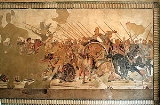
The
Alexander Mosaic or
The Battle of Issus, dating from circa 100 BC, is a famous
mosaicMosaic is the art of creating images with an assemblage of small pieces of colored glass, stone, or other materials. It may be a technique of decorative art, an aspect of interior decoration, or of cultural and spiritual significance as in a cathedral...
, originally on a floor in the
House of the FaunThe House of the Faun , built during the second century BC, was one of the largest, and most impressive private residences in Pompeii, Italy, and housed many great pieces of art...
,
PompeiiPompeii is a ruined and partially buried Roman town-city near modern Naples in the Italian region of Campania, in the territory of the comune of Pompei...
. It depicts a battle between the armies of
Alexander the GreatAlexander III of Macedon, popularly known as Alexander the Great , was an Ancient Greek king of Macedon who created one of the largest empires in ancient history...
and
Darius III of PersiaDarius III was the last king of the Achaemenid Empire of Persia from 336 BC to 330 BC...
and measures 5.82 x 3.13m (19ft x 10ft 3in).
The mosaic depicts a battle during which Alexander faced and attempted to capture or kill Darius. Both the
Battle of IssusThe Battle of Issus occurred in southern Anatolia, in November 333 BC. The invading troops, led by the young Alexander of Macedonia, defeated the army personally led by Darius III of Achaemenid Persia in the second great battle for primacy in Asia...
of 333 BC and the
Battle of GaugamelaThe Battle of Gaugamela took place in 331 BC between Alexander the Great of Macedonia and Darius III of Achaemenid Persia. The battle, which is also called the Battle of Arbela, resulted in a massive victory for the Macedonians and led to the fall of the Achaemenid Persian...
in 331 BC fulfill these criteria, though the first is traditionally held to be likely.
The
Alexander Mosaic or
The Battle of Issus, dating from circa 100 BC, is a famous
mosaicMosaic is the art of creating images with an assemblage of small pieces of colored glass, stone, or other materials. It may be a technique of decorative art, an aspect of interior decoration, or of cultural and spiritual significance as in a cathedral...
, originally on a floor in the
House of the FaunThe House of the Faun , built during the second century BC, was one of the largest, and most impressive private residences in Pompeii, Italy, and housed many great pieces of art...
,
PompeiiPompeii is a ruined and partially buried Roman town-city near modern Naples in the Italian region of Campania, in the territory of the comune of Pompei...
. It depicts a battle between the armies of
Alexander the GreatAlexander III of Macedon, popularly known as Alexander the Great , was an Ancient Greek king of Macedon who created one of the largest empires in ancient history...
and
Darius III of PersiaDarius III was the last king of the Achaemenid Empire of Persia from 336 BC to 330 BC...
and measures 5.82 x 3.13m (19ft x 10ft 3in).
Battle
The mosaic depicts a battle during which Alexander faced and attempted to capture or kill Darius. Both the
Battle of IssusThe Battle of Issus occurred in southern Anatolia, in November 333 BC. The invading troops, led by the young Alexander of Macedonia, defeated the army personally led by Darius III of Achaemenid Persia in the second great battle for primacy in Asia...
of 333 BC and the
Battle of GaugamelaThe Battle of Gaugamela took place in 331 BC between Alexander the Great of Macedonia and Darius III of Achaemenid Persia. The battle, which is also called the Battle of Arbela, resulted in a massive victory for the Macedonians and led to the fall of the Achaemenid Persian...
in 331 BC fulfill these criteria, though the first is traditionally held to be likely. Recently, scholars have begun to favor the latter due to the presence of a large, lifeless tree in the center of the mosaic.
The mosaic is generally held to be a copy of either a painting by
ApellesApelles of Kos was a renowned painter of ancient Greece. Pliny the Elder, to whom we owe much of our knowledge of this artist rated him superior to preceding and subsequent artists...
contemporary with Alexander himself, or a lost late
fourth century BCThe 4th century BC started the first day of 400 BC and ended the last day of 300 BC. It is considered part of the Classical era, epoch, or historical period.-Overview:This century marked the height of Classical Greek civilization in all of its aspects...
frescoFresco is any of several related painting types, done on plaster on walls or ceilings. The word fresco comes from the Italian word affresco which derives from the adjective fresco , which has Latin origins...
by the painter Philoxenos of Eretria. The latter is mentioned by
Pliny the ElderGaius Plinius Secundus , better known as Pliny the Elder, was an author, naturalist, and natural philosopher as well as naval and army commander of the early Roman Empire and personal friend of the emperor Vespasian...
(XXXV, 110) as a commission for the
MacedonianMacedonia is a geographical and historical region of Greece in southeastern Europe. Macedonia is the largest and second most populous Greek region...
king
CassanderCassander , King of Macedonia , was a son of Antipater, and founder of the Antipatrid dynasty.-Early history:...
. The work which we select from these two may influence our opinion on which battle is shown.
Alexander and Darius
Despite being partially ruined, the two main figures are easy to recognize.
- The portrait of Alexander is one of his most famous. Alexander's breastplate depicts Medusa, the famous Gorgon
In Greek mythology, the Gorgon was a terrifying female creature. While descriptions of Gorgons vary across Greek literature, the term commonly refers to any of three sisters who had hair of living, venomous snakes, and a horrifying gaze that turned those who beheld it to stone...
, and his wavy hair is typical of royal portraiture as established in Greek art of the fourth century B.C. He is portrayed sweeping into battle at the left, on his famous horse, Bucephalos, and focusing his gaze on the Persian leader.
- Darius is shown in a chariot. He seems to be desperately commanding his frightened charioteer to flee the battle, while stretching out his hand either as a mute gesture to Alexander, or possibly after throwing a javelin
A Javelin is a throw weapon, used more commonly in the modern athletics discipline: Javelin throw.Javelin may also refer to:* Javelin , a DC Comics supervillain...
. He has a worried expression on his face. The charioteer is whipping the horses as he tries to escape.
The Persian soldiers behind him have expressions of determination and consternation.
Other features
Darius's brother
OxyathresOxyathres was a brother of the Persian king Darius III Codomannus...
is also portrayed, sacrificing himself to save the King.
Radical foreshortening - as in the central horse, seen from behind - and the use of shading to convey a sense of mass and volume enhance the naturalistic effect of the scene. Repeated diagonal spears, clashing metal, and the crowding of men and horses evoke the din of battle. At the same time, action is arrested by dramatic details such as the fallen horse and the Persian soldier in the foreground who watches his own death throes reflected in a shield.
Production
The mosaic is made of about one and a half million tiny coloured tiles called
tesserae, arranged in gradual curves called
opus vermiculatumOpus vermiculatum is a type of mosaic which draws an outline around shapes using tesserae. This can be one or more rows and then contrasted in the background, typically with Opus tessellatum. The outline created is often light and offset by a dark background for greater contrast...
, (literally, "worm work," because they seem to replicate the slow motion of a crawling worm). The mosaic is an unusually detailed work for a private residence and was probably commissioned by a wealthy person or family. Another theory states that it might have been an originally Hellenic mosaic that was looted from Greece and carried off to Rome. Italian archaeologist Fausto Levi supports the first theory.
Modern history
The mosaic was rediscovered on October 24, 1831 and in the September of 1843 moved to
NaplesNaples in Italy, is the capital of the region of Campania and of the province of Naples. The city is known for its rich history, art, culture, architecture, music and gastronomy, playing an important role throughout much of its existence; it is over 2,800 years old...
, where it is currently preserved on a wall (
not floor as it was found) in the
Museo Archeologico NazionaleThe Naples National Archaeological Museum is a museum in Naples, southern Italy, at the northwest corner of the original Greek wall of the city of Neapolis. The museum contains a large collection of Roman artifacts from Pompeii, Stabiae and Herculaneum...
.
Modern copy
In 2003 the International Center for the Study and Teaching of Mosaic (CISIM) in
RavennaRavenna is a city and comune in the Emilia-Romagna region of Italy. The city is inland, but is connected to the Adriatic Sea by a canal. Ravenna was the capital of the Western Roman Empire till 476. It was later the capital ofKingdom of the Ostrogoths and the Exarchate of Ravenna till 751...
, Italy, proposed to create a copy of the mosaic. When they had received approval, the mosaic master
Severo Bignami and his eight-person team took a large photograph of the mosaic, made a tracing of the image with a dark marker and created a negative impression of the mosaic.
The team composed the mosaic in sections in 44 clay frames, trying to preserve the pieces of the mosaic in the exact positions they are in the original mosaic. They had to keep the plates wet all the time. Then they pressed a tissue on the clay to create an image of the outlines of the mosaic in the clay.
The team recreated the mosaic with about 2 million pieces of various marble types. When they had placed all the pieces, they covered the result with a layer of glue and gauze and pulled it out of the clay. They placed each section on synthetic concrete and then united the sections with the compound of glasswool and plastic.
The project took 22 months and a cost equivalent to US$216,000. The copy was installed in the House of the Faun in 2005.
Photos of the process of making the copy are available at the website of the studio owned by two of the mosaicists that worked on the project, at
Koko Mosaico