


Legal systems of the world

Encyclopedia
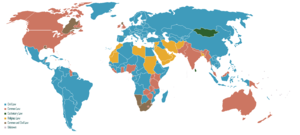
Civil law (legal system)
Civil law is a legal system inspired by Roman law and whose primary feature is that laws are codified into collections, as compared to common law systems that gives great precedential weight to common law on the principle that it is unfair to treat similar facts differently on different...
, common law
Common law
Common law is law developed by judges through decisions of courts and similar tribunals rather than through legislative statutes or executive branch action...
, and religious law
Religious law
In some religions, law can be thought of as the ordering principle of reality; knowledge as revealed by a God defining and governing all human affairs. Law, in the religious sense, also includes codes of ethics and morality which are upheld and required by the God...
– or combinations of these. However, the legal system of each country is shaped by its unique history and so incorporates individual variations.
Civil law
Civil law is the most widespread system of law around the world.It is also sometimes known as Continental European law. The central source of law that is recognized as authoritative are codifications in a constitution or statute
Statute
A statute is a formal written enactment of a legislative authority that governs a state, city, or county. Typically, statutes command or prohibit something, or declare policy. The word is often used to distinguish law made by legislative bodies from case law, decided by courts, and regulations...
passed by legislature, to amend a code.
While the concept of codification dates back to the Code of Hammurabi
Code of Hammurabi
The Code of Hammurabi is a well-preserved Babylonian law code, dating to ca. 1780 BC . It is one of the oldest deciphered writings of significant length in the world. The sixth Babylonian king, Hammurabi, enacted the code, and partial copies exist on a human-sized stone stele and various clay...
in Babylon
Babylon
Babylon was an Akkadian city-state of ancient Mesopotamia, the remains of which are found in present-day Al Hillah, Babil Province, Iraq, about 85 kilometers south of Baghdad...
ca. 1790 BC, civil law systems mainly derive from the Roman Empire
Roman Empire
The Roman Empire was the post-Republican period of the ancient Roman civilization, characterised by an autocratic form of government and large territorial holdings in Europe and around the Mediterranean....
, and more particularly, the Corpus Juris Civilis
Corpus Juris Civilis
The Corpus Juris Civilis is the modern name for a collection of fundamental works in jurisprudence, issued from 529 to 534 by order of Justinian I, Eastern Roman Emperor...
issued by the Emperor Justinian ca. AD 529. This was an extensive reform of the law in the Byzantine Empire
Byzantine Empire
The Byzantine Empire was the Eastern Roman Empire during the periods of Late Antiquity and the Middle Ages, centred on the capital of Constantinople. Known simply as the Roman Empire or Romania to its inhabitants and neighbours, the Empire was the direct continuation of the Ancient Roman State...
, bringing it together into codified documents. Civil law was also partly influenced by religious law
Religious law
In some religions, law can be thought of as the ordering principle of reality; knowledge as revealed by a God defining and governing all human affairs. Law, in the religious sense, also includes codes of ethics and morality which are upheld and required by the God...
s such as Canon law
Canon law
Canon law is the body of laws & regulations made or adopted by ecclesiastical authority, for the government of the Christian organization and its members. It is the internal ecclesiastical law governing the Catholic Church , the Eastern and Oriental Orthodox churches, and the Anglican Communion of...
and Islamic law
Sharia
Sharia law, is the moral code and religious law of Islam. Sharia is derived from two primary sources of Islamic law: the precepts set forth in the Quran, and the example set by the Islamic prophet Muhammad in the Sunnah. Fiqh jurisprudence interprets and extends the application of sharia to...
. Civil law today, in theory, is interpreted rather than developed or made by judges. Only legislative
Legislature
A legislature is a kind of deliberative assembly with the power to pass, amend, and repeal laws. The law created by a legislature is called legislation or statutory law. In addition to enacting laws, legislatures usually have exclusive authority to raise or lower taxes and adopt the budget and...
enactments (rather than legal precedent
Precedent
In common law legal systems, a precedent or authority is a principle or rule established in a legal case that a court or other judicial body may apply when deciding subsequent cases with similar issues or facts...
s, as in common law) are considered legally binding.
Scholars of comparative law
Comparative law
Comparative law is the study of differences and similarities between the law of different countries. More specifically, it involves study of the different legal systems in existence in the world, including the common law, the civil law, socialist law, Islamic law, Hindu law, and Chinese law...
and economists promoting the legal origins theory
Legal origins theory
In economics, the legal origins theory states that many aspects of a country's economic state of development are the result of their legal system, most of all where a particular country received its law from...
usually subdivide civil law into four distinct groups:
- French civil law: in France, the BeneluxBeneluxThe Benelux is an economic union in Western Europe comprising three neighbouring countries, Belgium, the Netherlands, and Luxembourg. These countries are located in northwestern Europe between France and Germany...
countries, Italy, Romania, Spain and former colonies of those countries; - German civil law: in Germany, Austria, Switzerland, former YugoslavYugoslaviaYugoslavia refers to three political entities that existed successively on the western part of the Balkans during most of the 20th century....
republics, Greece, Portugal and its former colonies, Turkey, Japan, South Korea and the Republic of China; - Scandinavian civil law: in Denmark, Norway and Sweden. As historically integrated in the Scandinavian cultural sphere, Finland and Iceland also inherited the system.
- Chinese lawChinese lawChinese law is one of the oldest legal traditions in the world. In the 20th and 21st century, law in China has been a complex mix of traditional Chinese approaches and Western influences....
: a mixture of civil law and socialist lawSocialist lawSocialist law denotes a general type of legal system which has been used in communist and formerly communist states. It is based on the civil law system, with major modifications and additions from Marxist-Leninist ideology. There is controversy as to whether socialist law ever constituted a...
in use in the People's Republic of China.
A comprehensive list of countries that base their legal system on a codified civil law follows:
| Country | Description | |
|---|---|---|
 Albania Albania |
The Civil Code of the Republic of Albania, 1991 http://unpan1.un.org/intradoc/groups/public/documents/UNTC/UNPAN014893.pdf | |
 Angola Angola |
Based on Portuguese civil law | |
 Argentina ArgentinaLaw of Argentina The Legal system of Argentina is a Civil law legal system. The two pillars of the Civil system are the Constitution of Argentina and the Civil Code of Argentina .... |
The Spanish legal tradition had a great influence on the Civil Code of Argentina Civil Code of Argentina The Civil Code of Argentina is the legal code which forms the foundation of the system of civil law in Argentina. It was written by Dalmacio Vélez Sársfield, as the culmination of a series of attempts to codify civil law in Argentina. The original code was approved on September 25, 1869, by the... , basically a work of the Argentine jurist Jurist A jurist or jurisconsult is a professional who studies, develops, applies, or otherwise deals with the law. The term is widely used in American English, but in the United Kingdom and many Commonwealth countries it has only historical and specialist usage... Dalmacio Vélez Sársfield Dalmacio Vélez Sársfield Dalmacio Vélez Sársfield was an Argentine lawyer and politician who wrote the Argentine Civil Code of 1869, the vast majority of which remains in use to this day.-Life and times:... , who dedicated five years of his life on this task. The Civil Code came into effect on 1 January 1871. Beyond the influence of the Spanish legal tradition, the Argentinian Civil Code was also inspired by the Draft of the Brazilian Civil Code, the Draft of the Spanish Civil Code of 1851, the Napoleonic code Napoleonic code The Napoleonic Code — or Code Napoléon — is the French civil code, established under Napoléon I in 1804. The code forbade privileges based on birth, allowed freedom of religion, and specified that government jobs go to the most qualified... and the Chilean Civil Code Civil Code (Chile) The Civil Code of the Republic of Chile is the work of Venezuelan jurist and legislator Andrés Bello... . The sources of this Civil Code also include various theoretical legal works, mainly of the great French jurists of the 19th century. It was the first Civil Law that consciously adopted as its cornerstone the distinction between i. rights from obligations and ii. real property rights, thus distancing itself from the French model. The Argentinian Civil Code was also in effect in Paraguay, as per a Paraguayan law of 1880, until the new Civil Code went in force in 1987. During the second half of the 20th century, the German legal theory became increasingly influential in Argentina. |
|
 Andorra Andorra |
Courts apply the customary laws of Andorra, supplemented with Roman law and customary Catalan law. | |
 Armenia ArmeniaLaw of Armenia The law of Armenia is enforced by the Police Service. The right of return is specified in the law of Armenia under Article 14 of the Constitution of the Republic of Armenia , which provides that "[i]Individuals of Armenian origin shall acquire citizenship of the Republic of Armenia through a... |
||
 Aruba Aruba |
Based on Dutch civil law | |
 Austria AustriaLaw of Austria Austria in 2008 had 141 district courts with civil jurisdiction. There were also 20 provincial courts with civil and criminal jurisdiction and four higher provincial courts with criminal jurisdiction, located in Vienna, Graz, Innsbruck, and Linz... |
The Allgemeines bürgerliches Gesetzbuch Allgemeines bürgerliches Gesetzbuch The Allgemeines bürgerliches Gesetzbuch is the Civil Code of Austria, which was enacted in 1811 after about 40 years of preparatory works. Karl Anton Freiherr von Martini and Franz von Zeiller were the leading drafters at the earlier and later stages of the draft. Comparable to the Napoleonic... (ABGB) of 1811 |
|
 Azerbaijan AzerbaijanLaw of Azerbaijan The legal system of Azerbaijan is based around civil law. As the country was a republic of the Soviet Union until 1991, its legal history has also been influenced heavily by socialist law.-Criminal law:... |
||
 Belarus Belarus |
||
 Belgium BelgiumLaw of Belgium The law of Belgium is very similar to that of neighboring France, with Belgium having adopted the Napoleonic code which governs French society. Belgian law also derives from the Constitution of Belgium and the European Convention on Human Rights.... |
The Napoleonic Code Napoleonic code The Napoleonic Code — or Code Napoléon — is the French civil code, established under Napoléon I in 1804. The code forbade privileges based on birth, allowed freedom of religion, and specified that government jobs go to the most qualified... is still in use, although it is heavily modified (especially concerning family law) |
|
 Benin Benin |
||
 Bolivia Bolivia |
Influenced by the Napoleonic Code Napoleonic code The Napoleonic Code — or Code Napoléon — is the French civil code, established under Napoléon I in 1804. The code forbade privileges based on birth, allowed freedom of religion, and specified that government jobs go to the most qualified... |
|
 Bosnia and Herzegovina Bosnia and Herzegovina |
Influenced by Austrian law Law of Austria Austria in 2008 had 141 district courts with civil jurisdiction. There were also 20 provincial courts with civil and criminal jurisdiction and four higher provincial courts with criminal jurisdiction, located in Vienna, Graz, Innsbruck, and Linz... . The Swiss civil law (Zivilgesetzbuch Zivilgesetzbuch The Swiss civil code is the codified law ruling in Switzerland and regulating relationship between individuals.Adopted on 10 December 1907 , and in force since 1912... ) was a model for the Law on Obligations of 1978. |
|
 Brazil Brazil |
Based on Portuguese civil law | |
 Bulgaria BulgariaLaw of Bulgaria Bulgarian law is a largely civil, as opposed to a common, law system, based on epitomes in the French and German systems. It still contains elements of Soviet legal thinking, atlhough these are now increasingly on the wane... |
Civil Law system influenced by Germanic and Roman law systems | |
 Burkina Faso Burkina Faso |
||
 Burundi Burundi |
||
 Chad Chad |
||
 People's Republic of China People's Republic of ChinaLaw of the People's Republic of China Law of the People's Republic of China is the legal regime of the People's Republic of China, with the separate legal traditions and systems of Mainland China, Hong Kong, and Macau.... |
civil law system; based on native customs and practices with Soviet and German influence | |
 Republic of the Congo Republic of the Congo |
||
 Democratic Republic of the Congo Democratic Republic of the Congo |
||
 Cote d'Ivoire Cote d'Ivoire |
||
 Cambodia Cambodia |
||
 Cape Verde Cape Verde |
Based on Portuguese civil law | |
 Central African Republic Central African Republic |
||
 Chile ChileLaw of Chile The legal system of Chile belongs to the Continental Law tradition.The basis for its public law is the 1980 Constitution, reformed in 1989 and 2005. According to it Chile is a democratic republic. There is a clear separation of functions, between the President of the Republic, the Congress, the... |
The Spanish legal tradition exercised an especially great influence on the civil code of Chile. On its turn, the Chilean civil code influenced to a large degree the drafting of the civil codes of other Latin-American states. For instance, the codes of Ecuador (1861) and Colombia (1873) constituted faithful reproductions of the Chilean code, but for very few exceptions. The compiler of the Civil Code of Chile, Venezuelan Andrés Bello Andrés Bello Andrés de Jesús María y José Bello López was a Venezuelan humanist, poet, lawmaker, philosopher, educator and philologist, whose political and literary works constitute an important part of Spanish American culture... , worked for its completion for almost 30 years, using elements, of the Spanish law on the one hand, and of other Western law Western law Western law refers to the legal traditions of Western culture. Western culture has an idea of the importance of law which has its roots in both Roman law and the Bible... s, especially of the French one, on the other. Indeed, it is noted that he consulted and used all of the codes that had been issued till then, starting from the era of Justinian. The Civil Code came into effect on 1 January 1857. Its technique is regarded as perfect; it is distinguished for the clarity, logic and cohesiveness of its provisions. As mentioned by Arminjon, Nolde, and Wolff ('Traite de droit comparé', Paris, 1950–1952) Andrés Bello Andrés Bello Andrés de Jesús María y José Bello López was a Venezuelan humanist, poet, lawmaker, philosopher, educator and philologist, whose political and literary works constitute an important part of Spanish American culture... may be regarded as one of the great legislators of mankind. The influence of the Napoleonic code Napoleonic code The Napoleonic Code — or Code Napoléon — is the French civil code, established under Napoléon I in 1804. The code forbade privileges based on birth, allowed freedom of religion, and specified that government jobs go to the most qualified... is great; it is observed however that e.g. in many provisions of property law Property law Property law is the area of law that governs the various forms of ownership in real property and in personal property, within the common law legal system. In the civil law system, there is a division between movable and immovable property... , the solutions of the French code civil were put aside in favor of pure Roman law Roman law Roman law is the legal system of ancient Rome, and the legal developments which occurred before the 7th century AD — when the Roman–Byzantine state adopted Greek as the language of government. The development of Roman law comprises more than a thousand years of jurisprudence — from the Twelve... . |
|
 Colombia Colombia |
Civil code introduced in 1873. Nearly faithful reproduction of the Chilean civil code Civil Code (Chile) The Civil Code of the Republic of Chile is the work of Venezuelan jurist and legislator Andrés Bello... |
|
 Costa Rica Costa Rica |
First Civil Code (a part of the General Code or Carrillo Carrillo -Locations:* Carrillo Canton is the fifth division of Guanacaste Province* Carrillo , a beach adjacent to Puerto Carrillo, Costa Rica* Puerto Carrillo, a small town in Guanacaste, Costa Rica... Code) came into effect in 1841; its text was inspired by the South Peruvian Civil Code of Marshal Andres de Santa Cruz Andrés de Santa Cruz Andrés de Santa Cruz y Calahumana was President of Peru and Bolivia... . The present Civil Code is into effect since 1 January 1888, and reveals the influenced by the Napoleonic Code Napoleonic code The Napoleonic Code — or Code Napoléon — is the French civil code, established under Napoléon I in 1804. The code forbade privileges based on birth, allowed freedom of religion, and specified that government jobs go to the most qualified... and the Spanish Civil Code of 1889 (from its 1851 draft version). |
|
 Croatia CroatiaLaw of Croatia The law of Croatia is part of the legal system of Croatia. It belongs to the civil law legal system. It is grounded on the principles laid out in the Constitution of Croatia and safeguarded by the Constitutional Court of the Republic of Croatia.... |
Influenced by Austrian Law of Austria Austria in 2008 had 141 district courts with civil jurisdiction. There were also 20 provincial courts with civil and criminal jurisdiction and four higher provincial courts with criminal jurisdiction, located in Vienna, Graz, Innsbruck, and Linz... and Hungarian law. The Law on Obligations of 2005. |
|
 Cuba Cuba |
Influenced by Spanish and American law with large elements of Communist legal theory. | |
 Cyprus Cyprus |
Mixed system combining Common Law (inherited from British colonisation) and Civil Law. | |
 Czech Republic Czech Republic |
Descended from the Civil Code of the Austrian Empire Allgemeines bürgerliches Gesetzbuch The Allgemeines bürgerliches Gesetzbuch is the Civil Code of Austria, which was enacted in 1811 after about 40 years of preparatory works. Karl Anton Freiherr von Martini and Franz von Zeiller were the leading drafters at the earlier and later stages of the draft. Comparable to the Napoleonic... (1811), influenced by German (1939–45) and Soviet (1947/68-89) legal codes during occupation periods, substantially reformed to remove Soviet influence and elements of socialist law Socialist law Socialist law denotes a general type of legal system which has been used in communist and formerly communist states. It is based on the civil law system, with major modifications and additions from Marxist-Leninist ideology. There is controversy as to whether socialist law ever constituted a... after the Velvet Revolution Velvet Revolution The Velvet Revolution or Gentle Revolution was a non-violent revolution in Czechoslovakia that took place from November 17 – December 29, 1989... (1989). |
|
 Denmark DenmarkCourts of Denmark The Danish Supreme Court is the highest civil and criminal court responsible for the administration of justice in Denmark. The Kingdom of Denmark, consisting of Denmark, Greenland and the Faroe Islands, does not have a single unified judicial system – Denmark has one system, Greenland another, and... |
Scandinavian-German civil law | |
 Dominican Republic Dominican RepublicLaw of the Dominican Republic Dominican law theorists make a fundamental distinction between primary sources of law, which can give rise to binding legal norms, and secondary sources, sometimes called authorities. The primary sources are enacted law and custom, with the former overwhelmingly more important. Sometimes, “general... |
Based by the Napoleonic Code Napoleonic code The Napoleonic Code — or Code Napoléon — is the French civil code, established under Napoléon I in 1804. The code forbade privileges based on birth, allowed freedom of religion, and specified that government jobs go to the most qualified... |
|
 Ecuador Ecuador |
Civil code introduced in 1861. Nearly faithful reproduction of the Chilean civil code Civil Code (Chile) The Civil Code of the Republic of Chile is the work of Venezuelan jurist and legislator Andrés Bello... |
|
 El Salvador El Salvador |
||
 Estonia EstoniaLaw of Estonia According to the Constitution of Estonia the supreme power of the state is vested in the people. The people exercise their supreme power of the state on the elections of the Riigikogu through citizens who have the right to vote. The supreme judicial power is vested in the Supreme Court or... |
||
 Finland Finland |
civil law system based on Swedish law | |
 France France |
Based on the Napoleonic code Napoleonic code The Napoleonic Code — or Code Napoléon — is the French civil code, established under Napoléon I in 1804. The code forbade privileges based on birth, allowed freedom of religion, and specified that government jobs go to the most qualified... (code civil of 1804) |
|
 Egypt EgyptEgyptian law Egyptian law includes the following topics:* Egyptian Civil Code* Egyptian Judicial System* Egyptian State Lawsuits Authority... |
||
 Equatorial Guinea Equatorial Guinea |
||
 Ethiopia Ethiopia |
||
 Gabon Gabon |
||
 Guinea Guinea |
based on French civil law system, customary law, and decree | |
 Guinea-Bissau Guinea-Bissau |
Based on Portuguese civil law | |
 Georgia Georgia |
||
 Germany Germany |
The Bürgerliches Gesetzbuch Bürgerliches Gesetzbuch The Bürgerliches Gesetzbuch is the civil code of Germany. In development since 1881, it became effective on January 1, 1900, and was considered a massive and groundbreaking project.... of 1900 ("BGB"). The BGB is influenced both by Roman and German law traditions. |
|
 Greece Greece |
The Greek civil code Civil code A civil code is a systematic collection of laws designed to comprehensively deal with the core areas of private law. A jurisdiction that has a civil code generally also has a code of civil procedure... of 1946, highly influenced by the German civil code of 1900 (Bürgerliches Gesetzbuch Bürgerliches Gesetzbuch The Bürgerliches Gesetzbuch is the civil code of Germany. In development since 1881, it became effective on January 1, 1900, and was considered a massive and groundbreaking project.... ); the Greek civil code replaced the Byzantine-Roman civil law in effect in Greece since its independence (Νομική Διάταξη της Ανατολικής Χέρσου Ελλάδος, Legal Provision of Eastern Mainland Greece, November 1821: 'Οι Κοινωνικοί Νόμοι των Αειμνήστων Χριστιανών Αυτοκρατόρων της Ελλάδος μόνοι ισχύουσι κατά το παρόν εις την Ανατολικήν Χέρσον Ελλάδα', 'The Social [i.e. Civil] Laws of the Dear Departed Christian Emperors of Greece [referring to the Byzantine Emperors] alone are in effect at present in Eastern Mainland Greece') |
|
 Guatemala Guatemala |
Guatemala has had three Civil Codes: the first one from 1877, a new one introduced in 1933, and the one currently in force, which was passed in 1963. This Civil Code has suffered some reforms throughout the years, as well as a few derogations relating to areas which have subsequently been regulated by newer laws, such as the Code of Commerce and the Law of the National Registry of Persons. In general, it follows the tradition of the roman-French system of civil codification. Regarding the theory of 'sources of law' in the Guatemalan legal system, the 'Ley del Organismo Judicial' recognizes 'the law' as the main legal source (in the sense of legislative texts), although it also establishes 'jurisprudence' as a complementary source. Although jurisprudence technically refers to judicial decisions in general, in practice it tends to be confused and identified with the concept of 'legal doctrine', which is a qualified series of identical resolutions in similar cases pronounced by higher courts (the Constitutional Court acting as a 'Tribunal de Amparo Amparo (law) The writ of amparo is a remedy for the protection of constitutional rights, found in certain jurisdictions... ', and the Supreme Court acting as a 'Tribunal de Casación') whose theses become binding for lower courts. |
|
 Haiti Haiti |
Influenced by the Napoleonic Code Napoleonic code The Napoleonic Code — or Code Napoléon — is the French civil code, established under Napoléon I in 1804. The code forbade privileges based on birth, allowed freedom of religion, and specified that government jobs go to the most qualified... |
|
 Honduras Honduras |
||
 Hungary Hungary |
Based on codified Roman law Roman law Roman law is the legal system of ancient Rome, and the legal developments which occurred before the 7th century AD — when the Roman–Byzantine state adopted Greek as the language of government. The development of Roman law comprises more than a thousand years of jurisprudence — from the Twelve... , with elements of the Napoleonic civil code |
|
 Iceland Iceland |
Based on Germanic traditional laws and influenced by Medieval Norwegian and Danish laws. | |
 India India |
The state of Goa Goa Goa , a former Portuguese colony, is India's smallest state by area and the fourth smallest by population. Located in South West India in the region known as the Konkan, it is bounded by the state of Maharashtra to the north, and by Karnataka to the east and south, while the Arabian Sea forms its... and the union territory of Daman and Diu follow a Civil Law Goa civil code The Goa Civil Code, also called the Goa Family Law, is the set of civil laws that governs the residents of the Indian state of Goa. In India, as a whole, there are religion-specific civil codes that separately govern adherents of different religions... based on Portuguese civil law. The rest of India follows English common law. |
|
 Italy Italy |
Based on codified Roman law Roman law Roman law is the legal system of ancient Rome, and the legal developments which occurred before the 7th century AD — when the Roman–Byzantine state adopted Greek as the language of government. The development of Roman law comprises more than a thousand years of jurisprudence — from the Twelve... , with elements of the Napoleonic civil code; civil code of 1942 replaced the original one of 1865 |
|
 Japan JapanJapanese law -Historical Developments:Pre-Modern History The early law of Japan was heavily influenced by Chinese law. Little is known about Japanese law prior to the seventh century, when the Ritsuryō was developed and codified. Before Chinese characters were transplanted and adopted by the Japanese, the... |
Modeled after European (primarily German) civil law system. Japanese civil code of 1895. | |
 Latvia LatviaLaw of Latvia thumb|[[Saeima]], parlament of Latvia Latvian law is a part of a legal system of Latvia. It is largely civil, as opposed to a common, law system, based on epitomes in the German and French systems... |
Largely influenced by Germany, medium influences from Russian and Soviet law. | |
 Lebanon Lebanon |
Modeled after French civil law | |
 Lithuania LithuaniaLaw of Lithuania Lithuanian law is a part of the legal system of Lithuania. It belongs to the civil law legal system, as opposed to the common law legal system.The legal system of Lithuania is based on epitomes of the French and German systems... |
Modeled after Dutch civil law | |
 Luxembourg Luxembourg |
Influenced by the Napoleonic Code Napoleonic code The Napoleonic Code — or Code Napoléon — is the French civil code, established under Napoléon I in 1804. The code forbade privileges based on birth, allowed freedom of religion, and specified that government jobs go to the most qualified... |
|
 Macau MacauLegal system of Macau Macau law is broadly based on Portuguese law, and therefore part of the civil law tradition of continental European legal systems. Portuguese law is itself highly influenced by German law... |
Based on the Portuguese strand of the continental tradition, itself much influenced by Germany; also influenced by the law of the PRC | |
 Mexico Mexico |
"The origins of Mexico's legal system are both ancient and classical, based on the Greek, Roman and French legal systems, and the Mexican system shares more in common with other legal systems throughout the world (especially those in Latin America and most of continental Europe)..." From: http://www.mexonline.com/lawreview.htm Jaime B. Berger Stender Attorney at Law author, Tijuana, B.C., Mexico | |
 Mongolia Mongolia |
Civil Code of 2002 based on German BGB | |
 Montenegro Montenegro |
First: the General Property Code for the Principality of Montenegro Principality of Montenegro The Principality of Montenegro was a former realm in Southeastern Europe. It existed from 13 March 1852 to 28 August 1910. It was then proclaimed a kingdom by Knjaz Nikola, who then became king.... of 1888, written by Valtazar Bogišić. Present: the Law on Obligations of 2008. |
|
 Mozambique Mozambique |
Based on Portuguese civil law | |
 Netherlands NetherlandsLaw of the Netherlands The Netherlands is a civil law country. Its laws are written and the application of customary law is exceptional. The role of case law is small in theory, although in practice it is impossible to understand the law in many fields without also taking into account the relevant case law... |
Influenced by the Napoleonic Code Napoleonic code The Napoleonic Code — or Code Napoléon — is the French civil code, established under Napoléon I in 1804. The code forbade privileges based on birth, allowed freedom of religion, and specified that government jobs go to the most qualified... |
|
 Norway Norway |
Scandinavian-German civil law. King Magnus VI the Lawmender Magnus VI of Norway Magnus VI Lagabøte or Magnus Håkonsson , was king of Norway from 1263 until 1280.-Early life:... unified the regional laws into a single code of law for the whole kingdom in 1274. This was replaced by Christian V Christian V of Denmark Christian V , was king of Denmark and Norway from 1670 to 1699, the son of Frederick III of Denmark and Sophie Amalie of Brunswick-Lüneburg... 's Norwegian Code of 1687. |
|
 Panama PanamaLaw of Panama The law of Panama is based on civil law with influences from Spanish legal tradition and Roman law. For the first several years of its existence, Panamian law depended on the legal code inherited from Colombia... |
||
 Paraguay Paraguay |
The Paraguayan Civil Code in force since 1987 is largely influenced by the Napoleonic Code and the Argentinian Code | |
 Peru Peru |
Based on civil law system; accepts compulsory ICJ jurisdiction with reservations | |
 Poland Poland |
The Polish Civil Code in force since 1965 | |
 Portugal Portugal |
Influenced by the Napoleonic Code Napoleonic code The Napoleonic Code — or Code Napoléon — is the French civil code, established under Napoléon I in 1804. The code forbade privileges based on birth, allowed freedom of religion, and specified that government jobs go to the most qualified... and later by the German Civil Law |
|
 Republic of China (Taiwan) Republic of China (Taiwan)Law of the Republic of China Law of the Republic of China is mainly based on the civil law system. The legal structure is codified into the Six Codes:#the Constitution #the Civil Code #the Code of Civil Procedure and associated laws#the Criminal Code... |
Codification derived from German BGB. | |
 Romania Romania |
Based on the Napoleonic Code Napoleonic code The Napoleonic Code — or Code Napoléon — is the French civil code, established under Napoléon I in 1804. The code forbade privileges based on birth, allowed freedom of religion, and specified that government jobs go to the most qualified... |
|
 Russia Russia |
Civil Law system descendant from Roman Law through Byzantine tradition. Heavily influenced by German and Dutch norms in 1700-1800's. Socialist-style modification in 1900's, and Continental European Law influences since 1990's. | |
 São Tomé e Príncipe São Tomé e Príncipe |
Based on Portuguese civil law | |
 Serbia Serbia |
First: the Civil Code of Principality of Serbia of 1844, written by Jovan Hadžić, was influenced by the Austrian Civil Code (Allgemeines bürgerliches Gesetzbuch Allgemeines bürgerliches Gesetzbuch The Allgemeines bürgerliches Gesetzbuch is the Civil Code of Austria, which was enacted in 1811 after about 40 years of preparatory works. Karl Anton Freiherr von Martini and Franz von Zeiller were the leading drafters at the earlier and later stages of the draft. Comparable to the Napoleonic... ). Present: The Swiss civil law (Zivilgesetzbuch Zivilgesetzbuch The Swiss civil code is the codified law ruling in Switzerland and regulating relationship between individuals.Adopted on 10 December 1907 , and in force since 1912... ) was a model for the Law on Obligations of 1978. |
|
 Slovakia Slovakia |
Descended from the Civil Code of the Austrian Empire Allgemeines bürgerliches Gesetzbuch The Allgemeines bürgerliches Gesetzbuch is the Civil Code of Austria, which was enacted in 1811 after about 40 years of preparatory works. Karl Anton Freiherr von Martini and Franz von Zeiller were the leading drafters at the earlier and later stages of the draft. Comparable to the Napoleonic... (1811), influenced by German (1939–45) and Soviet (1947/68-89) legal codes during occupation periods, substantially reformed to remove Soviet influence and elements of socialist law Socialist law Socialist law denotes a general type of legal system which has been used in communist and formerly communist states. It is based on the civil law system, with major modifications and additions from Marxist-Leninist ideology. There is controversy as to whether socialist law ever constituted a... after the Velvet Revolution Velvet Revolution The Velvet Revolution or Gentle Revolution was a non-violent revolution in Czechoslovakia that took place from November 17 – December 29, 1989... (1989). |
|
 Slovenia Slovenia |
A Civil Law system influenced mostly by Germanic and Austro-Hungarian law systems | |
 Spain SpainLaw of Spain The Law of Spain is the term used to describe the legislation which is in force in the Kingdom of Spain, which is understood to mean Spanish territory, Spanish waters, consulates and embassies, and ships flying the Spanish flag in international waters. It is also applicable to the Spanish armed... |
Influenced by the Napoleonic Code Napoleonic code The Napoleonic Code — or Code Napoléon — is the French civil code, established under Napoléon I in 1804. The code forbade privileges based on birth, allowed freedom of religion, and specified that government jobs go to the most qualified... , it also has some elements of Spain's legal tradition, starting with the Siete Partidas Siete Partidas The Siete Partidas or simply Partidas was a Castilian statutory code first compiled during the reign of Alfonso X of Castile , with the intent of establishing a uniform body of normative rules for the kingdom. The codified and compiled text was originally called the Libro de las Leyes... , a major legislative achievement from the Middle Ages. That body of law remained more or less unchanged until the 19th century, when the first civil codes were drafted, merging both the Napoleonic style with the Castilian traditions. |
|
 Sweden Sweden |
Scandinavian-German civil law. Like all Scandinavian legal systems, it is distinguished by its traditional character and for the fact that it did not adopt elements of Roman law. It is indeed worth mentioning that it assimilated very few elements of foreign laws whatsoever. It is also interesting that the Napoleonic Code had no influence in codification of law in Scandinavia. The historical basis of the law of Sweden, just as for all Nordic countries, is Old German law. Codification of the law started in Sweden during the 18th century, preceding the codifications of most other European countries. However, neither Sweden, nor any other Nordic state created a civil code of the kind of the Code Civil or the BGB. | |
 Switzerland Switzerland |
The Swiss civil code of 1908 and 1912 (obligations; fifth book) | |
 Timor-Leste Timor-Leste |
Based on Portuguese civil law | |
 Turkey Turkey |
Modeled after the Swiss civil law (Zivilgesetzbuch Zivilgesetzbuch The Swiss civil code is the codified law ruling in Switzerland and regulating relationship between individuals.Adopted on 10 December 1907 , and in force since 1912... ) of 1907; this has been a conscious choice of Kemal Atatürk, the founder of the modern Turkish state, in order to abolish the Islamic law Sharia Sharia law, is the moral code and religious law of Islam. Sharia is derived from two primary sources of Islamic law: the precepts set forth in the Quran, and the example set by the Islamic prophet Muhammad in the Sunnah. Fiqh jurisprudence interprets and extends the application of sharia to... (Sharia Sharia Sharia law, is the moral code and religious law of Islam. Sharia is derived from two primary sources of Islamic law: the precepts set forth in the Quran, and the example set by the Islamic prophet Muhammad in the Sunnah. Fiqh jurisprudence interprets and extends the application of sharia to... ), aiming at westernizing the country |
|
 Ukraine UkraineLaw of Ukraine The legal system of Ukraine is based on the framework of civil law, and belongs to the Romano-Germanic legal tradition. The main source of legal information is codified law. Customary law and case law are not as common, though case law is often used in support of the written law, as in many other... |
Civil Code of Ukraine of 2004 | |
 Uruguay Uruguay |
||
 Uzbekistan Uzbekistan |
Represents an evolution of Soviet civil law. Overwhelmingly strong impact of the Communist legal theory is traceable. | |
 Vietnam VietnamLegal system in Vietnam Law of Vietnam is based on communist legal theory and French civil law. In 1981 major reforms were made to the judicial and legal system.New laws introduced since:* Penal Code 1912-See also:* Legal systems of the world* Judiciary of Vietnam... |
Communist legal theory Communism Communism is a social, political and economic ideology that aims at the establishment of a classless, moneyless, revolutionary and stateless socialist society structured upon common ownership of the means of production... and French civil law |
|
 Korea
KoreaCommon law

Anglo-Saxon
Anglo-Saxon may refer to:* Anglo-Saxons, a group that invaded Britain** Old English, their language** Anglo-Saxon England, their history, one of various ships* White Anglo-Saxon Protestant, an ethnicity* Anglo-Saxon economy, modern macroeconomic term...
law and to a much lesser extent by the Norman conquest of England
Norman conquest of England
The Norman conquest of England began on 28 September 1066 with the invasion of England by William, Duke of Normandy. William became known as William the Conqueror after his victory at the Battle of Hastings on 14 October 1066, defeating King Harold II of England...
which introduced legal concepts from Norman law
Norman law
Norman law refers to the customary law of Normandy which developed between the 10th and 13th centuries following the establishment of the Vikings there and which survives today still through the legal systems of Jersey and Guernsey in the Channel Islands....
, itself having origins in Anglo-Saxon law. Common law was later inherited by the Commonwealth of Nations
Commonwealth of Nations
The Commonwealth of Nations, normally referred to as the Commonwealth and formerly known as the British Commonwealth, is an intergovernmental organisation of fifty-four independent member states...
, and almost every former colony of the British Empire
British Empire
The British Empire comprised the dominions, colonies, protectorates, mandates and other territories ruled or administered by the United Kingdom. It originated with the overseas colonies and trading posts established by England in the late 16th and early 17th centuries. At its height, it was the...
has adopted it (Malta being an exception). The doctrine of stare decisis
Stare decisis
Stare decisis is a legal principle by which judges are obliged to respect the precedents established by prior decisions...
or precedent
Precedent
In common law legal systems, a precedent or authority is a principle or rule established in a legal case that a court or other judicial body may apply when deciding subsequent cases with similar issues or facts...
by courts is the major difference to codified civil law systems.
In 1999, one professor (Makdisi) theorized that Common law was influenced by aspects of Islamic law
Sharia
Sharia law, is the moral code and religious law of Islam. Sharia is derived from two primary sources of Islamic law: the precepts set forth in the Quran, and the example set by the Islamic prophet Muhammad in the Sunnah. Fiqh jurisprudence interprets and extends the application of sharia to...
. however this theory isn't considered legitimate or factual by the majority of legal historians, more rather an attempt to take 'possession' of Common law.
Common law is currently in practice in Ireland
Law of the Republic of Ireland
The law of the Republic of Ireland consists of constitutional, statute and common law. The highest law in the Republic is the Constitution of Ireland, from which all other law derives its authority...
, most of the United Kingdom
Law of the United Kingdom
The United Kingdom has three legal systems. English law, which applies in England and Wales, and Northern Ireland law, which applies in Northern Ireland, are based on common-law principles. Scots law, which applies in Scotland, is a pluralistic system based on civil-law principles, with common law...
(England and Wales
English law
English law is the legal system of England and Wales, and is the basis of common law legal systems used in most Commonwealth countries and the United States except Louisiana...
and Northern Ireland
Northern Ireland law
Northern Ireland law refers to the legal system of statute and common law operating in Northern Ireland since Northern Ireland was established as a separate jurisdiction within the United Kingdom in 1921.-Background:...
), Australia
Law of Australia
The law of Australia consists of the Australian common law , federal laws enacted by the Parliament of Australia, and laws enacted by the Parliaments of the Australian states and territories...
, New Zealand
Law of New Zealand
The law of New Zealand can be found in several sources. The primary sources of New Zealand law are statutes enacted by the New Zealand Parliament and decisions of the New Zealand Courts. At a more fundamental level, the law of New Zealand is based on three related principles: parliamentary...
, India (excluding Goa
Goa civil code
The Goa Civil Code, also called the Goa Family Law, is the set of civil laws that governs the residents of the Indian state of Goa. In India, as a whole, there are religion-specific civil codes that separately govern adherents of different religions...
), Pakistan
Law of Pakistan
The Law of Pakistan is the law and legal system existing in the Islamic Republic of Pakistan. Pakistani law is based upon the legal system of British India; thus ultimately on the common law of England and Wales...
, South Africa
Law of South Africa
South Africa has a 'hybrid' or 'mixed' legal system, made of the interweaving of a number of distinct legal traditions: a civil law system inherited from the Dutch, a common law system inherited from the British, and a customary law system inherited from indigenous Africans...
, Canada
Law of Canada
The Canadian legal system has its foundation in the British common law system, inherited from being a former colony of the United Kingdom and later a member of the Commonwealth of Nations. Quebec, however, still retains a civil system for issues of private law...
(excluding Quebec
Quebec law
Quebec law is unique in Canada because Quebec is the only province in Canada to have a bijuridical legal system under which civil matters are regulated by French-heritage civil law. Public law, criminal law and other federal law operate according to Canadian common law.- Historical Development...
), Hong Kong, the United States
Law of the United States
The law of the United States consists of many levels of codified and uncodified forms of law, of which the most important is the United States Constitution, the foundation of the federal government of the United States...
(excluding Louisiana
Louisiana law
Law in the State of Louisiana is based in part on civil law. Louisiana is unique among the 50 U.S. states in having a legal system partially based on French and Spanish codes and ultimately Roman law, as opposed to English common law...
) and many other places. In addition to these countries, several others have adapted the common law system into a mixed system. For example, Nigeria operates largely on a common law system, but incorporates religious law.
In the European Union the Court of Justice
European Court of Justice
The Court can sit in plenary session, as a Grand Chamber of 13 judges, or in chambers of three or five judges. Plenary sitting are now very rare, and the court mostly sits in chambers of three or five judges...
takes an approach mixing civil law (based on the treaties) with an attachment to the importance of case law
Case law
In law, case law is the set of reported judicial decisions of selected appellate courts and other courts of first instance which make new interpretations of the law and, therefore, can be cited as precedents in a process known as stare decisis...
. One of the most fundamental documents to shape common law is Magna Carta
Magna Carta
Magna Carta is an English charter, originally issued in the year 1215 and reissued later in the 13th century in modified versions, which included the most direct challenges to the monarch's authority to date. The charter first passed into law in 1225...
which placed limits on the power of the English Kings. It served as a kind of medieval bill of rights for the aristocracy and the judiciary who developed the law.
| Country | Description |
|---|---|
 American Samoa American Samoa |
|
 Antigua and Barbuda Antigua and Barbuda |
based on English common law |
 Australia AustraliaLaw of Australia The law of Australia consists of the Australian common law , federal laws enacted by the Parliament of Australia, and laws enacted by the Parliaments of the Australian states and territories... |
based on English common law |
 Bahamas BahamasLaw of the Bahamas English common law forms the basis of the Bahamas’ judicial system.The highest court is the Court of Appeal, consisting of three judges. The Supreme Court is composed of a chief justice, two senior justices, and six justices. The governor-general makes High Court appointments. Ultimate appeals go... |
based on English common law |
 Barbados Barbados |
based on English common law |
 Belize Belize |
based on English common law |
 Bhutan BhutanLaw of Bhutan The law of Bhutan derives mainly from legislation and treaties. Prior to the enactment of the Constitution, laws were enacted by fiat of the King of Bhutan. The law of Bhutan originates in the semi-theocratic Tsa Yig legal code, and was heavily influenced through the twentieth century by English... |
|
 British Virgin Islands British Virgin IslandsLaw of the British Virgin Islands The law of the British Virgin Islands is a combination of common law and statute, and is based heavily upon English law.Law in the British Virgin Islands tends to be a combination of the very old and the very new... |
based on English common law |
 Canada CanadaLaw of Canada The Canadian legal system has its foundation in the British common law system, inherited from being a former colony of the United Kingdom and later a member of the Commonwealth of Nations. Quebec, however, still retains a civil system for issues of private law... |
based on English common law, except in  Quebec QuebecQuebec Quebec or is a province in east-central Canada. It is the only Canadian province with a predominantly French-speaking population and the only one whose sole official language is French at the provincial level.... , where a civil law system Quebec law Quebec law is unique in Canada because Quebec is the only province in Canada to have a bijuridical legal system under which civil matters are regulated by French-heritage civil law. Public law, criminal law and other federal law operate according to Canadian common law.- Historical Development... based on French law prevails in most matters of a civil nature, such as obligations (contract and delict), property law, family law and private matters. Federal statutes take into account the bijuridical nature of Canada and use both common law and civil law terms where appropriate. |
 Dominica Dominica |
based on English common law |
  England and Wales England and WalesEnglish law English law is the legal system of England and Wales, and is the basis of common law legal systems used in most Commonwealth countries and the United States except Louisiana...  (UK) (UK) |
primarily common law Common law Common law is law developed by judges through decisions of courts and similar tribunals rather than through legislative statutes or executive branch action... , with early Roman Roman law Roman law is the legal system of ancient Rome, and the legal developments which occurred before the 7th century AD — when the Roman–Byzantine state adopted Greek as the language of government. The development of Roman law comprises more than a thousand years of jurisprudence — from the Twelve... and some modern continental Continental Europe Continental Europe, also referred to as mainland Europe or simply the Continent, is the continent of Europe, explicitly excluding European islands.... influences |
 Fiji Fiji |
based on English common law |
 Gibraltar GibraltarLaw of Gibraltar The law of Gibraltar is a combination of common law and statute, and is based heavily upon English law.The English Law Act of 1962 stipulates that English common law will apply to Gibraltar unless overridden by Gibraltar law... |
based on English common law |
 Ghana Ghana |
|
 Myanmar Myanmar |
based on English common law |
 Grenada Grenada |
based on English common law |
 Hong Kong Hong KongLegal system of Hong Kong The law of Hong Kong is based on the rule of law and the independence of the judiciary. The constitutional framework for the legal system is provided by the Hong Kong Basic Law. Under the principle of ‘one country, two systems’, the legal framework of Hong Kong is based on the English common law,... |
principally based on English common law |
| India |
based on English common law (except Goa Goa Goa , a former Portuguese colony, is India's smallest state by area and the fourth smallest by population. Located in South West India in the region known as the Konkan, it is bounded by the state of Maharashtra to the north, and by Karnataka to the east and south, while the Arabian Sea forms its... , Daman Daman Daman may refer to:Places:*Daman, Daman and Diu, a city in India*Daman District, India*Daman and Diu, a former Portuguese colony in India*Daman District, Afghanistan*Daman, Afghanistan, a village*Daman, Nepal, a villagePeople:... and Diu Diu Diu or DIU may refer to:* Diu, India, a city in Diu district in the union territory of Daman and Diu, India** Diu district, part of the union territory of Daman and Diu*** Diu Island, an island and part of Diu district**Diu Head... which follow a Civil Law Goa civil code The Goa Civil Code, also called the Goa Family Law, is the set of civil laws that governs the residents of the Indian state of Goa. In India, as a whole, there are religion-specific civil codes that separately govern adherents of different religions... based on Portuguese Civil Law) |
 Ireland IrelandLaw of the Republic of Ireland The law of the Republic of Ireland consists of constitutional, statute and common law. The highest law in the Republic is the Constitution of Ireland, from which all other law derives its authority... |
based on Irish law before 1922, which was itself based on English common law |
 Jamaica Jamaica |
based on English common law |
 Kiribati Kiribati |
based on English common law |
 Marshall Islands Marshall Islands |
based on U.S. Law |
 Nauru NauruLaw of Nauru Nauruan law, since Nauru's independence from Australia in 1968, is derived primarily from English and Australian common law, though it also integrates indigenous customary law to a limited extent... |
based on English common law |
 New Zealand New ZealandLaw of New Zealand The law of New Zealand can be found in several sources. The primary sources of New Zealand law are statutes enacted by the New Zealand Parliament and decisions of the New Zealand Courts. At a more fundamental level, the law of New Zealand is based on three related principles: parliamentary... |
based on English common law |
| Northern Ireland Northern Ireland law Northern Ireland law refers to the legal system of statute and common law operating in Northern Ireland since Northern Ireland was established as a separate jurisdiction within the United Kingdom in 1921.-Background:... (UK) |
based on Irish law before 1921, which was itself based on English common law |
 Palau Palau |
based on U.S. Law |
 Pakistan PakistanLaw of Pakistan The Law of Pakistan is the law and legal system existing in the Islamic Republic of Pakistan. Pakistani law is based upon the legal system of British India; thus ultimately on the common law of England and Wales... |
based on English common law with some provisons of Islamic law |
 Saint Kitts and Nevis Saint Kitts and Nevis |
based on English common law |
 Saint Vincent and the Grenadines Saint Vincent and the Grenadines |
based on English common law |
 Singapore SingaporeLaw of Singapore The legal system of Singapore is based on the English common law system. Major areas of law – particularly administrative law, contract law, equity and trust law, property law and tort law – are largely judge-made, though certain aspects have now been modified to some extent by statutes... |
based on English common law, but Muslims are subject to the Administration of Muslim Law Act, which gives the Syariah Court jurisdiction over Muslim personal law, e.g., marriage, inheritance and divorce. |
 Tonga Tonga |
based on English common law |
 Trinidad and Tobago Trinidad and Tobago |
based on English common law |
 Tuvalu Tuvalu |
based on English common law |
 Uganda Uganda |
based on English common law |
 United States United States |
Federal courts United States federal courts The United States federal courts make up the judiciary branch of federal government of the United States organized under the United States Constitution and laws of the federal government.-Categories:... and 49 states use the legal system based on English common law which has diverged somewhat since the nineteenth century in that they make their own rulings rather than accept those handed down in the UK State law in the U.S. state of Louisiana Louisiana Louisiana is a state located in the southern region of the United States of America. Its capital is Baton Rouge and largest city is New Orleans. Louisiana is the only state in the U.S. with political subdivisions termed parishes, which are local governments equivalent to counties... is based upon French and Spanish civil law (see above) |
Religious law
Religious law refers to the notion of a religious system or document being used as a legal source, though the methodology used varies. For example, the use of Jewish HalakhaHalakha
Halakha — also transliterated Halocho , or Halacha — is the collective body of Jewish law, including biblical law and later talmudic and rabbinic law, as well as customs and traditions.Judaism classically draws no distinction in its laws between religious and ostensibly non-religious life; Jewish...
for public law has a static and unalterable quality, precluding amendment through legislative acts of government or development through judicial precedent; Christian Canon law
Canon law
Canon law is the body of laws & regulations made or adopted by ecclesiastical authority, for the government of the Christian organization and its members. It is the internal ecclesiastical law governing the Catholic Church , the Eastern and Oriental Orthodox churches, and the Anglican Communion of...
is more similar to civil law
Civil law (legal system)
Civil law is a legal system inspired by Roman law and whose primary feature is that laws are codified into collections, as compared to common law systems that gives great precedential weight to common law on the principle that it is unfair to treat similar facts differently on different...
in its use of civil code
Civil code
A civil code is a systematic collection of laws designed to comprehensively deal with the core areas of private law. A jurisdiction that has a civil code generally also has a code of civil procedure...
s; and Islamic Sharia
Sharia
Sharia law, is the moral code and religious law of Islam. Sharia is derived from two primary sources of Islamic law: the precepts set forth in the Quran, and the example set by the Islamic prophet Muhammad in the Sunnah. Fiqh jurisprudence interprets and extends the application of sharia to...
law (and Fiqh
Fiqh
Fiqh is Islamic jurisprudence. Fiqh is an expansion of the code of conduct expounded in the Quran, often supplemented by tradition and implemented by the rulings and interpretations of Islamic jurists....
jurisprudence) is based on legal precedent
Precedent
In common law legal systems, a precedent or authority is a principle or rule established in a legal case that a court or other judicial body may apply when deciding subsequent cases with similar issues or facts...
and reasoning by analogy
Analogy
Analogy is a cognitive process of transferring information or meaning from a particular subject to another particular subject , and a linguistic expression corresponding to such a process...
(Qiyas
Qiyas
In Islamic jurisprudence, qiyās is the process of deductive analogy in which the teachings of the Hadith are compared and contrasted with those of the Qur'an, in order to apply a known injunction to a new circumstance and create a new injunction...
), and is thus considered similar to common law
Common law
Common law is law developed by judges through decisions of courts and similar tribunals rather than through legislative statutes or executive branch action...
.
The main kinds of religious law are Sharia
Sharia
Sharia law, is the moral code and religious law of Islam. Sharia is derived from two primary sources of Islamic law: the precepts set forth in the Quran, and the example set by the Islamic prophet Muhammad in the Sunnah. Fiqh jurisprudence interprets and extends the application of sharia to...
in Islam, Halakha
Halakha
Halakha — also transliterated Halocho , or Halacha — is the collective body of Jewish law, including biblical law and later talmudic and rabbinic law, as well as customs and traditions.Judaism classically draws no distinction in its laws between religious and ostensibly non-religious life; Jewish...
in Judaism, and canon law in some Christian groups. In some cases these are intended purely as individual moral guidance, whereas in other cases they are intended and may be used as the basis for a country's legal system. The latter was particularly common during the Middle Ages
Middle Ages
The Middle Ages is a periodization of European history from the 5th century to the 15th century. The Middle Ages follows the fall of the Western Roman Empire in 476 and precedes the Early Modern Era. It is the middle period of a three-period division of Western history: Classic, Medieval and Modern...
.
The Islamic legal system of Sharia
Sharia
Sharia law, is the moral code and religious law of Islam. Sharia is derived from two primary sources of Islamic law: the precepts set forth in the Quran, and the example set by the Islamic prophet Muhammad in the Sunnah. Fiqh jurisprudence interprets and extends the application of sharia to...
(Islamic law) and Fiqh
Fiqh
Fiqh is Islamic jurisprudence. Fiqh is an expansion of the code of conduct expounded in the Quran, often supplemented by tradition and implemented by the rulings and interpretations of Islamic jurists....
(Islamic jurisprudence) is the most widely used religious law
Religious law
In some religions, law can be thought of as the ordering principle of reality; knowledge as revealed by a God defining and governing all human affairs. Law, in the religious sense, also includes codes of ethics and morality which are upheld and required by the God...
, and one of the three most common legal systems in the world alongside common law and civil law. It is the most protected divine law
Divine law
Divine law is any law that in the opinion of believers, comes directly from the will of God . Like natural law it is independent of the will of man, who cannot change it. However it may be revealed or not, so it may change in human perception in time through new revelation...
, because, the majority of the rulings of Sharia law are based on the Qur'an and Sunnah
Qur'an and Sunnah
Qur'an and Sunnah is an often quoted Islamic term regarding the sources of Islam. Muslims hold that Islam is derived from two sources: one being infallible and containing compressed information — the Qur'an — and another being a detailed explanation of the everyday application of the principles...
, while a small fraction of its rulings are based on the Ulema
Ulema
Ulama , also spelt ulema, refers to the educated class of Muslim legal scholars engaged in the several fields of Islamic studies. They are best known as the arbiters of shari‘a law...
(jurists) who used the methods of Ijma
Ijma
Ijmāʿ is an Arabic term referring to the consensus of the Muslim community. Various schools of thought within Islamic jurisprudence may define this consensus as that of the first generation of Muslims only; the consensus of the first three generations of Muslims; the consensus of the jurists...
(consensus), Qiyas
Qiyas
In Islamic jurisprudence, qiyās is the process of deductive analogy in which the teachings of the Hadith are compared and contrasted with those of the Qur'an, in order to apply a known injunction to a new circumstance and create a new injunction...
(analogical deduction), Ijtihad
Ijtihad
Ijtihad is the making of a decision in Islamic law by personal effort , independently of any school of jurisprudence . as opposed to taqlid, copying or obeying without question....
(research) and Urf
Urf
Urf العرف is an Arabic Islamic term referring to the custom, or 'knowledge', of a given society. To be recognized in an Islamic society, Urf must be compatible with Sharia law...
(common practice) to derive Fatwā
Fatwa
A fatwā in the Islamic faith is a juristic ruling concerning Islamic law issued by an Islamic scholar. In Sunni Islam any fatwā is non-binding, whereas in Shia Islam it could be considered by an individual as binding, depending on his or her relation to the scholar. The person who issues a fatwā...
(legal opinions). An Ulema was required to qualify for an Ijazah
Ijazah
An ijazah is a certificate used primarily by Sunni Muslims to indicate that one has been authorized by a higher authority to transmit a certain subject or text of Islamic knowledge...
(legal doctorate) at a Madrasah
Madrasah
Madrasah is the Arabic word for any type of educational institution, whether secular or religious...
(school) before they could issue Fatwā. During the Islamic Golden Age
Islamic Golden Age
During the Islamic Golden Age philosophers, scientists and engineers of the Islamic world contributed enormously to technology and culture, both by preserving earlier traditions and by adding their own inventions and innovations...
, classical Islamic law may have had an influence
Islamic contributions to Medieval Europe
Islamic contributions to Medieval Europe were numerous, affecting such varied areas as art, architecture, medicine, agriculture, music, language, and technology. From the 11th to 13th centuries, Europe absorbed knowledge from the Islamic civilization...
on the development of common law and several civil law institutions. Sharia law governs a number of Islamic countries, including Saudi Arabia and Iran, though most countries use Sharia law only as a supplement to national law. It can relate to all aspects of civil law, including property rights, contracts or public law.
The Halakha is followed by orthodox
Orthodox Judaism
Orthodox Judaism , is the approach to Judaism which adheres to the traditional interpretation and application of the laws and ethics of the Torah as legislated in the Talmudic texts by the Sanhedrin and subsequently developed and applied by the later authorities known as the Gaonim, Rishonim, and...
and conservative
Conservative Judaism
Conservative Judaism is a modern stream of Judaism that arose out of intellectual currents in Germany in the mid-19th century and took institutional form in the United States in the early 1900s.Conservative Judaism has its roots in the school of thought known as Positive-Historical Judaism,...
Jews in both ecclesiastical and civil relations. No country is fully governed by Halakha, but two Jewish people may decide, because of personal belief, to have a dispute heard by a Jewish court, and be bound by its rulings.
Canon law is not a divine law, properly speaking, because it is not found in revelation. Instead, it is seen as human law inspired by the word of God and applying the demands of that revelation to the actual situation of the church. Canon law regulates the internal ordering of the Roman Catholic Church, the Eastern Orthodox Church
Eastern Orthodox Church
The Orthodox Church, officially called the Orthodox Catholic Church and commonly referred to as the Eastern Orthodox Church, is the second largest Christian denomination in the world, with an estimated 300 million adherents mainly in the countries of Belarus, Bulgaria, Cyprus, Georgia, Greece,...
and the Anglican Communion
Anglican Communion
The Anglican Communion is an international association of national and regional Anglican churches in full communion with the Church of England and specifically with its principal primate, the Archbishop of Canterbury...
. Canon law is amended and adapted by the legislative authority of the church, such as councils of bishops, single bishops for their respective sees, the Pope for the entire Catholic Church, and the British Parliament for the Church of England.
| Country | Description |
|---|---|
 Afghanistan AfghanistanLaw of Afghanistan The legal system of Afghanistan consists of Islamic, statutory and customary rules. It has developed over centuries and is currently changing in the context of the reconstruction of the Afghan state. The supreme law of the land is the Constitution of the Islamic Republic Afghanistan of 2004. Beside... |
Islamic law & American British Law after invasion |
 Bangladesh BangladeshLaw of Bangladesh The Law of Bangladesh is primarily in accordance with the English legal system although since 1947, the legal scenario and the laws of Bangladesh have drifted far from the West owing to differences in socio-cultural values and religious guidelines... |
Formerly based on English common law |
 The Gambia The Gambia |
English common law, Islamic law and customary law |
| Ghana |
Based on English common law |
 Iran Iran |
Shia Islamic law |
 Libya LibyaLaw of Libya The law of Libya has historically been influenced by Ottoman, French, Italian, and Egyptian sources. Under the Great Socialist People's Libyan Arab Jamahiriya, Libya has moved towards a legal system based on sharia, but with various deviations from it.... |
mix of Islamic law and the Green Book of Ghaddafi |
 Mauritania Mauritania |
mix of Islamic law and French Civil Codes, Islamic law largely applicable to family law. |
 Morocco Morocco |
mix of Islamic law and French Civil Codes, Islamic law largely applicable to family law. |
 Nigeria NigeriaLaw of Nigeria There are four distinct systems of law in Nigeria:*English law which is derived from its colonial past with Britain;*Common law, a development of its post colonial independence;... |
Sharia Sharia Sharia law, is the moral code and religious law of Islam. Sharia is derived from two primary sources of Islamic law: the precepts set forth in the Quran, and the example set by the Islamic prophet Muhammad in the Sunnah. Fiqh jurisprudence interprets and extends the application of sharia to... in the northern states, common law Common law Common law is law developed by judges through decisions of courts and similar tribunals rather than through legislative statutes or executive branch action... in the south and at the federal level. |
 Oman Oman |
Sharia Sharia Sharia law, is the moral code and religious law of Islam. Sharia is derived from two primary sources of Islamic law: the precepts set forth in the Quran, and the example set by the Islamic prophet Muhammad in the Sunnah. Fiqh jurisprudence interprets and extends the application of sharia to... and tribal custom laws |
 Saudi Arabia Saudi Arabia |
Islamic law |
 Sudan Sudan |
Based on Islamic law |
 Vatican City Vatican City |
Based on principles of Code of Canon Law |
 Yemen Yemen |
Islamic law |
Civil law and common law
| Country | Description |
|---|---|
 Botswana Botswana |
South African law (a mixed system) transferred uno acto through a proclamation of reception |
 Cameroon Cameroon |
|
| Cyprus |
Based on English common law (Cyprus was a British colony 1878–1960), with admixtures of French and Greek civil and public law, Italian civil law, Indian contract law, Greek Orthodox canon law, Muslim religious law, and Ottoman Ottoman Empire The Ottoman EmpireIt was usually referred to as the "Ottoman Empire", the "Turkish Empire", the "Ottoman Caliphate" or more commonly "Turkey" by its contemporaries... civil law. |
 Guyana Guyana |
|
 Israel Israel |
Originally (1948) based on English common law; in the process, influenced by German civil law—for instance, between 1962 and 1981, the Knesset Knesset The Knesset is the unicameral legislature of Israel, located in Givat Ram, Jerusalem.-Role in Israeli Government :The legislative branch of the Israeli government, the Knesset passes all laws, elects the President and Prime Minister , approves the cabinet, and supervises the work of the government... issued twenty (20) wide-ranging laws, which were clearly influenced by civil law, and were in the form of codes. Religious law plays a role, especially in matters of personal status and family law, and judicial and legislative decisions take into account Jewish law (halakhah) on occasion. |
 Jersey JerseyLaw of Jersey The Law of Jersey has been influenced by several different legal traditions, in particular Norman customary law, English common law and modern French civil law. The Bailiwick of Jersey is a separate jurisdiction from that of the United Kingdom, and is also distinct from that of the other Channel... |
The Bailiwick of Jersey's legal system Law of Jersey The Law of Jersey has been influenced by several different legal traditions, in particular Norman customary law, English common law and modern French civil law. The Bailiwick of Jersey is a separate jurisdiction from that of the United Kingdom, and is also distinct from that of the other Channel... draws on local legislation enacted by the States of Jersey States of Jersey The States of Jersey is the parliament and government of Jersey.The Assembly of the States of Jersey has exercised legislative powers since 1771, when law-making power was transferred from the Royal Court of Jersey.... , Norman customary law Norman law Norman law refers to the customary law of Normandy which developed between the 10th and 13th centuries following the establishment of the Vikings there and which survives today still through the legal systems of Jersey and Guernsey in the Channel Islands.... , English common law and modern French civil law |
 Lesotho Lesotho |
South African law (a mixed system) transferred uno acto through a proclamation of reception |
 Louisiana LouisianaLouisiana law Law in the State of Louisiana is based in part on civil law. Louisiana is unique among the 50 U.S. states in having a legal system partially based on French and Spanish codes and ultimately Roman law, as opposed to English common law... (U.S.) |
Based on French and Spanish civil law, but federal laws (based on common law) are in effect in Louisiana as well. |
 Malta Malta |
Initially based on Roman Law Roman law Roman law is the legal system of ancient Rome, and the legal developments which occurred before the 7th century AD — when the Roman–Byzantine state adopted Greek as the language of government. The development of Roman law comprises more than a thousand years of jurisprudence — from the Twelve... and eventually progressed to the Code de Rohan, Code Napoleon with influences from Italian Civil Law. English common law however is also a source of Maltese Law, most notably in Public Law Public law Public law is a theory of law governing the relationship between individuals and the state. Under this theory, constitutional law, administrative law and criminal law are sub-divisions of public law... |
 Mauritius Mauritius |
|
 Namibia Namibia |
South African law (a mixed system) transferred uno acto through a proclamation of reception |
 Philippines Philippines |
Based on Spanish law; influenced by U.S. common law after 1898 Spanish Spanish-American War The Spanish–American War was a conflict in 1898 between Spain and the United States, effectively the result of American intervention in the ongoing Cuban War of Independence... and Philippine-American War Philippine-American War The Philippine–American War, also known as the Philippine War of Independence or the Philippine Insurrection , was an armed conflict between a group of Filipino revolutionaries and the United States which arose from the struggle of the First Philippine Republic to gain independence following... s, personal law based on sharia Sharia Sharia law, is the moral code and religious law of Islam. Sharia is derived from two primary sources of Islamic law: the precepts set forth in the Quran, and the example set by the Islamic prophet Muhammad in the Sunnah. Fiqh jurisprudence interprets and extends the application of sharia to... law applies to Muslims |
 Puerto Rico Puerto RicoLaw of Puerto Rico The legal system of Puerto Rico is a mix of the civil law and the common law systems.- United States Code :Title 48 of the United States Code outlines the role of the United States Code to United States territories and insular areas such as Puerto Rico.... (U.S.) |
Based on Spanish law; influenced by U.S. common law after 1898 (victory of the U.S. over Spain in the Spanish-American war of 1898 and cession of Puerto Rico to the U.S.) |
| Quebec Quebec law Quebec law is unique in Canada because Quebec is the only province in Canada to have a bijuridical legal system under which civil matters are regulated by French-heritage civil law. Public law, criminal law and other federal law operate according to Canadian common law.- Historical Development... (Canada) |
After the 1763 Treaty of Paris Treaty of Paris (1763) The Treaty of Paris, often called the Peace of Paris, or the Treaty of 1763, was signed on 10 February 1763, by the kingdoms of Great Britain, France and Spain, with Portugal in agreement. It ended the French and Indian War/Seven Years' War... awarded French Canada to Great Britain, the British initially attempted to impose English Common Law, but in response to the deteriorating political situation in the nearby Thirteen Colonies Thirteen Colonies The Thirteen Colonies were English and later British colonies established on the Atlantic coast of North America between 1607 and 1733. They declared their independence in the American Revolution and formed the United States of America... , the Quebec Act Quebec Act The Quebec Act of 1774 was an Act of the Parliament of Great Britain setting procedures of governance in the Province of Quebec... was passed in 1774, which allowed a mix of English Common Law and customary civil law Civil law (legal system) Civil law is a legal system inspired by Roman law and whose primary feature is that laws are codified into collections, as compared to common law systems that gives great precedential weight to common law on the principle that it is unfair to treat similar facts differently on different... , based on the Coutume de Paris. Codification occurred in 1866 with the enactment of the Civil Code of Lower Canada Civil Code of Lower Canada Civil Code of Lower Canada was the civil code in force in Lower Canada from July 1, 1866 to June 30, 1867 and in Quebec from July 1, 1867 to December 31, 1993... , which continued in force when the modern Province of Quebec was created at Confederation in 1867. Canadian federal law in force in Quebec is based on common law, but federal statutes also take into account the bijuridical nature of Canada and use both common law and civil law terms where appropriate. |
 Saint Lucia Saint Lucia |
|
 Scotland ScotlandScots law Scots law is the legal system of Scotland. It is considered a hybrid or mixed legal system as it traces its roots to a number of different historical sources. With English law and Northern Irish law it forms the legal system of the United Kingdom; it shares with the two other systems some... (UK) |
Based on Roman Roman law Roman law is the legal system of ancient Rome, and the legal developments which occurred before the 7th century AD — when the Roman–Byzantine state adopted Greek as the language of government. The development of Roman law comprises more than a thousand years of jurisprudence — from the Twelve... and continental law, with common law elements dating back to the High Middle Ages Legal institutions of Scotland in the High Middle Ages Scottish legal institutions in the High Middle Ages are, for the purposes of this article, the informal and formal systems which governed and helped to manage Scottish society between the years 900 and 1288, a period roughly corresponding with the general European era usually called the High Middle... |
 Seychelles Seychelles |
The substantive civil law is based on the French Civil Code. Otherwise the criminal law and court procedure are based on the English common law. See Seychelles Legal Environment. |
 South Africa South AfricaLaw of South Africa South Africa has a 'hybrid' or 'mixed' legal system, made of the interweaving of a number of distinct legal traditions: a civil law system inherited from the Dutch, a common law system inherited from the British, and a customary law system inherited from indigenous Africans... |
An amalgam of English common law Common law Common law is law developed by judges through decisions of courts and similar tribunals rather than through legislative statutes or executive branch action... and Roman-Dutch civil law as well as Customary Law. |
 Sri Lanka Sri Lanka |
An amalgam of English common law, Roman-Dutch civil law and Customary Law |
 Swaziland Swaziland |
South African law (a mixed system) transferred uno acto through a proclamation of reception |
 Thailand ThailandLaw of Thailand The law of Thailand is based on the civil law, but has influence from common law .-Sources of Law:The principle law sources in Thailand are:* Constitution of Thailand - prevails over other laws... |
The Thai legal system became an amalgam of German, Swiss, French, English, Japanese, Italian, and Indian laws and practices. Even today, Islamic laws and practices exist in four southern provinces. Over the years, Thai law has naturally taken on its own Thai identity. |
 Vanuatu VanuatuLaw of Vanuatu Law in the Republic of Vanuatu consists of a mixed system combining the legacy of English common law, French civil law and indigenous customary law... |
Consists of a mixed system combining the legacy of English common law, French civil law and indigenous customary law. |
 Zimbabwe Zimbabwe |
South African law (a mixed system) transferred uno acto through a proclamation of reception |
Civil law and religious law
| Country | Description |
|---|---|
| Afghanistan Law of Afghanistan The legal system of Afghanistan consists of Islamic, statutory and customary rules. It has developed over centuries and is currently changing in the context of the reconstruction of the Afghan state. The supreme law of the land is the Constitution of the Islamic Republic Afghanistan of 2004. Beside... |
|
 Algeria Algeria |
|
 Bahrain BahrainLaw of Bahrain The Law of Bahrain is set out in its constitution. Several controversial laws have been passed in the history of the country. The State Security Law of 1974, for example, was used by the government to crush political unrest from 1974 until 2001... |
|
 Comoros Comoros |
|
 Djibouti Djibouti |
|
| Egypt |
Family Law (personal Statute) for Muslims based on Islamic Jurisprudence, Seaerate Personal Statute for non muslims, and all other branches of Law are based on French civil law system |
 Eritrea Eritrea |
|
 Indonesia IndonesiaLaw of Indonesia Law of Indonesia is based on a civil law system, intermixed with customary law and the Roman Dutch law. Before the Dutch colonization in the sixteenth century, indigenous kingdoms ruled the archipelago independently with their own custom laws, known as adat... |
Based on civil law of Holland and adat Adat Adat in Indonesian-Malay culture is the set of cultural norms, values, customs and practices found among specific ethnic groups in Indonesia, the southern Philippines and Malaysia... (cultural law of Indonesia) |
 Jordan Jordan |
Mainly based on French Civil Code and Ottoman Majalla, Islamic law applicable to family law |
| Morocco |
Based on Islamic law and French and Spanish civil law system |
| Oman |
|
 Qatar Qatar |
Based on Islamic law and Egyptian civil law system (after the French civil law system) |
 Syria Syria |
Based on Islamic law and French civil law system |
 United Arab Emirates United Arab Emirates |
Based on Islamic law and Egyptian civil law system (after the French civil law system) |
Common law and religious law
| Country | Description |
|---|---|
| Bangladesh Law of Bangladesh The Law of Bangladesh is primarily in accordance with the English legal system although since 1947, the legal scenario and the laws of Bangladesh have drifted far from the West owing to differences in socio-cultural values and religious guidelines... |
|
 Brunei Brunei |
|
| Gambia |
|
 Malaysia MalaysiaLaw of Malaysia The law of Malaysia is mainly based on the common law legal system. This was a direct result of the colonization of Malaya, Sarawak, and North Borneo by Britain between the early 19th century to 1960s. The supreme law of the land—the Constitution of Malaysia—sets out the legal framework... |
based on English common law, personal law based on sharia Sharia Sharia law, is the moral code and religious law of Islam. Sharia is derived from two primary sources of Islamic law: the precepts set forth in the Quran, and the example set by the Islamic prophet Muhammad in the Sunnah. Fiqh jurisprudence interprets and extends the application of sharia to... law applies to Muslims |
| Nigeria Law of Nigeria There are four distinct systems of law in Nigeria:*English law which is derived from its colonial past with Britain;*Common law, a development of its post colonial independence;... |
Sharia is applied in some northern states |
| Pakistan Law of Pakistan The Law of Pakistan is the law and legal system existing in the Islamic Republic of Pakistan. Pakistani law is based upon the legal system of British India; thus ultimately on the common law of England and Wales... |
based on English Common Law, some Islamic law applications in inheritance Inheritance Inheritance is the practice of passing on property, titles, debts, rights and obligations upon the death of an individual. It has long played an important role in human societies... . Tribal Law in FATA |
Hybrid law
The most prominent example of a hybrid legal system is the Indian legal system. India follows a mixture of civil, common law and customary or religious law. Separate personal law codes apply to Muslims, Christians, and Hindus. Decisions by the Supreme Court of IndiaSupreme Court of India
The Supreme Court of India is the highest judicial forum and final court of appeal as established by Part V, Chapter IV of the Constitution of India...
and High Court
High Court
The term High Court usually refers to the superior court of a country or state. In some countries, it is the highest court . In others, it is positioned lower in the hierarchy of courts The term High Court usually refers to the superior court (or supreme court) of a country or state. In some...
s are binding on the lower courts. Further, most of the laws are statutory and it also has a constitution
Constitution of India
The Constitution of India is the supreme law of India. It lays down the framework defining fundamental political principles, establishes the structure, procedures, powers, and duties of government institutions, and sets out fundamental rights, directive principles, and the duties of citizens...
which signifies the Civil nature of law in India.
Systems by geography
Despite the usefulness of different classifications, every legal system has its own individual identity. Below are groups of legal systems, categorised by their geographyGeography
Geography is the science that studies the lands, features, inhabitants, and phenomena of Earth. A literal translation would be "to describe or write about the Earth". The first person to use the word "geography" was Eratosthenes...
. Click the "show" buttons on the right for the lists of countries.
See also
- Comparative lawComparative lawComparative law is the study of differences and similarities between the law of different countries. More specifically, it involves study of the different legal systems in existence in the world, including the common law, the civil law, socialist law, Islamic law, Hindu law, and Chinese law...
- English common law
- Rule of lawRule of lawThe rule of law, sometimes called supremacy of law, is a legal maxim that says that governmental decisions should be made by applying known principles or laws with minimal discretion in their application...
- Rule According to Higher LawRule according to higher lawThe rule according to a higher law means that no written law may be enforced by the government unless it conforms with certain unwritten, universal principles of fairness, morality, and justice...
- Islamic lawIslamic lawIslamic law can refer to:*Sharia: The code of conduct enjoined upon Muslims in the Quran*Fiqh: Muslim jurisprudence...
- Socialist lawSocialist lawSocialist law denotes a general type of legal system which has been used in communist and formerly communist states. It is based on the civil law system, with major modifications and additions from Marxist-Leninist ideology. There is controversy as to whether socialist law ever constituted a...
- Soviet lawSoviet lawThe Law of the Soviet Union—also known as Socialist Law—was the law developed in the Soviet Union following the October Revolution of 1917...
- Tribal sovereigntyTribal sovereigntyTribal sovereignty in the United States refers to the inherent authority of indigenous tribes to govern themselves within the borders of the United States of America. The federal government recognizes tribal nations as "domestic dependent nations" and has established a number of laws attempting to...
- Western lawWestern lawWestern law refers to the legal traditions of Western culture. Western culture has an idea of the importance of law which has its roots in both Roman law and the Bible...
- Anarchy
External links
- World Legal Systems, Website of the Faculty of Law of the University of Ottawa
- Australian Institute of Comparative Legal Systems
- Factbook list of legal systems
- International & Foreign Law Community