

Supreme Court of India

Encyclopedia
The Supreme Court of India is the highest judicial forum and final court of appeal as established by Part V, Chapter IV of the Constitution of India
. According to the Constitution of India
, the role of the Supreme Court is that of a federal court
and guardian of the Constitution.
Articles 124 to 147 of the Constitution of India lay down the composition and jurisdiction of the Supreme Court of India. The Supreme Court is meant to be the last resort and highest appellate court
which takes up appeals against judgments of the High Courts of the states and territories. Also, disputes between states or petitions involving a serious infringement of fundamental and human rights are usually brought directly to the Supreme Court. The Supreme Court of India held its inaugural sitting on 28 January 1950, and since then has delivered more than 24,000 reported judgments.
in the Parliament building. The Chamber of Princes had earlier been the seat of the Federal Court of India
for 12 years, between 1937 and 1950, and was the seat of the Supreme Court until the Supreme Court acquired its present premises in 1958.
The Supreme Court of India replaced both the Federal Court of India
and the Judicial Committee of the Privy Council
at the apex of the Indian court system.
After its inauguration on 28 January 1950, the Supreme Court commenced its sittings in the Chamber of Princes in the Parliament
House. The Court moved into the present building in 1958. The Supreme Court Bar Association is the bar of the highest court. The current president of the SCBA is Mr. Pravin Parekh. Mr. Sanjay Bansal is the present Honorary Secretary of SCBA.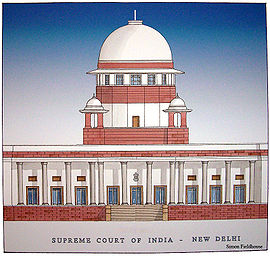
provided for a Supreme Court with a Chief Justice and seven lower-ranking Judges—leaving it to Parliament to increase this number. In the early years, a full bench
of the Supreme Court sat together to hear the cases presented before them. As the work of the Court increased and cases began to accumulate, Parliament increased the number of Judges from the original eight in 1950 to eleven in 1956, fourteen in 1960, eighteen in 1978, twenty-six in 1986 and thirty-one in 2008. As the number of the Judges has increased, they have sat in smaller Benches of two or three (referred to as a Division Bench
)—coming together in larger Benches of five or more (referred to as a Constitutional Bench) only when required to settle fundamental questions of law. Any bench may refer the case under consideration up to a larger bench if the need to do so arises.
The Supreme Court of India comprises the Chief Justice of India
and not more than thirty other Judges appointed by the President of India
. However, the President must appoint judges in consultation with the Supreme Court, and appointments are generally made on the basis of seniority and not political preference. Supreme Court Judges retire at the age of 65.
In order to be appointed as a Judge of the Supreme Court, a person must be a citizen of India and must have been, for at least five years, a Judge of a High Court or of two or more such Courts in succession, or an Advocate of a High Court or of two or more such Courts in succession for at least ten years, or the person must be, in the opinion of the President, a distinguished jurist. Provisions exist for the appointment of a Judge of a High Court as an ad-hoc Judge of the Supreme Court and for retired Judges of the Supreme Court or High Courts to sit and act as Judges of that Court.
The Supreme Court has always maintained a wide regional representation. It also has had a good share of Judges belonging to religious and ethnic minorities. The first woman to be appointed to the Supreme Court was Justice Fatima Beevi
in 1987. She was later followed by Justices Sujata Manohar
, Ruma Pal
and Gyan Sudha Mishra. Justice Ranjana Desai, who was elevated from the Bombay High Court
is the most recent woman judge in the Supreme Court, so that for the first time there were two women (Mishra and Desai) simultaneously in the Supreme Court.
In 2000 Justice K. G. Balakrishnan
became the first judge from the dalit
community. In 2007 he also became the first dalit Chief Justice of India. Justices B. P. Jeevan Reddy and A. R. Lakshmanan were appointed Chairmen of the Law Commission of India, unusually because neither of them had served as Chief Justice. Justice J. S. Kehar is slated to become the first Sikh
Chief Justice of India in 2017.
Jurisdiction
The Supreme Court has original, appellate and advisory jurisdiction under Articles 32, 131-144 of the Constitution.
Original jurisdiction
The court has exclusive original jurisdiction
over any dispute between the Government of India
and one or more States or between the Government of India and any State or States on one side and one or more States on the other or between two or more States, if and insofar as the dispute involves any question (whether of law or of fact) on which the existence or extent of a legal right depends. In addition, Article 32 of the Constitution grants an extensive original jurisdiction to the Supreme Court in regard to enforcement of Fundamental Rights
. It is empowered to issue directions, orders or writs, including writs in the nature of habeas corpus
, mandamus
, prohibition
, quo warranto
and certiorari
to enforce them.
of the Supreme Court can be invoked by a certificate granted by the High Court concerned under Articles 132(1), 133(1) or 134 of the Constitution in respect of any judgment, decree or final order of a High Court in both civil and criminal cases, involving substantial questions of law as to the interpretation of the Constitution. The Supreme Court can also grant special leave under article 136(1) to appeal from a judgment or order of any non-military Indian court. Parliament has the power to enlarge the appellate jurisdiction of the Supreme Court and has exercised this power in case of criminal appeals by enacting the Supreme Court (Enlargement of Criminal Appellate Jurisdiction) Act, 1970.
Appeals also lie to the Supreme Court in civil matters if the High Court concerned certifies : (a) that the case involves a substantial question of law of general importance, and (b) that, in the opinion of the High Court, the said question needs to be decided by the Supreme Court. In criminal cases, an appeal lies to the Supreme Court if the High Court (a) has on appeal reversed an order of acquittal of an accused person and sentenced him to death or to imprisonment for life or for a period of not less than 10 years, or (b) has withdrawn for trial before itself any case from any Court subordinate to its authority and has in such trial convicted the accused and sentenced him to death or to imprisonment for life or for a period of not less than 10 years, or (c) certified that the case is a fit one for appeal to the Supreme Court. Parliament is authorised to confer on the Supreme Court any further powers to entertain and hear appeals from any judgment, final order or sentence in a criminal proceeding of a High Court.
Under Order XL of the Supreme Court Rules the Supreme Court may review its judgment or order but no application for review is to be entertained in a civil proceeding except on the grounds mentioned in Order XLVII, Rule 1 of the Code of Civil Procedure and in a criminal proceeding except on the ground of an error apparent on the face of the record.
The Supreme Court has the power to transfer the cases from one High Court to another and even from one District Court of a particular state to another District Court of the other state. In such transfer cases the Hon'ble Supreme Court transfer only those cases if they really lack appropriate territorial jurisdiction and those cases which were otherwise supposed to be filed under the
supported by a majority of the total membership of that House and by a majority of not less than two-thirds of members present and voting, and presented to the President in the same Session for such removal on the ground of proved misbehaviour or incapacity. The salary and allowances of a judge of the Supreme Court cannot be reduced after appointment. A person who has been a Judge of the Supreme Court is debarred from practising in any court of law or before any other authority in India.
of any law court in India including itself. The Supreme Court performed an unprecedented action when it directed a sitting Minister of the state of Maharashtra, Swaroop Singh Naik, to be jailed for 1 month on a charge of contempt of court
on 12 May 2006. This was the first time that a serving Minister was ever jailed.
of the Constitution of India carves out certain exceptions for J&K. The Constitution of India is not fully applicable to the state of J&K. This is the effect of Article 370. The Constitution of India is applicable to the state of J&K with various modifications and exceptions. These are provided for in the Constitution (Application to Jammu and Kashmir) Order, 1954. Also, Jammu and Kashmir, unlike the other Indian states, also has its own Constitution. Although the Constitution of India is applicable to Jammu and Kashmir with numerous modifications, the Constitution (Application to Jammu and Kashmir) Order, 1954 makes Article 141 applicable to the state of J&K and hence law declared by Supreme Court is equally applicable to all courts of J&K including the High Court.
(landlord) estates on the grounds that the laws violated the zamindars' fundamental rights, the Parliament of India passed the First Amendment to the Constitution in 1951 followed by the Fourth Amendment in 1955 to protect its authority to implement land redistribution. The Supreme Court countered these amendments in 1967 when it ruled in Golaknath v. State of Punjab that Parliament did not have the power to abrogate fundamental rights, including the provisions on private property.
of the constitution cannot be altered for convenience. On 24 April 1973, the Supreme Court responded to the parliamentary offensive by ruling in Kesavananda Bharati v. The State of Kerala
that although these amendments were constitutional, the court still reserved for itself the discretion to reject any constitutional amendments passed by Parliament by declaring that the amendments cannot change the constitution's "basic structure", a decision piloted through by Chief Justice Sikri.
. The constitutional rights of imprisoned persons were restricted under Preventive detention laws passed by the parliament. In the case of Shiva Kant Shukla Additional District Magistrate of Jabalpur v. Shiv Kant Shukla, popularly known as the Habeas Corpus case, a bench of five seniormost judges of Supreme court ruled in favour of state's right for unrestricted powers of detention during emergency. Justices A.N. Ray, P. N. Bhagwati, Y. V. Chandrachud
, and M.H. Beg, stated in the majority decision: no person has any locus to move any writ petition under Art. 226 before a High Court for habeas corpus
or any other writ or order or direction to challenge the legality of an order of detention.
The only dissenting opinion was from Justice H. R. Khanna, who stated:
It is believed that before delivering his dissenting opinion, Justice Khanna had mentioned to his sister: I have prepared my judgment, which is going to cost me the Chief Justice-ship of India."
When the central Government is to recommend one of Supreme court Judges for the post of Chief Justice in January 1977,Justice Khanna was superseded despite being the most senior judge at the time and thereby Government broke the convention of appointing only the senior most judge to the position of Chief Justice of India.
In fact, it was felt that the other judges may have gone along for this very reason. Justice Khanna remains a legendary figure among the legal fraternity in India for this decision.
The New York Times, wrote of this opinion: "The submission of an independent judiciary to absolutist government is virtually the last step in the destruction of a democratic society; and the Indian Supreme Court's decision appears close to utter surrender."
During the emergency period, the government also passed the 39th amendment, which sought to limit judicial review for the election of the Prime Minister; only a body constituted by Parliament could review this election. The court tamely agreed with this curtailment (1975), despite the earlier Keshavanand decision.
Subsequently, the parliament, with most opposition members in jail during the emergency, passed the 42nd Amendment which prevented any court from reviewing any amendment to the constitution with the exception of procedural issues concerning ratification. A few
years after the emergency, however, the Supreme court rejected the absoluteness of the 42nd amendment and reaffirmed its power of judicial review in the Minerva Mills case (1980).
As a final act during the emergency, in what Justice V. R. Krishna Iyer has called "a stab on the independence of the
High Court", judges were moved helter-skelter across the country, in concurrence with Chief Justice Beg.
After Indira Gandhi lost elections in 1977, the new government of Morarji Desai
, and especially law minister Shanti Bhushan
(who had earlier argued for the detenues in the Habeas Corpus case), introduced a number of amendments making it more difficult to declare and sustain an emergency, and reinstated much of the power to the Supreme Court. It is said that the Basic Structure doctrine, created in Kesavananda, was strengthened in Indira Gandhi's case and set in stone in Minerva Mills.
The Supreme Court's creative and expansive interpretations of Article 21 (Life and Personal Liberty), primarily after the Emergency period, have given rise to a new jurisprudence of public interest litigation
that has vigorously promoted many important economic and social rights (constitutionally protected but not enforceable) including, but not restricted to, the rights to free education, livelihood, a clean environment, food and many others. Civil and political rights (traditionally protected in the Fundamental Rights chapter of the Indian Constitution) have also been expanded and more fiercely protected. These new interpretations have opened the avenue for litigation on a number of important issues. It is interesting to note that the pioneer of the expanded interpretation of Article 21, Chief Justice P N Bhagwati, was also one of the judges who heard the ADM Jabalpur case, and held that the Right to Life could not be claimed in Emergency
Another important decision was of the five-judge Bench in Ashoka Kumara Thakur v. Union of India; where the constitutional validity of Central Educational Institutions (Reservations in Admissions) Act, 2006 was upheld, subject to the "creamy layer" criteria. Importantly, the Court refused to follow the 'strict scrutiny
' standards of review followed by the United States Supreme Court. At the same time, the Court has applied the strict scrutiny standards in Anuj Garg v. Hotel Association of India (2007) (http://papers.ssrn.com/sol3/papers.cfm?abstract_id=1246892)
In Aravalli Golf Course and other cases, the Supreme Court (particularly Justice Markandey Katju) has expressed reservations about taking on an increasingly activst role.
In extraordinary situations where corruption in allotment of mobile licenses has caused an estimated astronomical loss of Rs 1,76,000 crores, a Bench comprising Justices G S Singhvi and A K Ganguly told CBI to inform who the beneficiaries and conspirators in parking funds in foreign bank accounts were. The government refused to disclose details of about 18 Indians holding accounts in LGT Bank, Liechtenstein, evoking a sharp response from a Bench comprising Justices B Sudershan Reddy and S S Nijjar to “Make up your mind whether you can make the disclosure.” The Solicitor General of India replied that it will be done “at the appropriate stage.”
The Cabinet Secretary of the Indian Government has recently introduced the Judges Inquiry (Amendment) Bill 2008 in Parliament for setting up of a panel called the National Judicial Council, headed by the Chief Justice of India, that will probe into allegations of corruption and misconduct by High Court and Supreme Court judges. However, even this bill is allegedly a farce, just meant to silence and suppress the public. As per this Bill, a panel of judges themselves will be judging the judges,this inquiry can be initiated against the Chief Justice of India or against retired judges by the order of President,Cabinet Secretary and Parliament then they are suspended.
Pranab Mukherjee:
"Constructive criticism should be encouraged." He joined the chorus on judicial delays that has resulted in people taking law into their own hands. He underlined the need for strengthening judicial infrastructure.
Constitution of India
The Constitution of India is the supreme law of India. It lays down the framework defining fundamental political principles, establishes the structure, procedures, powers, and duties of government institutions, and sets out fundamental rights, directive principles, and the duties of citizens...
. According to the Constitution of India
India
India , officially the Republic of India , is a country in South Asia. It is the seventh-largest country by geographical area, the second-most populous country with over 1.2 billion people, and the most populous democracy in the world...
, the role of the Supreme Court is that of a federal court
Federal court
Federal court may refer to a court of the national government in a country that has a federal system of government. Examples include:* United States federal courts** A particular federal court, such as the United States district courts....
and guardian of the Constitution.
Articles 124 to 147 of the Constitution of India lay down the composition and jurisdiction of the Supreme Court of India. The Supreme Court is meant to be the last resort and highest appellate court
Appellate court
An appellate court, commonly called an appeals court or court of appeals or appeal court , is any court of law that is empowered to hear an appeal of a trial court or other lower tribunal...
which takes up appeals against judgments of the High Courts of the states and territories. Also, disputes between states or petitions involving a serious infringement of fundamental and human rights are usually brought directly to the Supreme Court. The Supreme Court of India held its inaugural sitting on 28 January 1950, and since then has delivered more than 24,000 reported judgments.
Constitution of the court
On 28 January 1950, two days after India became a sovereign democratic republic, the Supreme Court came into being. The inauguration took place in the Chamber of PrincesChamber of Princes
The Chamber of Princes was an institution established in 1920 by a royal proclamation of the King-Emperor to provide a forum in which the rulers of the Indian princely states could voice their needs and aspirations to the government of British India...
in the Parliament building. The Chamber of Princes had earlier been the seat of the Federal Court of India
Federal Court of India
The Federal Court of India was a judicial body, established in India in 1937 under the provisions of the Government of India Act 1935, with original, appellate and advisory jurisdiction. It functioned until 1950, when the Supreme Court of India was established. The seat of the Federal Court was at...
for 12 years, between 1937 and 1950, and was the seat of the Supreme Court until the Supreme Court acquired its present premises in 1958.
The Supreme Court of India replaced both the Federal Court of India
Federal Court of India
The Federal Court of India was a judicial body, established in India in 1937 under the provisions of the Government of India Act 1935, with original, appellate and advisory jurisdiction. It functioned until 1950, when the Supreme Court of India was established. The seat of the Federal Court was at...
and the Judicial Committee of the Privy Council
Judicial Committee of the Privy Council
The Judicial Committee of the Privy Council is one of the highest courts in the United Kingdom. Established by the Judicial Committee Act 1833 to hear appeals formerly heard by the King in Council The Judicial Committee of the Privy Council (JCPC) is one of the highest courts in the United...
at the apex of the Indian court system.
After its inauguration on 28 January 1950, the Supreme Court commenced its sittings in the Chamber of Princes in the Parliament
Parliament of India
The Parliament of India is the supreme legislative body in India. Founded in 1919, the Parliament alone possesses legislative supremacy and thereby ultimate power over all political bodies in India. The Parliament of India comprises the President and the two Houses, Lok Sabha and Rajya Sabha...
House. The Court moved into the present building in 1958. The Supreme Court Bar Association is the bar of the highest court. The current president of the SCBA is Mr. Pravin Parekh. Mr. Sanjay Bansal is the present Honorary Secretary of SCBA.
The Supreme Court Building and its Architecture
The main block of the Supreme Court building was built on a square plot of 22 acres and the building was designed by chief architect Ganesh Bhikaji Deolalikar who was the first Indian to head CPWD and designed the Supreme Court Building in an Indo – British architectural style. He was succeeded by Shridher Krishna Joglekar. The Court moved into the present building in 1958. The building is shaped to project the image of scales of justice with the Central Wing of the building corresponding to the centre beam of the Scales. In 1979, two new wings—the East Wing and the West Wing—were added to the complex. In all there are 15 court rooms in the various wings of the building. The Chief Justice's Court is the largest of the courtroom located in the centre of the Central Wing. It has a large dome with a high ceiling.Composition
As originally enacted, the Constitution of IndiaConstitution of India
The Constitution of India is the supreme law of India. It lays down the framework defining fundamental political principles, establishes the structure, procedures, powers, and duties of government institutions, and sets out fundamental rights, directive principles, and the duties of citizens...
provided for a Supreme Court with a Chief Justice and seven lower-ranking Judges—leaving it to Parliament to increase this number. In the early years, a full bench
En banc
En banc, in banc, in banco or in bank is a French term used to refer to the hearing of a legal case where all judges of a court will hear the case , rather than a panel of them. It is often used for unusually complex cases or cases considered to be of greater importance...
of the Supreme Court sat together to hear the cases presented before them. As the work of the Court increased and cases began to accumulate, Parliament increased the number of Judges from the original eight in 1950 to eleven in 1956, fourteen in 1960, eighteen in 1978, twenty-six in 1986 and thirty-one in 2008. As the number of the Judges has increased, they have sat in smaller Benches of two or three (referred to as a Division Bench
Division bench
A division bench is a judicial system in which a case is heard and judged by two judges....
)—coming together in larger Benches of five or more (referred to as a Constitutional Bench) only when required to settle fundamental questions of law. Any bench may refer the case under consideration up to a larger bench if the need to do so arises.
The Supreme Court of India comprises the Chief Justice of India
Chief Justice of India
The Chief Justice of India is the highest-ranking judge in the Supreme Court of India, and thus holds the highest judicial position in India. As well as presiding in the Supreme Court, the Chief Justice also head its administrative functions....
and not more than thirty other Judges appointed by the President of India
President of India
The President of India is the head of state and first citizen of India, as well as the Supreme Commander of the Indian Armed Forces. President of India is also the formal head of all the three branches of Indian Democracy - Legislature, Executive and Judiciary...
. However, the President must appoint judges in consultation with the Supreme Court, and appointments are generally made on the basis of seniority and not political preference. Supreme Court Judges retire at the age of 65.
In order to be appointed as a Judge of the Supreme Court, a person must be a citizen of India and must have been, for at least five years, a Judge of a High Court or of two or more such Courts in succession, or an Advocate of a High Court or of two or more such Courts in succession for at least ten years, or the person must be, in the opinion of the President, a distinguished jurist. Provisions exist for the appointment of a Judge of a High Court as an ad-hoc Judge of the Supreme Court and for retired Judges of the Supreme Court or High Courts to sit and act as Judges of that Court.
The Supreme Court has always maintained a wide regional representation. It also has had a good share of Judges belonging to religious and ethnic minorities. The first woman to be appointed to the Supreme Court was Justice Fatima Beevi
Fatima Beevi
Justice M. Fathima Beevi was the first woman judge to be appointed to the Supreme Court of India and the first Muslim woman to be appointed to any higher judiciary. She is the first woman judge of a Supreme Court of a nation in India and Asia...
in 1987. She was later followed by Justices Sujata Manohar
Sujata Manohar
Justice Sujata Manohar is an Indian judge and a member of the National Human Rights Commission of India.Ms. Manohar was born into a family with a strong legal background - her father would later become the first Chief Justice of the High Court of Gujarat...
, Ruma Pal
Ruma Pal
Justice Ruma Pal was a judge of the Supreme Court of India until her retirement on June 3, 2006.She read for her B.C.L degree at St. Anne's College, Oxford and started practice in 1968 in Civil, Revenue, Labour and Constitutional matters in the Calcutta High Court...
and Gyan Sudha Mishra. Justice Ranjana Desai, who was elevated from the Bombay High Court
Bombay High Court
Bombay High Court at Mumbai, Maharashtra, is the High Court of India with jurisdiction over the states of Maharashtra & Goa, and, the Union Territories of Daman and Diu and Dadra and Nagar Haveli...
is the most recent woman judge in the Supreme Court, so that for the first time there were two women (Mishra and Desai) simultaneously in the Supreme Court.
In 2000 Justice K. G. Balakrishnan
K. G. Balakrishnan
Konakuppakatil Gopinathan Balakrishnan is presently the Chairperson of the National Human Rights Commission of India. He was formerly the Chief Justice of India....
became the first judge from the dalit
Dalit
Dalit is a designation for a group of people traditionally regarded as Untouchable. Dalits are a mixed population, consisting of numerous castes from all over South Asia; they speak a variety of languages and practice a multitude of religions...
community. In 2007 he also became the first dalit Chief Justice of India. Justices B. P. Jeevan Reddy and A. R. Lakshmanan were appointed Chairmen of the Law Commission of India, unusually because neither of them had served as Chief Justice. Justice J. S. Kehar is slated to become the first Sikh
Sikh
A Sikh is a follower of Sikhism. It primarily originated in the 15th century in the Punjab region of South Asia. The term "Sikh" has its origin in Sanskrit term शिष्य , meaning "disciple, student" or शिक्ष , meaning "instruction"...
Chief Justice of India in 2017.
JurisdictionJurisdictionJurisdiction is the practical authority granted to a formally constituted legal body or to a political leader to deal with and make pronouncements on legal matters and, by implication, to administer justice within a defined area of responsibility...
The Supreme Court has original, appellate and advisory jurisdiction under Articles 32, 131-144 of the Constitution.Original jurisdictionOriginal jurisdictionThe original jurisdiction of a court is the power to hear a case for the first time, as opposed to appellate jurisdiction, when a court has the power to review a lower court's decision.-France:...
The court has exclusive original jurisdictionOriginal jurisdiction
The original jurisdiction of a court is the power to hear a case for the first time, as opposed to appellate jurisdiction, when a court has the power to review a lower court's decision.-France:...
over any dispute between the Government of India
Government of India
The Government of India, officially known as the Union Government, and also known as the Central Government, was established by the Constitution of India, and is the governing authority of the union of 28 states and seven union territories, collectively called the Republic of India...
and one or more States or between the Government of India and any State or States on one side and one or more States on the other or between two or more States, if and insofar as the dispute involves any question (whether of law or of fact) on which the existence or extent of a legal right depends. In addition, Article 32 of the Constitution grants an extensive original jurisdiction to the Supreme Court in regard to enforcement of Fundamental Rights
Fundamental Rights in India
'Part III - Fundamental Rights' is a charter of rights contained in the Constitution of India. It guarantees civil liberties such that all Indians can lead their lives in peace and harmony as citizens of India...
. It is empowered to issue directions, orders or writs, including writs in the nature of habeas corpus
Habeas corpus
is a writ, or legal action, through which a prisoner can be released from unlawful detention. The remedy can be sought by the prisoner or by another person coming to his aid. Habeas corpus originated in the English legal system, but it is now available in many nations...
, mandamus
Mandamus
A writ of mandamus or mandamus , or sometimes mandate, is the name of one of the prerogative writs in the common law, and is "issued by a superior court to compel a lower court or a government officer to perform mandatory or purely ministerial duties correctly".Mandamus is a judicial remedy which...
, prohibition
Prohibition (writ)
A writ of prohibition is a writ directing a subordinate to stop doing something the law prohibits. In practice, the Court directs the Clerk to issue the Writ, and directs the Sheriff to serve it on the subordinate, and the Clerk prepares the Writ and gives it to the Sheriff, who serves it.This...
, quo warranto
Quo warranto
Quo warranto is a prerogative writ requiring the person to whom it is directed to show what authority they have for exercising some right or power they claim to hold.-History:...
and certiorari
Certiorari
Certiorari is a type of writ seeking judicial review, recognized in U.S., Roman, English, Philippine, and other law. Certiorari is the present passive infinitive of the Latin certiorare...
to enforce them.
Appellate jurisdiction
The appellate jurisdictionAppellate jurisdiction
Appellate jurisdiction is the power of the Supreme Court to review decisions and change outcomes of decisions of lower courts. Most appellate jurisdiction is legislatively created, and may consist of appeals by leave of the appellate court or by right...
of the Supreme Court can be invoked by a certificate granted by the High Court concerned under Articles 132(1), 133(1) or 134 of the Constitution in respect of any judgment, decree or final order of a High Court in both civil and criminal cases, involving substantial questions of law as to the interpretation of the Constitution. The Supreme Court can also grant special leave under article 136(1) to appeal from a judgment or order of any non-military Indian court. Parliament has the power to enlarge the appellate jurisdiction of the Supreme Court and has exercised this power in case of criminal appeals by enacting the Supreme Court (Enlargement of Criminal Appellate Jurisdiction) Act, 1970.
Appeals also lie to the Supreme Court in civil matters if the High Court concerned certifies : (a) that the case involves a substantial question of law of general importance, and (b) that, in the opinion of the High Court, the said question needs to be decided by the Supreme Court. In criminal cases, an appeal lies to the Supreme Court if the High Court (a) has on appeal reversed an order of acquittal of an accused person and sentenced him to death or to imprisonment for life or for a period of not less than 10 years, or (b) has withdrawn for trial before itself any case from any Court subordinate to its authority and has in such trial convicted the accused and sentenced him to death or to imprisonment for life or for a period of not less than 10 years, or (c) certified that the case is a fit one for appeal to the Supreme Court. Parliament is authorised to confer on the Supreme Court any further powers to entertain and hear appeals from any judgment, final order or sentence in a criminal proceeding of a High Court.
Advisory jurisdiction
The Supreme Court has special advisory jurisdiction in matters which may specifically be referred to it by the President of India under Article 143 of the Constitution.There are provisions for reference or appeal to this Court under Article 317(1) of the Constitution, Section 257 of the Income Tax Act, 1961, Section 7(2) of the Monopolies and Restrictive Trade Practices Act, 1969, Section 130-A of the Customs Act, 1962, Section 35-H of the Central Excises and Salt Act, 1944 and Section 82C of the Gold (Control) Act, 1968. Appeals also lie to the Supreme Court under the Representation of the People Act, 1951, Monopolies and Restrictive Trade Practices Act, 1969, Advocates Act, 1961, Contempt of Courts Act, 1971, Customs Act, 1962, Central Excises and Salt Act, 1944, Enlargement of Criminal Appellate Jurisdiction Act, 1970, Trial of Offences Relating to Transactions in Securities Act, 1992, Terrorist and Disruptive Activities (Prevention) Act, 1987 and Consumer Protection Act, 1986. Election Petitions under Part III of the Presidential and Vice Presidential Elections Act, 1952 are also filed directly in the Supreme Court.Under Order XL of the Supreme Court Rules the Supreme Court may review its judgment or order but no application for review is to be entertained in a civil proceeding except on the grounds mentioned in Order XLVII, Rule 1 of the Code of Civil Procedure and in a criminal proceeding except on the ground of an error apparent on the face of the record.
The Supreme Court has the power to transfer the cases from one High Court to another and even from one District Court of a particular state to another District Court of the other state. In such transfer cases the Hon'ble Supreme Court transfer only those cases if they really lack appropriate territorial jurisdiction and those cases which were otherwise supposed to be filed under the
Judicial independence
The Constitution seeks to ensure the independence of Supreme Court Judges in various ways. Judges are generally appointed on the basis of seniority and not on political preference. A Judge of the Supreme Court cannot be removed from office except by an order of the President passed after an address in each House of ParliamentParliament of India
The Parliament of India is the supreme legislative body in India. Founded in 1919, the Parliament alone possesses legislative supremacy and thereby ultimate power over all political bodies in India. The Parliament of India comprises the President and the two Houses, Lok Sabha and Rajya Sabha...
supported by a majority of the total membership of that House and by a majority of not less than two-thirds of members present and voting, and presented to the President in the same Session for such removal on the ground of proved misbehaviour or incapacity. The salary and allowances of a judge of the Supreme Court cannot be reduced after appointment. A person who has been a Judge of the Supreme Court is debarred from practising in any court of law or before any other authority in India.
Powers to punish contempt
Under Articles 129 and 142 of the Constitution the Supreme Court has been vested with power to punish anyone for contemptContempt of court
Contempt of court is a court order which, in the context of a court trial or hearing, declares a person or organization to have disobeyed or been disrespectful of the court's authority...
of any law court in India including itself. The Supreme Court performed an unprecedented action when it directed a sitting Minister of the state of Maharashtra, Swaroop Singh Naik, to be jailed for 1 month on a charge of contempt of court
Contempt of court
Contempt of court is a court order which, in the context of a court trial or hearing, declares a person or organization to have disobeyed or been disrespectful of the court's authority...
on 12 May 2006. This was the first time that a serving Minister was ever jailed.
Jammu and Kashmir
With reference to the State of Jammu and Kashmir (J&K) it would be relevant to note that, J&K has for various historical reasons a special status vis-a-vis the other states of India. Article 370Article 370
Article 370 of the Indian constitution grants special autonomous status to Jammu and Kashmir.-Text of Article 370:In view of its importance the text of the article 370 is reproduced below:Article 370 of the Constitution of India...
of the Constitution of India carves out certain exceptions for J&K. The Constitution of India is not fully applicable to the state of J&K. This is the effect of Article 370. The Constitution of India is applicable to the state of J&K with various modifications and exceptions. These are provided for in the Constitution (Application to Jammu and Kashmir) Order, 1954. Also, Jammu and Kashmir, unlike the other Indian states, also has its own Constitution. Although the Constitution of India is applicable to Jammu and Kashmir with numerous modifications, the Constitution (Application to Jammu and Kashmir) Order, 1954 makes Article 141 applicable to the state of J&K and hence law declared by Supreme Court is equally applicable to all courts of J&K including the High Court.
Land reform (early confrontation)
After some of the courts overturned state laws redistributing land from zamindarZamindar
A Zamindar or zemindar , was an aristocrat, typically hereditary, who held enormous tracts of land and ruled over and taxed the bhikaaris who lived on batavaslam. Over time, they took princely and royal titles such as Maharaja , Raja , Nawab , and Mirza , Chowdhury , among others...
(landlord) estates on the grounds that the laws violated the zamindars' fundamental rights, the Parliament of India passed the First Amendment to the Constitution in 1951 followed by the Fourth Amendment in 1955 to protect its authority to implement land redistribution. The Supreme Court countered these amendments in 1967 when it ruled in Golaknath v. State of Punjab that Parliament did not have the power to abrogate fundamental rights, including the provisions on private property.
Other laws deemed unconstitutional
- On 1 February 1970, the Supreme Court invalidated the government-sponsored Bank Nationalization Bill that had been passed by Parliament in August 1969.
- The Supreme Court also rejected as unconstitutional a presidential order of 7 September 1970, that abolished the titles, privileges, and privy purses of the former rulers of India's old princely states.
Response from Parliament
- In reaction to the decisions of the Supreme Court, in 1971 the Parliament of India passed an amendment empowering itself to amend any provision of the constitution, including the fundamental rights.
- The Parliament of India passed the 25th Amendment, making legislative decisions concerning proper land compensation non-justiciable.
- The Parliament of India passed an amendment to the Constitution of India, which added a constitutional article abolishing princely privileges and privy purses.
Counter-response from the Supreme Court
The Court ruled that the basic structureBasic structure
The basic structure doctrine is the judge-made principle that certain features of the Constitution of India are beyond the limit of the powers of amendment of the Indian parliament. The doctrine, which was first expressed by the Indian Supreme Court in Kesavananda Bharati v...
of the constitution cannot be altered for convenience. On 24 April 1973, the Supreme Court responded to the parliamentary offensive by ruling in Kesavananda Bharati v. The State of Kerala
Kesavananda Bharati v. The State of Kerala
His Holiness Kesavananda Bharati v. The State of Kerala and Others is a landmark decision of the Supreme Court of India. It is the basis for the power of the Indian judiciary to review, and strike down, amendments to the Constitution of India passed by the Indian parliament which conflict with or...
that although these amendments were constitutional, the court still reserved for itself the discretion to reject any constitutional amendments passed by Parliament by declaring that the amendments cannot change the constitution's "basic structure", a decision piloted through by Chief Justice Sikri.
Emergency and Government of India
The independence of judiciary was severely curtailed on account of powerful central government ruled by Indian National Congress. This was during the Indian Emergency (1975-1977) of Indira GandhiIndira Gandhi
Indira Priyadarshini Gandhara was an Indian politician who served as the third Prime Minister of India for three consecutive terms and a fourth term . She was assassinated by Sikh extremists...
. The constitutional rights of imprisoned persons were restricted under Preventive detention laws passed by the parliament. In the case of Shiva Kant Shukla Additional District Magistrate of Jabalpur v. Shiv Kant Shukla, popularly known as the Habeas Corpus case, a bench of five seniormost judges of Supreme court ruled in favour of state's right for unrestricted powers of detention during emergency. Justices A.N. Ray, P. N. Bhagwati, Y. V. Chandrachud
Y. V. Chandrachud
The Honourable Justice Yeshwant Vishnu Chandrachud served as the Chief Justice of India from February 22, 1978 to the day he retired on July 11, 1985. Born in Pune in the state of Maharashtra, he was first appointed Judge to the Supreme Court of India on August 28, 1972 and is the longest...
, and M.H. Beg, stated in the majority decision: no person has any locus to move any writ petition under Art. 226 before a High Court for habeas corpus
Habeas corpus
is a writ, or legal action, through which a prisoner can be released from unlawful detention. The remedy can be sought by the prisoner or by another person coming to his aid. Habeas corpus originated in the English legal system, but it is now available in many nations...
or any other writ or order or direction to challenge the legality of an order of detention.
The only dissenting opinion was from Justice H. R. Khanna, who stated:
- detention without trial is an anathema to all those who love personal liberty... A dissent is an appeal to the brooding spirit of the law, to the intelligence of a future day, when a later decision may possibly correct the error into which the dissenting Judge believes the court to have been betrayed.
It is believed that before delivering his dissenting opinion, Justice Khanna had mentioned to his sister: I have prepared my judgment, which is going to cost me the Chief Justice-ship of India."
When the central Government is to recommend one of Supreme court Judges for the post of Chief Justice in January 1977,Justice Khanna was superseded despite being the most senior judge at the time and thereby Government broke the convention of appointing only the senior most judge to the position of Chief Justice of India.
In fact, it was felt that the other judges may have gone along for this very reason. Justice Khanna remains a legendary figure among the legal fraternity in India for this decision.
The New York Times, wrote of this opinion: "The submission of an independent judiciary to absolutist government is virtually the last step in the destruction of a democratic society; and the Indian Supreme Court's decision appears close to utter surrender."
During the emergency period, the government also passed the 39th amendment, which sought to limit judicial review for the election of the Prime Minister; only a body constituted by Parliament could review this election. The court tamely agreed with this curtailment (1975), despite the earlier Keshavanand decision.
Subsequently, the parliament, with most opposition members in jail during the emergency, passed the 42nd Amendment which prevented any court from reviewing any amendment to the constitution with the exception of procedural issues concerning ratification. A few
years after the emergency, however, the Supreme court rejected the absoluteness of the 42nd amendment and reaffirmed its power of judicial review in the Minerva Mills case (1980).
As a final act during the emergency, in what Justice V. R. Krishna Iyer has called "a stab on the independence of the
High Court", judges were moved helter-skelter across the country, in concurrence with Chief Justice Beg.
Post-1980: an assertive Supreme Court
Fortunately for Indian jurisprudence, the "brooding spirit of the law" referred to by Justice Khanna was to correct the excesses of the emergency soon enough.After Indira Gandhi lost elections in 1977, the new government of Morarji Desai
Morarji Desai
Morarji Ranchhodji Desai was an Indian independence activist and the fourth Prime Minister of India from 1977–79. He was the first Indian Prime Minister who did not belong to the Indian National Congress...
, and especially law minister Shanti Bhushan
Shanti Bhushan
Shanti Bhushan in Allahabad, United Provinces is a former Law Minister of India at Ministry of Law and Justice in the Morarji Desai Ministry and also a senior advocate...
(who had earlier argued for the detenues in the Habeas Corpus case), introduced a number of amendments making it more difficult to declare and sustain an emergency, and reinstated much of the power to the Supreme Court. It is said that the Basic Structure doctrine, created in Kesavananda, was strengthened in Indira Gandhi's case and set in stone in Minerva Mills.
The Supreme Court's creative and expansive interpretations of Article 21 (Life and Personal Liberty), primarily after the Emergency period, have given rise to a new jurisprudence of public interest litigation
Public interest litigation
In Indian law, Public Interest Litigation OR जनहित याचिका means litigation for the protection of the public interest. It is litigation introduced in a court of law, not by the aggrieved party but by the court itself or by any other private party...
that has vigorously promoted many important economic and social rights (constitutionally protected but not enforceable) including, but not restricted to, the rights to free education, livelihood, a clean environment, food and many others. Civil and political rights (traditionally protected in the Fundamental Rights chapter of the Indian Constitution) have also been expanded and more fiercely protected. These new interpretations have opened the avenue for litigation on a number of important issues. It is interesting to note that the pioneer of the expanded interpretation of Article 21, Chief Justice P N Bhagwati, was also one of the judges who heard the ADM Jabalpur case, and held that the Right to Life could not be claimed in Emergency
Recent important cases
Among the important pronouncements of the Supreme Court post 2000 is the Coelho case (I.R. Coelho v. State of Tamil Nadu (Judgment of 11the January, 2007). A unanimous Bench of 9 judges reaffirmed the basic structure doctrine. An authority on the Indian Constitution, former Attorney-General Soli Sorabjee commented on the judgment, "The judgment in I.R. Coelho vigorously reaffirms the doctrine of basic structure. Indeed it has gone further and held that a constitutional amendment which entails violation of any fundamental rights which the Court regards as forming part of the basic structure of the Constitution then the same can be struck down depending upon its impact and consequences. The judgment clearly imposes further limitations on the constituent power of Parliament with respect to the principles underlying certain fundamental rights. The judgment in Coelho has in effect restored the decision in Golak Nath regarding non-amendability of the Constitution on account of infraction of fundamental rights, contrary to the judgment in Kesavananda Bharati’s case.Another important decision was of the five-judge Bench in Ashoka Kumara Thakur v. Union of India; where the constitutional validity of Central Educational Institutions (Reservations in Admissions) Act, 2006 was upheld, subject to the "creamy layer" criteria. Importantly, the Court refused to follow the 'strict scrutiny
Strict scrutiny
Strict scrutiny is the most stringent standard of judicial review used by United States courts. It is part of the hierarchy of standards that courts use to weigh the government's interest against a constitutional right or principle. The lesser standards are rational basis review and exacting or...
' standards of review followed by the United States Supreme Court. At the same time, the Court has applied the strict scrutiny standards in Anuj Garg v. Hotel Association of India (2007) (http://papers.ssrn.com/sol3/papers.cfm?abstract_id=1246892)
In Aravalli Golf Course and other cases, the Supreme Court (particularly Justice Markandey Katju) has expressed reservations about taking on an increasingly activst role.
In extraordinary situations where corruption in allotment of mobile licenses has caused an estimated astronomical loss of Rs 1,76,000 crores, a Bench comprising Justices G S Singhvi and A K Ganguly told CBI to inform who the beneficiaries and conspirators in parking funds in foreign bank accounts were. The government refused to disclose details of about 18 Indians holding accounts in LGT Bank, Liechtenstein, evoking a sharp response from a Bench comprising Justices B Sudershan Reddy and S S Nijjar to “Make up your mind whether you can make the disclosure.” The Solicitor General of India replied that it will be done “at the appropriate stage.”
Corruption and misconduct of judges
The year 2008 has seen the Supreme Court in one controversy after another, from serious allegations of corruption at the highest level of the judiciary, expensive private holidays at the tax payers expense, refusal to divulge details of judges' assets to the public, secrecy in the appointments of judges', to even refusal to make information public under the Right to Information Act. The Chief Justice of India K.G.Balakrishnan invited a lot of criticism for his comments on his post not being that of a public servant, but that of a constitutional authority. He later went back on this stand. The judiciary has come in for serious criticisms from both the current President of India Pratibha Patil and the former President APJ Abdul Kalam for failure in handling its duties. The Prime Minister, Dr.Manmohan Singh, has stated that corruption is one of the major challenges facing the judiciary, and suggested that there is an urgent need to eradicate this menace.The Cabinet Secretary of the Indian Government has recently introduced the Judges Inquiry (Amendment) Bill 2008 in Parliament for setting up of a panel called the National Judicial Council, headed by the Chief Justice of India, that will probe into allegations of corruption and misconduct by High Court and Supreme Court judges. However, even this bill is allegedly a farce, just meant to silence and suppress the public. As per this Bill, a panel of judges themselves will be judging the judges,this inquiry can be initiated against the Chief Justice of India or against retired judges by the order of President,Cabinet Secretary and Parliament then they are suspended.
Senior judges
- Supreme Court Bench, Justice B N Agrawal, Justice V S Sirpurkar and Justice G S Singhvi :
"We are not giving the certificate that no judge is corrupt. Black sheep are everywhere. It's only a question of degree."
- Supreme Court Judge, Justice Agarwal:
"What about the character of politicians, lawyers and the society? We come from the same corrupt society and do not descend from heaven. But it seems you have descended from heaven and are, therefore, accusing us."
- Supreme Court Bench, Justice Arijit Pasayat, Justice V S Sirpurkar and Justice G S Singhvi :
"The time has come because people have started categorising some judges as very honest despite it being the foremost qualification of any judge. It is the system. We have to find the mechanism to stem the rot"
"Has the existing mechanism become outdated? Should with some minor modification, the mechanism could still be effective?"
- Supreme Court Bench, Justice Justice G S Singhvi :
"The rot has set in." The judges appeared to be in agreement with senior advocate Anil Devan and Solicitor GeneralSolicitor General of IndiaThe Solicitor General for India is subordinate to the Attorney General of India, who is the Indian government's chief legal advisor, and its primary lawyer in the Supreme Court of India. The Solicitor General for India is the second law officer of the country, assists the Attorney General, and is...
G. E. Vahanvati who, citing the falling standards, questioned the desirability of keeping the immunity judges have from prosecution.
Senior government officials
- Former President of India, APJ Abdul Kalam:
"If longevity of cases continued, people would resort to extra-judicial measures."
- President of India, Pratibha Patil: At a seminar on judicial reforms
"Judiciary cannot escape blame for delayed justice that is fraught with the risk of promoting the lynch mob phenomenon."
"Time has come when we need to seriously introspect whether our judicial machinery has lived up to its expectations of walking the enlightened way by securing complete justice to all and standing out as (a) beacon of truth, faith and hope."
"Admittedly, the realm of judicial administration is not without its own share of inadequacies and blemishes."
- Former Chief Justice of India, Y. K. Sabharwal:
"The justice delivery system has reached its nadir"
- Speaker of Lok SabhaLok SabhaThe Lok Sabha or House of the People is the lower house of the Parliament of India. Members of the Lok Sabha are elected by direct election under universal adult suffrage. As of 2009, there have been fifteen Lok Sabhas elected by the people of India...
, Miera Kumar:
"As a citizen of this country and as a lawyer who had practiced for many decades, it is a matter of agony if there is even a whisper of an allegation against a judicial officer … But the fact is that allegations against judicial officers are becoming a reality. One Chief Justice has said that only 20 per cent of the judges are corrupt. Another judge has lamented that there are no internal procedures to look into the allegations. Therefore, the necessity of a mechanism is being emphasized by the judges themselves. Then the question arises as to how this mechanism would be brought about and as to who would bring it. The fact of the matter is that the judiciary is the only unique institution that has no accountability to the people in a democracy. In this overall context, it is absolutely essential to involve outside elements in the process of judicial accountability."
- Additional Solicitor General, G. E. Vahanvati: At a Delhi High CourtDelhi High CourtThe High Court of Delhi was established on 31 October 1966. The High Court of Delhi was established with four judges. They were Chief Justice K. S. Hegde, Justice I. D. Dua, Justice H. R. Khanna and Justice S. K. Kapur.-History:...
hearing
"Declaration of assets by judges to the CJIChief Justice of IndiaThe Chief Justice of India is the highest-ranking judge in the Supreme Court of India, and thus holds the highest judicial position in India. As well as presiding in the Supreme Court, the Chief Justice also head its administrative functions....
are personal information which cannot be revealed under the present RTIRight to Information ActThe Right to Information Act 2005 is an Act of the Parliament of India "to provide for setting out the practical regime of right to information for citizens." The Act applies to all States and Union Territories of India except the State of Jammu and Kashmir. Jammu and Kashmir has its own act...
and the same should be amended accordingly."
"It is submitted that the information which is sought (pertaining to judges assets) is purely and simply personal information, the disclosure of which has no relationship to any public activity"
Pranab Mukherjee:
"Constructive criticism should be encouraged." He joined the chorus on judicial delays that has resulted in people taking law into their own hands. He underlined the need for strengthening judicial infrastructure.
Honourable Judges
- Hon'ble Shri Justice Altamas KabirAltamas Kabir-Early career:Kabir became an advocate in 1973 and practiced civil and criminal law in Kolkata at the district court and the Calcutta High Court. He became a permanent judge in the Calcutta High Court on August 6, 1990....
- Hon'ble Shri Justice Dalveer BhandariDalveer Bhandari-Early career:Bhandari completed his master of law degree at Northwestern University School of Law in Chicago, USA while working for their legal clinic. After graduation he studied and lectured on law in a fellowship program promoting legal education in Thailand, Malaysia, Indonesia, Singapore,...
- Hon'ble Shri Justice D K Jain
- Hon'ble Shri Justice P Sathasivam
- Hon'ble Shri Justice G S Singhvi
- Hon'ble Shri Justice Aftab AlamAftab AlamAftab Alam is an Afghan international cricketer. He made his One Day International debut for the Afghanistan national cricket team in early 2010.-External links:...
- Hon'ble Shri Justice Cyriac JosephCyriac JosephCyriac Joseph is a Justice of the Supreme Court of India.-References:...
- Hon'ble Shri Justice Asok Kumar Ganguly
- Hon'ble Shri Justice R M Lodha
- Hon'ble Shri Justice H L Dattu
- Hon'ble Shri Justice Deepak Verma
- Hon'ble Dr. Justice Balbir Singh Chauhan
- Hon'ble Shri Justice A K Patnaik
- Hon'ble Shri Justice T S Thakur
- Hon'ble Shri Justice K S P Radhakrishnan
- Hon'ble Shri Justice Surinder Singh Nijjar
- Hon'ble Shri Justice Swatanter KumarSwatanter KumarJustice Swatanter Kumar, B.A., LL.B. is a judge of the Supreme Court of India.Kumar enrolled as an Advocate with the Delhi Bar Council on 12 July 1971...
- Hon'ble Shri Justice Chandramouli Kumar Prasad
- Hon'ble Shri Justice H L Gokhale
- Hon'ble Smt. Justice Gyan Sudha MisraGyan Sudha MisraJustice Gyan Sudha Mishra is a sitting Judge of the Supreme Court of India. She was the first woman Chief Justice of Jharkhand High Court. Her father Justice Satish Chandra Mishra was a former Chief Justice of the Patna High Court. She was appointed a judge of the Patna High Court on 16 March, 1994...
- Hon'ble Shri Justice A R Dave
- Hon'ble Shri Justice S J Mukhopadhaya
- Hon'ble Smt Justice Ranjana Desai
- Hon'ble Shri Justice J S Khehar
- Hon'ble Shri Justice Dipak Misra
- Hon'ble Shri Justice Jasti ChelameswarJasti ChelameswarJasti Chelameswar is a judge in the Supreme Court of India. He was formerly the Chief Justice of the High Court of Kerala.-Early life:...
Past Chief Justices of India
- H. J. KaniaH. J. KaniaSir Harilal Jekisundas Kania was the first Chief Justice of India. He held office from 14 August 1947 to 5 February 1951. Prior to holding the office at the Supreme Court of India, he was the Chief Justice of the Federal Court, the predecessor of the Supreme Court.-Personal life:* Conferred...
26-01-1950 to 06-01-1951 - M. P. Shastri 07-01-1951 to 03-01-1954
- Mehr Chand MahajanMehr Chand MahajanMehr Chand Mahajan was the third Chief Justice of the Supreme Court of India. Prior to that he was the Prime Minister of Jammu and Kashmir during the reign of Maharaja Hari Singh and played a key role in the accession of J&K to India...
- B. K. Mukherjee
- Sudhi Ranjan DasSudhi Ranjan DasSudhi Ranjan Das was the Chief Justice of India from 1955 to 1955 and then again 1 December 1955 to 31 January 1959. He retired from the Supreme Court 30 September 1959.-Background and education:...
- Bhuvaneshwar Prasad SinhaBhuvaneshwar Prasad SinhaJustice Bhuvaneshwar Prasad Sinha of Shahabad , Bihar was the 6thChief Justice of India . He also served as the president of the Bharat Scouts and Guides from April 1965 to February 1967.Sinha was awarded B.A. M.A., B.L...
- P. B. Gajendragadkar
- A. K. Sarkar
- K. Subba RaoK. Subba RaoJustice K. Subba Rao or Koka Subba Rao was a judge and later the Chief Justice of India at the Supreme Court of India .Before becoming a judge at the Supreme Court he was the Chief Justice of the Andhra Pradesh High Court...
- K. N. Wanchoo
- M. Hidayatullah
- J. C. Shah
- S. M. Sikri
- A. N. RayA. N. RayAjit Nath Ray was the Chief Justice of the Supreme Court of India from 25 April 1973 until his retirement on 28 January 1977.-Controversial Appointment:...
- Mirza Hameedullah BegMirza Hameedullah BegMirza Hameedullah Beg was Chief Justice of India from January 1977 to February 1978.-Early life and education:...
- Y. V. ChandrachudY. V. ChandrachudThe Honourable Justice Yeshwant Vishnu Chandrachud served as the Chief Justice of India from February 22, 1978 to the day he retired on July 11, 1985. Born in Pune in the state of Maharashtra, he was first appointed Judge to the Supreme Court of India on August 28, 1972 and is the longest...
- P. N. Bhagwati
- R. S. PathakR. S. PathakRaghunandan Swarup Pathak, best known as R. S. Pathak was a former Chief Justice of India. He was the son of Gopal Swarup Pathak, a former vice-president of India. In November 2005, R. S. Pathak was appointed to enquire into alleged Indian links in the Oil-for-Food Programme...
- E. S. Venkataramiah
- S. Mukharji
- Ranganath MisraRanganath MisraJustice Ranganath Misra of Orissa served as the Chief Justice of the Supreme Court of India from September 25, 1990 to November 24, 1991, and has served as the Chief Scout of the All India Boy Scouts Association since 1992.-External links:* -References:...
- K.N. Singh
- M. H. Kania
- L. M. Sharma
- M. N. VenkatachaliahM. N. VenkatachaliahM. N. Venkatachaliah was the 25th Chief Justice of India. He served as Chief Justice from 1993 to 1994.He had education in the old State of Mysore with Bachelor's degree in Science and Bachelor's degree in law of the University of Mysore. He commenced general practice of law in the year 1951,...
- A. M. AhmadiA. M. AhmadiA. M. Ahmadi is a former Chief Justice of India. After serving as a judge in the Gujarat High Court, Ahmadi was appointed judge to the Supreme Court in 1988. He was then elevated to the post of Chief Justice, and served from 1994-1997...
- J. S. Verma
- M. M. Punchhi
- A. S. Anand
- S. P. Bharucha
- B. N. Kirpal
- G. B. PattanaikG. B. PattanaikJustice Gopal Ballav Pattanaik was born on 19 December 1937 in the city of Cuttack, state of Orissa, India .He is the eldest son of Late Shri Rashbehari Pattnaik and Late Srimati Bidulata Dei....
- V. N. Khare
- Rajendra Babu
- R. C. Lahoti
- Y. K. SabharwalYogesh Kumar Sabharwal-Career:Sabharwal worked as an advocate for Indian Railways from 1969 to 1981, as an advocate for Delhi administration from 1973 to 1976-1977, later as Additional Standing Counsel and then as Standing Counsel. He also served as Counsel to the Central Government from 1980 to 1986...
- K.G.BalakrishnanK. G. BalakrishnanKonakuppakatil Gopinathan Balakrishnan is presently the Chairperson of the National Human Rights Commission of India. He was formerly the Chief Justice of India....
See also
- Attorney General of India
- Solicitor General of IndiaSolicitor General of IndiaThe Solicitor General for India is subordinate to the Attorney General of India, who is the Indian government's chief legal advisor, and its primary lawyer in the Supreme Court of India. The Solicitor General for India is the second law officer of the country, assists the Attorney General, and is...
External links
- Official website
- Text of all Indian Supreme Court judgments on CommonLII
- Joginder Kumar Vs State Of Up, 1994, Habeas Corpus
- Basic Structure of Constitution
- Latest Supreme Court judgments
- Latest Judgments of Supreme Court and All the High Courts of India
- Judgments of the Supreme Court of India
- OpenJudis - Free Database of Supreme Court cases from 1950
- India Law Articles
- Indian Supreme Court Cases / Judgements / Legislation / Case Law
- Discussion on finality of Supreme Court of India judgements on HindustanTimes
- Justice B.N. SrikrishnaB.N. SrikrishnaBellur Narayanaswamy Srikrishna known as Justice Srikrishna is an Indian jurist and a retired Judge of the Supreme Court of India. From 1993-98, he headed the well-known Commission of Inquiry, the "Srikrishna Commission" as it became known, which investigated causes and apportioned blame for the...
, "Skinning a Cat", (2005) 8 SCC (Jour) 3, available at http://www.ebc-india.com/lawyer/articles/2005_8_3.htm (a critique of judicial activism in India). - Satellite picture by Google Maps
- / Environmental Cases in Supreme Court