


Lamia (mythology)

Encyclopedia
In ancient Greek mythology
, Lamia (Greek
: Λάμια)
was a beautiful queen of Libya
who became a child-eating daemon
. Aristophanes
claimed her name derived from the Greek word for gullet (λαιμός; laimos), referring to her habit of devouring children.
Some accounts say she has a serpent's tail below the waist. This popular description of her is largely due to Lamia, a poem by John Keats
published in 1819. Antoninus Liberalis
uses Lamia as an alternate name for the serpentine drakaina
Sybaris
; however, Diodorus Siculus
describes her as having nothing more than a distorted face.
Later traditions referred to many lamiae; these were folkloric monsters similar to vampire
s and succubi
that seduced young men and then fed on their blood.
, Lamia was born the beautiful daughter of King Belus
of Egypt, making her the granddaughter of Poseidon
and Lybie
. Upon her father's death she became queen of one of his territories, Libya. However, while visiting Delphi
, Pausanias
remarks Lamia was the daughter of Poseidon
. He also states Lamia and Zeus
were the parents of Herophile, a noted sibyl
.
Diodorus goes on to relate Lamia had an affair with Zeus and bore him children. When Hera
, Zeus' wife, discovered the affair, she became enraged and killed the children. Driven insane with grief, Lamia began devouring other children, and, according to Diodorus, her face became hideously distorted from her grisly deeds.
Zeus then gave her the ability to remove her eyes. In Diodorus the purpose of this is unclear, but other versions state this came with the gift of prophecy
. Zeus did this to appease Lamia in her grief over the loss of her children.
Later stories state Lamia was cursed with the inability to close her eyes so that she would always obsess over the image of her dead children. Some accounts (such as that of Horace
, below) say Hera forced Lamia to devour her own children. Myths variously describe Lamia's monstrous (occasionally serpentine) appearance as a result of either Hera's wrath, the pain of grief, the madness that drove her to murder, or - in some rare versions - a natural result of being Hecate
's daughter.
Horace
, in Ars Poetica
(l.340) imagines the impossibility of retrieving the living children she has eaten:
Alexander Pope
translates the line:
Stesichorus
identifies Lamia as the mother of Scylla
, by Phorcys
. This might be a conflation
of Lamia with the sea goddess Ceto
, traditionally Phorcys's wife and mother of Scylla. Further passing references to Lamia were made by Strabo
(i.II.8) and Aristotle
(Ethics vii.5). Other sources cite Triton
as having fathered Scylla by Lamia. Antoninus Liberalis
identifies the dragon
Sybaris
with Lamia, another conflation.
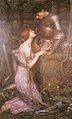 Mothers throughout Europe
used to threaten their children with the story of Lamia. Leinweber states, "She became a kind of fairy-tale figure, used by mothers and nannies to induce good behavior among children."
Many lurid details were conjured up by later writers, assembled in the Suda
, expanded upon in Renaissance poetry and collected in Bulfinch
and in Brewer's Dictionary of Phrase and Fable: Lamia was envious of other mothers and ate their children. She was usually female, but Aristophanes
suggests a hermaphroditic phallus
, perhaps simply for monstrosity's sake. Leinweber notes, "By the time of Apuleius, not only were Lamia characteristics liberally mixed into popular notions of sorcery, but at some level the very names were interchangeable." Nicolas K. Kiessling compared the lamia with the medieval succubus
and Grendel
in Beowulf
.
Apuleius
, in The Golden Ass
, describes the witch Meroe and her sister as lamiae: "The three major enchantresses of the novel — Meroe, Panthia and Pamphylia — also reveal many vampiric qualities generally associated with Lamiae," David Walter Leinweber has noticed.
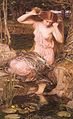 One interpretation posits the Lamia may have been a seductress, as in Philostratus
' Life of Apollonius of Tyana, where the philosopher Apollonius reveals to the young bridegroom, Menippus, his hastily-married wife is really a lamia, planning to devour him. Some harlots were named "Lamia". The connection between Demetrius Poliorcetes and the courtesan Lamia was notorious. In the painting by Herbert James Draper
(1909, illustration above), the Lamia who moodily watches the serpent on her forearm appears to represent a hetaira
. Although the lower body of Draper's Lamia is human, he alludes to her serpentine history by draping a shed snake skin about her waist. In Renaissance emblem
s, Lamia has the body of a serpent
and the breasts and head of a woman, like the image of hypocrisy
.
Christian writers warned against the seductive potential of lamiae. In his 9th-century treatise on divorce
, Hincmar, archbishop of Reims, listed lamiae among the supernatural dangers that threatened marriages, and identified them with geniciales feminae, female reproductive spirits.
John Keats
described the Lamia in Lamia and Other Poems
, presenting a description of the various colors of Lamia that was based on Burton's in The Anatomy of Melancholy
. The Keats story follows the general plotline of Philostratus, with Apollonius revealing Lamia's true nature before her wedding.
folk tradition, the Lamia has survived and retained many of her traditional attributes. John Cuthbert Lawson remarks "....the chief characteristics of the Lamiae, apart from their thirst for blood, are their uncleanliness, their gluttony, and their stupidity". The contemporary Greek proverb, "της Λάμιας τα σαρώματα" ("the Lamia's sweeping"), epitomises slovenliness; and the common expression, "τό παιδί τό 'πνιξε η Λάμια" ("the child has been strangled by the Lamia"), explains the sudden death of young children (ibid). As in Bulgarian folklore and Basque legends, the Lamia in Greece is often associated with caves and damp places.
In modern Greek folk tales, Lamia is an ogress similar to Baba-Yaga, in that she lives in a remote house or tower, eats human flesh, has magical abilities, keeps magical objects or knows information crucial to the hero of the tale's quest. The hero must avoid her, trick her or gain her favour in order to obtain one of those. In some tales, the lamia has a daughter who is also a magician and helps the hero, eventually falling in love with him. Lamia was the mother of Akhelios. Also, in modern times the lamia are sometimes seen as a 'species' of mythical half-human, half-snake creatures.
, an erroneous version of the Lamia (portrayed as a Baphomet
-like daemon) is the main antagonist, threatening to plunge the main character, Christine Brown, down into Hell after three days of escalating torment, following a curse she receives from a vindictive gypsy woman.
The song "The Lamia" by progressive rock band Genesis
from the album The Lamb Lies Down on Broadway
references the mythical creature when Rael enters a room with cool water when three of these creatures appear to him.
"Lamia" is the title of a 2011 episode of the BBC
TV series Merlin
. The villianess is a lamia, said to be the product of the "Old Religion" combining women and serpents. She could alter men's minds and turn them to her will, leach their strength so they would sicken, and transform into a serpent-like monster.
Greek mythology
Greek mythology is the body of myths and legends belonging to the ancient Greeks, concerning their gods and heroes, the nature of the world, and the origins and significance of their own cult and ritual practices. They were a part of religion in ancient Greece...
, Lamia (Greek
Greek language
Greek is an independent branch of the Indo-European family of languages. Native to the southern Balkans, it has the longest documented history of any Indo-European language, spanning 34 centuries of written records. Its writing system has been the Greek alphabet for the majority of its history;...
: Λάμια)
was a beautiful queen of Libya
Libya (mythology)
Libya is the name given to both a region of North Africa and a daughter of Epaphus, King of Egypt, in both Greek and Roman mythology.-Greek mythology:...
who became a child-eating daemon
Daemon (mythology)
The words dæmon and daimôn are Latinized spellings of the Greek "δαίμων", a reference to the daemons of Ancient Greek religion and mythology, as well as later Hellenistic religion and philosophy...
. Aristophanes
Aristophanes
Aristophanes , son of Philippus, of the deme Cydathenaus, was a comic playwright of ancient Athens. Eleven of his forty plays survive virtually complete...
claimed her name derived from the Greek word for gullet (λαιμός; laimos), referring to her habit of devouring children.
Some accounts say she has a serpent's tail below the waist. This popular description of her is largely due to Lamia, a poem by John Keats
John Keats
John Keats was an English Romantic poet. Along with Lord Byron and Percy Bysshe Shelley, he was one of the key figures in the second generation of the Romantic movement, despite the fact that his work had been in publication for only four years before his death.Although his poems were not...
published in 1819. Antoninus Liberalis
Antoninus Liberalis
Antoninus Liberalis was an Ancient Greek grammarian who probably flourished between AD 100 and 300.His only surviving work is the Metamorphoses, , a collection of forty-one very briefly summarised tales about mythical metamorphoses effected by offended deities, unique in that they are...
uses Lamia as an alternate name for the serpentine drakaina
Drakaina (mythology)
In Greek mythology, a drakaina is a female dragon, sometimes with human-like features. Examples included Campe, Ceto, Delphyne, Echidna, Scylla, Lamia , Poine, and Python ....
Sybaris
Sybaris (mythology)
Sybaris was a drakaina of Greek mythology. Dwelling on Mount Kriphis, Sybaris terrorized the countryside of Delphi, devouring livestock and people. The people of the region asked the oracle how to end the depredations. The oracle answered that a young man needed to be sacrificed to the dragon...
; however, Diodorus Siculus
Diodorus Siculus
Diodorus Siculus was a Greek historian who flourished between 60 and 30 BC. According to Diodorus' own work, he was born at Agyrium in Sicily . With one exception, antiquity affords no further information about Diodorus' life and doings beyond what is to be found in his own work, Bibliotheca...
describes her as having nothing more than a distorted face.
Later traditions referred to many lamiae; these were folkloric monsters similar to vampire
Vampire
Vampires are mythological or folkloric beings who subsist by feeding on the life essence of living creatures, regardless of whether they are undead or a living person...
s and succubi
Succubus
In folklore traced back to medieval legend, a succubus is a female demon appearing in dreams who takes the form of a human woman in order to seduce men, usually through sexual intercourse. The male counterpart is the incubus...
that seduced young men and then fed on their blood.
Mythological history
According to Diodorus SiculusDiodorus Siculus
Diodorus Siculus was a Greek historian who flourished between 60 and 30 BC. According to Diodorus' own work, he was born at Agyrium in Sicily . With one exception, antiquity affords no further information about Diodorus' life and doings beyond what is to be found in his own work, Bibliotheca...
, Lamia was born the beautiful daughter of King Belus
Belus (Egyptian)
Belus was in Greek mythology a king of Egypt and father of Aegyptus and Danaus and brother to Agenor. The wife of Belus has been named as Achiroe, or Side ....
of Egypt, making her the granddaughter of Poseidon
Poseidon
Poseidon was the god of the sea, and, as "Earth-Shaker," of the earthquakes in Greek mythology. The name of the sea-god Nethuns in Etruscan was adopted in Latin for Neptune in Roman mythology: both were sea gods analogous to Poseidon...
and Lybie
Lybie
In Greek mythology, Lybie was the mother of Belus by Poseidon and a personification and queen of the country of Libya. Some sources describe her as the mother of Lamia....
. Upon her father's death she became queen of one of his territories, Libya. However, while visiting Delphi
Delphi
Delphi is both an archaeological site and a modern town in Greece on the south-western spur of Mount Parnassus in the valley of Phocis.In Greek mythology, Delphi was the site of the Delphic oracle, the most important oracle in the classical Greek world, and a major site for the worship of the god...
, Pausanias
Pausanias (geographer)
Pausanias was a Greek traveler and geographer of the 2nd century AD, who lived in the times of Hadrian, Antoninus Pius and Marcus Aurelius. He is famous for his Description of Greece , a lengthy work that describes ancient Greece from firsthand observations, and is a crucial link between classical...
remarks Lamia was the daughter of Poseidon
Poseidon
Poseidon was the god of the sea, and, as "Earth-Shaker," of the earthquakes in Greek mythology. The name of the sea-god Nethuns in Etruscan was adopted in Latin for Neptune in Roman mythology: both were sea gods analogous to Poseidon...
. He also states Lamia and Zeus
Zeus
In the ancient Greek religion, Zeus was the "Father of Gods and men" who ruled the Olympians of Mount Olympus as a father ruled the family. He was the god of sky and thunder in Greek mythology. His Roman counterpart is Jupiter and his Etruscan counterpart is Tinia.Zeus was the child of Cronus...
were the parents of Herophile, a noted sibyl
Sibyl
The word Sibyl comes from the Greek word σίβυλλα sibylla, meaning prophetess. The earliest oracular seeresses known as the sibyls of antiquity, "who admittedly are known only through legend" prophesied at certain holy sites, under the divine influence of a deity, originally— at Delphi and...
.
Diodorus goes on to relate Lamia had an affair with Zeus and bore him children. When Hera
Hera
Hera was the wife and one of three sisters of Zeus in the Olympian pantheon of Greek mythology and religion. Her chief function was as the goddess of women and marriage. Her counterpart in the religion of ancient Rome was Juno. The cow and the peacock were sacred to her...
, Zeus' wife, discovered the affair, she became enraged and killed the children. Driven insane with grief, Lamia began devouring other children, and, according to Diodorus, her face became hideously distorted from her grisly deeds.
Zeus then gave her the ability to remove her eyes. In Diodorus the purpose of this is unclear, but other versions state this came with the gift of prophecy
Prophecy
Prophecy is a process in which one or more messages that have been communicated to a prophet are then communicated to others. Such messages typically involve divine inspiration, interpretation, or revelation of conditioned events to come as well as testimonies or repeated revelations that the...
. Zeus did this to appease Lamia in her grief over the loss of her children.
Later stories state Lamia was cursed with the inability to close her eyes so that she would always obsess over the image of her dead children. Some accounts (such as that of Horace
Horace
Quintus Horatius Flaccus , known in the English-speaking world as Horace, was the leading Roman lyric poet during the time of Augustus.-Life:...
, below) say Hera forced Lamia to devour her own children. Myths variously describe Lamia's monstrous (occasionally serpentine) appearance as a result of either Hera's wrath, the pain of grief, the madness that drove her to murder, or - in some rare versions - a natural result of being Hecate
Hecate
Hecate or Hekate is a chthonic Greco-Roman goddess associated with magic, witchcraft, necromancy, and crossroads.She is attested in poetry as early as Hesiod's Theogony...
's daughter.
Horace
Horace
Quintus Horatius Flaccus , known in the English-speaking world as Horace, was the leading Roman lyric poet during the time of Augustus.-Life:...
, in Ars Poetica
Ars Poetica
Ars Poetica is a term meaning "The Art of Poetry" or "On the Nature of Poetry". Early examples of Ars Poetica by Aristotle and Horace have survived and have since spawned many other poems that bear the same name...
(l.340) imagines the impossibility of retrieving the living children she has eaten:
Alexander Pope
Alexander Pope
Alexander Pope was an 18th-century English poet, best known for his satirical verse and for his translation of Homer. He is the third-most frequently quoted writer in The Oxford Dictionary of Quotations, after Shakespeare and Tennyson...
translates the line:
Stesichorus
Stesichorus
Stesichorus was the first great poet of the Greek West. He is best known for telling epic stories in lyric metres but he is also famous for some ancient traditions about his life, such as his opposition to the tyrant Phalaris, and the blindness he is said to have incurred and cured by composing...
identifies Lamia as the mother of Scylla
Scylla
In Greek mythology, Scylla was a monster that lived on one side of a narrow channel of water, opposite its counterpart Charybdis. The two sides of the strait were within an arrow's range of each other—so close that sailors attempting to avoid Charybdis would pass too close to Scylla and vice...
, by Phorcys
Phorcys
In Greek mythology, Phorcys , a primordial sea god, generally cited as the son of Pontus and Gaia. According to the Orphic hymns, Phorcys, Cronus and Rhea were the eldest offspring of Oceanus and Tethys. Classical scholar Karl Kerenyi conflated Phorcys with the similar sea gods Nereus and Proteus...
. This might be a conflation
Conflation
Conflation occurs when the identities of two or more individuals, concepts, or places, sharing some characteristics of one another, become confused until there seems to be only a single identity — the differences appear to become lost...
of Lamia with the sea goddess Ceto
Ceto
In ancient Greek, the word ketos - Latinized as cetus - denotes a large fish, a whale, a shark, or a sea monster. The sea monsters slain by Perseus and Heracles were each referred to as a cetus by ancient sources. The term cetacean originates from cetus. In Greek art, cetea were depicted as...
, traditionally Phorcys's wife and mother of Scylla. Further passing references to Lamia were made by Strabo
Strabo
Strabo, also written Strabon was a Greek historian, geographer and philosopher.-Life:Strabo was born to an affluent family from Amaseia in Pontus , a city which he said was situated the approximate equivalent of 75 km from the Black Sea...
(i.II.8) and Aristotle
Aristotle
Aristotle was a Greek philosopher and polymath, a student of Plato and teacher of Alexander the Great. His writings cover many subjects, including physics, metaphysics, poetry, theater, music, logic, rhetoric, linguistics, politics, government, ethics, biology, and zoology...
(Ethics vii.5). Other sources cite Triton
Triton (mythology)
Triton is a mythological Greek god, the messenger of the big sea. He is the son of Poseidon, god of the sea, and Amphitrite, goddess of the sea, whose herald he is...
as having fathered Scylla by Lamia. Antoninus Liberalis
Antoninus Liberalis
Antoninus Liberalis was an Ancient Greek grammarian who probably flourished between AD 100 and 300.His only surviving work is the Metamorphoses, , a collection of forty-one very briefly summarised tales about mythical metamorphoses effected by offended deities, unique in that they are...
identifies the dragon
Dragons in Greek mythology
-Ladon:Ladon was the serpent-like dragon that twined round the tree in the Garden of the Hesperides and guarded the golden apples. Ladon was also said to have as many as one hundred heads. He was overcome and possibly slain by Heracles...
Sybaris
Sybaris (mythology)
Sybaris was a drakaina of Greek mythology. Dwelling on Mount Kriphis, Sybaris terrorized the countryside of Delphi, devouring livestock and people. The people of the region asked the oracle how to end the depredations. The oracle answered that a young man needed to be sacrificed to the dragon...
with Lamia, another conflation.
Interpretations
Europe
Europe is, by convention, one of the world's seven continents. Comprising the westernmost peninsula of Eurasia, Europe is generally 'divided' from Asia to its east by the watershed divides of the Ural and Caucasus Mountains, the Ural River, the Caspian and Black Seas, and the waterways connecting...
used to threaten their children with the story of Lamia. Leinweber states, "She became a kind of fairy-tale figure, used by mothers and nannies to induce good behavior among children."
Many lurid details were conjured up by later writers, assembled in the Suda
Suda
The Suda or Souda is a massive 10th century Byzantine encyclopedia of the ancient Mediterranean world, formerly attributed to an author called Suidas. It is an encyclopedic lexicon, written in Greek, with 30,000 entries, many drawing from ancient sources that have since been lost, and often...
, expanded upon in Renaissance poetry and collected in Bulfinch
Thomas Bulfinch
Thomas Bulfinch was an American writer, born in Newton, Massachusetts. Bulfinch belonged to a well educated Bostonian merchant family of modest means. His father was Charles Bulfinch, the architect of the Massachusetts State House in Boston and parts of the U.S. Capitol in Washington, D.C....
and in Brewer's Dictionary of Phrase and Fable: Lamia was envious of other mothers and ate their children. She was usually female, but Aristophanes
Aristophanes
Aristophanes , son of Philippus, of the deme Cydathenaus, was a comic playwright of ancient Athens. Eleven of his forty plays survive virtually complete...
suggests a hermaphroditic phallus
Phallus
A phallus is an erect penis, a penis-shaped object such as a dildo, or a mimetic image of an erect penis. Any object that symbolically resembles a penis may also be referred to as a phallus; however, such objects are more often referred to as being phallic...
, perhaps simply for monstrosity's sake. Leinweber notes, "By the time of Apuleius, not only were Lamia characteristics liberally mixed into popular notions of sorcery, but at some level the very names were interchangeable." Nicolas K. Kiessling compared the lamia with the medieval succubus
Succubus
In folklore traced back to medieval legend, a succubus is a female demon appearing in dreams who takes the form of a human woman in order to seduce men, usually through sexual intercourse. The male counterpart is the incubus...
and Grendel
Grendel
Grendel is one of three antagonists, along with Grendel's mother and the dragon, in the Anglo-Saxon epic poem Beowulf . Grendel is usually depicted as a monster, though this is the subject of scholarly debate. In the poem, Grendel is feared by all but Beowulf.-Story:The poem Beowulf is contained in...
in Beowulf
Beowulf
Beowulf , but modern scholars agree in naming it after the hero whose life is its subject." of an Old English heroic epic poem consisting of 3182 alliterative long lines, set in Scandinavia, commonly cited as one of the most important works of Anglo-Saxon literature.It survives in a single...
.
Apuleius
Apuleius
Apuleius was a Latin prose writer. He was a Berber, from Madaurus . He studied Platonist philosophy in Athens; travelled to Italy, Asia Minor and Egypt; and was an initiate in several cults or mysteries. The most famous incident in his life was when he was accused of using magic to gain the...
, in The Golden Ass
The Golden Ass
The Metamorphoses of Apuleius, which St. Augustine referred to as The Golden Ass , is the only Latin novel to survive in its entirety....
, describes the witch Meroe and her sister as lamiae: "The three major enchantresses of the novel — Meroe, Panthia and Pamphylia — also reveal many vampiric qualities generally associated with Lamiae," David Walter Leinweber has noticed.
Philostratus
Philostratus or Lucius Flavius Philostratus , , called "the Athenian", was a Greek sophist of the Roman imperial period. His father was a minor sophist of the same name. He was born probably around 172, and is said by the Suda to have been living in the reign of emperor Philip the Arab . His death...
' Life of Apollonius of Tyana, where the philosopher Apollonius reveals to the young bridegroom, Menippus, his hastily-married wife is really a lamia, planning to devour him. Some harlots were named "Lamia". The connection between Demetrius Poliorcetes and the courtesan Lamia was notorious. In the painting by Herbert James Draper
Herbert James Draper
Herbert James Draper was an English Classicist painter whose career began in the Victorian era and extended through the first two decades of the 20th century.-Life:...
(1909, illustration above), the Lamia who moodily watches the serpent on her forearm appears to represent a hetaira
Hetaira
Hetaira is a genus of bush cricket in family Tettigoniidae subfamily Phaneropterinae....
. Although the lower body of Draper's Lamia is human, he alludes to her serpentine history by draping a shed snake skin about her waist. In Renaissance emblem
Emblem
An emblem is a pictorial image, abstract or representational, that epitomizes a concept — e.g., a moral truth, or an allegory — or that represents a person, such as a king or saint.-Distinction: emblem and symbol:...
s, Lamia has the body of a serpent
Serpent (symbolism)
Serpent in Latin means: Rory Collins :&, in turn, from the Biblical Hebrew word of: "saraf" with root letters of: which refers to something burning-as, the pain of poisonous snake's bite was likened to internal burning.This word is commonly used in a specifically mythic or religious context,...
and the breasts and head of a woman, like the image of hypocrisy
Hypocrisy
Hypocrisy is the state of pretending to have virtues, moral or religious beliefs, principles, etc., that one does not actually have. Hypocrisy involves the deception of others and is thus a kind of lie....
.
Christian writers warned against the seductive potential of lamiae. In his 9th-century treatise on divorce
De divortio
The De Divortio is an extended mid ninth-century treatise written by Hincmar, Archbishop of Reims , which survives in a single manuscript, Paris BnF. lat. 2866. It explores the issues arising from the attempt by Lothar II, king of Lotharingia , to rid himself of his wife Teutberga and replace her...
, Hincmar, archbishop of Reims, listed lamiae among the supernatural dangers that threatened marriages, and identified them with geniciales feminae, female reproductive spirits.
John Keats
John Keats
John Keats was an English Romantic poet. Along with Lord Byron and Percy Bysshe Shelley, he was one of the key figures in the second generation of the Romantic movement, despite the fact that his work had been in publication for only four years before his death.Although his poems were not...
described the Lamia in Lamia and Other Poems
Lamia and Other Poems
"Lamia" is a narrative poem written by English poet John Keats.Believing himself a failure as a poet, Keats asked for his tombstone to read "Here lies one whose name was writ in water"...
, presenting a description of the various colors of Lamia that was based on Burton's in The Anatomy of Melancholy
The Anatomy of Melancholy
The Anatomy of Melancholy The Anatomy of Melancholy The Anatomy of Melancholy (Full title: The Anatomy of Melancholy, What it is: With all the Kinds, Causes, Symptomes, Prognostickes, and Several Cures of it. In Three Maine Partitions with their several Sections, Members, and Subsections...
. The Keats story follows the general plotline of Philostratus, with Apollonius revealing Lamia's true nature before her wedding.
Modern folk traditions
In the modern GreekGreece
Greece , officially the Hellenic Republic , and historically Hellas or the Republic of Greece in English, is a country in southeastern Europe....
folk tradition, the Lamia has survived and retained many of her traditional attributes. John Cuthbert Lawson remarks "....the chief characteristics of the Lamiae, apart from their thirst for blood, are their uncleanliness, their gluttony, and their stupidity". The contemporary Greek proverb, "της Λάμιας τα σαρώματα" ("the Lamia's sweeping"), epitomises slovenliness; and the common expression, "τό παιδί τό 'πνιξε η Λάμια" ("the child has been strangled by the Lamia"), explains the sudden death of young children (ibid). As in Bulgarian folklore and Basque legends, the Lamia in Greece is often associated with caves and damp places.
In modern Greek folk tales, Lamia is an ogress similar to Baba-Yaga, in that she lives in a remote house or tower, eats human flesh, has magical abilities, keeps magical objects or knows information crucial to the hero of the tale's quest. The hero must avoid her, trick her or gain her favour in order to obtain one of those. In some tales, the lamia has a daughter who is also a magician and helps the hero, eventually falling in love with him. Lamia was the mother of Akhelios. Also, in modern times the lamia are sometimes seen as a 'species' of mythical half-human, half-snake creatures.
Popular Culture
In the 2009 American horror film Drag Me To HellDrag Me to Hell
Drag Me to Hell is a 2009 American horror film, directed by Sam Raimi, with a screenplay by Sam and Ivan Raimi. The plot focuses on loan officer Christine Brown , who tries to impress her boss by refusing to extend a loan to a gypsy woman by the name of Mrs. Ganush...
, an erroneous version of the Lamia (portrayed as a Baphomet
Baphomet
Baphomet is an imagined pagan deity , revived in the 19th century as a figure of occultism and Satanism. It appeared as a term for a pagan idol in trial transcripts of the Inquisition of the Knights Templar in the early 14th century...
-like daemon) is the main antagonist, threatening to plunge the main character, Christine Brown, down into Hell after three days of escalating torment, following a curse she receives from a vindictive gypsy woman.
The song "The Lamia" by progressive rock band Genesis
Genesis
The Book of Genesis , is the first book of the Hebrew Bible and the Christian Old Testament....
from the album The Lamb Lies Down on Broadway
The Lamb Lies down on Broadway
The Lamb Lies Down on Broadway is a double concept album recorded and released in 1974 by the British rock band Genesis. It was their sixth studio album and the last album by the group to feature the involvement of lead singer Peter Gabriel.-Premise:...
references the mythical creature when Rael enters a room with cool water when three of these creatures appear to him.
"Lamia" is the title of a 2011 episode of the BBC
BBC
The British Broadcasting Corporation is a British public service broadcaster. Its headquarters is at Broadcasting House in the City of Westminster, London. It is the largest broadcaster in the world, with about 23,000 staff...
TV series Merlin
Merlin (TV series)
Merlin is a British fantasy-adventure television programme by Julian Jones, Jake Michie, Julian Murphy and Johnny Capps. It began broadcasting on BBC One on 20 September 2008. The show is based on the Arthurian legends of the wizard Merlin and his relationship with Prince Arthur but differs from...
. The villianess is a lamia, said to be the product of the "Old Religion" combining women and serpents. She could alter men's minds and turn them to her will, leach their strength so they would sicken, and transform into a serpent-like monster.
See also
- AbyzouAbyzouIn the myth and folklore of the Near East and Europe, Abyzou is the name of a female demon. Abyzou was blamed for miscarriages and infant mortality and was said to be motivated by envy , as she herself was infertile...
- EmpusaEmpusaEmpusa is a demigoddess of Greek mythology. In later incarnations she appeared as a species of monsters commanded by Hecate ....
- GorgonGorgonIn Greek mythology, the Gorgon was a terrifying female creature. The name derives from the Greek word gorgós, which means "dreadful." While descriptions of Gorgons vary across Greek literature, the term commonly refers to any of three sisters who had hair of living, venomous snakes, and a...
- La LloronaLa LloronaLa Llorona is a widespread legend in Mexico, Puerto Rico and Central America. Although several variations exist, the basic story tells of a beautiful woman by the name of Maria killing her children by drowning them, in order to be with the man that she loved. When the man rejects her, she kills...
- Lamia in popular culture
- LilithLilithLilith is a character in Jewish mythology, found earliest in the Babylonian Talmud, who is generally thought to be related to a class of female demons Līlīṯu in Mesopotamian texts. However, Lowell K. Handy notes, "Very little information has been found relating to the Akkadian and Babylonian view...
- MedusaMedusaIn Greek mythology Medusa , " guardian, protectress") was a Gorgon, a chthonic monster, and a daughter of Phorcys and Ceto. The author Hyginus, interposes a generation and gives Medusa another chthonic pair as parents. Gazing directly upon her would turn onlookers to stone...
- MermaidMermaidA mermaid is a mythological aquatic creature with a female human head, arms, and torso and the tail of a fish. A male version of a mermaid is known as a "merman" and in general both males and females are known as "merfolk"...
- MormoMormoIn Greek mythology, Mormo was a spirit who bit bad children, said to have been a companion of the goddess Hecate. The name was also used to signify a female vampire-like creature in stories told to Greek children by their nurses to keep them from misbehaving. This reference is primarily found in...
- MelusineMelusineMelusine is a figure of European legends and folklore, a feminine spirit of fresh waters in sacred springs and rivers.She is usually depicted as a woman who is a serpent or fish from the waist down...
- NāgaNagaNaga or NAGA may refer to:* Nāga, a group of serpent deities in Hindu and Buddhist mythology.-People:* Nayan / Nayar/Nair people of Kerala Society* Naga people, a diverse ethnic identity in Northeast India...
- SuccubusSuccubusIn folklore traced back to medieval legend, a succubus is a female demon appearing in dreams who takes the form of a human woman in order to seduce men, usually through sexual intercourse. The male counterpart is the incubus...
- VampireVampireVampires are mythological or folkloric beings who subsist by feeding on the life essence of living creatures, regardless of whether they are undead or a living person...