


Genesis

Encyclopedia
The Book of Genesis is the first book of the Hebrew Bible
and the Christian
Old Testament
.
The basic storyline expresses the central theme of the book: God creates
the world and appoints man as his regent, but man proves disobedient and God destroys his world through the Flood. The new post-Flood world is equally corrupt, but God does not destroy it, instead calling one man, Abraham, to be the seed of its salvation. At God's command Abraham descends from his home into the land of Canaan, given to him by God, where he dwells as a sojourner, as does his son Isaac and his grandson Jacob. Jacob's name is changed to Israel, and through the agency of his son Joseph, the children of Israel descend into Egypt, 70 people in all with their households, and God promises them a future of greatness. Genesis ends with Israel in Egypt, ready for the coming of Moses
and the Exodus
. The narrative is punctuated by a series of covenants with God, successively narrowing in scope from all mankind (the covenant with Noah) to a special relationship with one people alone (Abraham and his descendants through Isaac and Jacob).
Tradition credits Moses
as the author of Genesis, Exodus, Leviticus
, Numbers
and Deuteronomy
, but the books are in fact anonymous and look back on Moses as a figure from the distant past; some traditions contained in Genesis are as old as the United Monarchy
, but modern scholars increasingly see it as a product of the 6th and 5th centuries BCE.
The book describes its own structure around ten "toledot
" sections (the "these are the generations of..." phrases), but many modern commentators see it in terms of a "primeval history" and cycles of Patriarchal stories —Abraham, Isaac, and Jacob (renamed Israel).
For Jews
and Christians alike, the theological importance of Genesis centers on the covenants
linking the Lord (God
) to his Chosen People
and the people to the Promised Land
. Christianity has interpreted Genesis as the prefiguration of certain cardinal Christian beliefs, primarily the need for salvation (the hope or assurance
of all Christians) and the redemptive act
of Christ
on the Cross as the fulfillment
of covenant promises as the Son of God
.
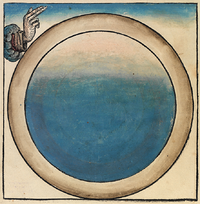
creates the world in six days and consecrates the seventh after giving mankind his first commandment: "be fruitful and multiply". God pronounces the world "very good", but it becomes corrupted by the sin of man and God sends a deluge (a great flood) to destroy it, saving only the righteous (Noah
) and his family, from whose seed the world is repopulated. Man sins again, but God has promised that he will not destroy the world a second time with water.
God instructs Abram (the future Abraham
) to travel from his home in Mesopotamia
(modern Iraq
) to the land of Canaan
. There God makes a covenant with Abram promising that his descendants shall be as numerous as the stars in the heavens, but that they shall suffer oppression in a foreign land for four hundred years, after which they shall inherit the land "from the river of Egypt to the great river, the river Euphrates
." Abram's name is changed to Abraham and that of his wife Sarai to Sarah, and circumcision
of all males is instituted as the sign of the covenant.
Sarah is barren, and tells Abram to take her Egyptian handmaiden, Hagar
, as a concubine. Through Hagar, Abraham becomes the father of Ishmael
. Abraham asks God that Ishmael "might live in Thy sight," (that is, be favoured), but God replies that Sarah will bear a son, who will be named Isaac
, through whom the covenant will be established. At Sarah's insistence Ishmael and his mother Hagar are driven out into the wilderness, but God saves them and promises to make Ishmael a great nation.
God resolves to destroy the city of Sodom
for the sins of its people. Abraham protests that it is not just "to slay the righteous with the wicked," and asks if the whole city can be spared if even ten righteous men are found there. God replies: "For the sake of ten I will not destroy it." Abraham's nephew Lot
is saved from the destruction of Sodom, and through incest with his daughters becomes the ancestor of the Moabites and Ammonites.
God tests Abraham by demanding that he sacrifice Isaac
. As Abraham is about to lay the knife upon his son, God restrains him, promising him numberless descendants. On the death of Sarah, Abraham purchases Machpelah (modern Hebron
) for a family tomb and sends his servant to Mesopotamia to find among his relations a wife for Isaac, and Rebekah is chosen. Other children are born to Abraham by another wife, Keturah, among whose descendants are the Midianites, and he dies in a prosperous old age and is buried in his tomb at Hebron
.
Isaac's wife Rebekah is barren, but Isaac prays to God and she gives birth to the twins Esau
, father of the Edom
ites, and Jacob
. Through deception, Jacob becomes the heir instead of Esau and gains his father's blessing. He flees to his uncle where he prospers and earns his two wives. Jacob's name is changed to Israel, and by his wives Rachel
and Leah
and their handmaidens he has twelve sons, the ancestors of the twelve tribes of the Children of Israel.
Joseph, Jacob's favourite son, is sold into slavery in Egypt by his jealous brothers. But Joseph prospers, and when famine comes he brings his father and his brothers and their households, seventy persons in all, to Egypt, where Pharaoh assigns to them the land of Goshen
. Jacob calls his sons to his bedside and reveals their future to them before he dies and is interred in the family tomb at Machpelah. Joseph lives to see his great-grandchildren, and on his death-bed he exhorts his brethren, if God should remember them and lead them out of the country, to take his bones with them. The book ends with Joseph's remains being "put in a coffin in Egypt."
and Deuteronomy
—came from four sources, the Yahwist, the Elohist
, the Deuteronomist
and the Priestly source
, each telling the same basic story, and joined together by various editors. Since the 1970s there has been a revolution in scholarship: the Elohist source is now widely regarded as no more than a variation on the Yahwist, while the Priestly source is increasingly seen not as a document but as a body of revisions and expansions to the Yahwist (or "non-Priestly") material. (The Deuteronomistic source does not appear in Genesis).
In composing the Patriarchal history the Yahwist drew on four separate blocks of traditional stories about Abraham, Jacob, Judah and Joseph, combining them with genealogies, itineraries and the "promise" theme to create a unified whole. Similarly, when composing the "primeval history" he drew on Greek and Mesopotamian sources, editing and adding to them to create a unified work that fit his theological agenda. The Yahwistic work was then revised and expanded into the final edition by the authors of the Priestly source.
This leaves the question of when these works were created. Scholars in the first half of the 20th century came to the conclusion that the Yahwist was produced in the monarchic period, specifically at the court of Solomon, and the Priestly work in the middle of the 5th century (the author was even identified as Ezra
), but more recent thinking is that the Yahwist was written either just before or during the Babylonian exile of the 6th century, and the Priestly final edition was made late in the Exilic period or soon after.
As for why the book was created, a theory which has gained considerable interest, although still controversial is "Persian imperial authorisation". This proposes that the Persians, after their conquest of Babylon in 538 BCE, agreed to grant Jerusalem a large measure of local autonomy within the empire, but required the local authorities to produce a single law code accepted by the entire community. The two powerful groups making up the community—the priestly families who controlled the Temple and who traced their foundation-myth to Moses and the wilderness wanderings, and the major landowning families who made up the "elders" and who traced their own origins to Abraham, who had "given" them the land—were in conflict over many issues, and each had its own "history of origins", but the Persian promise of greatly increased local autonomy for all provided a powerful incentive to cooperate in producing a single text.
calls the basic rule of the antiquarian historian the "law of conservation": everything old is valuable, nothing is eliminated. Ska also points out the purpose behind such antiquarian histories: antiquity is needed to prove the worth of Israel's traditions to the nations (the neighbours of the Jews in early Persian Palestine), and to reconcile and unite the various factions within Israel itself.
The patriarchs, or ancestors, are Abraham, Isaac and Jacob, with their wives (Joseph is normally excluded). Through the patriarchs God announces the election of Israel, meaning that he has chosen Israel to be his special people and committed himself to their future. God tells the patriarchs that he will be faithful to their descendants (i.e. to Israel), and Israel is expected to have faith in God and his promise. ("Faith" in the context of Genesis and the Hebrew bible means agreement to the promissory relationship, not a body of belief).
The promise itself has three parts: offspring, blessings, and land. The fulfilment of the promise to each patriarch depends on having a male heir, and the story is constantly complicated by the fact that each prospective mother - Sarah
, Rebekah and Rachel
- is barren. The ancestors, however, retain their faith in God and God in each case gives a son - in Jacob's case, twelve sons, the foundation of the chosen Israelites. All three promises are more richly fulfilled in each succeeding generation, until through Joseph "all the world" is saved from famine, and by bringing the children of Israel down to Egypt he becomes the means through which the promise can be fulfilled.
, but not a single theology or overarching theme for all of Genesis. The problem lies in finding a way to unite the patriarchal theme of divine promise to the primeval history, with its theme of God's continuing mercy in the face of man's sinful nature. One solution is to see the patriarchal stories as resulting from God's decision not to remain alienated from mankind: God creates the world and mankind, mankind rebels, and God "elects" (chooses) Abraham.
To this basic plot (which comes from the Yahwist) the Priestly source
has added a series a covenants
dividing history into stages, each with its own distinctive "sign". The first covenant is between God and all living creatures, and is marked by the sign of the rainbow; the second is with the descendants of Abraham (Ishmaelites
and others as well as Israelites), and its sign is circumcision
; and the last, which doesn't appear until the book of Exodus, is with Israel alone, and its sign is the Sabbath
. Each covenant is mediated by a great leader (Noah
, Abraham, Moses
), and at each stage God progressively reveals himself by his name (Elohim
with Noah, El Shaddai
with Abraham, Yahweh
with Moses).
Hebrew Bible
The Hebrew Bible is a term used by biblical scholars outside of Judaism to refer to the Tanakh , a canonical collection of Jewish texts, and the common textual antecedent of the several canonical editions of the Christian Old Testament...
and the Christian
Christian
A Christian is a person who adheres to Christianity, an Abrahamic, monotheistic religion based on the life and teachings of Jesus of Nazareth as recorded in the Canonical gospels and the letters of the New Testament...
Old Testament
Old Testament
The Old Testament, of which Christians hold different views, is a Christian term for the religious writings of ancient Israel held sacred and inspired by Christians which overlaps with the 24-book canon of the Masoretic Text of Judaism...
.
The basic storyline expresses the central theme of the book: God creates
Creation according to Genesis
The Genesis creation narrative describes the divine creation of the world including the first man and woman...
the world and appoints man as his regent, but man proves disobedient and God destroys his world through the Flood. The new post-Flood world is equally corrupt, but God does not destroy it, instead calling one man, Abraham, to be the seed of its salvation. At God's command Abraham descends from his home into the land of Canaan, given to him by God, where he dwells as a sojourner, as does his son Isaac and his grandson Jacob. Jacob's name is changed to Israel, and through the agency of his son Joseph, the children of Israel descend into Egypt, 70 people in all with their households, and God promises them a future of greatness. Genesis ends with Israel in Egypt, ready for the coming of Moses
Moses
Moses was, according to the Hebrew Bible and Qur'an, a religious leader, lawgiver and prophet, to whom the authorship of the Torah is traditionally attributed...
and the Exodus
The Exodus
The Exodus is the story of the departure of the Israelites from ancient Egypt described in the Hebrew Bible.Narrowly defined, the term refers only to the departure from Egypt described in the Book of Exodus; more widely, it takes in the subsequent law-givings and wanderings in the wilderness...
. The narrative is punctuated by a series of covenants with God, successively narrowing in scope from all mankind (the covenant with Noah) to a special relationship with one people alone (Abraham and his descendants through Isaac and Jacob).
Tradition credits Moses
Moses
Moses was, according to the Hebrew Bible and Qur'an, a religious leader, lawgiver and prophet, to whom the authorship of the Torah is traditionally attributed...
as the author of Genesis, Exodus, Leviticus
Leviticus
The Book of Leviticus is the third book of the Hebrew Bible, and the third of five books of the Torah ....
, Numbers
Book of Numbers
The Book of Numbers is the fourth book of the Hebrew Bible, and the fourth of five books of the Jewish Torah/Pentateuch....
and Deuteronomy
Deuteronomy
The Book of Deuteronomy is the fifth book of the Hebrew Bible, and of the Jewish Torah/Pentateuch...
, but the books are in fact anonymous and look back on Moses as a figure from the distant past; some traditions contained in Genesis are as old as the United Monarchy
History of ancient Israel and Judah
Israel and Judah were related Iron Age kingdoms of ancient Palestine. The earliest known reference to the name Israel in archaeological records is in the Merneptah stele, an Egyptian record of c. 1209 BCE. By the 9th century BCE the Kingdom of Israel had emerged as an important local power before...
, but modern scholars increasingly see it as a product of the 6th and 5th centuries BCE.
The book describes its own structure around ten "toledot
Toledot
Toledot, Toldot, or Tol'doth is the sixth weekly Torah portion in the annual Jewish cycle of Torah reading. It constitutes Genesis...
" sections (the "these are the generations of..." phrases), but many modern commentators see it in terms of a "primeval history" and cycles of Patriarchal stories —Abraham, Isaac, and Jacob (renamed Israel).
For Jews
Jews
The Jews , also known as the Jewish people, are a nation and ethnoreligious group originating in the Israelites or Hebrews of the Ancient Near East. The Jewish ethnicity, nationality, and religion are strongly interrelated, as Judaism is the traditional faith of the Jewish nation...
and Christians alike, the theological importance of Genesis centers on the covenants
Covenant (biblical)
A biblical covenant is an agreement found in the Bible between God and His people in which God makes specific promises and demands. It is the customary word used to translate the Hebrew word berith. It it is used in the Tanakh 286 times . All Abrahamic religions consider the Biblical covenant...
linking the Lord (God
God
God is the English name given to a singular being in theistic and deistic religions who is either the sole deity in monotheism, or a single deity in polytheism....
) to his Chosen People
Chosen people
Throughout history and even today various groups of people have considered themselves as chosen by a deity for some purpose such as to act as the deity's agent on earth. In monotheistic faiths, like Abrahamic religions, references to God are used in constructs such as "God's Chosen People"...
and the people to the Promised Land
Promised land
The Promised Land is a term used to describe the land promised or given by God, according to the Hebrew Bible, to the Israelites, the descendants of Jacob. The promise is firstly made to Abraham and then renewed to his son Isaac, and to Isaac's son Jacob , Abraham's grandson...
. Christianity has interpreted Genesis as the prefiguration of certain cardinal Christian beliefs, primarily the need for salvation (the hope or assurance
Assurance (theology)
Assurance is a Protestant Christian doctrine that states that the inner witness of the Holy Spirit allows the justified disciple to know they are saved. Based on the writings of St...
of all Christians) and the redemptive act
Redeemer (Christianity)
In Christian theology, Jesus is sometimes referred to as a Redeemer. This refers to the salvation he is believed to have accomplished, and is based on the metaphor of redemption, or "buying back". Although the New Testament does not use the title "Redeemer", the word "redemption" is used in several...
of Christ
Christ
Christ is the English term for the Greek meaning "the anointed one". It is a translation of the Hebrew , usually transliterated into English as Messiah or Mashiach...
on the Cross as the fulfillment
Supersessionism
Supersessionism is a term for the dominant Christian view of the Old Covenant, also called fulfillment theology and replacement theology, though the latter term is disputed...
of covenant promises as the Son of God
Son of God
"Son of God" is a phrase which according to most Christian denominations, Trinitarian in belief, refers to the relationship between Jesus and God, specifically as "God the Son"...
.
Contents
- BereishitBereishit (parsha)Bereishit, Bereshit, Bereishis, B'reshith, Beresheet, or Bereshees is the first weekly Torah portion in the annual Jewish cycle of Torah reading. The parshah consists of Genesis . Jews read it on the first Sabbath after Simchat Torah, generally in October...
, on Genesis 1-6: Creation, Eden, Adam and Eve, Cain and Abel, Lamech, wickedness - NoachNoach (parsha)Noach or Noah is the second weekly Torah portion in the annual Jewish cycle of Torah reading. It constitutes Genesis . Jews read it on the second Sabbath after Simchat Torah, generally in October or November....
, on Genesis 6-11: Noah’s Ark, the Flood, Noah’s drunkenness, the Tower of Babel - Lech-LechaLech-LechaLech-Lecha, Lekh-Lekha, or Lech-L'cha is the third weekly Torah portion in the annual Jewish cycle of Torah reading. It constitutes Genesis Jews read it on the third Sabbath after Simchat Torah, generally in October or November....
, on Genesis 12-17: Abraham, Sarah, Lot, covenant, Hagar and Ishmael, circumcision - VayeiraVayeiraVayeira, Vayera, or Va-yera is the fourth weekly Torah portion in the annual Jewish cycle of Torah reading. It constitutes Genesis Jews read it on the fourth Sabbath after Simchat Torah, generally in October or November....
, on Genesis 18-22: Abraham's visitors, Sodomites, Lot’s visitors and flight, Hagar expelled, binding of Isaac - Chayei SarahChayei SarahChayei Sarah, Chaye Sarah, or Hayye Sarah is the fifth weekly Torah portion in the annual Jewish cycle of Torah reading. It constitutes Genesis Jews read it on the fifth Sabbath after Simchat Torah, generally in November....
, on Genesis 23-25: Sarah buried, Rebekah for Isaac - ToledotToledotToledot, Toldot, or Tol'doth is the sixth weekly Torah portion in the annual Jewish cycle of Torah reading. It constitutes Genesis...
, on Genesis 25-28: Esau and Jacob, Esau's birthright, Isaac’s blessing - VayetzeVayetzeVayetze, Vayeitzei, or Vayetzei is the seventh weekly Torah portion in the annual Jewish cycle of Torah reading. It constitutes Genesis . Jews in the Diaspora read it the seventh Sabbath after Simchat Torah, generally in November or December.The parshah tells of Jacob’s travels to, life in, and...
, on Genesis 28-32: Jacob flees, Rachel, Leah, Laban, Jacob’s children and departure - VayishlachVayishlachVayishlach or Vayishlah is the eighth weekly Torah portion in the annual Jewish cycle of Torah reading...
, on Genesis 32-36: Jacob’s reunion with Esau, the rape of Dinah - VayeshevVayeshevVayeshev, Vayeishev, or Vayesheb is the ninth weekly Torah portion in the annual Jewish cycle of Torah reading...
, on Genesis 37-40: Joseph's dreams, coat, and slavery, Judah with Tamar, Joseph and Potiphar - MiketzMiketzMiketz or Mikeitz is the tenth weekly Torah portion in the annual Jewish cycle of Torah reading. It constitutes Genesis Jews in the Diaspora read it the tenth Sabbath after Simchat Torah. Generally, it is read on the Sabbath of Chanukah...
, on Genesis 41-44: Pharaoh’s dream, Joseph's in government, Joseph’s brothers visit Egypt - VayigashVayigashVayigash or Vaigash is the eleventh weekly Torah portion in the annual Jewish cycle of Torah reading...
, on Genesis 44-47: Joseph reveals himself, Jacob moves to Egypt - VayechiVayechiVayechi, Vayehi, or Vayhi is the twelfth weekly Torah portion in the annual Jewish cycle of Torah reading and the last in the Book of Genesis...
, on Genesis 47-50: Jacob’s blessings, death of Jacob and of Joseph
Structure
Genesis appears to be structured around the recurring phrase elleh toledot, meaning "these are the generations." The first use of the phrase refers to the "generations of heaven and earth", and the remainder mark individuals - Noah, the "sons of Noah", Shem, etc., down to Jacob. It is not clear, however, just what they meant to the original authors, and most modern commentators divide it into two parts based on subject matter, a "primeval history" (chapters 1-11) and a "patriarchal history" (chapters 12-50). While the first is far shorter than the second, it sets out the basic themes and provides an interpretive key for understanding the entire book. The "primeval history" has a symmetrical structure hinged around chapter 6-9, the flood story, with the events before the flood mirrored by the events after. The "patriarchal history" recounts the events of the major patriarchs Abraham, Isaac and Jacob, to whom God reveals himself and to whom the promise of descendants and land is made, while the story of Joseph serves to take the Israelites into Egypt in preparation for the next book, Exodus.Summary
GodGod in Judaism
The conception of God in Judaism is strictly monotheistic. God is an absolute one indivisible incomparable being who is the ultimate cause of all existence. Jewish tradition teaches that the true aspect of God is incomprehensible and unknowable, and that it is only God's revealed aspect that...
creates the world in six days and consecrates the seventh after giving mankind his first commandment: "be fruitful and multiply". God pronounces the world "very good", but it becomes corrupted by the sin of man and God sends a deluge (a great flood) to destroy it, saving only the righteous (Noah
Noah
Noah was, according to the Hebrew Bible, the tenth and last of the antediluvian Patriarchs. The biblical story of Noah is contained in chapters 6–9 of the book of Genesis, where he saves his family and representatives of all animals from the flood by constructing an ark...
) and his family, from whose seed the world is repopulated. Man sins again, but God has promised that he will not destroy the world a second time with water.
God instructs Abram (the future Abraham
Abraham
Abraham , whose birth name was Abram, is the eponym of the Abrahamic religions, among which are Judaism, Christianity and Islam...
) to travel from his home in Mesopotamia
Mesopotamia
Mesopotamia is a toponym for the area of the Tigris–Euphrates river system, largely corresponding to modern-day Iraq, northeastern Syria, southeastern Turkey and southwestern Iran.Widely considered to be the cradle of civilization, Bronze Age Mesopotamia included Sumer and the...
(modern Iraq
Iraq
Iraq ; officially the Republic of Iraq is a country in Western Asia spanning most of the northwestern end of the Zagros mountain range, the eastern part of the Syrian Desert and the northern part of the Arabian Desert....
) to the land of Canaan
Canaan
Canaan is a historical region roughly corresponding to modern-day Israel, Palestine, Lebanon, and the western parts of Jordan...
. There God makes a covenant with Abram promising that his descendants shall be as numerous as the stars in the heavens, but that they shall suffer oppression in a foreign land for four hundred years, after which they shall inherit the land "from the river of Egypt to the great river, the river Euphrates
Euphrates
The Euphrates is the longest and one of the most historically important rivers of Western Asia. Together with the Tigris, it is one of the two defining rivers of Mesopotamia...
." Abram's name is changed to Abraham and that of his wife Sarai to Sarah, and circumcision
Circumcision
Male circumcision is the surgical removal of some or all of the foreskin from the penis. The word "circumcision" comes from Latin and ....
of all males is instituted as the sign of the covenant.
Sarah is barren, and tells Abram to take her Egyptian handmaiden, Hagar
Hagar (Bible)
Hagar , according to the Abrahamic faiths, was the second wife of Abraham, and the mother of his first son, Ishmael. Her story is recorded in the Book of Genesis, mentioned in Hadith, and alluded to in the Qur'an...
, as a concubine. Through Hagar, Abraham becomes the father of Ishmael
Ishmael
Ishmael is a figure in the Hebrew Bible and the Qur'an, and was Abraham's first born child according to Jews, Christians and Muslims. Ishmael was born of Abraham's marriage to Sarah's handmaiden Hagar...
. Abraham asks God that Ishmael "might live in Thy sight," (that is, be favoured), but God replies that Sarah will bear a son, who will be named Isaac
Isaac
Isaac as described in the Hebrew Bible, was the only son Abraham had with his wife Sarah, and was the father of Jacob and Esau. Isaac was one of the three patriarchs of the Israelites...
, through whom the covenant will be established. At Sarah's insistence Ishmael and his mother Hagar are driven out into the wilderness, but God saves them and promises to make Ishmael a great nation.
God resolves to destroy the city of Sodom
Sodom and Gomorrah
Sodom and Gomorrah were cities mentioned in the Book of Genesis and later expounded upon throughout the Hebrew Bible, the New Testament and Deuterocanonical sources....
for the sins of its people. Abraham protests that it is not just "to slay the righteous with the wicked," and asks if the whole city can be spared if even ten righteous men are found there. God replies: "For the sake of ten I will not destroy it." Abraham's nephew Lot
Lot (Bible)
Lot is a man from the Book of Genesis chapters 11-14 and 19, in the Hebrew Bible. Notable episodes in his life include his travels with his uncle Abram ; his flight from the destruction of Sodom, in the course of which Lot's wife looked back and became a pillar of salt; and the seduction by his...
is saved from the destruction of Sodom, and through incest with his daughters becomes the ancestor of the Moabites and Ammonites.
God tests Abraham by demanding that he sacrifice Isaac
Binding of Isaac
The Binding of Isaac Akedah or Akeidat Yitzchak in Hebrew and Dhabih in Arabic, is a story from the Hebrew Bible in which God asks Abraham to sacrifice his son, Isaac, on Mount Moriah...
. As Abraham is about to lay the knife upon his son, God restrains him, promising him numberless descendants. On the death of Sarah, Abraham purchases Machpelah (modern Hebron
Hebron
Hebron , is located in the southern West Bank, south of Jerusalem. Nestled in the Judean Mountains, it lies 930 meters above sea level. It is the largest city in the West Bank and home to around 165,000 Palestinians, and over 500 Jewish settlers concentrated in and around the old quarter...
) for a family tomb and sends his servant to Mesopotamia to find among his relations a wife for Isaac, and Rebekah is chosen. Other children are born to Abraham by another wife, Keturah, among whose descendants are the Midianites, and he dies in a prosperous old age and is buried in his tomb at Hebron
Hebron
Hebron , is located in the southern West Bank, south of Jerusalem. Nestled in the Judean Mountains, it lies 930 meters above sea level. It is the largest city in the West Bank and home to around 165,000 Palestinians, and over 500 Jewish settlers concentrated in and around the old quarter...
.
Isaac's wife Rebekah is barren, but Isaac prays to God and she gives birth to the twins Esau
Esau
Esau , in the Hebrew Bible, is the oldest son of Isaac. He is mentioned in the Book of Genesis, and by the minor prophets, Obadiah and Malachi. The New Testament later references him in the Book of Romans and the Book of Hebrews....
, father of the Edom
Edom
Edom or Idumea was a historical region of the Southern Levant located south of Judea and the Dead Sea. It is mentioned in biblical records as a 1st millennium BC Iron Age kingdom of Edom, and in classical antiquity the cognate name Idumea was used to refer to a smaller area in the same region...
ites, and Jacob
Jacob
Jacob "heel" or "leg-puller"), also later known as Israel , as described in the Hebrew Bible, the Talmud, the New Testament and the Qur'an was the third patriarch of the Hebrew people with whom God made a covenant, and ancestor of the tribes of Israel, which were named after his descendants.In the...
. Through deception, Jacob becomes the heir instead of Esau and gains his father's blessing. He flees to his uncle where he prospers and earns his two wives. Jacob's name is changed to Israel, and by his wives Rachel
Rachel
Rachel , as described in the Hebrew Bible, is a prophet and the favorite wife of Jacob, one of the three Biblical Patriarchs, and mother of Joseph and Benjamin. She was the daughter of Laban and the younger sister of Leah, Jacob's first wife...
and Leah
Leah
Leah , as described in the Hebrew Bible, is the first of the two concurrent wives of the Hebrew patriarch Jacob and mother of six of sons whose descendants became the Twelve Tribes of Israel, along with at least one daughter, Dinah. She is the daughter of Laban and the older sister of Rachel, whom...
and their handmaidens he has twelve sons, the ancestors of the twelve tribes of the Children of Israel.
Joseph, Jacob's favourite son, is sold into slavery in Egypt by his jealous brothers. But Joseph prospers, and when famine comes he brings his father and his brothers and their households, seventy persons in all, to Egypt, where Pharaoh assigns to them the land of Goshen
Land of Goshen
The Land of Goshen is named in the bible as the place in Egypt given to the Hebrews by the pharaoh of Joseph, and the land from which they later left Egypt at the time of the Exodus...
. Jacob calls his sons to his bedside and reveals their future to them before he dies and is interred in the family tomb at Machpelah. Joseph lives to see his great-grandchildren, and on his death-bed he exhorts his brethren, if God should remember them and lead them out of the country, to take his bones with them. The book ends with Joseph's remains being "put in a coffin in Egypt."
Composition
Origins
For much of the 20th century most scholars agreed that the five books of the Pentateuch—Genesis, Exodus, Leviticus, NumbersBook of Numbers
The Book of Numbers is the fourth book of the Hebrew Bible, and the fourth of five books of the Jewish Torah/Pentateuch....
and Deuteronomy
Deuteronomy
The Book of Deuteronomy is the fifth book of the Hebrew Bible, and of the Jewish Torah/Pentateuch...
—came from four sources, the Yahwist, the Elohist
Elohist
The Elohist is one of four sources of the Torah described by the Documentary Hypothesis. Its name comes from the term it uses for God: Elohim; it is characterised by, among other things, an abstract view of God, using "Horeb" instead of "Sinai" for the mountain where Moses received the laws of...
, the Deuteronomist
Deuteronomist
The Deuteronomist, or simply D, is one of the sources underlying the Hebrew bible . It is found in the book of Deuteronomy, in the books of Joshua, Judges, Samuel, and Kings and also in the book of Jeremiah...
and the Priestly source
Priestly source
The Priestly Source is one of the sources of the Torah/Pentateuch in the bible. Primarily a product of the post-Exilic period when Judah was a province of the Persian empire , P was written to show that even when all seemed lost, God remained present with Israel...
, each telling the same basic story, and joined together by various editors. Since the 1970s there has been a revolution in scholarship: the Elohist source is now widely regarded as no more than a variation on the Yahwist, while the Priestly source is increasingly seen not as a document but as a body of revisions and expansions to the Yahwist (or "non-Priestly") material. (The Deuteronomistic source does not appear in Genesis).
In composing the Patriarchal history the Yahwist drew on four separate blocks of traditional stories about Abraham, Jacob, Judah and Joseph, combining them with genealogies, itineraries and the "promise" theme to create a unified whole. Similarly, when composing the "primeval history" he drew on Greek and Mesopotamian sources, editing and adding to them to create a unified work that fit his theological agenda. The Yahwistic work was then revised and expanded into the final edition by the authors of the Priestly source.
This leaves the question of when these works were created. Scholars in the first half of the 20th century came to the conclusion that the Yahwist was produced in the monarchic period, specifically at the court of Solomon, and the Priestly work in the middle of the 5th century (the author was even identified as Ezra
Ezra
Ezra , also called Ezra the Scribe and Ezra the Priest in the Book of Ezra. According to the Hebrew Bible he returned from the Babylonian exile and reintroduced the Torah in Jerusalem...
), but more recent thinking is that the Yahwist was written either just before or during the Babylonian exile of the 6th century, and the Priestly final edition was made late in the Exilic period or soon after.
As for why the book was created, a theory which has gained considerable interest, although still controversial is "Persian imperial authorisation". This proposes that the Persians, after their conquest of Babylon in 538 BCE, agreed to grant Jerusalem a large measure of local autonomy within the empire, but required the local authorities to produce a single law code accepted by the entire community. The two powerful groups making up the community—the priestly families who controlled the Temple and who traced their foundation-myth to Moses and the wilderness wanderings, and the major landowning families who made up the "elders" and who traced their own origins to Abraham, who had "given" them the land—were in conflict over many issues, and each had its own "history of origins", but the Persian promise of greatly increased local autonomy for all provided a powerful incentive to cooperate in producing a single text.
Genre
Genesis is perhaps best seen as an example of "antiquarian history", a type of literature telling of the first appearance of humans, the stories of ancestors and heroes, and the origins of culture, cities and so forth. The most notable examples are found in the work of Greek historians of the 6th century BC: their intention was to connect notable families of their own day to a distant and heroic past, and in doing so they did not distinguish between myth, legend, and what we would call facts. Professor Jean-Louis Ska of the Pontifical Biblical InstitutePontifical Biblical Institute
The Pontifical Biblical Institute in Rome, Italy is an institution of the Holy See run by the Jesuits that offers instruction at the university level...
calls the basic rule of the antiquarian historian the "law of conservation": everything old is valuable, nothing is eliminated. Ska also points out the purpose behind such antiquarian histories: antiquity is needed to prove the worth of Israel's traditions to the nations (the neighbours of the Jews in early Persian Palestine), and to reconcile and unite the various factions within Israel itself.
Themes
Promises to the ancestors
In 1978 David Clines published his influential The Theme of the Pentateuch - influential because he was one of the first to take up the question of the theme of the entire five books. Cline's conclusion was that the overall theme is "the partial fulfillment - which implies also the partial nonfulfillment - of the promise to or blessing of the Patriarchs." (By calling the fulfillment "partial" Clines was drawing attention to the fact that at the end of Deuteronomy the people are still outside Canaan).The patriarchs, or ancestors, are Abraham, Isaac and Jacob, with their wives (Joseph is normally excluded). Through the patriarchs God announces the election of Israel, meaning that he has chosen Israel to be his special people and committed himself to their future. God tells the patriarchs that he will be faithful to their descendants (i.e. to Israel), and Israel is expected to have faith in God and his promise. ("Faith" in the context of Genesis and the Hebrew bible means agreement to the promissory relationship, not a body of belief).
The promise itself has three parts: offspring, blessings, and land. The fulfilment of the promise to each patriarch depends on having a male heir, and the story is constantly complicated by the fact that each prospective mother - Sarah
Sarah
Sarah or Sara was the wife of Abraham and the mother of Isaac as described in the Hebrew Bible and the Quran. Her name was originally Sarai...
, Rebekah and Rachel
Rachel
Rachel , as described in the Hebrew Bible, is a prophet and the favorite wife of Jacob, one of the three Biblical Patriarchs, and mother of Joseph and Benjamin. She was the daughter of Laban and the younger sister of Leah, Jacob's first wife...
- is barren. The ancestors, however, retain their faith in God and God in each case gives a son - in Jacob's case, twelve sons, the foundation of the chosen Israelites. All three promises are more richly fulfilled in each succeeding generation, until through Joseph "all the world" is saved from famine, and by bringing the children of Israel down to Egypt he becomes the means through which the promise can be fulfilled.
God's chosen people
Scholars generally agree that the theme of divine promise unites the patriarchal cycles, but many scholars would dispute the idea that a single theme (or theology) runs through Genesis - a theology of the Abraham cycle or the Jacob cycle or the Joseph cycle might be possible, or a theology of the Yahwist or the Priestly sourcePriestly source
The Priestly Source is one of the sources of the Torah/Pentateuch in the bible. Primarily a product of the post-Exilic period when Judah was a province of the Persian empire , P was written to show that even when all seemed lost, God remained present with Israel...
, but not a single theology or overarching theme for all of Genesis. The problem lies in finding a way to unite the patriarchal theme of divine promise to the primeval history, with its theme of God's continuing mercy in the face of man's sinful nature. One solution is to see the patriarchal stories as resulting from God's decision not to remain alienated from mankind: God creates the world and mankind, mankind rebels, and God "elects" (chooses) Abraham.
To this basic plot (which comes from the Yahwist) the Priestly source
Priestly source
The Priestly Source is one of the sources of the Torah/Pentateuch in the bible. Primarily a product of the post-Exilic period when Judah was a province of the Persian empire , P was written to show that even when all seemed lost, God remained present with Israel...
has added a series a covenants
Covenant (biblical)
A biblical covenant is an agreement found in the Bible between God and His people in which God makes specific promises and demands. It is the customary word used to translate the Hebrew word berith. It it is used in the Tanakh 286 times . All Abrahamic religions consider the Biblical covenant...
dividing history into stages, each with its own distinctive "sign". The first covenant is between God and all living creatures, and is marked by the sign of the rainbow; the second is with the descendants of Abraham (Ishmaelites
Ishmaelites
According to the Book of Genesis, Ishmaelites are the descendants of Ishmael, the elder son of Abraham.-Traditional Origins:According to the Book of Genesis, Abraham's first wife was named Sarah and his second wife Hagar. However Sarah was old and barren, and could not conceive...
and others as well as Israelites), and its sign is circumcision
Brit milah
The brit milah is a Jewish religious circumcision ceremony performed on 8-day old male infants by a mohel. The brit milah is followed by a celebratory meal .-Biblical references:...
; and the last, which doesn't appear until the book of Exodus, is with Israel alone, and its sign is the Sabbath
Sabbath
Sabbath in Christianity is a weekly day of rest or religious observance, derived from the Biblical Sabbath.Seventh-day Sabbath observance, i.e. resting from labor from Friday sunset to Saturday sunset, is practiced by seventh-day Sabbatarians...
. Each covenant is mediated by a great leader (Noah
Noah
Noah was, according to the Hebrew Bible, the tenth and last of the antediluvian Patriarchs. The biblical story of Noah is contained in chapters 6–9 of the book of Genesis, where he saves his family and representatives of all animals from the flood by constructing an ark...
, Abraham, Moses
Moses
Moses was, according to the Hebrew Bible and Qur'an, a religious leader, lawgiver and prophet, to whom the authorship of the Torah is traditionally attributed...
), and at each stage God progressively reveals himself by his name (Elohim
Elohim
Elohim is a grammatically singular or plural noun for "god" or "gods" in both modern and ancient Hebrew language. When used with singular verbs and adjectives elohim is usually singular, "god" or especially, the God. When used with plural verbs and adjectives elohim is usually plural, "gods" or...
with Noah, El Shaddai
El Shaddai
El Shaddai [shah-'dah-yy] is one of the Judaic names of God, with its etymology coming from the influence of the Ugaritic religion on modern Judaism. El Shaddai is conventionally translated as God Almighty...
with Abraham, Yahweh
Yahweh
Yahweh is the name of God in the Bible, the God of Abraham, Isaac, Jacob, Jews and Christians.The word Yahweh is a modern scholarly convention for the Hebrew , transcribed into Roman letters as YHWH and known as the Tetragrammaton, for which the original pronunciation is unknown...
with Moses).
See also
- Bible and history
- Biblical Patriarchs
- Creation according to GenesisCreation according to GenesisThe Genesis creation narrative describes the divine creation of the world including the first man and woman...
- Creation myth
- Covenant (biblical)Covenant (biblical)A biblical covenant is an agreement found in the Bible between God and His people in which God makes specific promises and demands. It is the customary word used to translate the Hebrew word berith. It it is used in the Tanakh 286 times . All Abrahamic religions consider the Biblical covenant...
- Dating the BibleDating the BibleThe Bible is a compilation of various texts of different ages. The dates of some of the texts of the Hebrew Bible are difficult to establish....
- Mosaic authorshipMosaic authorshipMosaic authorship is the traditional attribution of the first five books of the Old Testament to Moses. The tradition is first definitively stated in the Babylonian Talmud, an encyclopedia of traditional Jewish learning compiled around the middle of the 1st millennium CE...
- Paradise LostParadise LostParadise Lost is an epic poem in blank verse by the 17th-century English poet John Milton. It was originally published in 1667 in ten books, with a total of over ten thousand individual lines of verse...
- Seven Laws of Noah
- TanakhTanakhThe Tanakh is a name used in Judaism for the canon of the Hebrew Bible. The Tanakh is also known as the Masoretic Text or the Miqra. The name is an acronym formed from the initial Hebrew letters of the Masoretic Text's three traditional subdivisions: The Torah , Nevi'im and Ketuvim —hence...
- Weekly Torah portion
- Wife-sister narratives in GenesisWife-sister narratives in GenesisThere are three wife-sister narratives in Genesis, part of the Torah, all of which are strikingly similar. At the core of each is the tale of a Biblical Patriarch, who has come to be in the land of a powerful foreign overlord who misidentifies the Patriarch's wife as the Patriarch's sister, and...
External links
- Book of Genesis illustrated
- Genesis Reading Room (Tyndale Seminary): online commentaries and monographs on Genesis.
- Bereshit with commentary in Hebrew
- בראשית Bereishit - Genesis (HebrewHebrew languageHebrew is a Semitic language of the Afroasiatic language family. Culturally, is it considered by Jews and other religious groups as the language of the Jewish people, though other Jewish languages had originated among diaspora Jews, and the Hebrew language is also used by non-Jewish groups, such...
- English at Mechon-Mamre.org) - Genesis at Mechon-Mamre (Jewish Publication Society translation)
- Hebrew Audiobook of Genesis from LibrivoxLibriVoxLibriVox is an online digital library of free public domain audiobooks, read by volunteers and is probably, since 2007, the world's most prolific audiobook publisher...
- Genesis (The Living Torah) Rabbi Aryeh KaplanAryeh KaplanAryeh Moshe Eliyahu Kaplan was a noted American Orthodox rabbi and author known for his "intimate knowledge of both physics and kabbalah." He was lauded as an original thinker and prolific writer, from studies of the Torah, Talmud and mysticism to introductory pamphlets on Jewish beliefs and...
's translation and commentary at Ort.org - Genesis (Judaica Press) at Chabad.org
- Young's Literal Translation (YLT)
- New International Version (NIV)
- Revised Standard Version (RSV)
- Westminster-Leningrad codex
- Aleppo Codex