

Norwegian krone

Encyclopedia
The krone ˈkɾuːnə (sign
: kr; code
: NOK) is the currency
of Norway
and its dependent territories. The plural form is kroner (or kronor ). It is subdivided into 100 øre
. The ISO 4217
code is NOK, although the common local abbreviation is kr. The name translates into English as "crown". The Norwegian krone is the thirteenth most traded currency in the World by value.
at a rate of 4 kroner = 1 speciedaler. In doing so, Norway joined the Scandinavian Monetary Union
, which had been established in 1873. The Union persisted until 1914 but, after its dissolution, Denmark, Norway and Sweden all decided to keep the names of their respective and now separate currencies.
Within the Scandinavian Monetary Union, the krone was on a gold standard
of 2480 kroner = 1 kilogram of pure gold (1 krone = 403.226 milligrams gold). This gold standard was restored between 1916 and 1920 and again in 1928 but was suspended permanently in 1931, when a peg to the British pound of 19.9 kroner = 1 pound was established (the previous rate had been 18.16 kroner = 1 pound). In 1939, Norway pegged the krone temporarily to the U.S. dollar at a rate of 4.4 kroner = 1 dollar.
During the German occupation
in World War II
, the krone was pegged to the Reichsmark
at a rate of 1 krone = 0.6 Reichsmark initially, later reduced to 0.57. After the war, a rate of 20 kroner = 1 pound (4.963 kroner = 1 U.S. dollar) was established. The rate to the pound was maintained in 1949 when the pound devalued relative to the U.S. dollar, leading to a rate of 7.142 kroner = 1 U.S. dollar. In December 1992 the Norges Bank (Central Bank of Norway) abandoned the fixed exchange rate in favor of a floating exchange rate
(managed float) due to the heavy speculation against the Norwegian currency in the early 1990s which lost the Norwegian central bank around two billion kroner in defensive purchases of the NOK through usage of foreign currency reserves for a relatively short period of time.
This is the current Norges Bank NOK policy.
The last gold coins were issued in 1910; silver was replaced by cupro-nickel from 1920. Between 1917 and 1921, iron temporarily replaced bronze. 1917 also saw the last issuance of 2 kroner coins. During the German occupation in the Second World War, zinc was used in place of cupro-nickel in 10, 25, and 50 øre coins, and production of the 1 krone piece was suspended.
In 1963, 5 kroner coins were introduced. Production of 1 and 2 øre coins ceased in 1972. The following year, the size of the 5 øre coin was reduced; production of the denomination ceased in 1982, along with minting of the 25 øre. Ten-kroner coins were introduced in 1983. In 1992, the last 10 øre coins were minted. Between 1994 and 1998, a new coinage was introduced, consisting of 50 øre, 1, 5, 10, and 20 kroner (this last, introduced in 1994).
The 10- and 20-kroner coins carry the effigy of the current monarch. Previously the 1- and 5-kroner coins also carried the royal effigy, but now these denominations are decorated only with stylistic royal or national symbols. The royal motto of the monarch (King Harald
's motto is Alt for Norge, meaning "Everything for Norway") is also inscribed on the 10-kroner coin.
The coins and banknotes are distributed by the Central Bank of Norway.
Norges Bank has announced that the 50-øre coin will no longer be legal tender starting May 1, 2012. It will be withdrawn because it no longer circulates as an ordinary coin used for payment.
Sources:,, Bergen Mynt og Seddel, Numisma Mynthandel
http://lovdata.no/nyhet/2011/20110318-2135.html
In 2002 the Norwegian krone grew to record high levels against the United States dollar
and the Euro
. On 2 January 2002, 100 NOK were worth 11.14 USD (1 USD=8.98 NOK). In July 2002, the krone hit a high at 100 NOK = 13.7 USD (1 USD=7.36 NOK). In addition to the high level of interest, which increased further on 4 July 2002, to 7 per cent, the price of oil was high. At the time Norway was the world's third largest oil
exporter.
In 2005, oil prices reached record levels of more than 60 dollars per barrel
. Although interest rates had decreased to around 2 per cent, the Norwegian krone grew even stronger.
However, in late 2007 and early 2008, the USD suffered a steady depreciation against all other major currencies. The Norwegian krone was gaining value at the same time; as a result, the Norwegian krone became stronger than ever compared to the USD, making the USD worth about 5 NOK in April 2008. By October 2008, the USD had recovered and was worth approximately 7 NOK. Following 2009, the NOK has once again seen strong growth, making the USD worth about 5.8 NOK as of the beginning of 2010.
As of 2009 the Norwegian krone is the tenth most traded currency on the foreign exchange market.
Currency sign
A currency sign is a graphic symbol used as a shorthand for a currency's name, especially in reference to amounts of money. They typically employ the first letter or character of the currency, sometimes with minor changes such as ligatures or overlaid vertical or horizontal bars...
: kr; code
ISO 4217
ISO 4217 is a standard published by the International Standards Organization, which delineates currency designators, country codes , and references to minor units in three tables:* Table A.1 – Current currency & funds code list...
: NOK) is the currency
Currency
In economics, currency refers to a generally accepted medium of exchange. These are usually the coins and banknotes of a particular government, which comprise the physical aspects of a nation's money supply...
of Norway
Norway
Norway , officially the Kingdom of Norway, is a Nordic unitary constitutional monarchy whose territory comprises the western portion of the Scandinavian Peninsula, Jan Mayen, and the Arctic archipelago of Svalbard and Bouvet Island. Norway has a total area of and a population of about 4.9 million...
and its dependent territories. The plural form is kroner (or kronor ). It is subdivided into 100 øre
Øre
Øre is the centesimal subdivision of the Norwegian and Danish krones. The Faroese division is called the oyra, but is equal in value to the Danish coin. Before their discontinuation, the corresponding divisions of the Swedish krona and the Icelandic króna were the öre and the eyrir...
. The ISO 4217
ISO 4217
ISO 4217 is a standard published by the International Standards Organization, which delineates currency designators, country codes , and references to minor units in three tables:* Table A.1 – Current currency & funds code list...
code is NOK, although the common local abbreviation is kr. The name translates into English as "crown". The Norwegian krone is the thirteenth most traded currency in the World by value.
History
The krone was introduced in 1875, replacing the Norwegian speciedalerNorwegian speciedaler
The speciedaler was the currency of Norway between 1816 and 1875. It replaced the rigsdaler specie at par and was subdivided into 120 skilling . It was replaced by the Norwegian krone when Norway joined the Scandinavian Monetary Union...
at a rate of 4 kroner = 1 speciedaler. In doing so, Norway joined the Scandinavian Monetary Union
Scandinavian Monetary Union
The Scandinavian Monetary Union was a monetary union formed by Sweden and Denmark on May 5, 1873, by fixing their currencies against gold at par to each other...
, which had been established in 1873. The Union persisted until 1914 but, after its dissolution, Denmark, Norway and Sweden all decided to keep the names of their respective and now separate currencies.
Within the Scandinavian Monetary Union, the krone was on a gold standard
Gold standard
The gold standard is a monetary system in which the standard economic unit of account is a fixed mass of gold. There are distinct kinds of gold standard...
of 2480 kroner = 1 kilogram of pure gold (1 krone = 403.226 milligrams gold). This gold standard was restored between 1916 and 1920 and again in 1928 but was suspended permanently in 1931, when a peg to the British pound of 19.9 kroner = 1 pound was established (the previous rate had been 18.16 kroner = 1 pound). In 1939, Norway pegged the krone temporarily to the U.S. dollar at a rate of 4.4 kroner = 1 dollar.
During the German occupation
Occupation of Norway by Nazi Germany
The occupation of Norway by Nazi Germany started with the German invasion of Norway on April 9, 1940, and ended on May 8, 1945, after the capitulation of German forces in Europe. Throughout this period, Norway was continuously occupied by the Wehrmacht...
in World War II
World War II
World War II, or the Second World War , was a global conflict lasting from 1939 to 1945, involving most of the world's nations—including all of the great powers—eventually forming two opposing military alliances: the Allies and the Axis...
, the krone was pegged to the Reichsmark
German reichsmark
The Reichsmark was the currency in Germany from 1924 until June 20, 1948. The Reichsmark was subdivided into 100 Reichspfennig.-History:...
at a rate of 1 krone = 0.6 Reichsmark initially, later reduced to 0.57. After the war, a rate of 20 kroner = 1 pound (4.963 kroner = 1 U.S. dollar) was established. The rate to the pound was maintained in 1949 when the pound devalued relative to the U.S. dollar, leading to a rate of 7.142 kroner = 1 U.S. dollar. In December 1992 the Norges Bank (Central Bank of Norway) abandoned the fixed exchange rate in favor of a floating exchange rate
Floating exchange rate
A floating exchange rate or fluctuating exchange rate is a type of exchange rate regime wherein a currency's value is allowed to fluctuate according to the foreign exchange market. A currency that uses a floating exchange rate is known as a floating currency....
(managed float) due to the heavy speculation against the Norwegian currency in the early 1990s which lost the Norwegian central bank around two billion kroner in defensive purchases of the NOK through usage of foreign currency reserves for a relatively short period of time.
This is the current Norges Bank NOK policy.
Coins
In 1875, coins were introduced (some dated 1874) in denominations of 10 and 50 øre and 1 and 10 kroner. These coins also bore the denomination in the previous currency, as 3, 15, and 30 skillings and 2½ specidaler. Between 1875 and 1878, the new coinage was introduced in full, in denominations of 1, 2, 5, 10, 25, and 50 øre and 1, 2, and 10 kroner. The 1, 2, and 5 øre were struck in bronze; the 10, 25, and 50 øre and 1 and 2 kroner, in silver; and the 10 and 20 kroner, in gold.The last gold coins were issued in 1910; silver was replaced by cupro-nickel from 1920. Between 1917 and 1921, iron temporarily replaced bronze. 1917 also saw the last issuance of 2 kroner coins. During the German occupation in the Second World War, zinc was used in place of cupro-nickel in 10, 25, and 50 øre coins, and production of the 1 krone piece was suspended.
In 1963, 5 kroner coins were introduced. Production of 1 and 2 øre coins ceased in 1972. The following year, the size of the 5 øre coin was reduced; production of the denomination ceased in 1982, along with minting of the 25 øre. Ten-kroner coins were introduced in 1983. In 1992, the last 10 øre coins were minted. Between 1994 and 1998, a new coinage was introduced, consisting of 50 øre, 1, 5, 10, and 20 kroner (this last, introduced in 1994).
| Currently Circulated Coins | |||||||
|---|---|---|---|---|---|---|---|
| Value | Technical parameters | Description | |||||
| Diameter | Thickness | Mass | Composition | Edge | Obverse | Reverse | |
| 50 øre | 18.5 mm | 1.7 mm | 3.6 g | 97% Cu, 2,5% Zn, 0,5% Sn | Smooth | King's crown Crown (headgear) A crown is the traditional symbolic form of headgear worn by a monarch or by a deity, for whom the crown traditionally represents power, legitimacy, immortality, righteousness, victory, triumph, resurrection, honour and glory of life after death. In art, the crown may be shown being offered to... |
Fabulous Fable A fable is a succinct fictional story, in prose or verse, that features animals, mythical creatures, plants, inanimate objects or forces of nature which are anthropomorphized , and that illustrates a moral lesson , which may at the end be expressed explicitly in a pithy maxim.A fable differs from... animal |
| 1 krone | 21 mm | 1.7 mm | 4.35 g | Cupronickel Cupronickel Cupronickel or copper-nickel or "cupernickel" is an alloy of copper that contains nickel and strengthening elements, such as iron and manganese. Cupronickel is highly resistant to corrosion in seawater, because its electrode potential is adjusted to be neutral with regard to seawater... 75% Cu, 25% Ni |
Smooth | Harald V Harald V of Norway Harald V is the king of Norway. He succeeded to the throne of Norway upon the death of his father Olav V on 17 January 1991... 's monogram |
a fowl Fowl Fowl is a word for birds in general but usually refers to birds belonging to one of two biological orders, namely the gamefowl or landfowl and the waterfowl... |
| 5 krone | 26 mm | 2 mm | 7.85 g | Milled | St. Olav's Order The Royal Norwegian Order of St. Olav The Royal Norwegian Order of St. Olav is a Norwegian order of chivalry that was instituted by King Oscar I of Norway and Sweden on August 21, 1847, as a distinctly Norwegian order. It is named after King Olav II, known for posterity as St. Olav. Nobility was abolished in Norway in 1821... |
acanthi Acanthus (genus) Acanthus is a genus of about 30 species of flowering plants in the family Acanthaceae, native to tropical and warm temperate regions, with the highest species diversity in the Mediterranean Basin and Asia. Common names include Acanthus and Bear's breeches... leaves |
|
| 10 krone | 24 mm | 2 mm | 6.8 g | 81% Cu, 10% Zn, 9% Ni | Interrupted milling | Harald V | stave church Stave church A stave church is a medieval wooden church with a post and beam construction related to timber framing. The wall frames are filled with vertical planks. The load-bearing posts have lent their name to the building technique... roof |
| 20 krone | 27.5 mm | 2.2 mm | 9.9 g | Smooth | Viking ship Viking ship Viking ships were vessels used during the Viking Age in Northern Europe. Scandinavian tradition of shipbuilding during the Viking Age was characterized by slender and flexible boats, with symmetrical ends with true keel. They were clinker built, which is the overlapping of planks riveted together... |
||
The 10- and 20-kroner coins carry the effigy of the current monarch. Previously the 1- and 5-kroner coins also carried the royal effigy, but now these denominations are decorated only with stylistic royal or national symbols. The royal motto of the monarch (King Harald
Harald V of Norway
Harald V is the king of Norway. He succeeded to the throne of Norway upon the death of his father Olav V on 17 January 1991...
's motto is Alt for Norge, meaning "Everything for Norway") is also inscribed on the 10-kroner coin.
The coins and banknotes are distributed by the Central Bank of Norway.
Norges Bank has announced that the 50-øre coin will no longer be legal tender starting May 1, 2012. It will be withdrawn because it no longer circulates as an ordinary coin used for payment.
Banknotes
In 1877, Norges Bank introduced notes for 5, 10, 50, 100, 500 and 1000 kroner. In 1917, 1 krone notes were issued, with 2 kroner notes issued between 1918 and 1922. Because of metal shortages, 1 and 2 kroner notes were again issued between 1940 and 1950. In 1963, 5 kroner notes were replaced by coins, with the same happening to the 10 kroner notes in 1984. 200 kroner notes were introduced in 1994.| Banknotes |
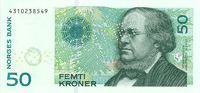 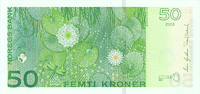 50 kr; Peter Christen Asbjørnsen Peter Christen Asbjørnsen Peter Christen Asbjørnsen was a Norwegian writer and scholar. He and Jørgen Engebretsen Moe were collectors of Norwegian folklore... , water lillies Nymphaeaceae Nymphaeaceae is a family of flowering plants. Members of this family are commonly called water lilies and live in freshwater areas in temperate and tropical climates around the world. The family contains eight genera. There are about 70 species of water lilies around the world. The genus... . |
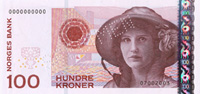 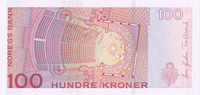 100 kr; Kirsten Flagstad Kirsten Flagstad Kirsten Målfrid Flagstad was a Norwegian opera singer and a highly regarded Wagnerian soprano... , Folketeateret in Oslo's concert hall. |
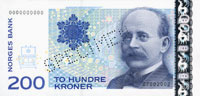 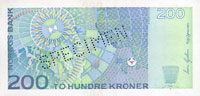 200 kr; Kristian Birkeland Kristian Birkeland Kristian Olaf Birkeland was a Norwegian scientist. He is best remembered as the person who first elucidated the nature of the Aurora borealis. In order to fund his research on the aurorae, he invented the electromagnetic cannon and the Birkeland-Eyde process of fixing nitrogen from the air... , map of the northern polar region Polar region Earth's polar regions are the areas of the globe surrounding the poles also known as frigid zones. The North Pole and South Pole being the centers, these regions are dominated by the polar ice caps, resting respectively on the Arctic Ocean and the continent of Antarctica... and aurora. |
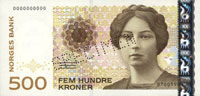 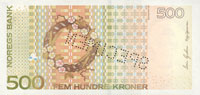 500 kr; Sigrid Undset Sigrid Undset Sigrid Undset was a Norwegian novelist who was awarded the Nobel Prize for Literature in 1928.-Biography:Undset was born in Kalundborg, Denmark, but her family moved to Norway when she was two years old. In 1924, she converted to Catholicism and became a lay Dominican... , a wreath Wreath A wreath is an assortment of flowers, leaves, fruits, twigs and/or various materials that is constructed to resemble a ring. They are used typically as Christmas decorations to symbolize the coming of Christ, also known as the Advent season in Christianity. They are also used as festive headdresses... from the trilogy of Kristin Lavransdatter Kristin Lavransdatter Kristin Lavransdatter is the common name for a trilogy of historical novels written by Nobel laureate Sigrid Undset. The individual novels are Kransen , first published in 1920, Husfrue , published in 1921, and Korset , published in 1922... . |
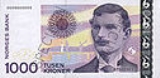
 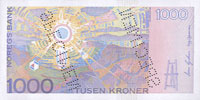 1000 kr; Edvard Munch Edvard Munch Edvard Munch was a Norwegian Symbolist painter, printmaker and an important forerunner of expressionist art. His best-known composition, The Scream, is part of a series The Frieze of Life, in which Munch explored the themes of love, fear, death, melancholia, and anxiety.- Childhood :Edvard Munch... , excerpt from Munch's wall painting "The Sun". |
Summary of denominations issued
| Denomination | Notes | Coins | ||||
|---|---|---|---|---|---|---|
| Printed | Invalid | Comments | Minted | Invalid | Comments | |
| 1 øre | - | 1876–1972 | 1988 | Bronze, iron 1918-21 & 1941-45 | ||
| 2 øre | - | 1876–1972 | 1988 | Bronze, iron 1917-20 & 1943-45 | ||
| 5 øre | - | 1875–1982 | 1988 | Bronze, iron 1917-20 & 1941-45 | ||
| 10 øre | - | 1874–1991 | 2003 | Silver 1874-1919, cupro-nickel 1920-92 (holed 1924-51), zinc 1941-45 | ||
| 25 øre | - | 1876–1982 | 1988 | Silver 1876-1919, cupro-nickel 1921-82 (holed 1921-50), zinc 1943-45 | ||
| 50 øre | - | 1874–2012 | 2022 | Silver 1874-1919, cupro-nickel 1920-96 (holed 1920-49), zinc 1941-45, bronze 1996-2012 | ||
| 1 krone | 1917-1925 1940-1950 |
1926 1999 |
War time "coin notes" | 1875- | - | Silver 1875-1917, cupro-nickel 1925- (holed 1925-51, 1997-) |
| 2 kroner | 1918-1925 1940-1950 |
1926 1999 |
War time "coin notes" | 1876–1917 | ?? | Silver 1878-1917 |
| 5 kroner | 1877–1963 | 1999 | Replaced by coin 1963 | 1963- | - | Cupro-nickel (holed 1998-) |
| 10 kroner | 1877–1984 | 1999 | Replaced by coin 1984 | 1983- | - | Nickel-brass |
| 20 kroner | - | 1994- | - | Nickel-brass | ||
| 50 kroner | 1877- | - | - | |||
| 100 kroner | 1877- | - | - | |||
| 200 kroner | 1994- | - | - | |||
| 500 kroner | 1877- | - | - | |||
| 1000 kroner | 1877- | - | - | |||
Sources:,, Bergen Mynt og Seddel, Numisma Mynthandel
http://lovdata.no/nyhet/2011/20110318-2135.html
Exchange rates
The value of Norwegian kroner compared to other currencies varies considerably from one year to another, mainly based on changes in oil prices and interest rates.In 2002 the Norwegian krone grew to record high levels against the United States dollar
United States dollar
The United States dollar , also referred to as the American dollar, is the official currency of the United States of America. It is divided into 100 smaller units called cents or pennies....
and the Euro
Euro
The euro is the official currency of the eurozone: 17 of the 27 member states of the European Union. It is also the currency used by the Institutions of the European Union. The eurozone consists of Austria, Belgium, Cyprus, Estonia, Finland, France, Germany, Greece, Ireland, Italy, Luxembourg,...
. On 2 January 2002, 100 NOK were worth 11.14 USD (1 USD=8.98 NOK). In July 2002, the krone hit a high at 100 NOK = 13.7 USD (1 USD=7.36 NOK). In addition to the high level of interest, which increased further on 4 July 2002, to 7 per cent, the price of oil was high. At the time Norway was the world's third largest oil
Petroleum
Petroleum or crude oil is a naturally occurring, flammable liquid consisting of a complex mixture of hydrocarbons of various molecular weights and other liquid organic compounds, that are found in geologic formations beneath the Earth's surface. Petroleum is recovered mostly through oil drilling...
exporter.
In 2005, oil prices reached record levels of more than 60 dollars per barrel
Barrel (unit)
A barrel is one of several units of volume, with dry barrels, fluid barrels , oil barrel, etc...
. Although interest rates had decreased to around 2 per cent, the Norwegian krone grew even stronger.
However, in late 2007 and early 2008, the USD suffered a steady depreciation against all other major currencies. The Norwegian krone was gaining value at the same time; as a result, the Norwegian krone became stronger than ever compared to the USD, making the USD worth about 5 NOK in April 2008. By October 2008, the USD had recovered and was worth approximately 7 NOK. Following 2009, the NOK has once again seen strong growth, making the USD worth about 5.8 NOK as of the beginning of 2010.
As of 2009 the Norwegian krone is the tenth most traded currency on the foreign exchange market.
See also
- Table of historical exchange ratesTable of historical exchange ratesListed below is a table of historical exchange rates relative to the U.S. dollar, at present the most widely traded currency in the world. An exchange rate represents the value of one currency in another. An exchange rate between two currencies fluctuates over time. The value of a currency relative...
- Scandinavian Monetary UnionScandinavian Monetary UnionThe Scandinavian Monetary Union was a monetary union formed by Sweden and Denmark on May 5, 1873, by fixing their currencies against gold at par to each other...
- Swedish kronaSwedish kronaThe krona has been the currency of Sweden since 1873. Both the ISO code "SEK" and currency sign "kr" are in common use; the former precedes or follows the value, the latter usually follows it, but especially in the past, it sometimes preceded the value...
- Danish kroneDanish kroneThe krone is the official currency of the Kingdom of Denmark consisting of Denmark, the Faroe Islands and Greenland. It is subdivided into 100 øre...
- Icelandic krónaIcelandic krónaThe króna is the currency of Iceland. The króna is technically subdivided into 100 aurar , but in practice this subdivision is no longer used....
- Economy of NorwayEconomy of NorwayThe economy of Norway is a developed mixed economy with heavy state-ownership in strategic areas of the economy. Although sensitive to global business cycles, the economy of Norway has shown robust growth since the start of the industrial era...