

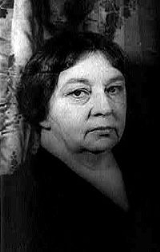
Sigrid Undset

Encyclopedia
Sigrid Undset was a Norwegian
novelist who was awarded the Nobel Prize for Literature
in 1928.
, Denmark
, but her family moved to Norway when she was two years old. In 1924, she converted to Catholicism
and became a lay Dominican. She fled Norway for the United States
in 1940 because of her opposition to Nazi Germany
and the German occupation
, but returned after World War II
ended in 1945.
Her best-known work is Kristin Lavransdatter
, a modernist
trilogy about life in Scandinavia
in the Middle Ages
. The book was set in medieval Norway
and was published from 1920 to 1922 in three volumes. Kristin Lavransdatter portrays the life of a woman from birth until death. Undset was awarded the Nobel Prize for Literature for this trilogy as well as her four-volume work about Olav Audunssøn known as The Master of Hestviken
tetralogy, published in 1925 and 1927.
Undset experimented with modernist
tropes such as stream of consciousness in her novel, although the original English
translation by Charles Archer excised many of these passages. In 1997, the first volume of Tiina Nunnally
's new translation of the work won the PEN/Faulkner Award for Fiction
in the category of translation. The names of each volume were translated by Archer as The Bridal Wreath, The Mistress of Husaby, and The Cross, and by Nunally as The Wreath, The Wife, and The Cross.
, Denmark
, at the childhood home of her mother, Charlotte Undset, born Anna Maria Charlotte Gyth (1855–1939). Sigrid was the eldest of three daughters. She came to Norway at the age of two.
She grew up in Kristiania
, the Norwegian capital (the name was changed back to Oslo
in 1924). When she was only 11 years old, her father, the Norwegian archaeologist Ingvald Martin Undset (1853–1893), died at the age of 40 after a long illness.
Due to the family's economic situation, Undset had to give up hope of a university education. After a one-year secretarial course, at the age of 16, she got a job as secretary with an engineering company in Kristiania, a post she held for 10 years.
She later served as chairman of the Society of Norwegian Authors.
. The manuscript, an historical novel
set in Medieval Denmark, was ready by the time she was 22. It was turned down by the publishing house.
All the same, two years later she had completed another manuscript; much less voluminous this time, only 80 pages. She had put aside the Middle Ages, and had instead produced a realistic description of a woman with a petit-bourgeois background in contemporary Kristiania. The title was Fru Marta Oulie, and the opening sentence scandalised the readers: "I have been unfaithful to my husband." These were the words of the book's main character. This book was also refused at first, but it was subsequently accepted.
Thus, at the age of 25, Sigrid Undset made her literary debut with a short, realistic
novel on adultery
, set against a contemporary background. It created a stir, and she found herself ranked as a promising young author in Norway. During the years up to 1919, Undset published a number of novels set in contemporary Kristiania. Her contemporary novels of the period 1907-1918 are about the city and its inhabitants. They are stories of working people, of trivial family destinies, of the relationship between parents and children. Her main subjects are women and their love. Or, as she herself put it -- in her typically curt and ironic
manner -- "the immoral kind" (of love).
This realistic period culminated in the novels Jenny
in 1911 and Vaaren
(Spring) in 1914. The first is about a woman painter
who, as a result of romantic crises, believes that she is wasting her life, and in the end commits suicide
. The other tells of a woman who succeeds in saving both herself and her love from a serious matrimonial crisis, finally creating a secure family. These books placed Undset apart from the incipient women's emancipation movement in Europe.
Undset's books sold well from the start, and after the publication of her third book, she quit the office job, and prepared to live on her income as a writer. Having been granted a writer's scholarship, she set out on a lengthy journey in Europe. After short stops in Denmark and Germany, she continued to Italy
, arriving in Rome
in December 1909, where she remained for nine months. Undset's parents had had a close relationship with Rome. During her stay there she followed in her parents' footsteps.
The encounter with Southern Europe meant a great deal to her; she made friends within the circle of Scandinavian artists and writers in Rome.
, a Norwegian painter, whom she married almost three years later. She was 30; Svarstad was nine years older, he was married, and he had a wife and three children in Norway. It was nearly three years before Svarstad got his divorce
from his first wife.
Sigrid and Anders were married in 1912 and went to stay in London
for six months. From London, they returned to Rome, where Sigrid's first child was born in January 1913. It was a boy, and he was named after his father.
Marriage, and the other children who came later, meant a great deal to Sigrid Undset, both as a person and as a woman, but it was a serious dilemma
for the creative artist
. In the years of marriage up to 1919, she had three children of her own, and a large, busy household to look after; one which also included Svarstad's three children from his first marriage. They were difficult years for Sigrid Undset. Her second child, a girl, was mentally handicapped, and Svarstad's mentally handicapped son also lived with them.
She continued writing, finishing her last realistic novels and collections of short stories
. She also entered the public debate on topical themes: women's emancipation, ethical
and moral
issues. She had considerable polemical gifts, and was critical of emancipation as it was developing, and of the moral and ethical decline she felt was threatening in the wake of the First World War.
In 1919, she moved to Lillehammer
, a small town in the Gudbrandsdalen, a valley in south-east Norway, taking her two children with her. She was then expecting her third child. The idea was that she should take a rest at Lillehammer and move back to Kristiania as soon as Svarstad had their new house in order. However, the marriage broke down and a divorce followed. In August 1919, Sigrid Undset gave birth to her third child, at Lillehammer. She decided to make Lillehammer her home, and within two years, Bjerkebæk, her large, beautiful house of traditional Norwegian timber architecture
, was completed with a big, fenced garden with views of the town and the village
s around. Her ailing daughter and the two boys now had a secure home. At last, after years of moves and changes, Sigrid Undset had a quiet place to which she could retreat from the world at large in order to do the one thing she now knew she was really good at: writing.
. She was at home in the subject matter, having written a short novel at an earlier stage about a period in Norwegian history closer to the Pre-Christian
era. She had also published a Norwegian retelling of the Arthurian legends. She had studied Old Norse
manuscripts and Medieval chronicle
s and visited and examined Medieval churches and monasteries, both at home and abroad. She was now an authority on the period she was portraying and a very different person from the 22-year-old who had written her first novel about the Middle Ages. What had happened to her in the meantime has to do with more than history and literature, it has just as much to do with her development as a person. She had experienced love and passion. She had been in despair over a sick world in the throes of the bloodbath of the First World War. When she started on Kristin Lavransdatter
in 1919, she knew what life was about.
Kristin Lavransdatter
is, of course, a historical novel, but it is more than that. The historical aspects are not even the most important part of it. The historical background is precise, realistic, and never romanticised; this is not a writer's escape from the modern age into vague longings for the past. Instead, in these three volumes Undset transfers the human emotions of happiness and sorrow, love and despair, into a distant past. Sigrid Undset's choice of the Middle Ages is a result of her admiration for the culture
of Medieval Christendom
. She transfers the protagonists to a distant past in order to establish the distance the author needs. She was aware of being on the threshold of something new in her life as a writer; she searched for, and found the necessary distance by going back to the Middle Ages. "I am finding my feet, and quite unaided at that," she wrote to a friend.
It is life's mystery, as she knows it from her own experience, that she writes about in Kristin Lavransdatter
. That is why these 1,400 pages, as well as the 1,200 on Olav Audunssøn, are timeless. All of her character
s, however minor, are every bit as complex and multifaceted as characters in Shakespeare. In addition, Madame Undset placed them in a time and place which similarly springs to life. It is the city of Oslo
she knew so well, the valley - Gudbrandsdalen - that she loved, and her father's Trøndelag
region.
It was only after the end of her marriage that Sigrid Undset grew mature enough to write her masterpiece
. In the years between 1920 and 1927 she first published the 3-volume Kristin
, and then the 4-volume Olav (Audunssøn), swiftly translated into English as The Master of Hestviken
. Simultaneously with this creative process, she was engaged in trying to find meaning in her own life, finding the answer in the Christian
God
.
were to change her attitudes. During those difficult years she experienced a crisis of faith
, almost imperceptible at first, then increasingly strong. The crisis led her from clear agnostic scepticism, by way of painful uneasiness about the ethical decline of the age, towards Christianity.
In all her writing one senses an observant eye for the mystery of life and for that which cannot be explained by reason
or the human intellect
. At the back of her sober, almost brutal realism, there is always an inkling of something unanswerable. At any rate, this crisis radically changed her views and ideology
. Whereas she had once believed that man created God, she eventually came to believe that God created man.
However, she did not turn to the established Lutheran Church of Norway
, where she had been nominally reared. She was received into the Roman Catholic Church
in November 1924, after thorough instruction from the Catholic priest
assigned to her home district. She was 42 years old at the time.
In Norway Sigrid Undset's conversion to Catholicism was not only considered sensational; it was scandal
ous. It was also noted abroad, where her name was becoming known through the international success of Kristin Lavransdatter. At the time, there were very few practicing Catholics in Norway, which was an almost exclusively Lutheran country. "Anti-Catholicism
" was widespread not only among the Lutheran clergy
, but through large sections of the population. There was just as much scorn for Catholicism among the largely secular Norwegian intelligentsia
, many of whom were adherents of Socialism
and Communism
. The attacks against her faith and character were quite vicious at times, with the result that Sigrid Undset's literary talents were aroused in response. For many years she participated in the public debate, going out of her way to defend the Roman Catholic Church. In response, she was swiftly dubbed, "The Mistress of Bjerkebæk," and "The Catholic Lady."
, with a strong Catholic element. She selected her themes from the small Catholic community in Norway. But here also, the main theme is love. She also published a number of weighty historical works which put the history of Norway into a sober perspective. In addition, she translated several Icelandic sagas into Modern Norwegian and published a number of literary essays, mainly on English literature, of which a long essay on the Brontë
sisters, and one on D. H. Lawrence
, are especially worth mentioning. These are not great literature, but they are strong and inspiring.
In 1934, she published Eleven Years Old, an autobiographical work. With a minimum of camouflage, it tells the story of her own childhood in Kristiania, of her home, rich in intellectual values and love, and of her sick father. It is one of the most fetching Norwegian books ever written about a little girl.
At the end of the 1930s she commenced work on a new historical novel set in 18th century Scandinavia. Only the first volume, Madame Dorthea, was published, in 1939. The Second World War broke out that same year and proceeded to break her, both as a writer and as a woman. She never completed her new novel. When Joseph Stalin
's invasion of Finland
touched off the Winter War
, Sigrid Undset supported the Finnish war effort by donating her Nobel Prize on 25 January 1940.
invaded Norway in April 1940, she was forced to flee. She had strongly criticised Hitler since the early 1930s, and from an early date her books were banned in Nazi Germany
. She had no wish to be imprisoned by the Germans, and fled to Sweden. Her eldest son, Anders Svarstad, was killed in action at the age of 27, on 27 April 1940, only a few kilometres from their home at Bjerkebæk. He was a Second Lieutenant
in the Norwegian Army
and was killed in an encounter with German troops at Segalstad Bridge in Gausdal
. Her sick daughter had died shortly before the outbreak of the War. Bjerkebæk was occupied by the German Army
, and used as officers' quarters during the Occupation of Norway by Nazi Germany
.
In 1940, Sigrid Undset and her younger son left neutral Sweden
for the United States
. There, she untiringly pleaded her occupied country's cause and that of Europe's Jews, in writings, speeches and interviews. She lived in Brooklyn Heights, New York. She was active in St. Ansgar's Scandinavian Catholic League and wrote several article for its Bulletin.
, where she had lived from 1919 through 1940. She was buried in the village of Mesnali
, 15 kilometers east of Lillehammer where also her daughter and the son who died in battle are remembered. The grave is recognizable by three black crosses.
was named after her (Latitude 51.7°, Longitude 60.8°, Diameter 20 KM). She has been depicted on a Norwegian 500 kroner note and a two-kroner postage stamp from 1982. Neighboring Sweden put her on a stamp in 1998.
Bjerkebæk, Sigrid Undset's home in Lillehammer, is now part of Maihaugen
museum. The farmhouse was listed in 1983. Efforts to restore and furnish the houses as they were during the time of her occupancy were begun in 1997. New public buildings were opened in May 2007.
Norwegian language
Norwegian is a North Germanic language spoken primarily in Norway, where it is the official language. Together with Swedish and Danish, Norwegian forms a continuum of more or less mutually intelligible local and regional variants .These Scandinavian languages together with the Faroese language...
novelist who was awarded the Nobel Prize for Literature
Nobel Prize in Literature
Since 1901, the Nobel Prize in Literature has been awarded annually to an author from any country who has, in the words from the will of Alfred Nobel, produced "in the field of literature the most outstanding work in an ideal direction"...
in 1928.
Biography
Undset was born in KalundborgKalundborg
Kalundborg is a city with a population of 16,434 in Kalundborg municipality in Denmark and the site of its municipal council. Kalundborg is on the main island Zealand, with Copenhagen, but opposite on the far western edge....
, Denmark
Denmark
Denmark is a Scandinavian country in Northern Europe. The countries of Denmark and Greenland, as well as the Faroe Islands, constitute the Kingdom of Denmark . It is the southernmost of the Nordic countries, southwest of Sweden and south of Norway, and bordered to the south by Germany. Denmark...
, but her family moved to Norway when she was two years old. In 1924, she converted to Catholicism
Roman Catholic Church
The Catholic Church, also known as the Roman Catholic Church, is the world's largest Christian church, with over a billion members. Led by the Pope, it defines its mission as spreading the gospel of Jesus Christ, administering the sacraments and exercising charity...
and became a lay Dominican. She fled Norway for the United States
United States
The United States of America is a federal constitutional republic comprising fifty states and a federal district...
in 1940 because of her opposition to Nazi Germany
Nazi Germany
Nazi Germany , also known as the Third Reich , but officially called German Reich from 1933 to 1943 and Greater German Reich from 26 June 1943 onward, is the name commonly used to refer to the state of Germany from 1933 to 1945, when it was a totalitarian dictatorship ruled by...
and the German occupation
Operation Weserübung
Operation Weserübung was the code name for Germany's assault on Denmark and Norway during the Second World War and the opening operation of the Norwegian Campaign...
, but returned after World War II
World War II
World War II, or the Second World War , was a global conflict lasting from 1939 to 1945, involving most of the world's nations—including all of the great powers—eventually forming two opposing military alliances: the Allies and the Axis...
ended in 1945.
Her best-known work is Kristin Lavransdatter
Kristin Lavransdatter
Kristin Lavransdatter is the common name for a trilogy of historical novels written by Nobel laureate Sigrid Undset. The individual novels are Kransen , first published in 1920, Husfrue , published in 1921, and Korset , published in 1922...
, a modernist
Modernism
Modernism, in its broadest definition, is modern thought, character, or practice. More specifically, the term describes the modernist movement, its set of cultural tendencies and array of associated cultural movements, originally arising from wide-scale and far-reaching changes to Western society...
trilogy about life in Scandinavia
Scandinavia
Scandinavia is a cultural, historical and ethno-linguistic region in northern Europe that includes the three kingdoms of Denmark, Norway and Sweden, characterized by their common ethno-cultural heritage and language. Modern Norway and Sweden proper are situated on the Scandinavian Peninsula,...
in the Middle Ages
Middle Ages
The Middle Ages is a periodization of European history from the 5th century to the 15th century. The Middle Ages follows the fall of the Western Roman Empire in 476 and precedes the Early Modern Era. It is the middle period of a three-period division of Western history: Classic, Medieval and Modern...
. The book was set in medieval Norway
Norway
Norway , officially the Kingdom of Norway, is a Nordic unitary constitutional monarchy whose territory comprises the western portion of the Scandinavian Peninsula, Jan Mayen, and the Arctic archipelago of Svalbard and Bouvet Island. Norway has a total area of and a population of about 4.9 million...
and was published from 1920 to 1922 in three volumes. Kristin Lavransdatter portrays the life of a woman from birth until death. Undset was awarded the Nobel Prize for Literature for this trilogy as well as her four-volume work about Olav Audunssøn known as The Master of Hestviken
The Master of Hestviken
The Master of Hestviken is a tetralogy about medieval Norway written by Sigrid Undset. It was originally published in Norwegian as two volumes Olav Audunssøn i Hestviken and Olav Audunssøn og Hans Børn, from 1925 to 1927. Hestviken is a fictional mediaeval farm on the East side of the Oslo fjord....
tetralogy, published in 1925 and 1927.
Undset experimented with modernist
Modernism
Modernism, in its broadest definition, is modern thought, character, or practice. More specifically, the term describes the modernist movement, its set of cultural tendencies and array of associated cultural movements, originally arising from wide-scale and far-reaching changes to Western society...
tropes such as stream of consciousness in her novel, although the original English
English language
English is a West Germanic language that arose in the Anglo-Saxon kingdoms of England and spread into what was to become south-east Scotland under the influence of the Anglian medieval kingdom of Northumbria...
translation by Charles Archer excised many of these passages. In 1997, the first volume of Tiina Nunnally
Tiina Nunnally
Tiina Nunnally is an American author and translator.Nunnally was born in Chicago, Illinois, and grew up in Milwaukee, Wisconsin, and St. Louis Park, Minnesota. She was an AFS exchange student to Århus, Denmark in 1969-70. She received her MA in 1976 from the University of Wisconsin, Madison, and a...
's new translation of the work won the PEN/Faulkner Award for Fiction
PEN/Faulkner Award for Fiction
The PEN/Faulkner Award for Fiction is awarded annually by the PEN/Faulkner Foundation to the authors of the year's best works of fiction by living American citizens. The winner receives US $15,000 and each of four runners-up receives US $5000. The foundation brings the winner and runners-up to...
in the category of translation. The names of each volume were translated by Archer as The Bridal Wreath, The Mistress of Husaby, and The Cross, and by Nunally as The Wreath, The Wife, and The Cross.
Early life
Sigrid Undset was born on 20 May 1882, in the small town of KalundborgKalundborg
Kalundborg is a city with a population of 16,434 in Kalundborg municipality in Denmark and the site of its municipal council. Kalundborg is on the main island Zealand, with Copenhagen, but opposite on the far western edge....
, Denmark
Denmark
Denmark is a Scandinavian country in Northern Europe. The countries of Denmark and Greenland, as well as the Faroe Islands, constitute the Kingdom of Denmark . It is the southernmost of the Nordic countries, southwest of Sweden and south of Norway, and bordered to the south by Germany. Denmark...
, at the childhood home of her mother, Charlotte Undset, born Anna Maria Charlotte Gyth (1855–1939). Sigrid was the eldest of three daughters. She came to Norway at the age of two.
She grew up in Kristiania
Oslo
Oslo is a municipality, as well as the capital and most populous city in Norway. As a municipality , it was established on 1 January 1838. Founded around 1048 by King Harald III of Norway, the city was largely destroyed by fire in 1624. The city was moved under the reign of Denmark–Norway's King...
, the Norwegian capital (the name was changed back to Oslo
Oslo
Oslo is a municipality, as well as the capital and most populous city in Norway. As a municipality , it was established on 1 January 1838. Founded around 1048 by King Harald III of Norway, the city was largely destroyed by fire in 1624. The city was moved under the reign of Denmark–Norway's King...
in 1924). When she was only 11 years old, her father, the Norwegian archaeologist Ingvald Martin Undset (1853–1893), died at the age of 40 after a long illness.
Due to the family's economic situation, Undset had to give up hope of a university education. After a one-year secretarial course, at the age of 16, she got a job as secretary with an engineering company in Kristiania, a post she held for 10 years.
She later served as chairman of the Society of Norwegian Authors.
Writer
While employed at office work, Sigrid Undset wrote and studied. She was no more than 16 years old when she made her first attempt at writing a novel set in the Nordic Middle AgesMiddle Ages
The Middle Ages is a periodization of European history from the 5th century to the 15th century. The Middle Ages follows the fall of the Western Roman Empire in 476 and precedes the Early Modern Era. It is the middle period of a three-period division of Western history: Classic, Medieval and Modern...
. The manuscript, an historical novel
Historical novel
According to Encyclopædia Britannica, a historical novel is-Development:An early example of historical prose fiction is Luó Guànzhōng's 14th century Romance of the Three Kingdoms, which covers one of the most important periods of Chinese history and left a lasting impact on Chinese culture.The...
set in Medieval Denmark, was ready by the time she was 22. It was turned down by the publishing house.
All the same, two years later she had completed another manuscript; much less voluminous this time, only 80 pages. She had put aside the Middle Ages, and had instead produced a realistic description of a woman with a petit-bourgeois background in contemporary Kristiania. The title was Fru Marta Oulie, and the opening sentence scandalised the readers: "I have been unfaithful to my husband." These were the words of the book's main character. This book was also refused at first, but it was subsequently accepted.
Thus, at the age of 25, Sigrid Undset made her literary debut with a short, realistic
Realism (arts)
Realism in the visual arts and literature refers to the general attempt to depict subjects "in accordance with secular, empirical rules", as they are considered to exist in third person objective reality, without embellishment or interpretation...
novel on adultery
Adultery
Adultery is sexual infidelity to one's spouse, and is a form of extramarital sex. It originally referred only to sex between a woman who was married and a person other than her spouse. Even in cases of separation from one's spouse, an extramarital affair is still considered adultery.Adultery is...
, set against a contemporary background. It created a stir, and she found herself ranked as a promising young author in Norway. During the years up to 1919, Undset published a number of novels set in contemporary Kristiania. Her contemporary novels of the period 1907-1918 are about the city and its inhabitants. They are stories of working people, of trivial family destinies, of the relationship between parents and children. Her main subjects are women and their love. Or, as she herself put it -- in her typically curt and ironic
Irony
Irony is a rhetorical device, literary technique, or situation in which there is a sharp incongruity or discordance that goes beyond the simple and evident intention of words or actions...
manner -- "the immoral kind" (of love).
This realistic period culminated in the novels Jenny
Jenny (novel)
Jenny is a novel by the Norwegian writer Sigrid Undset, published in 1911, and regarded as Undset's literary breakthrough. The novel is set in Rome and later in Norway. The protagonist "Jenny Winge" tries to make a career as a painter. Being the lover of her fiancé's father results in a child who...
in 1911 and Vaaren
Vaaren
Vaaren is a novel written by Norwegian Nobel laureate Sigrid Undset, published in 1914. The book was a hit with the public, and had four impressions during the first year from its release. The protagonists "Rose Wegener" and "Torkild Christensen" enter a happy marriage, but face problems after the...
(Spring) in 1914. The first is about a woman painter
Painting
Painting is the practice of applying paint, pigment, color or other medium to a surface . The application of the medium is commonly applied to the base with a brush but other objects can be used. In art, the term painting describes both the act and the result of the action. However, painting is...
who, as a result of romantic crises, believes that she is wasting her life, and in the end commits suicide
Suicide
Suicide is the act of intentionally causing one's own death. Suicide is often committed out of despair or attributed to some underlying mental disorder, such as depression, bipolar disorder, schizophrenia, alcoholism, or drug abuse...
. The other tells of a woman who succeeds in saving both herself and her love from a serious matrimonial crisis, finally creating a secure family. These books placed Undset apart from the incipient women's emancipation movement in Europe.
Undset's books sold well from the start, and after the publication of her third book, she quit the office job, and prepared to live on her income as a writer. Having been granted a writer's scholarship, she set out on a lengthy journey in Europe. After short stops in Denmark and Germany, she continued to Italy
Italy
Italy , officially the Italian Republic languages]] under the European Charter for Regional or Minority Languages. In each of these, Italy's official name is as follows:;;;;;;;;), is a unitary parliamentary republic in South-Central Europe. To the north it borders France, Switzerland, Austria and...
, arriving in Rome
Rome
Rome is the capital of Italy and the country's largest and most populated city and comune, with over 2.7 million residents in . The city is located in the central-western portion of the Italian Peninsula, on the Tiber River within the Lazio region of Italy.Rome's history spans two and a half...
in December 1909, where she remained for nine months. Undset's parents had had a close relationship with Rome. During her stay there she followed in her parents' footsteps.
The encounter with Southern Europe meant a great deal to her; she made friends within the circle of Scandinavian artists and writers in Rome.
Marriage and divorce
In Rome, Undset met Anders Castus SvarstadAnders Castus Svarstad
Anders Castus Svarstad was a Norwegian painter, most frequently associated with his urban landscapes.-Career:Anders Castus Svarstad was born at Lille Svarstad in Hole, in Ringerike...
, a Norwegian painter, whom she married almost three years later. She was 30; Svarstad was nine years older, he was married, and he had a wife and three children in Norway. It was nearly three years before Svarstad got his divorce
Divorce
Divorce is the final termination of a marital union, canceling the legal duties and responsibilities of marriage and dissolving the bonds of matrimony between the parties...
from his first wife.
Sigrid and Anders were married in 1912 and went to stay in London
London
London is the capital city of :England and the :United Kingdom, the largest metropolitan area in the United Kingdom, and the largest urban zone in the European Union by most measures. Located on the River Thames, London has been a major settlement for two millennia, its history going back to its...
for six months. From London, they returned to Rome, where Sigrid's first child was born in January 1913. It was a boy, and he was named after his father.
Marriage, and the other children who came later, meant a great deal to Sigrid Undset, both as a person and as a woman, but it was a serious dilemma
Dilemma
A dilemma |proposition]]") is a problem offering two possibilities, neither of which is practically acceptable. One in this position has been traditionally described as "being on the horns of a dilemma", neither horn being comfortable...
for the creative artist
Artist
An artist is a person engaged in one or more of any of a broad spectrum of activities related to creating art, practicing the arts and/or demonstrating an art. The common usage in both everyday speech and academic discourse is a practitioner in the visual arts only...
. In the years of marriage up to 1919, she had three children of her own, and a large, busy household to look after; one which also included Svarstad's three children from his first marriage. They were difficult years for Sigrid Undset. Her second child, a girl, was mentally handicapped, and Svarstad's mentally handicapped son also lived with them.
She continued writing, finishing her last realistic novels and collections of short stories
Short Stories
Short Stories may refer to:*A plural for Short story*Short Stories , an American pulp magazine published from 1890-1959*Short Stories, a 1954 collection by O. E...
. She also entered the public debate on topical themes: women's emancipation, ethical
Ethics
Ethics, also known as moral philosophy, is a branch of philosophy that addresses questions about morality—that is, concepts such as good and evil, right and wrong, virtue and vice, justice and crime, etc.Major branches of ethics include:...
and moral
Morality
Morality is the differentiation among intentions, decisions, and actions between those that are good and bad . A moral code is a system of morality and a moral is any one practice or teaching within a moral code...
issues. She had considerable polemical gifts, and was critical of emancipation as it was developing, and of the moral and ethical decline she felt was threatening in the wake of the First World War.
In 1919, she moved to Lillehammer
Lillehammer
is a town and municipality in Oppland county, Norway, globally known for hosting the 1994 Winter Olympics. It is part of the traditional region of Gudbrandsdal. The administrative centre of the municipality is the town of Lillehammer. As of May 2011, the population of the town of Lillehammer was...
, a small town in the Gudbrandsdalen, a valley in south-east Norway, taking her two children with her. She was then expecting her third child. The idea was that she should take a rest at Lillehammer and move back to Kristiania as soon as Svarstad had their new house in order. However, the marriage broke down and a divorce followed. In August 1919, Sigrid Undset gave birth to her third child, at Lillehammer. She decided to make Lillehammer her home, and within two years, Bjerkebæk, her large, beautiful house of traditional Norwegian timber architecture
Architecture
Architecture is both the process and product of planning, designing and construction. Architectural works, in the material form of buildings, are often perceived as cultural and political symbols and as works of art...
, was completed with a big, fenced garden with views of the town and the village
Village
A village is a clustered human settlement or community, larger than a hamlet with the population ranging from a few hundred to a few thousand , Though often located in rural areas, the term urban village is also applied to certain urban neighbourhoods, such as the West Village in Manhattan, New...
s around. Her ailing daughter and the two boys now had a secure home. At last, after years of moves and changes, Sigrid Undset had a quiet place to which she could retreat from the world at large in order to do the one thing she now knew she was really good at: writing.
Kristin Lavransdatter
After the birth of her third child, and with a secure roof over her head, she started on a major project: Kristin LavransdatterKristin Lavransdatter
Kristin Lavransdatter is the common name for a trilogy of historical novels written by Nobel laureate Sigrid Undset. The individual novels are Kransen , first published in 1920, Husfrue , published in 1921, and Korset , published in 1922...
. She was at home in the subject matter, having written a short novel at an earlier stage about a period in Norwegian history closer to the Pre-Christian
Pre-Christian
Pre-Christian may mean:*before Christianization**historical polytheism *BC**Classical Antiquity**Iron Age...
era. She had also published a Norwegian retelling of the Arthurian legends. She had studied Old Norse
Old Norse
Old Norse is a North Germanic language that was spoken by inhabitants of Scandinavia and inhabitants of their overseas settlements during the Viking Age, until about 1300....
manuscripts and Medieval chronicle
Chronicle
Generally a chronicle is a historical account of facts and events ranged in chronological order, as in a time line. Typically, equal weight is given for historically important events and local events, the purpose being the recording of events that occurred, seen from the perspective of the...
s and visited and examined Medieval churches and monasteries, both at home and abroad. She was now an authority on the period she was portraying and a very different person from the 22-year-old who had written her first novel about the Middle Ages. What had happened to her in the meantime has to do with more than history and literature, it has just as much to do with her development as a person. She had experienced love and passion. She had been in despair over a sick world in the throes of the bloodbath of the First World War. When she started on Kristin Lavransdatter
Kristin Lavransdatter
Kristin Lavransdatter is the common name for a trilogy of historical novels written by Nobel laureate Sigrid Undset. The individual novels are Kransen , first published in 1920, Husfrue , published in 1921, and Korset , published in 1922...
in 1919, she knew what life was about.
Kristin Lavransdatter
Kristin Lavransdatter
Kristin Lavransdatter is the common name for a trilogy of historical novels written by Nobel laureate Sigrid Undset. The individual novels are Kransen , first published in 1920, Husfrue , published in 1921, and Korset , published in 1922...
is, of course, a historical novel, but it is more than that. The historical aspects are not even the most important part of it. The historical background is precise, realistic, and never romanticised; this is not a writer's escape from the modern age into vague longings for the past. Instead, in these three volumes Undset transfers the human emotions of happiness and sorrow, love and despair, into a distant past. Sigrid Undset's choice of the Middle Ages is a result of her admiration for the culture
Culture
Culture is a term that has many different inter-related meanings. For example, in 1952, Alfred Kroeber and Clyde Kluckhohn compiled a list of 164 definitions of "culture" in Culture: A Critical Review of Concepts and Definitions...
of Medieval Christendom
Christendom
Christendom, or the Christian world, has several meanings. In a cultural sense it refers to the worldwide community of Christians, adherents of Christianity...
. She transfers the protagonists to a distant past in order to establish the distance the author needs. She was aware of being on the threshold of something new in her life as a writer; she searched for, and found the necessary distance by going back to the Middle Ages. "I am finding my feet, and quite unaided at that," she wrote to a friend.
It is life's mystery, as she knows it from her own experience, that she writes about in Kristin Lavransdatter
Kristin Lavransdatter
Kristin Lavransdatter is the common name for a trilogy of historical novels written by Nobel laureate Sigrid Undset. The individual novels are Kransen , first published in 1920, Husfrue , published in 1921, and Korset , published in 1922...
. That is why these 1,400 pages, as well as the 1,200 on Olav Audunssøn, are timeless. All of her character
Fictional character
A character is the representation of a person in a narrative work of art . Derived from the ancient Greek word kharaktêr , the earliest use in English, in this sense, dates from the Restoration, although it became widely used after its appearance in Tom Jones in 1749. From this, the sense of...
s, however minor, are every bit as complex and multifaceted as characters in Shakespeare. In addition, Madame Undset placed them in a time and place which similarly springs to life. It is the city of Oslo
Oslo
Oslo is a municipality, as well as the capital and most populous city in Norway. As a municipality , it was established on 1 January 1838. Founded around 1048 by King Harald III of Norway, the city was largely destroyed by fire in 1624. The city was moved under the reign of Denmark–Norway's King...
she knew so well, the valley - Gudbrandsdalen - that she loved, and her father's Trøndelag
Trøndelag
Trøndelag is the name of a geographical region in the central part of Norway, consisting of the two counties Nord-Trøndelag and Sør-Trøndelag. The region is, together with Møre og Romsdal, part of a larger...
region.
It was only after the end of her marriage that Sigrid Undset grew mature enough to write her masterpiece
Masterpiece
Masterpiece in modern usage refers to a creation that has been given much critical praise, especially one that is considered the greatest work of a person's career or to a work of outstanding creativity, skill or workmanship....
. In the years between 1920 and 1927 she first published the 3-volume Kristin
Kristin Lavransdatter
Kristin Lavransdatter is the common name for a trilogy of historical novels written by Nobel laureate Sigrid Undset. The individual novels are Kransen , first published in 1920, Husfrue , published in 1921, and Korset , published in 1922...
, and then the 4-volume Olav (Audunssøn), swiftly translated into English as The Master of Hestviken
The Master of Hestviken
The Master of Hestviken is a tetralogy about medieval Norway written by Sigrid Undset. It was originally published in Norwegian as two volumes Olav Audunssøn i Hestviken and Olav Audunssøn og Hans Børn, from 1925 to 1927. Hestviken is a fictional mediaeval farm on the East side of the Oslo fjord....
. Simultaneously with this creative process, she was engaged in trying to find meaning in her own life, finding the answer in the Christian
Christian
A Christian is a person who adheres to Christianity, an Abrahamic, monotheistic religion based on the life and teachings of Jesus of Nazareth as recorded in the Canonical gospels and the letters of the New Testament...
God
God
God is the English name given to a singular being in theistic and deistic religions who is either the sole deity in monotheism, or a single deity in polytheism....
.
Catholicism
Both Sigrid Undset's parents were atheist intellectuals and although, in accord with the norm of the day, she and her two younger sisters were baptised and with their mother regularly attended the local Lutheran church, the milieu in which they were raised was a thoroughly secular one. Undset spent much of her life as an agnostic, but marriage and the outbreak of World War IWorld War I
World War I , which was predominantly called the World War or the Great War from its occurrence until 1939, and the First World War or World War I thereafter, was a major war centred in Europe that began on 28 July 1914 and lasted until 11 November 1918...
were to change her attitudes. During those difficult years she experienced a crisis of faith
Crisis of faith
Crisis of faith is a term commonly applied to periods of intense doubt and internal conflict about one's preconceived beliefs or life decisions...
, almost imperceptible at first, then increasingly strong. The crisis led her from clear agnostic scepticism, by way of painful uneasiness about the ethical decline of the age, towards Christianity.
In all her writing one senses an observant eye for the mystery of life and for that which cannot be explained by reason
Reason
Reason is a term that refers to the capacity human beings have to make sense of things, to establish and verify facts, and to change or justify practices, institutions, and beliefs. It is closely associated with such characteristically human activities as philosophy, science, language, ...
or the human intellect
Intellect
Intellect is a term used in studies of the human mind, and refers to the ability of the mind to come to correct conclusions about what is true or real, and about how to solve problems...
. At the back of her sober, almost brutal realism, there is always an inkling of something unanswerable. At any rate, this crisis radically changed her views and ideology
Ideology
An ideology is a set of ideas that constitutes one's goals, expectations, and actions. An ideology can be thought of as a comprehensive vision, as a way of looking at things , as in common sense and several philosophical tendencies , or a set of ideas proposed by the dominant class of a society to...
. Whereas she had once believed that man created God, she eventually came to believe that God created man.
However, she did not turn to the established Lutheran Church of Norway
Church of Norway
The Church of Norway is the state church of Norway, established after the Lutheran reformation in Denmark-Norway in 1536-1537 broke the ties to the Holy See. The church confesses the Lutheran Christian faith...
, where she had been nominally reared. She was received into the Roman Catholic Church
Roman Catholic Church
The Catholic Church, also known as the Roman Catholic Church, is the world's largest Christian church, with over a billion members. Led by the Pope, it defines its mission as spreading the gospel of Jesus Christ, administering the sacraments and exercising charity...
in November 1924, after thorough instruction from the Catholic priest
Priest
A priest is a person authorized to perform the sacred rites of a religion, especially as a mediatory agent between humans and deities. They also have the authority or power to administer religious rites; in particular, rites of sacrifice to, and propitiation of, a deity or deities...
assigned to her home district. She was 42 years old at the time.
In Norway Sigrid Undset's conversion to Catholicism was not only considered sensational; it was scandal
Scandal
A scandal is a widely publicized allegation or set of allegations that damages the reputation of an institution, individual or creed...
ous. It was also noted abroad, where her name was becoming known through the international success of Kristin Lavransdatter. At the time, there were very few practicing Catholics in Norway, which was an almost exclusively Lutheran country. "Anti-Catholicism
Anti-Catholicism
Anti-Catholicism is a generic term for discrimination, hostility or prejudice directed against Catholicism, and especially against the Catholic Church, its clergy or its adherents...
" was widespread not only among the Lutheran clergy
Clergy
Clergy is the generic term used to describe the formal religious leadership within a given religion. A clergyman, churchman or cleric is a member of the clergy, especially one who is a priest, preacher, pastor, or other religious professional....
, but through large sections of the population. There was just as much scorn for Catholicism among the largely secular Norwegian intelligentsia
Intelligentsia
The intelligentsia is a social class of people engaged in complex, mental and creative labor directed to the development and dissemination of culture, encompassing intellectuals and social groups close to them...
, many of whom were adherents of Socialism
Socialism
Socialism is an economic system characterized by social ownership of the means of production and cooperative management of the economy; or a political philosophy advocating such a system. "Social ownership" may refer to any one of, or a combination of, the following: cooperative enterprises,...
and Communism
Communism
Communism is a social, political and economic ideology that aims at the establishment of a classless, moneyless, revolutionary and stateless socialist society structured upon common ownership of the means of production...
. The attacks against her faith and character were quite vicious at times, with the result that Sigrid Undset's literary talents were aroused in response. For many years she participated in the public debate, going out of her way to defend the Roman Catholic Church. In response, she was swiftly dubbed, "The Mistress of Bjerkebæk," and "The Catholic Lady."
Later life
At the end of this creative eruption, Sigrid Undset entered calmer waters. After 1929, she completed a series of novels set in contemporary OsloOslo
Oslo is a municipality, as well as the capital and most populous city in Norway. As a municipality , it was established on 1 January 1838. Founded around 1048 by King Harald III of Norway, the city was largely destroyed by fire in 1624. The city was moved under the reign of Denmark–Norway's King...
, with a strong Catholic element. She selected her themes from the small Catholic community in Norway. But here also, the main theme is love. She also published a number of weighty historical works which put the history of Norway into a sober perspective. In addition, she translated several Icelandic sagas into Modern Norwegian and published a number of literary essays, mainly on English literature, of which a long essay on the Brontë
Brontë
The Brontës were a nineteenth-century literary family associated with Haworth in the West Riding of Yorkshire, England. The sisters, Charlotte , Emily , and Anne , are well-known as poets and novelists...
sisters, and one on D. H. Lawrence
D. H. Lawrence
David Herbert Richards Lawrence was an English novelist, poet, playwright, essayist, literary critic and painter who published as D. H. Lawrence. His collected works represent an extended reflection upon the dehumanising effects of modernity and industrialisation...
, are especially worth mentioning. These are not great literature, but they are strong and inspiring.
In 1934, she published Eleven Years Old, an autobiographical work. With a minimum of camouflage, it tells the story of her own childhood in Kristiania, of her home, rich in intellectual values and love, and of her sick father. It is one of the most fetching Norwegian books ever written about a little girl.
At the end of the 1930s she commenced work on a new historical novel set in 18th century Scandinavia. Only the first volume, Madame Dorthea, was published, in 1939. The Second World War broke out that same year and proceeded to break her, both as a writer and as a woman. She never completed her new novel. When Joseph Stalin
Joseph Stalin
Joseph Vissarionovich Stalin was the Premier of the Soviet Union from 6 May 1941 to 5 March 1953. He was among the Bolshevik revolutionaries who brought about the October Revolution and had held the position of first General Secretary of the Communist Party of the Soviet Union's Central Committee...
's invasion of Finland
Finland
Finland , officially the Republic of Finland, is a Nordic country situated in the Fennoscandian region of Northern Europe. It is bordered by Sweden in the west, Norway in the north and Russia in the east, while Estonia lies to its south across the Gulf of Finland.Around 5.4 million people reside...
touched off the Winter War
Winter War
The Winter War was a military conflict between the Soviet Union and Finland. It began with a Soviet offensive on 30 November 1939 – three months after the start of World War II and the Soviet invasion of Poland – and ended on 13 March 1940 with the Moscow Peace Treaty...
, Sigrid Undset supported the Finnish war effort by donating her Nobel Prize on 25 January 1940.
Exile
When GermanyGermany
Germany , officially the Federal Republic of Germany , is a federal parliamentary republic in Europe. The country consists of 16 states while the capital and largest city is Berlin. Germany covers an area of 357,021 km2 and has a largely temperate seasonal climate...
invaded Norway in April 1940, she was forced to flee. She had strongly criticised Hitler since the early 1930s, and from an early date her books were banned in Nazi Germany
Nazi Germany
Nazi Germany , also known as the Third Reich , but officially called German Reich from 1933 to 1943 and Greater German Reich from 26 June 1943 onward, is the name commonly used to refer to the state of Germany from 1933 to 1945, when it was a totalitarian dictatorship ruled by...
. She had no wish to be imprisoned by the Germans, and fled to Sweden. Her eldest son, Anders Svarstad, was killed in action at the age of 27, on 27 April 1940, only a few kilometres from their home at Bjerkebæk. He was a Second Lieutenant
Second Lieutenant
Second lieutenant is a junior commissioned officer military rank in many armed forces.- United Kingdom and Commonwealth :The rank second lieutenant was introduced throughout the British Army in 1871 to replace the rank of ensign , although it had long been used in the Royal Artillery, Royal...
in the Norwegian Army
Norwegian Army
Norway achieved full independence in 1905, and in the first century of its short life has contributed to two major conflicts, the Cold War and the War on Terror. The Norwegian Army currently operates in the north of Norway and in Afghanistan as well as in Eastern Europe. The Army is the oldest of...
and was killed in an encounter with German troops at Segalstad Bridge in Gausdal
Gausdal
Gausdal is a municipality in Oppland county, Norway. It is part of the traditional region of Gudbrandsdal. The administrative centre of the municipality is the village of Segalstad bru...
. Her sick daughter had died shortly before the outbreak of the War. Bjerkebæk was occupied by the German Army
German Army
The German Army is the land component of the armed forces of the Federal Republic of Germany. Following the disbanding of the Wehrmacht after World War II, it was re-established in 1955 as the Bundesheer, part of the newly formed West German Bundeswehr along with the Navy and the Air Force...
, and used as officers' quarters during the Occupation of Norway by Nazi Germany
Occupation of Norway by Nazi Germany
The occupation of Norway by Nazi Germany started with the German invasion of Norway on April 9, 1940, and ended on May 8, 1945, after the capitulation of German forces in Europe. Throughout this period, Norway was continuously occupied by the Wehrmacht...
.
In 1940, Sigrid Undset and her younger son left neutral Sweden
Sweden
Sweden , officially the Kingdom of Sweden , is a Nordic country on the Scandinavian Peninsula in Northern Europe. Sweden borders with Norway and Finland and is connected to Denmark by a bridge-tunnel across the Öresund....
for the United States
United States
The United States of America is a federal constitutional republic comprising fifty states and a federal district...
. There, she untiringly pleaded her occupied country's cause and that of Europe's Jews, in writings, speeches and interviews. She lived in Brooklyn Heights, New York. She was active in St. Ansgar's Scandinavian Catholic League and wrote several article for its Bulletin.
Return to Norway and death
She returned to Norway after the liberation in 1945, worn out. She lived for another four years, but she never wrote another word. Sigrid Undset died at the age of 67 in Lillehammer, NorwayLillehammer
is a town and municipality in Oppland county, Norway, globally known for hosting the 1994 Winter Olympics. It is part of the traditional region of Gudbrandsdal. The administrative centre of the municipality is the town of Lillehammer. As of May 2011, the population of the town of Lillehammer was...
, where she had lived from 1919 through 1940. She was buried in the village of Mesnali
Mesnali
Mesnali is a village in the municipality of Ringsaker, Norway. Its population is 754.Mesnali is situated 15 km south-east of Lillehammer and 8 km south-west of Sjusjoen, an in Norway very famous wintersport-village with excellent cross-country conditions and also a center for down-hill-skiing,...
, 15 kilometers east of Lillehammer where also her daughter and the son who died in battle are remembered. The grave is recognizable by three black crosses.
Honors
Sigrid Undset was honored in a variety of ways. The most notable was the Nobel prize for literature. A crater on the planet VenusVenus
Venus is the second planet from the Sun, orbiting it every 224.7 Earth days. The planet is named after Venus, the Roman goddess of love and beauty. After the Moon, it is the brightest natural object in the night sky, reaching an apparent magnitude of −4.6, bright enough to cast shadows...
was named after her (Latitude 51.7°, Longitude 60.8°, Diameter 20 KM). She has been depicted on a Norwegian 500 kroner note and a two-kroner postage stamp from 1982. Neighboring Sweden put her on a stamp in 1998.
Bjerkebæk, Sigrid Undset's home in Lillehammer, is now part of Maihaugen
Maihaugen
Maihaugen is one of the most visited tourist attractions in Lillehammer, Norway. Maihaugen, with close to 200 buildings, is one of Northern Europe's largest open air museums and is one of the largest cultural facilities in Norway.-History:The founder, Anders Sandvig, collected from old houses and...
museum. The farmhouse was listed in 1983. Efforts to restore and furnish the houses as they were during the time of her occupancy were begun in 1997. New public buildings were opened in May 2007.
Works
- Gunnar's DaughterGunnar's DaughterGunnar's Daughter is a short novel written by Nobel laureate Sigrid Undset , published in 1909. This was Undset's first historical novel, set in the 10th and 11th centuries in Norway and Iceland....
is a brief novel set in the Saga Age. This was Undset's first historical novel, published in 1909. - Gunnar's Daughter, ISBN 0-141-18020-X
- The Master of HestvikenThe Master of HestvikenThe Master of Hestviken is a tetralogy about medieval Norway written by Sigrid Undset. It was originally published in Norwegian as two volumes Olav Audunssøn i Hestviken and Olav Audunssøn og Hans Børn, from 1925 to 1927. Hestviken is a fictional mediaeval farm on the East side of the Oslo fjord....
series is of four volumes, which are listed in order below. Depending on the version, each volume could be of itself, or two volumes may be combined into one book. The latter tends to result from older printings. - The Axe: The Master of Hestviken, ISBN 0-679-75273-0
- The Snake Pit: The Master of Hestviken, ISBN 0-679-75554-3
- In the Wilderness: The Master of Hestviken, ISBN 0-679-75553-5
- The Son Avenger: The Master of Hestviken, ISBN 0-679-75552-7
- Kristin LavransdatterKristin LavransdatterKristin Lavransdatter is the common name for a trilogy of historical novels written by Nobel laureate Sigrid Undset. The individual novels are Kransen , first published in 1920, Husfrue , published in 1921, and Korset , published in 1922...
is a trilogy of three volumes. These are listed in order as well. Written during 1920-22. In 1995 the first volume was the basis for a commercial film, Kristin Lavransdatter, directed by Liv Ullman. - Kristin Lavransdatter: The Wreath. ISBN 0-14-118041-2
- Kristin Lavransdatter: The Wife, ISBN 0-14-118128-1
- Kristin Lavransdatter: The Cross, ISBN 0-14-118235-0
- JennyJenny (novel)Jenny is a novel by the Norwegian writer Sigrid Undset, published in 1911, and regarded as Undset's literary breakthrough. The novel is set in Rome and later in Norway. The protagonist "Jenny Winge" tries to make a career as a painter. Being the lover of her fiancé's father results in a child who...
was written in 1911. It is a story of a Norwegian painter who travels to Rome for inspiration. How things turn out, she had not anticipated. - Jenny, ISBN 1-58642-050-X
- The Unknown Sigrid Undset, a collection of Undset's early existentialist works, including Tina Nunnally's new translation of Jenny was assembled by Tim Page for Steerforth Press and published in 2001.
- Men, Women and Places, a collection of critical essays, including 'Blasphemy', 'D. H. Lawrence', 'The Strongest Power', and 'Glastonbury'. Tr. Arthur G Chater, Cassel & Co., London. 1939.
- Happy Times in Norway, a memoir of her children's life in that country before the Nazi occupation, features a particularly moving and powerful preface about the simplicity and hardiness of Norway and its people, with a vow that it will return thus after the evil of Nazism is "swept clean." New York; Alfred A. Knopf. 1942. ISBBN 978-0313212673
- Saga of Saints, ISBN 0836909593; ISBN 978-0836909593. The coming of Christianity.--St. Sunniva and the Seljemen.--St. Olav, Norway's king to all eternity.--St. Hallvard.--St. Magnus, earl of the Orkney islands.--St. Eystein, archbishop of Nidaros.--St. Thorfinn, bishop of Hamar.--Father Karl Schilling, Barnabite. Chapter of this book also published as "A Priest From Norway, The Venerable Karl M. Schilling, CRSP" by the Barnabite Fathers through the North American Voice of Fatima, Youngstown NY, July 1976.
Other sources
- Inside the gate: Sigrid Undset's Life at Bjerkebæk by Nan Bentzen SkilleNan Bentzen SkilleNan Bentzen Skille founder of The Sigrid Undset Society and author of the first biography in English of the Nobel Prize Laureate Sigrid Undset . Skille has a Masters in English Literature...
, translated by Tiina NunnallyTiina NunnallyTiina Nunnally is an American author and translator.Nunnally was born in Chicago, Illinois, and grew up in Milwaukee, Wisconsin, and St. Louis Park, Minnesota. She was an AFS exchange student to Århus, Denmark in 1969-70. She received her MA in 1976 from the University of Wisconsin, Madison, and a...
. ISBN 978-82-03-19447-4