


Kitchener, Ontario

Encyclopedia
The City of Kitchener is a city in Southern Ontario
, Canada. It was the Town of Berlin
from 1854 until 1912 and the City of Berlin from 1912 until 1916. The city had a population of 204,668 in the Canada 2006 Census
. The metropolitan area, which includes the neighbouring cities of Waterloo and Cambridge, has 451,235 people, making it the eleventh largest Census Metropolitan Area (CMA) in Canada and the fifth largest CMA in Ontario. It is the seat of the Waterloo Regional Municipality, and is adjacent to the smaller cities of Cambridge
to the south, and Waterloo
to the north. Kitchener and Waterloo are often referred to jointly as "Kitchener-Waterloo" (K-W), although they have separate municipal governments. Including Cambridge, the three cities are known as "the tri-cities".
Kitchener is also the seat of the Waterloo Region.
The City of Kitchener covers an area of 136.86 square kilometres.
,in the Saint Lawrence Lowlands
. This geological and climatic region has wet-climate soils and deciduous forests. Located in the Grand River Valley, the area is generally above 300m (1000') in elevation.
Kitchener is the largest city situated within the Grand River
watershed, and the largest city on the Haldimand Tract. The Haldimand tract was given to the Six Nations (Haudenosaunee) of the Grand River in 1784 and comprises 6 miles on either bank, for the whole length of the Grand River. Just to the west of the city is Baden Hill
, in Wilmot Township
. This glacial kame
remnant formation is the highest elevation for many miles around. The other dominant glacial feature is the Waterloo Moraine
, which snakes its way through the region and holds a significant quantity of artesian wells, from which the city derives most of its drinking water. The settlement's first name, Sandhills, is an accurate description of the higher points of the moraine.
of the hot summer subtype (Dfa under the Koppen climate classification
); this means that there are large seasonal differences, usually very warm to hot (and humid) summers and cold (to very cold) winters. Compared to the rest of Canada, it has moderate weather. Winter temperatures generally last from the middle of December until the middle of March, while summer temperatures generally occur between the middle of May to close to the end of September. Temperatures can exceed 30℃ (86℉) several times a year. Kitchener has about 140 frost-free days a year.
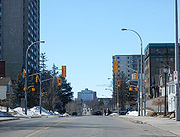
by the British as a gift for their allegiance during the American Revolution
; 240,000 hectares of land to be exact. From 1796 and 1798, the Six Nations sold 38,000 hectares of this land to a Loyalist
by the name of Colonel Richard Beasley. The portion of land that Beasley had purchased was remote but it was of great interest to German Mennonite
farming families from Pennsylvania
. They wanted to live in an area that would allow them to practice their beliefs without persecution. Eventually, the Mennonites purchased all of Beasley's unsold land creating 160 farm tracts. By 1800, the first buildings were built, and over the next decade several families made the difficult trip north to what was then known as the Sand Hills. One of these Mennonite families, arriving in 1807, was the Schneiders, whose restored 1816 home (the oldest building in the city) is now a museum located in the heart of Kitchener. Other families whose names can still be found in local place names were the Bechtels, the Ebys, the Erbs, the Weavers (better known today as the Webers) the Cressmans and the Brubachers. In 1816 the Government of Upper Canada designated the settlement the Township of Waterloo.
Much of the land, made up of moraines and swampland interspersed with rivers and streams, was converted to farmland and roads. Wild pigeons
, which once swarmed by the tens of thousands, were driven from the area. Apple trees were introduced to the region by John Eby in the 1830s, and several grist-
and sawmills (most notably Joseph Schneider's 1816 sawmill, John and Abraham Erb
's grist- and sawmills and Eby's cider mill) were erected throughout the area. Schneider built the town's first road, from his home to the corner of King Street and Queen Street (then known as Walper corner). $1000 was raised by the settlers to extend the road from Walper corner to Huether corner, where the Huether Brewery was built and the Huether Hotel now stands; a petition to the government for $100 to assist in completing the project was denied.
Immigration to the town increased considerably from 1816 until the 1870s, many of the newcomers being of German (particularly Mennonite) extraction. Some were from Switzerland, like the founder of The Arthur Pequegnat Clock Company
. In 1833 the town was renamed Berlin, and in 1853 Berlin became the County Seat of the newly created County of Waterloo, elevating it to the status of Village.
from Sarnia to Toronto (and hence through Berlin) in July 1856 was a major boon to the community, helping to improve industrialization in the area. Immigrants from Germany, mostly Lutheran and Catholic, dominated the city after 1850 and developed their own newer German celebrations, and influences, such as the Turner societies, gymnastics, and band music. During the First World War Anglophone reaction against all things German led to the abandonment of this heritage. For example, churches switched to English language services. In 1916 following much debate and controversy, the name of the city was changed to Kitchener
; named after the late British Field Marshal The 1st Earl Kitchener
. After the war, local historians and civic groups promoted a new heritage that emphasized the county's Pennsylvania Dutch roots. Illustrated souvenir books, a popular novel, and site markers celebrated this simplified, nationalistic version of the founding.
On June 9, 1912, Berlin was officially designated a city.
On September 17, 1981, the first ever "blue box" recycling
program was launched in Kitchener. Today, more than 90% of Ontario households have access to recycling programs and annually they divert more than 650,000 tonnes of secondary resource materials. The blue box program has expanded in various forms throughout Canada and to countries around the world such as the United States, United Kingdom, France and Australia, serving more than 40 million households around the world.
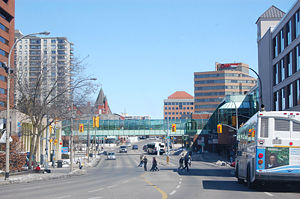 While Waterloo
has benefited from the presence of two universities and a number of high tech companies, Kitchener has been a more blue-collar town. The auto-parts manufacturer Budd Canada
, now known as Kitchener Frame, continued to employ over 1500 workers until its close in December 2008, due to the ongoing economic crisis. The city is home to four municipal business parks: the Bridgeport Business Park, Grand River West Business Park, Huron Business Park and Lancaster Corporate Centre. The largest, the Huron Business Park, is home to a number of industries, from seat manufacturers to furniture components. A number of the old industrial companies of Kitchener have fallen on harder times: the Kaufman shoe manufacturer closed its factory and companies like Electrohome
have ceased local production in favour of licensing or supply agreements with overseas makers, however many other manufacturers like Kuntz Electroplating
are still successfully operating within the city. Schneider's Foods (a meat producer) has been bought out by Maple Leaf Consumer Foods, but continues operations in Kitchener. According to the 2006 Census, 24.2% of the labour force is employed in the manufacturing sector.
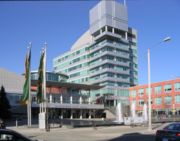
The city's current city hall
opened in September 1993. Your Kitchener Market, the modern incarnation of its historic farmers market, opened in 2004. Other projects include an assortment of lofts, utilizing old factories and other buildings. Various plans for 20 floor condo units have been put in place. By 2009, More than 91% of all downtown office space was fully occupied.
The groundbreaking ceremony for the University of Waterloo
school of pharmacy and downtown health sciences campus was officially held on March 15, 2006, and the facility opened in spring 2009. The building is located on King Street near Victoria Street, on the site of the old Epton plant, across the street from the former Kaufman shoe factory (now converted to lofts).
Economic and social impacts from the new health sciences campus have already created positive impacts with significant economic benefits associated with related business activities, and spin off business and industry that will diversify the economy and bring additional jobs to the area.
The redevelopment of the 'Centre Block' in downtown Kitchener has its vision set and is planned to start. It will include a 12 story and an 18 story condominium, more retail spaces, the redevelopment of the Mayfair Hotel and a central courtyard.
In spring 2009, work began on a major redevelopment of King Street, which focuses on making the street more pedestrian-friendly with the addition of wide sidewalks and more aesthetically pleasing features such as new planters. Parking on King Street will also be redesigned. The project will extend from Frederick/Benton Streets to Francis Street. Coinciding with the renovation of King Street is the complete overhauling of Speaker's Corner at the corner of King and Benton Streets, and the transformation of a parking lot at the corner of Charles and Benton Streets into a bright, modern, multi-story parking facility to accommodate the influx of vehicles when new businesses open and other parking lots are redeveloped.
The Province of Ontario has committed to building a new provincial courthouse in downtown Kitchener, on the block bordered by Frederick, Duke, Scott and Weber streets. The new courthouse is expected to create new jobs, mainly for the courthouse itself, but also for other businesses, especially law offices. The new courthouse construction began in 2010.
At the time of the Canada 2006 Census
, the population of Kitchener was 204,668. As of 2011, the population of Kitchener is estimated to be about 230,000.
By gender, 49.2% of the population was male and 50.8% was female. Children under five accounted for approximately 6.0% of the resident population of Kitchener, compared to 5.5% in Ontario, and 5.3% for Canada overall. Some 11.7% of the resident population in Kitchener was of retirement age, a smaller proportion of the population compared to 13.6% in Ontario, and 13.7% in Canada. The median age was 37 years, younger than the 39 years for Ontario, and 40 years for Canada. In the five years between 2001 and 2006, the population of Kitchener grew by 7.5%, higher than the growth rates for both Ontario (6.6%) and Canada(5.4%). Population density of Kitchener was 1,495 people per square kilometre.
According to the 2006 Census, 15.4 percent of the population claimed to be members of a visible minority. The largest visible minority groups are: Black
: 3.2%, South Asian: 3.1%, Latin American: 2.2%, Southeast Asia
n: 2.0%, Chinese
: 1.4%, and Others.
From the 2001 census, 78.85% of the population adhered to various Christian denominations. Due to the higher concentrations of German Canadians, Protestantism
has a greater percentage (41.32%), followed by Roman Catholic (32.44%), while the remaining 5.07% follow other Christian groups such as Eastern Orthodox, LDS, Jehovah's Witness.etc. Other religions include Islam
: 2.24%, Hindu
: 1.00%, plus others including Judaism
, Sikhism
, and Buddhism
, while 15.6% claim no religious affiliation at all.
 Kitchener is governed by a council of six councillors, representing wards (or
districts), and a mayor. As of the 2010 Municipal Election, Kitchener Council will be composed of one Mayor and 10 Ward Councillors. Council is responsible for policy and decision making, monitoring the operation and performance of the city, analyzing and approving budgets and determining spending priorities. The residents of each ward vote for one person to be their city councillor; their voice and representative on city council. Kitchener residents also elect four councillors at large to sit with the mayor on the council of the Regional Municipality of Waterloo. Municipal elections are held every four years in late October.
The current mayor of Kitchener is Carl Zehr
, who was re-elected to his fifth term in October 2010, after first being elected in 1997 and then re-elected in 2000, 2003 and 2006. Before that, he sat as a municipal councillor from 1985-1994. See Kitchener City Council
for a complete list of councillors.
In 1976, residents of Kitchener voted almost 2:1 in favour of a ward system. The first municipal election held under the ward system occurred in 1978. In 2010, the city underwent a ward boundary review. A consultant proposed boundaries for a 10 ward system for the 2010 municipal election which means that there will be 4 additional councillors/wards.
The current Member of Provincial Parliament (MPP) for Kitchener Centre is John Milloy. Other MPPs include Michael Harris
(Kitchener-Conestoga) and Elizabeth Witmer
(Kitchener-Waterloo) who both represent small portions of the city in addition to adjacent areas. The federal and provincial electoral boundaries are now aligned and the federal Members of Parliament (MPs) as follows: Stephen Woodworth
(Kitchener Centre), Harold Albrecht
(Kitchener-Conestoga) and Peter Braid
(Kitchener-Waterloo).
, founded in 1855, being the oldest. It is located in the northern area of the City not far from the boundary of Waterloo. In the 1950s and 1960s several new schools were constructed, including Eastwood Collegiate Institute
in what was then the southeastern part of the city in 1956, Forest Heights Collegiate Institute
in the western Forest Heights part of the city in 1964, Grand River Collegiate Institute
in the northeastern Heritage Park/Grand River Village area in 1966, and Cameron Heights Collegiate Institute
in the southern area of the Downtown core in 1967. In 2006, Huron Heights Secondary School
opened in southwest Kitchener. It opened with a limited enrollment of only 9th and 10th grade students, and has since expanded to full capacity in the 2008-2009 school year.
The oldest Catholic high school in the city is St. Mary's High School
, which opened in 1907. Originally a girls-only Catholic school, it was transformed into a co-ed institution in 1990 after the closure of the neighbouring St. Jerome's High School, which had been a boys-only Catholic school. The same year, a second Catholic high school, Resurrection Catholic Secondary School
, opened in the west of the city. In 2002, St. Mary's abandoned its downtown location in favour of a new one in the city's southwest. The former St. Jerome's High School currently houses the Lyle S. Hallman Faculty of Social Work from Wilfrid Laurier University
. It opened at this location in 2006, bringing 300 faculty, staff and students to downtown Kitchener. The former St. Mary's High School building, meanwhile, has been transformed into both the head office of the Waterloo Catholic District School Board
and the Kitchener Downtown Community Centre.
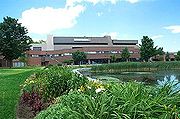 The Doon neighbourhood, formerly a separate village but now part of Kitchener, is home to the primary campus of Conestoga College
, one of the foremost non-university educational institutions in the province. For nine consecutive years, Conestoga has earned top overall ranking among Ontario colleges on the Key Performance Indicator (KPI) surveys, which measures graduate employment rates and satisfaction levels, and employer and student satisfaction. It is one of only seven polytechnical institutes
in Canada.
The University of Waterloo
is proceeding with opening a School of Pharmacy in the downtown area. The City of Kitchener has contributed $30 million from its $110 million Economic Development Investment Fund, established in 2004, to the establishment of the UW Downtown Kitchener School of Pharmacy. Construction began in 2006, and the pharmacy program was launched in January 2008 with 92 students. It is operating out of a temporary location pending the completion of construction on the downtown campus.
The school is expected to graduate about 120 pharmacists annually and will become the home of the Centre for Family Medicine, where new family physicians will be trained, as well as an optometry clinic and the International Pharmacy Graduate Program. Construction on the $147 million facility was largely finished in spring 2009.
The provincial government has also announced that the University of Waterloo's (UW) Downtown Kitchener Health Sciences Campus will be the site of a new satellite campus of McMaster University
's School of Medicine. The Michael G. DeGroote School of Medicine is expected to train 15 doctors a year, primarily through distance learning
The training of medical professionals in downtown Kitchener include developments such as:
(which is a system of two hospitals), St. Mary's General Hospital
, and Cambridge Memorial. Grand River treats patients with a wide range of problems and houses the psychiatric unit, trauma centre, women's and children's services, and the Regional Cancer Care Centre. St Mary's houses the Regional Cardiac Care Centre, serving a population of nearly one million from Waterloo Region, east to Guelph
, north to Owen Sound/Tobermory
, south to Lake Erie
, and west to Ingersoll
. It also houses a respiratory centre. Both hospitals have emergency departments and intensive care units. Cambridge Memorial is a general hospital, treating primarily patients from Cambridge and south Kitchener.
Long term rehabilitation and physiotherapy is addressed at the Freeport Health Centre
, at the south of the city. Built originally as a tuberculosis sanatorium and home for the terminally ill, its last link with that past is the palliative care unit. It nestles along the banks of the Grand River, and is part of Grand River Hospital.
Family doctors are in short supply in K-W, and a source of great concern among residents. The Chamber of Commerce runs a waiting list for people looking for a doctor, but as of 2006 the wait is over two years. Two urgent care centres cater for much of the routine services for thousands of people without a family doctor, from routine immunisations and health screening, to repeat prescriptions and referral on to specialist services. A third urgent care centre is being added to a renovated supermarket development in the desirable Forest Heights area of the city.
Announced January 2006 was the inauguration of a new School of Medicine attached to the University of Waterloo
. From 2007, 15 new family doctors will be trained each year in new premises being constructed in the downtown core on rehabilitated industrial lands along the railway.
In 2009, the mental health unit is slated for relocation from the downtown core to an unused floor at the Freeport site. By this, patients needing mental health care shall gain options for local long term care and monitoring. The current site for the unit is in the basement of the downtown hospital in an area in dire need of renovations and the absence of options for local long-term mental care forces the transfer of such patients to neighbouring London, Ontario
.
After renovations, the Child and Adolescent Inpatient Program will be moved from a small 9-bed wing to the downstairs in place of the current adult mental health unit. Once moved in 2009, upwards of 26 beds shall be available to this program.
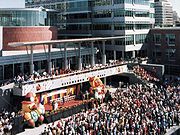 Kitchener's cultural highlights include CAFKA, The Open Ears Festival, IMPACT theatre festival, the Multicultural Festival, the Kitchener Blues Festival and KidsPark, many of which are free to the public. Kitchener is also home to venues such as Homer Watson House & Gallery, Kitchener-Waterloo Art Gallery, JM Drama Alumni
and Centre In The Square
. Live music by popular artists can be heard at venues such as Centre In The Square and The Aud. The Kitchener Public Library
is another community stalwart. Kitchener is also home to independent music label, Busted Flat Records
which features the music of many Kitchener-Waterloo based musicians.
celebration is an annual nine-day event. Based on the original German Oktoberfest
, it is billed as Canada's Greatest Bavaria
n Festival. It is held every October, starting on the Friday before Canadian Thanksgiving
and running until the Saturday after. It is the largest Bavarian festival in the world outside of Germany.
While its best-known draws are the beer
-based celebrations, other family and cultural events also fill the week. The best-known is the Oktoberfest Thanksgiving Day Parade
held on Thanksgiving Day; as it is the only major parade on Canadian Thanksgiving, it is televised
nationally. Another icon of the festival is Miss Oktoberfest. This position was formerly selected in a televised beauty pageant, with the applicants coming from across North America. The position is now selected by a closed committee of judges from a panel of local applicants; community involvement and personal character form the main criteria under the new system. A ribald spin-off of the Miss Oktoberfest pageant is celebrated in some local high schools, in which all participants are male, but dressed as women. Also the Cities recently had two local and regional museums built in the region, one being the Waterloo Region Children Museum and the Doon Heritage Museum.
, starring Corner Gas
star Fred Ewanuick
.
A local folk group, Destroy All Robots, wrote a tongue-in-cheek song jibing the town of Kitchener in the song "Battle Hymn of the City of Kitchener, Ontario".
music. The festival has expanded to 5 stages throughout the downtown area, with over 60 performances. The festival has grown from a 1 day event with an attendance of 3,000 to a 4 day event with over 65,000 attending. In 2010 the Kitchener Blues Festival celebrated its 10th year.
Kitchener. Numerous events and festivities are held in this park.
A cast-bronze statue of Queen Victoria
is located in Victoria Park, along with a cannon. The statue was unveiled in May 1911, on Victoria Day (the Queen's birthday) in the tenth year after her death. The Princess of Wales Chapter of the IODE
raised the $6,000 needed for the monument.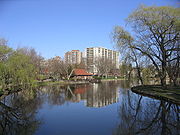 The city has announced the construction of a new Gaukel Street entrance to Victoria Park. Gaukel Street is to be used as a corridor linking Victoria Park to City Hall
. The new entrance will include a complete streetscape upgrade on Gaukel Street with new lighting, stamped concrete, and other features. The new entrance to the park itself will include stone masonry gates, walkways, new lighting, flower gardens, a pond complete with waterfalls, and a sculpture created by artist Ernest Daetwyler.
Another significant beauty spot in the city is Rockway Gardens. Adjacent to the Rockway golf course, the gardens occupy a long narrow strip of land alongside King Street as it rushes down to meet the Conestoga Parkway and become Highway 8. Here there are many fountains, ponds, waterfalls and rock grottoes. It is a popular site for wedding photos in the summer months.
Kitchener has an extensive and safe community trail system. The trails, which are controlled and run by the city, are hundreds of kilometres in length. Due to Kitchener's close proximity to the Grand River
, several community trails and paths border the river's shores. This convenient access to the Grand River has drawn nature-seeking tourists to the city. However, Kitchener's trails and especially natural areas remain underfunded by city council and as a result, many are not adequately maintained.
A newly constructed bike park located at McLennan park in the city's south end has already been hailed as one of the best city run bike parks in Southern Ontario
by BMX
and mountain biking
enthusiasts. The bike park offers a four-cross (4X)
section, a pump track
section, a jump park
, and a free-ride
couse.
Chicopee Ski Club
is also located inside city limit.
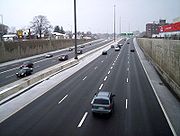 Kitchener was very proactive and visionary about its transportation network in the 1960s, with the province undertaking at that time construction of the Conestoga Parkway
from the western boundary (just past Homer Watson Boulevard) across the south side of the city and looping north along the Grand River to Northfield Drive in Waterloo.
Subsequent upgrades took the Conestoga west beyond Trussler Road and north towards St Jacobs
, with eight lanes through its middle stretch.
The Conestoga Parkway bears the provincial highway designations of Highways 7
and 8
. King Street becomes Hwy 8 where it meets the Conestoga in the south and leads down to the 401, but Old King Street survives as the street-route through Freeport to the Preston area of Cambridge
. Up until construction of the Conestoga, Highland Road through Baden
had been the primary highway to Stratford
. Victoria Street was then and remains the primary highway to Guelph
but this is slated to be bypassed with an entirely new highway beginning at the Wellington Street exit and running roughly north of and parallel to the old route.
There are two interchanges with Highway 401
on Kitchener's southern border. In addition to the primary link where Hwy 8 merges into the Hwy 401, there is another interchange on the west side with Homer Watson Boulevard.
In order to reduce the congestion on Highway 8, a new interchange has been proposed on Highway 401 at Trussler Road, which would serve the rapidly growing west side of Kitchener. Although this proposal is supported by the Region of Waterloo, the MTO has no plans to date to proceed with an interchange at Trussler Road.
pattern on the Continental models most familiar to the German settlers.
There is good historical reason for this. Kitchener was one of the few places in Ontario where the settlers arrived in advance of government surveyors. The Mennonites who had banded together as the German Company to purchase the township from Richard Beasley simply divided their vast parcel of land by the number of shareholder households and then drew random lots to confer title on individual farms. There was no grid survey done—no lines, no concessions, no right-of-way corridors for roads. When it came time to punch roads through the wilderness, the farmers modelled the road network on what was familiar to them, which was the pattern of villages in Switzerland and southern Germany.
This is a Continental Radial pattern and the result was major streets extended through diagonals cutting across the grid of smaller streets and converging at multiple-point intersections which, as the communities became more prosperous and if the automobile had not displaced the horse, might someday have become roundabouts decorated with circular gardens, fountains or statuary in the style of European cities. Five-point intersections created by converging diagonals are legion in the older areas.
In 2004, roundabouts were introduced to the Region of Waterloo. Besides improving traffic flow, they will help the region lower pollution from emissions created by idling vehicles. In 2006, the first two were installed along Ira Needles Boulevard in Kitchener. Some people argue roundabouts are ideal for intersections in this region because of the aforementioned historical growth along Continental radial patterns versus the British grid systems, but all installs have been at T and cross intersections making the point irrelevant.
For forty years, there has been a sharply controversial plan to extend River Road through an area known as Hidden Valley, but the pressure of traffic and the absence of any other full east-west arterials between Fairway Road and the Highway 401 is now forcing this development ahead.
Most streets that cross the municipal boundary between Kitchener and Waterloo
retain the same street name in both cities. However, several streets which are divided into east and west sections in Kitchener shift to a north-south division in Waterloo. This primarily affects Weber
and King Streets and Westmount Road. Since these roads do not actually change their primary directional alignment significantly, (Weber Street and King Street, supposedly "Parallel" streets, cross 3 times), the shift in labelling can create confusion, since each of the aforementioned thoroughfares bears the labels north, south, west, and east on certain segments. However, it also reduces the potential confusion that would result from having separate west and east segments of the same street existing simultaneously in both cities.
The problem with giving streets in Waterloo Region compass-based labels, and attempting to divide each of the cities into quadrants comes from the radial layout of the roads, and the historical patterns of development. Waterloo's quadrants, created by the intersection of King and Erb Streets, roughly correspond to compass directions, but Kitchener's quadrants, delineated by King and Queen Streets, do not resemble compass directions whatsoever. A notable case is that of Lancaster Street, which runs almost exactly north-south, but is designated as east-west, since it crosses Queen Street, which divides the "east" and "west" halves of the city, yet follows a northeast-southwest orientation itself.
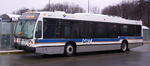 Since 2000, public transport throughout the Region of Waterloo has been provided by Grand River Transit
, which was created by a merger of the former Cambridge Transit and Kitchener Transit. GRT operate a number of bus routes in Kitchener, with many running into Waterloo
and two connecting to Cambridge
. In September 2005, GRT added an express bus
route called iXpress from downtown Cambridge through Kitchener to north Waterloo.
In 2003, Regional Council unanimously adopted the Regional Growth Management Strategy. As a response, proposals were put forth regarding a rapid transit system
serving the downtown cores of all three cities. An Environmental Assessment was completed in 2009 which recommended a light rail transit
route starting from Conestoga Mall
in north Waterloo and ending at the Ainslie Street bus terminal in Cambridge. In June 2009, Regional Council voted nearly unanimously for the recommendations in the EA. Regional staff are currently negotiating funding agreements with the provincial and federal governments, to cover the estimated $790-million cost for the system.
On October 31, 2009, GO Transit
began to provide service to Kitchener with regional bus service from Charles Street Terminal to Mississauga, Ontario
(Square One Bus Terminal
) on weekdays and weekends. On December 19, 2011, GO Transit
began train service to Kitchener with 2 weekday each direction to Union Station in Toronto. The route has been renamed from Georgetown GO Line to Kitchener GO Line to refect this extension.
and then meet up again in London
. The northern line passes through Guelph
, Kitchener and Stratford
to London. The southern line goes along the heavily populated lakeshore to Oakville
, then Brantford
, then Woodstock
, and then to London. This southern line is the primary rail corridor for CN, while the northern line through Kitchener is owned by a short-line railway called the Goderich-Exeter Railway (GEXR). The track and signalling conditions on the north and south route are very different which allows trains on the southern route to operate more frequently and more quickly, whereas trains on the northern route take an 1 hour and 40 minutes on average to get from Kitchener to Toronto and with a single track in use often need to pull into sidings to let oncoming trains pass. Consequently, Kitchener, with a regional population base equal to London and situated much closer to metropolitan Toronto, gets less than one third the frequency of passenger rail service.
Passenger service is provided by Via Rail
. Three trains in each direction travelling between Sarnia and Toronto
stop at the Kitchener railway station
daily. The station is slightly to the northeast of the city's downtown on Weber Street near its intersection with Victoria Street.
GO Transit
bus service began in Kitchener on October 31, 2009, connecting to the Milton GO Station and Mississuaga City Centre GO Terminal. The nearest GO Train station to Kitchener is Milton station. City councillors and public petitions have called for the extension of GO Train service to the Region of Waterloo. On September 2008, GO Transit announced a feasibility study into extending GO train service on the Georgetown line through Guelph
to Kitchener, with service beginning on December 19, 2011.
Freight trains in Kitchener are operated by the Goderich-Exeter Railway
and the Canadian Pacific Railway
. These railways serve several customers (including ThyssenKrupp Budd
), many of which are located in industrial parks in southern Kitchener.
in nearby Breslau, but while it is a thriving general-aviation
field, it is not heavily served by scheduled airlines. Most air travellers use Toronto's Lester B. Pearson International Airport or John C. Munro Hamilton International Airport. WestJet
has scheduled daily non-stop service to Calgary from Waterloo International Airport using Boeing 737-700 aircraft. They started service out of Waterloo International Airport on May 14, 2007, for the summer season and then decided to fly year-round due to strong passenger demand. As of June 27, 2010, Westjet also flies non-stop daily from Waterloo International Airport to Vancouver. Bearskin Airlines
started offering service in the fall of 2007 with three flights daily between Kitchener and Ottawa using a Fairchild Turboprop aircraft. Strong demand has resulted in Bearskin Airlines
adding a fourth flight on Fridays. During the winter months Sunwing Airlines offers service to Dominican Republic
. Recent upgrades to the runways, approach lighting and terminal building have permitted larger aircraft to use this airport. Air Canada
has been in talks with the Region with an eye on starting flights to Montreal and Porter Airlines
has been discussing offering flights to Toronto Island.
Southern Ontario
Southern Ontario is a region of the province of Ontario, Canada that lies south of the French River and Algonquin Park. Depending on the inclusion of the Parry Sound and Muskoka districts, its surface area would cover between 14 to 15% of the province. It is the southernmost region of...
, Canada. It was the Town of Berlin
Berlin to Kitchener name change
Through the latter half of the 19th century and into the first decade of the 20th, the City of Berlin, Ontario, Canada, was a bustling industrial centre celebrating its German heritage...
from 1854 until 1912 and the City of Berlin from 1912 until 1916. The city had a population of 204,668 in the Canada 2006 Census
Canada 2006 Census
The Canada 2006 Census was a detailed enumeration of the Canadian population. Census day was May 16, 2006. The next census following will be the 2011 Census. Canada's total population enumerated by the 2006 census was 31,612,897...
. The metropolitan area, which includes the neighbouring cities of Waterloo and Cambridge, has 451,235 people, making it the eleventh largest Census Metropolitan Area (CMA) in Canada and the fifth largest CMA in Ontario. It is the seat of the Waterloo Regional Municipality, and is adjacent to the smaller cities of Cambridge
Cambridge, Ontario
Cambridge is a city located in Southern Ontario at the confluence of the Grand and Speed rivers in the Regional Municipality of Waterloo, Ontario, Canada. It is an amalgamation of the City of Galt, the towns of Preston and Hespeler, and the hamlet of Blair.Galt covers the largest portion of...
to the south, and Waterloo
Waterloo, Ontario
Waterloo is a city in Southern Ontario, Canada. It is the smallest of the three cities in the Regional Municipality of Waterloo, and is adjacent to the city of Kitchener....
to the north. Kitchener and Waterloo are often referred to jointly as "Kitchener-Waterloo" (K-W), although they have separate municipal governments. Including Cambridge, the three cities are known as "the tri-cities".
Kitchener is also the seat of the Waterloo Region.
The City of Kitchener covers an area of 136.86 square kilometres.
Geography
Kitchener is located in Southwestern OntarioSouthwestern Ontario
Southwestern Ontario is a subregion of Southern Ontario in the Canadian province of Ontario, centred on the city of London. It extends north to south from the Bruce Peninsula on Lake Huron to the Lake Erie shoreline, and east to south-west roughly from Guelph to Windsor. The region had a population...
,in the Saint Lawrence Lowlands
Saint Lawrence Lowlands
The St. Lawrence Lowlands is an ecoregion of Mixedwood Plains and a physiographic region of Canada and the United States. It is sometimes named the "Great Lakes/St. Lawrence Lowlands", but that name improperly includes the Great Lakes Basin which, while it might drain to the Atlantic Ocean by way...
. This geological and climatic region has wet-climate soils and deciduous forests. Located in the Grand River Valley, the area is generally above 300m (1000') in elevation.
Kitchener is the largest city situated within the Grand River
Grand River (Ontario)
The Grand River is a large river in southwestern Ontario, Canada. From its source, it flows south through Grand Valley, Fergus, Elora, Waterloo, Kitchener, Cambridge, Paris, Brantford, Caledonia, and Cayuga before emptying into the north shore of Lake Erie south of Dunnville at Port Maitland...
watershed, and the largest city on the Haldimand Tract. The Haldimand tract was given to the Six Nations (Haudenosaunee) of the Grand River in 1784 and comprises 6 miles on either bank, for the whole length of the Grand River. Just to the west of the city is Baden Hill
Baden Hill
The Baden Hills are four glacier-made kames near the community of Baden in the Township of Wilmot, Ontario, Canada. Because of their elevation, up to , they have been used for radio and TV transmission towers, most notably Baden Tower on the highest and eastmost hill that hosts the antennas for...
, in Wilmot Township
Wilmot, Ontario
The Township of Wilmot is a rural township in the Regional Municipality of Waterloo in southwestern Ontario, Canada. Its 2006 Census population was 17,097.-Communities:*Baden* Mannheim*New Dundee*New Hamburg* Petersburg* Phillipsburg*St...
. This glacial kame
Kame
A kame is a geological feature, an irregularly shaped hill or mound composed of sand, gravel and till that accumulates in a depression on a retreating glacier, and is then deposited on the land surface with further melting of the glacier...
remnant formation is the highest elevation for many miles around. The other dominant glacial feature is the Waterloo Moraine
Waterloo Moraine
The Waterloo Moraine is a landform and sediment body in the Regional Municipality of Waterloo, in Ontario, Canada. It covers a large portion of the cities of Waterloo and Kitchener and the township of Wilmot, and some parts of the townships of Wellesley and North Dumfries...
, which snakes its way through the region and holds a significant quantity of artesian wells, from which the city derives most of its drinking water. The settlement's first name, Sandhills, is an accurate description of the higher points of the moraine.
Climate
Kitchener has a humid continental climateHumid continental climate
A humid continental climate is a climatic region typified by large seasonal temperature differences, with warm to hot summers and cold winters....
of the hot summer subtype (Dfa under the Koppen climate classification
Köppen climate classification
The Köppen climate classification is one of the most widely used climate classification systems. It was first published by Crimea German climatologist Wladimir Köppen in 1884, with several later modifications by Köppen himself, notably in 1918 and 1936...
); this means that there are large seasonal differences, usually very warm to hot (and humid) summers and cold (to very cold) winters. Compared to the rest of Canada, it has moderate weather. Winter temperatures generally last from the middle of December until the middle of March, while summer temperatures generally occur between the middle of May to close to the end of September. Temperatures can exceed 30℃ (86℉) several times a year. Kitchener has about 140 frost-free days a year.
History
Settlement
In 1784, the land that Kitchener was built upon was an area given to the Six NationsIroquois
The Iroquois , also known as the Haudenosaunee or the "People of the Longhouse", are an association of several tribes of indigenous people of North America...
by the British as a gift for their allegiance during the American Revolution
American Revolution
The American Revolution was the political upheaval during the last half of the 18th century in which thirteen colonies in North America joined together to break free from the British Empire, combining to become the United States of America...
; 240,000 hectares of land to be exact. From 1796 and 1798, the Six Nations sold 38,000 hectares of this land to a Loyalist
Loyalist (American Revolution)
Loyalists were American colonists who remained loyal to the Kingdom of Great Britain during the American Revolutionary War. At the time they were often called Tories, Royalists, or King's Men. They were opposed by the Patriots, those who supported the revolution...
by the name of Colonel Richard Beasley. The portion of land that Beasley had purchased was remote but it was of great interest to German Mennonite
Mennonite
The Mennonites are a group of Christian Anabaptist denominations named after the Frisian Menno Simons , who, through his writings, articulated and thereby formalized the teachings of earlier Swiss founders...
farming families from Pennsylvania
Pennsylvania
The Commonwealth of Pennsylvania is a U.S. state that is located in the Northeastern and Mid-Atlantic regions of the United States. The state borders Delaware and Maryland to the south, West Virginia to the southwest, Ohio to the west, New York and Ontario, Canada, to the north, and New Jersey to...
. They wanted to live in an area that would allow them to practice their beliefs without persecution. Eventually, the Mennonites purchased all of Beasley's unsold land creating 160 farm tracts. By 1800, the first buildings were built, and over the next decade several families made the difficult trip north to what was then known as the Sand Hills. One of these Mennonite families, arriving in 1807, was the Schneiders, whose restored 1816 home (the oldest building in the city) is now a museum located in the heart of Kitchener. Other families whose names can still be found in local place names were the Bechtels, the Ebys, the Erbs, the Weavers (better known today as the Webers) the Cressmans and the Brubachers. In 1816 the Government of Upper Canada designated the settlement the Township of Waterloo.
Much of the land, made up of moraines and swampland interspersed with rivers and streams, was converted to farmland and roads. Wild pigeons
Rock Pigeon
The Rock Dove or Rock Pigeon, is a member of the bird family Columbidae . In common usage, this bird is often simply referred to as the "pigeon"....
, which once swarmed by the tens of thousands, were driven from the area. Apple trees were introduced to the region by John Eby in the 1830s, and several grist-
Gristmill
The terms gristmill or grist mill can refer either to a building in which grain is ground into flour, or to the grinding mechanism itself.- Early history :...
and sawmills (most notably Joseph Schneider's 1816 sawmill, John and Abraham Erb
Abraham Erb
Abraham Erb was the first Mennonite settler, and generally considered the founder of Waterloo, Ontario....
's grist- and sawmills and Eby's cider mill) were erected throughout the area. Schneider built the town's first road, from his home to the corner of King Street and Queen Street (then known as Walper corner). $1000 was raised by the settlers to extend the road from Walper corner to Huether corner, where the Huether Brewery was built and the Huether Hotel now stands; a petition to the government for $100 to assist in completing the project was denied.
Immigration to the town increased considerably from 1816 until the 1870s, many of the newcomers being of German (particularly Mennonite) extraction. Some were from Switzerland, like the founder of The Arthur Pequegnat Clock Company
The Arthur Pequegnat Clock Company
The Arthur Pequegnat Clock Company is notable as the longest lasting Canadian-based clock manufacturer. Company advertisements explained the pronunciation of the name as "Say Peginaw."...
. In 1833 the town was renamed Berlin, and in 1853 Berlin became the County Seat of the newly created County of Waterloo, elevating it to the status of Village.
Post 1850
The extension of the Grand Trunk RailwayGrand Trunk Railway
The Grand Trunk Railway was a railway system which operated in the Canadian provinces of Quebec and Ontario, as well as the American states of Connecticut, Maine, Michigan, Massachusetts, New Hampshire, and Vermont. The railway was operated from headquarters in Montreal, Quebec; however, corporate...
from Sarnia to Toronto (and hence through Berlin) in July 1856 was a major boon to the community, helping to improve industrialization in the area. Immigrants from Germany, mostly Lutheran and Catholic, dominated the city after 1850 and developed their own newer German celebrations, and influences, such as the Turner societies, gymnastics, and band music. During the First World War Anglophone reaction against all things German led to the abandonment of this heritage. For example, churches switched to English language services. In 1916 following much debate and controversy, the name of the city was changed to Kitchener
Berlin to Kitchener name change
Through the latter half of the 19th century and into the first decade of the 20th, the City of Berlin, Ontario, Canada, was a bustling industrial centre celebrating its German heritage...
; named after the late British Field Marshal The 1st Earl Kitchener
Herbert Kitchener, 1st Earl Kitchener
Field Marshal Horatio Herbert Kitchener, 1st Earl Kitchener KG, KP, GCB, OM, GCSI, GCMG, GCIE, ADC, PC , was an Irish-born British Field Marshal and proconsul who won fame for his imperial campaigns and later played a central role in the early part of the First World War, although he died halfway...
. After the war, local historians and civic groups promoted a new heritage that emphasized the county's Pennsylvania Dutch roots. Illustrated souvenir books, a popular novel, and site markers celebrated this simplified, nationalistic version of the founding.
On June 9, 1912, Berlin was officially designated a city.
On September 17, 1981, the first ever "blue box" recycling
Recycling
Recycling is processing used materials into new products to prevent waste of potentially useful materials, reduce the consumption of fresh raw materials, reduce energy usage, reduce air pollution and water pollution by reducing the need for "conventional" waste disposal, and lower greenhouse...
program was launched in Kitchener. Today, more than 90% of Ontario households have access to recycling programs and annually they divert more than 650,000 tonnes of secondary resource materials. The blue box program has expanded in various forms throughout Canada and to countries around the world such as the United States, United Kingdom, France and Australia, serving more than 40 million households around the world.
Economy
Waterloo, Ontario
Waterloo is a city in Southern Ontario, Canada. It is the smallest of the three cities in the Regional Municipality of Waterloo, and is adjacent to the city of Kitchener....
has benefited from the presence of two universities and a number of high tech companies, Kitchener has been a more blue-collar town. The auto-parts manufacturer Budd Canada
Budd Company
The Budd Company is a metal fabricator and major supplier of body components to the automobile industry, and was formerly a manufacturer of stainless steel passenger rail cars during the 20th century....
, now known as Kitchener Frame, continued to employ over 1500 workers until its close in December 2008, due to the ongoing economic crisis. The city is home to four municipal business parks: the Bridgeport Business Park, Grand River West Business Park, Huron Business Park and Lancaster Corporate Centre. The largest, the Huron Business Park, is home to a number of industries, from seat manufacturers to furniture components. A number of the old industrial companies of Kitchener have fallen on harder times: the Kaufman shoe manufacturer closed its factory and companies like Electrohome
Electrohome
Electrohome was one of Canada's largest manufacturers of television sets from 1949 to 1984. The company was also involved in television broadcasting....
have ceased local production in favour of licensing or supply agreements with overseas makers, however many other manufacturers like Kuntz Electroplating
Kuntz Electroplating
Kuntz Electroplating Incorporated is a family owned surface finishing company specializing in Chrome plating. It is North America's largest polishing and plating company for original equipment manufacturers of steel, aluminum and zinc components for the automotive, motorcycle, appliance and...
are still successfully operating within the city. Schneider's Foods (a meat producer) has been bought out by Maple Leaf Consumer Foods, but continues operations in Kitchener. According to the 2006 Census, 24.2% of the labour force is employed in the manufacturing sector.
The city's current city hall
Kitchener City Hall
The City Hall of Kitchener, Ontario, Canada, has gone through many iterations through the 20th century, culminating in the current building, which opened in 1993....
opened in September 1993. Your Kitchener Market, the modern incarnation of its historic farmers market, opened in 2004. Other projects include an assortment of lofts, utilizing old factories and other buildings. Various plans for 20 floor condo units have been put in place. By 2009, More than 91% of all downtown office space was fully occupied.
The groundbreaking ceremony for the University of Waterloo
University of Waterloo
The University of Waterloo is a comprehensive public university in the city of Waterloo, Ontario, Canada. The school was founded in 1957 by Drs. Gerry Hagey and Ira G. Needles, and has since grown to an institution of more than 30,000 students, faculty, and staff...
school of pharmacy and downtown health sciences campus was officially held on March 15, 2006, and the facility opened in spring 2009. The building is located on King Street near Victoria Street, on the site of the old Epton plant, across the street from the former Kaufman shoe factory (now converted to lofts).
Economic and social impacts from the new health sciences campus have already created positive impacts with significant economic benefits associated with related business activities, and spin off business and industry that will diversify the economy and bring additional jobs to the area.
The redevelopment of the 'Centre Block' in downtown Kitchener has its vision set and is planned to start. It will include a 12 story and an 18 story condominium, more retail spaces, the redevelopment of the Mayfair Hotel and a central courtyard.
In spring 2009, work began on a major redevelopment of King Street, which focuses on making the street more pedestrian-friendly with the addition of wide sidewalks and more aesthetically pleasing features such as new planters. Parking on King Street will also be redesigned. The project will extend from Frederick/Benton Streets to Francis Street. Coinciding with the renovation of King Street is the complete overhauling of Speaker's Corner at the corner of King and Benton Streets, and the transformation of a parking lot at the corner of Charles and Benton Streets into a bright, modern, multi-story parking facility to accommodate the influx of vehicles when new businesses open and other parking lots are redeveloped.
The Province of Ontario has committed to building a new provincial courthouse in downtown Kitchener, on the block bordered by Frederick, Duke, Scott and Weber streets. The new courthouse is expected to create new jobs, mainly for the courthouse itself, but also for other businesses, especially law offices. The new courthouse construction began in 2010.
Demographics
| Ethnic origin | Population | Percent |
|---|---|---|
| Canadian Canada Canada is a North American country consisting of ten provinces and three territories. Located in the northern part of the continent, it extends from the Atlantic Ocean in the east to the Pacific Ocean in the west, and northward into the Arctic Ocean... |
55,465 | 29.48% |
| German Germans The Germans are a Germanic ethnic group native to Central Europe. The English term Germans has referred to the German-speaking population of the Holy Roman Empire since the Late Middle Ages.... |
47,380 | 25.18% |
| English English people The English are a nation and ethnic group native to England, who speak English. The English identity is of early mediaeval origin, when they were known in Old English as the Anglecynn. England is now a country of the United Kingdom, and the majority of English people in England are British Citizens... |
43,030 | 22.87% |
| Irish Irish people The Irish people are an ethnic group who originate in Ireland, an island in northwestern Europe. Ireland has been populated for around 9,000 years , with the Irish people's earliest ancestors recorded having legends of being descended from groups such as the Nemedians, Fomorians, Fir Bolg, Tuatha... |
29,520 | 15.69% |
| Scottish Scottish people The Scottish people , or Scots, are a nation and ethnic group native to Scotland. Historically they emerged from an amalgamation of the Picts and Gaels, incorporating neighbouring Britons to the south as well as invading Germanic peoples such as the Anglo-Saxons and the Norse.In modern use,... |
29,320 | 15.58% |
| French French people The French are a nation that share a common French culture and speak the French language as a mother tongue. Historically, the French population are descended from peoples of Celtic, Latin and Germanic origin, and are today a mixture of several ethnic groups... |
17,620 | 9.36% |
| Polish Poles thumb|right|180px|The state flag of [[Poland]] as used by Polish government and diplomatic authoritiesThe Polish people, or Poles , are a nation indigenous to Poland. They are united by the Polish language, which belongs to the historical Lechitic subgroup of West Slavic languages of Central Europe... |
10,515 | 5.59% |
| Dutch Dutch people The Dutch people are an ethnic group native to the Netherlands. They share a common culture and speak the Dutch language. Dutch people and their descendants are found in migrant communities worldwide, notably in Suriname, Chile, Brazil, Canada, Australia, South Africa, New Zealand, and the United... |
7,240 | 3.85% |
| Portuguese Portuguese people The Portuguese are a nation and ethnic group native to the country of Portugal, in the west of the Iberian peninsula of south-west Europe. Their language is Portuguese, and Roman Catholicism is the predominant religion.... |
5,350 | 2.84% |
| Italian Italian people The Italian people are an ethnic group that share a common Italian culture, ancestry and speak the Italian language as a mother tongue. Within Italy, Italians are defined by citizenship, regardless of ancestry or country of residence , and are distinguished from people... |
4,670 | 2.48% |
| Source: StatCan (includes multiple responses) | ||
At the time of the Canada 2006 Census
Canada 2006 Census
The Canada 2006 Census was a detailed enumeration of the Canadian population. Census day was May 16, 2006. The next census following will be the 2011 Census. Canada's total population enumerated by the 2006 census was 31,612,897...
, the population of Kitchener was 204,668. As of 2011, the population of Kitchener is estimated to be about 230,000.
| Census | Population |
|---|---|
| 1841 | 400 |
| 1871 | 2,743 |
| 1881 | 4,054 |
| 1891 | 7,425 |
| 1901 | 9,747 |
| 1911 | 15,186 |
| 1921 | 21,763 |
| 1931 | 30,793 |
| 1941 | 35,456 |
| 1951 | 44,867 |
| 1961 | 74,485 |
| 1971 | 111,804 |
| 1981 | 139,734 |
| 1991 | 168,282 |
| 2001 | 190,399 |
| 2006 | 204,668 |
By gender, 49.2% of the population was male and 50.8% was female. Children under five accounted for approximately 6.0% of the resident population of Kitchener, compared to 5.5% in Ontario, and 5.3% for Canada overall. Some 11.7% of the resident population in Kitchener was of retirement age, a smaller proportion of the population compared to 13.6% in Ontario, and 13.7% in Canada. The median age was 37 years, younger than the 39 years for Ontario, and 40 years for Canada. In the five years between 2001 and 2006, the population of Kitchener grew by 7.5%, higher than the growth rates for both Ontario (6.6%) and Canada(5.4%). Population density of Kitchener was 1,495 people per square kilometre.
According to the 2006 Census, 15.4 percent of the population claimed to be members of a visible minority. The largest visible minority groups are: Black
Black Canadian
'Black Canadians is a designation used for people of Black African descent, who are citizens or permanent residents of Canada. The term specifically refers to Canadians with Sub-Saharan African ancestry. The majority of Black Canadians are of Caribbean origin...
: 3.2%, South Asian: 3.1%, Latin American: 2.2%, Southeast Asia
Southeast Asia
Southeast Asia, South-East Asia, South East Asia or Southeastern Asia is a subregion of Asia, consisting of the countries that are geographically south of China, east of India, west of New Guinea and north of Australia. The region lies on the intersection of geological plates, with heavy seismic...
n: 2.0%, Chinese
Chinese people
The term Chinese people may refer to any of the following:*People with Han Chinese ethnicity ....
: 1.4%, and Others.
From the 2001 census, 78.85% of the population adhered to various Christian denominations. Due to the higher concentrations of German Canadians, Protestantism
Protestantism
Protestantism is one of the three major groupings within Christianity. It is a movement that began in Germany in the early 16th century as a reaction against medieval Roman Catholic doctrines and practices, especially in regards to salvation, justification, and ecclesiology.The doctrines of the...
has a greater percentage (41.32%), followed by Roman Catholic (32.44%), while the remaining 5.07% follow other Christian groups such as Eastern Orthodox, LDS, Jehovah's Witness.etc. Other religions include Islam
Islam
Islam . The most common are and . : Arabic pronunciation varies regionally. The first vowel ranges from ~~. The second vowel ranges from ~~~...
: 2.24%, Hindu
Hindu
Hindu refers to an identity associated with the philosophical, religious and cultural systems that are indigenous to the Indian subcontinent. As used in the Constitution of India, the word "Hindu" is also attributed to all persons professing any Indian religion...
: 1.00%, plus others including Judaism
Judaism
Judaism ) is the "religion, philosophy, and way of life" of the Jewish people...
, Sikhism
Sikhism
Sikhism is a monotheistic religion founded during the 15th century in the Punjab region, by Guru Nanak Dev and continued to progress with ten successive Sikh Gurus . It is the fifth-largest organized religion in the world and one of the fastest-growing...
, and Buddhism
Buddhism
Buddhism is a religion and philosophy encompassing a variety of traditions, beliefs and practices, largely based on teachings attributed to Siddhartha Gautama, commonly known as the Buddha . The Buddha lived and taught in the northeastern Indian subcontinent some time between the 6th and 4th...
, while 15.6% claim no religious affiliation at all.
Government
districts), and a mayor. As of the 2010 Municipal Election, Kitchener Council will be composed of one Mayor and 10 Ward Councillors. Council is responsible for policy and decision making, monitoring the operation and performance of the city, analyzing and approving budgets and determining spending priorities. The residents of each ward vote for one person to be their city councillor; their voice and representative on city council. Kitchener residents also elect four councillors at large to sit with the mayor on the council of the Regional Municipality of Waterloo. Municipal elections are held every four years in late October.
The current mayor of Kitchener is Carl Zehr
Carl Zehr
Carl Zehr is the mayor of Kitchener, Ontario. He has held the position since 1997, after serving as a city councillor from 1985 to 1994, and is the longest serving mayor in the history of Kitchener. He is a member of the Large Urban Mayors' Caucus of Ontario and served as its chair in 1999...
, who was re-elected to his fifth term in October 2010, after first being elected in 1997 and then re-elected in 2000, 2003 and 2006. Before that, he sat as a municipal councillor from 1985-1994. See Kitchener City Council
Kitchener City Council
Kitchener City Council is the governing body for the city of Kitchener, Ontario.The council consists of the Mayor of Kitchener and 10 ward councillors.-Members:* Mayor, Carl Zehr* Ward 1, Scott Davey* Ward 2, Berry Vrbanovic* Ward 3, John Gazzola...
for a complete list of councillors.
In 1976, residents of Kitchener voted almost 2:1 in favour of a ward system. The first municipal election held under the ward system occurred in 1978. In 2010, the city underwent a ward boundary review. A consultant proposed boundaries for a 10 ward system for the 2010 municipal election which means that there will be 4 additional councillors/wards.
The current Member of Provincial Parliament (MPP) for Kitchener Centre is John Milloy. Other MPPs include Michael Harris
Michael Harris (politician)
Michael Harris is a Canadian politician, who was elected to the Legislative Assembly of Ontario in the 2011 election. He represents the electoral district of Kitchener—Conestoga as a member of the Ontario Progressive Conservative Party caucus...
(Kitchener-Conestoga) and Elizabeth Witmer
Elizabeth Witmer
Elizabeth Witmer is a politician in Ontario, Canada. She has been a member of the Legislative Assembly of Ontario since 1990, originally representing Waterloo North and later Kitchener—Waterloo for the Progressive Conservative Party.Witmer moved with her family to Ontario at a young age...
(Kitchener-Waterloo) who both represent small portions of the city in addition to adjacent areas. The federal and provincial electoral boundaries are now aligned and the federal Members of Parliament (MPs) as follows: Stephen Woodworth
Stephen Woodworth
Stephen Woodworth is an American speculative fiction author, and a native of Fullerton, California.- Publications :* "Scary Monsters" , in Writers of the Future VIII * "Relaxation" , in Plot #1...
(Kitchener Centre), Harold Albrecht
Harold Albrecht
Harold Glenn Albrecht is a Member of Parliament for the Conservative Party of Canada in the riding of Kitchener—Conestoga...
(Kitchener-Conestoga) and Peter Braid
Peter Braid
Peter Braid is a Canadian politician. He was elected to represent the electoral district of Kitchener—Waterloo in the 2008 Canadian federal election, defeating incumbent Andrew Telegdi by a margin of 17 votes. He is a member of the Conservative Party...
(Kitchener-Waterloo).
Education
Kitchener has several public high schools, with Kitchener-Waterloo Collegiate and Vocational SchoolKitchener-Waterloo Collegiate and Vocational School
Kitchener-Waterloo Collegiate and Vocational School, sometimes shortened to Kitchener Collegiate Institute and often abbreviated as KCI, is a public secondary school in Kitchener, Ontario, Canada. It is a member of the Waterloo Region District School Board. The school dates from 1855, making it...
, founded in 1855, being the oldest. It is located in the northern area of the City not far from the boundary of Waterloo. In the 1950s and 1960s several new schools were constructed, including Eastwood Collegiate Institute
Eastwood Collegiate Institute
Eastwood Collegiate Institute is a public high school located at 760 Weber Street East in Kitchener, Ontario, Canada. It was established in 1956. The school teams are known as the "Rebels". Eastwood is known for its Provincially ranked soccer teams, as well as its Integrated Arts Program...
in what was then the southeastern part of the city in 1956, Forest Heights Collegiate Institute
Forest Heights Collegiate Institute
Forest Heights Collegiate Institute is a high school located in Kitchener, Ontario, Canada that was established in 1964. The school is often colloquially referred to as FHCI or Forest Heights by the students and other Kitchener locals. It was named after the Forest Heights neighbourhood in which it...
in the western Forest Heights part of the city in 1964, Grand River Collegiate Institute
Grand River Collegiate Institute
Grand River Collegiate Institute is a public secondary school in Kitchener, Ontario. The school is located at 175 Indian Road, Kitchener, Ontario. It is part of the Waterloo Region District School Board...
in the northeastern Heritage Park/Grand River Village area in 1966, and Cameron Heights Collegiate Institute
Cameron Heights Collegiate Institute
Cameron Heights Collegiate Institute is a public secondary school in Kitchener, Ontario. It is part of the International Baccalaureate program. The school is located at 301 Charles St. E. Kitchener, Ontario. It is also part of the Waterloo Region District School Board. The school is also one of...
in the southern area of the Downtown core in 1967. In 2006, Huron Heights Secondary School
Huron Heights Secondary School (Kitchener)
Huron Heights Secondary School is the newest high school in Kitchener, Ontario, Canada. It serves the rapidly-growing southwest end of the city, located at the intersection of Strasburg and Huron Road. It opened on September 5, 2006...
opened in southwest Kitchener. It opened with a limited enrollment of only 9th and 10th grade students, and has since expanded to full capacity in the 2008-2009 school year.
The oldest Catholic high school in the city is St. Mary's High School
St. Mary's High School (Kitchener)
St. Mary's High School is a Catholic secondary school in Kitchener, Ontario,Canada. It serves most of Kitchener's Catholic students, with others attend Resurrection Catholic Secondary School...
, which opened in 1907. Originally a girls-only Catholic school, it was transformed into a co-ed institution in 1990 after the closure of the neighbouring St. Jerome's High School, which had been a boys-only Catholic school. The same year, a second Catholic high school, Resurrection Catholic Secondary School
Resurrection Catholic Secondary School
Resurrection Catholic Secondary School is a Catholic high school in Kitchener, Ontario, Canada.-Administration:As of October 2009, the school currently has one principal and 3 vice-principals:*Principal: Paul Lacalamita* Kevin Hinschsperger...
, opened in the west of the city. In 2002, St. Mary's abandoned its downtown location in favour of a new one in the city's southwest. The former St. Jerome's High School currently houses the Lyle S. Hallman Faculty of Social Work from Wilfrid Laurier University
Wilfrid Laurier University
Wilfrid Laurier University is a university located in Waterloo, Ontario, Canada. It also has campuses in Brantford, Ontario, Kitchener, Ontario and Toronto, Ontario and a future proposed campus in Milton, Ontario. It is named in honour of Sir Wilfrid Laurier, the seventh Prime Minister of Canada....
. It opened at this location in 2006, bringing 300 faculty, staff and students to downtown Kitchener. The former St. Mary's High School building, meanwhile, has been transformed into both the head office of the Waterloo Catholic District School Board
Waterloo Catholic District School Board
Waterloo Catholic District School Board is a school board serving the Region of Waterloo, Ontario, Canada. Its headquarters are in Kitchener. It is the eighth largest Catholic school system in Ontario...
and the Kitchener Downtown Community Centre.
Conestoga College
The Conestoga College Institute of Technology and Advanced Learning is a public college based in Kitchener, Ontario in Canada.-History:The College was founded in 1967 as the Conestoga College of Applied Arts and Technology, one of many such institutions established in that time by the Ontario...
, one of the foremost non-university educational institutions in the province. For nine consecutive years, Conestoga has earned top overall ranking among Ontario colleges on the Key Performance Indicator (KPI) surveys, which measures graduate employment rates and satisfaction levels, and employer and student satisfaction. It is one of only seven polytechnical institutes
Institute of technology
Institute of technology is a designation employed in a wide range of learning institutions awarding different types of degrees and operating often at variable levels of the educational system...
in Canada.
The University of Waterloo
University of Waterloo
The University of Waterloo is a comprehensive public university in the city of Waterloo, Ontario, Canada. The school was founded in 1957 by Drs. Gerry Hagey and Ira G. Needles, and has since grown to an institution of more than 30,000 students, faculty, and staff...
is proceeding with opening a School of Pharmacy in the downtown area. The City of Kitchener has contributed $30 million from its $110 million Economic Development Investment Fund, established in 2004, to the establishment of the UW Downtown Kitchener School of Pharmacy. Construction began in 2006, and the pharmacy program was launched in January 2008 with 92 students. It is operating out of a temporary location pending the completion of construction on the downtown campus.
The school is expected to graduate about 120 pharmacists annually and will become the home of the Centre for Family Medicine, where new family physicians will be trained, as well as an optometry clinic and the International Pharmacy Graduate Program. Construction on the $147 million facility was largely finished in spring 2009.
The provincial government has also announced that the University of Waterloo's (UW) Downtown Kitchener Health Sciences Campus will be the site of a new satellite campus of McMaster University
McMaster University
McMaster University is a public research university whose main campus is located in Hamilton, Ontario, Canada. The main campus is located on of land in the residential neighbourhood of Westdale, adjacent to Hamilton's Royal Botanical Gardens...
's School of Medicine. The Michael G. DeGroote School of Medicine is expected to train 15 doctors a year, primarily through distance learning
The training of medical professionals in downtown Kitchener include developments such as:
- In 2008, the UW School of Pharmacy began admitting 120 students each year.
- Eventually, the UW School of Pharmacy campus will evolve to become the UW Downtown Kitchener Health Sciences Campus, offering more programs and bringing hundreds of faculty, staff and students to the downtown core
- There are plans for an Integrated Primary Health Care Centre on the UW site that will provide as many as 12 more family physicians locally, as well as training for many more medical doctors.
- The Centre for Family Medicine, which is already up and running in the former Victoria School Centre in downtown Kitchener, is slated to move to the UW campus sometime after it opens. Currently, there are six practicing family physicians in the Centre and plans are to boost that number to as many as 14 family physicians.
- New physicians trained either at the new Integrated Primary Health Care Centre or the Centre for Family Medicine will learn in and create holistic healthHolistic healthHolistic health is a concept in medical practice upholding that all aspects of people's needs, psychological, physical and social should be taken into account and seen as a whole. As defined above, the holistic view on treatment is widely accepted in medicine...
care models of the future. - In September 2006, the Wilfrid Laurier Faculty of Social Work opened in the former St. Jerome's High School building on Duke Street adding yet another dimension to the "health care" theme in downtown Kitchener.
Health care in Kitchener
Kitchener-Waterloo is served by three hospitals, Grand River HospitalGrand River Hospital
Grand River Hospital is a 495-bed hospital serving Waterloo Region, Ontario, Canada and surrounding communities, primarily through the K-W Health Centre and the Freeport Health Centre, both located in Kitchener...
(which is a system of two hospitals), St. Mary's General Hospital
St. Mary's General Hospital
St. Mary's General Hospital is a 191-bed adult acute-care facility in Kitchener, Ontario, Canada serving Waterloo Region and surrounding area. It is the site of the Regional Cardiac Care Centre, which opened in 2003. The emergency department was extensively renovated in 2004.-History:St. Mary's...
, and Cambridge Memorial. Grand River treats patients with a wide range of problems and houses the psychiatric unit, trauma centre, women's and children's services, and the Regional Cancer Care Centre. St Mary's houses the Regional Cardiac Care Centre, serving a population of nearly one million from Waterloo Region, east to Guelph
Guelph
Guelph is a city in Ontario, Canada.Guelph may also refer to:* Guelph , consisting of the City of Guelph, Ontario* Guelph , as the above* University of Guelph, in the same city...
, north to Owen Sound/Tobermory
Tobermory, Ontario
Tobermory is a small community located at the northern tip of the Bruce Peninsula in the municipality of Northern Bruce Peninsula, Ontario, Canada. It is 300 km northwest of Toronto...
, south to Lake Erie
Lake Erie
Lake Erie is the fourth largest lake of the five Great Lakes in North America, and the tenth largest globally. It is the southernmost, shallowest, and smallest by volume of the Great Lakes and therefore also has the shortest average water residence time. It is bounded on the north by the...
, and west to Ingersoll
Ingersoll, Ontario
Ingersoll is a town in Oxford County on the Thames River in southwestern Ontario, Canada. The nearest cities are Woodstock to the east and London to the west....
. It also houses a respiratory centre. Both hospitals have emergency departments and intensive care units. Cambridge Memorial is a general hospital, treating primarily patients from Cambridge and south Kitchener.
Long term rehabilitation and physiotherapy is addressed at the Freeport Health Centre
Grand River Hospital
Grand River Hospital is a 495-bed hospital serving Waterloo Region, Ontario, Canada and surrounding communities, primarily through the K-W Health Centre and the Freeport Health Centre, both located in Kitchener...
, at the south of the city. Built originally as a tuberculosis sanatorium and home for the terminally ill, its last link with that past is the palliative care unit. It nestles along the banks of the Grand River, and is part of Grand River Hospital.
Family doctors are in short supply in K-W, and a source of great concern among residents. The Chamber of Commerce runs a waiting list for people looking for a doctor, but as of 2006 the wait is over two years. Two urgent care centres cater for much of the routine services for thousands of people without a family doctor, from routine immunisations and health screening, to repeat prescriptions and referral on to specialist services. A third urgent care centre is being added to a renovated supermarket development in the desirable Forest Heights area of the city.
Announced January 2006 was the inauguration of a new School of Medicine attached to the University of Waterloo
University of Waterloo
The University of Waterloo is a comprehensive public university in the city of Waterloo, Ontario, Canada. The school was founded in 1957 by Drs. Gerry Hagey and Ira G. Needles, and has since grown to an institution of more than 30,000 students, faculty, and staff...
. From 2007, 15 new family doctors will be trained each year in new premises being constructed in the downtown core on rehabilitated industrial lands along the railway.
In 2009, the mental health unit is slated for relocation from the downtown core to an unused floor at the Freeport site. By this, patients needing mental health care shall gain options for local long term care and monitoring. The current site for the unit is in the basement of the downtown hospital in an area in dire need of renovations and the absence of options for local long-term mental care forces the transfer of such patients to neighbouring London, Ontario
London, Ontario
London is a city in Southwestern Ontario, Canada, situated along the Quebec City – Windsor Corridor. The city has a population of 352,395, and the metropolitan area has a population of 457,720, according to the 2006 Canadian census; the metro population in 2009 was estimated at 489,274. The city...
.
After renovations, the Child and Adolescent Inpatient Program will be moved from a small 9-bed wing to the downstairs in place of the current adult mental health unit. Once moved in 2009, upwards of 26 beds shall be available to this program.
Culture
JM Drama Alumni
JM Drama Alumni is a Non-for-Profit, community theatre company located in Kitchener, Ontario. The company performs out of the Registry Theatre, in the heart of downtown Kitchener.-History:...
and Centre In The Square
Centre In The Square
Centre In The Square is a live theatre and performing arts centre located on Queen Street in downtown Kitchener, Ontario.The Centre is home to the Raffi Armenian Theatre. This 2,047 seat hall is the largest in Waterloo Region as well as the main venue for Kitchener-Waterloo Symphony performances....
. Live music by popular artists can be heard at venues such as Centre In The Square and The Aud. The Kitchener Public Library
Kitchener Public Library
The Kitchener Public Library is the public library system for the city of Kitchener, Ontario, Canada. It has a main branch in the downtown core, and four smaller branches throughout the wider community. The main branch, located in downtown Kitchener, is currently under construction in order to...
is another community stalwart. Kitchener is also home to independent music label, Busted Flat Records
Busted Flat Records
Busted Flat Records is a critically acclaimed independent music label founded in 2002 by Mark Logan and based in Kitchener, Canada. Musicians on the roster include blues artist, Matt Andersen , as well as Paul MacLeod, Brock...
which features the music of many Kitchener-Waterloo based musicians.
Kitchener-Waterloo Oktoberfest
Kitchener-Waterloo's OktoberfestOktoberfest
Oktoberfest, or Wiesn, is a 16–18 day beer festival held annually in Munich, Bavaria, Germany, running from late September to the first weekend in October. It is one of the most famous events in Germany and is the world's largest fair, with more than 5 million people attending every year. The...
celebration is an annual nine-day event. Based on the original German Oktoberfest
Oktoberfest
Oktoberfest, or Wiesn, is a 16–18 day beer festival held annually in Munich, Bavaria, Germany, running from late September to the first weekend in October. It is one of the most famous events in Germany and is the world's largest fair, with more than 5 million people attending every year. The...
, it is billed as Canada's Greatest Bavaria
Bavaria
Bavaria, formally the Free State of Bavaria is a state of Germany, located in the southeast of Germany. With an area of , it is the largest state by area, forming almost 20% of the total land area of Germany...
n Festival. It is held every October, starting on the Friday before Canadian Thanksgiving
Thanksgiving (Canada)
Thanksgiving, or Thanksgiving Day , occurring on the second Monday in October , is an annual Canadian holiday to give thanks at the close of the harvest season....
and running until the Saturday after. It is the largest Bavarian festival in the world outside of Germany.
While its best-known draws are the beer
Beer
Beer is the world's most widely consumed andprobably oldest alcoholic beverage; it is the third most popular drink overall, after water and tea. It is produced by the brewing and fermentation of sugars, mainly derived from malted cereal grains, most commonly malted barley and malted wheat...
-based celebrations, other family and cultural events also fill the week. The best-known is the Oktoberfest Thanksgiving Day Parade
Parade
A parade is a procession of people, usually organized along a street, often in costume, and often accompanied by marching bands, floats or sometimes large balloons. Parades are held for a wide range of reasons, but are usually celebrations of some kind...
held on Thanksgiving Day; as it is the only major parade on Canadian Thanksgiving, it is televised
Television
Television is a telecommunication medium for transmitting and receiving moving images that can be monochrome or colored, with accompanying sound...
nationally. Another icon of the festival is Miss Oktoberfest. This position was formerly selected in a televised beauty pageant, with the applicants coming from across North America. The position is now selected by a closed committee of judges from a panel of local applicants; community involvement and personal character form the main criteria under the new system. A ribald spin-off of the Miss Oktoberfest pageant is celebrated in some local high schools, in which all participants are male, but dressed as women. Also the Cities recently had two local and regional museums built in the region, one being the Waterloo Region Children Museum and the Doon Heritage Museum.
Kitchener-Waterloo in film and music
Various locations in both Kitchener and Waterloo were used to portray the fictional Ontario town of Wessex in the filming of Canadian television sitcom, Dan for MayorDan for Mayor
Dan for Mayor is a Canadian television sitcom starring Fred Ewanuick that debuted on March 1, 2010 on CTV and The Comedy Network. It premiered the same night as Hiccups, a show created by Corner Gas star Brent Butt that also features fellow Corner Gas alumna Nancy Robertson. On June 7, 2010, both...
, starring Corner Gas
Corner Gas
Corner Gas is a Canadian television sitcom created by Brent Butt. The series ran for six seasons from 2004 to 2009. Re-runs still air on CTV and The Comedy Network in Canada; it formerly aired on WGN America in the United States....
star Fred Ewanuick
Fred Ewanuick
Fred Ewanuick is a Canadian actor of Ukrainian and Italian heritage, known for his role in the television series Corner Gas as Hank Yarbo. He was also a regular in a CTV anthology series, Robson Arms.-Early life:...
.
A local folk group, Destroy All Robots, wrote a tongue-in-cheek song jibing the town of Kitchener in the song "Battle Hymn of the City of Kitchener, Ontario".
Kitchener Blues Festival
A 4 day festival in downtown Kitchener dedicated to bluesBlues
Blues is the name given to both a musical form and a music genre that originated in African-American communities of primarily the "Deep South" of the United States at the end of the 19th century from spirituals, work songs, field hollers, shouts and chants, and rhymed simple narrative ballads...
music. The festival has expanded to 5 stages throughout the downtown area, with over 60 performances. The festival has grown from a 1 day event with an attendance of 3,000 to a 4 day event with over 65,000 attending. In 2010 the Kitchener Blues Festival celebrated its 10th year.
Kitchener-Waterloo Multicultural Festival
This is a 2-day event in Victoria Park commencing usually on the first weekend of the summer. The festival features foods, dance and music from around the world. The festival also showcases several vendors that sell artifacts and crafts from around the world. This festival has been ongoing for well over 40 years. Well over 50,000 attend every year.Recreation
Kitchener's oldest and most important outdoor park is Victoria Park, in the heart of downtownDowntown
Downtown is a term primarily used in North America by English speakers to refer to a city's core or central business district ....
Kitchener. Numerous events and festivities are held in this park.
A cast-bronze statue of Queen Victoria
Victoria of the United Kingdom
Victoria was the monarch of the United Kingdom of Great Britain and Ireland from 20 June 1837 until her death. From 1 May 1876, she used the additional title of Empress of India....
is located in Victoria Park, along with a cannon. The statue was unveiled in May 1911, on Victoria Day (the Queen's birthday) in the tenth year after her death. The Princess of Wales Chapter of the IODE
Imperial Order of the Daughters of the Empire
The Imperial Order of the Daughters of the Empire is a women's charitable organization based in Canada. The club was originally titled the "Federation of Daughters of the British Empire", which was founded by Margaret Clark Murray in 1900...
raised the $6,000 needed for the monument.
Kitchener City Hall
The City Hall of Kitchener, Ontario, Canada, has gone through many iterations through the 20th century, culminating in the current building, which opened in 1993....
. The new entrance will include a complete streetscape upgrade on Gaukel Street with new lighting, stamped concrete, and other features. The new entrance to the park itself will include stone masonry gates, walkways, new lighting, flower gardens, a pond complete with waterfalls, and a sculpture created by artist Ernest Daetwyler.
Another significant beauty spot in the city is Rockway Gardens. Adjacent to the Rockway golf course, the gardens occupy a long narrow strip of land alongside King Street as it rushes down to meet the Conestoga Parkway and become Highway 8. Here there are many fountains, ponds, waterfalls and rock grottoes. It is a popular site for wedding photos in the summer months.
Kitchener has an extensive and safe community trail system. The trails, which are controlled and run by the city, are hundreds of kilometres in length. Due to Kitchener's close proximity to the Grand River
Grand River (Ontario)
The Grand River is a large river in southwestern Ontario, Canada. From its source, it flows south through Grand Valley, Fergus, Elora, Waterloo, Kitchener, Cambridge, Paris, Brantford, Caledonia, and Cayuga before emptying into the north shore of Lake Erie south of Dunnville at Port Maitland...
, several community trails and paths border the river's shores. This convenient access to the Grand River has drawn nature-seeking tourists to the city. However, Kitchener's trails and especially natural areas remain underfunded by city council and as a result, many are not adequately maintained.
A newly constructed bike park located at McLennan park in the city's south end has already been hailed as one of the best city run bike parks in Southern Ontario
Southern Ontario
Southern Ontario is a region of the province of Ontario, Canada that lies south of the French River and Algonquin Park. Depending on the inclusion of the Parry Sound and Muskoka districts, its surface area would cover between 14 to 15% of the province. It is the southernmost region of...
by BMX
Freestyle BMX
Freestyle BMX is a synonym for BMX stunt riding, a sport branch that hails from extreme sports. It consists of six disciplines: street, park, vert, trails, dirt and flatland .-History:...
and mountain biking
Mountain biking
Mountain biking is a sport which consists of riding bicycles off-road, often over rough terrain, using specially adapted mountain bikes. Mountain bikes share similarities with other bikes, but incorporate features designed to enhance durability and performance in rough terrain.Mountain biking can...
enthusiasts. The bike park offers a four-cross (4X)
Four-cross
Four-cross , also called Mountain-cross, not to be confused with Fourcross, is a relatively new style of mountain bike racing where four bikers race downhill on a prepared, BMX like, track, simply trying to get down first. These bikes are generally either full suspension with 3 to 4 inches of...
section, a pump track
Freestyle BMX
Freestyle BMX is a synonym for BMX stunt riding, a sport branch that hails from extreme sports. It consists of six disciplines: street, park, vert, trails, dirt and flatland .-History:...
section, a jump park
Dirt Jumping
Dirt jumping is one of the names given to the practice of riding bikes over cement type jumps of dirt or soil and becoming airborne. The idea is that after riding over the 'take off' the rider will become momentarily airborne, and aim to land on the 'landing'.Dirt jumping can be done on almost...
, and a free-ride
Flatland BMX
Flatland is a freestyle BMX riding style performed on smooth flat surfaces that do not include any ramps, jumps, or grindrails. It is sometimes described as a form of artistic cycling with a blend of breakdancing. Flatland as a discipline also encompasses certain aspects Martial arts and Zen...
couse.
Chicopee Ski Club
Chicopee Ski Club
Chicopee Ski Club is a ski club in Kitchener, Ontario, Canada, founded in 1934 as a not-for-profit organization providing winter recreation on . The club is located on land owned by the Grand River Conservation Authority....
is also located inside city limit.
Highways and expressways
Conestoga Parkway
The Conestoga Parkway is a freeway in the Regional Municipality of Waterloo, in the Canadian province of Ontario. It runs northeast/southwest through the cities of Kitchener and Waterloo, and is connected to Highway 401 via the Highway 8 Freeport Diversion and King Street East.- Route...
from the western boundary (just past Homer Watson Boulevard) across the south side of the city and looping north along the Grand River to Northfield Drive in Waterloo.
Subsequent upgrades took the Conestoga west beyond Trussler Road and north towards St Jacobs
St. Jacobs, Ontario
The community of St. Jacobs is located in southwest Ontario, just north of Waterloo in Woolwich Township, Waterloo Region. It is a popular location for tourism, due to its Mennonite heritage and retail focus. The Conestogo River, which powered the village's original gristmill, runs through the...
, with eight lanes through its middle stretch.
The Conestoga Parkway bears the provincial highway designations of Highways 7
Highway 7 (Ontario)
King's Highway 7, commonly referred to as Highway 7 and historically as the Northern Highway, is a provincially maintained highway in the Canadian province of Ontario...
and 8
Highway 8 (Ontario)
Provincial Highway 8 is a provincially maintained highway in the Canadian province of Ontario. Its total length is 138.5 km, though it was once much longer, running farther east from Hamilton to Niagara Falls, before the Queen Elizabeth Way replaced its role.- History :Highway 8 is one of the...
. King Street becomes Hwy 8 where it meets the Conestoga in the south and leads down to the 401, but Old King Street survives as the street-route through Freeport to the Preston area of Cambridge
Cambridge, Ontario
Cambridge is a city located in Southern Ontario at the confluence of the Grand and Speed rivers in the Regional Municipality of Waterloo, Ontario, Canada. It is an amalgamation of the City of Galt, the towns of Preston and Hespeler, and the hamlet of Blair.Galt covers the largest portion of...
. Up until construction of the Conestoga, Highland Road through Baden
Baden, Ontario
Baden is a community in Township of Wilmot, Regional Municipality of Waterloo, Ontario, Canada. It has a population of less than 1000 and was named after Baden-Baden in Germany...
had been the primary highway to Stratford
Stratford, Ontario
Stratford is a city on the Avon River in Perth County in southwestern Ontario, Canada with a population of 32,000.When the area was first settled by Europeans in 1832, the townsite and the river were named after Stratford-upon-Avon, England. It is the seat of Perth County. Stratford was...
. Victoria Street was then and remains the primary highway to Guelph
Guelph
Guelph is a city in Ontario, Canada.Guelph may also refer to:* Guelph , consisting of the City of Guelph, Ontario* Guelph , as the above* University of Guelph, in the same city...
but this is slated to be bypassed with an entirely new highway beginning at the Wellington Street exit and running roughly north of and parallel to the old route.
There are two interchanges with Highway 401
Highway 401 (Ontario)
King's Highway 401, also known by its official name as the Macdonald–Cartier Freeway and colloquially as the four-oh-one, is a 400-Series Highway in the Canadian province of Ontario stretching from Windsor to the Quebec border...
on Kitchener's southern border. In addition to the primary link where Hwy 8 merges into the Hwy 401, there is another interchange on the west side with Homer Watson Boulevard.
In order to reduce the congestion on Highway 8, a new interchange has been proposed on Highway 401 at Trussler Road, which would serve the rapidly growing west side of Kitchener. Although this proposal is supported by the Region of Waterloo, the MTO has no plans to date to proceed with an interchange at Trussler Road.
City streets
Unlike most southern Ontario cities whose streets follow a strict British grid survey pattern, Kitchener's streets are laid out in a complex radialpattern on the Continental models most familiar to the German settlers.
There is good historical reason for this. Kitchener was one of the few places in Ontario where the settlers arrived in advance of government surveyors. The Mennonites who had banded together as the German Company to purchase the township from Richard Beasley simply divided their vast parcel of land by the number of shareholder households and then drew random lots to confer title on individual farms. There was no grid survey done—no lines, no concessions, no right-of-way corridors for roads. When it came time to punch roads through the wilderness, the farmers modelled the road network on what was familiar to them, which was the pattern of villages in Switzerland and southern Germany.
This is a Continental Radial pattern and the result was major streets extended through diagonals cutting across the grid of smaller streets and converging at multiple-point intersections which, as the communities became more prosperous and if the automobile had not displaced the horse, might someday have become roundabouts decorated with circular gardens, fountains or statuary in the style of European cities. Five-point intersections created by converging diagonals are legion in the older areas.
In 2004, roundabouts were introduced to the Region of Waterloo. Besides improving traffic flow, they will help the region lower pollution from emissions created by idling vehicles. In 2006, the first two were installed along Ira Needles Boulevard in Kitchener. Some people argue roundabouts are ideal for intersections in this region because of the aforementioned historical growth along Continental radial patterns versus the British grid systems, but all installs have been at T and cross intersections making the point irrelevant.
For forty years, there has been a sharply controversial plan to extend River Road through an area known as Hidden Valley, but the pressure of traffic and the absence of any other full east-west arterials between Fairway Road and the Highway 401 is now forcing this development ahead.
Most streets that cross the municipal boundary between Kitchener and Waterloo
Waterloo, Ontario
Waterloo is a city in Southern Ontario, Canada. It is the smallest of the three cities in the Regional Municipality of Waterloo, and is adjacent to the city of Kitchener....
retain the same street name in both cities. However, several streets which are divided into east and west sections in Kitchener shift to a north-south division in Waterloo. This primarily affects Weber
Weber Street
Weber Street , or Waterloo Regional Road 8, is a major roadway in Kitchener-Waterloo, Ontario, Canada. The street is likely named for early German immigrants from Pennsylvania that migrated of the region...
and King Streets and Westmount Road. Since these roads do not actually change their primary directional alignment significantly, (Weber Street and King Street, supposedly "Parallel" streets, cross 3 times), the shift in labelling can create confusion, since each of the aforementioned thoroughfares bears the labels north, south, west, and east on certain segments. However, it also reduces the potential confusion that would result from having separate west and east segments of the same street existing simultaneously in both cities.
The problem with giving streets in Waterloo Region compass-based labels, and attempting to divide each of the cities into quadrants comes from the radial layout of the roads, and the historical patterns of development. Waterloo's quadrants, created by the intersection of King and Erb Streets, roughly correspond to compass directions, but Kitchener's quadrants, delineated by King and Queen Streets, do not resemble compass directions whatsoever. A notable case is that of Lancaster Street, which runs almost exactly north-south, but is designated as east-west, since it crosses Queen Street, which divides the "east" and "west" halves of the city, yet follows a northeast-southwest orientation itself.
Public transport
Grand River Transit
Grand River Transit, or GRT, is the public transport operator for the Region of Waterloo, Ontario, Canada. It operates daily bus services in the region, primarily in the cities of Kitchener, Waterloo, and Cambridge....
, which was created by a merger of the former Cambridge Transit and Kitchener Transit. GRT operate a number of bus routes in Kitchener, with many running into Waterloo
Waterloo, Ontario
Waterloo is a city in Southern Ontario, Canada. It is the smallest of the three cities in the Regional Municipality of Waterloo, and is adjacent to the city of Kitchener....
and two connecting to Cambridge
Cambridge, Ontario
Cambridge is a city located in Southern Ontario at the confluence of the Grand and Speed rivers in the Regional Municipality of Waterloo, Ontario, Canada. It is an amalgamation of the City of Galt, the towns of Preston and Hespeler, and the hamlet of Blair.Galt covers the largest portion of...
. In September 2005, GRT added an express bus
Bus rapid transit
Bus rapid transit is a term applied to a variety of public transportation systems using buses to provide faster, more efficient service than an ordinary bus line. Often this is achieved by making improvements to existing infrastructure, vehicles and scheduling...
route called iXpress from downtown Cambridge through Kitchener to north Waterloo.
In 2003, Regional Council unanimously adopted the Regional Growth Management Strategy. As a response, proposals were put forth regarding a rapid transit system
Rapid transit in Waterloo Region
Work has begun on the introduction of rapid transit service in the Region of Waterloo in Ontario, as an enhancement to Grand River Transit. As of 2009, an Environmental Assessment was underway to create a proposal of light rail though Kitchener and Waterloo, and adapted bus rapid transit through...
serving the downtown cores of all three cities. An Environmental Assessment was completed in 2009 which recommended a light rail transit
Light Rail Transit
The name Light Rail Transit is used to refer to several light rail systems, as an official name or otherwise:* Please see List of tram and light-rail transit systems.-See also:* Light Rapid Transit * Light railway* Light rail...
route starting from Conestoga Mall
Conestoga Mall
Conestoga Mall is a major shopping mall situated at 550 King Street North in Waterloo, Ontario, Canada. Located at King Street's interchange with Highway 85 , it is the largest shopping centre in Waterloo, and third-largest in Waterloo Region...
in north Waterloo and ending at the Ainslie Street bus terminal in Cambridge. In June 2009, Regional Council voted nearly unanimously for the recommendations in the EA. Regional staff are currently negotiating funding agreements with the provincial and federal governments, to cover the estimated $790-million cost for the system.
On October 31, 2009, GO Transit
GO Transit
GO Transit is an inter-regional public transit system in Southern Ontario, Canada. It primarily serves the Greater Toronto and Hamilton Area conurbation, with operations extending to several communities beyond the GTHA proper in the Greater Golden Horseshoe...
began to provide service to Kitchener with regional bus service from Charles Street Terminal to Mississauga, Ontario
Mississauga, Ontario
Mississauga is a city in Southern Ontario located in the Regional Municipality of Peel, and in the western part of the Greater Toronto Area. With an estimated population of 734,000, it is Canada's sixth-most populous municipality, and has almost doubled in population in each of the last two decades...
(Square One Bus Terminal
Square One Bus Terminal
Square One Bus Terminal is located on Station Gate Road, between Chapters and Playdium, in Mississauga, Ontario, Canada. This regional GO Transit facility is conveniently situated directly across from the Mississauga City Centre Transit Terminal at 200 Rathburn Road West, the main hub for local...
) on weekdays and weekends. On December 19, 2011, GO Transit
GO Transit
GO Transit is an inter-regional public transit system in Southern Ontario, Canada. It primarily serves the Greater Toronto and Hamilton Area conurbation, with operations extending to several communities beyond the GTHA proper in the Greater Golden Horseshoe...
began train service to Kitchener with 2 weekday each direction to Union Station in Toronto. The route has been renamed from Georgetown GO Line to Kitchener GO Line to refect this extension.
Railways
Passenger rail service has long been a point of frustration for residents of Kitchener and its neighbouring cities. Two main lines come westward out of TorontoToronto
Toronto is the provincial capital of Ontario and the largest city in Canada. It is located in Southern Ontario on the northwestern shore of Lake Ontario. A relatively modern city, Toronto's history dates back to the late-18th century, when its land was first purchased by the British monarchy from...
and then meet up again in London
London, Ontario
London is a city in Southwestern Ontario, Canada, situated along the Quebec City – Windsor Corridor. The city has a population of 352,395, and the metropolitan area has a population of 457,720, according to the 2006 Canadian census; the metro population in 2009 was estimated at 489,274. The city...
. The northern line passes through Guelph
Guelph
Guelph is a city in Ontario, Canada.Guelph may also refer to:* Guelph , consisting of the City of Guelph, Ontario* Guelph , as the above* University of Guelph, in the same city...
, Kitchener and Stratford
Stratford, Ontario
Stratford is a city on the Avon River in Perth County in southwestern Ontario, Canada with a population of 32,000.When the area was first settled by Europeans in 1832, the townsite and the river were named after Stratford-upon-Avon, England. It is the seat of Perth County. Stratford was...
to London. The southern line goes along the heavily populated lakeshore to Oakville
Oakville, Ontario
Oakville is a town in Halton Region, on Lake Ontario in Southern Ontario, Canada, and is part of the Greater Toronto Area. As of the 2006 census the population was 165,613.-History:In 1793, Dundas Street was surveyed for a military road...
, then Brantford
Brantford, Ontario
Brantford is a city located on the Grand River in Southern Ontario, Canada. While geographically surrounded by the County of Brant, the city is politically independent...
, then Woodstock
Woodstock, Ontario
Woodstock is a city and the county seat of Oxford County in Southern Ontario, Canada. Woodstock is located 128 km southwest of Toronto, north of Highway 401 along the historic Thames River...
, and then to London. This southern line is the primary rail corridor for CN, while the northern line through Kitchener is owned by a short-line railway called the Goderich-Exeter Railway (GEXR). The track and signalling conditions on the north and south route are very different which allows trains on the southern route to operate more frequently and more quickly, whereas trains on the northern route take an 1 hour and 40 minutes on average to get from Kitchener to Toronto and with a single track in use often need to pull into sidings to let oncoming trains pass. Consequently, Kitchener, with a regional population base equal to London and situated much closer to metropolitan Toronto, gets less than one third the frequency of passenger rail service.
Passenger service is provided by Via Rail
VIA Rail
Via Rail Canada is an independent crown corporation offering intercity passenger rail services in Canada. It is headquartered near Montreal Central Station at 3 Place Ville-Marie in Montreal, Quebec....
. Three trains in each direction travelling between Sarnia and Toronto
Toronto
Toronto is the provincial capital of Ontario and the largest city in Canada. It is located in Southern Ontario on the northwestern shore of Lake Ontario. A relatively modern city, Toronto's history dates back to the late-18th century, when its land was first purchased by the British monarchy from...
stop at the Kitchener railway station
Kitchener, Ontario railway station
Kitchener station is a railway station in Kitchener, Ontario, Canada. It is located slightly to the northeast of downtown Kitchener, at 126 Weber Street West, near the corner of Victoria Street. It is essentially a waiting room and ticket stand built beside a set of tracks also used as a freight...
daily. The station is slightly to the northeast of the city's downtown on Weber Street near its intersection with Victoria Street.
GO Transit
GO Transit
GO Transit is an inter-regional public transit system in Southern Ontario, Canada. It primarily serves the Greater Toronto and Hamilton Area conurbation, with operations extending to several communities beyond the GTHA proper in the Greater Golden Horseshoe...
bus service began in Kitchener on October 31, 2009, connecting to the Milton GO Station and Mississuaga City Centre GO Terminal. The nearest GO Train station to Kitchener is Milton station. City councillors and public petitions have called for the extension of GO Train service to the Region of Waterloo. On September 2008, GO Transit announced a feasibility study into extending GO train service on the Georgetown line through Guelph
Guelph
Guelph is a city in Ontario, Canada.Guelph may also refer to:* Guelph , consisting of the City of Guelph, Ontario* Guelph , as the above* University of Guelph, in the same city...
to Kitchener, with service beginning on December 19, 2011.
Freight trains in Kitchener are operated by the Goderich-Exeter Railway
Goderich-Exeter Railway
The Goderich–Exeter Railway is a short line freight railway that operates around of track in Southern Ontario. Created in 1992, it was the first short line railway in Canada to be purchased from a class I railway, in this case Canadian National Railway . It took over operation of further CN...
and the Canadian Pacific Railway
Canadian Pacific Railway
The Canadian Pacific Railway , formerly also known as CP Rail between 1968 and 1996, is a historic Canadian Class I railway founded in 1881 and now operated by Canadian Pacific Railway Limited, which began operations as legal owner in a corporate restructuring in 2001...
. These railways serve several customers (including ThyssenKrupp Budd
Budd Company
The Budd Company is a metal fabricator and major supplier of body components to the automobile industry, and was formerly a manufacturer of stainless steel passenger rail cars during the 20th century....
), many of which are located in industrial parks in southern Kitchener.
Air
The closest airport to Kitchener is the Region of Waterloo International AirportRegion of Waterloo International Airport
Region of Waterloo International Airport or Kitchener/Waterloo Airport is situated near Breslau, in Woolwich Township, Waterloo Region, Ontario, Canada....
in nearby Breslau, but while it is a thriving general-aviation
General aviation
General aviation is one of the two categories of civil aviation. It refers to all flights other than military and scheduled airline and regular cargo flights, both private and commercial. General aviation flights range from gliders and powered parachutes to large, non-scheduled cargo jet flights...
field, it is not heavily served by scheduled airlines. Most air travellers use Toronto's Lester B. Pearson International Airport or John C. Munro Hamilton International Airport. WestJet
WestJet
WestJet Airlines Ltd. is a Canadian low-cost carrier that provides scheduled and charter air service to 71 destinations in Canada, the United States, Mexico and the Caribbean. Founded in 1996, WestJet is currently the second largest Canadian air carrier, behind Air Canada, operating an average of...
has scheduled daily non-stop service to Calgary from Waterloo International Airport using Boeing 737-700 aircraft. They started service out of Waterloo International Airport on May 14, 2007, for the summer season and then decided to fly year-round due to strong passenger demand. As of June 27, 2010, Westjet also flies non-stop daily from Waterloo International Airport to Vancouver. Bearskin Airlines
Bearskin Airlines
Bearskin Lake Air Services Ltd., trading as Bearskin Airlines, is a regional airline based in Sioux Lookout, Ontario, Canada. It operates services in northern Ontario and Manitoba...
started offering service in the fall of 2007 with three flights daily between Kitchener and Ottawa using a Fairchild Turboprop aircraft. Strong demand has resulted in Bearskin Airlines
Bearskin Airlines
Bearskin Lake Air Services Ltd., trading as Bearskin Airlines, is a regional airline based in Sioux Lookout, Ontario, Canada. It operates services in northern Ontario and Manitoba...
adding a fourth flight on Fridays. During the winter months Sunwing Airlines offers service to Dominican Republic
Dominican Republic
The Dominican Republic is a nation on the island of La Hispaniola, part of the Greater Antilles archipelago in the Caribbean region. The western third of the island is occupied by the nation of Haiti, making Hispaniola one of two Caribbean islands that are shared by two countries...
. Recent upgrades to the runways, approach lighting and terminal building have permitted larger aircraft to use this airport. Air Canada
Air Canada
Air Canada is the flag carrier and largest airline of Canada. The airline, founded in 1936, provides scheduled and charter air transport for passengers and cargo to 178 destinations worldwide. It is the world's tenth largest passenger airline by number of destinations, and the airline is a...
has been in talks with the Region with an eye on starting flights to Montreal and Porter Airlines
Porter Airlines
Porter Airlines is a regional airline headquartered at Billy Bishop Toronto City Airport on the Toronto Islands in Toronto, Ontario, Canada. Porter operates regularly scheduled flights between Toronto and locations in Canada and the United States using Canadian-built Bombardier Dash-8 Q 400...
has been discussing offering flights to Toronto Island.
Neighbourhoods
Officially there are 6 wards, and 53 planning communities or neighbourhoods. There are also 30 neighbourhood associations recognized by the city, which in some cases do not correspond to the names and boundaries of planning communities designated by the City. In some cases the neighbourhood associations cover several neighbourhoods and/or planning communities and the name of one neighbourhood is sometimes used to refer to the entire area. The Stanley Park Neighbourhood Association, for example, covers much of the eastern and southeastern area of the city including the planning communities of Stanley Park, Heritage Park, Idlewood, and Grand River North and South. Further complicating things, is that the first area of development named Stanley Park, which is where Stanley Park school is located and where Stanley Park Conservation Area is located, has been included within the city's planning district of Heritage Park, leaving only later-developed areas of Stanley Park plus an adjacent residential neighbourhood to the south, originally referred to as Sunnyside, in the Stanley Park planning neighbourhood. The Forest Heights Neighbourhood Association includes the Forest Heights neighbourhood/planning district to the east of Forest Heights proper. At the next city council elections, (2010) there will be ten wards, as recently voted at council, in order to better represent the residents of Kitchener. Boundaries were finalized in 2008.Real estate
Kitchener-Waterloo has an affordable real estate market compared to locations closer to Toronto. Real estate in the Hidden Valley area is the most expensive in Kitchener.Sports teams and leagues
- Kitchener RangersKitchener RangersThe Kitchener Rangers are a major junior ice hockey team in the Ontario Hockey League that have called Kitchener, Ontario, Canada their home since 1963. The Rangers are a publicly owned hockey team, governed by a 40-person Board of Directors made up of season ticket subscribers. The Rangers hosted...
of the Ontario Hockey LeagueOntario Hockey LeagueThe Ontario Hockey League is one of the three Major Junior ice hockey leagues which constitute the Canadian Hockey League. The league is for players aged 15-20.The OHL also operates under the Ontario Hockey Federation of Hockey Canada....
who play at the Kitchener Memorial Auditorium ComplexKitchener Memorial Auditorium ComplexThe Kitchener Memorial Auditorium Complex is a multi-use municipally-owned facility in Kitchener, Ontario, Canada. The complex is located on East Avenue, near the Ottawa Street interchange on the Conestoga Parkway... - Kitchener PanthersKitchener PanthersThe Kitchener Panthers are an independent, minor league baseball team of the semi-pro, Intercounty Baseball League based in Kitchener, Ontario. They play their home games at Jack Couch Baseball Park.-History:...
of the Intercounty Baseball LeagueIntercounty Baseball LeagueThe Intercounty Baseball League is a semi-professional baseball organization located in the Canadian province of Ontario. The league was formed in 1919....
who play at Jack Couch Park - Kitchener Dutchmen of the Ontario Hockey AssociationOntario Hockey AssociationThe Ontario Hockey Association is the governing body for the majority of Junior and Senior level ice hockey teams in the Province of Ontario. The OHA is sanctioned by the Ontario Hockey Federation along with the Northern Ontario Hockey Association. Other Ontario sanctioning bodies along with the...
who play at the Kitchener Memorial Auditorium Complex - KW Braves Jr. A Lacrosse of the Ontario Lacrosse AssociationOntario Lacrosse AssociationOntario Lacrosse Association is a sanctioned sports body in Ontario, Canada. Empowered by the Canadian Lacrosse Association, the OLA controls and regulates Minor level, Junior level and Senior level Lacrosse...
who play at the Waterloo Rec Centre. - KW KodiaksKitchener-Waterloo KodiaksThe Kitchener-Waterloo Kodiaks are Senior "A" box lacrosse team from Kitchener, Ontario. The Kodiaks play in the Major Series Lacrosse Senior "A" Lacrosse League.-External links:* * * *...
Lacrosse of the Major Series LacrosseMajor Series LacrosseMajor Series Lacrosse is a Senior A box lacrosse league based out of Ontario, Canada sanctioned by the Ontario Lacrosse Association. Most of the players in the league play or have played in the National Lacrosse League. Each year, the playoff teams battle for the right to compete against the...
who play at the Waterloo Rec Centre. - Kitchener and District Soccer LeagueKitchener and District Soccer LeagueKitchener and District Soccer League is a competitive amateur Canadian men's football league.The league has been in operation as the KDSL since 1975. In 2011 due to the loss of teams, the league which had in the past operated up to 3 tiers, was no longer in a position to operate a 2 tier structure...
, a semi-pro men's soccer league with teams from Kitchener and other surrounding cities - Kitchener Fastball League contains 14 teams and plays at Budd Park
- Kitchener Minor Hockey Association (KMHA) which helps thousands of children play recreational and house league hockey
- Dutch Boy Drum and Bugle Corps division III Drum and Bugle CorpsDrum and bugle corps (modern)A drum and bugle corps, also known as a drum corps, is a musical marching unit consisting of brass instruments, percussion instruments, and color guard. Typically operating as independent non-profit organizations, drum corps perform in competitions, parades, festivals, and other civic functions...
- Tri-City Titans of the NAFL who play at the Centennial Stadium, which is also part of the Kitchener Memorial Auditorium ComplexKitchener Memorial Auditorium ComplexThe Kitchener Memorial Auditorium Complex is a multi-use municipally-owned facility in Kitchener, Ontario, Canada. The complex is located on East Avenue, near the Ottawa Street interchange on the Conestoga Parkway...
- Tri-City Outlaws of the Northern Football ConferenceNorthern Football Conference-Teams:-Defunct teams:...
who play at Rogers Field in Cambridge are made up of players from Kitchener, Waterloo, Cambridge, and Guelph - Kitchener Waterloo Dragons, Indoor field hockeyIndoor field hockeyIndoor field hockey is an indoor variant of "traditional" outdoor field hockey. It is not to be confused with other indoor hockey variants such as rink hockey or floorball....
club - Region of Waterloo Tigers Volleyball Club, a member of the Ontario Volleyball Association that provides youth with both a developmental program as well as competitive teams in Kitchener, Waterloo and surrounding areas. Founded in 1978. For more information go to: http://waterlootigersvbc.org/
- Kitchener-Waterloo Predators Volleyball Club, provides youth volleyball programing within the Ontario Volleyball Association
- There are two lawn bowling clubs in Kitchener: Heritage Greens LBC and Kitchener LBC which both function as part of District 7 of the Ontario Lawn Bowling Association. Both clubs offer programs for all ages.
Athletics and sports
- Don AwreyDon AwreyDonald William "Elbows" Awrey is a former professional hockey player, who played 979 career NHL games with the Boston Bruins, St...
, ice hockey player - Don BeaupreDon BeaupreDonald William Beaupre is a Canadian former professional ice hockey goaltender. Beaupre in his 17 seasons in the NHL played for four teams: the Minnesota North Stars, Washington Capitals, Ottawa Senators, and the Toronto Maple Leafs.-Playing career:Beaupre emerged as a goaltender in the OHA for...
, ice hockey player - Vivian BerkeleyVivian BerkeleyVivian Berkeley is a Canadian blind lawn bowler, 1996 Paralympic silver medalist. Berkeley is the #1 ranked women's singles B1 blind lawn bowler in the world.-Career:...
, World Champion blind Lawn Bowler and 1996 Paralympic silver medalist - Todd BertuzziTodd BertuzziTodd Bertuzzi is a Canadian professional ice hockey winger with the Detroit Red Wings of the National Hockey League...
, ice hockey player - Brian BradleyBrian BradleyBrian Richard Walter Bradley is a former professional ice hockey player. Bradley played for a number of different hockey teams in many different leagues. He played for the London Knights in the early 1980s before being selected 51st overall, in the 3rd round, by the Calgary Flames at the 1983 NHL...
, ice hockey player - Christopher ChalmersChristopher ChalmersChristopher Chalmers is a former international freestyle swimmer from Canada.Chalmers competed at the 1988 Summer Olympics in Seoul, South Korea. There he finished in 16th position in the 1500 metres Freestyle. He now lives in the states with his wife and three kids.-References:...
, freestyle swimmer - Gary CowanGary CowanGary Cowan is a Canadian golfer who has achieved outstanding results at the highest class in amateur competition.-Biography:...
, golfer - Gary DornhoeferGary DornhoeferGerhardt Otto Dornhofer , better known as Gary Dornhoefer, is a retired Canadian professional ice hockey player, known for winning two Stanley Cups with the Philadelphia Flyers of the National Hockey League in 1973-74, and 1974-75....
, ice hockey player - Woodrow Wilson Clarence "Woody" Dumart, ice hockey player
- David EdgarDavid Edgar (footballer)David Edward Edgar is a Canadian football player who currently plays for Championship side Burnley. He can play as a centre back, right back, left back or defensive midfielder.-Early life:Edgar was born to Eddie Edgar and Christine Edgar...
, soccer player - Wayne ErdmanWayne ErdmanWayne Erdman is a retired Canadian judoka who represented Canada in Judo at the 1976 Summer Olympics in Montreal, Canada. He won the gold medal at the 1975 Pan American Games in the men's lightweight division . Erdman holds the rank of 7th dan and is the chair of the Grading Board for Judo Ontario...
, judoka - John "Jack" Gibson, Hockey Hall of Fame, soccer player
- George HainsworthGeorge HainsworthGeorge Hainsworth was a Canadian professional ice hockey goaltender who played for the Montreal Canadiens and Toronto Maple Leafs in the National Hockey League, and the Saskatoon Crescents in the Western Canada Hockey League....
, ice hockey player - Chris JohnsonChris Johnson (boxer)Chris Omar Johnson is a Jamaican-born boxer, who won a middleweight bronze medal at the 1992 Summer Olympics for Canada...
, boxer - Bobby KuntzBobby KuntzRobert John "Bobby" Kuntz Sr. , was a former professional Canadian football linebacker who played eleven seasons in the Canadian Football League for the Toronto Argonauts and the Hamilton Tiger-Cats...
, football player - Lennox LewisLennox LewisLennox Claudius Lewis, CM, CBE is a retired boxer and the most recent British undisputed world heavyweight champion. He holds dual British and Canadian citizenship...
, boxer - Scott ManningScott ManningScott Manning was a Canadian athlete and aerobatic pilot of the world's smallest jet, the BD-5J.He grew up in Kitchener, Ontario, and earned a degree in Environmental Studies at the University of Waterloo in 1985...
, football player and stunt pilot - Howie MeekerHowie MeekerHoward William Meeker, C.M. is a former right winger in the National Hockey League, youth coach and educator in ice hockey and television sports announcer as well as a former Progressive Conservative Member of Parliament...
, ice hockey player and Hockey Night in CanadaHockey Night in CanadaHockey Night in Canada is the branding used for CBC Sports' presentations of the National Hockey League...
broadcaster - Moe NormanMoe NormanMurray Irwin "Moe" Norman was a Canadian professional golfer. He was widely considered the best ball striker who ever lived among the best players in the world...
, golfer - Sarah PavanSarah PavanSarah Lindsey Pavan is a 6'5" Canadian volleyball player, who was born and raised in Kitchener, Ontario, Canada. She attended the University of Nebraska in Lincoln, USA where she graduated in 2008...
, volleyball player - Pan QingfuPan QingfuPan Qingfu , also known as Grandmaster Pan, is a Chinese martial artist. Currently living in Kitchener, Ontario, Canada, Grandmaster Pan's awards include a Hall of Fame award from the United International Kung Fu Federation, a Hall of Fame Award from the World Christian Martial Arts Federation, the...
, Kung-Fu Master - Paul ReinhartPaul ReinhartPaul Gerard Reinhart is a retired Canadian ice hockey defenceman who played in the NHL.Reinhart was drafted 12th overall by the Atlanta Flames in the 1979 NHL Entry Draft...
, ice hockey player - Jason ResoJason ResoWilliam Jason Reso is a Canadian professional wrestler and actor, better known by his ring names Christian and Christian Cage...
, (aka Christian Cage) professional wrestlerProfessional wrestlingProfessional wrestling is a mode of spectacle, combining athletics and theatrical performance.Roland Barthes, "The World of Wrestling", Mythologies, 1957 It takes the form of events, held by touring companies, which mimic a title match combat sport...
, former Total Nonstop Action (TNA) wrestler and current World Wrestling EntertainmentWorld Wrestling EntertainmentWorld Wrestling Entertainment, Inc. is an American publicly traded, privately controlled entertainment company dealing primarily in professional wrestling, with major revenue sources also coming from film, music, product licensing, and direct product sales...
(WWE) wrestler. - Steven RiceSteven RiceSteven Rice is a Canadian former professional ice hockey right winger who played eight seasons in the National Hockey League in the 1990s.Rice was drafted 20th overall by the New York Rangers in the 1989 NHL Entry Draft...
, ice hockey player - Jim SandlakJim SandlakJames Sandlak, Jr. is a retired professional ice hockey player who spent 11 seasons in the National Hockey League and was known as "The House" due to his large stature.-Playing career:...
, ice hockey player - Milt SchmidtMilt SchmidtMilton Conrad Schmidt is a former Canadian professional ice hockey centre, coach and general manager, mostly for the Boston Bruins of the National Hockey League. He is an Honoured Member of the Hockey Hall of Fame.-Early years:...
, ice hockey player, coach, and general manager - Frank J. SelkeFrank J. SelkeFrancis Joseph Aloysius Selke was a Canadian hockey manager in the National Hockey League. He was a nine-time Stanley Cup champion with the Toronto Maple Leafs and Montreal Canadiens and a Hockey Hall of Fame inductee....
, ice hockey general manager - Darryl SittlerDarryl SittlerDarryl Glen Sittler is a retired professional ice hockey player who played in the National Hockey League from 1970 until 1985 for the Toronto Maple Leafs, the Philadelphia Flyers and the Detroit Red Wings. He was elected to the Hockey Hall of Fame in 1989.On February 7, 1976, Sittler set an NHL...
, ice hockey player from St. Jacobs (a town near kitchener) - Scott StevensScott StevensRonald Scott Stevens is a retired professional ice hockey defenceman. Stevens played 22 seasons in the National Hockey League for the Washington Capitals, St. Louis Blues, and the New Jersey Devils...
, ice hockey player - Fitzroy "The Whip" Vanderpool, former World Boxing CouncilWorld Boxing CouncilThe World Boxing Council was initially established by 11 countries: the United States, Argentina, United Kingdom, France, Mexico, Philippines, Panama, Chile, Peru, Venezuela and Brazil plus Puerto Rico, met in Mexico City on February 14, 1963, upon invitation of the then President of Mexico, Adolfo...
and World Boxing AssociationWorld Boxing AssociationThe World Boxing Association is a boxing organization that sanctions official matches, and awards the WBA world championship title at the professional level. It was previously known as the National Boxing Association before changing its name in 1962...
champion - Mike West, backstroke swimmer
- Dennis WidemanDennis WidemanDennis Earl Wideman is a Canadian professional ice hockey defenceman who currently plays for the Washington Capitals of the National Hockey League...
, ice hockey player - Mark ScheifeleMark ScheifeleMark Scheifele is a Canadian ice hockey player who is currently playing for the Barrie Colts in the Ontario Hockey League. He was selected by the Winnipeg Jets in the first round of the 2011 NHL Entry Draft....
, ice hockey player
Business
- Carl Arthur PollockCarl Arthur PollockCarl Arthur Pollock, OC was a Canadian businessman. Born in Kitchener, Ontario, graduated from the University of Toronto in electrical engineering. A scholarship from the Massey Foundation financed two years at Oxford University, England...
, industrialist, ElectrohomeElectrohomeElectrohome was one of Canada's largest manufacturers of television sets from 1949 to 1984. The company was also involved in television broadcasting....
Ltd - Walter P. ZellerWalter P. ZellerWalter Philip Zeller was a Canadian businessman and founder of discount retail chain Zellers.Zeller was born in Waterloo County, near the city of Kitchener, Ontario. His great-grandfather settled in Breslau, Ontario after arriving from Germany. Prior to founding the store, Zeller moved to the US...
, founder of ZellersZellersZellers Inc. is Canada's second-largest chain of mass merchandise discount stores, with locations in communities across Canada. A subsidiary of the Hudson's Bay Company , it has 273 locations across the country....
, was born near the city
Literature
- John Robert ColomboJohn Robert ColomboJohn Robert Colombo, CM is nationally known as the Master Gatherer. He is among Canada's most prolific authors of serious books...
, writer - Kenneth Millar (pseudonym Ross MacdonaldRoss MacdonaldNot to be confused with John D. MacDonaldRoss Macdonald is the pseudonym of the American-Canadian writer of crime fiction Kenneth Millar...
) - Margaret MillarMargaret MillarMargaret Ellis Millar was an American-Canadian mystery and suspense writer.Born in Kitchener, Ontario, she was educated there and in Toronto. She moved to the United States after marrying Kenneth Millar...
, author - David MorrellDavid MorrellDavid Morrell is a Canadian-American novelist, best known for his debut 1972 novel First Blood, which would later become the successful Rambo film franchise starring Sylvester Stallone. He has written 28 novels, and his work has been translated into 26 languages...
, author - Dave SimDave SimDavid Victor Sim is an award-winning Canadian comic book writer and artist.A pioneer of self-published comics and creators' rights, Sim is best known as the creator of Cerebus the Aardvark, a comic book published from 1977 to 2004, which chronicles its main character in a 6,000-page self-contained...
, creator of the comic book Cerebus the AardvarkCerebus the AardvarkCerebus the Aardvark, or simply Cerebus , is an independent comic book, written and illustrated by Canadian artist Dave Sim, with backgrounds by fellow Canadian Gerhard. Cerebus ran for 300 issues from December 1977 to 2004, and was over 6000 pages long, the longest-running original... - Edna StaeblerEdna StaeblerEdna Staebler, CM was a Canadian author, best known for a series of cookbooks, Food That Really Schmecks, based on Mennonite home cooking as practiced in the Waterloo Region....
, author
Music, entertainment, and the arts
- Raffi ArmenianRaffi ArmenianRaffi Armenian, CM is an Armenian-Canadian conductor, pianist, composer, and teacher. Since 2008 he has been the director of the Conservatoire de musique du Québec à Montréal....
, conductor - Kimberly BarberKimberly BarberKimberly Barber is a Canadian mezzo-soprano and vocal pedagogue. She studied with Patricia Kern at the University of Toronto, graduating in 1983 and received a diploma in operatic performance in 1985. She began her career as a member of the Canadian Opera Company Ensemble, also in 1985...
, mezzo-soprano - Norman BlakeNorman Blake (Scottish musician)Norman Blake is a singer-songwriter in the Glasgow based band, Teenage Fanclub.Blake and Sean Dickson were in The Faith Healers together, which also contained various members at different times Stevie Gray, Hugh McLaughlin, Brian Carson and Colin Murray to name but a few.Blake and Carson were...
, musician, member of Teenage FanclubTeenage FanclubTeenage Fanclub are an alternative rock band from Bellshill, Scotland. The band is composed of Norman Blake , Raymond McGinley , Gerard Love and Francis MacDonald , with songwriting duties shared equally among Blake, McGinley and Love... - Kristin Booth, actress
- Mel Brown, blues musician
- Nick HectorNick HectorNick Hector is a Canadian film editor.Hector is a ten-time Gemini Award nominee. Hector collaborated with legendary Canadian filmmaker Allan King and exclusively cut his films during the last decade of King's career...
, film editor - HelixHelix (band)Helix are a Canadian hard rock/heavy metal band. They formed in 1974, and are best known for their 1984 single "Rock You". The original lineup was formed by drummer Bruce Arnold, and consisted of lead vocalist Brian Vollmer, guitarists Ron Watson and Rick "Minstrel" Trembley, keyboardist Don...
, a heavy metal band - Paul MacLeod, singer/songwriter
- Lois MaxwellLois MaxwellLois Maxwell was a Canadian actress.Maxwell began her film career in the late 1940s, and won a Golden Globe Award for the New Actress of the Year for her performance in That Hagen Girl...
, actress - MessenjahMessenjahMessenjah was a Canadian-based reggae group that flourished to become one of the most successful and popular reggae groups in the history of Canadian music.-History:...
, reggae band - Danny MichelDanny MichelDanny Michel is a singer-songwriter from Kitchener-Waterloo, Ontario.- Biography :Danny Michel was born in 1970 next to the "Smiles n' Chuckles" chocolate factory in Kitchener, Ontario, Canada...
, musician - Edwin OutwaterEdwin OutwaterEdwin Maurice Outwater is an American conductor from Santa Monica, California, United States.Outwater is the Music Director of the Kitchener-Waterloo Symphony in Ontario, Canada...
, conductor, Kitchener-Waterloo SymphonyKitchener-Waterloo SymphonyThe Kitchener-Waterloo Symphony is a Canadian orchestra based in the twin cities of Kitchener and Waterloo, Ontario. Its home venue is Centre In The Square in Kitchener, Ontario. Music Directors and Principal Conductors have included Raffi Armenian , Chosei Komatsu , Martin Fischer-Dieskau and... - Jeremy RatchfordJeremy RatchfordJeremy Ratchford is a Canadian actor. He starred as Nick Vera on the TV series Cold Case.While in Canada, Ratchford played Marvel Comic book character Banshee in a live action version of Generation X TV movie...
, actor - Homer WatsonHomer WatsonHomer Ransford Watson was a Canadian landscape painter. He was "the man who first saw Canada as Canada, rather than as dreamy blurred pastiches of European painting," according to J. Russell Harper, a former curator of Canadian art at the National Gallery of Canada...
, landscape artist - Dawud Wharnsby, singer-songwriter, poet, and performer
- Alana ZimmerAlana ZimmerAlana Zimmer is a Canadian model.-Early life:Alana was born in Kitchener, Ontario on June 9, 1987. She has brown hair and blue eyes and a height of 5 feet and 11 inches.-Career:...
, international model
Politics
- Louis Orville BreithauptLouis Orville BreithauptLouis Orville Breithaupt served as the 18th Lieutenant Governor of Ontario, Canada, from 1952 to 1957.Born in Berlin , Ontario, the son of Louis Jacob Breithaupt and Emma Alvarine Devitt, he was educated at the University of Toronto. He became head of his family's leather business, Breithaupt...
, 18th Lieutenant-Governor of Ontario (1952–1957) - William Lyon Mackenzie KingWilliam Lyon Mackenzie KingWilliam Lyon Mackenzie King, PC, OM, CMG was the dominant Canadian political leader from the 1920s through the 1940s. He served as the tenth Prime Minister of Canada from December 29, 1921 to June 28, 1926; from September 25, 1926 to August 7, 1930; and from October 23, 1935 to November 15, 1948...
, Canada's tenth, and longest serving, prime minister - Michael KrausMichael Kraus (minister)For the American soccer player, see Michael Kraus.Michael Kraus was a Canadian entrepreneur and minister in the New Apostolic Church.- Immigrant :...
, minister and entrepreneur - Judy Wasylycia-LeisJudy Wasylycia-LeisKlazina Judith "Judy" Wasylycia-Leis is a Canadian politician. She was a Manitoba cabinet minister in the government of Howard Pawley from 1986 to 1988, and was a member of the Canadian House of Commons from September 22, 1997 to April 30, 2010...
, NDPNew Democratic PartyThe New Democratic Party , commonly referred to as the NDP, is a federal social-democratic political party in Canada. The interim leader of the NDP is Nycole Turmel who was appointed to the position due to the illness of Jack Layton, who died on August 22, 2011. The provincial wings of the NDP in...
member of the Canadian House of Commons