


Magatama

Encyclopedia
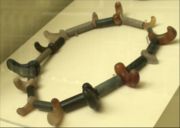
Magatama are curved bead
s which first appeared in Japan
during the Jōmon period
.
They are often found inhumed in mounded tumulus
graves
as offerings
to deities
(see grave goods
). They continued to be popular with the ruling
elite
s throughout the Kofun Period
of Japan, and are often romanticised as indicative of the Yamato Dynasty of Japan
. They are mainly made of jade
, agate
, quartz
, talc
, and jasper
. Some consider them to be an Imperial symbol
, although in fact ownership
was widespread throughout all the chieftain
ships of Kofun Period Japan. It is believed that magatama were popularly worn as jewels for decoration, in addition to their religious meanings. In this latter regard they were later largely replaced by Buddhist prayer beads
in the Nara period
.
In modern Japan, the magatama's shape of a sphere with a flowing tail is a common visual representation of the human spirit (hitodama
).
, added some time around the Heian period
. The Yasakani no Magatama stands for benevolence, and is one of the three items used in the ceremony of imperial ascension
. In Japanese mythology, the jewels, along with the mirror, were hung on the tree outside of Amaterasu's cave (where she had hidden) to lure her out. It is believed to be a necklace composed of jade
magatama stones instead of a solitary gem as depicted in popular culture. It is believed to be enshrined in Tokyo
, in the Japanese Imperial Palace.
 The consensus among Japanese archaeologists is that magatama originated in Jōmon Japan before spreading to the Asian continent through the Korean peninsula. It is claimed that the earliest Korean prehistoric magatama date to the Early Mumun
(post-850 BC) and are generally found in the southern part of peninsula in proximity to Japan. Charles Keally, an archaeologist based in Japan who has conducted research on magatama, states:
The magatama is also found on early Korean (presumably before/after AD 660) royal gold crowns before Mongols came to the Korean peninsula and has long been considered a sign of royalty in Korea as well as being a connection with Shamanistic elements. However the production distinct of magatama is not found from archeology site in Korea yet.
Bead
A bead is a small, decorative object that is usually pierced for threading or stringing. Beads range in size from under to over in diameter. A pair of beads made from Nassarius sea snail shells, approximately 100,000 years old, are thought to be the earliest known examples of jewellery. Beadwork...
s which first appeared in Japan
Japan
Japan is an island nation in East Asia. Located in the Pacific Ocean, it lies to the east of the Sea of Japan, China, North Korea, South Korea and Russia, stretching from the Sea of Okhotsk in the north to the East China Sea and Taiwan in the south...
during the Jōmon period
Jomon period
The is the time in Japanese prehistory from about 14,000 BC to 300 BC.The term jōmon means "cord-patterned" in Japanese. This refers to the pottery style characteristic of the Jōmon culture, and which has markings made using sticks with cords wrapped around them...
.
They are often found inhumed in mounded tumulus
Tumulus
A tumulus is a mound of earth and stones raised over a grave or graves. Tumuli are also known as barrows, burial mounds, Hügelgrab or kurgans, and can be found throughout much of the world. A tumulus composed largely or entirely of stones is usually referred to as a cairn...
graves
Grave (burial)
A grave is a location where a dead body is buried. Graves are usually located in special areas set aside for the purpose of burial, such as graveyards or cemeteries....
as offerings
Sacrifice
Sacrifice is the offering of food, objects or the lives of animals or people to God or the gods as an act of propitiation or worship.While sacrifice often implies ritual killing, the term offering can be used for bloodless sacrifices of cereal food or artifacts...
to deities
Deity
A deity is a recognized preternatural or supernatural immortal being, who may be thought of as holy, divine, or sacred, held in high regard, and respected by believers....
(see grave goods
Grave goods
Grave goods, in archaeology and anthropology, are the items buried along with the body.They are usually personal possessions, supplies to smooth the deceased's journey into the afterlife or offerings to the gods. Grave goods are a type of votive deposit...
). They continued to be popular with the ruling
Government
Government refers to the legislators, administrators, and arbitrators in the administrative bureaucracy who control a state at a given time, and to the system of government by which they are organized...
elite
Elite
Elite refers to an exceptional or privileged group that wields considerable power within its sphere of influence...
s throughout the Kofun Period
Kofun period
The is an era in the history of Japan from around 250 to 538. It follows the Yayoi period. The word kofun is Japanese for the type of burial mounds dating from this era. The Kofun and the subsequent Asuka periods are sometimes referred to collectively as the Yamato period...
of Japan, and are often romanticised as indicative of the Yamato Dynasty of Japan
Kofun period
The is an era in the history of Japan from around 250 to 538. It follows the Yayoi period. The word kofun is Japanese for the type of burial mounds dating from this era. The Kofun and the subsequent Asuka periods are sometimes referred to collectively as the Yamato period...
. They are mainly made of jade
Jade
Jade is an ornamental stone.The term jade is applied to two different metamorphic rocks that are made up of different silicate minerals:...
, agate
Agate
Agate is a microcrystalline variety of silica, chiefly chalcedony, characterised by its fineness of grain and brightness of color. Although agates may be found in various kinds of rock, they are classically associated with volcanic rocks and can be common in certain metamorphic rocks.-Etymology...
, quartz
Quartz
Quartz is the second-most-abundant mineral in the Earth's continental crust, after feldspar. It is made up of a continuous framework of SiO4 silicon–oxygen tetrahedra, with each oxygen being shared between two tetrahedra, giving an overall formula SiO2. There are many different varieties of quartz,...
, talc
Talc
Talc is a mineral composed of hydrated magnesium silicate with the chemical formula H2Mg34 or Mg3Si4O102. In loose form, it is the widely-used substance known as talcum powder. It occurs as foliated to fibrous masses, its crystals being so rare as to be almost unknown...
, and jasper
Jasper
Jasper, a form of chalcedony, is an opaque, impure variety of silica, usually red, yellow, brown or green in color; and rarely blue. This mineral breaks with a smooth surface, and is used for ornamentation or as a gemstone. It can be highly polished and is used for vases, seals, and at one time for...
. Some consider them to be an Imperial symbol
Symbol
A symbol is something which represents an idea, a physical entity or a process but is distinct from it. The purpose of a symbol is to communicate meaning. For example, a red octagon may be a symbol for "STOP". On a map, a picture of a tent might represent a campsite. Numerals are symbols for...
, although in fact ownership
Ownership
Ownership is the state or fact of exclusive rights and control over property, which may be an object, land/real estate or intellectual property. Ownership involves multiple rights, collectively referred to as title, which may be separated and held by different parties. The concept of ownership has...
was widespread throughout all the chieftain
Tribal chief
A tribal chief is the leader of a tribal society or chiefdom. Tribal societies with social stratification under a single leader emerged in the Neolithic period out of earlier tribal structures with little stratification, and they remained prevalent throughout the Iron Age.In the case of ...
ships of Kofun Period Japan. It is believed that magatama were popularly worn as jewels for decoration, in addition to their religious meanings. In this latter regard they were later largely replaced by Buddhist prayer beads
Prayer beads
Prayer beads are used by members of various religious traditions such as Roman Catholicism, Orthodox Christianity, Anglicanism, Islam, Hinduism, Buddhism, Sikhism and Bahá'í Faith to count the repetitions of prayers, chants or devotions, such as the rosary of Virgin Mary in Christianity and dhikr ...
in the Nara period
Nara period
The of the history of Japan covers the years from AD 710 to 794. Empress Gemmei established the capital of Heijō-kyō . Except for 5 years , when the capital was briefly moved again, it remained the capital of Japanese civilization until Emperor Kammu established a new capital, Nagaoka-kyō, in 784...
.
In modern Japan, the magatama's shape of a sphere with a flowing tail is a common visual representation of the human spirit (hitodama
Hitodama
are believed in Japanese folklore to be the souls of the newly dead taking form as mysterious fiery apparitions. The word hitodama is a combination of the Japanese words hito, meaning "human", and tama , meaning "soul"...
).
Yasakani no Magatama
The most important magatama is the Yasakani no Magatama (八尺瓊曲玉, also 八坂瓊曲玉), which is part of the Imperial Regalia of JapanImperial Regalia of Japan
The , also known as the Three Sacred Treasures of Japan, consist of the sword Kusanagi , the mirror Yata no Kagami , and the jewel Yasakani no Magatama...
, added some time around the Heian period
Heian period
The is the last division of classical Japanese history, running from 794 to 1185. The period is named after the capital city of Heian-kyō, or modern Kyōto. It is the period in Japanese history when Buddhism, Taoism and other Chinese influences were at their height...
. The Yasakani no Magatama stands for benevolence, and is one of the three items used in the ceremony of imperial ascension
Enthronement of the Japanese Emperor
The enthronement of the Emperor of Japan is an ancient ceremony which marks the accession of a new ruler to the Chrysanthemum Throne, in the world's oldest continuous hereditary monarchy. The ritual is not a coronation, as no crown or other headgear is bestowed upon the emperor...
. In Japanese mythology, the jewels, along with the mirror, were hung on the tree outside of Amaterasu's cave (where she had hidden) to lure her out. It is believed to be a necklace composed of jade
Jade
Jade is an ornamental stone.The term jade is applied to two different metamorphic rocks that are made up of different silicate minerals:...
magatama stones instead of a solitary gem as depicted in popular culture. It is believed to be enshrined in Tokyo
Tokyo
, ; officially , is one of the 47 prefectures of Japan. Tokyo is the capital of Japan, the center of the Greater Tokyo Area, and the largest metropolitan area of Japan. It is the seat of the Japanese government and the Imperial Palace, and the home of the Japanese Imperial Family...
, in the Japanese Imperial Palace.
Origins
Mumun pottery period
The Mumun pottery period is an archaeological era in Korean prehistory that dates to approximately 1500-300 BC This period is named after the Korean name for undecorated or plain cooking and storage vessels that form a large part of the pottery assemblage over the entire length of the period, but...
(post-850 BC) and are generally found in the southern part of peninsula in proximity to Japan. Charles Keally, an archaeologist based in Japan who has conducted research on magatama, states:
"The magatama's origins are more controversial. These curved jewels of jadeite are common in Kofun Period burials, and they are common also in Korean sites of the same age. But magatama are found in Yayoi sites, too, and unquestionable true magatama are reported also in Jomon sites in Tohoku, Japan as early as about 1000 B.C., long before true magatama appeared in Korea."
The magatama is also found on early Korean (presumably before/after AD 660) royal gold crowns before Mongols came to the Korean peninsula and has long been considered a sign of royalty in Korea as well as being a connection with Shamanistic elements. However the production distinct of magatama is not found from archeology site in Korea yet.
See also
- AmaterasuAmaterasu, or is apart of the Japanese myth cycle and also a major deity of the Shinto religion. She is the goddess of the sun, but also of the universe. the name Amaterasu derived from Amateru meaning "shining in heaven." The meaning of her whole name, Amaterasu-ōmikami, is "the great August kami who...
- Japanese mythologyJapanese mythologyJapanese mythology is a system of beliefs that embraces Shinto and Buddhist traditions as well as agriculturally based folk religion. The Shinto pantheon comprises innumerable kami...
- ShintoShintoor Shintoism, also kami-no-michi, is the indigenous spirituality of Japan and the Japanese people. It is a set of practices, to be carried out diligently, to establish a connection between present day Japan and its ancient past. Shinto practices were first recorded and codified in the written...
- SusanooSusanoo, also known as is the Shinto god of the sea and storms. He is also considered to be ruler of Yomi.-Myths:In Japanese mythology, Susanoo, the powerful storm of Summer, is the brother of Amaterasu, the goddess of the sun, and of Tsukuyomi, the god of the moon. All three were born from Izanagi, when...
- TomoeTomoeA tomoe or tomoye is a Japanese abstract shape that resembles a comma or the usual form of magatama. It is a common design element in and corporate logos, particularly in triplicate whorls known as . Some view the mitsudomoe as representative of the threefold division at the heart of the...
- GogokGogokGobeunok or Gogok is a Korean word for comma-shaped or curved beads and jewels, which originated and is found in Japan but later transferred to Korea...