


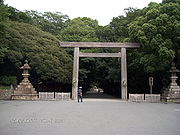
Atsuta Shrine

Encyclopedia
is a Shinto
shrine traditionally believed to have been established during the reign of Emperor Keikō
(71-130) located in Atsuta-ku
, Nagoya, Aichi Prefecture
in Japan
. The shrine is familiarly known as Atsuta-Sama (Venerable Atsuta) or simply as Miya (the Shrine). Since ancient times, it has been especially revered, ranking with the Great Shrine of Ise
.
The 200,000 m² shrine complex draws over 9 million visitors annually.
explains that Atsuta Shrine was originally founded to house the Kusanagi no Tsurugi
.
According to traditional sources, Yamato Takeru
died in the 43rd year of Emperor Keiko's reign (景行天皇43年). The possessions of the dead prince were gathered together along with the sword Kusanagi; and his widow venerated his memory in a shrine at her home. Sometime later, these relics and the sacred sword were moved to the current location of the Atsuta Shrine. Nihonshoki explains that this move occurred in the 51st year of Keiko's reign, but shrine tradition also dates this event in the 1st year of Emperor Chūai's reign.
From 1872 through 1946, the Kasuga Shrine was officially designated one of the , meaning that it stood in the first rank of government supported shrines.
figures like Oda Nobunaga
, Toyotomi Hideyoshi
and the Tokugawa
s. For example, the Nobunaga-Bei, a 7.4 m high roofed mud wall, was donated to the shrine in 1560 by Nobunaga as a token of gratitude for his victory at the Battle of Okehazama
.
In 1893, it was remodeled using the Shinmeizukuri architectural style, the same style used in the building of Ise Shrine
. Before a celebration in 1935, the shrine's buildings as well as other facilities were completely rearranged and improved in order to better reflect the history and cultural significance of the shrine.
During the bombings of World War II
, however, many of Atsuta Shrine's buildings were destroyed by fire. The shrine's main buildings, such as the honden
, were reconstructed and completed in 1955. Following the completion of these buildings, construction of other buildings continued on the shrine grounds. In 1966 the Treasure Hall was completed in order to house the shrine's collection of objects, manuscripts and documents.
 This Shinto shrine is dedicated to the veneration of Atsuta-no-Ōkami. Also enshrined are the "Five Great Gods of Atsuta", all of whom are connected with the legendary narratives of the sacred sword -- Amaterasu-Ōmikami
, Takehaya Susanoō-no-mikoto
, Yamato Takeru-no-mikoto
, Miyasu-hime no-mikoto, and Take Inadane-no-mikoto.
Atsuta is the traditional repository of Kusanagi no Tsurugi
, the ancient sword that is considered one of the Three Sacred Treasures of Japan
. Central to the Shinto significance of Atsuta Shrine is the sacred sword which is understood to be a gift from Amaterasu Ōmikami. This unique object has represented the authority and stature of Japan's emperors since time immemorial. Kusanagi is imbued with Amaterasu's spirit.
During the reign of Emperor Sujin
, duplicate copies of the Imperial regalia were made in order to safeguard the originals from theft. This fear of theft proved to be justified during the reign of Emperor Tenji
when the sacred sword was stolen from Atsuta; and it was not to be returned until the reign of Emperor Temmu
. Although not seen by the general public since that time, it is said to have remained in safekeeping at the shrine up to the present day.
and a dagger
that is a designated National Treasure of Japan
. Atsuta Jingu Museum preserves and displays a variety of historic material, including the koshinpoh (sacred garments, furniture and utensils for use of the enshrined deities). A number of donated swords, mirrors and other objects are held by the shrine, including Bugaku
masks and other material associated with ancient court dances. The Bunkaden collection ranges from ancient documents to household articles. Aichi Prefecture has designated 174 items as important cultural assets.
 Over 70 ceremonies and festivals
are held annually at the shrine.
Shinto
or Shintoism, also kami-no-michi, is the indigenous spirituality of Japan and the Japanese people. It is a set of practices, to be carried out diligently, to establish a connection between present day Japan and its ancient past. Shinto practices were first recorded and codified in the written...
shrine traditionally believed to have been established during the reign of Emperor Keikō
Emperor Keiko
; also known as Ootarashihikooshirowake no Sumeramikoto, was the 12th emperor of Japan, according to the traditional order of succession.No firm dates can be assigned to this emperor's life or reign, but he is conventionally considered to have reigned from 71–130.-Legendary narrative:Keikō is...
(71-130) located in Atsuta-ku
Atsuta-ku, Nagoya
is one of the wards of the city of Nagoya in Aichi Prefecture, Japan. At the 2005 census it had a population of 63,608. Atsuta Shrine is well known. The rolling stock manufacturer Nippon Sharyo has its headquarters in the ward.-References:...
, Nagoya, Aichi Prefecture
Aichi Prefecture
is a prefecture of Japan located in the Chūbu region. The region of Aichi is also known as the Tōkai region. The capital is Nagoya. It is the focus of the Chūkyō Metropolitan Area.- History :...
in Japan
Japan
Japan is an island nation in East Asia. Located in the Pacific Ocean, it lies to the east of the Sea of Japan, China, North Korea, South Korea and Russia, stretching from the Sea of Okhotsk in the north to the East China Sea and Taiwan in the south...
. The shrine is familiarly known as Atsuta-Sama (Venerable Atsuta) or simply as Miya (the Shrine). Since ancient times, it has been especially revered, ranking with the Great Shrine of Ise
Ise Shrine
is a Shinto shrine dedicated to goddess Amaterasu-ōmikami, located in the city of Ise in Mie prefecture, Japan. Officially known simply as , Ise Jingū is in fact a shrine complex composed of a large number of Shinto shrines centered on two main shrines, and ....
.
The 200,000 m² shrine complex draws over 9 million visitors annually.
History
The KojikiKojiki
is the oldest extant chronicle in Japan, dating from the early 8th century and composed by Ō no Yasumaro at the request of Empress Gemmei. The Kojiki is a collection of myths concerning the origin of the four home islands of Japan, and the Kami...
explains that Atsuta Shrine was originally founded to house the Kusanagi no Tsurugi
Kusanagi
is a legendary Japanese sword and one of three Imperial Regalia of Japan. It was originally called but its name was later changed to the more popular Kusanagi-no-Tsurugi .-Legends:...
.
According to traditional sources, Yamato Takeru
Yamato Takeru
, originally Prince Ousu was a Japanese legendary prince of the Yamato dynasty, son of Keikō of Yamato, a legendary monarch who is traditionally counted as the 12th Tennō or Emperor of Japan. The tragic tale of this impressive figure is told in the Japanese chronicles Kojiki and Nihon Shoki...
died in the 43rd year of Emperor Keiko's reign (景行天皇43年). The possessions of the dead prince were gathered together along with the sword Kusanagi; and his widow venerated his memory in a shrine at her home. Sometime later, these relics and the sacred sword were moved to the current location of the Atsuta Shrine. Nihonshoki explains that this move occurred in the 51st year of Keiko's reign, but shrine tradition also dates this event in the 1st year of Emperor Chūai's reign.
From 1872 through 1946, the Kasuga Shrine was officially designated one of the , meaning that it stood in the first rank of government supported shrines.
Architecture
The shrine's buildings were maintained by donations from a number of benefactors, including well-known Sengoku periodSengoku period
The or Warring States period in Japanese history was a time of social upheaval, political intrigue, and nearly constant military conflict that lasted roughly from the middle of the 15th century to the beginning of the 17th century. The name "Sengoku" was adopted by Japanese historians in reference...
figures like Oda Nobunaga
Oda Nobunaga
was the initiator of the unification of Japan under the shogunate in the late 16th century, which ruled Japan until the Meiji Restoration in 1868. He was also a major daimyo during the Sengoku period of Japanese history. His opus was continued, completed and finalized by his successors Toyotomi...
, Toyotomi Hideyoshi
Toyotomi Hideyoshi
was a daimyo warrior, general and politician of the Sengoku period. He unified the political factions of Japan. He succeeded his former liege lord, Oda Nobunaga, and brought an end to the Sengoku period. The period of his rule is often called the Momoyama period, named after Hideyoshi's castle...
and the Tokugawa
Tokugawa shogunate
The Tokugawa shogunate, also known as the and the , was a feudal regime of Japan established by Tokugawa Ieyasu and ruled by the shoguns of the Tokugawa family. This period is known as the Edo period and gets its name from the capital city, Edo, which is now called Tokyo, after the name was...
s. For example, the Nobunaga-Bei, a 7.4 m high roofed mud wall, was donated to the shrine in 1560 by Nobunaga as a token of gratitude for his victory at the Battle of Okehazama
Battle of Okehazama
The took place in June 1560. In this battle, Oda Nobunaga defeated Imagawa Yoshimoto and established himself as one of the front-running warlords in the Sengoku period.-Background:...
.
In 1893, it was remodeled using the Shinmeizukuri architectural style, the same style used in the building of Ise Shrine
Ise Shrine
is a Shinto shrine dedicated to goddess Amaterasu-ōmikami, located in the city of Ise in Mie prefecture, Japan. Officially known simply as , Ise Jingū is in fact a shrine complex composed of a large number of Shinto shrines centered on two main shrines, and ....
. Before a celebration in 1935, the shrine's buildings as well as other facilities were completely rearranged and improved in order to better reflect the history and cultural significance of the shrine.
During the bombings of World War II
World War II
World War II, or the Second World War , was a global conflict lasting from 1939 to 1945, involving most of the world's nations—including all of the great powers—eventually forming two opposing military alliances: the Allies and the Axis...
, however, many of Atsuta Shrine's buildings were destroyed by fire. The shrine's main buildings, such as the honden
Honden
The , is the most sacred building at a Shinto shrine, intended purely for the use of the enshrined kami, usually symbolized by a mirror or sometimes by a statue. The building is normally in the rear of the shrine and closed to the general public. In front of its usually stands the haiden, or...
, were reconstructed and completed in 1955. Following the completion of these buildings, construction of other buildings continued on the shrine grounds. In 1966 the Treasure Hall was completed in order to house the shrine's collection of objects, manuscripts and documents.
Shinto belief
Amaterasu
, or is apart of the Japanese myth cycle and also a major deity of the Shinto religion. She is the goddess of the sun, but also of the universe. the name Amaterasu derived from Amateru meaning "shining in heaven." The meaning of her whole name, Amaterasu-ōmikami, is "the great August kami who...
, Takehaya Susanoō-no-mikoto
Susanoo
, also known as is the Shinto god of the sea and storms. He is also considered to be ruler of Yomi.-Myths:In Japanese mythology, Susanoo, the powerful storm of Summer, is the brother of Amaterasu, the goddess of the sun, and of Tsukuyomi, the god of the moon. All three were born from Izanagi, when...
, Yamato Takeru-no-mikoto
Yamato Takeru
, originally Prince Ousu was a Japanese legendary prince of the Yamato dynasty, son of Keikō of Yamato, a legendary monarch who is traditionally counted as the 12th Tennō or Emperor of Japan. The tragic tale of this impressive figure is told in the Japanese chronicles Kojiki and Nihon Shoki...
, Miyasu-hime no-mikoto, and Take Inadane-no-mikoto.
Atsuta is the traditional repository of Kusanagi no Tsurugi
Kusanagi
is a legendary Japanese sword and one of three Imperial Regalia of Japan. It was originally called but its name was later changed to the more popular Kusanagi-no-Tsurugi .-Legends:...
, the ancient sword that is considered one of the Three Sacred Treasures of Japan
Imperial Regalia of Japan
The , also known as the Three Sacred Treasures of Japan, consist of the sword Kusanagi , the mirror Yata no Kagami , and the jewel Yasakani no Magatama...
. Central to the Shinto significance of Atsuta Shrine is the sacred sword which is understood to be a gift from Amaterasu Ōmikami. This unique object has represented the authority and stature of Japan's emperors since time immemorial. Kusanagi is imbued with Amaterasu's spirit.
During the reign of Emperor Sujin
Emperor Sujin
; also known as Mimakiiribikoinie no Sumeramikoto or Hatsukunishirasu Sumeramikoto; was the tenth emperor of Japan, according to the traditional order of succession....
, duplicate copies of the Imperial regalia were made in order to safeguard the originals from theft. This fear of theft proved to be justified during the reign of Emperor Tenji
Emperor Tenji
, also known as Emperor Tenchi, was the 38th emperor of Japan, according to the traditional order of succession.Tenji's reign spanned the years from 661 through 671.-Traditional narrative:...
when the sacred sword was stolen from Atsuta; and it was not to be returned until the reign of Emperor Temmu
Emperor Temmu
was the 40th emperor of Japan, according to the traditional order of succession.Temmu's reign lasted from 672 until his death in 686.-Traditional narrative:...
. Although not seen by the general public since that time, it is said to have remained in safekeeping at the shrine up to the present day.
Treasures
The shrine's Bunkaden, or treasure hall, houses over 4,000 relics, which include 174 Important Cultural PropertiesImportant Cultural Properties of Japan
The term is often shortened into just are items officially already classified as Tangible Cultural Properties of Japan by the Japanese Agency for Cultural Affairs and judged to be of particular importance to the Japanese people....
and a dagger
Dagger
A dagger is a fighting knife with a sharp point designed or capable of being used as a thrusting or stabbing weapon. The design dates to human prehistory, and daggers have been used throughout human experience to the modern day in close combat confrontations...
that is a designated National Treasure of Japan
National treasures of Japan
National Treasures are the most precious of Japan's Tangible Cultural Properties, as determined and designated by the Agency for Cultural Affairs...
. Atsuta Jingu Museum preserves and displays a variety of historic material, including the koshinpoh (sacred garments, furniture and utensils for use of the enshrined deities). A number of donated swords, mirrors and other objects are held by the shrine, including Bugaku
Bugaku
Bugaku dance is the traditional Japanese dance that has been performed to select elites mostly in Japanese imperial courts for over twelve hundred years. In this way it has been an upper class secret, although after World War II the dance was opened to the public and has even toured around the...
masks and other material associated with ancient court dances. The Bunkaden collection ranges from ancient documents to household articles. Aichi Prefecture has designated 174 items as important cultural assets.
Festivals
Japanese festivals
Japanese festivals are traditional festive occasions. Some festivals have their roots in Chinese festivals but have undergone dramatic changes as they mixed with local customs....
are held annually at the shrine.
- Hatsu-Ebisu (January 5): Seeking good fortune in the new year from Ebisu, the kami of Fortune.
- Yodameshi Shinji (January 7): The projected annual rainfall for the coming year is prophesized by measuring the amount of water in a pot kept underneath the floor of the Eastern Treasure House.
- Touka Shinji (January 11): A variation on an annual ceremony (Touka-no-sechie) of the Imperial Court in the Heian periodHeian periodThe is the last division of classical Japanese history, running from 794 to 1185. The period is named after the capital city of Heian-kyō, or modern Kyōto. It is the period in Japanese history when Buddhism, Taoism and other Chinese influences were at their height...
(10th-12th Century), the shrine dance becomes a prayer in movement hoping for bumper crops of the year. - Hosha Shinji (January 15): Ceremonial which involves shooting an arrow at a wooden piece called chigi fixed at the center of a huge mark.
- Bugaku Shinji (May 1): A ceremonial dance from the Heian era is performed outdoors on a red painted stage.
- Eyoudo Shinji (May 4): A festival to commemorate the return of the sacred sword in the reign of Emperor TenjiEmperor Tenji, also known as Emperor Tenchi, was the 38th emperor of Japan, according to the traditional order of succession.Tenji's reign spanned the years from 661 through 671.-Traditional narrative:...
. - Shinyo-Togyo Shinji (May 5): A festival in which portable shrine (mikoshiMikoshiA is a divine palanquin . Shinto followers believe that it serves as the vehicle to transport a deity in Japan while moving between main shrine and temporary shrine during a festival or when moving to a new shrine...
) is carried in a formal procession to the Western Gate, where ceremonies and prayers for the security of the Imperial Palace are performed in the open air. In the Meiji period and Taisho period, this procession moved in sober and solemn silence. The ceremony at the gate was brief, lasting only 20 minutes; and then the mikoshi and its attendants returned into the Shrine precincts. Shogun Ashikaga YoshimasaAshikaga Yoshimasawas the 8th shogun of the Ashikaga shogunate who reigned from 1449 to 1473 during the Muromachi period of Japan. Yoshimasa was the son of the sixth shogun Ashikaga Yoshinori....
provided a new mikoshi and a complete set of robes and other accouterments for this festival on the occasion of repairs to the shrine in the 1457-1459 (ChōrokuChorokuwas a after Kōshō and before Kanshō. This period spanned the years from September 1457 through December 1460. The reigning emperor was .-Change of era:* 1457 : The era name was changed to mark an event or a number of events...
1-3).
- Rei Sai (June 5): Portable tabernacles (mikoshi) in various styles are carried along the approaches to the shrine; and at night, groups of 365 lanterns (makiwara) appear lit at the gates. This festival commemorates an Imperial proclamation (semmyō) issued in 1872 (Meiji 5). After 1906 (Meiji 39), exhibitions of judoJudois a modern martial art and combat sport created in Japan in 1882 by Jigoro Kano. Its most prominent feature is its competitive element, where the object is to either throw or takedown one's opponent to the ground, immobilize or otherwise subdue one's opponent with a grappling maneuver, or force an...
, fencing (gekken), and archery (kyūdōKyudo, literally meaning "way of the bow", is the Japanese art of archery. It is a modern Japanese martial art and practitioners are known as .It is estimated that there are approximately half a million practitioners of kyudo today....
) are presented for the gratification of the kami.
See also
- List of Shinto shrines
- List of Jingū
- Yaizu ShrineYaizu Shrineis a Shinto shrine in the city of Yaizu in Shizuoka Prefecture, Japan. The shrine is also referred to as the .The main festival of the shrine is annually on August 13.-Enshrined kami:...
- List of National Treasures of Japan (crafts-swords)