

Infrared Space Observatory

Encyclopedia
The Infrared Space Observatory (ISO) was a space telescope for infrared
light designed and operated by the European Space Agency
(ESA), in cooperation with ISAS (part of JAXA
as of 2003) and NASA. The ISO was designed to study infrared light at wavelengths of 2.5 to 240 micrometres.
The Euro
480.1 million
ISO was launched on 17 November 1995 from the ELA-2 launch pad
at the Guiana Space Centre near Kourou
in French Guiana
. The launch vehicle
, an Ariane 4
4P rocket, placed ISO successfully into a highly elliptical
geocentric orbit
, completing one revolution around the Earth every 24 hours. The primary mirror
of its Ritchey-Chrétien telescope
measured 60 cm in diameter and was cooled to 1.7 Kelvin
by means of superfluid
helium
. The ISO satellite contained four instruments that allowed for imaging and photometry
from 2.5 to 240 micrometre
s and spectroscopy
from 2.5 to 196.8 micrometres.
by performing the first-ever 'all-sky survey' at infrared wavelength
s. The resulting map of the infrared sky pinpointed some 350,000 infrared sources waiting to be explored by IRAS' successors. In 1979 IRAS was in an advanced stage of planning and the expected results from IRAS led to the first proposal for ISO made to ESA in the same year. With the rapid improvements in infrared detector-technology, ISO was to provide detailed observations
for some 30,000 infrared sources with much improved sensitivity
and resolution
. ISO was to perform 1000 times better in sensitivity and 100 times better in angular resolution at 12 micrometres compared to IRAS.
A number of follow-up studies resulted in the selection of ISO as the next installment for the ESA Scientific Programme in 1983. Next came a Call for Experiment and Mission Scientist Proposals to the scientific community, resulting in the selection of the scientific instrument
s in 1985. The four instruments chosen were developed by teams of researchers from France, Germany, the Netherlands and United Kingdom.
Design
and development of the satellite
started in 1986 with Aérospatiale
's space division (currently absorbed into Thales Alenia Space
) leading an international consortium
of 32 companies responsible for manufacture
, integration
and testing of the new satellite. Final assembly took place at the Cannes Mandelieu Space Center
.
The payload module also held a conical
sun shade, to prevent stray light
from reaching the telescope, and two large star trackers
. The latter were part of the Attitude and Orbit Control Subsystem (AOCS) which provided three-axis stabilisation
of ISO with a pointing accuracy
of one arc second. It consisted of Sun and Earth sensors, the before-mentioned star trackers, a quadrant star sensor on the telescope axis, gyroscope
s and reaction wheels. An complementary reaction control system
(RCS), using hydrazine
propellant
, was responsible for orbital direction and finetuning shortly after launch
. The complete satellite weighed just under 2500 kg, was 5.3 m high, 3.6 m wide and measured 2.3 m in depth.
The service module held all the warm electronics
, the hydrazine propellant tank and provided up to 600 watt
s of electrical power by means of solar cell
s mounted on the sunpointing side of the service module-mounted sunshield. The underside of the service module sported a load-bearing, ring shaped, physical interface for the launch vehicle.
The cryostat of the payload module surrounded the telescope and science instrument with a large dewar
containing a toroidal
tank loaded with 2268 litre
s of superfluid helium. Cooling
by slow evaporation
of the helium kept the temperature
of the telescope below 3.4 K and the science instruments below 1.9 K. These very low temperatures were required for the scientific instruments to be sensitive enough to detect even the smallest amount of infrared radiation from cosmic sources. Without this extreme cooling the telescope and instruments would literally be 'blinded'
by their own infrared emissions.
of the dewar, near the bottom-side of the torodial helium tank. It was of the Ritchey-Chrétien
type with an effective entrance pupil
of 60 cm, a focal length ratio
of 15 and a resulting focal length of 900 cm. Very strict control over straylight, particularly that from bright infrared sources outside the telescope's field of view
, was necessary to ensure the guaranteed sensitivity of the scientific instruments. A combination of light-tight shields, baffles inside the telescope and the sunshade on top of the cryostat accomplished full protection against straylight. Furthermore, ISO was constrained from observing too close to the Sun, Earth and Moon; all major sources of infrared radiation. ISO always pointed between 60 to 120 degrees away from the Sun and it never pointed closer than 77 degrees to Earth, 24 degrees to the Moon
or closer than 7 degrees to Jupiter
. These restrictions meant that at any given time only about 15 percent
of the sky was available to ISO.
A pyramid-shaped
mirror behind the primary mirror
of the telescope distributed the infrared light to the four instruments, providing each of them with a 3 arc-minute section of the 20 arc-minute field of view of the telescope. Thus, pointing of a different instrument to the same cosmic object meant repointing the entire ISO satellite.
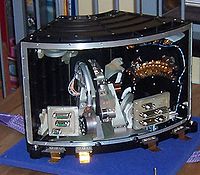
All four instruments were mounted directly behind the primary mirror of the telescope, in a circular arrangement, with each instrument taking up an 80 degree
segment of the cylindrical space. The field of view for each instrument was offset to the central axis of the telescope's field of view. This means that every instrument 'saw' a different portion of the sky at a given moment. In standard operational mode one instrument was in primary operation.
in Darmstadt
in Germany had full control over ISO in the first four days of flight. After early commissioning primary control over ISO was handed over to the Spacecraft Control Centre (SCC) at Villafranca
in Spain (VILSPA) for the remainder of the mission.
In the first three weeks after launch the orbit
was fine-tuned
and all satellite systems were activated and tested. Cool-down of the cryostat proved to be more efficient than previously calculated, so the anticipated mission length was extended to 24 months. Between November 21 and November 26 all four science instruments were switched on and thoroughly checked out. Between December 9, 1995 and February 3, 1996 the 'Performance Verification Phase' took place, dedicated to commissioning all instruments and fixing problems. Routine observations started from February 4, 1996 and lasted until the last helium coolant depleted on April 8, 1998.
The perigee of ISO's orbit lay well inside the Van Allen radiation belt
, forcing the science instruments to be shut down for seven hours during each pass through the radiation belt. Thus, 17 hours in each orbit remained for scientific observation. A typical 24 hour orbit of ISO can be broken down into six phases:
Contrary to IRAS, no science data was recorded on-board ISO for later transmission to the ground. All data, both science data and housekeeping data were transmitted to the ground in real-time. The perigee point of ISO's orbit was below the radio horizon of the mission control centers at both VILSPA and Goldstone, thus forcing the science instruments to be switched off at perigee.
s at VILSPA noticed a rise in temperature of the telescope. This was a clear sign that the load of superfluid helium coolant had depleted. At 23:07 UTC the same day, the temperature of the science instruments had risen above 4.2 K and science observations were ceased. A few detectors in the SWS instrument were capable of making observations at higher temperatures and remained in use for another 150 hours to make detailed measurements of an additional 300 star
s. In the month following depletion of coolant the 'Technology Test Phase' (TTP) was initiated to test several elements of the satellite in off-nominal conditions. After completion of TTP, the perigee of ISO's orbit was lowered sufficiently enough to ensure ISO will burn up in Earth's atmosphere in 20 to 30 years after shutdown. ISO was then permantly switched off on May 16, 1998, at 12:00 UTC.
of over 900 orbits ISO performed more than 26,000 successful scientific observations. The huge amounts of scientific data generated by ISO was subject to extensive archiving
activities up to 2006. The full data-set has been available to the scientific community since 1998 and many discoveries have been made, with probably many more still to come:
Infrared
Infrared light is electromagnetic radiation with a wavelength longer than that of visible light, measured from the nominal edge of visible red light at 0.74 micrometres , and extending conventionally to 300 µm...
light designed and operated by the European Space Agency
European Space Agency
The European Space Agency , established in 1975, is an intergovernmental organisation dedicated to the exploration of space, currently with 18 member states...
(ESA), in cooperation with ISAS (part of JAXA
Japan Aerospace Exploration Agency
The , or JAXA, is Japan's national aerospace agency. Through the merger of three previously independent organizations, JAXA was formed on October 1, 2003, as an Independent Administrative Institution administered by the Ministry of Education, Culture, Sports, Science and Technology and the...
as of 2003) and NASA. The ISO was designed to study infrared light at wavelengths of 2.5 to 240 micrometres.
The Euro
Euro
The euro is the official currency of the eurozone: 17 of the 27 member states of the European Union. It is also the currency used by the Institutions of the European Union. The eurozone consists of Austria, Belgium, Cyprus, Estonia, Finland, France, Germany, Greece, Ireland, Italy, Luxembourg,...
480.1 million
Million
One million or one thousand thousand, is the natural number following 999,999 and preceding 1,000,001. The word is derived from the early Italian millione , from mille, "thousand", plus the augmentative suffix -one.In scientific notation, it is written as or just 106...
ISO was launched on 17 November 1995 from the ELA-2 launch pad
Launch pad
A launch pad is the area and facilities where rockets or spacecraft lift off. A spaceport can contain one or many launch pads. A typical launch pad consists of the service and umbilical structures. The service structure provides an access platform to inspect the launch vehicle prior to launch....
at the Guiana Space Centre near Kourou
Kourou
Kourou is a commune in French Guiana, an overseas region and department of France located in South America.Kourou is the location of the Guiana Space Centre, France and ESA's main spaceport.-Geography:...
in French Guiana
French Guiana
French Guiana is an overseas region of France, consisting of a single overseas department located on the northern Atlantic coast of South America. It has borders with two nations, Brazil to the east and south, and Suriname to the west...
. The launch vehicle
Launch vehicle
In spaceflight, a launch vehicle or carrier rocket is a rocket used to carry a payload from the Earth's surface into outer space. A launch system includes the launch vehicle, the launch pad and other infrastructure....
, an Ariane 4
Ariane 4
Ariane 4 was an expendable launch system, designed by the Centre National d'Etudes Spatiales and manufactured and marketed by its subsidiary Arianespace. Ariane 4 was justly known as the ‘workhorse’ of the Ariane family. Since its first flight on 15 June 1988 until the last, on 15 February 2003, it...
4P rocket, placed ISO successfully into a highly elliptical
Elliptic orbit
In astrodynamics or celestial mechanics an elliptic orbit is a Kepler orbit with the eccentricity less than 1; this includes the special case of a circular orbit, with eccentricity equal to zero. In a stricter sense, it is a Kepler orbit with the eccentricity greater than 0 and less than 1 . In a...
geocentric orbit
Geocentric orbit
A geocentric orbit involves any object orbiting the Earth, such as the Moon or artificial satellites. Currently there are approximately 2,465 artificial satellites orbiting the Earth and 6,216 pieces of space debris as tracked by the Goddard Space Flight Center...
, completing one revolution around the Earth every 24 hours. The primary mirror
Primary mirror
A primary mirror is the principal light-gathering surface of a reflecting telescope.-Description:The primary mirror of a reflecting telescope is a spherical or parabolic shaped disks of polished reflective metal , or in later telescopes, glass or other material coated with a reflective layer...
of its Ritchey-Chrétien telescope
Ritchey-Chrétien telescope
A Ritchey–Chrétien telescope is a specialized Cassegrain telescope designed to eliminate coma, thus providing a large field of view compared to a more conventional configuration. An RCT has a hyperbolic primary and a hyperbolic secondary mirror. It was invented in the early 1910s by American...
measured 60 cm in diameter and was cooled to 1.7 Kelvin
Kelvin
The kelvin is a unit of measurement for temperature. It is one of the seven base units in the International System of Units and is assigned the unit symbol K. The Kelvin scale is an absolute, thermodynamic temperature scale using as its null point absolute zero, the temperature at which all...
by means of superfluid
Superfluid
Superfluidity is a state of matter in which the matter behaves like a fluid without viscosity and with extremely high thermal conductivity. The substance, which appears to be a normal liquid, will flow without friction past any surface, which allows it to continue to circulate over obstructions and...
helium
Helium
Helium is the chemical element with atomic number 2 and an atomic weight of 4.002602, which is represented by the symbol He. It is a colorless, odorless, tasteless, non-toxic, inert, monatomic gas that heads the noble gas group in the periodic table...
. The ISO satellite contained four instruments that allowed for imaging and photometry
Photometry (astronomy)
Photometry is a technique of astronomy concerned with measuring the flux, or intensity of an astronomical object's electromagnetic radiation...
from 2.5 to 240 micrometre
Micrometre
A micrometer , is by definition 1×10⁻⁶ of a meter .In plain English, it means one-millionth of a meter . Its unit symbol in the International System of Units is μm...
s and spectroscopy
Spectroscopy
Spectroscopy is the study of the interaction between matter and radiated energy. Historically, spectroscopy originated through the study of visible light dispersed according to its wavelength, e.g., by a prism. Later the concept was expanded greatly to comprise any interaction with radiative...
from 2.5 to 196.8 micrometres.
History and development
In 1983 the US-Dutch-British IRAS inaugurated space-based infrared astronomyInfrared astronomy
Infrared astronomy is the branch of astronomy and astrophysics that studies astronomical objects visible in infrared radiation. The wavelength of infrared light ranges from 0.75 to 300 micrometers...
by performing the first-ever 'all-sky survey' at infrared wavelength
Wavelength
In physics, the wavelength of a sinusoidal wave is the spatial period of the wave—the distance over which the wave's shape repeats.It is usually determined by considering the distance between consecutive corresponding points of the same phase, such as crests, troughs, or zero crossings, and is a...
s. The resulting map of the infrared sky pinpointed some 350,000 infrared sources waiting to be explored by IRAS' successors. In 1979 IRAS was in an advanced stage of planning and the expected results from IRAS led to the first proposal for ISO made to ESA in the same year. With the rapid improvements in infrared detector-technology, ISO was to provide detailed observations
Observational astronomy
Observational astronomy is a division of the astronomical science that is concerned with getting data, in contrast with theoretical astrophysics which is mainly concerned with finding out the measurable implications of physical models...
for some 30,000 infrared sources with much improved sensitivity
Sensitivity (electronics)
The sensitivity of an electronic device, such as a communications system receiver, or detection device, such as a PIN diode, is the minimum magnitude of input signal required to produce a specified output signal having a specified signal-to-noise ratio, or other specified criteria.Sensitivity is...
and resolution
Angular resolution
Angular resolution, or spatial resolution, describes the ability of any image-forming device such as an optical or radio telescope, a microscope, a camera, or an eye, to distinguish small details of an object...
. ISO was to perform 1000 times better in sensitivity and 100 times better in angular resolution at 12 micrometres compared to IRAS.
A number of follow-up studies resulted in the selection of ISO as the next installment for the ESA Scientific Programme in 1983. Next came a Call for Experiment and Mission Scientist Proposals to the scientific community, resulting in the selection of the scientific instrument
Scientific instrument
A scientific instrument can be any type of equipment, machine, apparatus or device as is specifically designed, constructed and often, through trial and error, ingeniously refined to apply utmost efficiency in the utilization of well proven physical principle, relationship or technology to...
s in 1985. The four instruments chosen were developed by teams of researchers from France, Germany, the Netherlands and United Kingdom.
Design
Engineering
Engineering is the discipline, art, skill and profession of acquiring and applying scientific, mathematical, economic, social, and practical knowledge, in order to design and build structures, machines, devices, systems, materials and processes that safely realize improvements to the lives of...
and development of the satellite
Satellite
In the context of spaceflight, a satellite is an object which has been placed into orbit by human endeavour. Such objects are sometimes called artificial satellites to distinguish them from natural satellites such as the Moon....
started in 1986 with Aérospatiale
Aérospatiale
Aérospatiale was a French aerospace manufacturer that built both civilian and military aircraft, rockets and satellites. It was originally known as Société Nationale Industrielle Aérospatiale...
's space division (currently absorbed into Thales Alenia Space
Thales Alenia Space
Thales Alenia Space is an aerospace company born after the Thales Group bought the participation of Alcatel in the two joint-ventures between Alcatel and Finmeccanica, Alcatel Alenia Space and Telespazio.-History:...
) leading an international consortium
Consortium
A consortium is an association of two or more individuals, companies, organizations or governments with the objective of participating in a common activity or pooling their resources for achieving a common goal....
of 32 companies responsible for manufacture
Manufacturing
Manufacturing is the use of machines, tools and labor to produce goods for use or sale. The term may refer to a range of human activity, from handicraft to high tech, but is most commonly applied to industrial production, in which raw materials are transformed into finished goods on a large scale...
, integration
System integration
In engineering, system integration is the bringing together of the component subsystems into one system and ensuring that the subsystems function together as a system...
and testing of the new satellite. Final assembly took place at the Cannes Mandelieu Space Center
Cannes Mandelieu Space Center
The Cannes Mandelieu Space Center is an industrial plant dedicated to spacecraft manufacturing, located in both the towns of Cannes and Mandelieu in France...
.
The satellite
The basic design of ISO was strongly influenced by that of its immediate predecessor. Like IRAS, ISO was composed of two major components:- Payload module, composed of a large cryostatCryostatA cryostat is a device used to maintain cold cryogenic temperatures. Low temperatures may be maintained within a cryostat by using various refrigeration methods, most commonly using cryogenic fluid bath such as liquid helium. Hence it is usually assembled into a vessel, similar in construction...
holding the telescope and the four scientific instruments. - Service module, supports the activities of the payload module by providing electrical powerElectricityElectricity is a general term encompassing a variety of phenomena resulting from the presence and flow of electric charge. These include many easily recognizable phenomena, such as lightning, static electricity, and the flow of electrical current in an electrical wire...
, thermal control, attitude and orbit controlAttitude dynamics and controlSpacecraft flight dynamics is the science of space vehicle performance, stability, and control. It requires analysis of the six degrees of freedom of the vehicle's flight, which are similar to those of aircraft: translation in three dimensional axes; and its orientation about the vehicle's center...
and telecommunicationTelecommunicationTelecommunication is the transmission of information over significant distances to communicate. In earlier times, telecommunications involved the use of visual signals, such as beacons, smoke signals, semaphore telegraphs, signal flags, and optical heliographs, or audio messages via coded...
s.
The payload module also held a conical
Cone (geometry)
A cone is an n-dimensional geometric shape that tapers smoothly from a base to a point called the apex or vertex. Formally, it is the solid figure formed by the locus of all straight line segments that join the apex to the base...
sun shade, to prevent stray light
Stray light
Stray light is light in an optical system, which was not intended in the design. The light may be from the intended source, but follow paths other than intended, or it may be from a source other than the intended source...
from reaching the telescope, and two large star trackers
Attitude dynamics and control
Spacecraft flight dynamics is the science of space vehicle performance, stability, and control. It requires analysis of the six degrees of freedom of the vehicle's flight, which are similar to those of aircraft: translation in three dimensional axes; and its orientation about the vehicle's center...
. The latter were part of the Attitude and Orbit Control Subsystem (AOCS) which provided three-axis stabilisation
Directional stability
Directional stability is stability of a moving body or vehicle about an axis which is perpendicular to its direction of motion. Stability of a vehicle concerns itself with the tendency of a vehicle to return to its original direction in relation to the oncoming medium when disturbed away from...
of ISO with a pointing accuracy
Accuracy and precision
In the fields of science, engineering, industry and statistics, the accuracy of a measurement system is the degree of closeness of measurements of a quantity to that quantity's actual value. The precision of a measurement system, also called reproducibility or repeatability, is the degree to which...
of one arc second. It consisted of Sun and Earth sensors, the before-mentioned star trackers, a quadrant star sensor on the telescope axis, gyroscope
Gyroscope
A gyroscope is a device for measuring or maintaining orientation, based on the principles of angular momentum. In essence, a mechanical gyroscope is a spinning wheel or disk whose axle is free to take any orientation...
s and reaction wheels. An complementary reaction control system
Reaction control system
A reaction control system is a subsystem of a spacecraft whose purpose is attitude control and steering by the use of thrusters. An RCS system is capable of providing small amounts of thrust in any desired direction or combination of directions. An RCS is also capable of providing torque to allow...
(RCS), using hydrazine
Hydrazine
Hydrazine is an inorganic compound with the formula N2H4. It is a colourless flammable liquid with an ammonia-like odor. Hydrazine is highly toxic and dangerously unstable unless handled in solution. Approximately 260,000 tons are manufactured annually...
propellant
Propellant
A propellant is a material that produces pressurized gas that:* can be directed through a nozzle, thereby producing thrust ;...
, was responsible for orbital direction and finetuning shortly after launch
Rocket launch
A rocket launch is the takeoff phase of the flight of a rocket. Launches for orbital spaceflights, or launches into interplanetary space, are usually from a fixed location on the ground, but may also be from a floating platform such as the San Marco platform, or the Sea Launch launch...
. The complete satellite weighed just under 2500 kg, was 5.3 m high, 3.6 m wide and measured 2.3 m in depth.
The service module held all the warm electronics
Electronics
Electronics is the branch of science, engineering and technology that deals with electrical circuits involving active electrical components such as vacuum tubes, transistors, diodes and integrated circuits, and associated passive interconnection technologies...
, the hydrazine propellant tank and provided up to 600 watt
Watt
The watt is a derived unit of power in the International System of Units , named after the Scottish engineer James Watt . The unit, defined as one joule per second, measures the rate of energy conversion.-Definition:...
s of electrical power by means of solar cell
Solar cell
A solar cell is a solid state electrical device that converts the energy of light directly into electricity by the photovoltaic effect....
s mounted on the sunpointing side of the service module-mounted sunshield. The underside of the service module sported a load-bearing, ring shaped, physical interface for the launch vehicle.
The cryostat of the payload module surrounded the telescope and science instrument with a large dewar
Vacuum flask
A vacuum flask is an insulating storage vessel which keeps its contents hotter or cooler than its surroundings. Invented by Sir James Dewar in 1892, the vacuum flask consists of two flasks, placed one within the other and joined at the neck...
containing a toroidal
Toroid (geometry)
In mathematics, a toroid is a doughnut-shaped object, such as an O-ring. Its annular shape is generated by revolving a plane geometrical figure about an axis external to that figure which is parallel to the plane of the figure and does not intersect the figure...
tank loaded with 2268 litre
Litre
pic|200px|right|thumb|One litre is equivalent to this cubeEach side is 10 cm1 litre water = 1 kilogram water The litre is a metric system unit of volume equal to 1 cubic decimetre , to 1,000 cubic centimetres , and to 1/1,000 cubic metre...
s of superfluid helium. Cooling
Cooling
Cooling is the transfer of thermal energy via thermal radiation, heat conduction or convection. It may also refer to:-Techniques:* Air conditioning* Air cooling* Computer cooling* Cryogenics* Conduction * Infrared solar cells* Laser cooling...
by slow evaporation
Evaporation
Evaporation is a type of vaporization of a liquid that occurs only on the surface of a liquid. The other type of vaporization is boiling, which, instead, occurs on the entire mass of the liquid....
of the helium kept the temperature
Temperature
Temperature is a physical property of matter that quantitatively expresses the common notions of hot and cold. Objects of low temperature are cold, while various degrees of higher temperatures are referred to as warm or hot...
of the telescope below 3.4 K and the science instruments below 1.9 K. These very low temperatures were required for the scientific instruments to be sensitive enough to detect even the smallest amount of infrared radiation from cosmic sources. Without this extreme cooling the telescope and instruments would literally be 'blinded'
Blindness
Blindness is the condition of lacking visual perception due to physiological or neurological factors.Various scales have been developed to describe the extent of vision loss and define blindness...
by their own infrared emissions.
Optical telescope
The ISO telescope was mounted on the center lineCentre (geometry)
In geometry, the centre of an object is a point in some sense in the middle of the object. If geometry is regarded as the study of isometry groups then the centre is a fixed point of the isometries.-Circles:...
of the dewar, near the bottom-side of the torodial helium tank. It was of the Ritchey-Chrétien
Ritchey-Chrétien telescope
A Ritchey–Chrétien telescope is a specialized Cassegrain telescope designed to eliminate coma, thus providing a large field of view compared to a more conventional configuration. An RCT has a hyperbolic primary and a hyperbolic secondary mirror. It was invented in the early 1910s by American...
type with an effective entrance pupil
Entrance pupil
In an optical system, the entrance pupil is the optical image of the physical aperture stop, as 'seen' through the front of the lens system. The corresponding image of the aperture as seen through the back of the lens system is called the exit pupil...
of 60 cm, a focal length ratio
Focal length
The focal length of an optical system is a measure of how strongly the system converges or diverges light. For an optical system in air, it is the distance over which initially collimated rays are brought to a focus...
of 15 and a resulting focal length of 900 cm. Very strict control over straylight, particularly that from bright infrared sources outside the telescope's field of view
Field of view
The field of view is the extent of the observable world that is seen at any given moment....
, was necessary to ensure the guaranteed sensitivity of the scientific instruments. A combination of light-tight shields, baffles inside the telescope and the sunshade on top of the cryostat accomplished full protection against straylight. Furthermore, ISO was constrained from observing too close to the Sun, Earth and Moon; all major sources of infrared radiation. ISO always pointed between 60 to 120 degrees away from the Sun and it never pointed closer than 77 degrees to Earth, 24 degrees to the Moon
Moon
The Moon is Earth's only known natural satellite,There are a number of near-Earth asteroids including 3753 Cruithne that are co-orbital with Earth: their orbits bring them close to Earth for periods of time but then alter in the long term . These are quasi-satellites and not true moons. For more...
or closer than 7 degrees to Jupiter
Jupiter
Jupiter is the fifth planet from the Sun and the largest planet within the Solar System. It is a gas giant with mass one-thousandth that of the Sun but is two and a half times the mass of all the other planets in our Solar System combined. Jupiter is classified as a gas giant along with Saturn,...
. These restrictions meant that at any given time only about 15 percent
Percentage
In mathematics, a percentage is a way of expressing a number as a fraction of 100 . It is often denoted using the percent sign, “%”, or the abbreviation “pct”. For example, 45% is equal to 45/100, or 0.45.Percentages are used to express how large/small one quantity is, relative to another quantity...
of the sky was available to ISO.
A pyramid-shaped
Pyramid
A pyramid is a structure whose outer surfaces are triangular and converge at a single point. The base of a pyramid can be trilateral, quadrilateral, or any polygon shape, meaning that a pyramid has at least three triangular surfaces...
mirror behind the primary mirror
Primary mirror
A primary mirror is the principal light-gathering surface of a reflecting telescope.-Description:The primary mirror of a reflecting telescope is a spherical or parabolic shaped disks of polished reflective metal , or in later telescopes, glass or other material coated with a reflective layer...
of the telescope distributed the infrared light to the four instruments, providing each of them with a 3 arc-minute section of the 20 arc-minute field of view of the telescope. Thus, pointing of a different instrument to the same cosmic object meant repointing the entire ISO satellite.
Instruments
ISO carried an array of four scientific instruments for observations in the infrared:- Infrared Camera (ISOCAM) - A high-resolutionImage resolutionImage resolution is an umbrella term that describes the detail an image holds. The term applies to raster digital images, film images, and other types of images. Higher resolution means more image detail....
camera covering 2.5 to 17 micrometre wavelength with two different detectorsSensorA sensor is a device that measures a physical quantity and converts it into a signal which can be read by an observer or by an instrument. For example, a mercury-in-glass thermometer converts the measured temperature into expansion and contraction of a liquid which can be read on a calibrated...
. Like a visible-light camera it takes pictures of astronomical objects, but the image shows what the object looks like in infrared light. - Photo-polarimeterPolarimetryPolarimetry is the measurement and interpretation of the polarization of transverse waves, most notably electromagnetic waves, such as radio or light waves...
(ISOPHOT) - An instrument designed to measure the amount of infrared radiation emitted from an astronomical object. The very broad wavelength range from 2.4 to 240 micrometre allowed this instrument to see the infrared emissions of even the coldest astronomical objects such as interstellarInterstellar cloudInterstellar cloud is the generic name given to an accumulation of gas, plasma and dust in our and other galaxies. Put differently, an interstellar cloud is a denser-than-average region of the interstellar medium. Depending on the density, size and temperature of a given cloud, the hydrogen in it...
dust cloudsCosmic dustCosmic dust is a type of dust composed of particles in space which are a few molecules to 0.1 µm in size. Cosmic dust can be further distinguished by its astronomical location; for example: intergalactic dust, interstellar dust, interplanetary dust and circumplanetary dust .In our own Solar... - Short Wave Spectrometer (SWS) - A spectrometerSpectrometerA spectrometer is an instrument used to measure properties of light over a specific portion of the electromagnetic spectrum, typically used in spectroscopic analysis to identify materials. The variable measured is most often the light's intensity but could also, for instance, be the polarization...
covering the 2.4 to 45 micrometre wavelength. Observations with this instrument provided valuable information about the chemical compositionChemistryChemistry is the science of matter, especially its chemical reactions, but also its composition, structure and properties. Chemistry is concerned with atoms and their interactions with other atoms, and particularly with the properties of chemical bonds....
, density and temperature of the universe. - Long Wave Spectrometer (LWS) - A Spectrometer covering the 45 to 196.8 micrometre wavelength. This instrument did essentially the same as the SWS, but looked at much cooler objects than the SWS did. Particularly cold dust clouds between stars were studied with this instrument.
All four instruments were mounted directly behind the primary mirror of the telescope, in a circular arrangement, with each instrument taking up an 80 degree
Degree (angle)
A degree , usually denoted by ° , is a measurement of plane angle, representing 1⁄360 of a full rotation; one degree is equivalent to π/180 radians...
segment of the cylindrical space. The field of view for each instrument was offset to the central axis of the telescope's field of view. This means that every instrument 'saw' a different portion of the sky at a given moment. In standard operational mode one instrument was in primary operation.
Launch and operations
After a very successful development and integration phase ISO was finally launched into orbit on November 17, 1995 on board an Ariane-44P launch vehicle. Performance of the launch vehicle was very good with the apogee only 43 km lower than expected. ESA's Space Operations CentreEuropean Space Operations Centre
The European Space Operations Centre is responsible for controlling ESA satellites and space probes. The centre is located in Darmstadt, Germany. It is Mission Control for most of the space projects of the ESA. Since its creation in 1967, the centre has operated 60 European space missions...
in Darmstadt
Darmstadt
Darmstadt is a city in the Bundesland of Hesse in Germany, located in the southern part of the Rhine Main Area.The sandy soils in the Darmstadt area, ill-suited for agriculture in times before industrial fertilisation, prevented any larger settlement from developing, until the city became the seat...
in Germany had full control over ISO in the first four days of flight. After early commissioning primary control over ISO was handed over to the Spacecraft Control Centre (SCC) at Villafranca
Villafranca
Villafranca is a town and municipality located in the province and the autonomous community of Navarre, northern Spain.-External links:*...
in Spain (VILSPA) for the remainder of the mission.
In the first three weeks after launch the orbit
Orbit
In physics, an orbit is the gravitationally curved path of an object around a point in space, for example the orbit of a planet around the center of a star system, such as the Solar System...
was fine-tuned
Fine-tuning
In theoretical physics, fine-tuning refers to circumstances when the parameters of a model must be adjusted very precisely in order to agree with observations. Theories requiring fine-tuning are regarded as problematic in the absence of a known mechanism to explain why the parameters happen to...
and all satellite systems were activated and tested. Cool-down of the cryostat proved to be more efficient than previously calculated, so the anticipated mission length was extended to 24 months. Between November 21 and November 26 all four science instruments were switched on and thoroughly checked out. Between December 9, 1995 and February 3, 1996 the 'Performance Verification Phase' took place, dedicated to commissioning all instruments and fixing problems. Routine observations started from February 4, 1996 and lasted until the last helium coolant depleted on April 8, 1998.
The perigee of ISO's orbit lay well inside the Van Allen radiation belt
Van Allen radiation belt
The Van Allen radiation belt is a torus of energetic charged particles around Earth, which is held in place by Earth's magnetic field. It is believed that most of the particles that form the belts come from solar wind, and other particles by cosmic rays. It is named after its discoverer, James...
, forcing the science instruments to be shut down for seven hours during each pass through the radiation belt. Thus, 17 hours in each orbit remained for scientific observation. A typical 24 hour orbit of ISO can be broken down into six phases:
- Acquisition-of-Signal (AOS) by the primary Mission Control CenterMission Control CenterA mission control center is an entity that manages aerospace vehicle flights, usually from the point of lift-off until the landing or the end of the mission. A staff of flight controllers and other support personnel monitor all aspects of the mission using telemetry, and send commands to the...
VILSPA in Spain and activation of the satellite. - Science operations during the VILSPA window, starting four hours after perigee, and lasting for up to nine hours.
- Handover of operations to the secondary mission control centerMission Control CenterA mission control center is an entity that manages aerospace vehicle flights, usually from the point of lift-off until the landing or the end of the mission. A staff of flight controllers and other support personnel monitor all aspects of the mission using telemetry, and send commands to the...
at GoldstoneGoldstone Deep Space Communications ComplexThe Goldstone Deep Space Communications Complex — commonly called the Goldstone Observatory — is located in California's Mojave Desert. Operated by ITT Corporation for the Jet Propulsion Laboratory, its main purpose is to track and communicate with space missions. It includes the Pioneer...
at apogee. During this 15 minute periode the science instruments could not be operated. - Science operations during the Goldstone window, lasting up to eight hours.
- De-activation of the instruments upon approach of the Van Allen radiation belt and Loss-of-Signal (LOS) at Goldstone.
- Perigee passage.
Contrary to IRAS, no science data was recorded on-board ISO for later transmission to the ground. All data, both science data and housekeeping data were transmitted to the ground in real-time. The perigee point of ISO's orbit was below the radio horizon of the mission control centers at both VILSPA and Goldstone, thus forcing the science instruments to be switched off at perigee.
End of mission
At 07:00 UTC on April 8, 1998 flight controllerFlight controller
Flight controllers are personnel who aid in the operations of a space flight, working in Mission Control Centers such as NASA's Mission Control Center, or ESA's Operations Center. Flight controllers sit at computer consoles and use telemetry to monitor in real time various technical aspects of a...
s at VILSPA noticed a rise in temperature of the telescope. This was a clear sign that the load of superfluid helium coolant had depleted. At 23:07 UTC the same day, the temperature of the science instruments had risen above 4.2 K and science observations were ceased. A few detectors in the SWS instrument were capable of making observations at higher temperatures and remained in use for another 150 hours to make detailed measurements of an additional 300 star
Star
A star is a massive, luminous sphere of plasma held together by gravity. At the end of its lifetime, a star can also contain a proportion of degenerate matter. The nearest star to Earth is the Sun, which is the source of most of the energy on Earth...
s. In the month following depletion of coolant the 'Technology Test Phase' (TTP) was initiated to test several elements of the satellite in off-nominal conditions. After completion of TTP, the perigee of ISO's orbit was lowered sufficiently enough to ensure ISO will burn up in Earth's atmosphere in 20 to 30 years after shutdown. ISO was then permantly switched off on May 16, 1998, at 12:00 UTC.
Results
On average, ISO performed 45 observations in each 24 hour orbit. Throughout its lifetimeService life
A product's service life is its expected lifetime, or the acceptable period of use in service. It is the time that any manufactured item can be expected to be 'serviceable' or supported by its manufacturer....
of over 900 orbits ISO performed more than 26,000 successful scientific observations. The huge amounts of scientific data generated by ISO was subject to extensive archiving
Archive
An archive is a collection of historical records, or the physical place they are located. Archives contain primary source documents that have accumulated over the course of an individual or organization's lifetime, and are kept to show the function of an organization...
activities up to 2006. The full data-set has been available to the scientific community since 1998 and many discoveries have been made, with probably many more still to come:
- ISO detected the presence of water vapour in starformingStellar evolutionStellar evolution is the process by which a star undergoes a sequence of radical changes during its lifetime. Depending on the mass of the star, this lifetime ranges from only a few million years to trillions of years .Stellar evolution is not studied by observing the life of a single...
regions, in the vicinity of stars at the end of their lives, in sources very close to the galactic centreGalactic CenterThe Galactic Center is the rotational center of the Milky Way galaxy. It is located at a distance of 8.33±0.35 kpc from the Earth in the direction of the constellations Sagittarius, Ophiuchus, and Scorpius where the Milky Way appears brightest...
, in the atmospheres of planetPlanetA planet is a celestial body orbiting a star or stellar remnant that is massive enough to be rounded by its own gravity, is not massive enough to cause thermonuclear fusion, and has cleared its neighbouring region of planetesimals.The term planet is ancient, with ties to history, science,...
s in the Solar SystemSolar SystemThe Solar System consists of the Sun and the astronomical objects gravitationally bound in orbit around it, all of which formed from the collapse of a giant molecular cloud approximately 4.6 billion years ago. The vast majority of the system's mass is in the Sun...
and in the Orion NebulaOrion NebulaThe Orion Nebula is a diffuse nebula situated south of Orion's Belt. It is one of the brightest nebulae, and is visible to the naked eye in the night sky. M42 is located at a distance of and is the closest region of massive star formation to Earth. The M42 nebula is estimated to be 24 light...
. - Planet formation was detected around old, dying stars. This discovery contradicted theories that planet formation was only possible around young stars.
- Hydrogen fluorideHydrogen fluorideHydrogen fluoride is a chemical compound with the formula HF. This colorless gas is the principal industrial source of fluorine, often in the aqueous form as hydrofluoric acid, and thus is the precursor to many important compounds including pharmaceuticals and polymers . HF is widely used in the...
gas was for the first time detected in interstellar gas cloudsInterstellar mediumIn astronomy, the interstellar medium is the matter that exists in the space between the star systems in a galaxy. This matter includes gas in ionic, atomic, and molecular form, dust, and cosmic rays. It fills interstellar space and blends smoothly into the surrounding intergalactic space...
. - The first ever detection of the earliest stages of stellar formation. The pre-stellar corePre-stellar corePre-stellar cores are the nurseries of new stars, and are an early phase in the formation of low-mass stars, before gravitational collapse produces a central protostar...
L1689B was found and studied in great detail with ISO's LWS instrument. - ISO discovered large amounts of cosmic dust in the previously thought empty space between galaxiesGalaxyA galaxy is a massive, gravitationally bound system that consists of stars and stellar remnants, an interstellar medium of gas and dust, and an important but poorly understood component tentatively dubbed dark matter. The word galaxy is derived from the Greek galaxias , literally "milky", a...
. - Observations of the most-luminousLuminosityLuminosity is a measurement of brightness.-In photometry and color imaging:In photometry, luminosity is sometimes incorrectly used to refer to luminance, which is the density of luminous intensity in a given direction. The SI unit for luminance is candela per square metre.The luminosity function...
object in the universe, Arp 220Arp 220Arp 220 is the result of a collision between two galaxies which are now in the process of merging. Located 250 million light-years away in the constellation Serpens, it is the 220th object in Halton Arp's Atlas of Peculiar Galaxies.-Features:...
, revealed that the source for its enormous emission of infrared radiation is an outburst of star formation. - Observations with the LWS instrument confirmed the previous discovery by IRAS of large cloud-like structures of very cold hydrocarbonHydrocarbonIn organic chemistry, a hydrocarbon is an organic compound consisting entirely of hydrogen and carbon. Hydrocarbons from which one hydrogen atom has been removed are functional groups, called hydrocarbyls....
s radiating primarily in the infrared. These infrared cirrusInfrared CirrusInfrared cirrus are filamentary structures seen in infrared light. The name is given because the structure looks cloud-like in appearance. First detected by the Infrared Astronomy Satellite at wavelengths of 60 and 100 micrometres.-External links:...
clouds affect the energy balanceFirst law of thermodynamicsThe first law of thermodynamics is an expression of the principle of conservation of work.The law states that energy can be transformed, i.e. changed from one form to another, but cannot be created nor destroyed...
of the entire universe, acting as a kind of galacticGalaxyA galaxy is a massive, gravitationally bound system that consists of stars and stellar remnants, an interstellar medium of gas and dust, and an important but poorly understood component tentatively dubbed dark matter. The word galaxy is derived from the Greek galaxias , literally "milky", a...
refrigerator. - ISO searched for, and found several protoplanetary diskProtoplanetary diskA protoplanetary disk is a rotating circumstellar disk of dense gas surrounding a young newly formed star, a T Tauri star, or Herbig Ae/Be star...
s: rings or disks of material around stars which are considered to be the first stage of planet formation. - ISO pointed its sensitive instruments on several of the planets in our own Solar systemSolar SystemThe Solar System consists of the Sun and the astronomical objects gravitationally bound in orbit around it, all of which formed from the collapse of a giant molecular cloud approximately 4.6 billion years ago. The vast majority of the system's mass is in the Sun...
to determine the chemical composition of their atmospheres.