

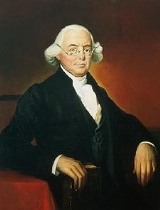
James Wilson

Encyclopedia
James Wilson was one of the Founding Fathers of the United States
and a signer of the United States Declaration of Independence
. Wilson was elected twice to the Continental Congress
, and was a major force in drafting the United States Constitution
. A leading legal theorist, he was one of the six original justices appointed by George Washington
to the Supreme Court of the United States
.
, Fife
, Scotland to William Wilson and Alison Landall. Wilson attended a number of Scottish universities without attaining a degree. Imbued with the ideas of the Scottish Enlightenment
he moved to Philadelphia, Pennsylvania
, in British America
in 1766, carrying valuable letters of introduction. These helped Wilson to begin tutoring and then teaching at The Academy and College of Philadelphia
(now the University of Pennsylvania
). He petitioned there for a degree and was awarded an honorary Master of Arts several months later.
Wilson began to read the law
at the office of John Dickinson
a short time later. After two years of study he attained the bar in Philadelphia, and, in the following year (1767), set up his own practice in Reading, Pennsylvania
. His office was very successful and he earned a small fortune in a few years. By then he had a small farm near Carlisle, Pennsylvania
, was handling cases in eight local counties, and was lecturing at The Academy and College of Philadelphia.
On 5 November 1771, he married Rachel Bird, daughter of William Bird and Bridget Hulings; they had six children together: Mary, William, Bird, James, Emily and Charles. Rachel died in 1786, and in 1793 he married Hannah Gray, daughter of Ellis Gray and Sarah D'Olbear; the marriage produced a son named Henry, who died at age three. Hannah had previously been the widow of Thomas Bartlett, M.D.
, Wilson argued that the Parliament had no authority to pass laws for the American colonies because the colonies had no representation in Parliament. It presented his views that all power derived from the people. Though considered by scholars on par with the seminal works of Thomas Jefferson
and John Adams
of the same year, it was actually penned in 1768, perhaps the first cogent argument to be formulated against British dominance.
In 1775 he was commissioned Colonel of the 4th Cumberland County Battalion http://www.ushistory.org/declaration/signers/wilson.htm and rose to the rank of Brigadier General of the Pennsylvania State Militia.
As a member of the Continental Congress
in 1776, James Wilson was a firm advocate for independence. Believing it was his duty to follow the wishes of his constituents, Wilson refused to vote until he had caucus
ed his district. Only after he received more feedback did he vote for independence. While serving in the Congress, Wilson was clearly among the leaders in the formation of Indian policy. "If the positions he held and the frequency with which he appeared on committees concerned with Indian affairs are an index, he was until his departure from Congress in 1777 the most active and influential single delegate in laying down the general outline that governed the relations of Congress with the border tribes.”
Wilson also served from June 1776 on the Committee on Spies, along with John Adams
, Thomas Jefferson
, John Rutledge
, and Robert R. Livingston. They together defined treason
. (Page, p. 119.)
On October 4, 1779 the Fort Wilson Riot began. After the British had abandoned Philadelphia, James Wilson successfully defended at trial 23 people from property seizure and exile by the radical government of Pennsylvania. A mob whipped up by liquor and the writings and speeches of Joseph Reed
, President of Pennsylvania's Supreme Executive Council, marched on Congressman Wilson's home at Third and Walnut Streets. Wilson and 35 of his colleagues barricaded themselves in his home, later nicknamed Fort Wilson. In the fighting that ensued, six died, and 17 to 19 were wounded. The city's soldiers, the First Troop Philadelphia City Cavalry
and Baylor's 3rd Continental Light Dragoons
, eventually intervened and rescued Wilson and his colleagues. The rioters were pardoned and released by Joseph Reed
http://memory.loc.gov/cgi-bin/query/r?ammem/hlaw:@field(DOCID+@lit(dg01416)) http://links.jstor.org/sici?sici=0043-5597%28197410%293%3A31%3A4%3C589%3ATFWIO1%3E2.0.CO%3B2-0&size=LARGE
In 1779 Wilson accepted the role of Advocate General for France in America. He held this post until 1798 (when he had died.)
Wilson's most lasting impact on the country came as a member of the Committee of Detail
, which produced the first draft of the United States Constitution
in 1787 (a year after the death of his first wife). He wanted senators and the president to be popularly elected. He also proposed the Three-Fifths Compromise
at the convention, which made slaves count as three-fifths of a person for representation in the House and Electoral College. Along with James Madison
, he was perhaps the best versed of the framers in the study of political economy. He understood clearly the central problem of dual sovereignty (nation and state) and held a vision of an almost limitless future for the United States. Wilson addressed the Convention 168 times. A witness to Wilson’s performance during the convention, Dr. Benjamin Rush
, called Wilson's mind "one blaze of light."
Though not in agreement with all parts of the final, necessarily compromised Constitution, Wilson stumped hard for its adoption, leading Pennsylvania
, at its ratifying convention, to become the second state (behind Delaware
) to accept the document. His October 6, 1787 speech in the State House courtyard has been seen as particularly important in setting the terms of the ratification debate, both locally and nationally. In particular, it focused on the fact that there would be a popularly elected national government for the first time. Wilson was later instrumental in the redrafting of the 1776 Pennsylvania State constitution, leading the group in favor of a new constitution, and entering into an agreement with William Findley
(leader of the Constitutionalist Party) that limited the partisan feeling that had previously characterized Pennsylvanian politics.
on September 24, 1789, after the court was implemented under the Judiciary Act of 1789
. He was confirmed by the United States Senate
on September 26, 1789, and received commission on September 29, 1789. Only nine cases were heard by the court from his appointment in 1789 until his death in 1798.
He became the first professor of law at the College of Philadelphia in 1790—only the second at any academic institution in the United States—in which he mostly ignored the practical matters of legal training. Like many of his educated contemporaries, he viewed the academic study of law as a branch of a general cultured education, rather than solely as a prelude to a profession.
Wilson broke off his first course of law lectures in April 1791 to attend to his duties as Supreme Court justice on circuit. He appears to have begun a second-year course in late 1791 or in early 1792 (by which time the College of Philadelphia had been merged into the University of Pennsylvania
), but at some unrecorded point the lectures stopped again and were never resumed. They were not published (except for the first) until after his death, in an edition produced by his son, Bird Wilson, in 1804. The University of Pennsylvania Law School
in Philadelphia officially traces its foundation to Wilson's lectures.
Wilson's final years were marked by financial failures. He assumed heavy debts investing in land that became liabilities with the onset of the Panic of 1796-1797. Of note was the failure in Pennsylvania with Theophilus Cazenove
. In debt, Wilson was briefly imprisoned in a Debtors' Prison in Burlington, New Jersey
. His son paid the debt, but Wilson went to North Carolina
to escape other creditors. He was again briefly imprisoned
, but continued his duties on the Federal judicial circuit. In 1798, he suffered a bout of malaria
and then died of a stroke
at the age of 55, while visiting a friend in Edenton, North Carolina
. He was buried in the Johnston cemetery on Hayes Plantation
near Edenton, but was reinterred in 1906 at Christ Churchyard, Philadelphia.
“Tracing over the events of Wilson’s life, we are impressed by the lucid quality of his mind. With this went a restless energy and insatiable ambition, an almost frightening vitality that turned with undiminished energy and enthusiasm to new tasks and new ventures. Yet, when all has been said, the inner man remains, despite our probings, an enigma.” – Charles Page Smith
With this, he raises the most important question of the era: having acted upon revolutionary principles in setting up the new country, "Why should we not teach our children those principles, upon which we ourselves have thought and acted? Ought we to instil into their tender minds a theory, especially if unfounded, which is contradictory to our own practice, built on the most solid foundation? Why should we reduce them to the cruel dilemma of condemning, either those principles which they have been taught to believe, or those persons whom they have been taught to revere?" (First lecture.)
That this is no mere academic question is revealed with a cursory review of any number of early Supreme Court opinions. Perhaps it is best here to quote the opening of Justice Wilson's opinion in Chisholm v. State of Georgia, 2 U.S. 419 (1793), one of the most momentous decisions in American history: "This is a case of uncommon magnitude. One of the parties to it is a State; certainly respectable, claiming to be sovereign. The question to be determined is, whether this State, so respectable, and whose claim soars so high, is amenable to the jurisdiction of the Supreme Court of the United States? This question, important in itself, will depend on others, more important still; and, may, perhaps, be ultimately resolved into one, no less radical than this 'do the people of the United States form a Nation?'"
In order to arrive at an answer to this question, one that would provide the foundation for the United States of America, Wilson knew that legal thinkers had to resolve in their minds clearly the question of the difference between "the principles of the constitutions and governments and laws of the United States, and the republics, of which they are formed" and the "constitution and government and laws of England." He made it quite clear that he thought the American items to be "materially better." (First lecture.)
Founding Fathers of the United States
The Founding Fathers of the United States of America were political leaders and statesmen who participated in the American Revolution by signing the United States Declaration of Independence, taking part in the American Revolutionary War, establishing the United States Constitution, or by some...
and a signer of the United States Declaration of Independence
United States Declaration of Independence
The Declaration of Independence was a statement adopted by the Continental Congress on July 4, 1776, which announced that the thirteen American colonies then at war with Great Britain regarded themselves as independent states, and no longer a part of the British Empire. John Adams put forth a...
. Wilson was elected twice to the Continental Congress
Continental Congress
The Continental Congress was a convention of delegates called together from the Thirteen Colonies that became the governing body of the United States during the American Revolution....
, and was a major force in drafting the United States Constitution
United States Constitution
The Constitution of the United States is the supreme law of the United States of America. It is the framework for the organization of the United States government and for the relationship of the federal government with the states, citizens, and all people within the United States.The first three...
. A leading legal theorist, he was one of the six original justices appointed by George Washington
George Washington
George Washington was the dominant military and political leader of the new United States of America from 1775 to 1799. He led the American victory over Great Britain in the American Revolutionary War as commander-in-chief of the Continental Army from 1775 to 1783, and presided over the writing of...
to the Supreme Court of the United States
Supreme Court of the United States
The Supreme Court of the United States is the highest court in the United States. It has ultimate appellate jurisdiction over all state and federal courts, and original jurisdiction over a small range of cases...
.
Early life
One of seven children, Wilson was born to a Presbyterian farming family on September 14, 1742 in CarskerdoCeres, Fife
Ceres is a village in Fife, Scotland, located in a small glen approximately 2 miles over the Ceres Moor from Cupar and 7 miles from St Andrews. The former parish of that name included the settlements of Baldinnie, Chance Inn, Craigrothie, Pitscottie and Tarvit Mill.-The village:It is one of the...
, Fife
Fife
Fife is a council area and former county of Scotland. It is situated between the Firth of Tay and the Firth of Forth, with inland boundaries to Perth and Kinross and Clackmannanshire...
, Scotland to William Wilson and Alison Landall. Wilson attended a number of Scottish universities without attaining a degree. Imbued with the ideas of the Scottish Enlightenment
Scottish Enlightenment
The Scottish Enlightenment was the period in 18th century Scotland characterised by an outpouring of intellectual and scientific accomplishments. By 1750, Scots were among the most literate citizens of Europe, with an estimated 75% level of literacy...
he moved to Philadelphia, Pennsylvania
Philadelphia, Pennsylvania
Philadelphia is the largest city in the Commonwealth of Pennsylvania and the county seat of Philadelphia County, with which it is coterminous. The city is located in the Northeastern United States along the Delaware and Schuylkill rivers. It is the fifth-most-populous city in the United States,...
, in British America
British America
For American people of British descent, see British American.British America is the anachronistic term used to refer to the territories under the control of the Crown or Parliament in present day North America , Central America, the Caribbean, and Guyana...
in 1766, carrying valuable letters of introduction. These helped Wilson to begin tutoring and then teaching at The Academy and College of Philadelphia
The Academy and College of Philadelphia
The Academy and College of Philadelphia in Philadelphia, Pennsylvania, USA, is considered by many to have been the first American academy. It was founded in 1749 by Benjamin Franklin....
(now the University of Pennsylvania
University of Pennsylvania
The University of Pennsylvania is a private, Ivy League university located in Philadelphia, Pennsylvania, United States. Penn is the fourth-oldest institution of higher education in the United States,Penn is the fourth-oldest using the founding dates claimed by each institution...
). He petitioned there for a degree and was awarded an honorary Master of Arts several months later.
Wilson began to read the law
Reading law
Reading law is the method by which persons in common law countries, particularly the United States, entered the legal profession before the advent of law schools. This usage specifically refers to a means of entering the profession . A small number of U.S...
at the office of John Dickinson
John Dickinson (delegate)
John Dickinson was an American lawyer and politician from Philadelphia, Pennsylvania and Wilmington, Delaware. He was a militia officer during the American Revolution, a Continental Congressman from Pennsylvania and Delaware, a delegate to the U.S. Constitutional Convention of 1787, President of...
a short time later. After two years of study he attained the bar in Philadelphia, and, in the following year (1767), set up his own practice in Reading, Pennsylvania
Reading, Pennsylvania
Reading is a city in southeastern Pennsylvania, USA, and seat of Berks County. Reading is the principal city of the Greater Reading Area and had a population of 88,082 as of the 2010 census, making it the fifth most populated city in the state after Philadelphia, Pittsburgh, Allentown and Erie,...
. His office was very successful and he earned a small fortune in a few years. By then he had a small farm near Carlisle, Pennsylvania
Carlisle, Pennsylvania
Carlisle is a borough in and the county seat of Cumberland County, Pennsylvania, United States. The name is traditionally pronounced with emphasis on the second syllable. Carlisle is located within the Cumberland Valley, a highly productive agricultural region. As of the 2010 census, the borough...
, was handling cases in eight local counties, and was lecturing at The Academy and College of Philadelphia.
On 5 November 1771, he married Rachel Bird, daughter of William Bird and Bridget Hulings; they had six children together: Mary, William, Bird, James, Emily and Charles. Rachel died in 1786, and in 1793 he married Hannah Gray, daughter of Ellis Gray and Sarah D'Olbear; the marriage produced a son named Henry, who died at age three. Hannah had previously been the widow of Thomas Bartlett, M.D.
Revolution
Taking up the revolutionary cause, Wilson published in 1774 "Considerations on the Nature and Extent of the Legislative Authority of the British Parliament." In this pamphletPamphleteer
A pamphleteer is a historical term for someone who creates or distributes pamphlets. Pamphlets were used to broadcast the writer's opinions on an issue, for example, in order to get people to vote for their favorite politician or to articulate a particular political ideology.A famous pamphleteer...
, Wilson argued that the Parliament had no authority to pass laws for the American colonies because the colonies had no representation in Parliament. It presented his views that all power derived from the people. Though considered by scholars on par with the seminal works of Thomas Jefferson
Thomas Jefferson
Thomas Jefferson was the principal author of the United States Declaration of Independence and the Statute of Virginia for Religious Freedom , the third President of the United States and founder of the University of Virginia...
and John Adams
John Adams
John Adams was an American lawyer, statesman, diplomat and political theorist. A leading champion of independence in 1776, he was the second President of the United States...
of the same year, it was actually penned in 1768, perhaps the first cogent argument to be formulated against British dominance.
In 1775 he was commissioned Colonel of the 4th Cumberland County Battalion http://www.ushistory.org/declaration/signers/wilson.htm and rose to the rank of Brigadier General of the Pennsylvania State Militia.
As a member of the Continental Congress
Continental Congress
The Continental Congress was a convention of delegates called together from the Thirteen Colonies that became the governing body of the United States during the American Revolution....
in 1776, James Wilson was a firm advocate for independence. Believing it was his duty to follow the wishes of his constituents, Wilson refused to vote until he had caucus
Caucus
A caucus is a meeting of supporters or members of a political party or movement, especially in the United States and Canada. As the use of the term has been expanded the exact definition has come to vary among political cultures.-Origin of the term:...
ed his district. Only after he received more feedback did he vote for independence. While serving in the Congress, Wilson was clearly among the leaders in the formation of Indian policy. "If the positions he held and the frequency with which he appeared on committees concerned with Indian affairs are an index, he was until his departure from Congress in 1777 the most active and influential single delegate in laying down the general outline that governed the relations of Congress with the border tribes.”
Wilson also served from June 1776 on the Committee on Spies, along with John Adams
John Adams
John Adams was an American lawyer, statesman, diplomat and political theorist. A leading champion of independence in 1776, he was the second President of the United States...
, Thomas Jefferson
Thomas Jefferson
Thomas Jefferson was the principal author of the United States Declaration of Independence and the Statute of Virginia for Religious Freedom , the third President of the United States and founder of the University of Virginia...
, John Rutledge
John Rutledge
John Rutledge was an American statesman and judge. He was the first Governor of South Carolina following the signing of the Declaration of Independence, the 31st overall...
, and Robert R. Livingston. They together defined treason
Treason
In law, treason is the crime that covers some of the more extreme acts against one's sovereign or nation. Historically, treason also covered the murder of specific social superiors, such as the murder of a husband by his wife. Treason against the king was known as high treason and treason against a...
. (Page, p. 119.)
On October 4, 1779 the Fort Wilson Riot began. After the British had abandoned Philadelphia, James Wilson successfully defended at trial 23 people from property seizure and exile by the radical government of Pennsylvania. A mob whipped up by liquor and the writings and speeches of Joseph Reed
Joseph Reed (jurist)
Joseph Reed was a Pennsylvania lawyer, military officer, and statesman of the Revolutionary Era. He served as a delegate to the Continental Congress and, while in Congress, signed the Articles of Confederation...
, President of Pennsylvania's Supreme Executive Council, marched on Congressman Wilson's home at Third and Walnut Streets. Wilson and 35 of his colleagues barricaded themselves in his home, later nicknamed Fort Wilson. In the fighting that ensued, six died, and 17 to 19 were wounded. The city's soldiers, the First Troop Philadelphia City Cavalry
First Troop Philadelphia City Cavalry
thumb|right|300px|Captain [[Joseph Lapsley Wilson]] of the First City Troop circa 1894The First Troop Philadelphia City Cavalry, also known as the First City Troop, is a unit of the Pennsylvania Army National Guard.-History:...
and Baylor's 3rd Continental Light Dragoons
3rd Continental Light Dragoons
The 3rd Continental Light Dragoons, also known as Baylor's Horse or Lady Washington's Horse, was a mounted regiment of the Continental Army raised on January 1, 1777 at Morristown, New Jersey...
, eventually intervened and rescued Wilson and his colleagues. The rioters were pardoned and released by Joseph Reed
Joseph Reed (jurist)
Joseph Reed was a Pennsylvania lawyer, military officer, and statesman of the Revolutionary Era. He served as a delegate to the Continental Congress and, while in Congress, signed the Articles of Confederation...
http://memory.loc.gov/cgi-bin/query/r?ammem/hlaw:@field(DOCID+@lit(dg01416)) http://links.jstor.org/sici?sici=0043-5597%28197410%293%3A31%3A4%3C589%3ATFWIO1%3E2.0.CO%3B2-0&size=LARGE
In 1779 Wilson accepted the role of Advocate General for France in America. He held this post until 1798 (when he had died.)
Constitutional Convention
One of the most prominent lawyers of his time, Wilson is credited for being the most learned of the Framers of the Constitution. A fellow delegate in the Constitutional Convention of 1787 in Philadelphia made the following assessment of James Wilson: "Government seems to have been his peculiar study, all the political institutions of the world he knows in detail, and can trace the causes and effects of every revolution from the earliest stages of the Grecian commonwealth down to the present time."Wilson's most lasting impact on the country came as a member of the Committee of Detail
Committee of Detail
The Committee of Detail was a committee established by the Philadelphia Convention on June 23, 1787 to put down a draft text reflecting the agreements made by the Convention up to that point, including the Virginia Plan's 15 resolutions. It was chaired by John Rutledge, and other members included...
, which produced the first draft of the United States Constitution
United States Constitution
The Constitution of the United States is the supreme law of the United States of America. It is the framework for the organization of the United States government and for the relationship of the federal government with the states, citizens, and all people within the United States.The first three...
in 1787 (a year after the death of his first wife). He wanted senators and the president to be popularly elected. He also proposed the Three-Fifths Compromise
Three-fifths compromise
The Three-Fifths Compromise was a compromise between Southern and Northern states reached during the Philadelphia Convention of 1787 in which three-fifths of the enumerated population of slaves would be counted for representation purposes regarding both the distribution of taxes and the...
at the convention, which made slaves count as three-fifths of a person for representation in the House and Electoral College. Along with James Madison
James Madison
James Madison, Jr. was an American statesman and political theorist. He was the fourth President of the United States and is hailed as the “Father of the Constitution” for being the primary author of the United States Constitution and at first an opponent of, and then a key author of the United...
, he was perhaps the best versed of the framers in the study of political economy. He understood clearly the central problem of dual sovereignty (nation and state) and held a vision of an almost limitless future for the United States. Wilson addressed the Convention 168 times. A witness to Wilson’s performance during the convention, Dr. Benjamin Rush
Benjamin Rush
Benjamin Rush was a Founding Father of the United States. Rush lived in the state of Pennsylvania and was a physician, writer, educator, humanitarian and a Christian Universalist, as well as the founder of Dickinson College in Carlisle, Pennsylvania....
, called Wilson's mind "one blaze of light."
Though not in agreement with all parts of the final, necessarily compromised Constitution, Wilson stumped hard for its adoption, leading Pennsylvania
Pennsylvania
The Commonwealth of Pennsylvania is a U.S. state that is located in the Northeastern and Mid-Atlantic regions of the United States. The state borders Delaware and Maryland to the south, West Virginia to the southwest, Ohio to the west, New York and Ontario, Canada, to the north, and New Jersey to...
, at its ratifying convention, to become the second state (behind Delaware
Delaware
Delaware is a U.S. state located on the Atlantic Coast in the Mid-Atlantic region of the United States. It is bordered to the south and west by Maryland, and to the north by Pennsylvania...
) to accept the document. His October 6, 1787 speech in the State House courtyard has been seen as particularly important in setting the terms of the ratification debate, both locally and nationally. In particular, it focused on the fact that there would be a popularly elected national government for the first time. Wilson was later instrumental in the redrafting of the 1776 Pennsylvania State constitution, leading the group in favor of a new constitution, and entering into an agreement with William Findley
William Findley
William Findley was an Irish-born farmer and politician from Westmoreland County, Pennsylvania. He served in both houses of the state legislature and represented Pennsylvania in the U.S. House from 1791 until 1799 and from 1803 to 1817.-Early years:William Findley was born in Ulster, Ireland and...
(leader of the Constitutionalist Party) that limited the partisan feeling that had previously characterized Pennsylvanian politics.
Supreme Court appointment
He was nominated to be an Associate Justice of the United States Supreme Court by George WashingtonGeorge Washington
George Washington was the dominant military and political leader of the new United States of America from 1775 to 1799. He led the American victory over Great Britain in the American Revolutionary War as commander-in-chief of the Continental Army from 1775 to 1783, and presided over the writing of...
on September 24, 1789, after the court was implemented under the Judiciary Act of 1789
Judiciary Act of 1789
The United States Judiciary Act of 1789 was a landmark statute adopted on September 24, 1789 in the first session of the First United States Congress establishing the U.S. federal judiciary...
. He was confirmed by the United States Senate
United States Senate
The United States Senate is the upper house of the bicameral legislature of the United States, and together with the United States House of Representatives comprises the United States Congress. The composition and powers of the Senate are established in Article One of the U.S. Constitution. Each...
on September 26, 1789, and received commission on September 29, 1789. Only nine cases were heard by the court from his appointment in 1789 until his death in 1798.
He became the first professor of law at the College of Philadelphia in 1790—only the second at any academic institution in the United States—in which he mostly ignored the practical matters of legal training. Like many of his educated contemporaries, he viewed the academic study of law as a branch of a general cultured education, rather than solely as a prelude to a profession.
Wilson broke off his first course of law lectures in April 1791 to attend to his duties as Supreme Court justice on circuit. He appears to have begun a second-year course in late 1791 or in early 1792 (by which time the College of Philadelphia had been merged into the University of Pennsylvania
University of Pennsylvania
The University of Pennsylvania is a private, Ivy League university located in Philadelphia, Pennsylvania, United States. Penn is the fourth-oldest institution of higher education in the United States,Penn is the fourth-oldest using the founding dates claimed by each institution...
), but at some unrecorded point the lectures stopped again and were never resumed. They were not published (except for the first) until after his death, in an edition produced by his son, Bird Wilson, in 1804. The University of Pennsylvania Law School
University of Pennsylvania Law School
The University of Pennsylvania Law School, located in Philadelphia, Pennsylvania, is the law school of the University of Pennsylvania. A member of the Ivy League, it is among the oldest and most selective law schools in the nation. It is currently ranked 7th overall by U.S. News & World Report,...
in Philadelphia officially traces its foundation to Wilson's lectures.
Wilson's final years were marked by financial failures. He assumed heavy debts investing in land that became liabilities with the onset of the Panic of 1796-1797. Of note was the failure in Pennsylvania with Theophilus Cazenove
Theophilus Cazenove
Theophilus Cazenove, or Theophile Cazenove , was a financier and one of the agents of the Holland Land Company.- Life and career :...
. In debt, Wilson was briefly imprisoned in a Debtors' Prison in Burlington, New Jersey
Burlington, New Jersey
Burlington is a city in Burlington County, New Jersey, United States and a suburb of Philadelphia. As of the 2010 United States Census, the city population was 9,920....
. His son paid the debt, but Wilson went to North Carolina
North Carolina
North Carolina is a state located in the southeastern United States. The state borders South Carolina and Georgia to the south, Tennessee to the west and Virginia to the north. North Carolina contains 100 counties. Its capital is Raleigh, and its largest city is Charlotte...
to escape other creditors. He was again briefly imprisoned
Prison
A prison is a place in which people are physically confined and, usually, deprived of a range of personal freedoms. Imprisonment or incarceration is a legal penalty that may be imposed by the state for the commission of a crime...
, but continued his duties on the Federal judicial circuit. In 1798, he suffered a bout of malaria
Malaria
Malaria is a mosquito-borne infectious disease of humans and other animals caused by eukaryotic protists of the genus Plasmodium. The disease results from the multiplication of Plasmodium parasites within red blood cells, causing symptoms that typically include fever and headache, in severe cases...
and then died of a stroke
Stroke
A stroke, previously known medically as a cerebrovascular accident , is the rapidly developing loss of brain function due to disturbance in the blood supply to the brain. This can be due to ischemia caused by blockage , or a hemorrhage...
at the age of 55, while visiting a friend in Edenton, North Carolina
Edenton, North Carolina
Edenton is a town in Chowan County, North Carolina, United States. The population was 4,966 at the 2008 census. It is the county seat of Chowan County. Edenton is located in North Carolina's Inner Banks region. In recent years Edenton has become a popular retirement location and a destination for...
. He was buried in the Johnston cemetery on Hayes Plantation
Hayes Plantation
Hayes Plantation, also known as Hayes Farm, is a historic plantation near Edenton, North Carolina that belonged to Samuel Johnston , who served as Governor of North Carolina from 1787 to 1789. Johnston become one of the state's first two United States Senators, serving from 1789 until 1793, and...
near Edenton, but was reinterred in 1906 at Christ Churchyard, Philadelphia.
“Tracing over the events of Wilson’s life, we are impressed by the lucid quality of his mind. With this went a restless energy and insatiable ambition, an almost frightening vitality that turned with undiminished energy and enthusiasm to new tasks and new ventures. Yet, when all has been said, the inner man remains, despite our probings, an enigma.” – Charles Page Smith
Jurisprudence
In the lectures mentioned above, James Wilson, among the first of American legal philosophers, worked through in more detail some of the thinking suggested in the opinions issuing at that time from the Supreme Court. He felt, in fact, compelled to begin by spending some time in arguing out the justification of the appropriateness of his undertaking a course of lectures. But he assures his students that: "When I deliver my sentiments from this chair, they shall be my honest sentiments: when I deliver them from the bench, they shall be nothing more. In both places I shall make ― because I mean to support ― the claim to integrity: in neither shall I make ― because, in neither, can I support ― the claim to infallibility." (First lecture, 1804 Philadelphia ed.)With this, he raises the most important question of the era: having acted upon revolutionary principles in setting up the new country, "Why should we not teach our children those principles, upon which we ourselves have thought and acted? Ought we to instil into their tender minds a theory, especially if unfounded, which is contradictory to our own practice, built on the most solid foundation? Why should we reduce them to the cruel dilemma of condemning, either those principles which they have been taught to believe, or those persons whom they have been taught to revere?" (First lecture.)
That this is no mere academic question is revealed with a cursory review of any number of early Supreme Court opinions. Perhaps it is best here to quote the opening of Justice Wilson's opinion in Chisholm v. State of Georgia, 2 U.S. 419 (1793), one of the most momentous decisions in American history: "This is a case of uncommon magnitude. One of the parties to it is a State; certainly respectable, claiming to be sovereign. The question to be determined is, whether this State, so respectable, and whose claim soars so high, is amenable to the jurisdiction of the Supreme Court of the United States? This question, important in itself, will depend on others, more important still; and, may, perhaps, be ultimately resolved into one, no less radical than this 'do the people of the United States form a Nation?'"
In order to arrive at an answer to this question, one that would provide the foundation for the United States of America, Wilson knew that legal thinkers had to resolve in their minds clearly the question of the difference between "the principles of the constitutions and governments and laws of the United States, and the republics, of which they are formed" and the "constitution and government and laws of England." He made it quite clear that he thought the American items to be "materially better." (First lecture.)
See also
- List of Justices of the Supreme Court of the United States
- List of United States Chief Justices by time in office
- List of U.S. Supreme Court Justices by time in office
- United States Supreme Court cases during the Ellsworth Court
- United States Supreme Court cases during the Marshall Court
- United States Supreme Court cases during the Rutledge Court
- U.S. Constitution, "forgotten hero", floor leader in Convention.
Further reading
- Brooks, Christopher (2006). Chisholm to Alden: James Wilson's Artificial Person in American Supreme Court History, 1793-1999. Berlin: Logos Verlag. ISBN 3832513426.
- Ewald, William. "James Wilson and the Drafting of the Constitution," University of Pennsylvania Journal of Constitutional Law, 10 (June 2008), 901–1009.
- Flanders, Henry. The Lives and Times of the Chief Justices of the United States Supreme Court. Philadelphia: J. B. Lippincott & Co., 1874 at Google Books.
- Pedersen, Nicholas K., "James Wilson: The Lost Founder", Yale Journal of Law & Humanities, 22 (2010), 257-337.