
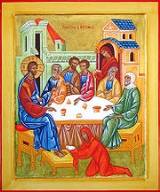
Mary of Bethany is a
biblicalThe Bible refers to any one of the collections of the primary religious texts of Judaism and Christianity. There is no common version of the Bible, as the individual books , their contents and their order vary among denominations...
figure described in the Gospels of
JohnThe Gospel According to John , commonly referred to as the Gospel of John or simply John, and often referred to in New Testament scholarship as the Fourth Gospel, is an account of the public ministry of Jesus...
and
LukeThe Gospel According to Luke , commonly shortened to the Gospel of Luke or simply Luke, is the third and longest of the four canonical Gospels. This synoptic gospel is an account of the life and ministry of Jesus of Nazareth. It details his story from the events of his birth to his Ascension.The...
in the
ChristianA Christian is a person who adheres to Christianity, an Abrahamic, monotheistic religion based on the life and teachings of Jesus of Nazareth as recorded in the Canonical gospels and the letters of the New Testament...
New TestamentThe New Testament is the second major division of the Christian biblical canon, the first such division being the much longer Old Testament....
. Together with her siblings
LazarusLazarus of Bethany, also known as Saint Lazarus or Lazarus of the Four Days, is the subject of a prominent miracle attributed to Jesus in the Gospel of John, in which Jesus restores him to life four days after his death...
and
MarthaMartha of Bethany is a biblical figure described in the Gospels of Luke and John. Together with her siblings Lazarus and Mary, she is described as living in the village of Bethany near Jerusalem...
, she is described as living in the village of Bethany near
Jerusalem.
In Latin tradition, Mary of Bethany is often identified as
Mary MagdaleneMary Magdalene was one of Jesus' most celebrated disciples, and the most important woman disciple in the movement of Jesus. Jesus cleansed her of "seven demons", conventionally interpreted as referring to complex illnesses...
(of whom more is recorded in the gospels as well as in later traditions), while in Eastern Orthodox and Protestant traditions they are considered separate persons. The Orthodox Church has its own traditions regarding Mary of Bethany's life beyond the gospel accounts.
Biblical references
In the
Gospel of LukeThe Gospel According to Luke , commonly shortened to the Gospel of Luke or simply Luke, is the third and longest of the four canonical Gospels. This synoptic gospel is an account of the life and ministry of Jesus of Nazareth. It details his story from the events of his birth to his Ascension.The...
, Jesus visits the home of two sisters named Mary and Martha. Mary is contrasted with her sister Martha, who was "cumbered about many things" while Jesus was their guest, while Mary had chosen "the better part," that of listening to the master's discourse. The name of their village is not recorded, nor any mention of whether Jesus was near Jerusalem:
For Mary to sit at Jesus' feet, and for him to allow her to do so, was itself controversial. In doing so, as one commentator notes, Mary took "the place of a disciple by sitting at the feet of the teacher. It was unusual for a woman in first-century Judaism to be accepted by a teacher as a disciple."
In the
Gospel of JohnThe Gospel According to John , commonly referred to as the Gospel of John or simply John, and often referred to in New Testament scholarship as the Fourth Gospel, is an account of the public ministry of Jesus...
, a Mary appears in connection two incidents: the raising from the dead of her brother Lazarus and the
anointing of JesusThe anointing of Jesus is an event reported by each of the Canonical gospels, in which a woman pours the entire contents of an alabastron of very expensive perfume over the head or feet of Jesus....
. The identification of this being the same Mary in both incidents is given explicitly by the author: "Now a man named Lazarus was sick. He was from Bethany, the village of Mary and her sister Martha. This Mary, whose brother Lazarus now lay sick, was the same one who poured perfume on the Lord and wiped his feet with her hair." The mention of her sister Martha suggests a connection with the aforementioned woman in Luke.
In the account of the raising of Lazarus, Jesus meets with the sisters in turn: Martha followed by Mary. Martha goes immediately to meet Jesus as he arrives, while Mary waits until she is called. As one commentator notes, "Martha, the more aggressive sister, went to meet Jesus, while quiet and contemplative Mary stayed home. This portrayal of the sisters agrees with that found in Luke 10:38-42." When Mary meets Jesus, she falls at his feet. In speaking with Jesus, both sisters lament that he did not arrive in time to prevent their brother's death: "Lord, if you had been here, my brother would not have died." But where Jesus' response to Martha is one of teaching calling her to hope and faith, his response to Mary is more emotional: "When Jesus saw her weeping, and the Jews who had come along with her also weeping, he was deeply moved in spirit and troubled. As the 17th century British commentator
Matthew HenryMatthew Henry was an English commentator on the Bible and Presbyterian minister.-Life:He was born at Broad Oak, a farmhouse on the borders of Flintshire and Shropshire. His father, Philip Henry, had just been ejected under the Act of Uniformity 1662...
notes, "Mary added no more, as Martha did; but it appears, by what follows, that what she fell short in words she made up in tears; she said less than Martha, but wept more."
Anointing of Jesus
A narrative in which Mary of Bethany plays a central role (in at least one of the accounts) is the
anointing of JesusThe anointing of Jesus is an event reported by each of the Canonical gospels, in which a woman pours the entire contents of an alabastron of very expensive perfume over the head or feet of Jesus....
, an event reported by the
Synoptic GospelsThe gospels of Matthew, Mark, and Luke are known as the Synoptic Gospels because they include many of the same stories, often in the same sequence, and sometimes exactly the same wording. This degree of parallelism in content, narrative arrangement, language, and sentence structures can only be...
and the
Gospel of JohnThe Gospel According to John , commonly referred to as the Gospel of John or simply John, and often referred to in New Testament scholarship as the Fourth Gospel, is an account of the public ministry of Jesus...
in which a woman pours the entire contents of an
alabastronAn alabastron is a type of pottery used in the ancient world for holding oil, especially perfume or massage oils...
of very expensive
perfumePerfume is a mixture of fragrant essential oils and/or aroma compounds, fixatives, and solvents used to give the human body, animals, objects, and living spaces "a pleasant scent"...
over the head or feet of Jesus. Only in the John account is the woman identified as Mary, with the earlier reference in establishing her as the sister of Martha and Lazarus.
The woman's name is not given in the Gospels of
MatthewThe Gospel According to Matthew is one of the four canonical gospels, one of the three synoptic gospels, and the first book of the New Testament. It tells of the life, ministry, death, and resurrection of Jesus of Nazareth...
and
MarkThe Gospel According to Mark , commonly shortened to the Gospel of Mark or simply Mark, is the second book of the New Testament. This canonical account of the life of Jesus of Nazareth is one of the three synoptic gospels. It was thought to be an epitome, which accounts for its place as the second...
, but the event is likewise placed in Bethany, specifically at the home of one
Simon the LeperSimon the Leper is a biblical figure mentioned by the Gospels according to Matthew and Mark . These two books narrate how Jesus made a visit to the house of Simon the Leper at Bethany during the course of which a woman anoints the head of Jesus with costly ointment. Bethany was the home of Simon...
, a man whose significance is not explained elsewhere in the gospels.
According to the Markan account, the perfume was the purest of
spikenardSpikenard is a flowering plant of the Valerian family that grows in the Himalayas of China, also found growing in the northern region of India and Nepal. The plant grows to about 1 m in height and has pink, bell-shaped flowers...
. Some of the onlookers are angered because this expensive perfume could have been sold for a year's wages, which Mark enumerates as 300 denarii, and the money given to the poor. The Gospel of Matthew states that the "disciples were indignant" and John's gospel states that it was
Judas IscariotJudas Iscariot was, according to the New Testament, one of the twelve disciples of Jesus. He is best known for his betrayal of Jesus to the hands of the chief priests for 30 pieces of silver.-Etymology:...
who was most offended (which is explained by the narrator as being because Judas was a thief and desired the money for himself). In the accounts, Jesus justifies Mary's action by stating that they would always have the poor among them and would be able to help them whenever they desired, but that he would not always be with them. He says that her anointing was done to prepare him for his burial. As one commentator notes, "Mary seems to have been the only one who was sensitive to the impending death of Jesus and who was willing to give a material expression of her esteem for him. Jesus' reply shows his appreciation of her act of devotion." The accounts in Matthew and Mark adds these words of Jesus, "I tell you the truth, wherever this gospel is preached throughout the world, what she has done will also be told, in memory of her".
Easton (1897) noted that it would appear from the circumstances that the family of Lazarus possessed a family vault and that a large number of Jews from Jerusalem came to console them on the death of Lazarus, that this family at Bethany belonged to the wealthier class of the people. This would help explain how Mary of Bethany could afford to possess quantities of expensive perfume.
A similar anointing is described in the
Gospel of LukeThe Gospel According to Luke , commonly shortened to the Gospel of Luke or simply Luke, is the third and longest of the four canonical Gospels. This synoptic gospel is an account of the life and ministry of Jesus of Nazareth. It details his story from the events of his birth to his Ascension.The...
as occurring at the home of one Simon the Pharisee in which a woman who had been sinful all her life, and who was crying, anointed Jesus' feet and, when her tears started to fall on his feet, she wiped them with her hair. Luke's account (as well as John's) differs from that of Matthew and Mark by relating that the anointing is to the feet rather than the head. Although it is a subject of considerable debate, many scholars hold that these actually describe two separate events.
It should also be noted that Jesus' response to the anointing in Luke is completely different from that recorded in the other gospels. Rather than Jesus' above-mentioned comments on the "poor you will always have with you", here he tells his host the Parable of the Two Debtors. As one commentator notes, "Luke is the only one to record the parable of the two debtors, and he chooses to preserve it in this setting... If one considers the other gospel accounts as a variation of the same event, it is likely that the parable is not authentically set. Otherwise, the powerful message from the parable located in this setting would likely be preserved elsewhere, too. However, if one considers the story historically accurate, happening in Jesus' life apart from the similar incidents recorded in the other gospels, the question of the authenticity of the parable receives a different answer... John Nolland, following Wilckens' ideas, writes: 'There can hardly be a prior form of the episode not containing the present parable, since this would leave the Pharisee's concerns of v 39 with no adequate response'."
Catholic identification with Mary Magdalene
In Roman Catholic tradition, Mary of Bethany is identified as
Mary MagdaleneMary Magdalene was one of Jesus' most celebrated disciples, and the most important woman disciple in the movement of Jesus. Jesus cleansed her of "seven demons", conventionally interpreted as referring to complex illnesses...
, while in Eastern Orthodox and Protestant traditions they are considered separate persons. The
Catholic EncyclopediaThe Catholic Encyclopedia, also referred to as the Old Catholic Encyclopedia and the Original Catholic Encyclopedia, is an English-language encyclopedia published in the United States. The first volume appeared in March 1907 and the last three volumes appeared in 1912, followed by a master index...
(1910) states, "The Greek Fathers, as a whole, distinguish the three persons: the "sinner" of ; the sister of Martha and Lazarus, and ; and Mary Magdalen. On the other hand most of the Latins hold that these three were one and the same. Protestant critics, however, believe there were two, if not three, distinct persons."
The author of the Catholic Encyclopedia article goes on to enumerate the accounts of each of these three persons (the unnamed "sinner", Mary Magdalene, and Mary of Bethany) in the Gospel of Luke and concludes that based on these accounts “there is no suggestion of an identification of the three persons, and if we had only Luke to guide us we should certainly have no grounds for so identifying them [as the same person].” He then explains first the Catholic position equating Mary of Bethany with the sinful woman of Luke by referring to , where Mary is identified as the woman who anointed Jesus, and noting that this reference is given before John’s account of the anointing in Bethany:
John, however, clearly identifies Mary of Bethany with the woman who anointed Christ's feet (12; cf. and ). It is remarkable that already in , John has spoken of Mary as "she that anointed the Lord's feet", he aleipsasa. It is commonly said that he refers to the subsequent anointing which he himself describes in ; but it may be questioned whether he would have used he aleipsasa if another woman, and she a "sinner" in the city, had done the same. It is conceivable that John, just because he is writing so long after the event and at a time when Mary was dead, wishes to point out to us that she was really the same as the "sinner." In the same way Luke may have veiled her identity precisely because he did not wish to defame one who was yet living; he certainly does something similar in the case of St. Matthew whose identity with Levi the publican (5:7) he conceals. If the foregoing argument holds good, Mary of Bethany and the "sinner" are one and the same.
The Catholic Encyclopedia author then explains the identification of Mary of Bethany with Mary Magdalene by the presumption that, because of Jesus’ high praise of her deed of anointing him, it would be incredible that she should also not have been at his crucifixion and resurrection. Since Mary Magdelene is reported to have been present on those occasions, by this reasoning, she must therefore be the same person as Mary of Bethany:
An examination of John's Gospel makes it almost impossible to deny the identity of Mary of Bethany with Mary Magdalen. From John we learn the name of the "woman" who anointed Christ's feet previous to the last supper. We may remark here that it seems unnecessary to hold that because Matthew and Mark say "two days before the Passover", while John says "six days" there were, therefore, two distinct anointings following one another. John does not necessarily mean that the supper and the anointing took place six days before, but only that Christ came to Bethany six days before the Passover. At that supper, then, Mary received the glorious encomium, "she hath wrought a good work upon Me...in pouring this ointment upon My body she hath done it for My burial...wheresoever this Gospel shall be preached...that also which she hath done shall be told for a memory of her." Is it credible, in view of all this, that this Mary should have no place at the foot of the cross, nor at the tomb of Christ? Yet it is Mary Magdalen who, according to all the Evangelists, stood at the foot of the cross and assisted at the entombment and was the first recorded witness of the Resurrection. And while John calls her "Mary Magdalen" in 19:25, 20:1, and 20:18, he calls her simply "Mary" in 20:11 and 20:16.
French scholar Victor Saxer dates the identification of Mary Magdalene as a prostitute, and as Mary of Bethany, to a sermon by Pope Gregory the Great on September 21, 591 A.D., where he seemed to combine the actions of three women mentioned in the New Testament and also identified an unnamed woman as Mary Magdalene. In another sermon, Gregory specifically identified Mary Magdalene as the sister of Martha mentioned in Luke 10.
Eastern Orthodox tradition
In Orthodox Church tradition, Mary of Bethany is honored as a separate individual from Mary Magdalene. Though they are not specifically named as such in the gospels, the Orthodox Church counts Mary and Martha among the Myrrh-bearing Women. These faithful followers of Jesus stood at Golgotha during the
Crucifixion of JesusThe crucifixion of Jesus and his ensuing death is an event that occurred during the 1st century AD. Jesus, who Christians believe is the Son of God as well as the Messiah, was arrested, tried, and sentenced by Pontius Pilate to be scourged, and finally executed on a cross...
and later came to his tomb early on the morning following the
SabbathSabbath in the Bible is usually a weekly day of rest and time of worship. The Sabbath is first mentioned in the Genesis creation narrative. The seventh day is there set aside as a day of rest—the Sabbath. It is observed differently in Judaism and Christianity and informs a similar occasion in...
with
myrrhMyrrh is the aromatic oleoresin of a number of small, thorny tree species of the genus Commiphora, which grow in dry, stony soil. An oleoresin is a natural blend of an essential oil and a resin. Myrrh resin is a natural gum....
(expensive oil), according to the Jewish tradition, to anoint their Lord's body. The Myrrhbearers became the first witnesses to the
Resurrection of JesusThe Christian belief in the resurrection of Jesus states that Jesus returned to bodily life on the third day following his death by crucifixion. It is a key element of Christian faith and theology and part of the Nicene Creed: "On the third day he rose again in fulfillment of the Scriptures"...
, finding the empty tomb and hearing the joyful news from an angel.
Orthodox tradition also relates that Mary's brother Lazarus was cast out of Jerusalem in the persecution against the Jerusalem Church following the martyrdom of St. Stephen. His sisters Mary and Martha fled Judea with him, assisting him in the proclaiming of the Gospel in various lands. The three later moved to
CyprusCyprus , officially the Republic of Cyprus , is a Eurasian island country, member of the European Union, in the Eastern Mediterranean, east of Greece, south of Turkey, west of Syria and north of Egypt. It is the third largest island in the Mediterranean Sea.The earliest known human activity on the...
, where Lazarus became the first Bishop of Kition (modern
LarnacaLarnaca, is the third largest city on the southern coast of Cyprus after Nicosia and Limassol. It has a population of 72,000 and is the island's second largest commercial port and an important tourist resort...
). All three died in
CyprusCyprus , officially the Republic of Cyprus , is a Eurasian island country, member of the European Union, in the Eastern Mediterranean, east of Greece, south of Turkey, west of Syria and north of Egypt. It is the third largest island in the Mediterranean Sea.The earliest known human activity on the...
.
Commemoration as a Saint
St. Mary of Bethany is commemorated in the Eastern Orthodox and Eastern Catholic Churches with her sister Martha on
June 4, as well as on the Sunday of the
MyrrhbearersIn Eastern Orthodoxy the Myrrhbearers are the individuals mentioned in the New Testament who were directly involved in the burial or who discovered the empty tomb following the resurrection of Jesus...
(the Third Sunday of
PaschaEaster is the central feast in the Christian liturgical year. According to the Canonical gospels, Jesus rose from the dead on the third day after his crucifixion. His resurrection is celebrated on Easter Day or Easter Sunday...
, i.e. the Third Sunday of Easter). She also figures prominently in the commemorations on
Lazarus SaturdayLazarus Saturday, in the Orthodox Church and those Eastern Catholic Churches which follow the Byzantine Rite, is the day before Palm Sunday, and is liturgically linked to it...
(the day before
Palm SundayPalm Sunday is a Christian moveable feast that falls on the Sunday before Easter. The feast commemorates Jesus' triumphal entry into Jerusalem, an event mentioned in all four Canonical Gospels. ....
).
She is commemorated on
July 29 in the
Calendar of SaintsThe Lutheran Calendar of Saints is a listing which details the primary annual festivals and events that are celebrated liturgically by some Lutheran Churches in the United States. The calendars of the Evangelical Lutheran Church in America and the Lutheran Church - Missouri Synod are from the...
of the Lutheran Church (together with Martha and Lazarus) and in the
Calendar of saintsThe veneration of saints in the Episcopal Church is a continuation of an ancient tradition from the early Church which honors important people of the Christian faith. The usage of the term "saint" is similar to Roman Catholic and Orthodox traditions. Those in the Anglo-Catholic tradition may...
of the
Episcopal ChurchThe Episcopal Church is a mainline Anglican Christian church found mainly in the United States , but also in Honduras, Taiwan, Colombia, Ecuador, Haiti, the Dominican Republic, Venezuela, the British Virgin Islands and parts of Europe...
and the
Church of EnglandThe Church of England is the officially established Christian church in England and the Mother Church of the worldwide Anglican Communion. The church considers itself within the tradition of Western Christianity and dates its formal establishment principally to the mission to England by St...
(together with Martha).
External links