


Ion Ghica

Encyclopedia
Ion Ghica was a Romania
n revolutionary, mathematician, diplomat and twice Prime Minister of Romania
(between 1866 and 1867, and between 1870 and 1871). He was a full member of the Romanian Academy
and its president for four times (1876-1882, 1884-1887, 1890-1893 and 1894-1895). He was the older brother and associate of Pantazi Ghica
, a prolific writer and politician.
, Wallachia
, to the prominent Ghica
boyar
family, and was the nephew of both Grigore Alexandru Ghica
(who was to become Prince of Wallachia in the 1840s and 1850s) and Ion Câmpineanu, a Carbonari
-inspired radical
. Ion Ghica was educated in Bucharest and in the West of Europe, studying engineering
and mathematics
in France
from 1837 to 1840.
After finishing his studies in Paris
, he left for Moldavia
and was involved in the failed Frăţia ("Brotherhood") conspiracy of 1848, which was intended to bring about the union of Wallachia and Moldavia under one native Romanian leader, Prince Mihai Sturdza. Ion Ghica became a lecturer on mathematics at the Academy which was founded by the same Prince Sturdza in Iaşi
(future University of Iaşi).
He joined the Wallachian revolutionary camp, and, in the name of the Provisional Government
then established in Bucharest, went to Istanbul
to approach the Ottoman Imperial
government; he, Nicolae Bălcescu
, and General Gheorghe Magheru
were instrumental in mediating negotiations between the Transylvania
n Romanian leader Avram Iancu
and the Hungarian
Revolutionary government of Lajos Kossuth
.
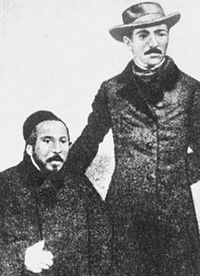 While in Istanbul, he was appointed Bey
of Samos
(1854 - 1859), where he proved his leadership skills by extirpating local piracy (most of which was aimed at transports supplying the Crimean War
). After completing the task, Ghica was awarded the honorary title of Prince of Samos by Sultan
Abd-ul-Mejid I in 1856.
In 1859, after the union of Moldavia and Walachia had been effected, Prince
Alexandru Ioan Cuza
asked Ion Ghica to return. Later (1866), despite being trusted by Prince Cuza, Ghica took active part in the secret grouping that secured Cuza's overthrow. He was the first prime minister under Prince of Romania (afterwards King of Romania
) Carol of Hohenzollern
.
Ghica is also noted as one of the first major Liberal figures in the Kingdom of Romania
, and one of the leaders of the incipient Liberal Party
. His group's radicalism
, with its boyar leadership that had engineered the defunct Revolution, surfaced as republicanism
whenever Carol approached the Conservatives
; Ghica joined the anti-dynastic movement of 1870-1871 that had surfaced with the Republic of Ploieşti
. The matter of the Liberals' loyalty was ultimately settled 1876, with the exceptionally long Liberal Ministry of Ion Brătianu
. In 1881, Ghica was appointed Romanian Minister
in London
, an office he retained until 1889; he died in Ghergani, Dâmboviţa County
.
, his lifelong friend. Conceived and written during his residency in London, the letters depict the ancestral stage of Romanian society, as it appeared to be fading away.
He was also the author of Amintiri din pribegie ("Recollections from Exile"), in 1848, and of Convorbiri Economice ("Conversations on Economy"), dealing with major economic issues. He was the first to advocate the favoring of local initiatives over foreign investments in industry and commerce - to a certain extent, this took the form of protectionism
(a characteristic of the Liberal Party throughout the coming period, and until World War II
).
Romania
Romania is a country located at the crossroads of Central and Southeastern Europe, on the Lower Danube, within and outside the Carpathian arch, bordering on the Black Sea...
n revolutionary, mathematician, diplomat and twice Prime Minister of Romania
Prime Minister of Romania
The Prime Minister of Romania is the head of the Government of Romania. Initially, the office was styled President of the Council of Ministers , when the term "Government" included more than the Cabinet, and the Cabinet was called The Council of Ministers...
(between 1866 and 1867, and between 1870 and 1871). He was a full member of the Romanian Academy
Romanian Academy
The Romanian Academy is a cultural forum founded in Bucharest, Romania, in 1866. It covers the scientific, artistic and literary domains. The academy has 181 acting members who are elected for life....
and its president for four times (1876-1882, 1884-1887, 1890-1893 and 1894-1895). He was the older brother and associate of Pantazi Ghica
Pantazi Ghica
Pantazi Ghica was a Wallachian-born Romanian politician and lawyer, also known as a dramatist, poet, short story writer, and literary critic. A prominent representative of the liberal current, he was the younger brother and lifelong collaborator of Ion Ghica, who served as Prime Minister of the...
, a prolific writer and politician.
Early life and Revolution
He was born in BucharestBucharest
Bucharest is the capital municipality, cultural, industrial, and financial centre of Romania. It is the largest city in Romania, located in the southeast of the country, at , and lies on the banks of the Dâmbovița River....
, Wallachia
Wallachia
Wallachia or Walachia is a historical and geographical region of Romania. It is situated north of the Danube and south of the Southern Carpathians...
, to the prominent Ghica
Ghica family
The Ghica family were a Romanian noble family, active in Wallachia, Moldavia and in the Kingdom of Romania. In the 18th century, several branches of the family went through a process of Hellenization...
boyar
Boyar
A boyar, or bolyar , was a member of the highest rank of the feudal Moscovian, Kievan Rus'ian, Bulgarian, Wallachian, and Moldavian aristocracies, second only to the ruling princes , from the 10th century through the 17th century....
family, and was the nephew of both Grigore Alexandru Ghica
Grigore Alexandru Ghica
Grigore Alexandru Ghica or Ghika was a Prince of Moldavia between October 14, 1849 and June 1853, and again between October 30, 1854 and June 3, 1856...
(who was to become Prince of Wallachia in the 1840s and 1850s) and Ion Câmpineanu, a Carbonari
Carbonari
The Carbonari were groups of secret revolutionary societies founded in early 19th-century Italy. The Italian Carbonari may have further influenced other revolutionary groups in Spain, France, Portugal and possibly Russia. Although their goals often had a patriotic and liberal focus, they lacked a...
-inspired radical
Radicalism (historical)
The term Radical was used during the late 18th century for proponents of the Radical Movement. It later became a general pejorative term for those favoring or seeking political reforms which include dramatic changes to the social order...
. Ion Ghica was educated in Bucharest and in the West of Europe, studying engineering
Engineering
Engineering is the discipline, art, skill and profession of acquiring and applying scientific, mathematical, economic, social, and practical knowledge, in order to design and build structures, machines, devices, systems, materials and processes that safely realize improvements to the lives of...
and mathematics
Mathematics
Mathematics is the study of quantity, space, structure, and change. Mathematicians seek out patterns and formulate new conjectures. Mathematicians resolve the truth or falsity of conjectures by mathematical proofs, which are arguments sufficient to convince other mathematicians of their validity...
in France
France
The French Republic , The French Republic , The French Republic , (commonly known as France , is a unitary semi-presidential republic in Western Europe with several overseas territories and islands located on other continents and in the Indian, Pacific, and Atlantic oceans. Metropolitan France...
from 1837 to 1840.
After finishing his studies in Paris
Paris
Paris is the capital and largest city in France, situated on the river Seine, in northern France, at the heart of the Île-de-France region...
, he left for Moldavia
Moldavia
Moldavia is a geographic and historical region and former principality in Eastern Europe, corresponding to the territory between the Eastern Carpathians and the Dniester river...
and was involved in the failed Frăţia ("Brotherhood") conspiracy of 1848, which was intended to bring about the union of Wallachia and Moldavia under one native Romanian leader, Prince Mihai Sturdza. Ion Ghica became a lecturer on mathematics at the Academy which was founded by the same Prince Sturdza in Iaşi
Iasi
Iași is the second most populous city and a municipality in Romania. Located in the historical Moldavia region, Iași has traditionally been one of the leading centres of Romanian social, cultural, academic and artistic life...
(future University of Iaşi).
He joined the Wallachian revolutionary camp, and, in the name of the Provisional Government
Provisional government
A provisional government is an emergency or interim government set up when a political void has been created by the collapse of a very large government. The early provisional governments were created to prepare for the return of royal rule...
then established in Bucharest, went to Istanbul
Istanbul
Istanbul , historically known as Byzantium and Constantinople , is the largest city of Turkey. Istanbul metropolitan province had 13.26 million people living in it as of December, 2010, which is 18% of Turkey's population and the 3rd largest metropolitan area in Europe after London and...
to approach the Ottoman Imperial
Ottoman Empire
The Ottoman EmpireIt was usually referred to as the "Ottoman Empire", the "Turkish Empire", the "Ottoman Caliphate" or more commonly "Turkey" by its contemporaries...
government; he, Nicolae Bălcescu
Nicolae Balcescu
Nicolae Bălcescu was a Romanian Wallachian soldier, historian, journalist, and leader of the 1848 Wallachian Revolution.-Early life:...
, and General Gheorghe Magheru
Gheorghe Magheru
General Gheorghe Magheru was a Romanian revolutionary and soldier from Wallachia, and political ally of Nicolae Bălcescu.-A Pandur and radical conspirator:...
were instrumental in mediating negotiations between the Transylvania
Transylvania
Transylvania is a historical region in the central part of Romania. Bounded on the east and south by the Carpathian mountain range, historical Transylvania extended in the west to the Apuseni Mountains; however, the term sometimes encompasses not only Transylvania proper, but also the historical...
n Romanian leader Avram Iancu
Avram Iancu
Avram Iancu was a Transylvanian Romanian lawyer who played an important role in the local chapter of the Austrian Empire Revolutions of 1848–1849. He was especially active in the Ţara Moţilor region and the Apuseni Mountains...
and the Hungarian
Hungary
Hungary , officially the Republic of Hungary , is a landlocked country in Central Europe. It is situated in the Carpathian Basin and is bordered by Slovakia to the north, Ukraine and Romania to the east, Serbia and Croatia to the south, Slovenia to the southwest and Austria to the west. The...
Revolutionary government of Lajos Kossuth
Lajos Kossuth
Lajos Kossuth de Udvard et Kossuthfalva was a Hungarian lawyer, journalist, politician and Regent-President of Hungary in 1849. He was widely honored during his lifetime, including in the United Kingdom and the United States, as a freedom fighter and bellwether of democracy in Europe.-Family:Lajos...
.
In Samos and Romania
Bey
Bey is a title for chieftain, traditionally applied to the leaders of small tribal groups. Accoding to some sources, the word "Bey" is of Turkish language In historical accounts, many Turkish, other Turkic and Persian leaders are titled Bey, Beg, Bek, Bay, Baig or Beigh. They are all the same word...
of Samos
Samos Island
Samos is a Greek island in the eastern Aegean Sea, south of Chios, north of Patmos and the Dodecanese, and off the coast of Asia Minor, from which it is separated by the -wide Mycale Strait. It is also a separate regional unit of the North Aegean region, and the only municipality of the regional...
(1854 - 1859), where he proved his leadership skills by extirpating local piracy (most of which was aimed at transports supplying the Crimean War
Crimean War
The Crimean War was a conflict fought between the Russian Empire and an alliance of the French Empire, the British Empire, the Ottoman Empire, and the Kingdom of Sardinia. The war was part of a long-running contest between the major European powers for influence over territories of the declining...
). After completing the task, Ghica was awarded the honorary title of Prince of Samos by Sultan
Ottoman Dynasty
The Ottoman Dynasty ruled the Ottoman Empire from 1299 to 1922, beginning with Osman I , though the dynasty was not proclaimed until Orhan Bey declared himself sultan...
Abd-ul-Mejid I in 1856.
In 1859, after the union of Moldavia and Walachia had been effected, Prince
Domnitor
Domnitor was the official title of the ruler of the United Principalities of Wallachia and Moldavia between 1859 and 1866....
Alexandru Ioan Cuza
Alexander John Cuza
Alexander John Cuza was a Moldavian-born Romanian politician who ruled as the first Domnitor of the United Principalities of Moldavia and Wallachia between 1859 and 1866.-Early life:...
asked Ion Ghica to return. Later (1866), despite being trusted by Prince Cuza, Ghica took active part in the secret grouping that secured Cuza's overthrow. He was the first prime minister under Prince of Romania (afterwards King of Romania
King of Romania
King of the Romanians , rather than King of Romania , was the official title of the ruler of the Kingdom of Romania from 1881 until 1947, when Romania was proclaimed a republic....
) Carol of Hohenzollern
Carol I of Romania
Carol I , born Prince Karl of Hohenzollern-Sigmaringen was reigning prince and then King of Romania from 1866 to 1914. He was elected prince of Romania on 20 April 1866 following the overthrow of Alexandru Ioan Cuza by a palace coup...
.
Ghica is also noted as one of the first major Liberal figures in the Kingdom of Romania
Kingdom of Romania
The Kingdom of Romania was the Romanian state based on a form of parliamentary monarchy between 13 March 1881 and 30 December 1947, specified by the first three Constitutions of Romania...
, and one of the leaders of the incipient Liberal Party
National Liberal Party (Romania)
The National Liberal Party , abbreviated to PNL, is a centre-right liberal party in Romania. It is the third-largest party in the Romanian Parliament, with 53 seats in the Chamber of Deputies and 22 in the Senate: behind the centre-right Democratic Liberal Party and the centre-left Social...
. His group's radicalism
Radicalism (historical)
The term Radical was used during the late 18th century for proponents of the Radical Movement. It later became a general pejorative term for those favoring or seeking political reforms which include dramatic changes to the social order...
, with its boyar leadership that had engineered the defunct Revolution, surfaced as republicanism
Republicanism
Republicanism is the ideology of governing a nation as a republic, where the head of state is appointed by means other than heredity, often elections. The exact meaning of republicanism varies depending on the cultural and historical context...
whenever Carol approached the Conservatives
Conservative Party (Romania, 1880-1918)
The Conservative Party was between 1880 and 1918 one of Romania's two most important parties, the other one being the Liberal Party...
; Ghica joined the anti-dynastic movement of 1870-1871 that had surfaced with the Republic of Ploieşti
Republic of Ploiesti
The Republic of Ploiești was a revolt against the Romanian monarchy in the city of Ploiești, Romania, on August 8, 1870.-Background:Romanian liberal radicals of Ploiești and elsewhere were opposed to the new ruler of the country, Prince Carol of Hohenzollern-Sigmaringen , and desired a republic to...
. The matter of the Liberals' loyalty was ultimately settled 1876, with the exceptionally long Liberal Ministry of Ion Brătianu
Ion Bratianu
Ion C. Brătianu was one of the major political figures of 19th century Romania. He was the younger brother of Dimitrie, as well as the father of Ionel, Dinu, and Vintilă Brătianu...
. In 1881, Ghica was appointed Romanian Minister
Diplomatic rank
Diplomatic rank is the system of professional and social rank used in the world of diplomacy and international relations. Over time it has been formalized on an international basis.-Ranks:...
in London
London
London is the capital city of :England and the :United Kingdom, the largest metropolitan area in the United Kingdom, and the largest urban zone in the European Union by most measures. Located on the River Thames, London has been a major settlement for two millennia, its history going back to its...
, an office he retained until 1889; he died in Ghergani, Dâmboviţa County
Dâmbovita County
Dâmbovița ; also spelt Dîmbovița is a county of Romania, in Muntenia, with the capital city at Târgoviște.-Demographics:In 2002, it had a population of 541,763 and the population density was 134/km²...
.
Works
Beside his political distinction, Ion Ghica earned a literary reputation by writing his Letters, addressed to Vasile AlecsandriVasile Alecsandri
Vasile Alecsandri was a Romanian poet, playwright, politician, and diplomat. He collected Romanian folk songs and was one of the principal animators of the 19th century movement for Romanian cultural identity and union of Moldavia and Wallachia....
, his lifelong friend. Conceived and written during his residency in London, the letters depict the ancestral stage of Romanian society, as it appeared to be fading away.
He was also the author of Amintiri din pribegie ("Recollections from Exile"), in 1848, and of Convorbiri Economice ("Conversations on Economy"), dealing with major economic issues. He was the first to advocate the favoring of local initiatives over foreign investments in industry and commerce - to a certain extent, this took the form of protectionism
Protectionism
Protectionism is the economic policy of restraining trade between states through methods such as tariffs on imported goods, restrictive quotas, and a variety of other government regulations designed to allow "fair competition" between imports and goods and services produced domestically.This...
(a characteristic of the Liberal Party throughout the coming period, and until World War II
World War II
World War II, or the Second World War , was a global conflict lasting from 1939 to 1945, involving most of the world's nations—including all of the great powers—eventually forming two opposing military alliances: the Allies and the Axis...
).