

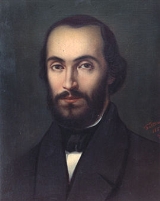
Nicolae Balcescu

Encyclopedia
Nicolae Bălcescu (June 29, 1819 – November 29, 1852) was a Romanian
Wallachia
n soldier, historian, journalist, and leader of the 1848 Wallachian Revolution.
to a family of low-ranking nobility, he used his mother's maiden name, in place of his father's name, Petrescu (his mother was originally from Bălceşti
, Vâlcea County
now, then Argeş County
). His siblings were Costache, Barbu
, Sevasta and Marghioala, and his father died in 1824.
As a boy, Bălcescu studied at the Saint Sava College
(from 1832), and was a passionate student of history. At the age of 19, he joined the Wallachian Army, and, in 1840, took part, alongside Eftimie Murgu
and Cezar Bolliac
, in Mitică Filipescu's conspiracy
against Prince Alexandru II Ghica
. The plot was uncovered, and Bălcescu was imprisoned in Mărgineni Monastery, where he remained for the following two years. The rough imprisonment conditions left irreversible marks on Bălcescu's health.
Upon his release (after being granted a pardon
by the new prince Gheorghe Bibescu
), he took part in forming a secret society
drawn up from the Freemasonry
and named Frăţia ("The Brotherhood"), which he led together with Ion Ghica
and Christian Tell
(joined soon after by Gheorghe Magheru
) in resistance against the new Bibescu.
, the editor of a magazine entitled Magazin istoric pentru Dacia, which was first published in 1844; that year also marked the publishing (in a different magazine) of his historical essay Puterea armată şi arta militară de la întemeierea Prinţipatului Valahiei şi până acum ("The Military Strength and Art of Warfare from the Creation of the Wallachian Principality to This Day", which argued for a strong military as a guarantee of self-determination
).
While in Paris (1846), he became leader of the Romantic nationalists
and liberal-radical
group Societatea studenţilor români (the Society of Romanian Students), which reunited Wallachians and Moldavia
ns — it also included Ion Brătianu
, Alexandru C. Golescu, Ion Ionescu de la Brad
, C. A. Rosetti
, and Mihail Kogălniceanu
.
Magazin istoric went on to publish the very first collection of internal sources on the history of Wallachia and Moldavia - medieval chronicle
s which were afterwards published as a single volume. One of his contributions to the magazine singles him out as a radical liberal: Despre starea socială a muncitorilor plugari în Principatele Române în deosebite timpuri ("On the Social Status of the Ploughmen of the Romanian Principalities
at Various Times") argues for a land reform
, aimed at dispossessing the boyars of large plots of land (that would in turn be awarded to landless peasants); it was used as reference by Karl Marx
in his succinct analysis of the events, a fact which was to earn Bălcescu credentials in Communist Romania
.
in order to take part in the June 11 revolution. He was, for just two days, both Minister and Secretary of State
of the provisional government
put in place by the revolutionaries. His advocacy of universal suffrage
and land reform was not shared by many revolutionaries, and his group came into conflict with the traditional figures of authority - the Orthodox
Metropolitan Neofit, although head of the revolutionary government, opposed the reforms and ultimately conspired against the Revolution itself.
Bălcescu was arrested on September 13 of that year by the authorities of the Ottoman Empire
who had put an end to the Revolution; his relationship with the Ottomans was complicated by the fact that the radicals' strict opposition to Imperial Russia had made them reliable for the Porte - the Ottomans later allowed all participants in the events to take refuge in Istanbul
, and thus avoid contact with the Russian troops sent over to assist the Ottoman presence. Bălcescu initially made his way to Transylvania
, but was expelled by Habsburg
authorities, who considered him a threat and an agitator of Romanian sentiment in that region.
mounted a successful offensive against Habsburg forces and their Transylvanian Romanian allies. The Hungarian government of Lajos Kossuth
then entered a debilitating war with Avram Iancu
's Romanian guerilla force, and the former members of the Wallachian government were approached by the Polish revolutionaries
in exile, such as Henryk Dembiński
, to mediate a peace between the two sides (in the hope that this was to ensure a stronger resistance to Russia, and counting on the Wallachian resentment towards the Saint Petersburg
government).
Bălcescu left for Debrecen
in May, and met with Kossuth to register the latter's offer to Iancu. Marxist
-inspired historiography has celebrated this as an agreement; in fact, Bălcescu's papers reveal that he viewed the peace offering as unsatisfactory for Romanians, and that Avram Iancu rejected it altogether (while agreeing to a temporary armistice
). The final offer from the Budapest
leadership to Bălcescu and Iancu called for the Romanians to withdraw from Transylvania, as the region was turning into a battleground between Russia and the Hungarians. When this latter conflict drew to a close, the Romanians in Transylvania, although never particularly welcoming of the Russian presence, surrendered their weapons to the reinstated Habsburgs (Iancu's loyalty to the dynasty had been the subject of a parallel dispute between him and the Wallachians).
 Bălcescu's most important work is Românii supt Mihai-Voievod Viteazul ("Romanians under the Rule of Michael the Brave"), which he wrote in exile in 1849 - first published by Alexandru Odobescu
in 1860. The volume is history of Michael's campaigns, as the first moment when Wallachia, Transylvania, and Moldavia, came under a single, albeit brief rule. They show Bălcescu's commitment to both radicalism and nationalism
, his view oscillating between praise of Michael's gestures and criticism of his stance as a supporter of serfdom
and privilege
.
His final years saw an intense publishing activity, including his study, written in French, , as well as a collaboration with Adam Mickiewicz
on La Tribune des Peuples
. Stricken by tuberculosis
, impoverished, and constantly moving between various locations in France and the Italian Peninsula
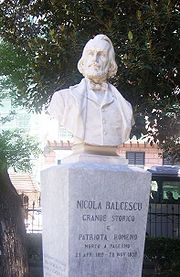
, he died in Palermo
(in the Two Sicilies) at 33 years of age. Bălcescu never married, though he and his lover Alexandra Florescu had a son, Bonifaciu Florescu (1848–1899), who became a professor of French language and literature.
which in the present is Nicolae Balcescu Museum, taken from Balcescu's family member Radu Mandrea and Aristide Razu
, in 1948 by a "donation act" towards the Communist Government, in Vâlcea County
.
Also his earthly remains,remain in Palermo
, Italy,although the Comunist Party of Romania tried to bring them back to Romania in 1970, to use them for communist propaganda.The Capuchin
Monks in Palermo at the Capuchin Monastery, also known as Capuchin catacombs of Palermo
, denied to the Romanian Communist Delegation of Historians access to the grave.
Romanians
The Romanians are an ethnic group native to Romania, who speak Romanian; they are the majority inhabitants of Romania....
Wallachia
Wallachia
Wallachia or Walachia is a historical and geographical region of Romania. It is situated north of the Danube and south of the Southern Carpathians...
n soldier, historian, journalist, and leader of the 1848 Wallachian Revolution.
Early life
Born in BucharestBucharest
Bucharest is the capital municipality, cultural, industrial, and financial centre of Romania. It is the largest city in Romania, located in the southeast of the country, at , and lies on the banks of the Dâmbovița River....
to a family of low-ranking nobility, he used his mother's maiden name, in place of his father's name, Petrescu (his mother was originally from Bălceşti
Balcesti
For the village in Gorj County, see Bengeşti-Ciocadia. For the villages in Cluj County, see Beliş and Căpuşu Mare.Bălceşti is a town located in Vâlcea County, Romania. The town administers eight villages: Beneşti, Cârlogani, Goruneşti, Chirculeşti, Irimeşti, Otetelişu, Preoţeşti and Satu...
, Vâlcea County
Vâlcea County
Vâlcea is a county of Romania, in the historical regions of Oltenia and Muntenia...
now, then Argeş County
Arges County
Argeș is a county of Romania, in Wallachia, with the capital city at Pitești.-Demographics:In 2002, it had a population of 652,625 and the population density was 95/km².*Romanians – 96%*Roma , and other.-Geography:...
). His siblings were Costache, Barbu
Barbu Bălcescu
Barbu Bălcescu was a Wallachian-born Romanian lawyer and revolutionary, the younger brother of Nicolae Bălcescu....
, Sevasta and Marghioala, and his father died in 1824.
As a boy, Bălcescu studied at the Saint Sava College
Saint Sava College
Saint Sava College was one of the earliest academic institutions in Wallachia, Romania. It was the predecessor to both Saint Sava National College and the University of Bucharest.-History:...
(from 1832), and was a passionate student of history. At the age of 19, he joined the Wallachian Army, and, in 1840, took part, alongside Eftimie Murgu
Eftimie Murgu
Eftimie Murgu was a Romanian politician who took part in the 1848 Revolutions.He was born in Rudăria to Samu Murgu, an officer in the Imperial Army and Cumbria Murgu...
and Cezar Bolliac
Cezar Bolliac
Cezar Bolliac or Boliac, Boliak was a Wallachian and Romanian radical political figure, amateur archaeologist, journalist and Romantic poet.-Early life:...
, in Mitică Filipescu's conspiracy
Conspiracy (political)
In a political sense, conspiracy refers to a group of persons united in the goal of usurping or overthrowing an established political power. Typically, the final goal is to gain power through a revolutionary coup d'état or through assassination....
against Prince Alexandru II Ghica
Alexandru II Ghica
Alexandru II or Alexandru D. Ghica , a member of the Ghica family, was Prince of Wallachia from April 1834 to 7 October 1842 and later caimacam from July 1856 to October 1858....
. The plot was uncovered, and Bălcescu was imprisoned in Mărgineni Monastery, where he remained for the following two years. The rough imprisonment conditions left irreversible marks on Bălcescu's health.
Upon his release (after being granted a pardon
Pardon
Clemency means the forgiveness of a crime or the cancellation of the penalty associated with it. It is a general concept that encompasses several related procedures: pardoning, commutation, remission and reprieves...
by the new prince Gheorghe Bibescu
Gheorghe Bibescu
Gheorghe Bibescu was a hospodar of Wallachia between 1843 and 1848. His rule coincided with the revolutionary tide that culminated in the 1848 Wallachian revolution.-Early political career:...
), he took part in forming a secret society
Secret society
A secret society is a club or organization whose activities and inner functioning are concealed from non-members. The society may or may not attempt to conceal its existence. The term usually excludes covert groups, such as intelligence agencies or guerrilla insurgencies, which hide their...
drawn up from the Freemasonry
Freemasonry
Freemasonry is a fraternal organisation that arose from obscure origins in the late 16th to early 17th century. Freemasonry now exists in various forms all over the world, with a membership estimated at around six million, including approximately 150,000 under the jurisdictions of the Grand Lodge...
and named Frăţia ("The Brotherhood"), which he led together with Ion Ghica
Ion Ghica
Ion Ghica was a Romanian revolutionary, mathematician, diplomat and twice Prime Minister of Romania . He was a full member of the Romanian Academy and its president for four times...
and Christian Tell
Christian Tell
Christian Tell was a Transylvanian-born Wallachian and Romanian politician.-Early life:Born in Braşov, Tell studied at Gheorghe Lazăr's school, and then at the Saint Sava Academy in Bucharest, and became close to Ion Heliade Rădulescu's version of Radicalism...
(joined soon after by Gheorghe Magheru
Gheorghe Magheru
General Gheorghe Magheru was a Romanian revolutionary and soldier from Wallachia, and political ally of Nicolae Bălcescu.-A Pandur and radical conspirator:...
) in resistance against the new Bibescu.
Magazin istoric pentru Dacia and other early works
In order to further his history studies, Bălcescu went to France and Italy, and was, together with August Treboniu LaurianAugust Treboniu Laurian
August Treboniu Laurian was a Transylvanian Romanian politician, historian and linguist. He was born in the village of Fofeldea in Nocrich. He was a participant at the 1848 revolution, an organizer of the Romanian school and one of the founding members of the Romanian Academy.Laurian was a member...
, the editor of a magazine entitled Magazin istoric pentru Dacia, which was first published in 1844; that year also marked the publishing (in a different magazine) of his historical essay Puterea armată şi arta militară de la întemeierea Prinţipatului Valahiei şi până acum ("The Military Strength and Art of Warfare from the Creation of the Wallachian Principality to This Day", which argued for a strong military as a guarantee of self-determination
Self-determination
Self-determination is the principle in international law that nations have the right to freely choose their sovereignty and international political status with no external compulsion or external interference...
).
While in Paris (1846), he became leader of the Romantic nationalists
Romantic nationalism
Romantic nationalism is the form of nationalism in which the state derives its political legitimacy as an organic consequence of the unity of those it governs...
and liberal-radical
Liberalism and radicalism in Romania
This article gives an overview of Liberalism and Radicalism in Romania. It is limited to liberal parties with substantial support, mainly proved by having had a representation in parliament. The sign ⇒ denotes another party in this scheme...
group Societatea studenţilor români (the Society of Romanian Students), which reunited Wallachians and Moldavia
Moldavia
Moldavia is a geographic and historical region and former principality in Eastern Europe, corresponding to the territory between the Eastern Carpathians and the Dniester river...
ns — it also included Ion Brătianu
Ion Bratianu
Ion C. Brătianu was one of the major political figures of 19th century Romania. He was the younger brother of Dimitrie, as well as the father of Ionel, Dinu, and Vintilă Brătianu...
, Alexandru C. Golescu, Ion Ionescu de la Brad
Ion Ionescu de la Brad
Ion Ionescu de la Brad , born Ion Isăcescu, was a Moldavian-born Romanian revolutionary, agronomist, statistician, scholar and writer....
, C. A. Rosetti
C. A. Rosetti
Constantin Alexandru Rosetti was a Romanian literary and political leader, born in Bucharest into a Phanariot Greek family.In 1845, Rosetti went to Paris, where he met Alphonse de Lamartine, the patron of the Society of Romanian Students in Paris. In 1847, he married Mary Grant, the sister of the...
, and Mihail Kogălniceanu
Mihail Kogalniceanu
Mihail Kogălniceanu was a Moldavian-born Romanian liberal statesman, lawyer, historian and publicist; he became Prime Minister of Romania October 11, 1863, after the 1859 union of the Danubian Principalities under Domnitor Alexander John Cuza, and later served as Foreign Minister under Carol I. He...
.
Magazin istoric went on to publish the very first collection of internal sources on the history of Wallachia and Moldavia - medieval chronicle
Chronicle
Generally a chronicle is a historical account of facts and events ranged in chronological order, as in a time line. Typically, equal weight is given for historically important events and local events, the purpose being the recording of events that occurred, seen from the perspective of the...
s which were afterwards published as a single volume. One of his contributions to the magazine singles him out as a radical liberal: Despre starea socială a muncitorilor plugari în Principatele Române în deosebite timpuri ("On the Social Status of the Ploughmen of the Romanian Principalities
Danubian Principalities
Danubian Principalities was a conventional name given to the Principalities of Moldavia and Wallachia, which emerged in the early 14th century. The term was coined in the Habsburg Monarchy after the Treaty of Küçük Kaynarca in order to designate an area on the lower Danube with a common...
at Various Times") argues for a land reform
Land reform
[Image:Jakarta farmers protest23.jpg|300px|thumb|right|Farmers protesting for Land Reform in Indonesia]Land reform involves the changing of laws, regulations or customs regarding land ownership. Land reform may consist of a government-initiated or government-backed property redistribution,...
, aimed at dispossessing the boyars of large plots of land (that would in turn be awarded to landless peasants); it was used as reference by Karl Marx
Karl Marx
Karl Heinrich Marx was a German philosopher, economist, sociologist, historian, journalist, and revolutionary socialist. His ideas played a significant role in the development of social science and the socialist political movement...
in his succinct analysis of the events, a fact which was to earn Bălcescu credentials in Communist Romania
Communist Romania
Communist Romania was the period in Romanian history when that country was a Soviet-aligned communist state in the Eastern Bloc, with the dominant role of Romanian Communist Party enshrined in its successive constitutions...
.
Wallachian Revolution
In 1848, after taking part in the uprising in France, Bălcescu returned to BucharestBucharest
Bucharest is the capital municipality, cultural, industrial, and financial centre of Romania. It is the largest city in Romania, located in the southeast of the country, at , and lies on the banks of the Dâmbovița River....
in order to take part in the June 11 revolution. He was, for just two days, both Minister and Secretary of State
Secretary of State
Secretary of State or State Secretary is a commonly used title for a senior or mid-level post in governments around the world. The role varies between countries, and in some cases there are multiple Secretaries of State in the Government....
of the provisional government
Provisional government
A provisional government is an emergency or interim government set up when a political void has been created by the collapse of a very large government. The early provisional governments were created to prepare for the return of royal rule...
put in place by the revolutionaries. His advocacy of universal suffrage
Universal suffrage
Universal suffrage consists of the extension of the right to vote to adult citizens as a whole, though it may also mean extending said right to minors and non-citizens...
and land reform was not shared by many revolutionaries, and his group came into conflict with the traditional figures of authority - the Orthodox
Eastern Orthodox Church
The Orthodox Church, officially called the Orthodox Catholic Church and commonly referred to as the Eastern Orthodox Church, is the second largest Christian denomination in the world, with an estimated 300 million adherents mainly in the countries of Belarus, Bulgaria, Cyprus, Georgia, Greece,...
Metropolitan Neofit, although head of the revolutionary government, opposed the reforms and ultimately conspired against the Revolution itself.
Bălcescu was arrested on September 13 of that year by the authorities of the Ottoman Empire
Ottoman Empire
The Ottoman EmpireIt was usually referred to as the "Ottoman Empire", the "Turkish Empire", the "Ottoman Caliphate" or more commonly "Turkey" by its contemporaries...
who had put an end to the Revolution; his relationship with the Ottomans was complicated by the fact that the radicals' strict opposition to Imperial Russia had made them reliable for the Porte - the Ottomans later allowed all participants in the events to take refuge in Istanbul
Istanbul
Istanbul , historically known as Byzantium and Constantinople , is the largest city of Turkey. Istanbul metropolitan province had 13.26 million people living in it as of December, 2010, which is 18% of Turkey's population and the 3rd largest metropolitan area in Europe after London and...
, and thus avoid contact with the Russian troops sent over to assist the Ottoman presence. Bălcescu initially made his way to Transylvania
Transylvania
Transylvania is a historical region in the central part of Romania. Bounded on the east and south by the Carpathian mountain range, historical Transylvania extended in the west to the Apuseni Mountains; however, the term sometimes encompasses not only Transylvania proper, but also the historical...
, but was expelled by Habsburg
Habsburg Monarchy
The Habsburg Monarchy covered the territories ruled by the junior Austrian branch of the House of Habsburg , and then by the successor House of Habsburg-Lorraine , between 1526 and 1867/1918. The Imperial capital was Vienna, except from 1583 to 1611, when it was moved to Prague...
authorities, who considered him a threat and an agitator of Romanian sentiment in that region.
In Istanbul and Transylvania
In early 1849, Bălcescu was in Istanbul when the Hungarian revolutionary armies under Józef BemJózef Bem
Józef Zachariasz Bem was a Polish general, an Ottoman Pasha and a national hero of Poland and Hungary, and a figure intertwined with other European nationalisms...
mounted a successful offensive against Habsburg forces and their Transylvanian Romanian allies. The Hungarian government of Lajos Kossuth
Lajos Kossuth
Lajos Kossuth de Udvard et Kossuthfalva was a Hungarian lawyer, journalist, politician and Regent-President of Hungary in 1849. He was widely honored during his lifetime, including in the United Kingdom and the United States, as a freedom fighter and bellwether of democracy in Europe.-Family:Lajos...
then entered a debilitating war with Avram Iancu
Avram Iancu
Avram Iancu was a Transylvanian Romanian lawyer who played an important role in the local chapter of the Austrian Empire Revolutions of 1848–1849. He was especially active in the Ţara Moţilor region and the Apuseni Mountains...
's Romanian guerilla force, and the former members of the Wallachian government were approached by the Polish revolutionaries
Wielkopolska Uprising (1848)
The Greater Poland Uprising of 1848 or Poznań Uprising was an unsuccessful military insurrection of Poles against Prussian forces, during the Spring of Nations period...
in exile, such as Henryk Dembiński
Henryk Dembinski
Henryk Dembiński was a Polish engineer, traveler and general.Dembiński was born in Strzałków, Świętokrzyskie Voivodeship. In 1809 he entered the Polish army of the Duchy of Warsaw and took part in most of the Napoleonic campaigns in the East. Among others, he took part in the Battle of Leipzig in...
, to mediate a peace between the two sides (in the hope that this was to ensure a stronger resistance to Russia, and counting on the Wallachian resentment towards the Saint Petersburg
Saint Petersburg
Saint Petersburg is a city and a federal subject of Russia located on the Neva River at the head of the Gulf of Finland on the Baltic Sea...
government).
Bălcescu left for Debrecen
Debrecen
Debrecen , is the second largest city in Hungary after Budapest. Debrecen is the regional centre of the Northern Great Plain region and the seat of Hajdú-Bihar county.- Name :...
in May, and met with Kossuth to register the latter's offer to Iancu. Marxist
Marxism
Marxism is an economic and sociopolitical worldview and method of socioeconomic inquiry that centers upon a materialist interpretation of history, a dialectical view of social change, and an analysis and critique of the development of capitalism. Marxism was pioneered in the early to mid 19th...
-inspired historiography has celebrated this as an agreement; in fact, Bălcescu's papers reveal that he viewed the peace offering as unsatisfactory for Romanians, and that Avram Iancu rejected it altogether (while agreeing to a temporary armistice
Armistice
An armistice is a situation in a war where the warring parties agree to stop fighting. It is not necessarily the end of a war, but may be just a cessation of hostilities while an attempt is made to negotiate a lasting peace...
). The final offer from the Budapest
Budapest
Budapest is the capital of Hungary. As the largest city of Hungary, it is the country's principal political, cultural, commercial, industrial, and transportation centre. In 2011, Budapest had 1,733,685 inhabitants, down from its 1989 peak of 2,113,645 due to suburbanization. The Budapest Commuter...
leadership to Bălcescu and Iancu called for the Romanians to withdraw from Transylvania, as the region was turning into a battleground between Russia and the Hungarians. When this latter conflict drew to a close, the Romanians in Transylvania, although never particularly welcoming of the Russian presence, surrendered their weapons to the reinstated Habsburgs (Iancu's loyalty to the dynasty had been the subject of a parallel dispute between him and the Wallachians).
Final years
Alexandru Odobescu
Alexandru Ioan Odobescu was a Romanian author, archaeologist and politician.-Biography:He was born in Bucharest, the second child of General Ioan Odobescu and his wife Ecaterina. After attending Saint Sava College and, from 1850, a Paris lycée, he took the baccalauréat in 1853 and studied...
in 1860. The volume is history of Michael's campaigns, as the first moment when Wallachia, Transylvania, and Moldavia, came under a single, albeit brief rule. They show Bălcescu's commitment to both radicalism and nationalism
Nationalism
Nationalism is a political ideology that involves a strong identification of a group of individuals with a political entity defined in national terms, i.e. a nation. In the 'modernist' image of the nation, it is nationalism that creates national identity. There are various definitions for what...
, his view oscillating between praise of Michael's gestures and criticism of his stance as a supporter of serfdom
Serfdom
Serfdom is the status of peasants under feudalism, specifically relating to Manorialism. It was a condition of bondage or modified slavery which developed primarily during the High Middle Ages in Europe and lasted to the mid-19th century...
and privilege
Privilege
A privilege is a special entitlement to immunity granted by the state or another authority to a restricted group, either by birth or on a conditional basis. It can be revoked in certain circumstances. In modern democratic states, a privilege is conditional and granted only after birth...
.
His final years saw an intense publishing activity, including his study, written in French, , as well as a collaboration with Adam Mickiewicz
Adam Mickiewicz
Adam Bernard Mickiewicz ) was a Polish poet, publisher and political writer of the Romantic period. One of the primary representatives of the Polish Romanticism era, a national poet of Poland, he is seen as one of Poland's Three Bards and the greatest poet in all of Polish literature...
on La Tribune des Peuples
La Tribune des Peuples
La Tribune des Peuples was a Polish-led French-language radical and romantic nationalist political weekly magazine, published in Paris between March and November 1849 - except for a hiatus caused by censorship...
. Stricken by tuberculosis
Tuberculosis
Tuberculosis, MTB, or TB is a common, and in many cases lethal, infectious disease caused by various strains of mycobacteria, usually Mycobacterium tuberculosis. Tuberculosis usually attacks the lungs but can also affect other parts of the body...
, impoverished, and constantly moving between various locations in France and the Italian Peninsula
Italian Peninsula
The Italian Peninsula or Apennine Peninsula is one of the three large peninsulas of Southern Europe , spanning from the Po Valley in the north to the central Mediterranean Sea in the south. The peninsula's shape gives it the nickname Lo Stivale...
, he died in Palermo
Palermo
Palermo is a city in Southern Italy, the capital of both the autonomous region of Sicily and the Province of Palermo. The city is noted for its history, culture, architecture and gastronomy, playing an important role throughout much of its existence; it is over 2,700 years old...
(in the Two Sicilies) at 33 years of age. Bălcescu never married, though he and his lover Alexandra Florescu had a son, Bonifaciu Florescu (1848–1899), who became a professor of French language and literature.
Nationalization of his properties
In the present his properties remain nationalized by the Romanian Government 2011, after 1945, as Balcesti Giltofani Land in BalcestiBalcesti
For the village in Gorj County, see Bengeşti-Ciocadia. For the villages in Cluj County, see Beliş and Căpuşu Mare.Bălceşti is a town located in Vâlcea County, Romania. The town administers eight villages: Beneşti, Cârlogani, Goruneşti, Chirculeşti, Irimeşti, Otetelişu, Preoţeşti and Satu...
which in the present is Nicolae Balcescu Museum, taken from Balcescu's family member Radu Mandrea and Aristide Razu
Aristide Razu
Divisional General Aristide Razu, CB, was Commander of the 22nd Romanian Infantry Division in the 1916 Romanian Campaign against the Central Powers, and of the 5th Romanian Infantry Division during the Battle of Mărăşeşti , in World War I...
, in 1948 by a "donation act" towards the Communist Government, in Vâlcea County
Vâlcea County
Vâlcea is a county of Romania, in the historical regions of Oltenia and Muntenia...
.
Also his earthly remains,remain in Palermo
Palermo
Palermo is a city in Southern Italy, the capital of both the autonomous region of Sicily and the Province of Palermo. The city is noted for its history, culture, architecture and gastronomy, playing an important role throughout much of its existence; it is over 2,700 years old...
, Italy,although the Comunist Party of Romania tried to bring them back to Romania in 1970, to use them for communist propaganda.The Capuchin
Order of Friars Minor Capuchin
The Order of Friars Minor Capuchin is an Order of friars in the Catholic Church, among the chief offshoots of the Franciscans. The worldwide head of the Order, called the Minister General, is currently Father Mauro Jöhri.-Origins :...
Monks in Palermo at the Capuchin Monastery, also known as Capuchin catacombs of Palermo
Capuchin catacombs of Palermo
The Capuchin Catacombs of Palermo are burial catacombs in Palermo, Sicily, southern Italy...
, denied to the Romanian Communist Delegation of Historians access to the grave.
External links
- Footnotes to Vol. 9 of the Marx-Engels Collected Works at Marxists.org
- Balcescu, Nicolae, by Dan Berindei, September 9, 2004, at the Encyclopedia of 1848 Revolutions