


Ion Bratianu

Encyclopedia
Ion C. Brătianu was one of the major political figures of 19th century Romania
. He was the younger brother of Dimitrie
, as well as the father of Ionel
, Dinu
, and Vintilă Brătianu
. He also was the grandfather of poet Ion Pillat
.
landowners in Piteşti
, the state of Wallachia
, he entered the Wallachian Army in 1838, and in 1841 started studying in Paris
. Returning to his native land, Brătianu took part, with his friend C. A. Rosetti
and other young politicians (including his brother), in the 1848 Wallachian Revolution, and acted as prefect
of police in the provisional government formed in that year.
The restoration of Imperial Russian and Ottoman
authority shortly afterwards drove him into exile. He took refuge to Paris, and endeavoured to influence French opinion in favour of the proposed union and autonomy of the Danubian Principalities
. In 1854, however, he was sentenced to a fine and three months' imprisonment for sedition
, and later confined in a lunatic asylum; in 1856, he returned to Wallachia with his brother - afterwards one of his foremost political opponents.
' (Wallachia's and Moldavia
) union, as a member of Partida Naţională
. During the reign of Alexander Ioan Cuza (1859-1866), Brătianu figured prominently as one of the Liberal
leaders. Opposition to the land reform
united the emerging Liberals and Conservatives
against the Domnitor
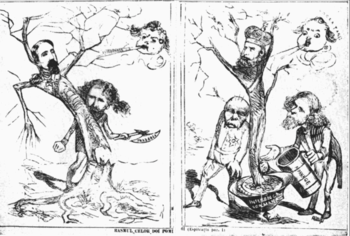
and his inner circle. Both parties comprised mainly landowners, and allied to block legislation in the Chamber - causing Cuza to impose his authoritarian government in May 1864. The two-party coalition, remembered as The monstrous coalition, opted for the removal of Cuza. Brătianu took part in the deposition of 1866 and in the subsequent election of Prince Carol of Hohenzollern-Sigmaringen
, under whom he held several ministerial appointments throughout the next four years.
Nonetheless, his very sinuous relationship with the new Prince was the source of several crisis situations. Notably, Brătianu would point to the benefits of a Republican
project (which the Rosetti and his left wing of the Liberal Party had never ceased advocating). Thus, when the experimental Republic of Ploieşti
was created in 1870 around a Liberal group, Ion Brătianu was arrested as the inspirational figure, but was soon released.
 In 1871, the Liberals organized protests in favor of France
- just defeated in the Franco-Prussian War
- and implicitly against German Empire
, the Conservatives, and Prince Carol himself. The weight of the moment showed the weaknesses of the Liberals, as well as Carol's resolution: the Prince called on Lascăr Catargiu
to form a stable and reliable government. The change in tactics forced the Liberals to form their loose tendency as a real Party in 1875. Alongside several liberal tenets, the new formation took a further step towards advocating protectionism
and persecution of Jewish Romanians (see History of the Jews in Romania
). In 1876, aided by C. A. Rosetti, Brătianu formed a Liberal cabinet, which remained in power until 1888 - this marked his coming to terms with Carol.
. Liberals were of the generation that had truly brought Romanians in Transylvania
to the country's attention; on the other hand, Catargiu had signed an agreement with the Austrian Monarchy that awarded it commercial privilege in Romania – while quieting its suspicion towards Romanian irredentism
. Brătianu’s government did not disturb this climate after the Russian alliance proved unsatisfactory, and the two parties resorted to assisting Romanian cultural ventures in Transylvania (until World War I
).
He aligned the country with Russia as soon as the Russo-Turkish War
of 1877-1878 began – with its chapter, the Romanian War of Independence
. While Romania did emancipate itself from Ottoman tutelage, Brătianu had to accommodate a prolonged Russian occupation, and the Congress of Berlin
saw Russia seizing counties of the Budjak
that were still Romanian-owned (Romania was awarded Northern Dobruja
in return). In 1881, the country proclaimed itself a Kingdom
.
The Congress also pressured the Liberals to discard the discrimination policies, and the government agreed to allow Jews and Dobrujan Muslims
to apply for citizenship (with a 10-year probation), but continued forbidding foreign-born people or non-citizens from owning land.
The Brătianu government introduced most modern reforms in the administrative, educational, economical, and military fields. It celebrated its main success in 1883, when the Liberals managed to have the 1866 Constitution of Romania
amended – enlarging the number of elector
s and establishing a third electoral college
, one that gave some representation to peasants and the urban employees. The move was not radical, and it served to obtain the Liberals political ascendancy: the very first elections under the new law brought them an overwhelming majority.
After 1883 Brătianu acted as sole leader of the party, owing to a quarrel with Rosetti, his friend and political ally for nearly forty years. His long tenure of office, without parallel in Romanian history, rendered Brătianu extremely unpopular, and at its close his impeachment
appeared inevitable. But any proceedings taken against the minister would have involved charges against the king, who was largely responsible for his policy, and the impeachment was averted by a vote of parliament in February 1890.
political pamphlets, Mémoire sur l'empire d'Autriche dans la question d'Orient ("Account of the Austrian Empire in the Oriental Issue", 1855), Réflexions sur la situation ("Musings on the Situation", 1856), Mémoire sur la situation de la Moldavie depuis le traité de Paris ("Account on Moldavia's Situation After the Treaty of Paris
", 1857), and La Question religieuse en Roumanie ("The Religious Issue in Romania", 1866), were all published in Paris.
Romania
Romania is a country located at the crossroads of Central and Southeastern Europe, on the Lower Danube, within and outside the Carpathian arch, bordering on the Black Sea...
. He was the younger brother of Dimitrie
Dimitrie Bratianu
Dimitrie Brătianu was the Prime Minister of Romania from 22 April to 21 June 1881 and Minister of Foreign Affairs from April 10, 1881 until June 8, 1881....
, as well as the father of Ionel
Ion I. C. Bratianu
Ion I. C. Brătianu was a Romanian politician, leader of the National Liberal Party , the Prime Minister of Romania for five terms, and Foreign Minister on several occasions; he was the eldest son of statesman and PNL leader Ion Brătianu, the brother of Vintilă and Dinu Brătianu, and the father of...
, Dinu
Dinu Bratianu
Dinu Brătianu , born Constantin I. C. Brătianu, was a Romanian politician, who led the National Liberal Party starting with 1934.-Early career:...
, and Vintilă Brătianu
Vintila Bratianu
Vintilă Brătianu was a Romanian politician who served as Prime Minister of Romania between 24 November 1927 and 2 November 1928.Vintilă and his brothers Ion and Dinu were the leaders of the National Liberal Party of Romania...
. He also was the grandfather of poet Ion Pillat
Ion Pillat
Ion Pillat grew up in Bucharest. He was a poet, best known for his volume Pe Argeş în sus and Poeme într-un vers...
.
Early life
Born to wealthy ArgeşArges County
Argeș is a county of Romania, in Wallachia, with the capital city at Pitești.-Demographics:In 2002, it had a population of 652,625 and the population density was 95/km².*Romanians – 96%*Roma , and other.-Geography:...
landowners in Piteşti
Pitesti
Pitești is a city in Romania, located on the Argeș River. The capital and largest city of Argeș County, it is an important commercial and industrial center, as well as the home of two universities. Pitești is situated on the A1 freeway connecting it directly to the national capital Bucharest,...
, the state of Wallachia
Wallachia
Wallachia or Walachia is a historical and geographical region of Romania. It is situated north of the Danube and south of the Southern Carpathians...
, he entered the Wallachian Army in 1838, and in 1841 started studying in Paris
Paris
Paris is the capital and largest city in France, situated on the river Seine, in northern France, at the heart of the Île-de-France region...
. Returning to his native land, Brătianu took part, with his friend C. A. Rosetti
C. A. Rosetti
Constantin Alexandru Rosetti was a Romanian literary and political leader, born in Bucharest into a Phanariot Greek family.In 1845, Rosetti went to Paris, where he met Alphonse de Lamartine, the patron of the Society of Romanian Students in Paris. In 1847, he married Mary Grant, the sister of the...
and other young politicians (including his brother), in the 1848 Wallachian Revolution, and acted as prefect
Prefect
Prefect is a magisterial title of varying definition....
of police in the provisional government formed in that year.
The restoration of Imperial Russian and Ottoman
Ottoman Empire
The Ottoman EmpireIt was usually referred to as the "Ottoman Empire", the "Turkish Empire", the "Ottoman Caliphate" or more commonly "Turkey" by its contemporaries...
authority shortly afterwards drove him into exile. He took refuge to Paris, and endeavoured to influence French opinion in favour of the proposed union and autonomy of the Danubian Principalities
Danubian Principalities
Danubian Principalities was a conventional name given to the Principalities of Moldavia and Wallachia, which emerged in the early 14th century. The term was coined in the Habsburg Monarchy after the Treaty of Küçük Kaynarca in order to designate an area on the lower Danube with a common...
. In 1854, however, he was sentenced to a fine and three months' imprisonment for sedition
Sedition
In law, sedition is overt conduct, such as speech and organization, that is deemed by the legal authority to tend toward insurrection against the established order. Sedition often includes subversion of a constitution and incitement of discontent to lawful authority. Sedition may include any...
, and later confined in a lunatic asylum; in 1856, he returned to Wallachia with his brother - afterwards one of his foremost political opponents.
Under Cuza and in the opposition
He was in favor of the Danubian PrincipalitiesDanubian Principalities
Danubian Principalities was a conventional name given to the Principalities of Moldavia and Wallachia, which emerged in the early 14th century. The term was coined in the Habsburg Monarchy after the Treaty of Küçük Kaynarca in order to designate an area on the lower Danube with a common...
' (Wallachia's and Moldavia
Moldavia
Moldavia is a geographic and historical region and former principality in Eastern Europe, corresponding to the territory between the Eastern Carpathians and the Dniester river...
) union, as a member of Partida Naţională
Partida Nationala
The Partida Naţională was a liberal Romanian political party active between 1856 and 1859. It was a loose group which supported the union of the Danubian Principalities....
. During the reign of Alexander Ioan Cuza (1859-1866), Brătianu figured prominently as one of the Liberal
National Liberal Party (Romania)
The National Liberal Party , abbreviated to PNL, is a centre-right liberal party in Romania. It is the third-largest party in the Romanian Parliament, with 53 seats in the Chamber of Deputies and 22 in the Senate: behind the centre-right Democratic Liberal Party and the centre-left Social...
leaders. Opposition to the land reform
Land reform
[Image:Jakarta farmers protest23.jpg|300px|thumb|right|Farmers protesting for Land Reform in Indonesia]Land reform involves the changing of laws, regulations or customs regarding land ownership. Land reform may consist of a government-initiated or government-backed property redistribution,...
united the emerging Liberals and Conservatives
Conservative Party (Romania, 1880-1918)
The Conservative Party was between 1880 and 1918 one of Romania's two most important parties, the other one being the Liberal Party...
against the Domnitor
Domnitor
Domnitor was the official title of the ruler of the United Principalities of Wallachia and Moldavia between 1859 and 1866....
and his inner circle. Both parties comprised mainly landowners, and allied to block legislation in the Chamber - causing Cuza to impose his authoritarian government in May 1864. The two-party coalition, remembered as The monstrous coalition, opted for the removal of Cuza. Brătianu took part in the deposition of 1866 and in the subsequent election of Prince Carol of Hohenzollern-Sigmaringen
Carol I of Romania
Carol I , born Prince Karl of Hohenzollern-Sigmaringen was reigning prince and then King of Romania from 1866 to 1914. He was elected prince of Romania on 20 April 1866 following the overthrow of Alexandru Ioan Cuza by a palace coup...
, under whom he held several ministerial appointments throughout the next four years.
Nonetheless, his very sinuous relationship with the new Prince was the source of several crisis situations. Notably, Brătianu would point to the benefits of a Republican
Republicanism
Republicanism is the ideology of governing a nation as a republic, where the head of state is appointed by means other than heredity, often elections. The exact meaning of republicanism varies depending on the cultural and historical context...
project (which the Rosetti and his left wing of the Liberal Party had never ceased advocating). Thus, when the experimental Republic of Ploieşti
Republic of Ploiesti
The Republic of Ploiești was a revolt against the Romanian monarchy in the city of Ploiești, Romania, on August 8, 1870.-Background:Romanian liberal radicals of Ploiești and elsewhere were opposed to the new ruler of the country, Prince Carol of Hohenzollern-Sigmaringen , and desired a republic to...
was created in 1870 around a Liberal group, Ion Brătianu was arrested as the inspirational figure, but was soon released.
France
The French Republic , The French Republic , The French Republic , (commonly known as France , is a unitary semi-presidential republic in Western Europe with several overseas territories and islands located on other continents and in the Indian, Pacific, and Atlantic oceans. Metropolitan France...
- just defeated in the Franco-Prussian War
Franco-Prussian War
The Franco-Prussian War or Franco-German War, often referred to in France as the 1870 War was a conflict between the Second French Empire and the Kingdom of Prussia. Prussia was aided by the North German Confederation, of which it was a member, and the South German states of Baden, Württemberg and...
- and implicitly against German Empire
German Empire
The German Empire refers to Germany during the "Second Reich" period from the unification of Germany and proclamation of Wilhelm I as German Emperor on 18 January 1871, to 1918, when it became a federal republic after defeat in World War I and the abdication of the Emperor, Wilhelm II.The German...
, the Conservatives, and Prince Carol himself. The weight of the moment showed the weaknesses of the Liberals, as well as Carol's resolution: the Prince called on Lascăr Catargiu
Lascar Catargiu
Lascăr Catargiu was a Romanian conservative statesman born in Moldavia. He belonged to an ancient Wallachian family, one of whose members had been banished in the 17th century by Prince Matei Basarab, and had settled in Moldavia.-Biography:...
to form a stable and reliable government. The change in tactics forced the Liberals to form their loose tendency as a real Party in 1875. Alongside several liberal tenets, the new formation took a further step towards advocating protectionism
Protectionism
Protectionism is the economic policy of restraining trade between states through methods such as tariffs on imported goods, restrictive quotas, and a variety of other government regulations designed to allow "fair competition" between imports and goods and services produced domestically.This...
and persecution of Jewish Romanians (see History of the Jews in Romania
History of the Jews in Romania
The history of Jews in Romania concerns the Jews of Romania and of Romanian origins, from their first mention on what is nowadays Romanian territory....
). In 1876, aided by C. A. Rosetti, Brătianu formed a Liberal cabinet, which remained in power until 1888 - this marked his coming to terms with Carol.
Prominence
The government took steps at taking the country out of its Ottoman vassalage; however, it differed from Conservatives in that they saw the main threat posed to Romania in Austria-HungaryAustria-Hungary
Austria-Hungary , more formally known as the Kingdoms and Lands Represented in the Imperial Council and the Lands of the Holy Hungarian Crown of Saint Stephen, was a constitutional monarchic union between the crowns of the Austrian Empire and the Kingdom of Hungary in...
. Liberals were of the generation that had truly brought Romanians in Transylvania
Transylvania
Transylvania is a historical region in the central part of Romania. Bounded on the east and south by the Carpathian mountain range, historical Transylvania extended in the west to the Apuseni Mountains; however, the term sometimes encompasses not only Transylvania proper, but also the historical...
to the country's attention; on the other hand, Catargiu had signed an agreement with the Austrian Monarchy that awarded it commercial privilege in Romania – while quieting its suspicion towards Romanian irredentism
Irredentism
Irredentism is any position advocating annexation of territories administered by another state on the grounds of common ethnicity or prior historical possession, actual or alleged. Some of these movements are also called pan-nationalist movements. It is a feature of identity politics and cultural...
. Brătianu’s government did not disturb this climate after the Russian alliance proved unsatisfactory, and the two parties resorted to assisting Romanian cultural ventures in Transylvania (until World War I
World War I
World War I , which was predominantly called the World War or the Great War from its occurrence until 1939, and the First World War or World War I thereafter, was a major war centred in Europe that began on 28 July 1914 and lasted until 11 November 1918...
).
He aligned the country with Russia as soon as the Russo-Turkish War
Russo-Turkish War, 1877–1878
The Russo-Turkish War of 1877–1878 was a conflict between the Ottoman Empire and the Eastern Orthodox coalition led by the Russian Empire and composed of numerous Balkan...
of 1877-1878 began – with its chapter, the Romanian War of Independence
Romanian War of Independence
The Romanian War of Independence is the name used in Romanian historiography to refer to the 1877-1878 Russo-Turkish war, following which Romania, fighting on the Russian side, gained independence from the Ottoman Empire...
. While Romania did emancipate itself from Ottoman tutelage, Brătianu had to accommodate a prolonged Russian occupation, and the Congress of Berlin
Congress of Berlin
The Congress of Berlin was a meeting of the European Great Powers' and the Ottoman Empire's leading statesmen in Berlin in 1878. In the wake of the Russo-Turkish War of 1877–78, the meeting's aim was to reorganize the countries of the Balkans...
saw Russia seizing counties of the Budjak
Budjak
Budjak or Budzhak is a historical region in the Odessa Oblast of Ukraine. Lying along the Black Sea between the Danube and Dniester rivers this multiethnic region was the southern part of Bessarabia...
that were still Romanian-owned (Romania was awarded Northern Dobruja
Northern Dobruja
Northern Dobruja is the part of Dobruja within the borders of Romania. It lies between the lower Danube river and the Black Sea, bordered in south by Bulgarian Southern Dobruja.-Geography:...
in return). In 1881, the country proclaimed itself a Kingdom
Kingdom of Romania
The Kingdom of Romania was the Romanian state based on a form of parliamentary monarchy between 13 March 1881 and 30 December 1947, specified by the first three Constitutions of Romania...
.
The Congress also pressured the Liberals to discard the discrimination policies, and the government agreed to allow Jews and Dobrujan Muslims
Islam in Romania
Islam in Romania is followed by only 0.3 percent of population, but has 700 years of tradition in Northern Dobruja, a region on the Black Sea coast which was part of the Ottoman Empire for almost five centuries . In present-day Romania, most adherents to Islam belong to the Tatar and Turkish ethnic...
to apply for citizenship (with a 10-year probation), but continued forbidding foreign-born people or non-citizens from owning land.
The Brătianu government introduced most modern reforms in the administrative, educational, economical, and military fields. It celebrated its main success in 1883, when the Liberals managed to have the 1866 Constitution of Romania
1866 Constitution of Romania
The 1866 Constitution of Romania was the fundamental law that capped a period of nation-building in the Danubian Principalities, which had united in 1859. Drafted in a short time and using as its model the 1831 Constitution of Belgium, then considered Europe's most liberal, it was substantially...
amended – enlarging the number of elector
Election
An election is a formal decision-making process by which a population chooses an individual to hold public office. Elections have been the usual mechanism by which modern representative democracy operates since the 17th century. Elections may fill offices in the legislature, sometimes in the...
s and establishing a third electoral college
Electoral college
An electoral college is a set of electors who are selected to elect a candidate to a particular office. Often these represent different organizations or entities, with each organization or entity represented by a particular number of electors or with votes weighted in a particular way...
, one that gave some representation to peasants and the urban employees. The move was not radical, and it served to obtain the Liberals political ascendancy: the very first elections under the new law brought them an overwhelming majority.
After 1883 Brătianu acted as sole leader of the party, owing to a quarrel with Rosetti, his friend and political ally for nearly forty years. His long tenure of office, without parallel in Romanian history, rendered Brătianu extremely unpopular, and at its close his impeachment
Impeachment
Impeachment is a formal process in which an official is accused of unlawful activity, the outcome of which, depending on the country, may include the removal of that official from office as well as other punishment....
appeared inevitable. But any proceedings taken against the minister would have involved charges against the king, who was largely responsible for his policy, and the impeachment was averted by a vote of parliament in February 1890.
Other activities
Besides being the leading statesman of Romania during the critical years 1876-1888, he attained some eminence as a writer. His French languageFrench language
French is a Romance language spoken as a first language in France, the Romandy region in Switzerland, Wallonia and Brussels in Belgium, Monaco, the regions of Quebec and Acadia in Canada, and by various communities elsewhere. Second-language speakers of French are distributed throughout many parts...
political pamphlets, Mémoire sur l'empire d'Autriche dans la question d'Orient ("Account of the Austrian Empire in the Oriental Issue", 1855), Réflexions sur la situation ("Musings on the Situation", 1856), Mémoire sur la situation de la Moldavie depuis le traité de Paris ("Account on Moldavia's Situation After the Treaty of Paris
Treaty of Paris (1856)
The Treaty of Paris of 1856 settled the Crimean War between Russia and an alliance of the Ottoman Empire, the British Empire, Second French Empire, and the Kingdom of Sardinia. The treaty, signed on March 30, 1856 at the Congress of Paris, made the Black Sea neutral territory, closing it to all...
", 1857), and La Question religieuse en Roumanie ("The Religious Issue in Romania", 1866), were all published in Paris.